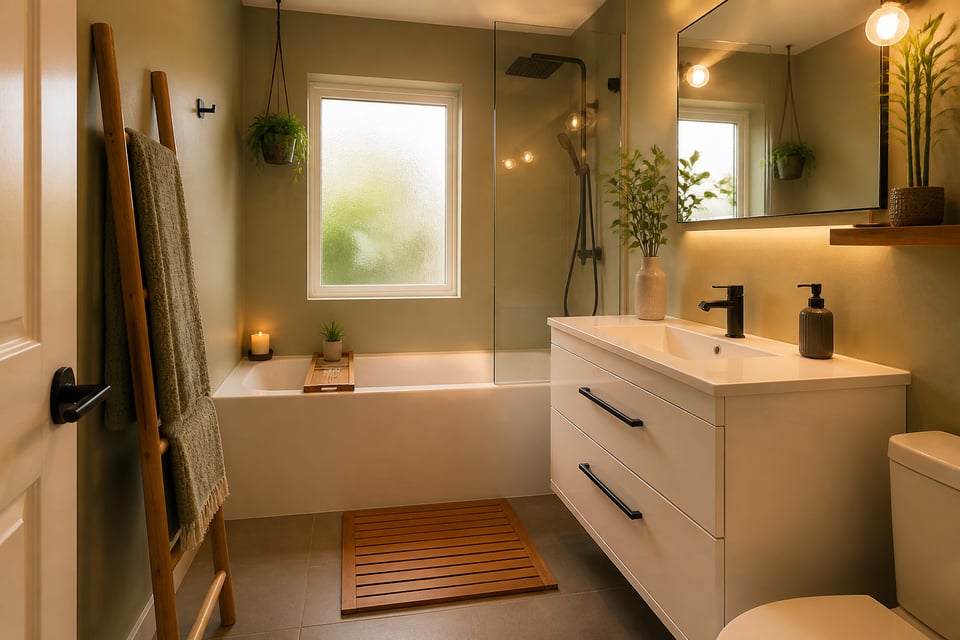
The most expensive-looking bathrooms aren’t always the most expensive ones. What they have in common is intention — someone made a series of deliberate choices rather than a series of random purchases. That’s the core principle of Japanese design philosophy: constraint sharpens taste. Working with less, you’re forced to choose better.
These 15 bathroom ideas on a budget treat the bathroom as what it actually is: a daily ritual space. Not a storage room with a toilet. Not a utility area you tolerate. A room that sets the tone for your morning and lets you decompress at the end of the day. None of these changes require a contractor, a skip, or a second mortgage. Most can be done in a weekend, several in an afternoon.
Start where it bothers you most. That’s usually the right answer.
1. Refresh Your Grout Lines for an Instant Deep-Clean Effect
There’s nothing that ages a bathroom faster than dirty grout. Even expensive tiles look tired when the lines between them have gone grey or brown. The surface might be perfectly clean — but the grout tells the eye a different story. And the eye is rarely wrong.
Among bathroom ideas on a budget, this one has the highest visual payoff for the lowest skill threshold. Grout pens (Ronseal and Grout Pen Pro are the widely available UK options, £5-£15 per pen) apply a pigmented sealant directly over cleaned grout lines, restoring them to a bright, consistent white or matching colour. The application takes patience rather than skill — work section by section along the lines, wipe the excess off the tile face while it’s still wet, and let it dry overnight.
When to Steam Clean or Regrout
For grout that’s stained below the surface, a steam cleaner does what no scrubbing brush can: high-pressure heat vapour lifts embedded dirt without chemicals in a single pass. A mid-range steam cleaner runs £50-£200, or you can hire one for a day for around £30-£40. The result is grout that looks newly laid.
The decision between recolouring and full regrouting comes down to structural condition. If the grout is intact but discoloured, a grout pen or colour sealer (Mapei Kerapoxy Color, available in trade stores, is the professional-grade version) is all you need. If the grout is cracked or crumbling, regrouting the affected areas — a bag of cement grout costs £5-£10 — prevents water ingress behind the tiles that causes far more expensive damage later.
Clean grout first. Decide what else you need after you see what it actually looks like.
2. Budget Bathroom Ideas: Swap Your Mirror for an Oversized Frameless Option
In a small bathroom, a mirror doesn’t just show you your reflection — it creates the illusion of a second room. Place a large frameless mirror on the wall behind the sink and the bathroom immediately reads as twice its actual size. This is basic optics applied to interior design, and it costs almost nothing to act on.
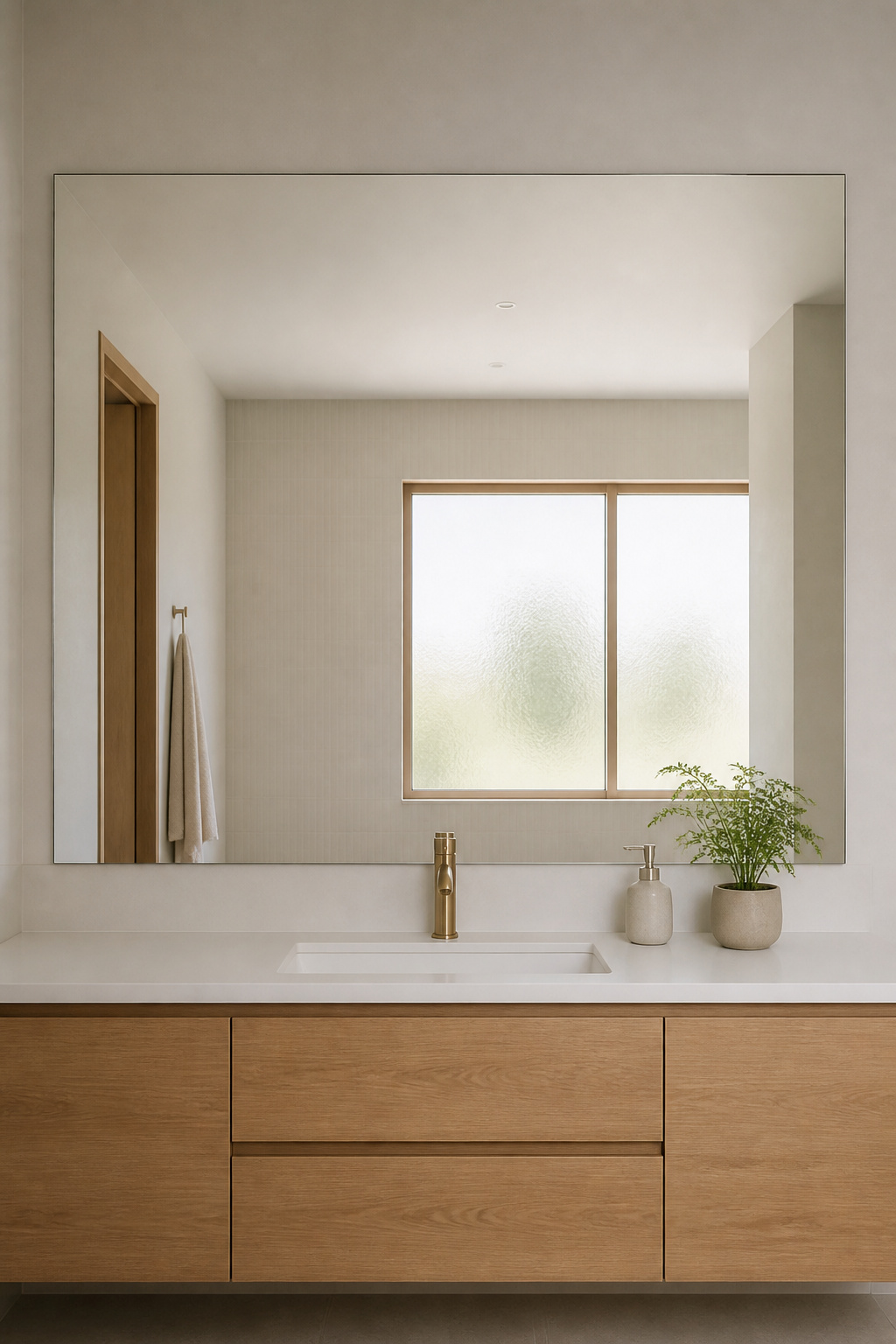
The Japanese design concept of ma — negative space, the importance of emptiness — is visible in a frameless mirror. A frame is furniture; removing it makes the mirror disappear into the wall and the room expand around it. A framed mirror of the same size reads as an object placed in the room. A frameless one makes the room feel like it has more depth.
For sizing, the guideline is simple: match the mirror width to the width of the vanity unit beneath it. This creates a clean geometric alignment that reads as designed rather than random. The bottom edge should sit 5-8 inches above the vanity top; the top edge at or above eye level for the tallest person using the room. A mirror placed opposite a window multiplies natural light — particularly useful in a north-facing bathroom.
Budget sources worth knowing: IKEA’s NISSEDAL (59×96cm, around £35) is the standard value option. Amazon’s frameless bathroom mirror range starts from £25. Don’t choose a mirror sized to match the light fixture rather than the vanity — this results in a floating, disconnected look that marks the choice as unconsidered.
3. Repaint Your Vanity Rather Than Replacing It
A new vanity unit costs £200-£800. A tin of cabinet paint and a bonding primer costs £40-£80. The results, done properly, are essentially indistinguishable — and in some cases the painted version looks better, because you chose the colour deliberately rather than accepting whatever the manufacturer offered.
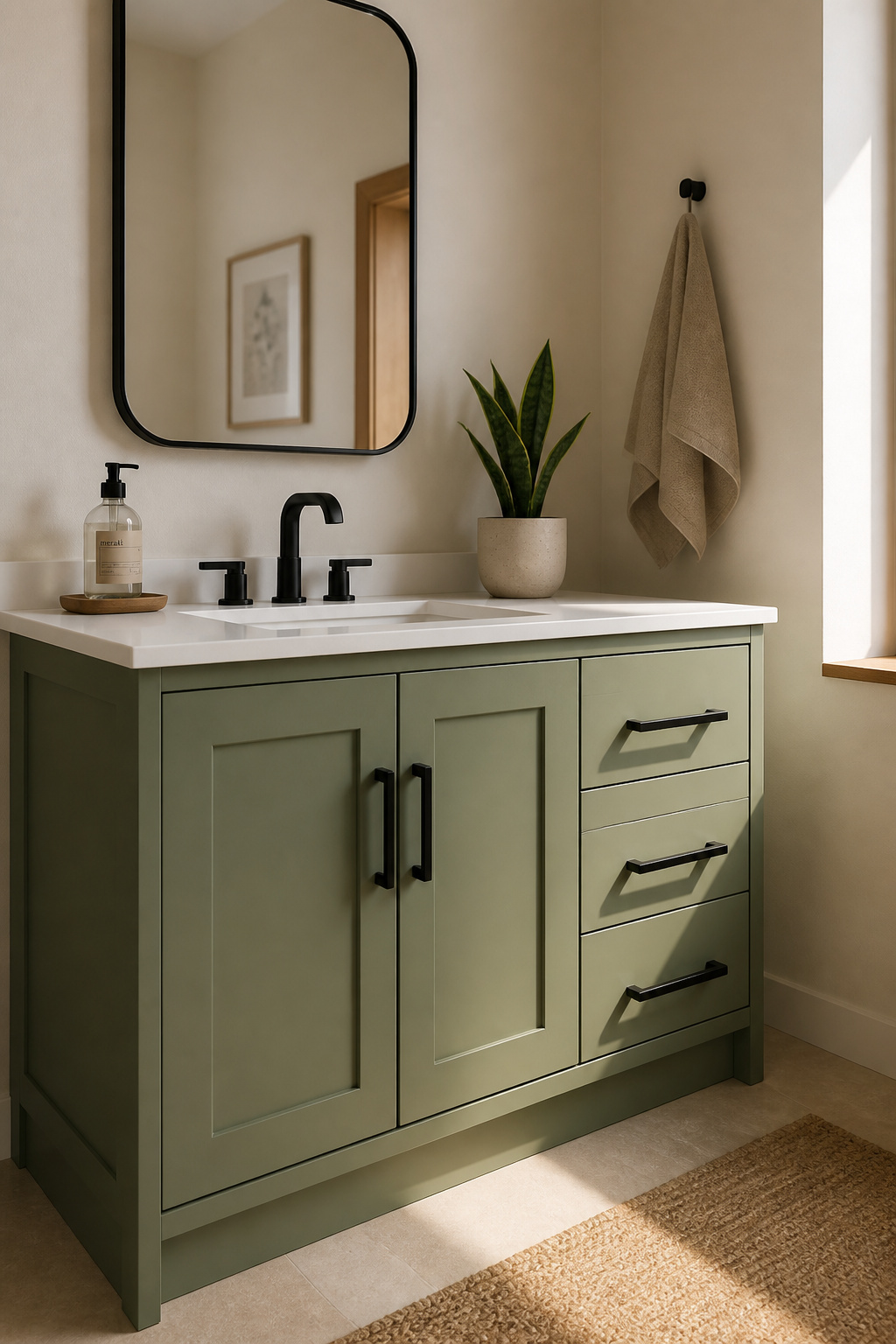
As bathroom ideas on a budget go, this is the most dramatic transformation for the materials cost. The wabi-sabi principle at work is straightforward: transform what exists rather than discarding it. If the vanity is structurally sound — doors swing cleanly, drawers pull without sticking, the carcass is solid — the only problem is the surface. And that’s a solvable problem.
Primer Is Not Optional
The key to a lasting paint job on a bathroom vanity is primer. Not the primer you roll onto walls before decorating. A bonding primer — specifically a shellac-based option like Zinsser BIN, or an oil-based equivalent — that grips the factory-coated or laminate surface that regular paint simply won’t adhere to. Without it, the finish looks fine for a week and then peels at the first knock or bump. With it, the paint bonds and holds.
For the topcoat, waterborne alkyd paint (Benjamin Moore ADVANCE or Dulux Trade Diamond range) gives a smooth, furniture-like finish with moisture resistance. Apply it with a small foam roller for doors and a brush for edges, sanding lightly between coats with 220-grit paper. Two coats are usually enough; three gives depth.
Finish with new hardware. A painted vanity with the original chrome handles still fitted looks like a DIY project. The same vanity with matte black or brushed brass handles looks like a considered choice. The hardware costs £20-£60 for a full set and takes 20 minutes to swap — it’s the punctuation that makes the sentence.
4. Replace Your Showerhead With a Low-Flow Rainfall Model
In Japanese onsen culture, bathing is a ritual rather than a task. The water isn’t a means to an end — it’s the point. A rainfall showerhead applies this principle to an everyday shower: the water falls from overhead instead of hitting at an angle, and what was a functional spray becomes an immersive experience.
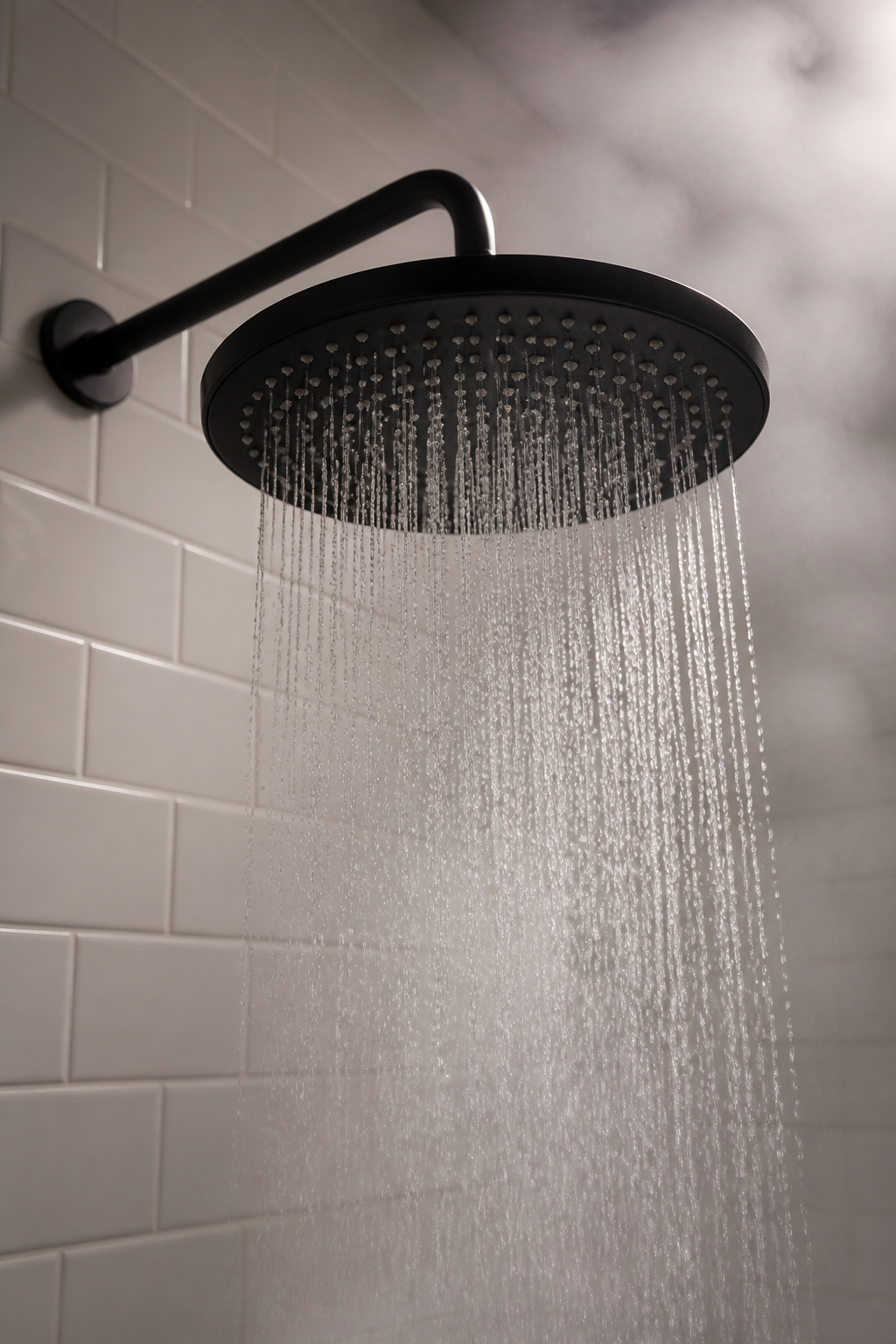
This is one of the highest-impact, lowest-cost bathroom ideas on a budget available. For £20-£40 — the price of a takeaway dinner — you change the most-used feature in the room. For modern bathroom shower ideas that genuinely transform the daily ritual, a quality showerhead is where most designers start.
The SparkPod High-Pressure Rainfall is the benchmark value option: consistently top-rated across independent tests, 1.8 GPM maximum flow rate, available in chrome and matte black, and it fits a standard ½-inch shower arm without an adaptor. A WaterSense-labelled head (2.0 GPM or less) like this saves an average family around 2,700 gallons of water annually compared to a standard 2.5 GPM head — lower bills, same experience.
Installation requires exactly three things: an adjustable wrench, a roll of PTFE tape (£1-£2 at any hardware shop), and 15 minutes. Remove the old head, wrap the shower arm threads with 2-3 layers of PTFE tape, and hand-thread the new head until snug. A quarter-turn with the wrench finishes it. One caveat: confirm the shower arm before ordering. Most UK showers have a standard wall-arm; some rainfall heads require a ceiling-mounted arm instead.
5. Affordable Bathroom Ideas: Install Open Floating Shelves for Mindful Storage
Closed cabinets give permission to accumulate. Doors that close are an invitation to push things in and forget about them. Open floating shelves remove that permission — what’s on display has to earn its place, because there’s nowhere to hide anything that doesn’t.
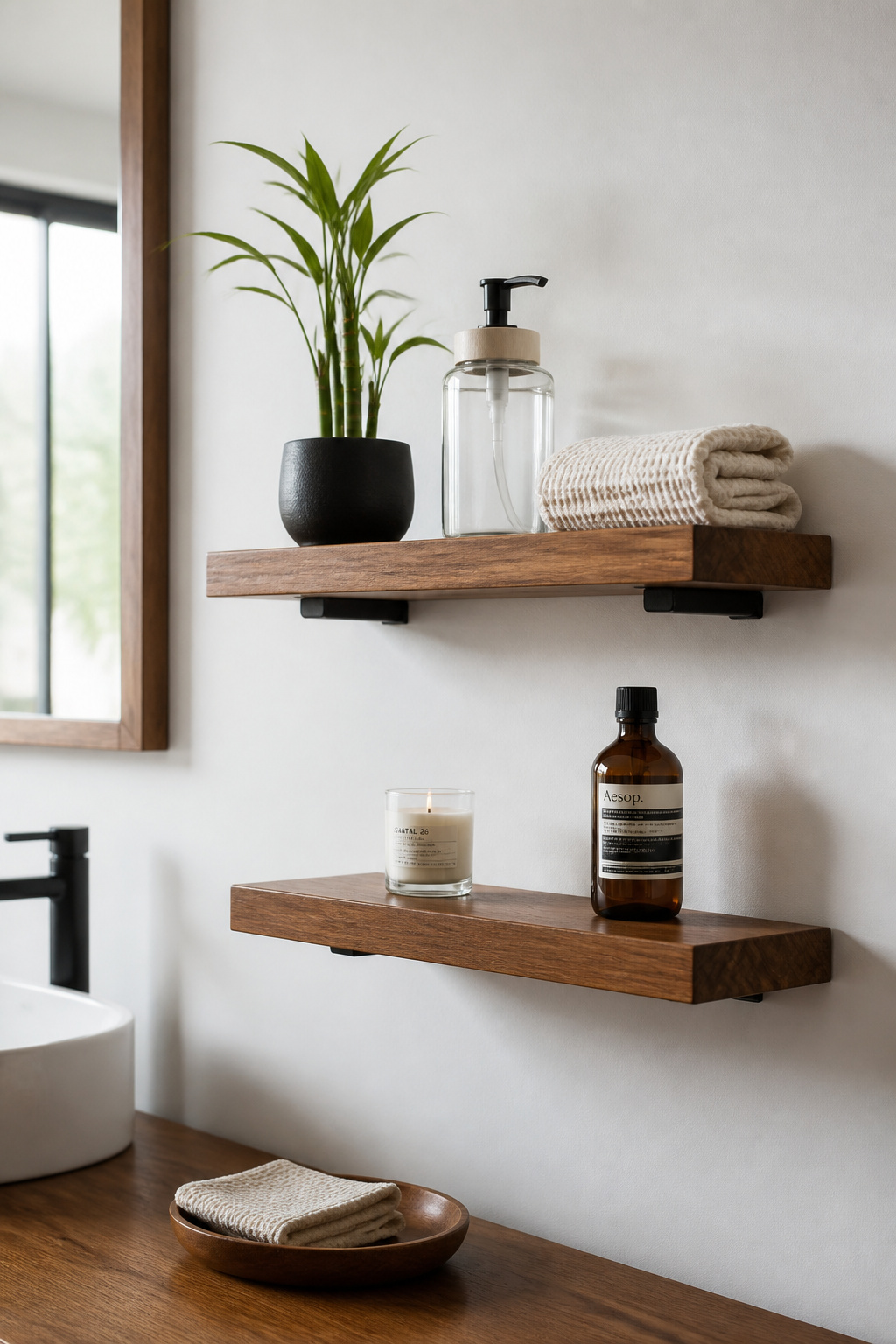
This is the design principle of kanso — the Japanese concept of simplicity through elimination — applied to bathroom storage. The result of enforced editing is that a bathroom with open shelves and five items on them looks exponentially calmer than a closed cabinet hiding forty. For bathroom storage ideas that maximize space, open shelving consistently outperforms cabinetry in rooms under 6m².
For materials, teak is the right choice if the budget allows: grade A teak’s natural oils make it inherently water-resistant, and AquaTeak floating shelves hold up to 10 lbs without any additional treatment. Pine works at lower cost (£5-£15 per plank) but must be sealed with marine-grade polyurethane before installation — unsealed pine warps in bathroom humidity within months. Powder-coated steel brackets add a clean industrial edge and won’t rust if the coating stays intact.
On brackets: invisible floating brackets look cleanest but need solid masonry or stud fixing. Standard L-brackets are more DIY-friendly, straightforward to locate over studs, and bear more weight (15-25kg depending on the fixing). For bathroom loads — 3-4 towels, a few bottles, a plant — any properly fixed bracket has more than enough capacity.
Install one shelf above the toilet and one beside the sink. Keep both to five items maximum.
6. Use Peel-and-Stick Wallpaper as a Feature Wall Behind the Toilet
The wall behind the toilet is the most underused opportunity in a budget bathroom. It’s never directly splashed, steam exposure is minimal, and it’s a naturally framed surface that the eye moves to first on entering the room. For bathroom ideas on a budget that add personality without risk, this is the move: peel-and-stick vinyl wallpaper on a single panel.
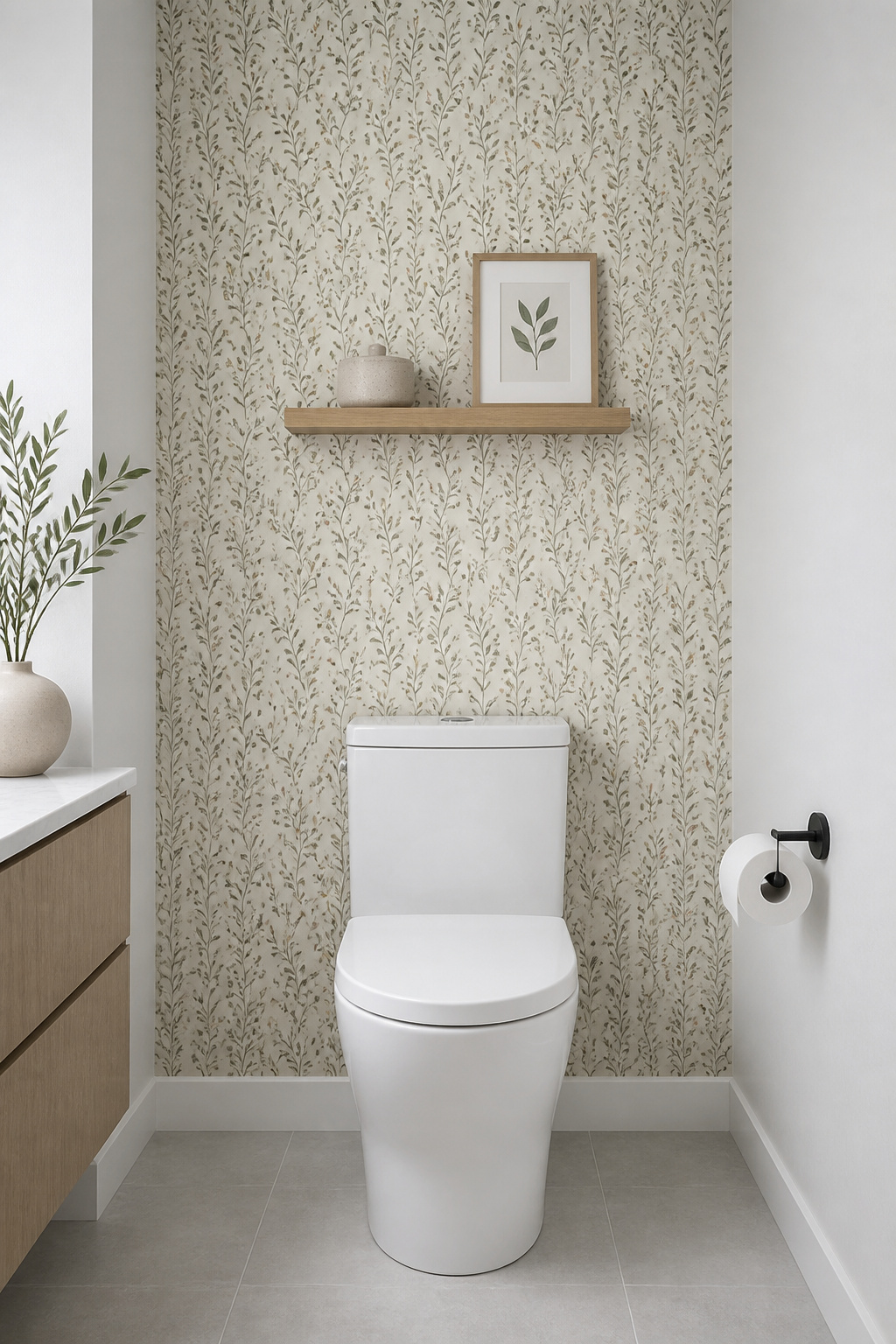
Vinyl peel-and-stick paper is moisture-resistant — not waterproof, but moisture-resistant, which is all the behind-toilet wall requires. Brands with purpose-made bathroom ranges include Tempaper, Huggleberry Hill, and Eazzy Walls. Best pattern types for a single panel: small-repeat geometrics, abstract watercolour washes, and organic botanicals — all look intentional without dominating a small space.
The application process is more forgiving than traditional wallpaper but less forgiving than people assume. Wall prep is critical: clean the surface with isopropyl alcohol and let it dry for a full 24 hours. Run the exhaust fan for 30 minutes before you start to pull residual moisture from the wall. Peel back 12 inches of backing, align the top to the ceiling line, and use a plastic smoothing tool working from the centre outward to clear air pockets as you go.
Leave a 2-3mm gap at the floor and keep the paper clear of any heat source, particularly towel rails — sustained warmth loosens the adhesive within weeks. For a full step-by-step walkthrough, bathroom wallpaper installation tips covers everything from wall prep to clean removal.
7. Regrout and Reseal Floor Tiles Instead of Replacing Them
Cracked or missing grout doesn’t just look bad — the eye moves to imperfection and stays there. A tiled floor with degraded jointing reads as neglected even if the tiles themselves are excellent quality. New grout restores the visual baseline: an uninterrupted surface that lets the tile pattern sit cleanly.
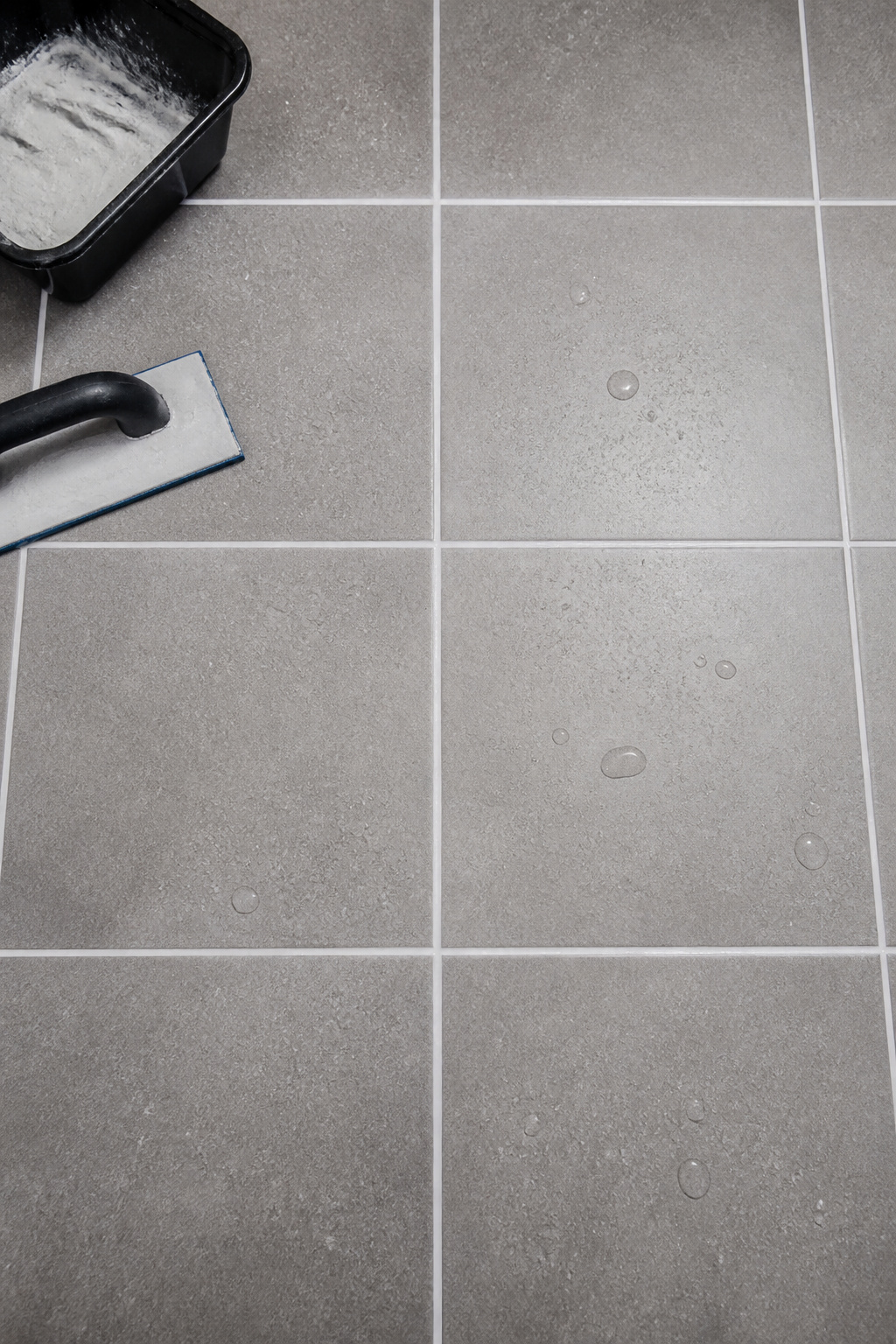
This is a different calculation from the grout pen work in item 1. Where the pen handles surface staining on intact grout, regrouting addresses structurally compromised jointing — crumbling, cracked, or missing sections that let water penetrate behind tiles. Left untreated, water behind tiles causes adhesive failure, lifting, and in severe cases, damage to the substrate that costs £500-£2,000 to repair.
Epoxy vs Cement in Wet Zones
For the bathroom floor’s wet zones — around the bath, in the shower tray — epoxy grout earns the premium. Made from epoxy resins, it creates an extremely dense non-porous joint that resists moisture, stains, and cleaning chemicals. It lasts 10-15 years without cracking or staining and never needs sealing. The trade-off: it’s harder to apply (thicker consistency, faster cure time), so work in small sections.
For the rest of the floor, standard cement grout sealed with a penetrating sealer (Mapei Ultracare Grout Sealer) does the job at lower material cost. Apply sealer 48-72 hours after the grout cures — applying too early traps moisture and causes cracking. Reapply every 1-2 years; a water bead test tells you when it’s time. If water soaks into the grout rather than beading, it’s time to reseal.
8. Bathroom on a Budget: Add a Ladder Towel Rail for Warmth Without the Radiator
A ladder towel rail does two things at once: it solves a functional problem (where do the towels go?) and it adds visual warmth to what is often a cold, hard room. Towels spread across multiple rungs dry faster than towels folded on a single bar — less mildew, less frequent washing. And vertically, the rail draws the eye up, making a low-ceilinged bathroom feel taller.
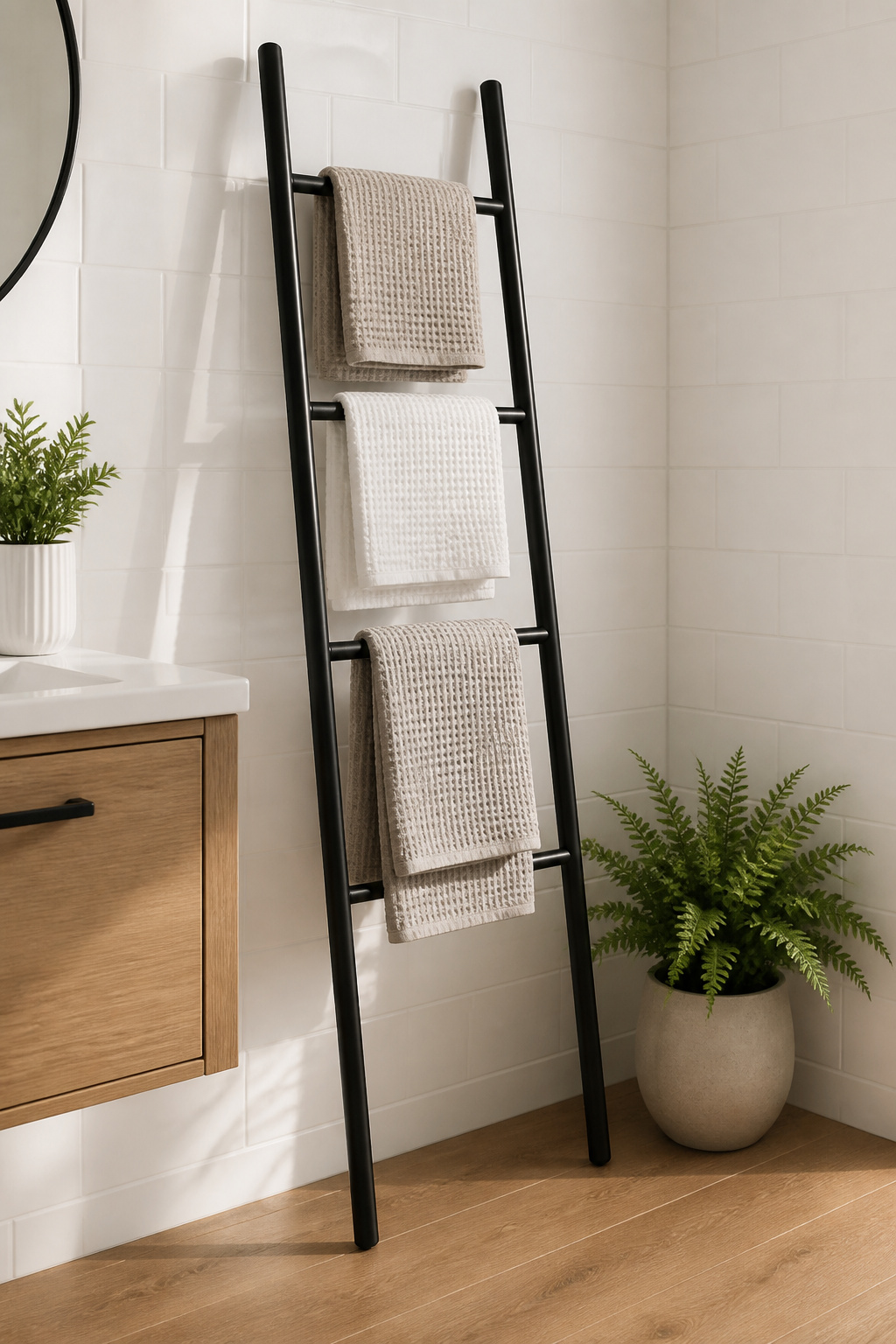
The freestanding version requires no drilling and no commitment — particularly useful for renters or for anyone not confident drilling into tile. Most freestanding ladders need 45-60cm of depth, which rules them out for very compact bathrooms. For a tight space, a wall-mounted two-rung rail clears the floor entirely and typically costs slightly less (from £20-£50) — though it requires four screws into the wall.
The finish you choose has an outsized effect on the room’s overall coherence. Whatever metal you choose for the towel rail should match or closely complement the taps, mirror fixings, and cabinet hardware. Three different metals in a small bathroom creates visual noise that no amount of styling resolves.
Matte black delivers strong graphic contrast against white or grey tiles — the dominant choice in renovated bathrooms right now. Brushed brass brings warmth and pairs well with cream, sage, or terracotta tones. Chrome pairs universally but shows water spots more readily — it needs regular wiping to stay sharp.
9. Introduce a Bamboo Plant or Air-Purifying Fern for Biophilic Calm
A single plant in a bathroom does more for the atmosphere than any number of decorative accessories. Biophilic design research consistently shows that even one living plant reduces perceived stress in interior spaces, and the effect is disproportionate to the plant’s size. This is also, by some margin, the cheapest bathroom idea on a budget on this list — a pot of lucky bamboo costs £3-£10.
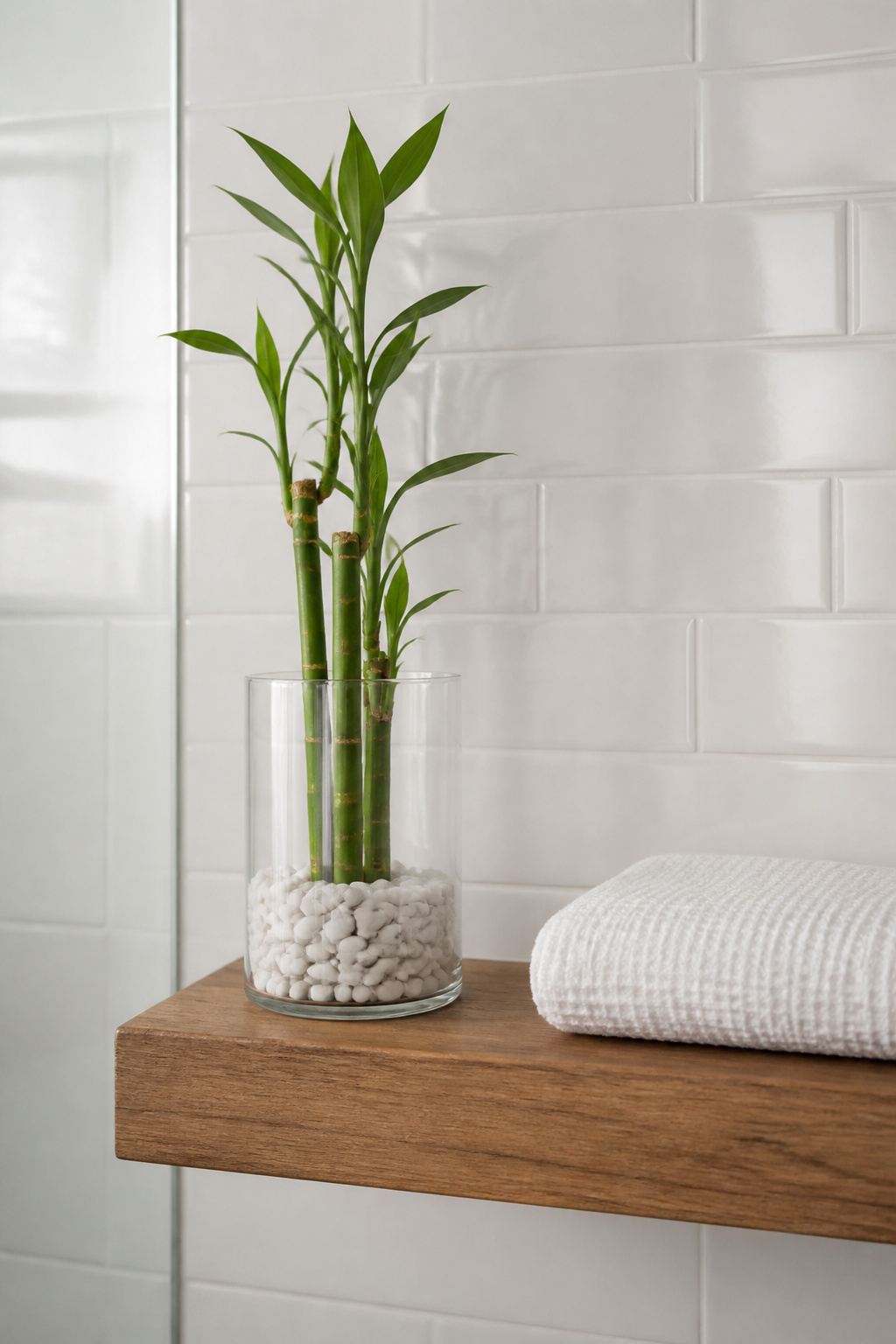
In traditional Japanese interiors, the tokonoma alcove holds exactly one carefully chosen object. The discipline is in the singular choice, and the result is that the chosen thing has room to be itself. One plant on a bathroom shelf operates on the same principle.
Choosing the Right Plant for Your Bathroom
Lucky bamboo (Dracaena sanderiana) is the ideal choice for a minimalist bathroom: it grows in water with pebbles in a glass vase, handles low light, and adds a quiet vertical element that suits a Zen-influenced room perfectly. Occasional water changes every couple of weeks are the full extent of the maintenance.
Boston fern thrives in steamy conditions and soaks moisture from the air. Bird’s-nest fern (Asplenium nidus) is native to East and Southeast Asia, adapts from low to bright indirect light, and brings a sculptural quality at home in a Japanese-inspired space. Golden Pothos tolerates low light and irregular watering — it can trail from a shelf and add lush character without demanding care.
For the pot: match the finish to the room’s hardware palette. Matte black ceramic in a contemporary bathroom, natural terracotta in an earthy Japandi-style room. Keep it to one pot. The moment you add a second, a considered placement becomes a collection.
10. Swap Cabinet Hardware for Matte Black or Brushed Brass Handles
Hardware is the jewellery of a room — a small detail with outsized visual weight, especially in a compact bathroom where the eye has little else to rest on. The same cabinet in chrome bar handles and in matte black bar handles is a different piece of furniture. The bones haven’t changed; the personality has entirely.
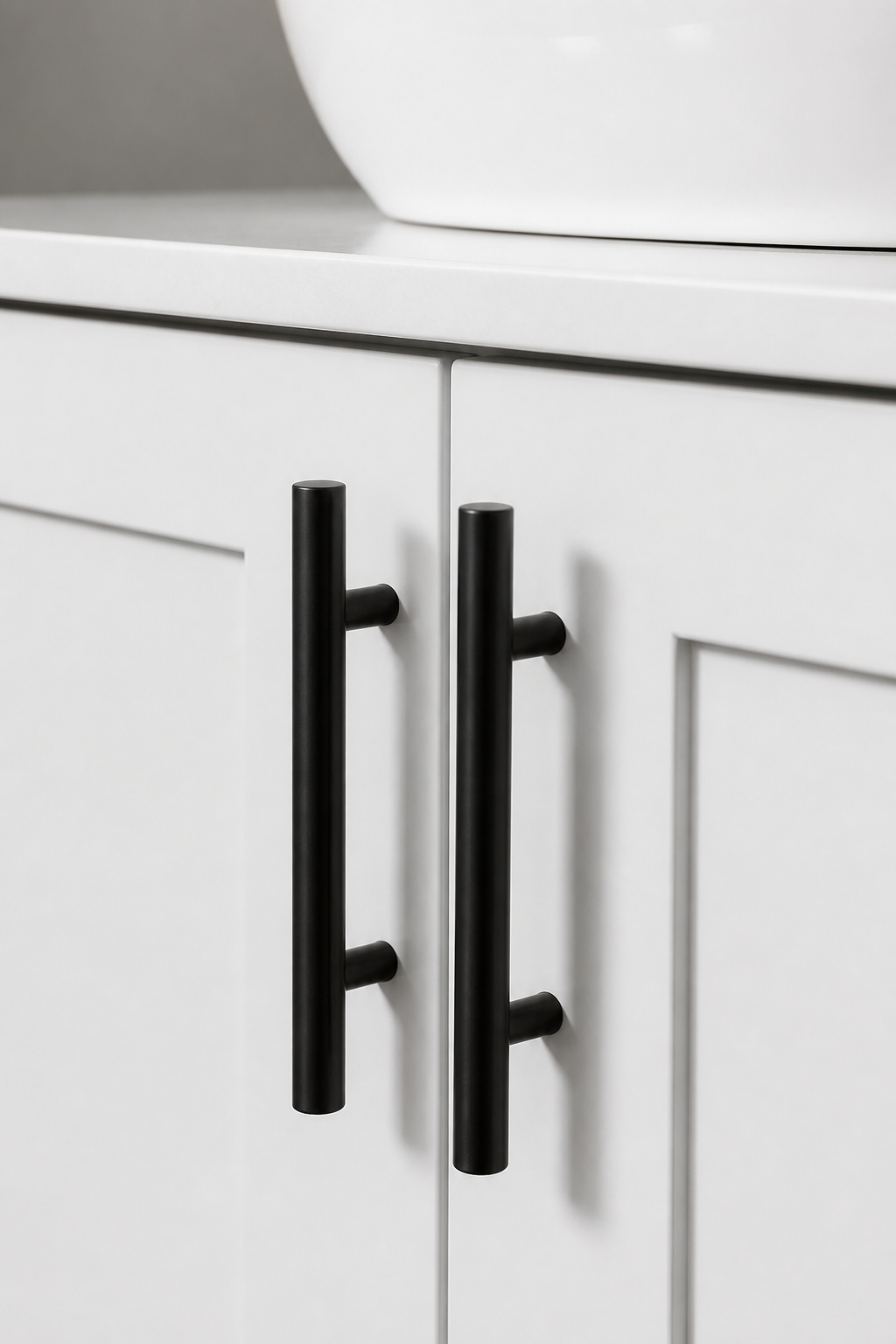
Among bathroom ideas on a budget, hardware swaps offer the highest return per hour of work. This is a 20-minute project requiring only a screwdriver, and it’s the cheapest possible way to modernise a bathroom vanity without repainting or replacing anything. A surprising number of people in dated bathrooms have never tried it.
Before buying, measure the existing handle’s hole centres — the distance between the two screw holes. Most UK and European vanity units use 96mm or 128mm spacing. Write this down before ordering. A 10-pack of handles returned because the spacing is wrong is a wasted half-day.
Brushed brass and matte black are the two finishes driving the premium look in 2025-2026 bathroom design. Budget sets are widely available: Franklin Brass matte black 10-pack runs £25-£35; Goldenwarm brushed brass 15-pack runs £30-£45. The one-finish rule applies here as everywhere else in the room: all metal should coordinate. If the taps are chrome, brushed nickel handles are the natural companion. If the taps are brass, matte black creates an intentional contrast.
11. Budget-Friendly Bathroom Ideas: Build a Cohesive Colour Story With Paint
A bathroom with mismatched accessories, dated fittings, and neutral walls looks like a room that hasn’t been thought about. The same bathroom — same fittings, same accessories — in a deliberate deep sage or warm taupe reads as designed. The paint did that. Not a renovation, not new tiles. A £20 tin of colour and a decision.
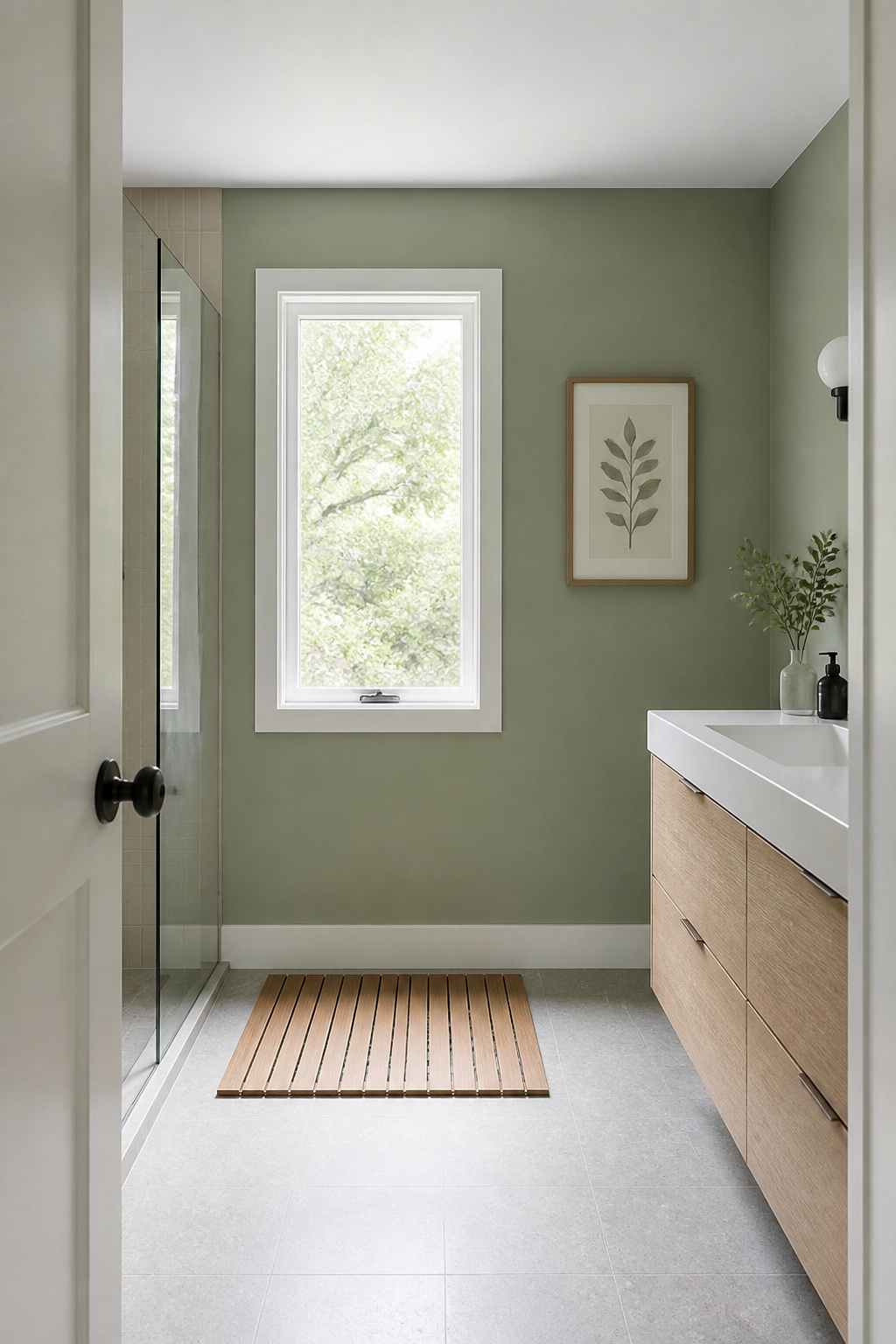
Paint is the cheapest large-surface change available, and its unifying effect is real: when the walls are a strong consistent colour, small mismatches in hardware or accessories recede. The eye responds to the dominant element and stops cataloguing the rest.
Paint That Lasts in a Wet Environment
Bathroom-specific paint matters — standard emulsion begins to peel within 6-12 months in a bathroom without adequate ventilation. The right choices are satin or semi-gloss finish in a formula rated for high-moisture environments. Dulux Trade Vinyl Silk has excellent moisture resistance and a mid-sheen that works in most bathroom sizes; Rust-Oleum 02711 has a built-in mildewcide formula; Ronseal Bathroom Paint is widely available and budget-priced.
For colour, Japanese and Japandi-influenced palettes are the best framework for a calm room: muted neutrals first — warm whites, soft greys, clay, and taupe — with the option of a single nature-inspired note in sage green or muted blue. For maximum space perception, light values on the walls with a slightly deeper tone on one feature wall adds depth without closing the room in. In a bathroom without a window, reach for semi-gloss rather than satin — the higher sheen reflects more of the artificial light you’re relying on.
12. Layer Textile Warmth With Waffle-Weave Towels and a Natural Teak Bath Mat
The fastest way to make a budget bathroom feel considered is through what you touch. Textiles signal quality before a single fixture is assessed. A new set of matching waffle-weave towels and a natural teak bath mat does more for the perceived quality of a bathroom than a £200 accessory installation — because the upgrade is tactile, felt and seen simultaneously.
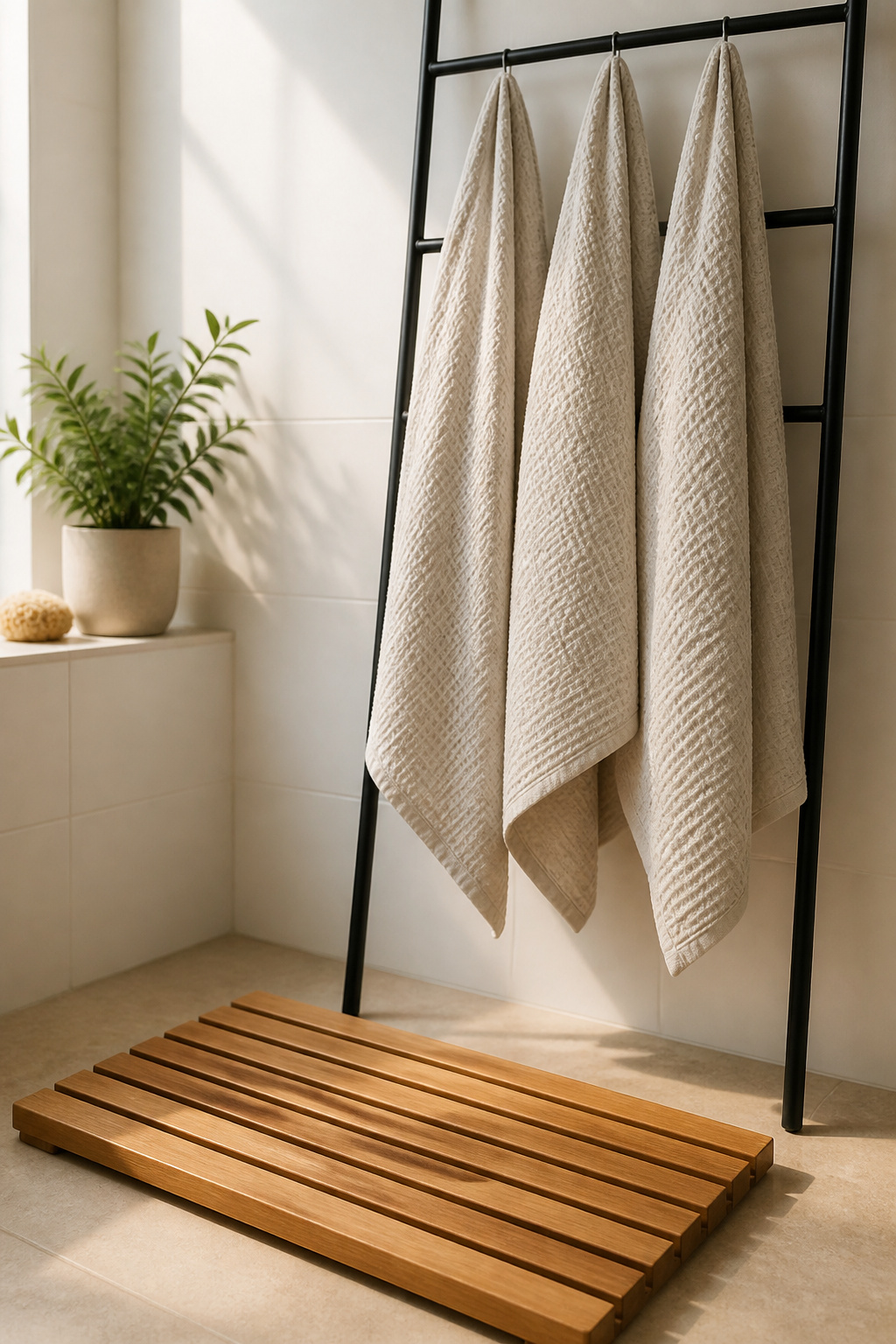
Hotels made the switch from terry cloth to waffle weave for a reason. Terry cloth absorbs moisture faster on initial contact, but waffle weave dries faster after use because its open grid structure lets air circulate. A terry cloth towel hung in a small bathroom can take hours to dry; a waffle towel can be ready in half that time. Less mildew, less laundry, less bulk on the rail.
The Teak Mat
Grade A teak has naturally high oil content that makes it inherently water-resistant — the same quality that made teak the standard for boat decks for centuries. Maintenance is minimal: a soft bristle brush and water, cleaning with the grain, then air-drying properly. Avoid teak oil products, which can promote mould; the wood’s own oils are sufficient. Budget options start from around £20-£45 for a standard 60×40cm mat.
Choose one neutral tone for the full towel set — stone, white, or sand — and buy enough to make the rail look intentional rather than temporary. Mixing colours across the set creates the appearance of a hotel bathroom that hasn’t been made up yet.
13. Replace a Bulky Shower Screen With a Simple Tension Rod and Linen Curtain
A fixed glass shower screen is a permanent architectural statement — and in a small bathroom or a rented flat, that’s not always what you want. A quality tension rod with a linen-look curtain costs £20-£60 total. A replacement shower screen costs £100-£400 minimum. The curtain comes down in two minutes without leaving a mark.
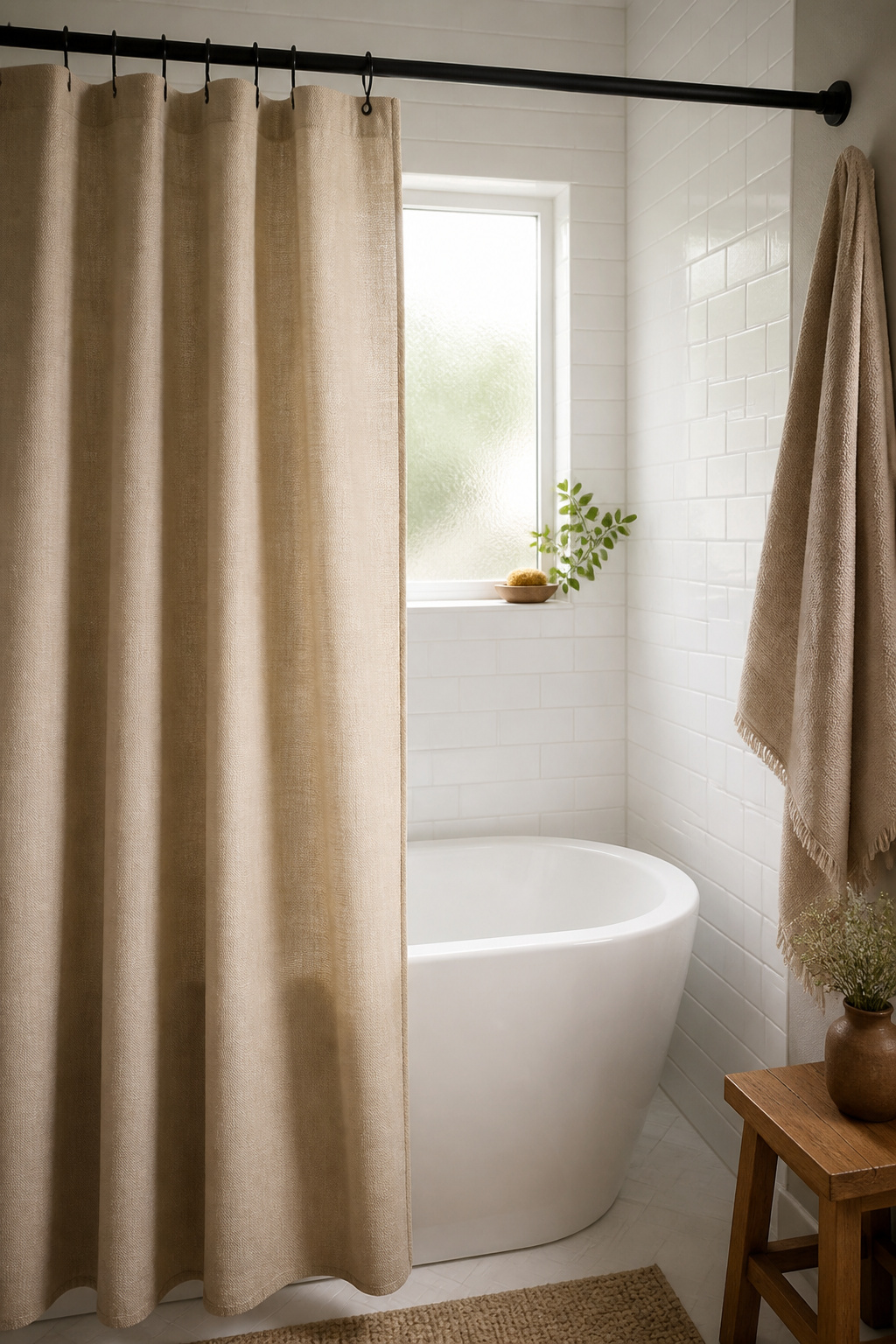
This swap works specifically for over-bath showers where the bath sits against a wall. Linen fabric makes a bathroom feel softer and warmer than glass does — particularly valuable in a white-tiled or neutral bathroom that risks feeling clinical. For genius bathroom ideas for small bathrooms, a linen curtain over a glass screen is consistently one of the more surprising but effective recommendations.
The critical factor in making this look deliberate is the tension rod itself. Cheap spring-steel rods collapse under heavy fabric or fail at the first bump. A 1-inch diameter 304 stainless steel tension rod (CorkLatta, TEECK, and Mcrbeay are consistently well-reviewed) holds 28-31 lbs without drilling, won’t leave rust rings on bath enamel, and adjusts from 31-80 inches — more than adequate for a standard UK bath.
For fabric, linen-look polyester (KGORGE and similar, £15-£35) is the budget version: it mimics natural linen texture, is machine washable, and is effectively waterproof. True linen curtains with an attached waterproof lining (Magiclinen, 3HLinen) give the best result — real linen texture with water containment — at £60-£120.
14. Bathroom Ideas on a Budget: Edit Your Accessories Down to Three Hero Pieces
This one costs nothing. It’s also, for most bathrooms, the most impactful change on this list.
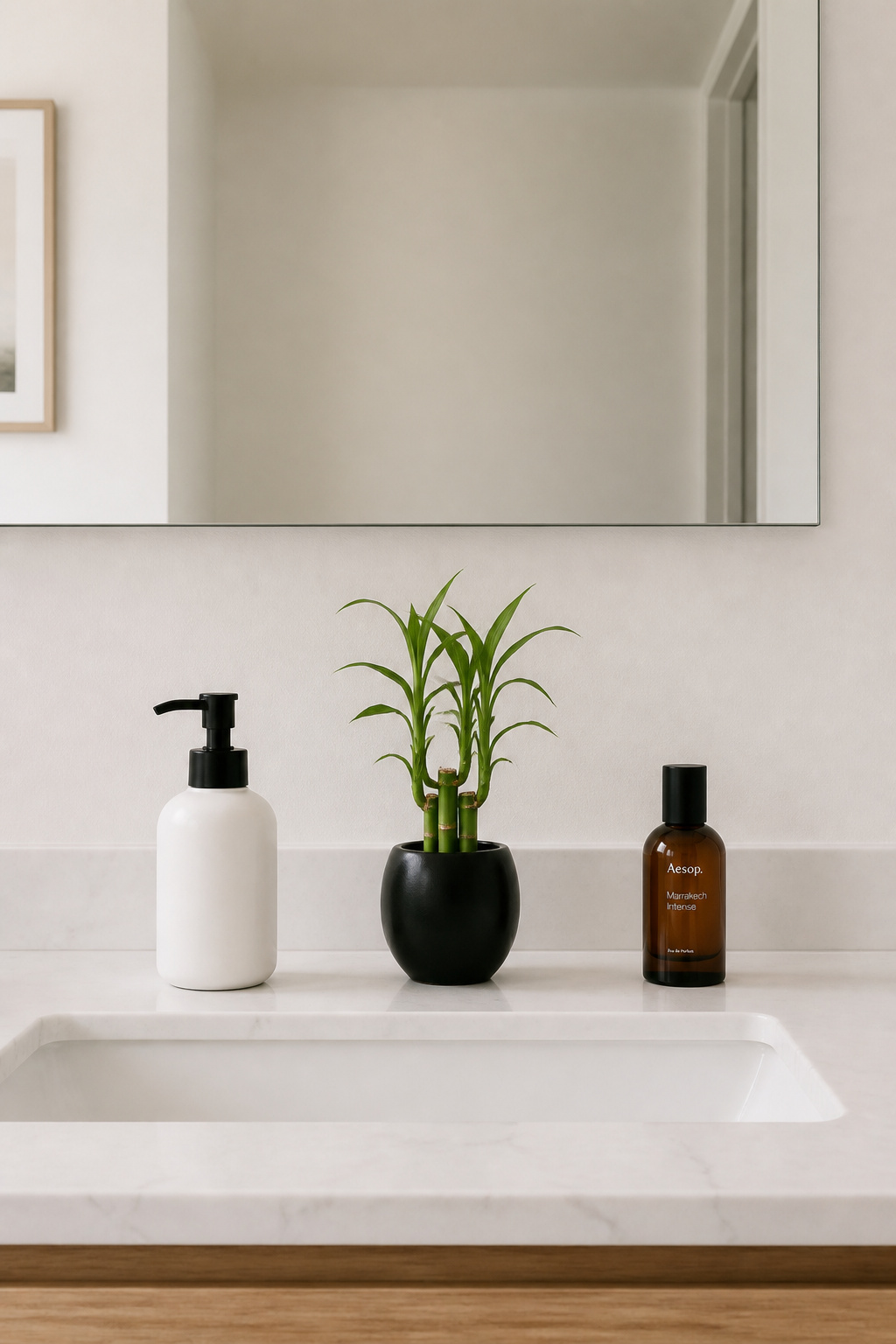
In Japanese interior philosophy, the tokonoma alcove traditionally holds exactly three objects arranged asymmetrically. The number comes from centuries of refined observation: three is the maximum the eye can hold comfortably before it starts grouping elements rather than seeing them individually. More than three objects in a small space don’t read as individual pieces — they read as clutter.
The exercise is identifying which three items on your bathroom counter earn permanent space. The criterion is simple: daily use. What do you reach for every single morning without exception? Those items stay. Everything used weekly or less goes under the sink. A well-chosen trio might be: a soap dispenser, a small plant, a single perfume or candle — functional, living, and sensory, three items contributing three different things without overlapping.
Under-Sink Storage That Disappears
For the things that go under the sink: the space there is typically 40-60cm wide and 30-40cm deep. A tension rod fitted inside the cabinet doubles vertical storage by letting spray bottles hang from their trigger handles rather than standing on the floor. Matching storage boxes — all white, all natural rattan, or all matte black — make the under-sink space look like a designed system rather than accumulated chaos. For practical ideas on maximising tight floor space, small bathroom interior ideas to maximize space covers solutions that work in even the most restricted footprints.
15. Use Warm-White Bulbs and a Dimmer Switch to Transform the Mood
Everything above this point changes what the bathroom looks like. This changes how it feels — which is, in the end, the thing that matters most.
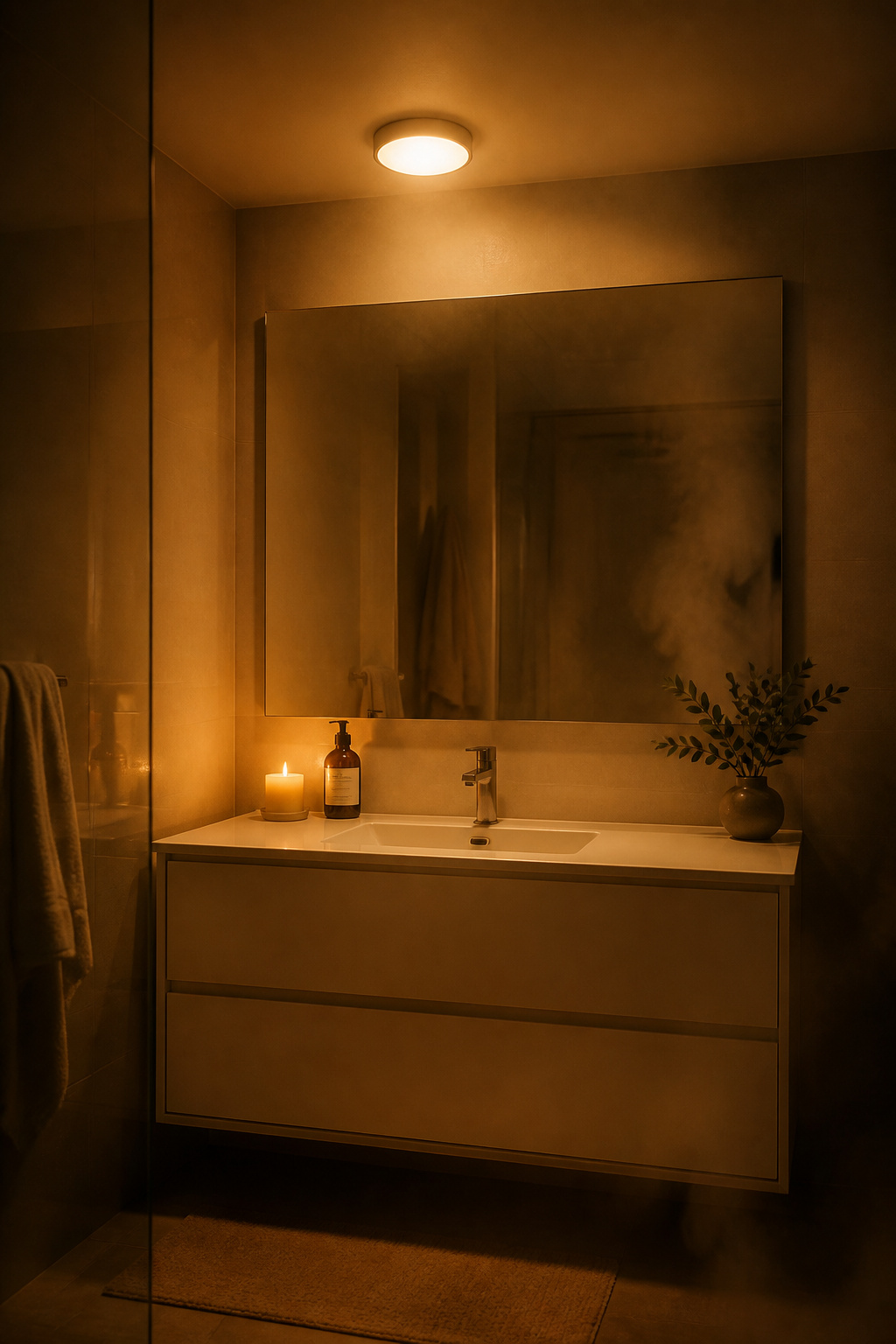
Lighting colour temperature determines a room’s emotional register before anything else registers consciously. At 4000-5000K — the cool white, blue-toned light that most bathrooms still run on — the room triggers alertness and mild unease. At 2700K (warm white, amber-toned, the temperature of candlelight) it triggers relaxation and the sense that this is a room worth being in.
Bulbs, Dimmers, and IP Ratings
The same white tiles, same vanity, same mirror. At 4000K: a hospital bathroom. At 2700K: a hotel.
Switching to 2700K warm-white LEDs costs £10-£25 for a full bathroom replacement (2-4 bulbs, £3-£6 each for Philips LEDClassic or Osram PARATHOM). The transformation is immediate on installation and the bulbs last 15,000-25,000 hours — roughly 10-15 years at 3 hours per day. This is the highest ROI change on the entire list per pound spent.
The dimmer switch takes it further. A bathroom-rated dimmer (IP44 minimum for zones around the bath and sink; IP65 directly above the shower) lets you shift between functional light for morning routines and genuinely low light for evening baths. Verify your chosen LED bulbs are specifically marked as dimmable before buying the switch — a standard LED bulb in a dimmer will flicker, buzz, or fail prematurely. Match the components deliberately, and the payoff is a bathroom that shifts register on demand.
Where to Start When You Have a Small Budget and a Big Vision
The question isn’t which of these bathroom ideas on a budget to do — eventually, most are worth doing. The question is what to do first with what you have now.
Phase one costs under £50 and requires no tools: swap to 2700K warm-white bulbs, apply a grout pen to discoloured lines, and spend an afternoon editing the counter down to three objects. These three changes are invisible to anyone trying to identify what specifically changed — but the room feels like a different place. The lighting does the heavy lifting; the grout restores the baseline; the editing removes friction.
Phase two runs £50-£150 and fits in a weekend: new cabinet hardware, a floating shelf with three curated items, a set of waffle towels and a teak mat, and a peel-and-stick wallpaper panel behind the toilet. This is where the room starts to read as considered rather than just clean.
Phase three — the vanity repaint, the oversized mirror, the new showerhead, the ladder towel rail — transforms the bones of the room for £150-£300 in materials. That’s a full bathroom transformation for the price of a single contractor visit, which often doesn’t cover much more than an assessment.
The point isn’t to do everything at once. The point is that each of these bathroom ideas on a budget costs less than you assumed and does more than you expected. That’s what constraint does — it forces clarity. And clarity, in a bathroom as in most things, looks a lot like intention.
Which, in the end, is what makes a room look expensive.