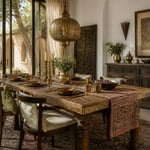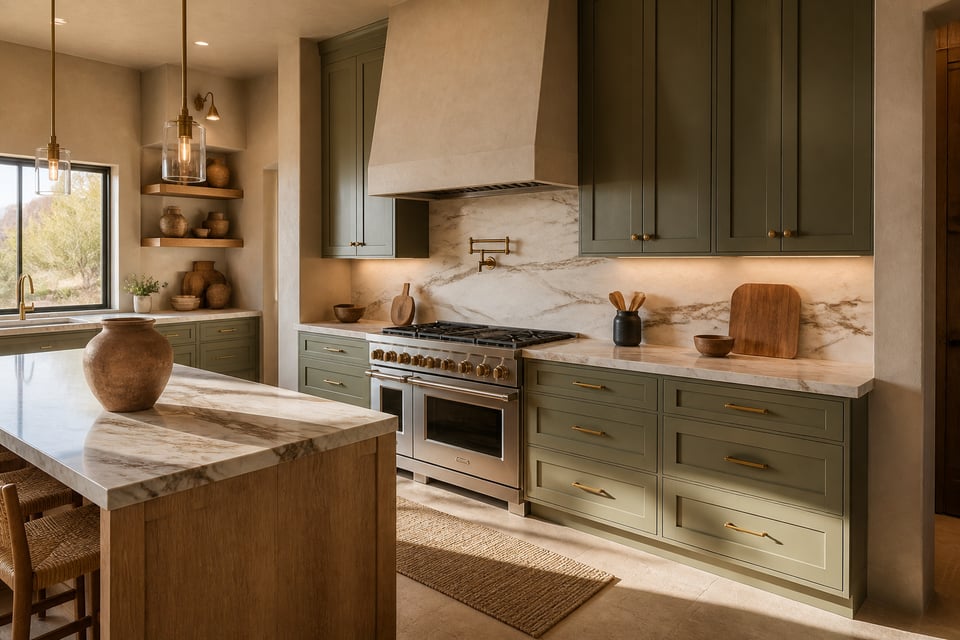
The kitchen is working harder than ever right now. After years of white-on-white uniformity, the most compelling kitchen design trends of 2026 are moving in the opposite direction. Warmer. More material. More personal. Natural stone that marks with use. Hardware that develops a patina from touch and air. Cabinet colours borrowed from desert floors and forest canopies.
I’ve spent months tracking what’s actually being specified — not what’s trending on mood boards, but what’s landing in real renovation briefs. The shift is unmistakable. The kitchens generating the most genuine interest are built on authentic materials and considered restraint. These 16 kitchen design trends represent the ideas worth investing in — whether you’re planning a full renovation or searching for the single change that moves the needle most.
1. Warm Earth Tones Replacing the All-White Kitchen
The all-white kitchen has peaked. Houzz’s 2026 Kitchen Trends Report shows that 63% of homeowners repainting cabinets are actively walking away from plain white. The colours replacing it read like a desert landscape: terracotta, sage, warm mushroom, and linen.
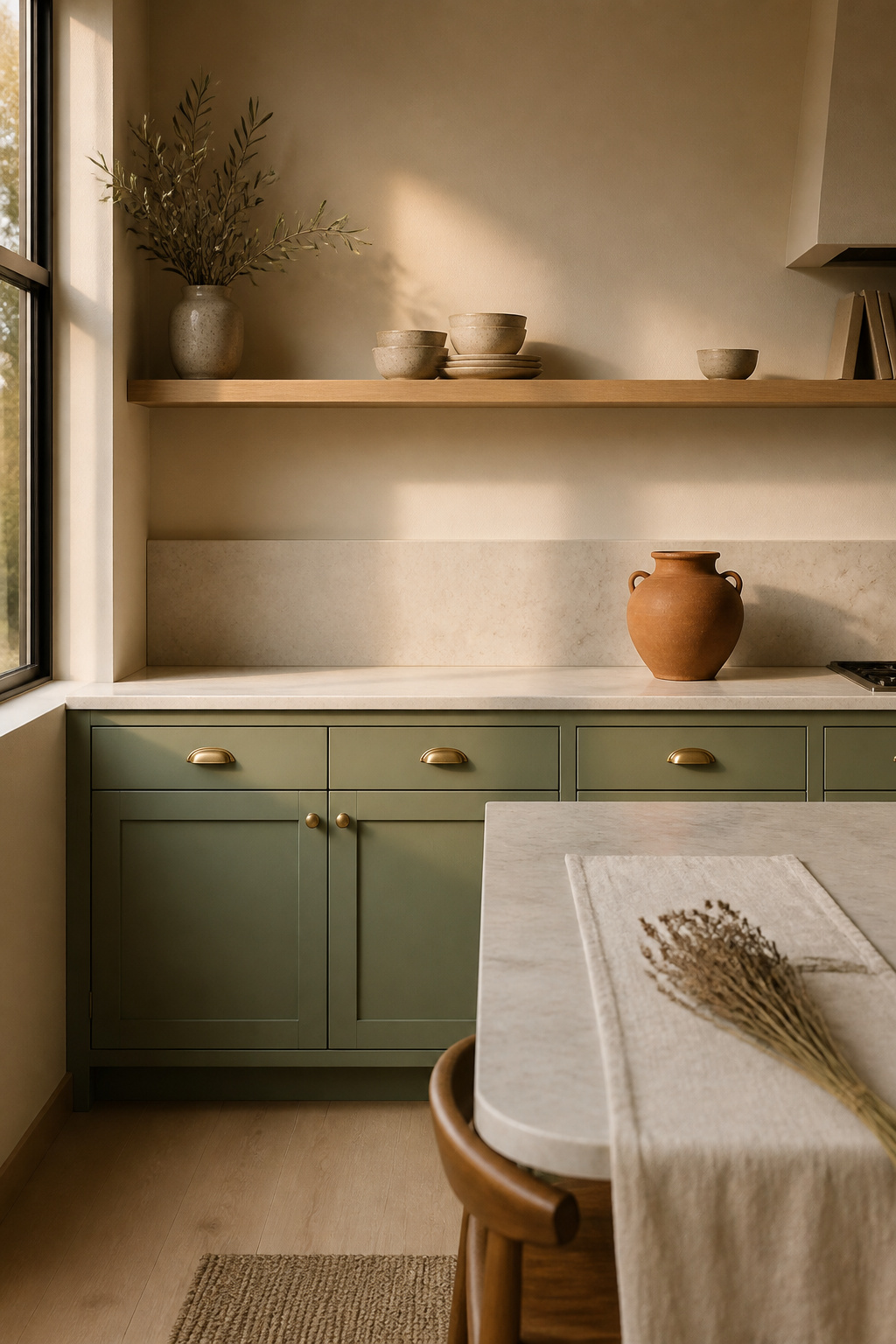
The Colours Replacing White: Earth Tones as Modern Kitchen Design Trends
This shift isn’t purely stylistic. Warm earth tones are consistently linked to lower cortisol levels and higher perceived comfort. Both matter in a room where families spend several hours a day. The clinical white kitchen made sense when kitchens were designed to be impressive. Now that the kitchen is the home’s social core, warmth earns its place.
The warm neutral family is the most accessible entry point. Linen, parchment, and antique white all have yellow or pink undertones. They feel welcoming rather than stark. From there, the bolder moves: full terracotta on an island, sage green on the perimeter, or a deep mushroom-taupe across every cabinet face.
For those considering the kitchen cabinet colour combinations before committing, test at large scale. Paint chips are unreliable for earth tones. These shades shift dramatically between morning light, afternoon sun, and artificial evening light. A professional cabinet repaint with quality bonding primer runs $1,000-3,000. Start with the island colour, live with it for a season, then decide on the perimeter.
2. Fluted Cabinet Fronts — the Kitchen Design Trend Everyone’s Talking About
Fluted cabinetry has moved from early-adopter territory into mainstream specification. Blakes London describes it as “the cabinet detail we are specifying more than ever right now.” That phrase typically means a third of new briefs. What drives the demand is something hard to fake: dimension.
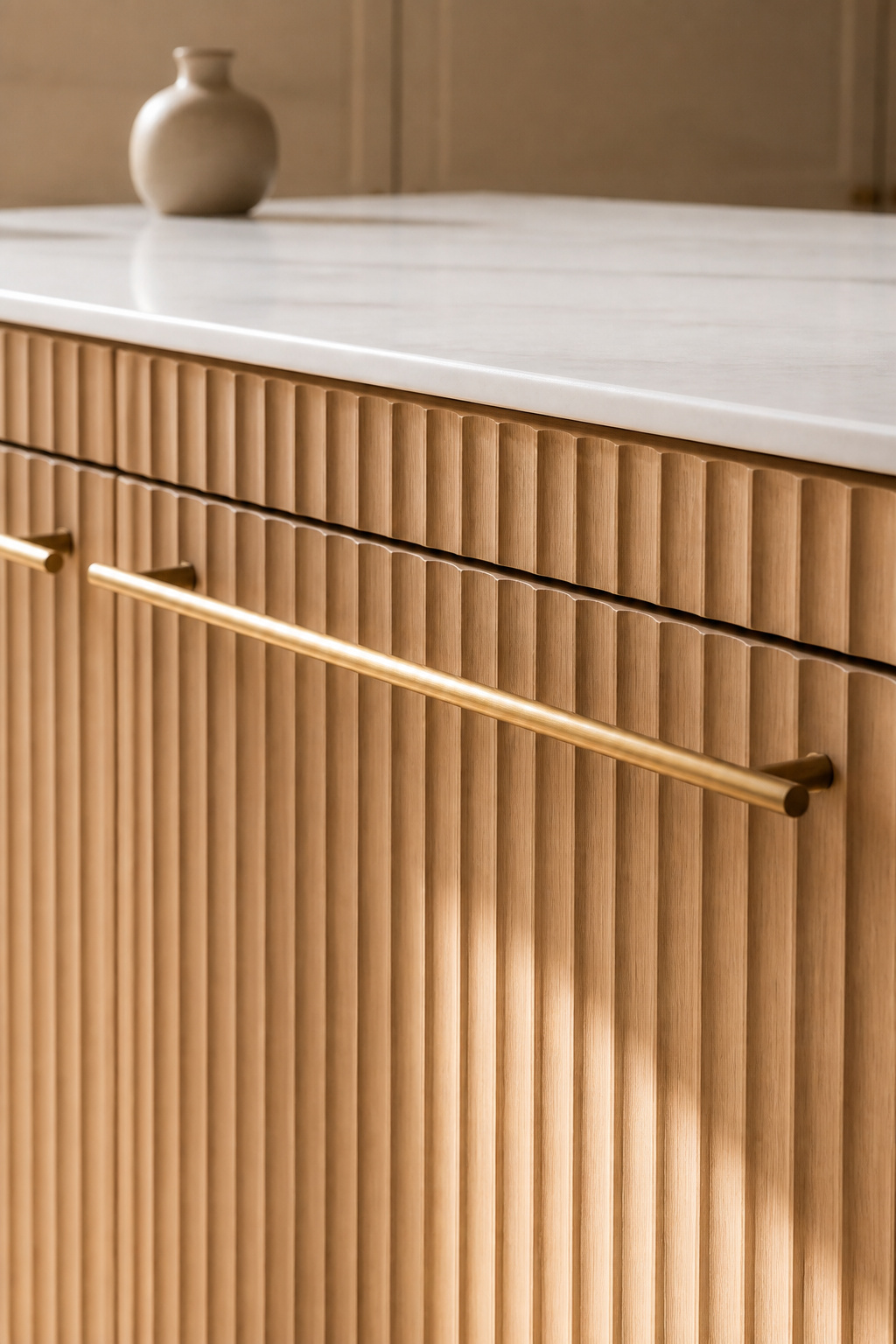
The vertical grooves cast shadows that change as light moves across the kitchen. In morning light they read as fine lines. In late afternoon raking light, they become pronounced ridges. On natural white oak, fluting reveals grain patterns in ways that flat panels never could. On lacquered MDF, the shadow line is cleaner and more graphic.
Ribbed glass inserts are the detail I recommend most often for pantry doors. You get a hint of the interior without the maintenance overhead of fully open shelving. Textured laminate in fluted profiles is the accessible entry point — easy to clean and genuinely convincing.
Island cabinet sides are the most natural application. Fluting on the island’s face panels creates a furniture-like quality. Lower cabinets also benefit in handle-free kitchens, where door joins can look pronounced. The groove pattern absorbs them visually. The common mistake is specifying fluting everywhere. It needs contrast against flat surfaces to read as intentional rather than excessive.
3. Curved Cabinetry and Arched Doors for Softer Kitchen Silhouettes
Walk into any high-end kitchen showroom right now and you’ll notice right angles starting to give way. Radius island ends, arched upper cabinet doors, pill-shaped drawer fronts — curved geometry is becoming one of the defining signatures of current kitchen design. Designers consistently describe the psychological effect: curved forms make kitchens feel warmer and less institutional.
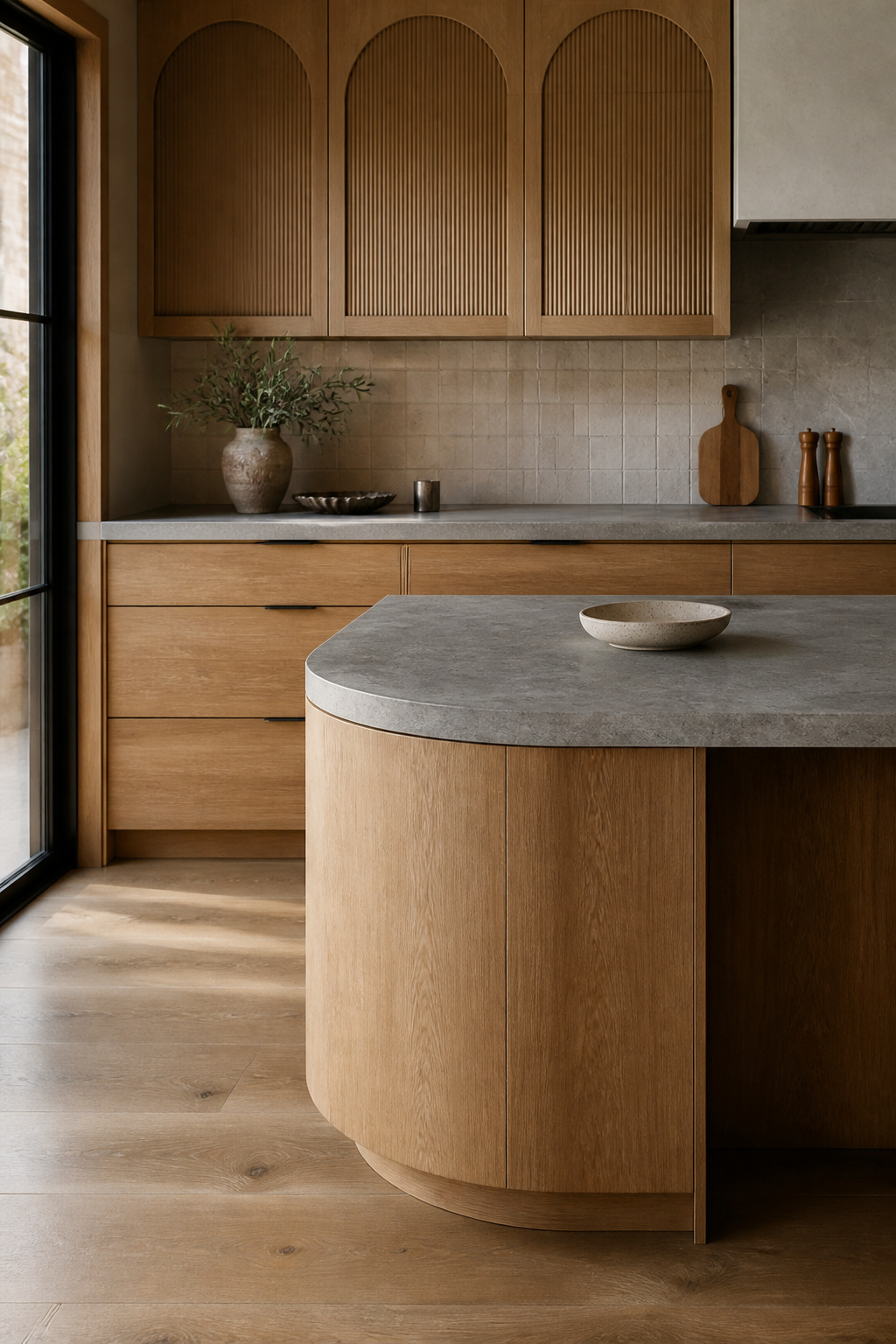
CNC precision manufacturing has made this kitchen design trend far more accessible. A radius island used to require specialist joinery at a premium price. Today it’s a standard option from many semi-custom cabinet makers. Arched upper cabinet doors are available as stock from manufacturers like Fabuwood and Schuler — accessible well below the custom tier.
The most architecturally interesting results combine a curved island base with a straight-edged countertop. The soft form below, the precise material above. One curved zone reads as intentional. Curving everything reads as unfocused. A wood island with kitchen island design possibilities explored at the brief stage almost always leads to better proportioning decisions than adding curves as an afterthought.
4. Integrated and Panel-Ready Appliances for a Seamless Look
Panel-ready appliances — refrigerators, dishwashers, wine coolers — that disappear entirely into the cabinetry line have become the hallmark of high-specification kitchen design. When appliances take custom cabinet panels and vanish into the run, the kitchen reads as architecture rather than a room with equipment in it.
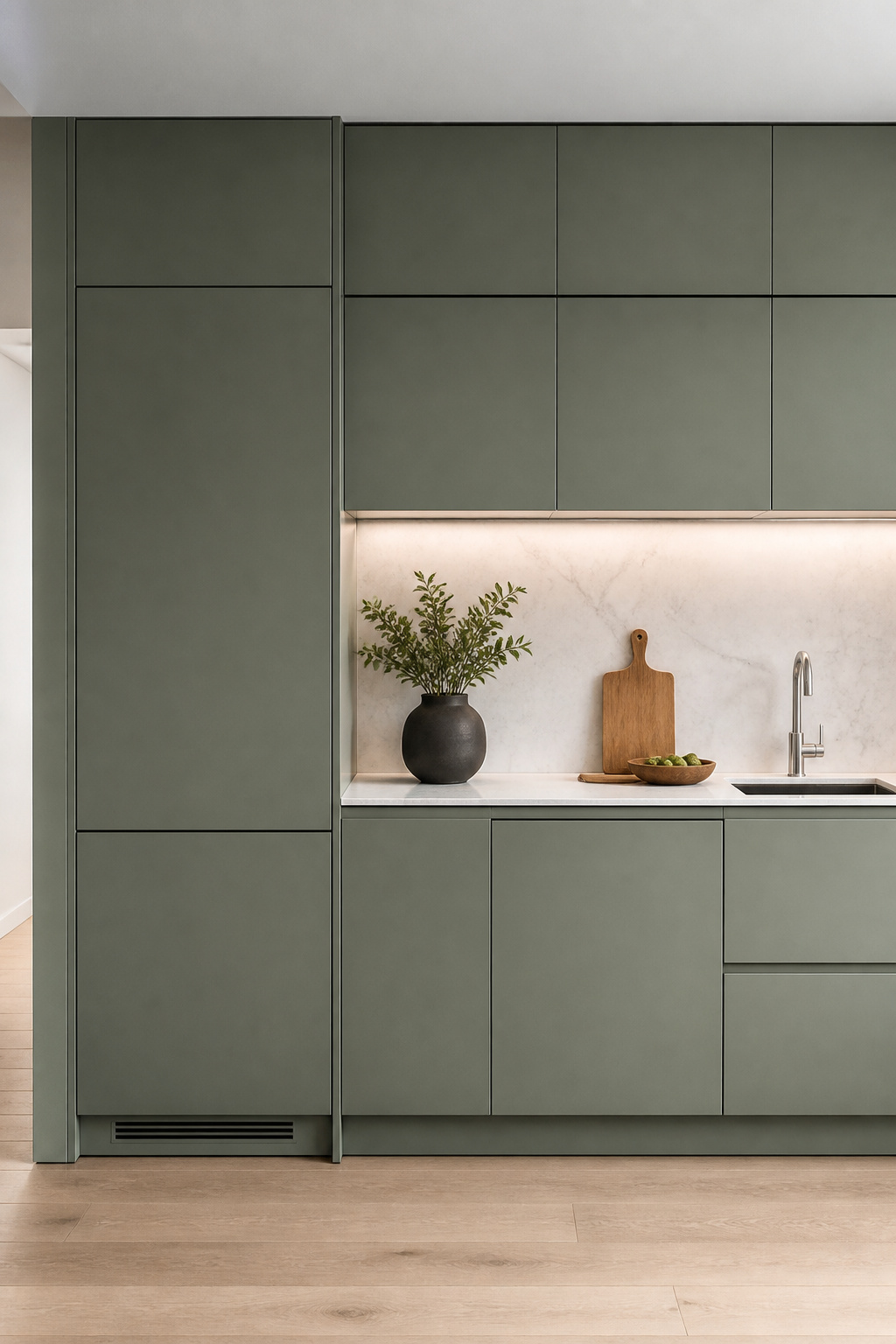
Sub-Zero leads the category for fit. Their panel-ready refrigerators range from $5,000 to $20,000 per unit. Miele’s integrated dishwashers are panel-ready as standard. Fisher & Paykel holds the most accessible premium position. A complete integrated kitchen — refrigerator, dishwasher, wine cooler — starts around $25,000 and can exceed $100,000 for fully specified flagship configurations.
Ventilation planning is critical. Integrated refrigerators still require dedicated airflow pathways — toe-kick vents or top cabinet vents — even when fully panelled. This needs to be designed into the cabinetry, not retrofitted. Dishwasher panel alignment catches many installers off guard. The panel must clear adjacent cabinet doors when open. Get this right at brief stage, not during installation.
5. Unlacquered Brass Hardware Adding Warmth and Slow Character
Unlacquered brass has been the dominant kitchen hardware finish for two consecutive years. The 2026 picture shows no softening. What separates it from polished and satin finishes is simple: it changes. No lacquer coating means the metal oxidises through contact with oxygen and skin oils. It develops a patina that is entirely personal — darker where touched most, brighter where it isn’t.
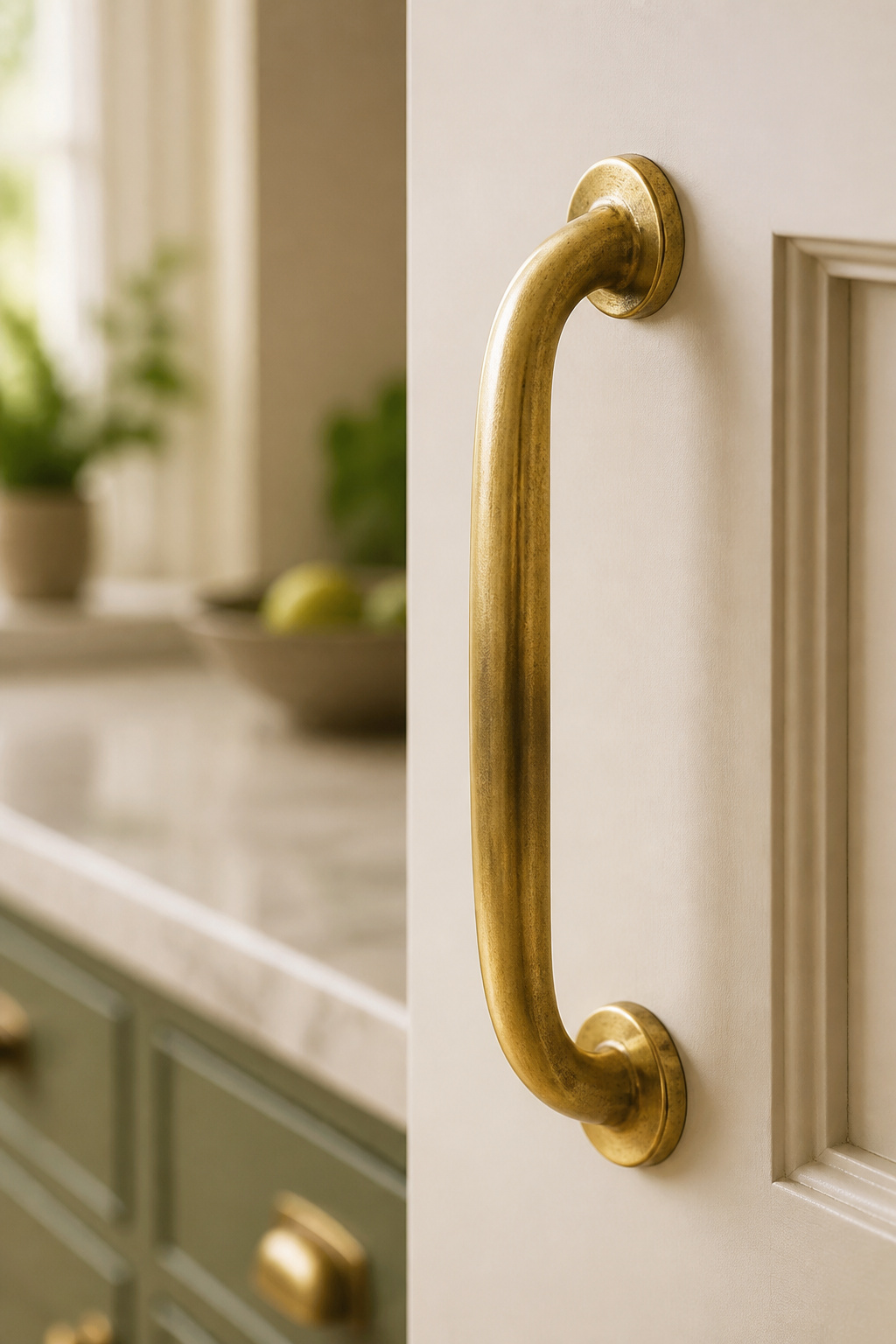
Why This Kitchen Design Trend Outperforms Fixed Metal Finishes
Lacquered brass has a predictable arc. It looks uniform until the coating wears unevenly. At that point it looks tired rather than characterful. Unlacquered brass follows the opposite arc entirely. A kitchen fitted with it today will carry a warm amber-bronze patina in five years. That patina cannot be replicated on a new finish.
Armac Martin, Classic Brass, Sun Valley Bronze, and Waterworks produce the highest-quality unlacquered brass. Patina develops over 6-24 months depending on use and air quality. To maintain a brighter appearance, occasional cleaning with Bar Keepers Friend removes surface oxidation. To encourage the patina faster, leave the hardware completely alone.
Pairing is straightforward once you understand the metal’s character. Unlacquered brass works with painted cabinetry in off-whites, warm greens, and navy. It works with natural stone countertops. It fights with cool grey tones. Avoid mixing it with polished chrome. Matte black is the natural second metal — a matte black tap, brass cabinet hardware, and a brass pendant creates the layered quality that distinguishes a designed kitchen from a curated one.
6. Natural Stone Countertops Leading Kitchen Design Trends This Year
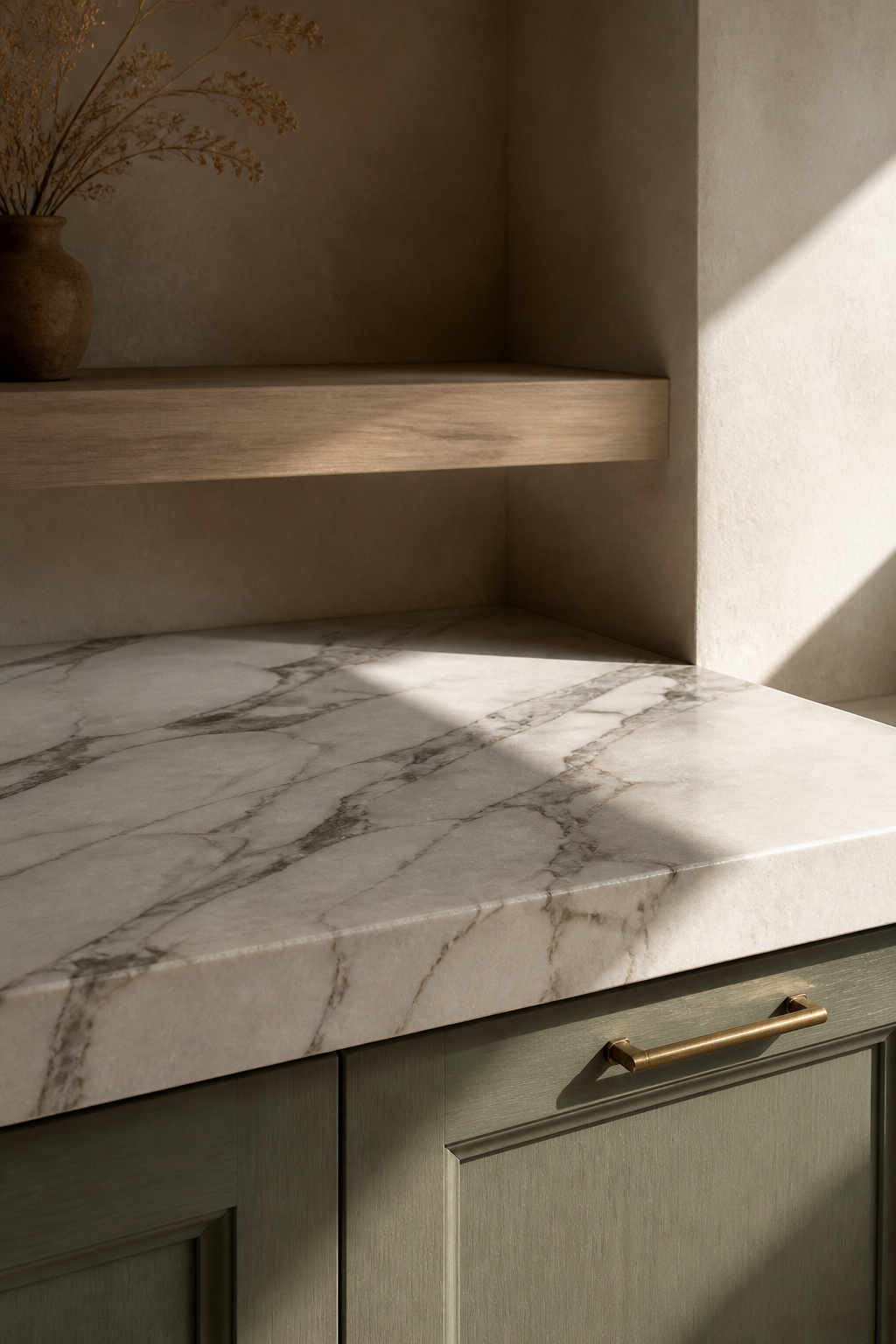
The engineered quartz countertop has had a long run as the default premium choice. But natural stone is making a definitive comeback in 2026. The reason isn’t hard to identify. Stone does something engineered products fundamentally cannot. It varies. Every slab is unique in veining, movement, and surface character. In a design culture actively moving away from mass-produced uniformity, that individuality has become an explicit selling point.
Marble, Quartzite, and Limestone: Choosing the Right Stone
Quartzite scores 7 on the Mohs hardness scale — harder than marble at 3-4. It resists etching better in a working kitchen. Super White quartzite is the most-specified variety this year. Installed costs run $80-220 per square foot. A typical kitchen totals $1,500-6,000 depending on slab dimensions and stone source.
Marble requires sealing every one to two years with a penetrating sealer like Miracle Sealants or Aqua Mix. It will etch with acid contact — lemon juice, wine, tomato. Many designers now specify honed rather than polished marble for this reason. Light etch marks are far less visible on a matte surface. For a full view of how natural stone performs alongside different cabinet choices, the guide to kitchen countertops with white cabinets covers the material combinations worth knowing.
Limestone costs $70-150 per square foot installed. It’s softer than both marble and quartzite. However, it carries beautiful warmth in low-traffic applications — as a splashback, a feature ledge, or a secondary prep zone.
7. Statement Range Hoods as Sculptural Kitchen Focal Points
The range hood has completed its transformation from functional unit to the kitchen’s primary architectural statement. Multiple design publications describe Venetian plaster range hoods as “the definitive, trendiest statement in high-end design” for 2026. It’s no longer one element among many — it’s the element around which the kitchen’s visual language is most frequently built.
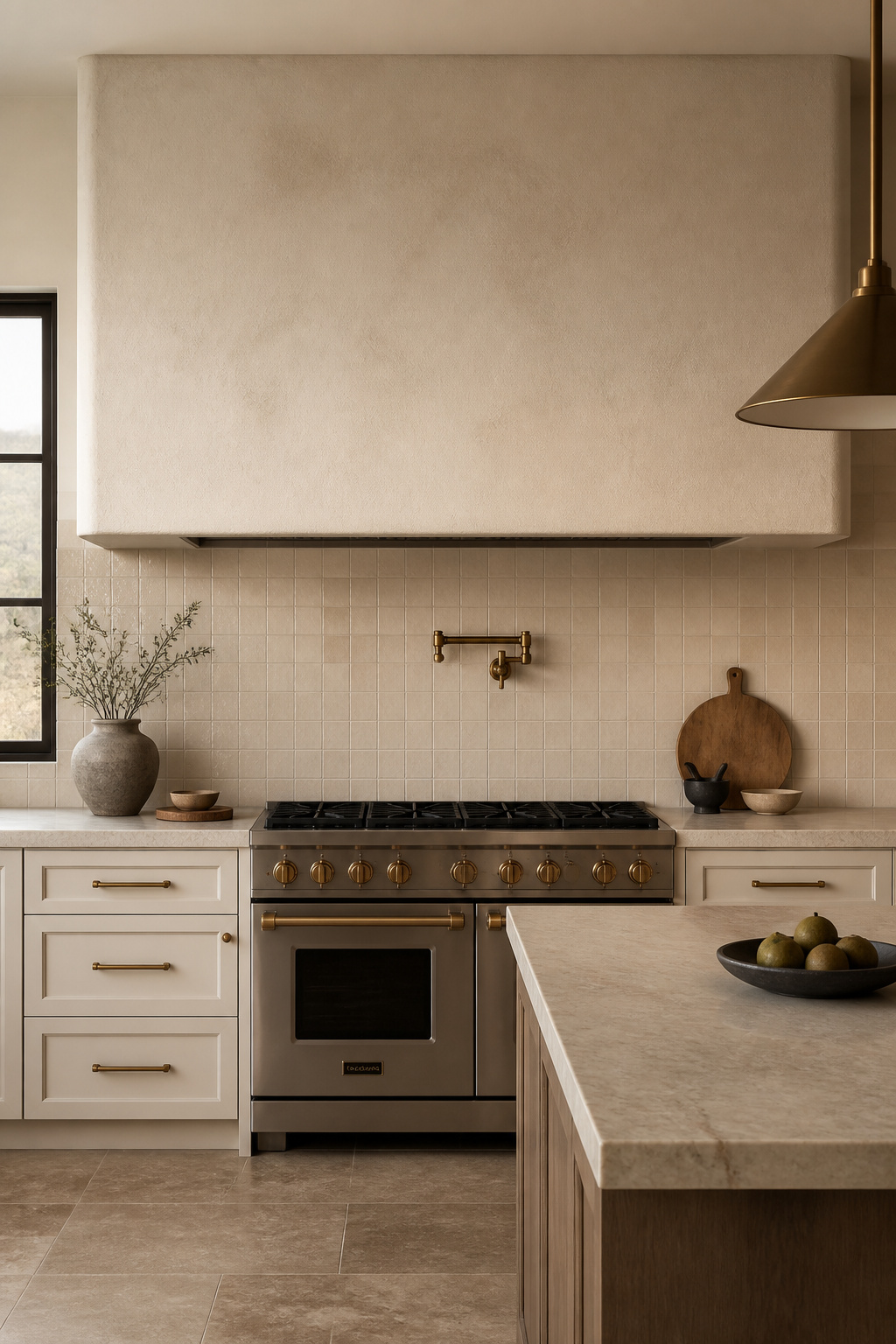
Venetian plaster is the most requested finish. It’s soft, monolithic, and has a textural warmth that relates naturally to limewashed walls and stone countertops. A standard hood with a smooth Venetian finish starts at approximately $2,800. Custom work with textural variation adds considerably to that figure.
Copper is the warm, characterful alternative. Amoretti Brothers and RangeCraft are established makers for custom copper commissions. The copper develops natural verdigris over years of use. Blackened steel suits urban and Japandi-adjacent kitchens with a cool, contemporary austerity.
The sizing rule is clear: the hood face should exceed the cooking surface width by at least three inches per side. A 36-inch range needs a minimum 42-inch hood face. Extraction capacity must be calculated before aesthetics — 100 CFM per 10,000 BTU of cooking surface. A beautiful plaster hood with inadequate CFM will leave cooking odours in the kitchen regardless of how good it looks. Ventilation specification should always drive hood sizing first.
8. Japandi-Inspired Minimalism in Contemporary Kitchen Design
Japandi — the synthesis of Japanese wabi-sabi and Scandinavian hygge — continues as one of the most coherent kitchen aesthetics in 2026. Its staying power comes from a quality that trend-driven styles rarely maintain: it has a philosophy, not just a look. The philosophy is restraint as a form of warmth. Removing visual noise to let individual material quality come forward.
In kitchen terms, this translates to specific choices. Light oak is the foundation wood. Its subtle golden hue reflects daylight. Its grey undertones stay neutral. Its tight grain reads as both natural and refined. The oak sits on handleless push-to-open cabinets, where touch-latch mechanisms allow a continuous, uninterrupted cabinet face.
The mistake designers consistently make with Japandi kitchens is over-minimising to the point of coldness. Authentic Japandi warmth comes from material quality, not decorative absence. One ceramic vessel, a wooden chopping board, a few dried herbs — these are the controlled moments of life that separate a considered kitchen from a sterile showroom. Lighting is also critical. Warm colour temperature at 2700K and pendants with organic forms — ceramic or hand-blown glass — provide the warmth the minimal palette needs.
9. Terrazzo Surfaces: A Kitchen Design Trend With Real Staying Power
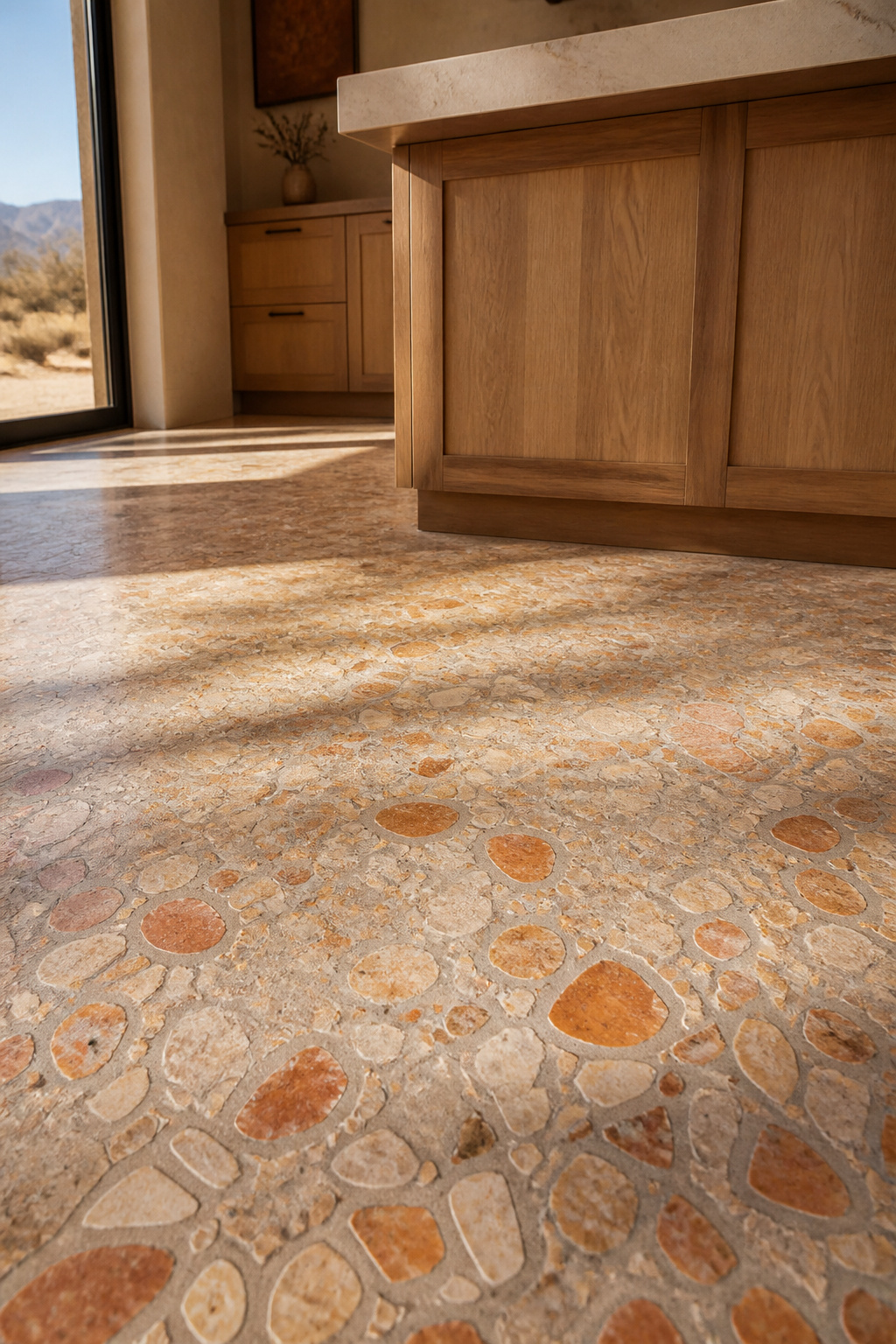
The terrazzo revival is in its second and more sophisticated wave. The 2026 version looks almost nothing like its predecessor. Fine-chip, cool-grey terrazzo is giving way to larger aggregates, higher contrast, and a warmer palette. Creamy white matrix with terracotta and rust chips. Dusty limestone tones with coral and ochre aggregate. These are materials built for the earth-tone kitchen, not the wellness spa.
Cost, Chip Size, and Placement for Terrazzo in the Kitchen
This kitchen design trend has genuine staying power because terrazzo is not fragile. Precast terrazzo tiles run $8-25 per square foot in material cost, with total installed costs of $15-35 per square foot. Countertop slabs run $40-75 per square foot, with typical kitchen totals of $2,000-7,500.
A terrazzo splashback is the most accessible entry point. A single 60 × 90cm section makes a strong statement with minimal material outlay. For a wider view of how pattern and surface texture interact in kitchens, the range of kitchen tile ideas for a modern sanctuary is worth exploring alongside terrazzo.
Chip size is the designer’s primary decision. Small chips (3-6mm) create a fine, peppered effect. Large chips up to 1.5 inches create bold character at a 15-25% price premium. The general rule: use terrazzo in one plane only. Terrazzo floors with terrazzo countertops create pattern-on-pattern exhaustion. Let one surface carry the pattern and keep the other plain.
10. Dark and Moody Kitchens With Deep-Toned Cabinet Colours
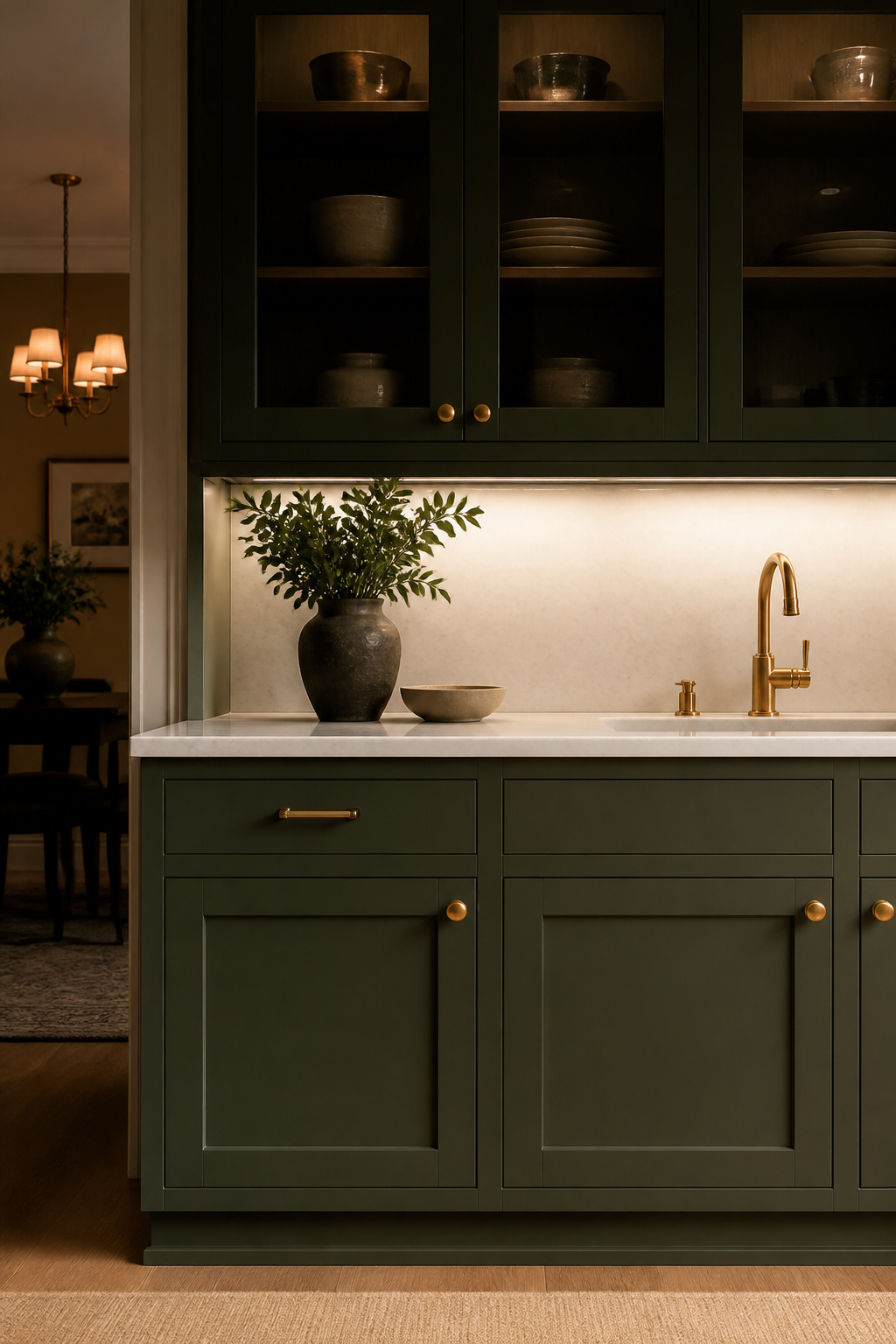
Sherwin-Williams Evergreen Fog (SW 9130) is the most-specified kitchen cabinet colour in 2026, per designer surveys and paint brand sell-through data. It has overtaken both navy and warm white in frequency. That data point tells a clear story: the dark kitchen is maturing. It’s moving away from showpiece drama toward a quieter confidence.
Compensating for Reduced Light in Dark Kitchens
Dark colours absorb light. The compensation strategy is well established. Use a reflective countertop — polished marble, white quartz, or stainless steel. Add glass-fronted upper cabinets that let interior depth contribute. Plan under-cabinet LED task lighting at the brief stage, not as an afterthought. Specify brass or copper hardware to create light reflection where the painted surfaces absorb it.
For darker accents without full commitment, a dark island against a light perimeter is the lowest-risk configuration in kitchens with limited natural light.
North-facing kitchens need warm dark tones — deep green and warm navy — not cool ones. Blue-black and cool charcoal will feel oppressive without natural light support. Always test dark colours with large swatches. Dark shades shift dramatically between daylight and artificial evening light. What looks right at noon can look wrong by 7 PM.
11. Warm Wood Tones Balancing Painted or Lacquered Cabinetry
White oak is the wood of 2026. NKBA’s Kitchen Trends Report shows 51% of design professionals specify it. The species has grey undertones rather than red or orange ones. Its grain is tight and consistent. It works across modern and transitional styles without anchoring either.
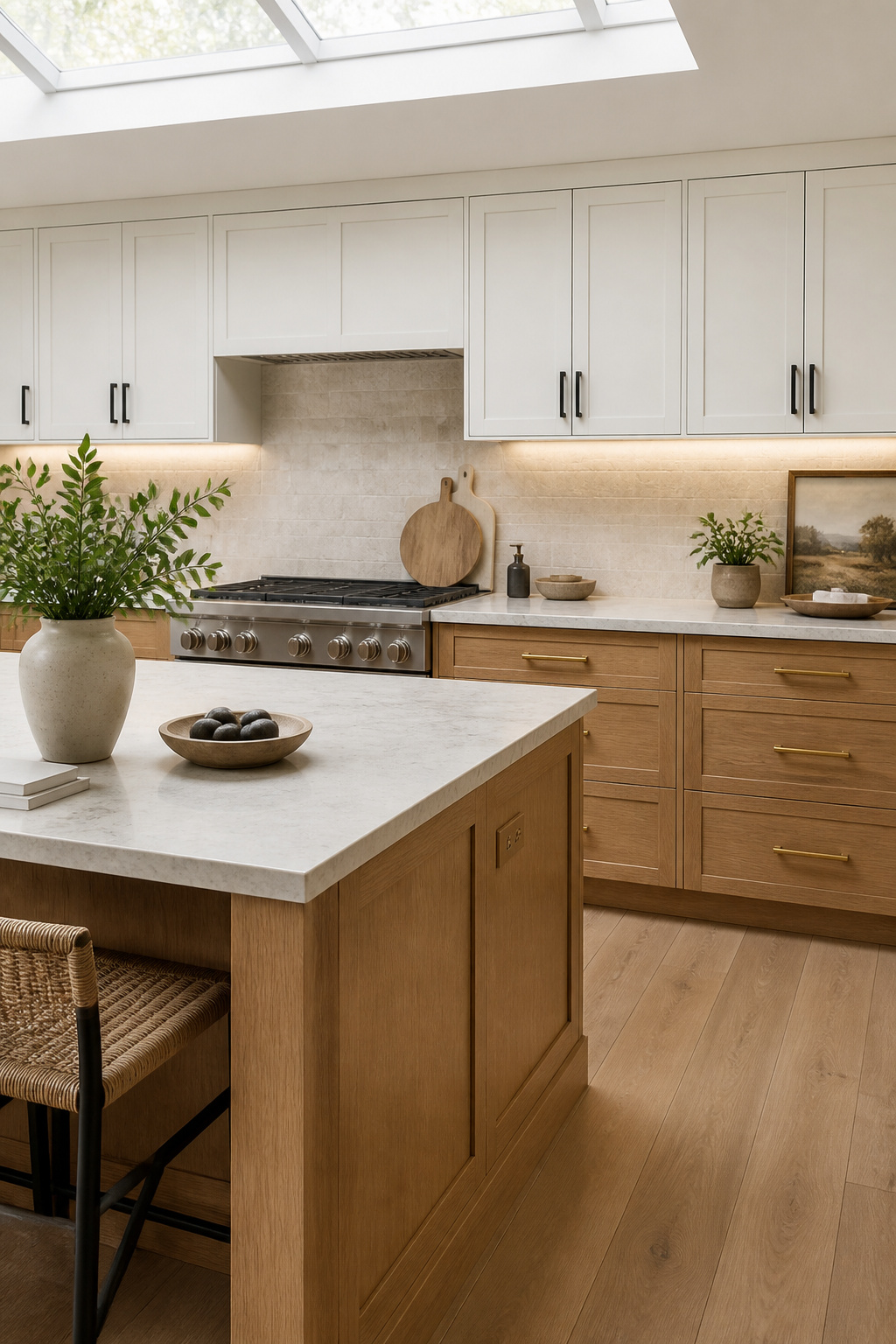
The two-tone kitchen is the plurality choice. Houzz data shows white leads upper cabinet specification at 40% and wood leads lower cabinet specification at 37%. The logic is clear: upper cabinets benefit from brightness and visual lightness. Lower cabinets benefit from the warmth and weight of wood. A wood island with painted perimeter cabinets reads as furniture within the room — something intentionally placed rather than built in.
Walnut and ash offer different characters. Walnut’s rich chocolate-brown works best with off-white rather than bright white uppers. Ash has excellent stain absorption and suits designers wanting a specific tone rather than natural wood colour. For finish, hardwax oil — Rubio Monocoat and Osmo Polyx — shows the wood’s character more fully than lacquer. Matte or satin is the 2026 specification regardless of species. Gloss finishes date a kitchen quickly.
12. Mixed Storage: Open Shelving Balanced With Closed Cabinetry
Full walls of upper cabinets are being replaced — not with pure open shelving, but with layered systems. Floating shelves combined with closed cabinets below. Glass-fronted upper sections alongside opaque ones. Recessed cubbies that create depth without sacrificing concealed storage. The hybrid delivers the lightness of open shelving without the curatorial overhead that pure open shelving demands.
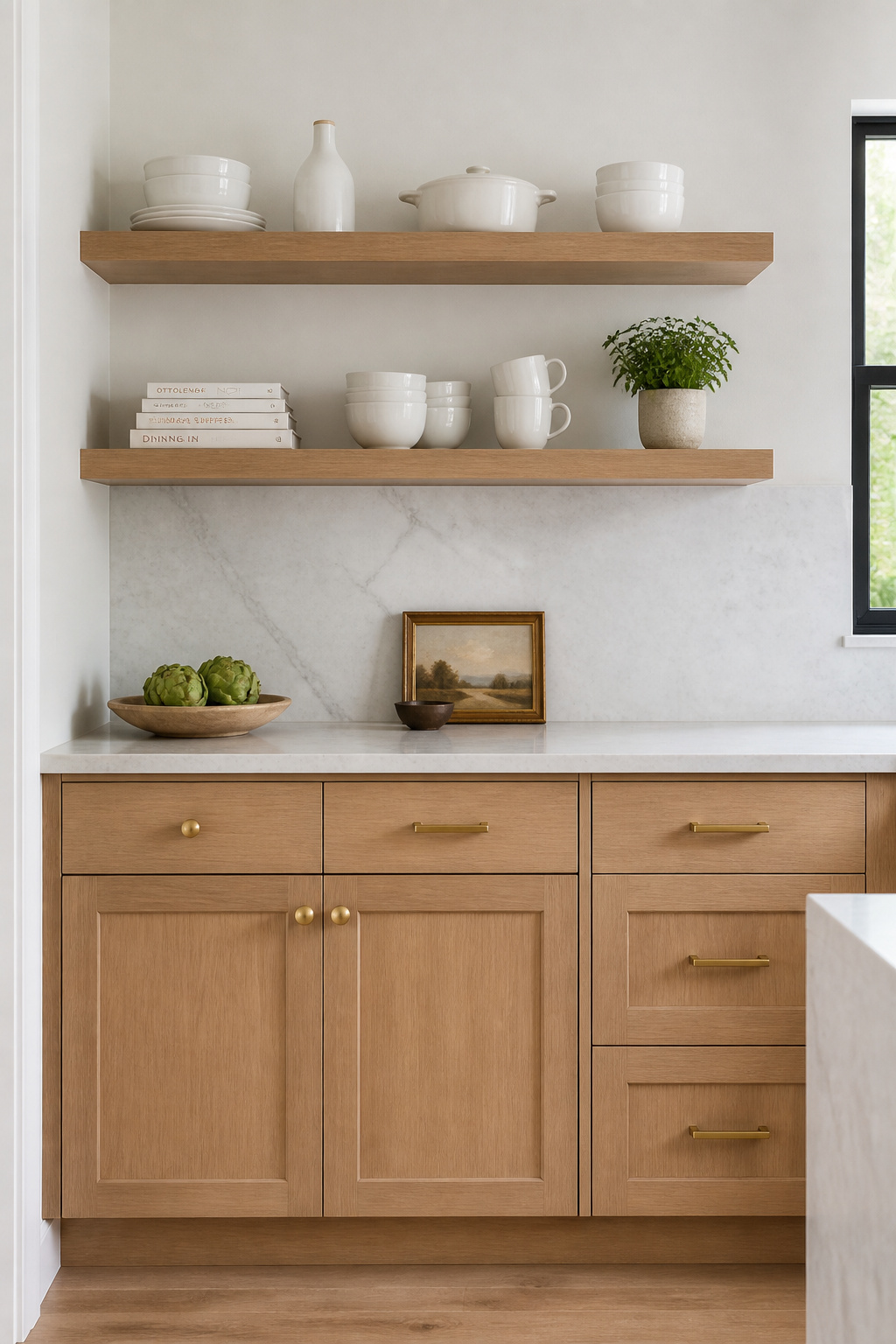
White oak shelves at 20-30mm thickness are the most specified material. They connect the shelf surfaces to wood lower cabinets and create visual consistency. The structural requirement is non-negotiable: floating shelves must be fixed to studs with concealed hardware rated for the intended load. 30kg per shelf requires direct stud fixing. Decorative brackets in blackened steel or unlacquered brass can serve as design features in their own right.
The curatorial discipline matters more than the shelving material. For practical guidance on making any storage system actually function, kitchen storage hacks for a clutter-free space covers the organisational layer in detail. Open shelves work for items that earn their visual place: matched ceramics, frequently used glassware, cookbooks. Items that should always stay behind a door: cleaning products, bulk pantry items, mismatched containers. If the shelf becomes a dumping zone with good lighting, the kitchen reads cluttered regardless of how good everything else is.
13. Layered Kitchen Lighting — One of the Most Transformative Kitchen Design Trends
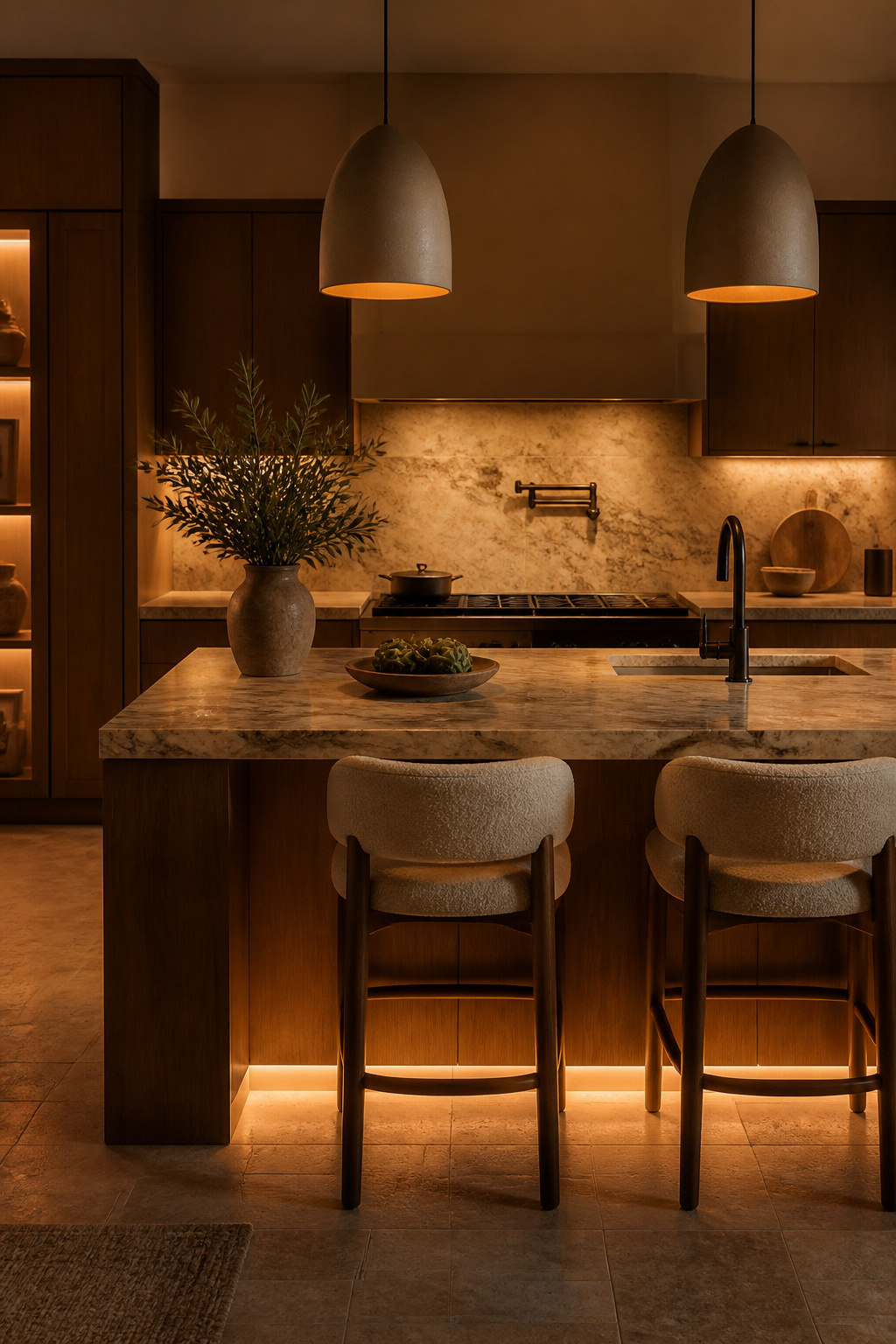
Three-layer kitchen lighting is the 2026 standard: ambient, task, and accent, on separate dimmer circuits, all running at 2700-3000K. The combination effect is greater than any single element. A kitchen lit only by recessed downlights looks flat and functional regardless of the materials. A kitchen with all three layers has a quality that is almost impossible to achieve any other way.
The Three Layers and How to Specify Them
The task layer is the most practically important. Under-cabinet LED strips illuminate the countertop directly, without the shadow a cook casts between overhead light and work surface. Specify high-CRI (90+) LED tape for accurate food colour rendering. Ledvance, Kichler, and Philips Hue all offer reliable under-cabinet solutions at different price points.
The accent layer separates a well-lit kitchen from an exceptional one. Toe-kick lighting along the island base creates the illusion that the cabinets are floating above the floor. In dark kitchens, this effect is particularly strong. For modern kitchen lighting ideas that go beyond the basics, exploring the full range of fixture types for each layer is worth doing before specifying anything.
Island pendant sizing: 30-36 inches above the countertop surface. 36 inches for prep-heavy islands, 30-32 for social or dining use. One large pendant or two generously sized ones creates visual weight. Multiple small pendants usually reads as busy. The 2026 styles worth noting: hand-blown glass in organic shapes, aged brass with opal diffusers, ceramic pendants with matte finishes.
All three layers should run on separate dimmer circuits. Lutron Caséta allows scene programming — a bright cooking setting, a social dimmed setting, an evening mood. The dimming is what makes all three layers feel cohesive rather than overlit.
14. Limewash and Plaster Wall Finishes Bringing Textural Warmth
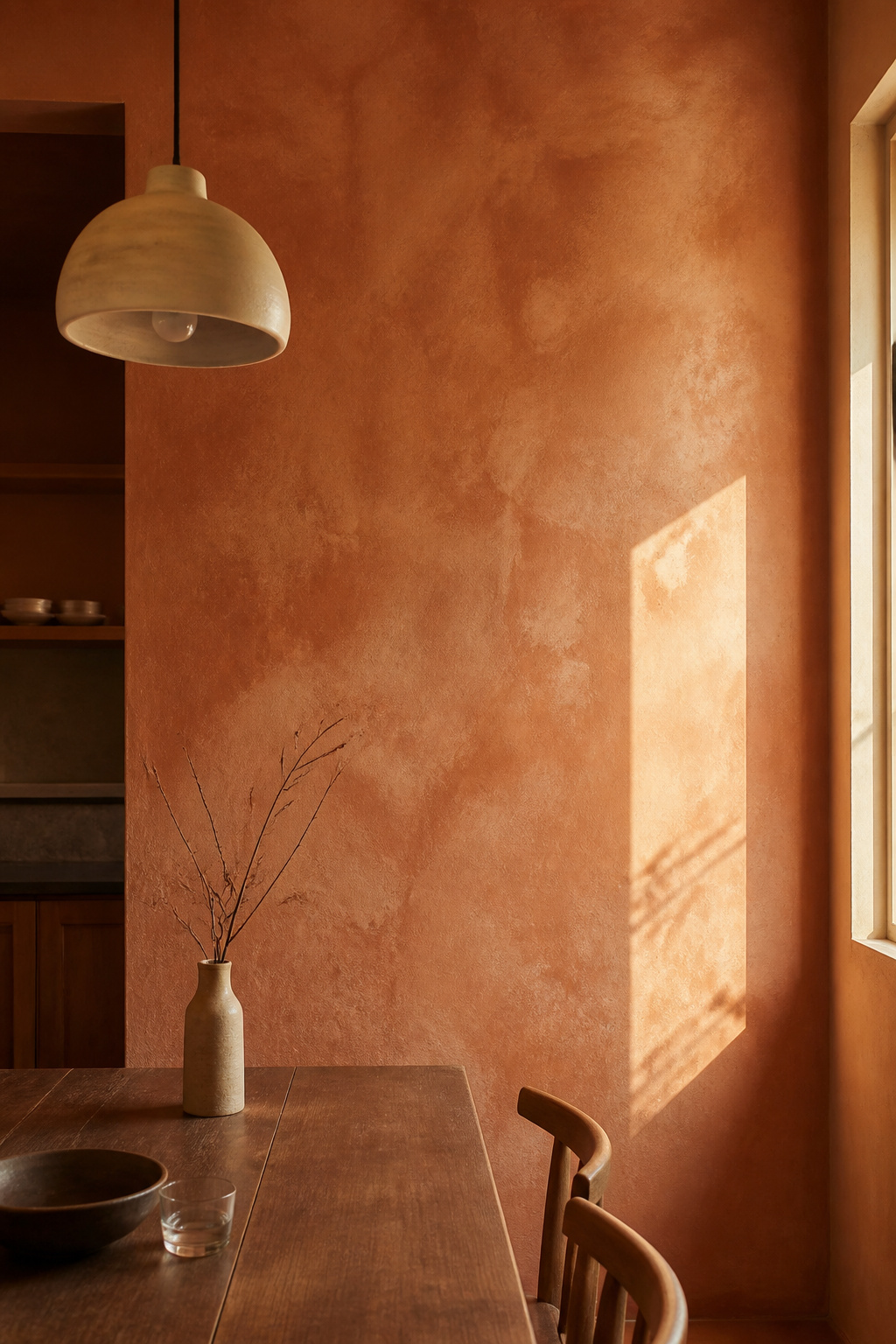
Limewash has built momentum for two or three years. In 2026, it’s arrived as a mainstream specification for feature walls and kitchen-adjacent spaces. The appeal is fundamental. Standard emulsion sits on the wall surface as a uniform film. Limewash — a mineral-based wash of slaked lime — penetrates the surface rather than coating it. The result is depth, translucency, and a quality that responds to light throughout the day.
Which Plaster Finish Suits a Kitchen Environment
Portola Paints’ Lime Wash line is the most widely available US product. Bauwerk Colour offers authentic Australian-made options. Keim Mineral Paints, founded in Germany in 1878, is the premium choice for true mineral-based formulations. Portola also makes Roman Clay — a gypsum-plaster hybrid troweled onto the wall — delivering stone-like depth with greater moisture tolerance.
Venetian plaster is the formal, high-gloss variant. Applied in multiple thin layers and polished through burnishing, it reaches near-reflective surfaces. It suits a more formal or luxurious kitchen aesthetic. Microcement is the most kitchen-practical option. Seamless, moisture-resistant, it can be applied over existing tiles. Professional microcement installation runs $6-12 per square foot for materials plus $8-15 for application.
The placement caveat is worth stating clearly. Limewash is breathable but not waterproof. Splashback areas behind hobs and sinks are not appropriate. Use tile, stone, or glass for those zones. Limewash on the walls adjacent to the cooking area — a feature wall, the wall opposite the range — is where the finish earns its full effect. The 2026 colour direction is shifting toward warm pinks and Roman clay tones. They sit naturally alongside terracotta cabinets and earth-tone palettes.
15. Sustainable and Reclaimed Materials as Emerging Kitchen Design Trends
Sustainability has moved out of the specialist brief and into the mainstream kitchen conversation. The 2026 version of this kitchen design trend looks different from earlier iterations. It’s no longer framed as compromise or obligation. The most interesting sustainable materials — recycled glass countertops, FSC-certified solid wood, reclaimed timber — are frequently the most characterful options available.
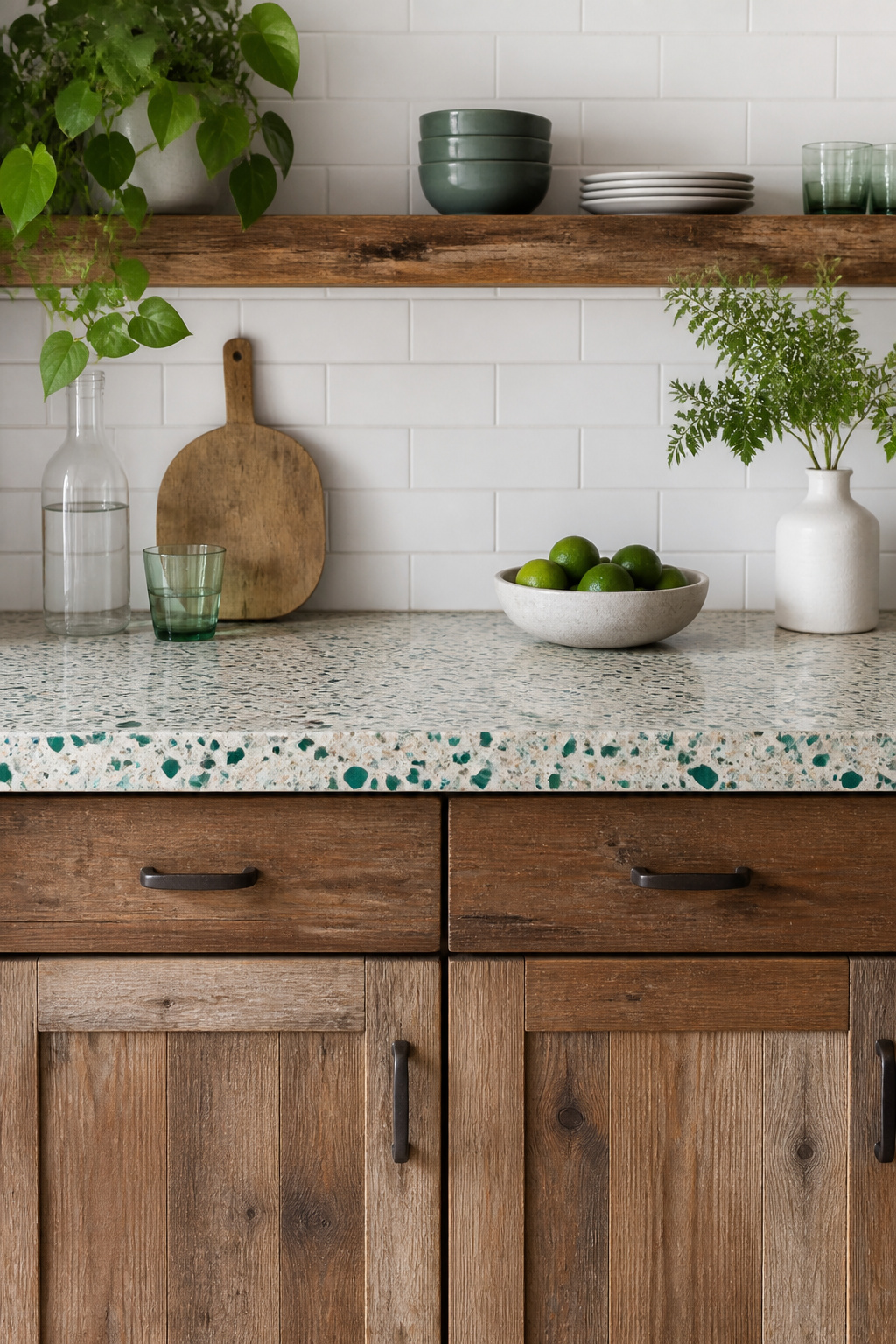
Vetrazzo makes the clearest case. Their countertops are 85% recycled glass — sourced from curbside recycling, broken traffic lights, stained glass, and laboratory glassware — set in cement binder. The material carries Cradle to Cradle Silver certification across all five categories. 16 colours are available. And the cost is notably accessible: recycled glass countertops run 50-75% less than comparable granite or quartz.
FSC-certified cabinetry matters because standard MDF and particle board use formaldehyde-based adhesives that off-gas for years post-installation. Greenguard Gold certified products have verified low VOC emissions. For anyone designing a complete approach to sustainable cabinetry, the FSC and Greenguard certification framework is the most practical starting point.
Reclaimed wood cabinetry carries its own irreplaceable character. Visible knots, nail holes, historical patina, and dimensional variation that custom joinery can accommodate but mass production cannot replicate. The honest framing of sustainable choices in 2026: ‘natural’ doesn’t automatically mean sustainable. Natural stone requires extensive quarrying and long-distance shipping. Genuine sustainability requires evaluating the full supply chain, not just the material category.
16. Bouclé and Textured Upholstery Arriving at the Kitchen Island
Bar stools were a functional afterthought in kitchen specification for most of the past decade. That’s changed. The upholstered island stool — in bouclé, performance linen, or textured weave — is now chosen with the same care as a living room sofa. The shift reflects something real about how kitchens are used. People linger at the island for coffee, work, and conversation for hours. Seating that rewards sitting has become worth investing in.
Fabric Choices for High-Traffic Kitchen Seating
Bouclé is the lead material. Its looped yarn structure creates a pebbled, tactile surface that photographs well and provides genuine warmth against the hard surfaces of a kitchen. A pair of creamy bouclé stools at a white oak island is one of the most reliably consistent combinations in 2026 kitchen design.
The practical qualification is real. Bouclé’s looped structure is difficult to deep-clean. For family kitchens with young children, a performance fabric that mimics bouclé visually — Revolution Fabrics’ family-friendly weaves, or Sunbrella’s outdoor-grade textile — delivers the look with genuine durability. The stool specification interacts significantly with island height, overhang depth, and intended use. Plan all three together rather than adding stools after the island is already built.
Quality upholstered counter stools start at $200-400 per stool for mid-market options. Designer or custom-fabric pieces run $600-2,000. Swivel stools on a central column are worth specifying wherever the island serves multiple purposes — cooking, eating, working, socialising. The ability to swivel without repositioning the whole stool matters more than it sounds in daily use. The 2026 colour direction: creamy off-white, warm taupe, and sage. All three coordinate naturally with earth-tone cabinet palettes.
Which Kitchen Design Trends Are Worth Your Investment?
The answer depends on where you are in the renovation cycle. For a full remodel, the permanent decisions matter most: countertop material, cabinetry construction quality, lighting circuits for all three layers, and structural support for a statement range hood. These set the quality ceiling for everything else. Get the stone, the wood species, and the electrical infrastructure right. After that, hardware, paint, and stools are comparatively simple to evolve.
For a refresh rather than a renovation, the calculus shifts. Replacing hardware with unlacquered brass, repainting cabinets in a quality earth tone, adding under-cabinet LED task lighting, and swapping tired stools for upholstered ones can transform a kitchen’s character for $3,000-5,000. That combination addresses warmth, material authenticity, functionality, and comfort — without a single structural change.
The most useful question for any of these kitchen design trends is longevity: are you choosing this because it’s genuinely right for how you cook and live, or because it photographed well in someone else’s renovation? The kitchens that age best rarely chased every trend at once. They chose a material language — warm woods and natural stone, or Japandi restraint and handcrafted detail — and committed to it with depth and intention. Start there. Most of the individual decisions follow naturally from that foundation.