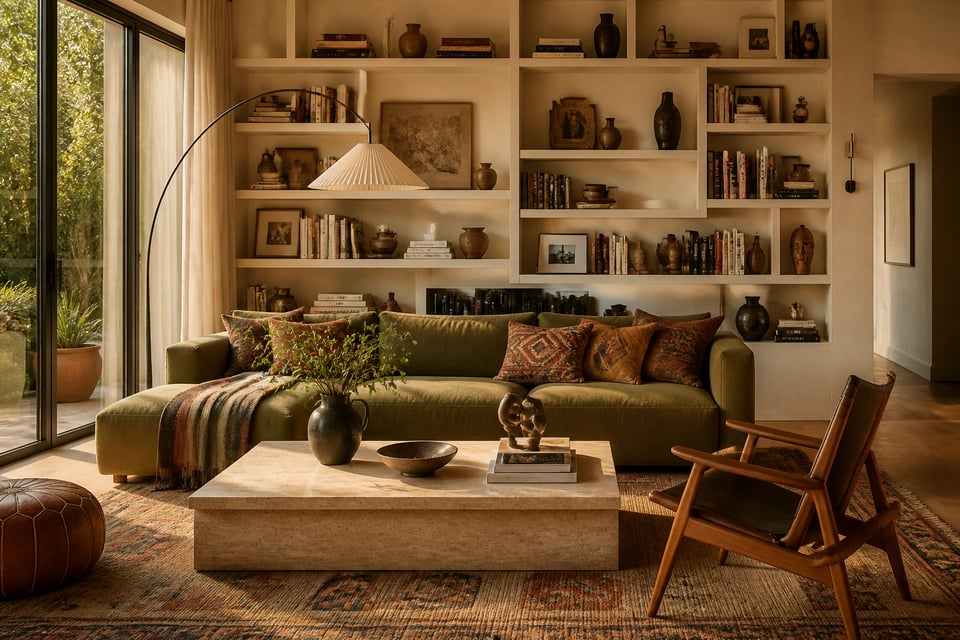
Most living rooms are assembled rather than designed, and the difference is visible from the doorway. The assembled room has the right elements; the designed room has the right relationships between them. Getting there is less about budget and more about understanding what each piece of living room furniture design actually needs to do — both functionally and visually — in a room built to last.
I’ve spent years advising on furniture that bridges contemporary sensibility with artisanal craft. The rooms I return to most often share a quality that is difficult to articulate but immediately felt: they seem finished in every corner yet still capable of evolving. The pieces earn their place. Nothing is temporary, nothing is provisional, and nothing looks like it arrived because it was on offer.
What follows is not a trend roundup. These 16 ideas represent the living room furniture design decisions that remain sound across decades — the sofa you’ll still love in fifteen years, the coffee table that anchors whatever room you carry it into, the window treatments that make the whole arrangement feel considered. Start with the foundational piece and work outward. The room that lasts is the one built around intention.
1. The Artisan Sofa: Living Room Furniture Design Starts Here
Before the colour palette, before the rug, before anything else: the sofa. It’s the room’s longest commitment, the piece that touches daily life at its most domestic level, and the one that most immediately communicates whether a room was designed or assembled. The difference between a sofa that outlasts a decade and one that sags within three years is determined inside the frame and beneath the cushions — the elements hidden by every fabric swatch.
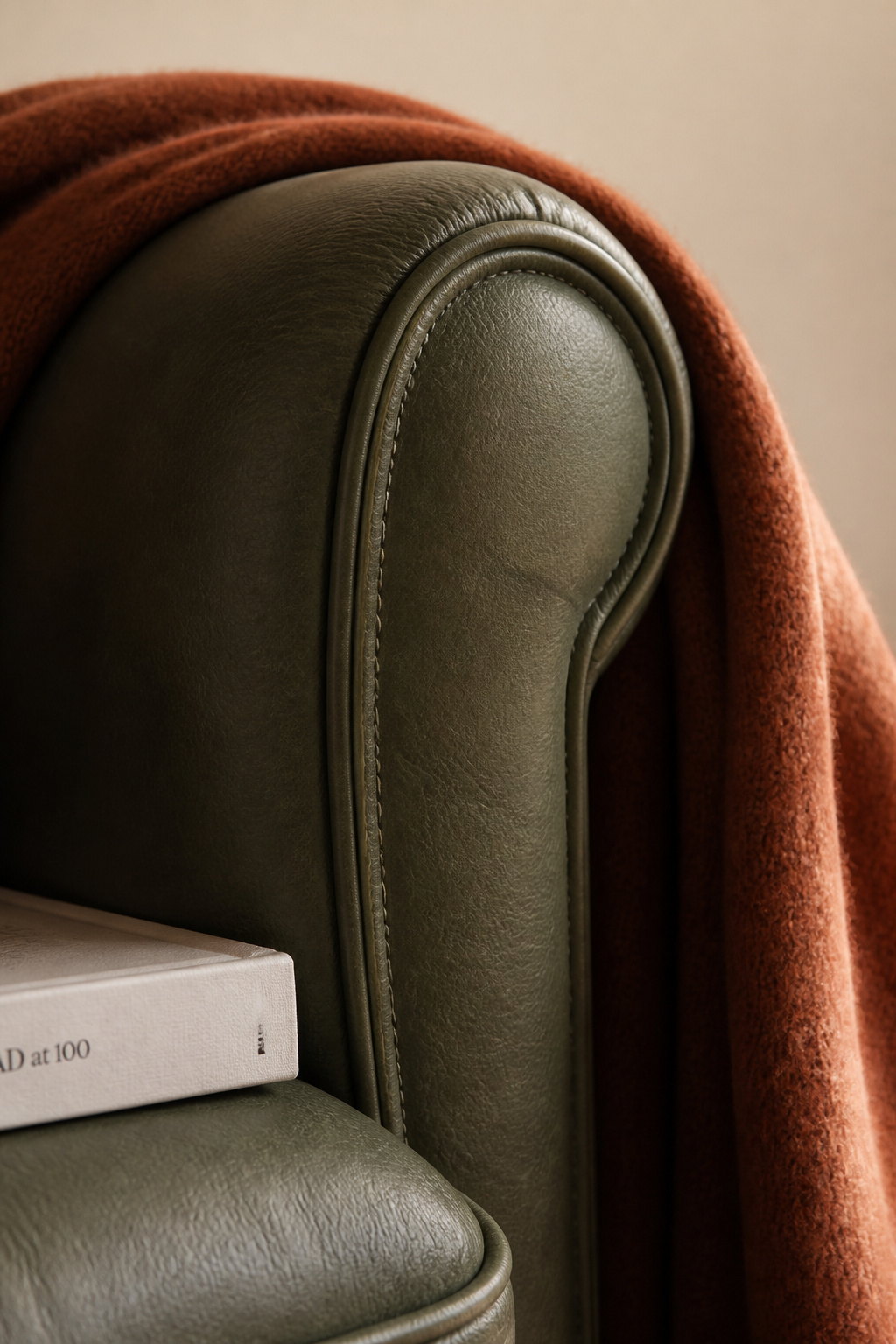
Start with the suspension. 8-way hand-tied springs create an independent coil system where each spring moves on its own, distributing pressure evenly across the seat and maintaining its profile for decades. In contrast, sinuous wire springs — acceptable in 8-gauge with cross-tie wires — are significantly less forgiving over time. Also essential: kiln-dried solid hardwood for the frame (maple, oak, or beech) resists the warping that engineered wood develops at its corner joints within a few years of regular use. High-resilience foam above 2.2 lb/ft³, ideally wrapped in down or feather, provides the cushion’s character and shape-retention.
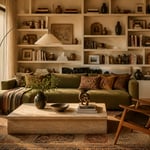
Silhouette matters next. Tuxedo sofas, where arm height equals back height, read as architectural and contemporary. Lawson sofas, with their low rolled arms and deep cushions, absorb throws and layered textiles without visual noise — they are the most versatile canvas. Camelback designs carry a formal heritage that creates productive tension beside modern accent pieces.
For fabric, Martindale ≥40,000 cycles or Wyzenbeek ≥50,000 double rubs is the threshold for a regularly used living room. Top-grain semi-aniline leather (1.0–1.2mm thickness) develops patina rather than wear. In South Asian design tradition, the sofa’s upholstery is the room’s primary statement, not an afterthought. Choosing living room furniture with these benchmarks in mind removes the guesswork from the room’s most important investment.
2. Curved Sectional to Define and Embrace the Seating Zone
There is a spatial argument for the curved sectional that goes beyond aesthetics: it defines an open-plan room. A standard L-shaped sofa typically settles against walls. A curved sectional works best positioned away from them, and this distinction is the point. Its arc creates visual enclosure without walls or partitions. The room signals “living space” through furniture geometry alone, which is something no paint colour or rug can replicate.
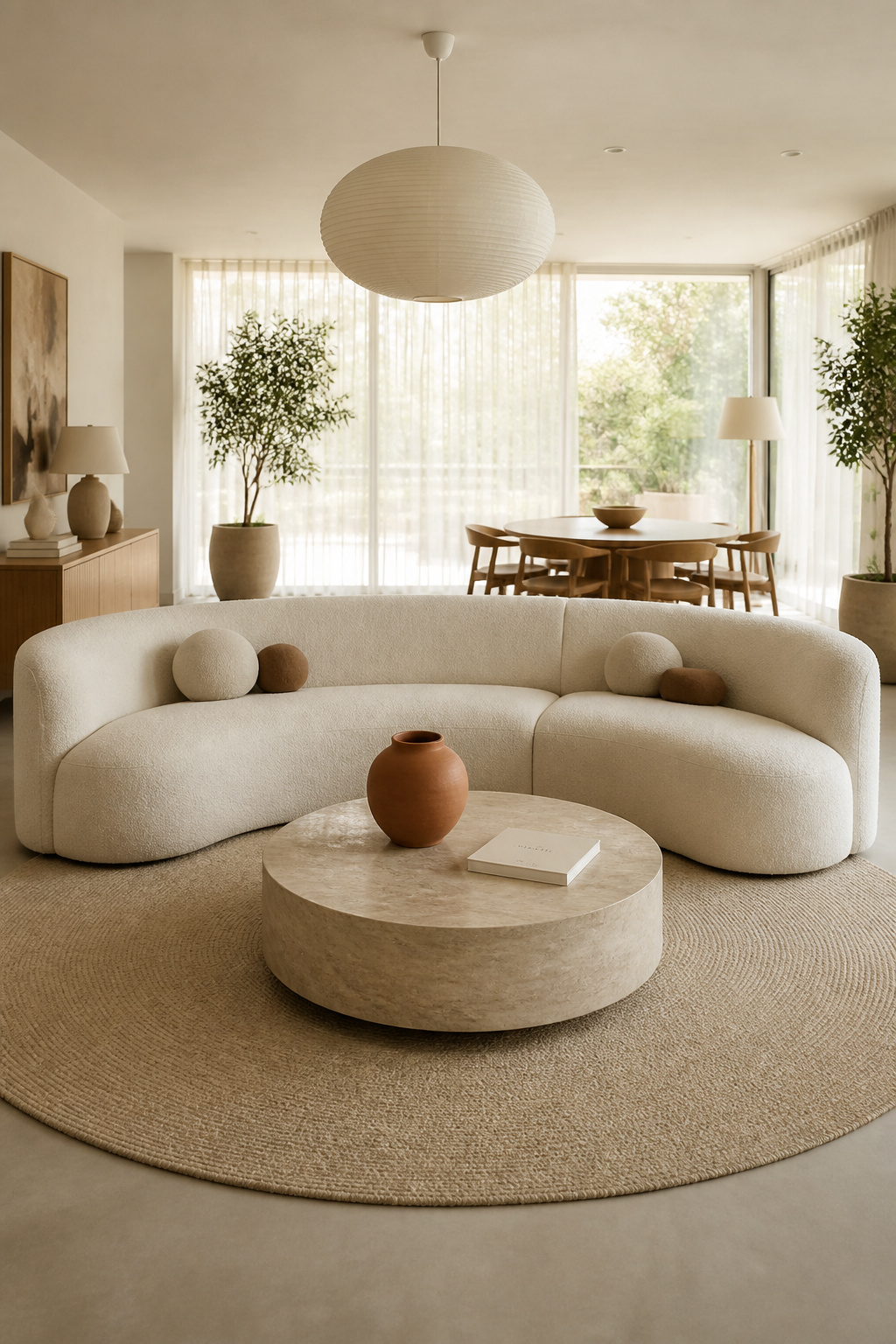
Typical curved sectionals run 95–120 inches wide and 36–40 inches deep, which is substantially larger than most people anticipate from photography. Measure before falling in love with a piece: you need a minimum 30–36 inches of clear circulation space around the sectional on all accessible sides. Anchor it with a round coffee table — the rectangle-against-curve relationship is visually awkward — and a rug at least 18–24 inches wider than the sectional’s footprint on all sides.
Fabric selection matters more on curved frames than on straight sofas. Tightly woven structures, such as performance velvet, close-weave boucle, and wool blends, hold their line across the curve. Loosely woven or chunky boucle can pull at the seam points over time, creating a slight distortion that distinguishes a well-maintained curved piece from one that’s given up. So, avoid large-scale pattern repeats: the curve makes pattern matching across the seating run difficult, and the mismatch is visible from across the room. Solid colours or tonal weaves let the silhouette do the work.
3. Coffee Tables That Tell a Story in Stone, Resin, and Reclaimed Wood
The coffee table is the living room’s centrepiece in both placement and function — and it is the piece most likely to be chosen last, quickly, for its colour rather than its material quality. The rooms that look genuinely considered treat the coffee table as a sculptural element that anchors the entire seating zone. The material tells a story. The proportions earn the position.
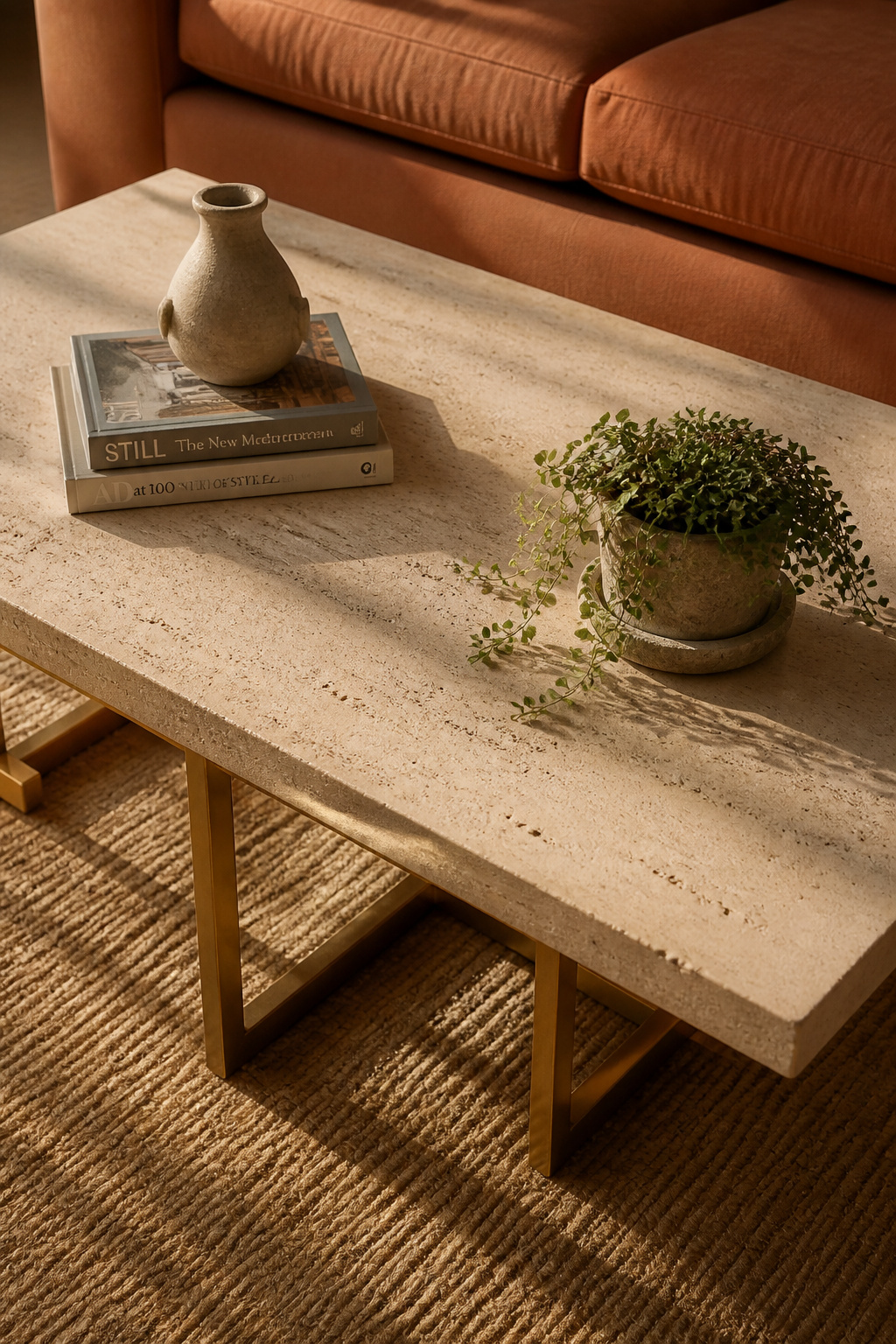
Travertine deserves particular attention here. It is more forgiving than polished marble, its surface developing patina that reads as character rather than wear, and its natural voids are typically filled for coffee table use. A 2-inch slab on a solid base creates a visual mass that grounds the room and reduces the need for other heavy elements. For coffee table design ideas that balance material interest with practical sizing, the proportions are as important as the choice of stone.
The proportions are specific. Two-thirds of the sofa length gives the width — a 90-inch sofa pairs with a 60-inch table. Standard height is 16–18 inches for sofas with 17–20 inch seat heights. Leave 12–18 inches between table edge and sofa: 12 inches is the comfortable minimum for resting feet; 18 inches allows a full stretch. For the surface styling, three elements maximum: one sculptural object, one stack of art books, one organic piece. Negative space on stone is part of the material’s point — leave 40% of the surface bare and let the travertine work.
4. Living Room Furniture Ideas: Layering Textiles With Global Influence
Textiles transform furniture faster and more affordably than any other living room intervention, and the most interesting combinations draw from traditions where pattern-making is an art form in its own right. Kilim, ikat, and block-print fabrics bring a visual depth that no mass-produced fabric can replicate. The irregularity, the slight imperfection, the evidence of hand and time — that is precisely what gives them presence.
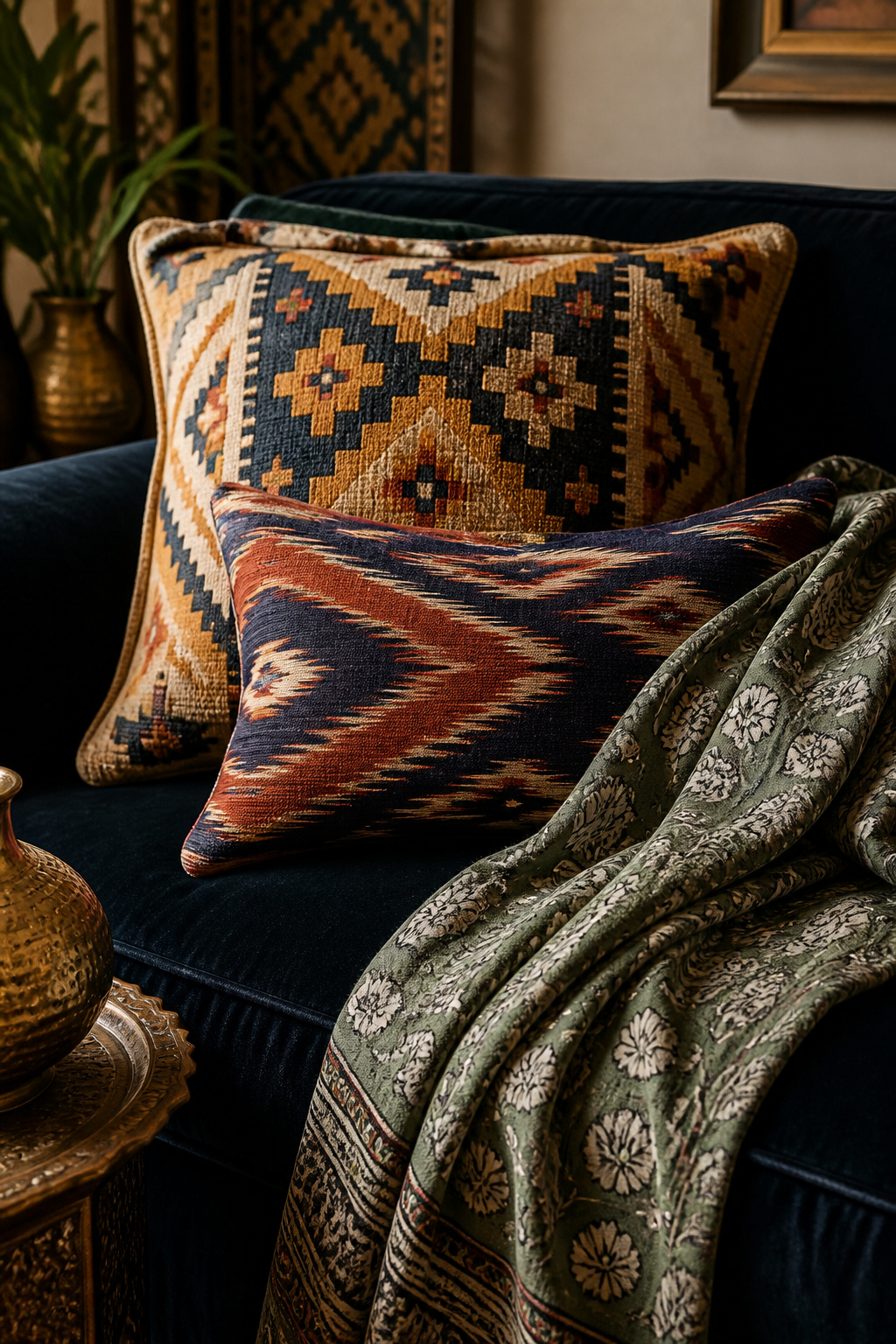
A kilim is a flat-woven textile from Central Asia or Anatolia. Its geometric patterns are structural, created by the weaving itself rather than by dye or print. That makes each piece reversible and gives it a tactile solidity that woven pile cannot match. Ikat uses resist-dyeing applied to threads before weaving, creating the characteristic blurred edge — a deliberate imprecision no machine replicates consistently. Double ikat, where both warp and weft are dyed before weaving, is the rarest form, associated particularly with the textile traditions of Gujarat and Japan. Indian block print uses hand-carved wooden blocks pressed into natural dyes on cotton. Each impression is fractionally different, and this variation is the point. These are textiles with biographies, and that biography is what the room inherits.
What makes these textiles work together rather than fight is the 60-30-10 approach: one dominant pattern (the largest-scale throw or rug at 60%), one secondary pattern (cushion fabric at 30%), one accent (a small woven object at 10%). Vary the scale dramatically. A large ikat print beside a small geometric block print creates scale tension that makes a layered arrangement feel intentional. Add one solid textile as a resting point for the eye. When in doubt, remove one piece rather than add another. The edit is always the final creative act.
5. Accent Chair as Functional Art Piece in the Corner
The accent chair is the room’s wildcard and its most revealing design statement. It introduces contrast — in material, scale, period, or colour — and in doing so tells you something about the owner that the sofa, however beautiful, cannot. This is where restraint ends and character begins.
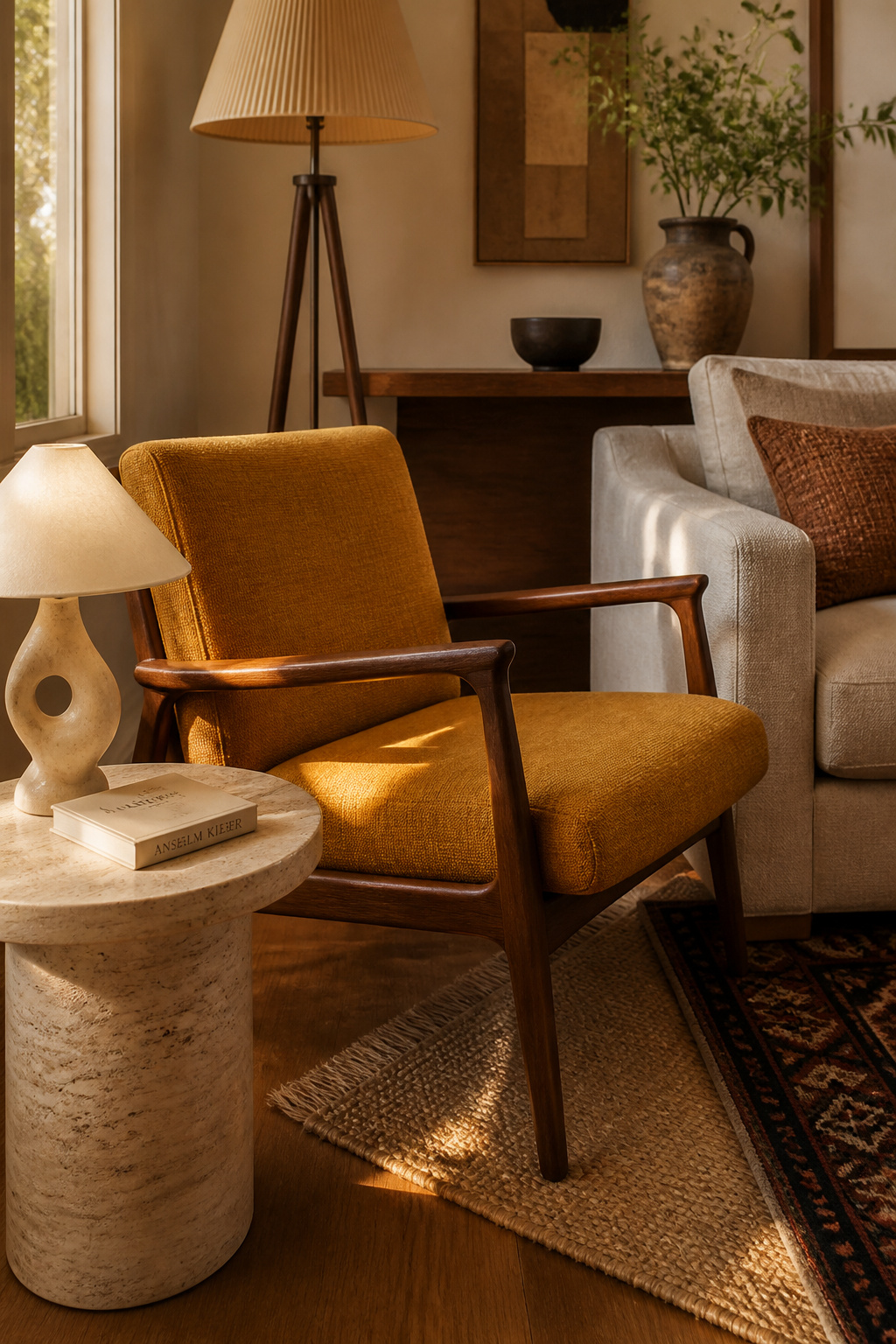
Scale comes first. A seat height of 16–18 inches should fall within two inches of the sofa’s seat height — mismatched seat heights look unconsidered when pieces are viewed together. The chair’s width should be no more than two-thirds of the sofa’s visible seat depth, so the sofa remains the primary visual anchor. Mid-century chairs with exposed walnut or oak frames earn their place specifically because the material contrast against an upholstered sofa creates visual energy — the difference between a canvas and a painting.
Choose between vintage and contemporary artisan editions on merit. Classic mid-century chairs — the Eames DSW, the Wegner Shell, the Saarinen Womb — are still produced by their original manufacturers with original tooling; these are not reproductions. Contemporary artisan editions take the clean mid-century silhouette into non-standard materials: curved fluted legs, mohair upholstery, hand-stitched welting. Both earn their price. Fast-furniture reproductions in injection-moulded plastic do not — the leg joints flex within 18 months of regular use.
For placement, position the chair at 45 degrees to the sofa corner rather than flanking it symmetrically. Let it breathe: a woven rug under its front legs, a marble side table beside it, a floor lamp positioned behind. That arrangement creates a secondary destination within the main seating zone. For more living room chair decor ideas that treat the accent chair as a genuine composition element, asymmetric placement is almost always the more interesting answer.
6. Floor Lamp as Structural Element in Living Room Furniture Design
Living rooms lit from a single overhead source look flat, in the sense that shadows flatten depth, and they feel institutional rather than residential. A floor lamp does three things: it adds a warm light source at human scale, fills a dark corner, and creates a vertical architectural line in a room of otherwise horizontal planes.
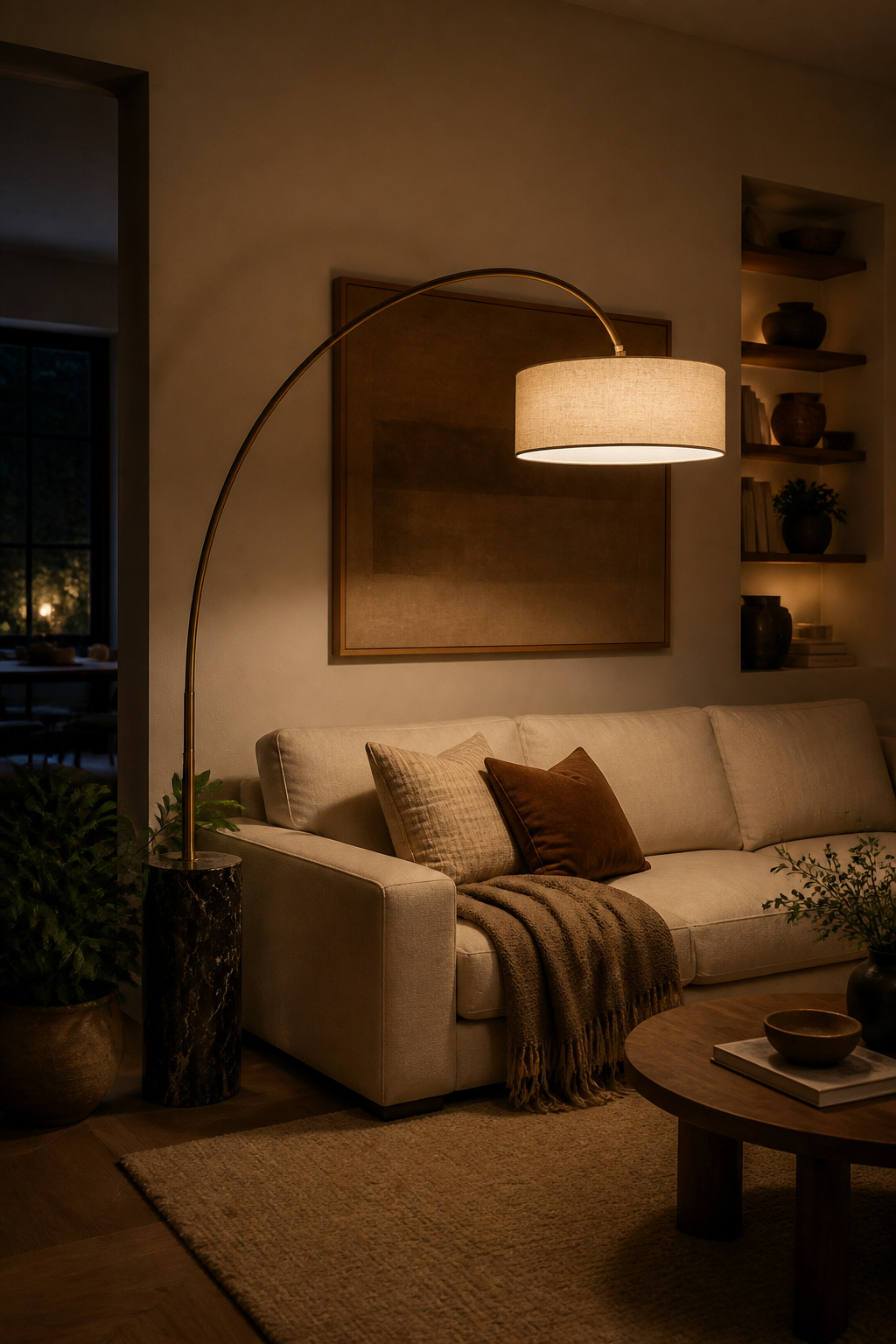
The lamp type should match the room’s character. Arc lamps, the tall curved column reaching over seating, suit sectionals specifically. They provide overhead light without the commitment of a ceiling fixture, though they require a heavy base — over 25kg or with floor anchors — because lightweight bases tip under curtain drafts. Tripod lamps echo the exposed-leg aesthetic of mid-century chairs through their three-legged structure and cast a 360° warm glow. Column lamps, with a solid vertical shaft in marble or ceramic, suit restrained contemporary rooms where a tripod’s visual busyness would compete. The full range of living room light fixture options at floor level requires matching lamp form to room character before considering lumen output.
For output: ambient floor lamps need 1,000–1,600 lumens to contribute meaningfully to the room’s light level; task and reading lamps need 400–800 focused lumens. Position the shade so its lower edge sits above eye level when seated — approximately 60–66 inches from floor — to prevent glare. The standard error is placing floor lamps in corners, divorced from the furniture. Instead, position them behind sofa arms or beside armchairs, where they create light pools that define the seating zone rather than merely illuminate the perimeter.
7. Modular Sofa Systems for Living Room Design That Adapts Over Time
The most persuasive case for modular sofas is not aesthetic — it’s mathematical. A single sofa purchase is a single room investment. A modular system is a furniture investment you carry across homes, household phases, and spatial configurations. For anyone in rented accommodation, expecting a household change, or simply resistant to the idea of any piece of furniture as permanent, the modular sofa is the rational choice.
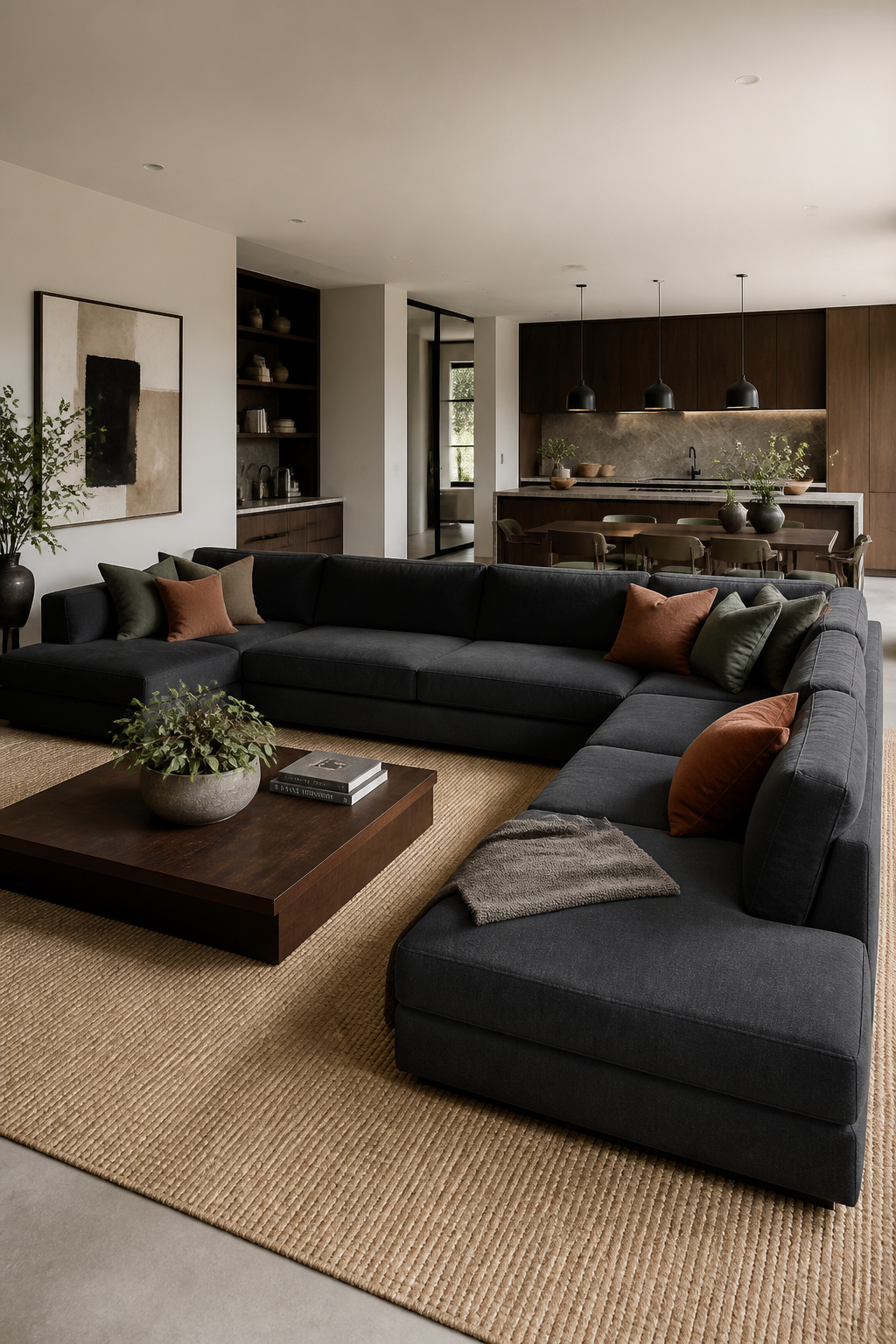
The quality gap between premium and budget modular systems is most visible at the connection hardware and the consistency of seat depth across modules. The Muuto In Situ uses FSC-certified wood frames with zig-zag springs, with a seat depth of 29.2 inches — generous and suited to taller users, though it can feel expansive for those under 5’6″. BoConcept’s Indivi system offers a more balanced seat depth; the Hampton configuration runs deeper still and suits dedicated lounge rooms rather than multipurpose living spaces. Budget modular systems use Velcro tabs or friction clips at the connection points. These shift with use and create visible gaps between modules. Quality systems use interlocking steel connectors or recessed brackets that remain flush for years.
Configuration by room footprint: small rooms (under 20 sq m) need two-seat plus corner without a chaise — adding the chaise pushes the sofa across the room’s short axis and creates circulation problems. Medium rooms (20–35 sq m): three-seat plus corner, or three-seat plus chaise. Large rooms (over 35 sq m): full U-shape or chaise with a matching footstool across the seating zone. Always measure doorways — individual corner modules still exceed standard UK door widths in some configurations.
8. Built-In Shelving That Reads as Architecture
Floor-to-ceiling shelving changes the geometry of a room more dramatically than any piece of freestanding furniture, because it is not furniture — it is architecture. The vertical line draws the eye upward, making standard ceiling heights feel taller, and the shelving creates a fixed structural element against which all other furniture is arranged rather than simply placed.
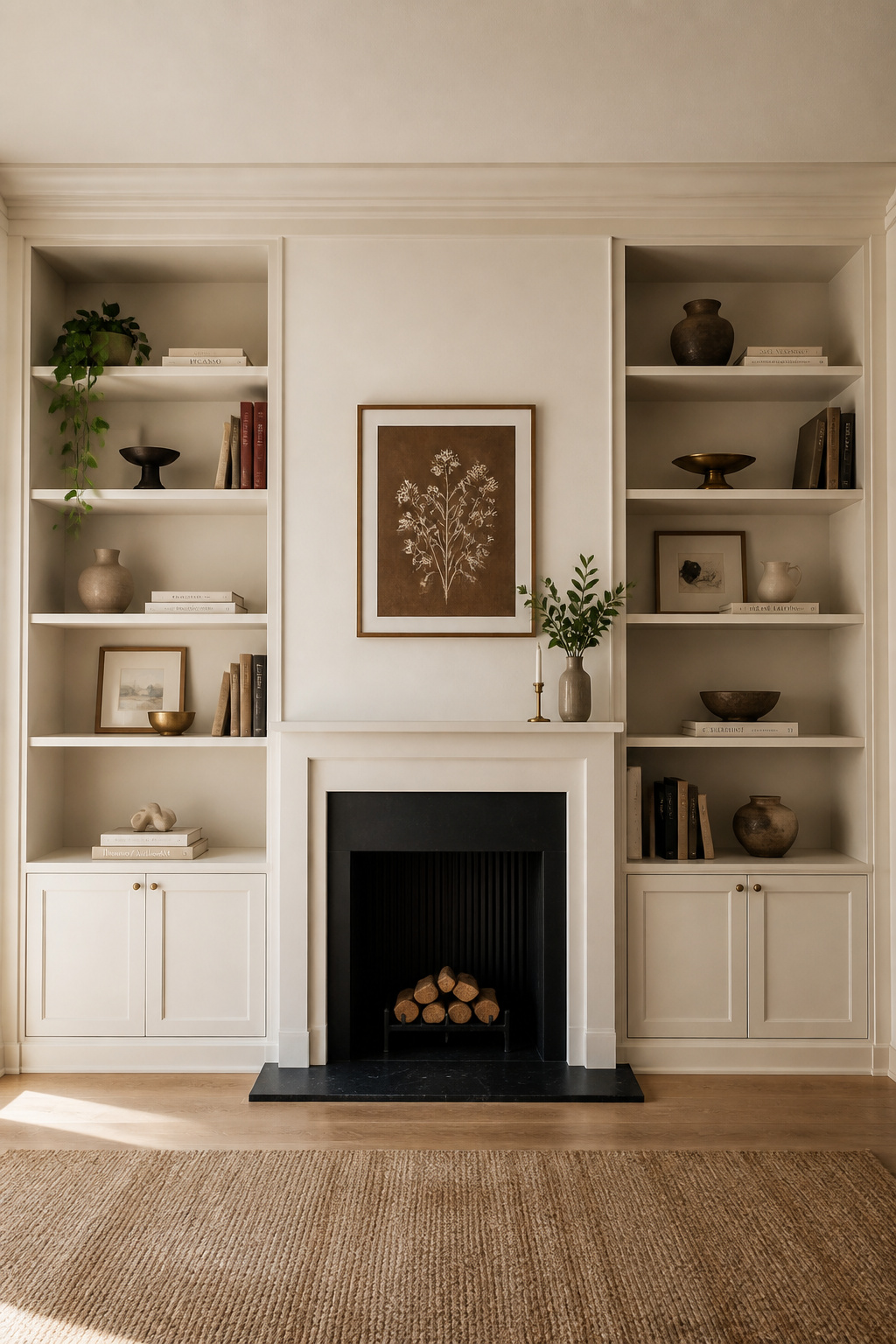
The difference between flat-pack shelving that looks designed and flat-pack shelving that looks like flat-pack comes down to three finishing details. The IKEA Billy system — four units at the 79.5-inch height with 11-inch extension units — totals approximately £276–£400 before finishing. Done correctly, it reads as genuinely architectural. First, 2×2-inch vertical capping strips at each bookcase edge conceal the seams. Second, crown moulding at the ceiling junction eliminates the gap that signals flat-pack origin. Third, baseboard trim at the floor grounds the piece. Fill screw holes with wood filler, prime, and paint. Done carefully, a visitor will not identify the source.
Bespoke joinery costs £200–£400 per linear metre, so a 3-metre run costs £600–1,200 versus £200–500 for the Billy equivalent. The bespoke option earns its premium in adjustable shelf spacing and integrated cable management options. That said, the finish quality of a carefully executed hack is genuinely comparable.
Styling the finished shelves: odd numbers of objects in varied heights, lower shelves with doors for storage (the visual stopping point), and at least one trailing plant where natural light hits the top shelf. Leave 40% of the shelf faces empty — those empty spaces are where the eye rests, and rest is what makes the arrangement feel considered rather than accumulated. Filling every shelf immediately is the most common styling mistake and also the most recoverable.
9. Sideboard and Media Console as Living Room Furniture Design Essentials
The dedicated media unit is one of the least interesting pieces of living room furniture ever produced. It announces the television as the room’s primary feature and subordinates everything else — the art, the shelving, the light — to the screen. A sideboard used as a TV stand solves this without sacrificing function: it integrates the display, keeps the aesthetic coherent, and provides surface space that no media unit offers.
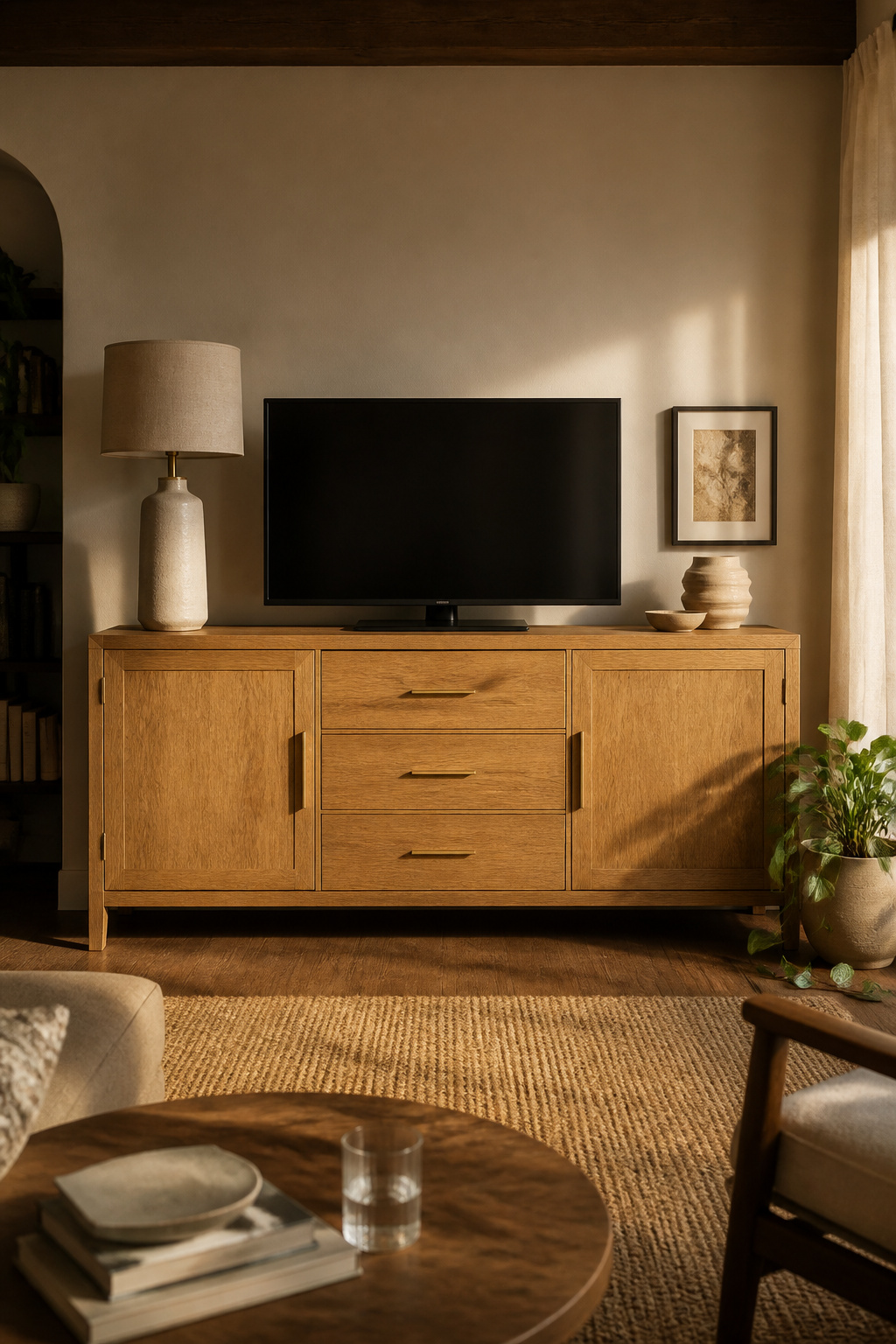
Standard sideboards run 60–80 inches wide and 28–32 inches high, and both dimensions are structurally ideal for TV placement. A 55-inch television on a 30-inch sideboard positions the screen centre at approximately 42–45 inches from floor — near-perfect seated eye level, without wall mounting. The TV occupies one portion of the surface; the remainder holds art objects, a lamp, and one meaningful thing. That is the opposite of the media unit’s logic, which is to hold as many devices as possible and remind you of every one.
The modification that resolves cable management is simple: drill a 50mm cable hole in the sideboard’s back panel, feed all cables through it, and bundle them inside with Velcro straps. AV components need 2–4 inches of clearance above them for ventilation. So, leave at least one shelf section without doors or drill a ventilation hole before placing anything heat-generating inside a sealed unit.
Surface styling follows the mantelpiece rule: no more than five objects, varied heights, the lamp as the tallest element, the television as the widest. Asymmetry reads as intention. Symmetry reads as effort. The sideboard earns its place by making the room feel like more than a place to watch television.
10. Side Tables That Earn Their Presence
The side table is the living room furniture piece most likely to be bought on impulse and most likely to date the room within three years. Glass-top on chrome-legs is the most common offender — photographed beautifully in every Scandinavian apartment editorial, worn immediately in daily use, every fingerprint and water ring requiring constant attention. Natural stone and solid materials age in the opposite direction.
The travertine side table has moved from trend to establishment over the past several years, and for good reason. Its surface develops patina that reads as character. Its stone weight grounds a seating arrangement in a way that metal or glass cannot. Its neutral, warm colouring integrates across virtually any palette without demanding attention. The 1970s Italian postmodern reference is self-aware enough to feel like a design choice rather than an accident. Nesting sets — a larger table around 46×46×37.5cm and a smaller at 37×37×32.5cm — allow flexibility for entertaining without permanently claiming floor space.
The height rule is specific and frequently ignored: a side table’s surface should sit within two inches of the sofa arm height in either direction. Standard sofa arms run 22–28 inches; most side tables run 22–30 inches. The overlap is significant, but only if you read the sofa specification before ordering the table rather than after.
Cane side tables introduce lightness and texture without visual weight — particularly useful where a second heavy element would overload the room. Solid oak in a natural oil finish warms gradually to an amber tone over the years. That movement is a quality indicator, not a sign of deterioration.
11. Living Room Furniture Ideas: The Ottoman as a Room’s Swiss Army Piece
The ottoman is the most multifunctional piece in the living room and, consistently, the least seriously considered at the point of purchase. Sized correctly and positioned with intention, a large upholstered ottoman replaces the coffee table, adds seating for guests, and stores every throw and board game in the house — all while reading as a comfortable footrest on a Tuesday evening.
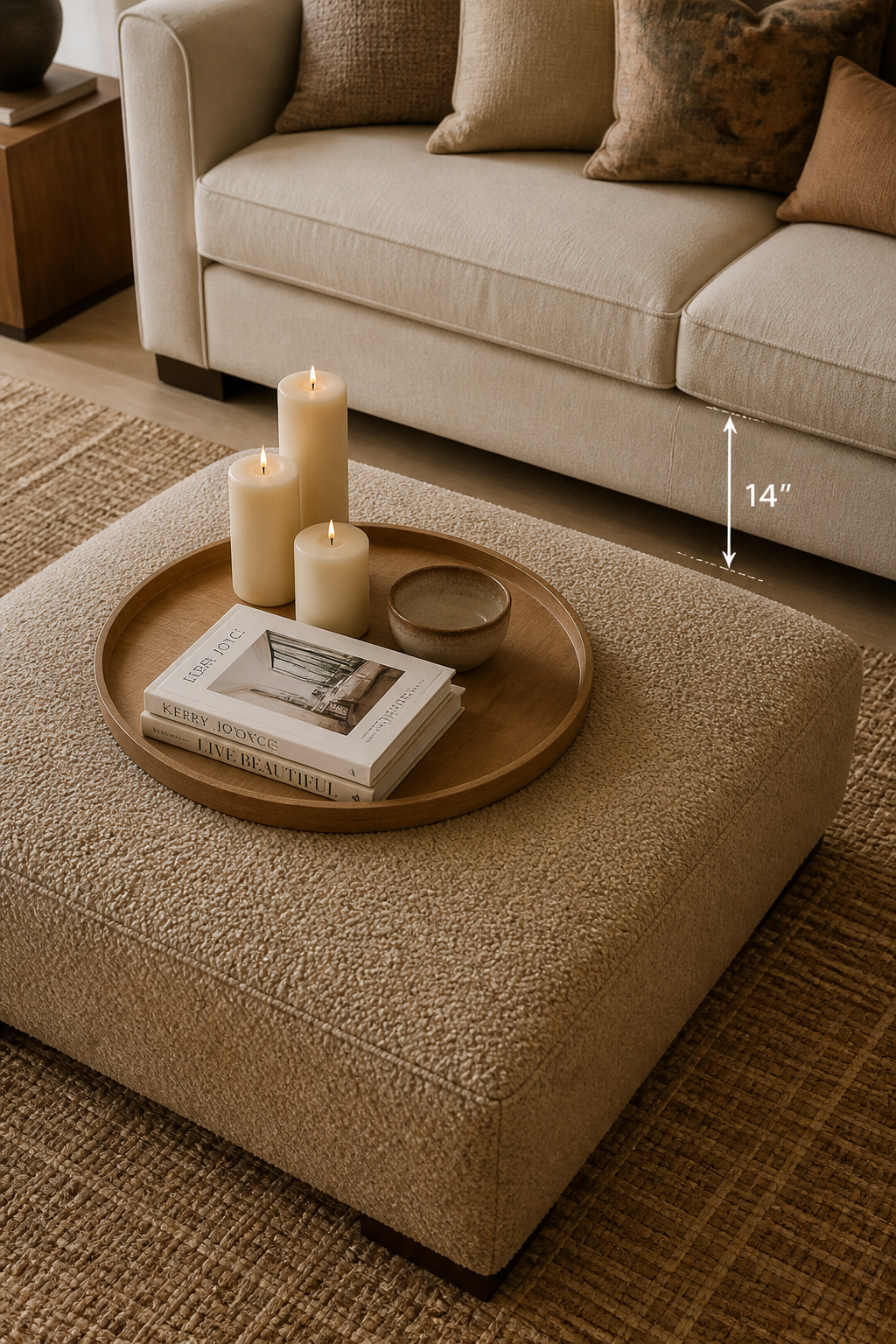
It plays four roles: footrest (primary), coffee table substitute with a tray (secondary), extra seating when the room needs it (tertiary), and storage for the household’s accumulated textile collection (a fourth role most people underestimate). A cocktail ottoman used as a coffee table handles children, dogs, and feet without ceremony. A storage ottoman with a lid resolves the throw, remote control, and board game problem in a single purchase.
Sizing has rules. No smaller than half the sofa length: for a 90-inch sofa, 45 inches is the minimum; 60 inches creates a generous footprint that handles trays and objects comfortably. Height within one to two inches of the sofa seat height — too low and the ankle angle is uncomfortable; too high and the legs are elevated rather than rested. Leave the same 12–18 inch clearance between sofa and ottoman as you would for a coffee table.
For fabric and tray: open-top ottomans used as coffee table substitutes need a tray, and the tray should match the ottoman’s shape. A round tray on a round ottoman reads as resolved. A rectangular tray on the same ottoman looks improvised. Also worth testing: some boucle and velvet surfaces cause trays to slide imperceptibly until they don’t.
12. Mixing Furniture Eras and Provenance for Collected Authenticity
A room furnished entirely from one era looks designed; a room furnished across several looks lived in, acquired over time, and genuinely inhabited by someone with a perspective rather than someone with a credit limit. The difference between an eclectic room that works and one that looks confused is not instinct — it is structure.
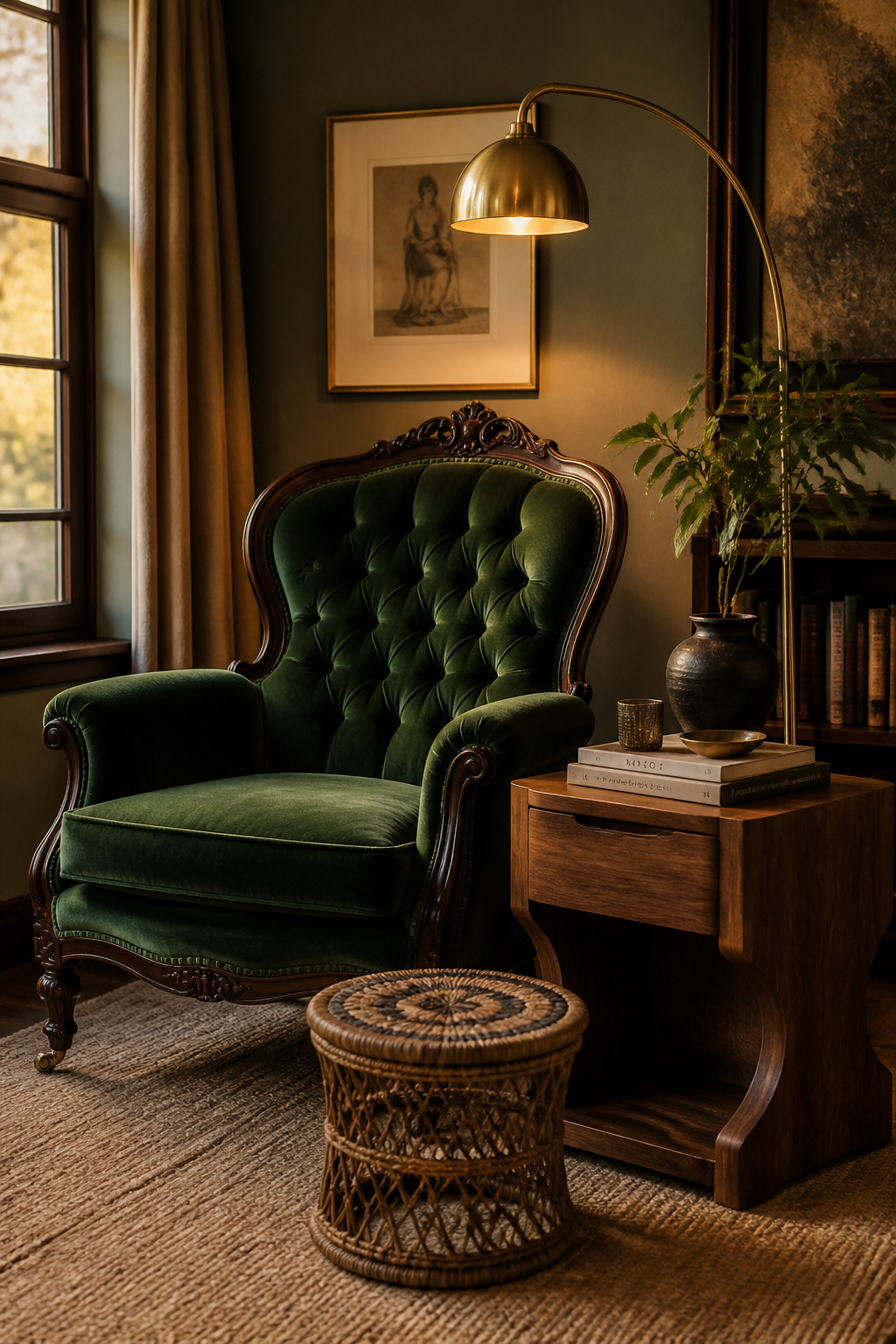
The anchor principle provides the structure. Designate one furniture era as dominant — typically guided by the architecture (a Victorian terrace suits pre-war pieces; an open-plan new build aligns naturally with mid-century or contemporary) — and let it occupy the room’s largest fixed pieces. One contrasting era introduces tension and prevents the room from reading as a period reconstruction. Then the wildcard: one piece with no obvious period allegiance — a woven African stool, a ceramic Japanese lamp base, an Indian hand-forged mirror frame. This is where cultural fusion finds its most authentic expression: not appropriation but conversation, where objects from different traditions address each other across the room.
For sourcing, Vinterior and 1stDibs offer curated routes to verified vintage furniture without the auction gamble on condition. Regional salerooms remain the best source for genuine value. 1950s–1970s Scandinavian pieces in excellent condition regularly appear at estimates of £80–£300, unrecognised by buyers focused on brand names.
Natural materials are the visual glue across eras. Solid wood, stone, leather, and linen transcend period-specific design language and create material relationships between pieces that their silhouettes alone never would. A restrained palette absorbs stylistic differences; saturated colour amplifies them. The mistake that ends most mixed-era rooms is scale imbalance — a massive Victorian dresser beside a delicate mid-century chair creates visual conflict that no colour palette resolves.
13. The Reading Nook as Design-Within-Design in the Living Room
A reading nook carved from a living room corner adds something that additional furniture almost never provides: psychological depth. It creates a second destination within the room — a place with its own logic and atmosphere — and this layering of room within room is what distinguishes a designed space from a furnished one. The equipment required is almost nothing: one chair, one pendant, one small shelf.
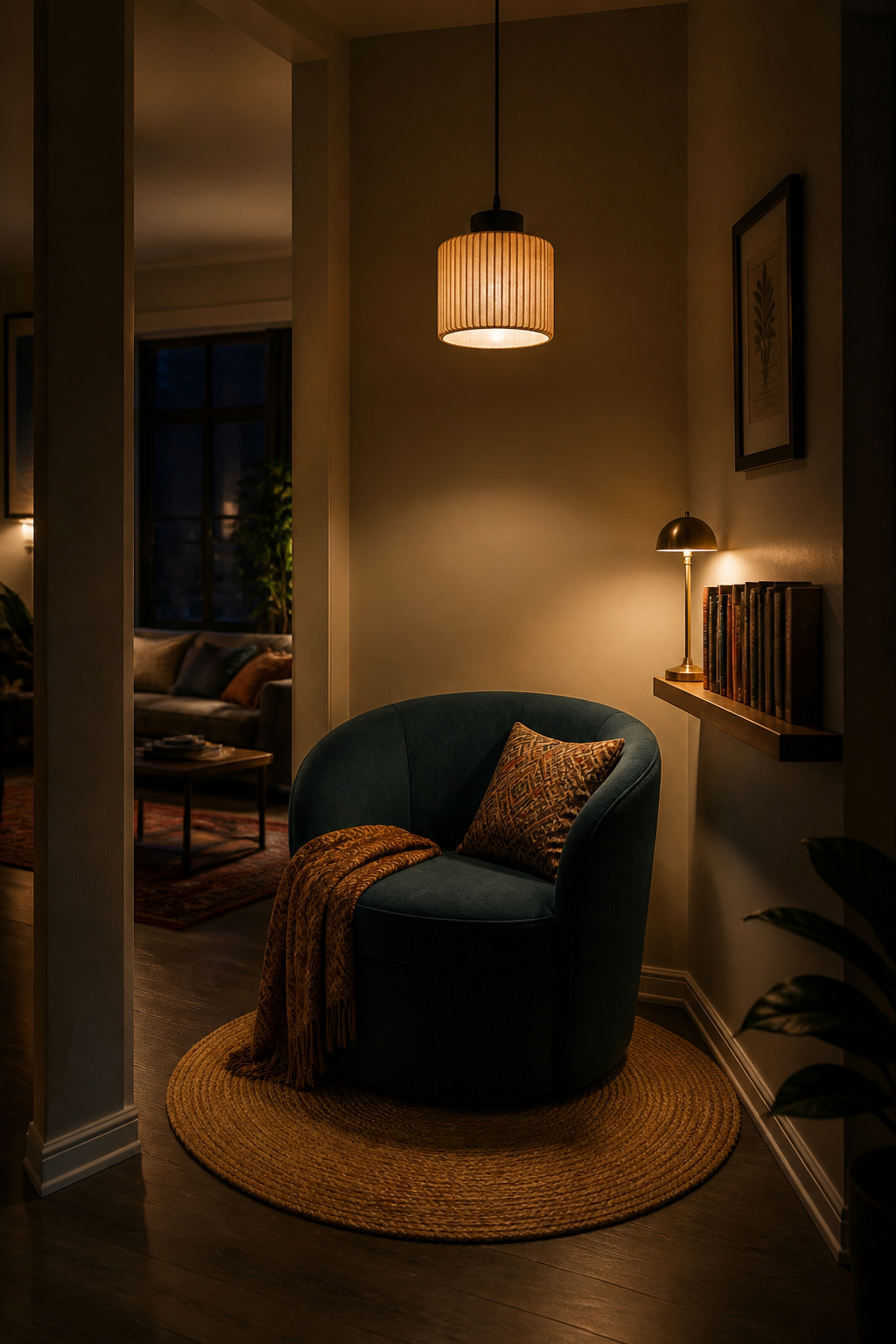
The pendant hung at 7 feet from the floor directly above the reading chair is the defining element. It creates a pool of light that visually separates the nook from the main seating area without any physical division. The chair should face into the room (the corner is its backdrop, not its subject), and a small wall-mounted shelf at arm-reach height holds 8–12 books and a lamp. This is the minimum viable reading nook. Everything beyond it is refinement.
The risk with a reading nook is disconnection — a corner that reads as a different room rather than an extension of the same one. The solution is material continuity: use the same textile family as the main seating zone in a different weight or texture. If the main sofa has a velvet throw, the reading chair carries a wool blanket in a complementary tone. A small rug under the chair’s front legs (150×200cm minimum) defines the zone without enclosing it. A single contrasting element — a different cushion colour, a slightly different wood tone on the side table — signals that this corner operates by its own design logic: intentionally different, not accidentally mismatched.
For lighting: the pendant creates presence, but a small table lamp on the side table provides the task element. Pendants alone rarely achieve the 300–500 lux needed at the page surface. These are precisely the layered decisions that cozy living room design gets right — intimacy without enclosure, distinction without disconnection.
14. Living Room Furniture Design: Investing in Sustainable Artisan Pieces
The financial argument for slow furniture is not sentimental — it is arithmetic. A £2,000 artisan sofa built to last 25 years costs £80 per year. A £600 mass-market replacement every five years costs £120 per year. The quality piece is cheaper by one-third, and it never ends up in a landfill. Nine million sofas are discarded in the UK annually — nearly all of them pieces built to the specification of three to five years, which is exactly what they achieved.
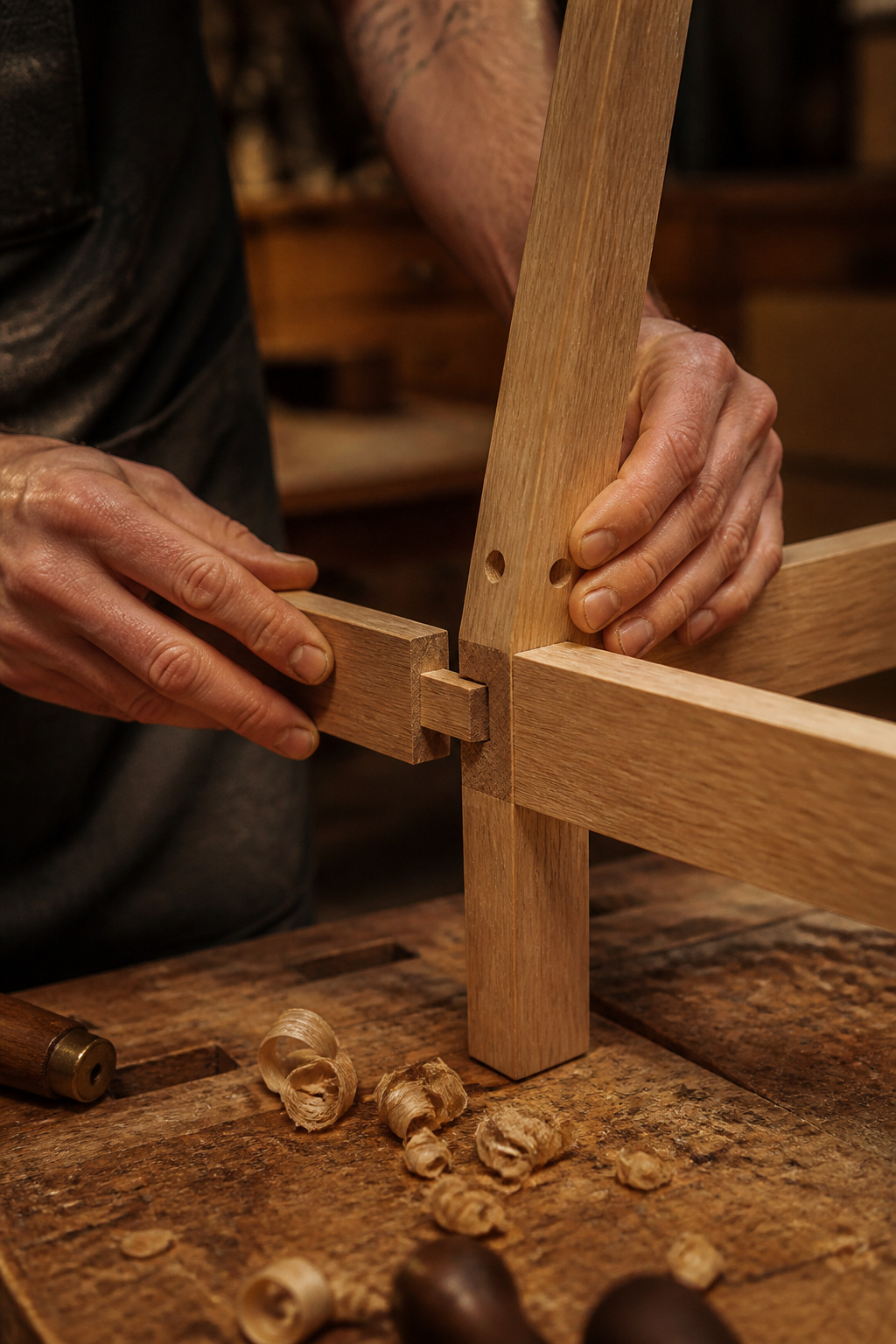
Certifications that mean something: FSC (Forest Stewardship Council) certification on wood components confirms responsible sourcing with third-party verification. It is specific and auditable. B Corp certification, which Case Furniture (working with designer Matthew Hilton) holds, covers the entire business operation, not just the materials. Water-based and low-VOC finishes are the meaningful standard for paints and stains applied to furniture. ‘Eco-friendly finish’ without specifying the chemistry is unverifiable, and worth treating as marketing rather than information.
The British makers worth the budget allocation: Benchmark handcrafts solid oak furniture in Berkshire with Woodland Carbon accreditation, designed for repair and inheritance rather than replacement. Case Furniture produces design-classic-level pieces — the Dulwich sofa, the Platform beds — in FSC-certified materials with water-based finishes and full B Corp accountability. Sebastian Cox tracks every carbon kilogram and uses British-grown timber exclusively; his stools and occasional pieces are the entry point into the practice. Tom Raffield in Cornwall steam-bends sustainably grown ash and oak into furniture and lighting with a craft character that owes nothing to Scandinavian influence and everything to British woodland tradition.
Reupholstery extends any quality frame’s life by 15–20 additional years at £300–£800. That figure, however, only makes sense when the frame is worth preserving. Budget frames are not, which is precisely the point.
15. Dining-Living Integration for Open-Plan Furniture Flow
Open-plan living fails most visibly when furniture arrangement creates a single undifferentiated space — a room with no legible zones, no destinations, no sense of transition between activities. The solution is not construction. It is furniture geometry, rug placement, and the coordination (not matching) of materials across zones.
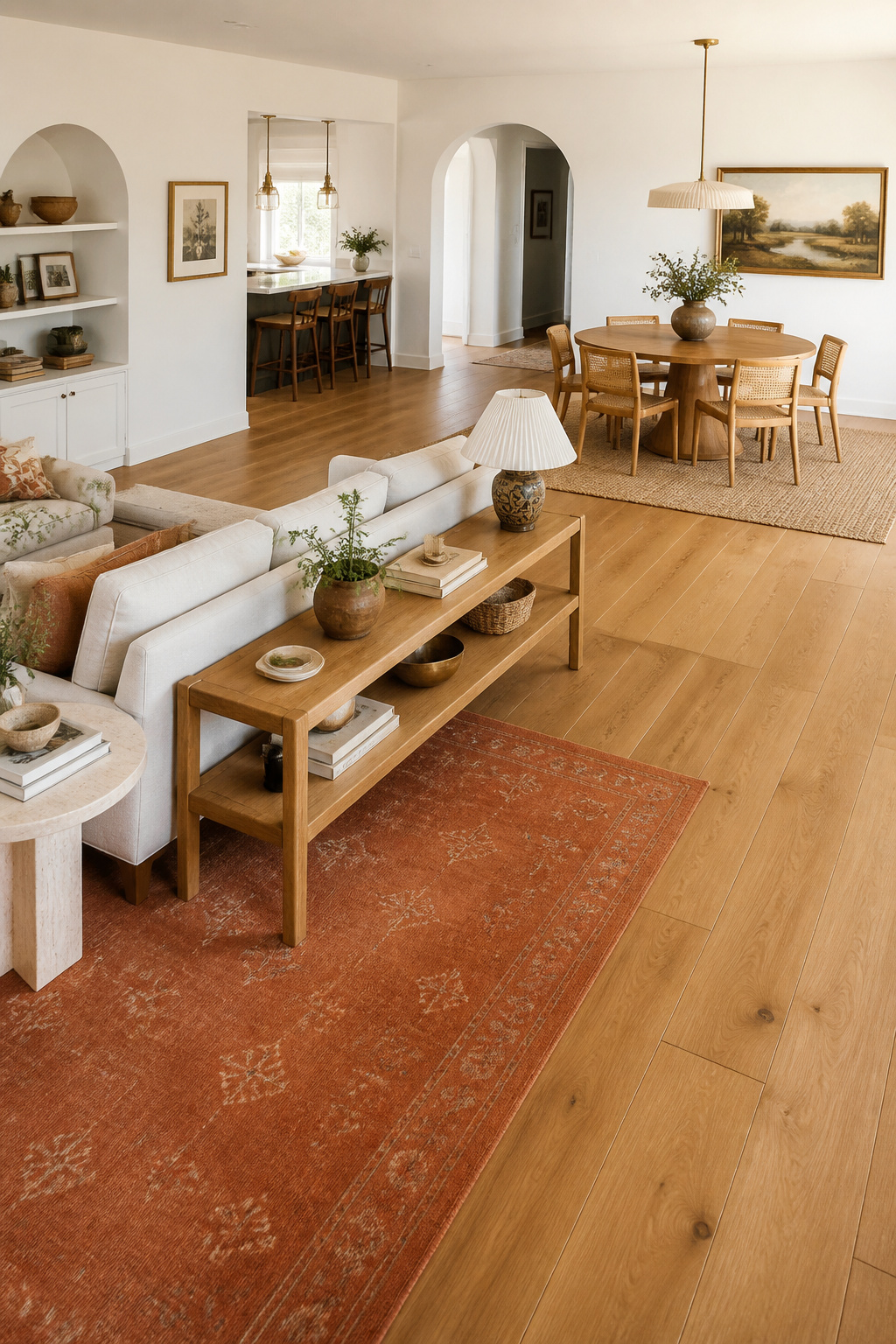
Zone definition begins with the sofa’s back. A sofa positioned with its back facing the dining zone is the most effective soft divider available. It signals “this is the living area” and its reverse face can carry a low console table that provides surface space oriented toward the dining zone. Float furniture away from walls in both zones. Furniture arranged against perimeters creates a waiting-room quality that no open plan recovers from easily. Leave 36 inches of clear circulation pathway connecting entry to kitchen or main window.
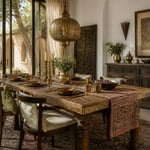
Rugs anchor each zone and connect them visually. The living room rug should measure at least 200×290cm, with all front sofa legs sitting on it — a rug that holds only the coffee table looks as though it arrived for a smaller room. The dining rug must extend at least 60cm beyond the table on all sides, so chairs remain on the rug when pulled out. Coordinating tones rather than matching patterns — a terracotta rug in the living zone and natural jute in the dining zone — share warmth without repetition.
Dining chairs that pick up one material from the living room — the same wood tone, a similar cane detail — create visual connection without requiring identical pieces. Avoid using the same upholstery fabric in both zones; the variation between zones gives each area its own identity and keeps the open plan from feeling like one very large, undifferentiated room.
16. Window Treatments That Align With Your Living Room Furniture Design
Curtains are the largest textile in the living room — larger than the rug, larger than any upholstered piece — yet they’re typically chosen last and quickly, often to match a wall colour rather than to work with the furniture at human scale. The heading style determines how the curtain falls, which determines how it reads against the furniture below, which determines whether the window treatment feels finished or incidental.
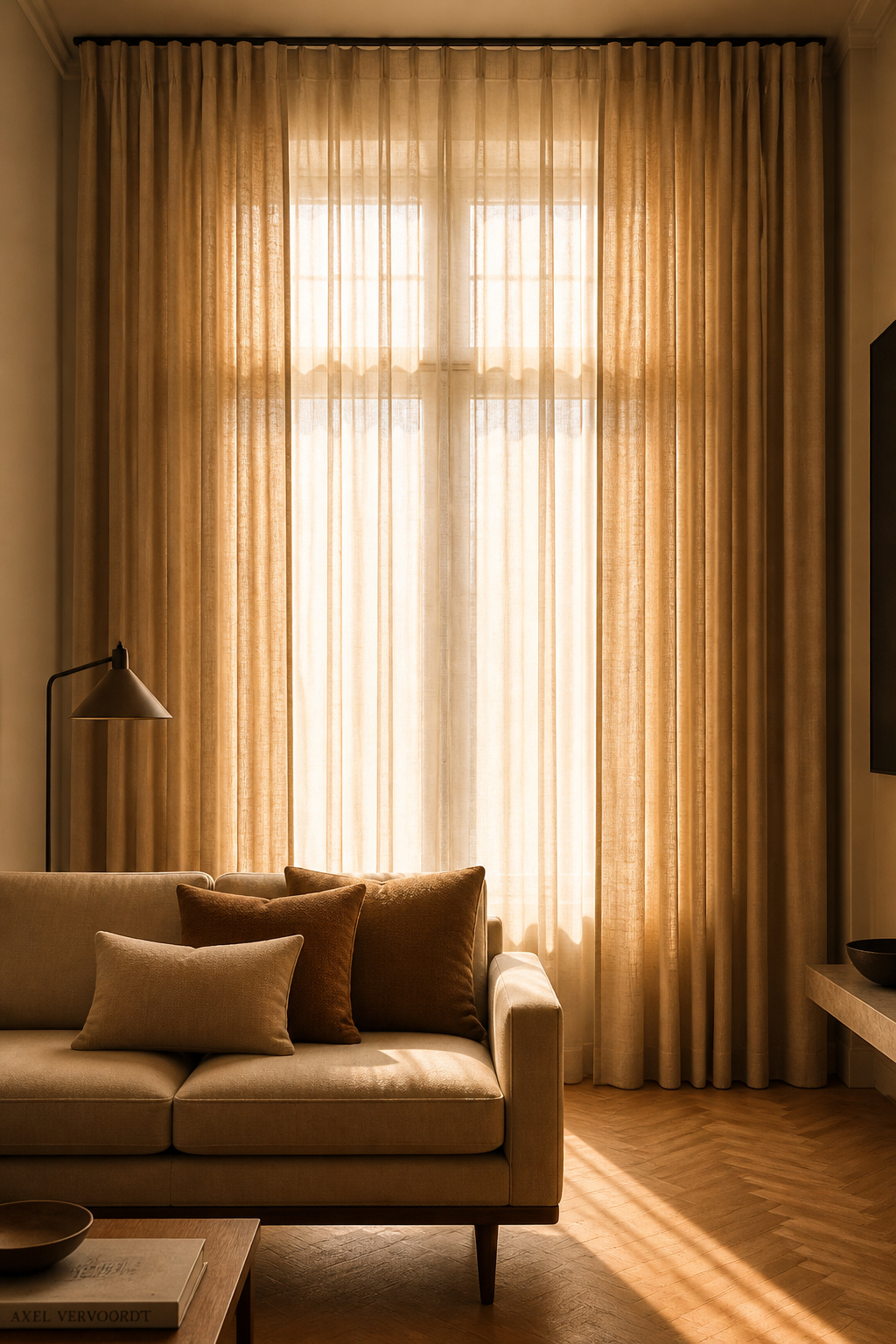
Heading styles carry different personalities. Triple pinch pleat creates structured formal folds and offers the best light control in heavy fabrics. It suits rooms with traditional or heritage furniture where formality is an asset. Wave (or ripple) heading runs in a continuous S-curve, suits contemporary furniture where clean movement is the visual point, and requires a specialist track. It also hangs about 20% heavier than a flat panel — worth knowing before budgeting the fabric. Pencil pleat is the most forgiving heading for lighter fabrics, particularly linen: it gathers without forcing the material into dramatic folds that linen wasn’t designed for. For a full living room curtain guide that maps heading styles to furniture aesthetics, the match is more specific than most installation guides suggest.
Floor-to-ceiling curtains — hanging from as close to the cornice as possible, falling to within 1–2cm of the floor — make standard ceiling heights feel taller. This is the most transformative and most frequently skipped upgrade in residential interior work. The most common error is hanging rails at window-frame height, which cuts the wall at the same level as the furniture and compresses the room. Hung at ceiling height, the same curtain and the same room feel entirely different.
Interlining, an extra wadding layer between face fabric and lining, adds body that unlined curtains cannot replicate regardless of heading style. For linen curtains specifically, interlining prevents the see-through quality that unlined linen exhibits in daylight. Blackout lining in a living room is not only about light control: it also reduces sound transmission on street-facing windows and eliminates the silhouetting effect that occurs when interior evening light meets a dark exterior.
Pulling Your Living Room Furniture Design Together: Where to Start
The rooms on these pages weren’t built in a weekend or assembled from a single shopping basket. They were considered, phased, and evolved. That approach is available at any budget, because it’s about sequence and intention rather than spending level.
The hierarchy is straightforward. Invest in the sofa, the rug, and built-in or quality shelving — these three see the most use, age most visibly, and define the room’s character more than any other purchases. Economise on side tables (stone-look options at £80–£150 are genuinely good), cushions and throws (these rotate and refresh without disrupting the room’s tone), and non-structural accent pieces. A broad allocation to keep in mind: approximately 40% of your living room furniture design budget on the sofa, 25% on storage and shelving, 15% on the rug, and the remaining 20% across all other pieces. These proportions are flexible. The ranking of priority is not.
Phase the rest across 12–24 months. Start with the sofa and rug — everything else responds to these two decisions, and buying accent pieces before the anchors leads to coordination problems that are expensive to resolve later. Phase two, three to six months in: coffee table, shelving, and floor lamp. These complete the functional layer and give the room its working atmosphere. Phase three, six to twenty-four months: accent chair, side tables, textiles, and window treatments. These final layers benefit enormously from being chosen after the room is in daily use. You’ll know what’s missing by living with what you have. You’ll know what works by noticing what you reach for first. The room that lasts is the one that reveals itself over time — and that only happens if you resist filling it all at once.