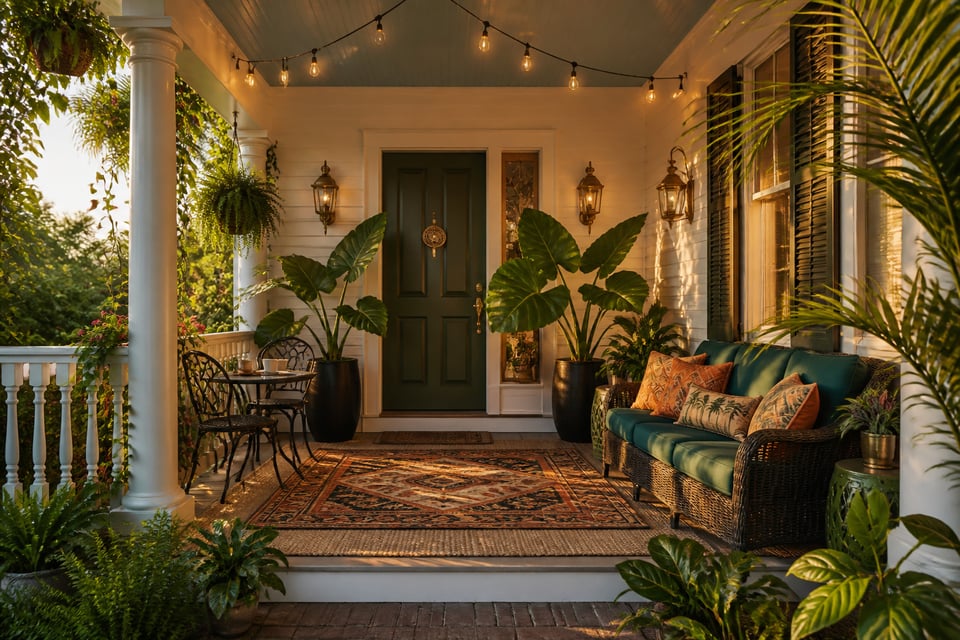
The front porch is the one room every visitor sees, every neighbor notices, and every passerby unconsciously judges. Most people treat it as an afterthought — the gap between the parking spot and the door. That’s a design opportunity hiding in plain sight. After years working with indoor-outdoor living spaces, I’ve come to see the front porch as the most powerful statement a home makes about what lies inside. Front porch decorating doesn’t require a renovation budget or a weekend of hard labor. Most of the ideas below deliver dramatic visual impact through paint, plants, textiles, and light. They work across porch sizes, climates, and design styles. Here are 17 specific, actionable ideas to transform your entry.
1. A Statement Front Door Color That Sets the Whole Mood
The front door color is the decision with the highest visual return for the least money spent. A gallon of exterior paint costs $40-60 and immediately transforms how your whole home reads from the street. You go from “a house with a door” to “a home with an intention.”
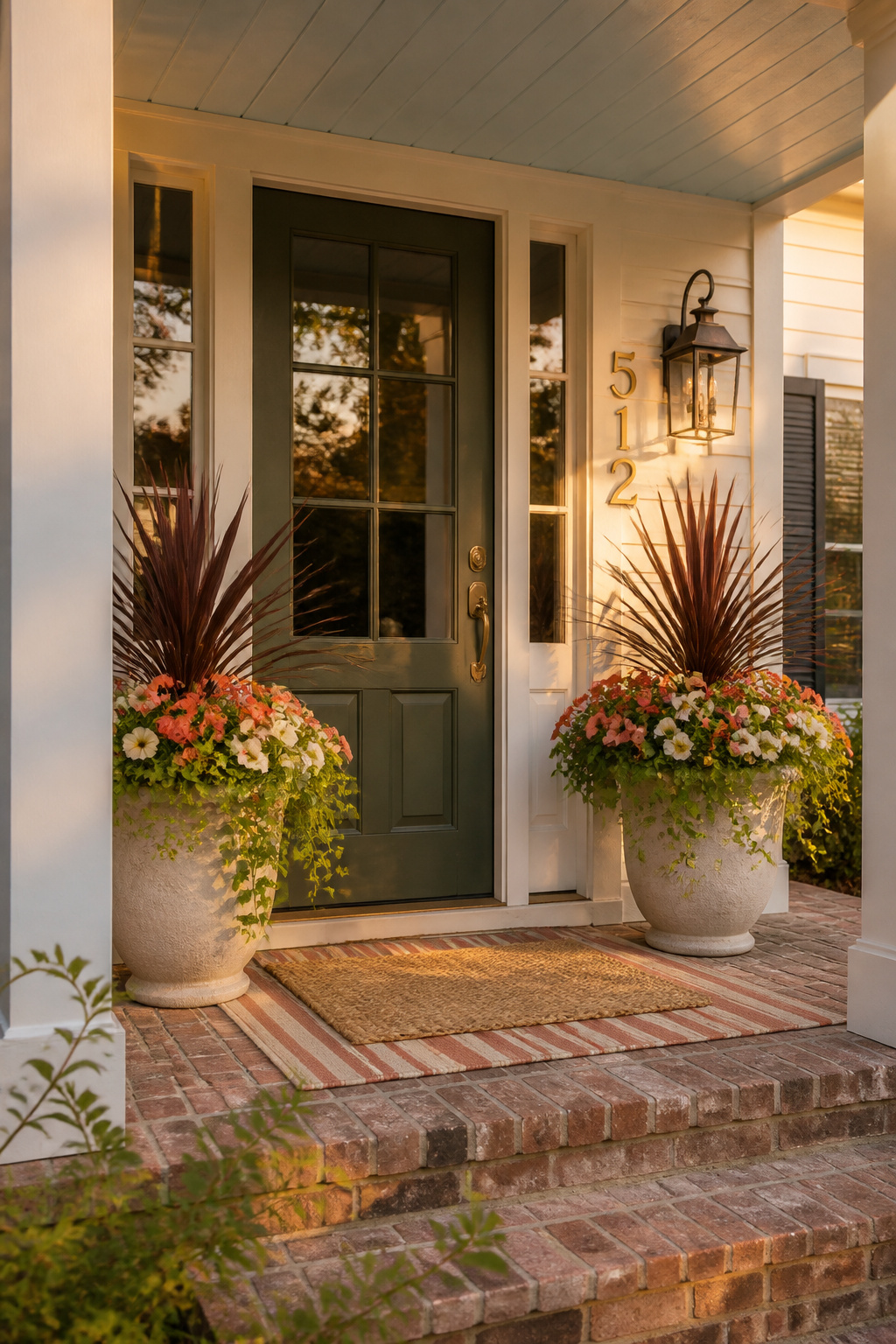
In 2026, the all-black door trend is giving way to something richer. Muted olive and eucalyptus greens are leading the shift. They work beautifully against warm wood soffits, red brick, and gray siding alike. For a more dramatic statement, deep navy or teal delivers year-round confidence. If your exterior runs neutral — white, cream, or light gray — a warm greige or mushroom tone creates an understated, expensive look.
Choosing Your Color and Hardware
The key is undertone coordination. Warm exterior materials need door colors with warm undertones. Red brick, golden stone, and cedar siding all pair best with olive, terracotta, sage, or warm navy. Cool gray or white siding can handle almost any tone. Test your shortlist at three times of day: morning, midday, and dusk. Door colors shift dramatically between them, and what looks perfect at noon can read wrong at 5pm.
Hardware is where the transformation becomes complete. Aged brass, antique gold, and soft bronze pair naturally with warm door tones. Matte black and satin nickel work with cooler palettes. Add oversized house numbers — 4-6 inch numerals in matching finish — and you’ve elevated the entry for under $300. Those details are small, but they register. For a full picture of how the door fits into the broader entry composition, porch decor ideas that boost curb appeal lay out how each element connects.
2. Layered Outdoor Rugs: One of the Simplest Front Porch Decor Upgrades
There’s a reason designers always start with the rug. It transforms a porch from a surface you cross into a space you’ve considered. The right rug signals: this is a designed room. It also sets the color story for everything else on the porch.
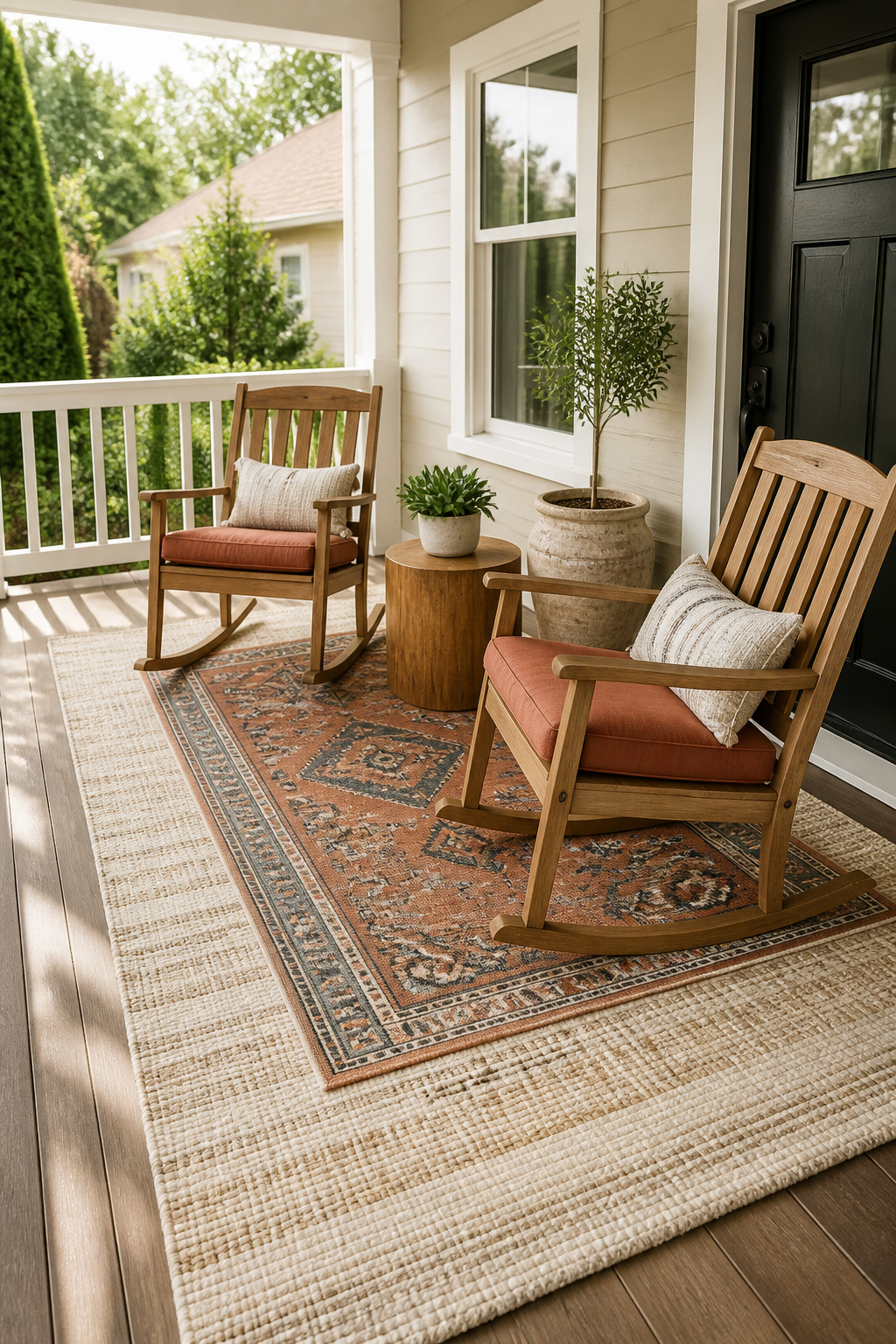
For front porch decor, material is everything. Solution-dyed polypropylene is the first choice for exposed porches. The pigment is locked into the fiber before spinning — UV can’t bleach what it can’t reach on the surface. These rugs dry within hours after rain. Recycled PET rugs, made from post-consumer plastic bottles, are the sustainability-forward option. They’re softer underfoot and work well on covered porches. They’re slightly less UV-resistant than polypropylene, but carry a strong environmental story. Natural jute and sisal look beautiful indoors. Outdoors in a rainy climate, they absorb moisture, dry slowly, and develop mildew within a season. Don’t do it.
For sizing, the furniture legs should sit on the rug — not float off the edge. A 4×6 works for a compact entry porch. Go 5×8 or 8×10 for a full seating setup. The layering technique is simple: place a large neutral flatweave as the base, then add a smaller personality mat closer to the door on top. The depth this creates reads as far more intentional than a single mat. Budget: both pieces together for $60-90.
3. Container Gardens With Height Variation for Visual Drama
The difference between planters that stop people and ones that register as nice-but-forgettable is nearly always height variation. A flat row of annuals in matching pots is fine. A composition that layers from ankle to shoulder height, combines contrasting textures, and spills over the edges? That’s arresting.
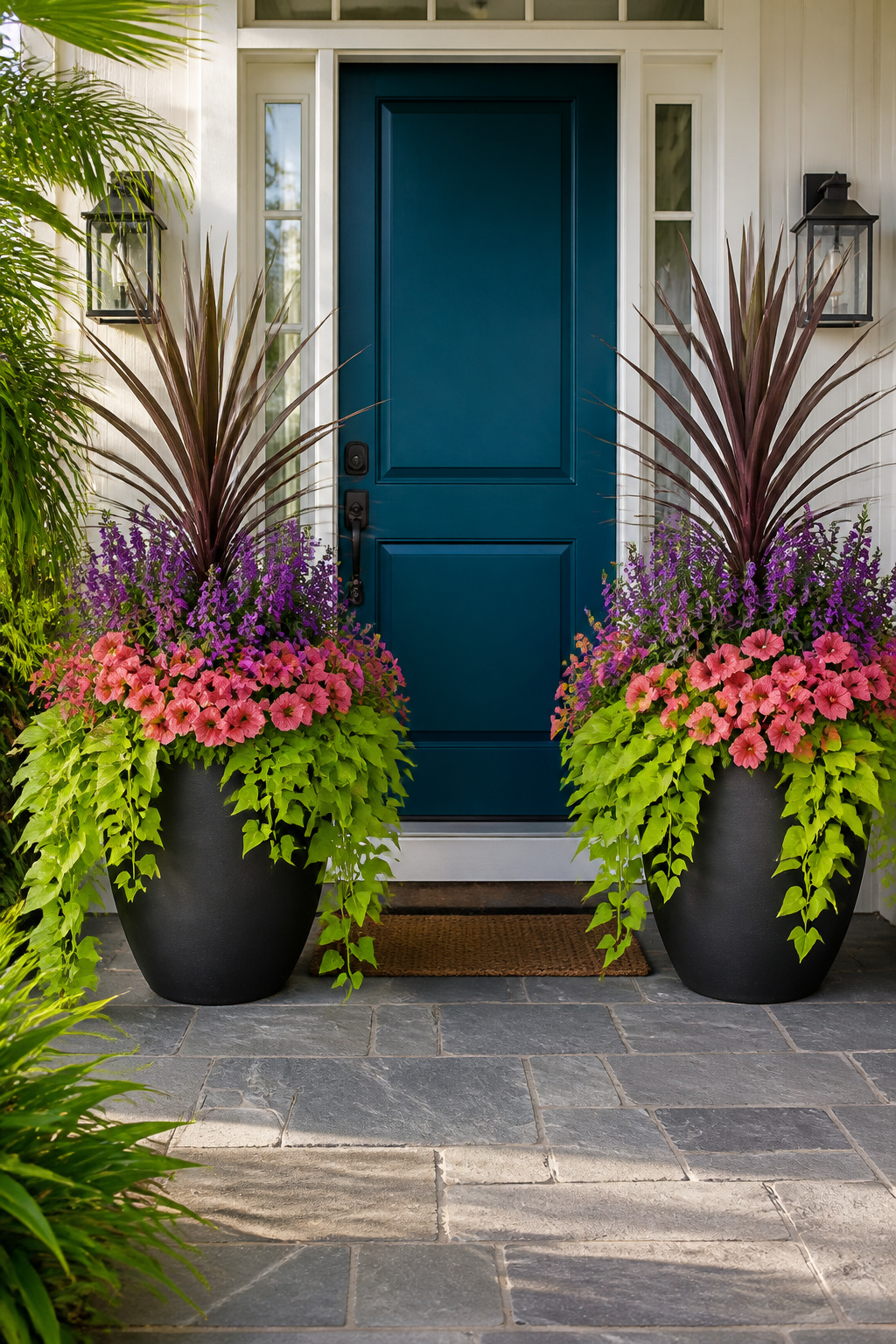
The formula to know is thriller-filler-spiller. One tall focal plant (the thriller) creates vertical drama. Mounding plants surround it (fillers) to add mass and fullness. Trailing plants cascade over the edges (spillers) for movement. In full sun: cordyline or dracaena as the thriller, angelonia or coleus for fill, wave petunias or trailing lantana as spillers. For shaded porches: a large caladium makes a spectacular thriller. Pair it with impatiens or begonias for fill, then sweet potato vine or bacopa over the sides.
Pot materials matter more than most people realize. Fiberglass has improved dramatically. It now convincingly mimics stone, terracotta, and concrete at a fraction of the weight. This matters for freeze-thaw climates where genuine terracotta cracks, and for anyone moving containers seasonally. Two matching tall containers flanking the door create formal symmetry. Aim for final plant height of at least 18-24 inches to register properly against the door scale. If this approach inspires you to extend container planting into other spaces, container garden ideas for small spaces show how to apply the same thinking in compact outdoor areas.
4. A Classic Porch Swing That Earns Its Place All Season Long
A porch swing does something no other furniture piece can. It creates a reason to sit down and stay. The gentle motion is genuinely calming. It changes how people inhabit the porch — from walking through to lingering in. Install one and notice how often guests migrate toward it.
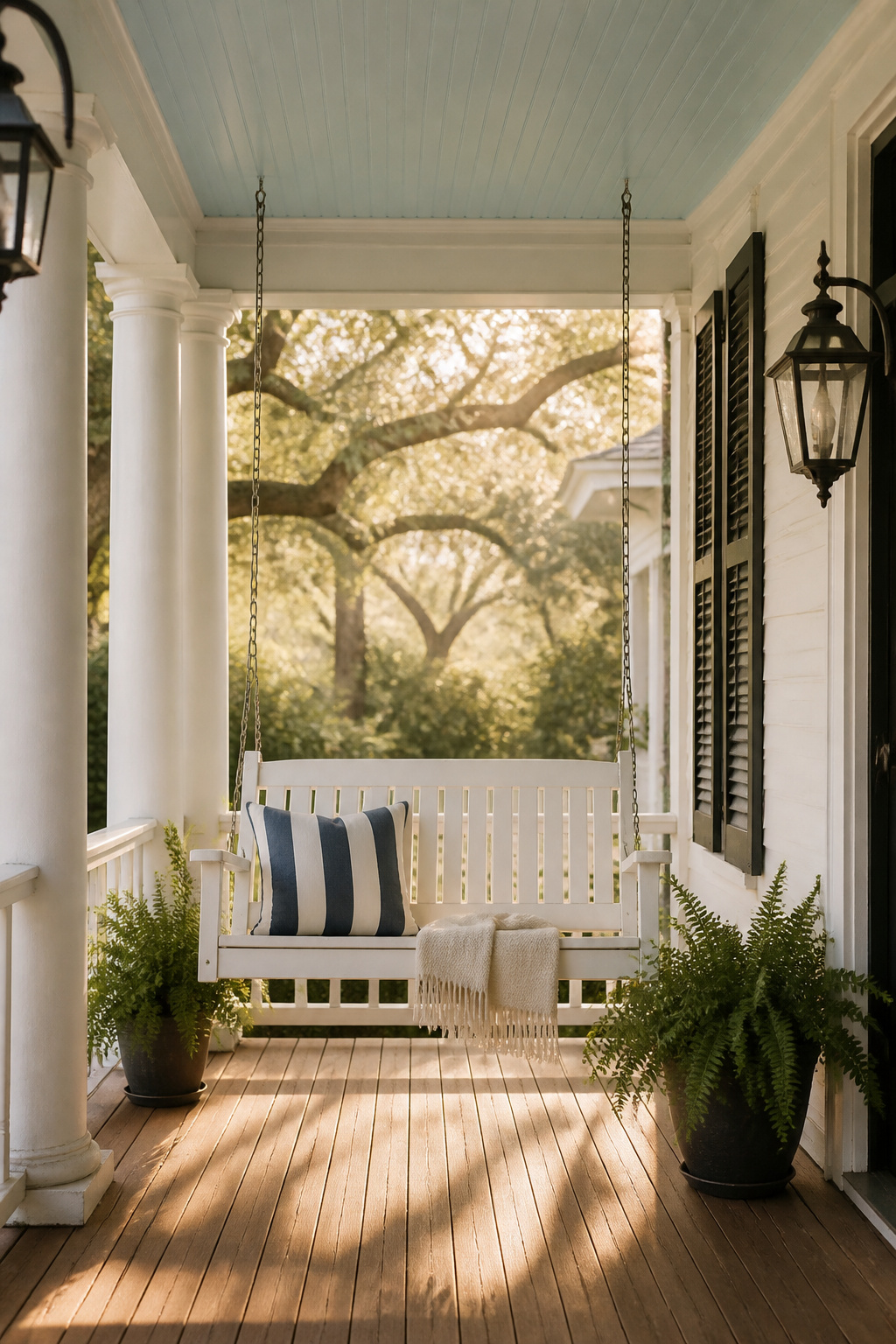
Installation requires structural honesty. The swing must attach to ceiling joists — not drywall or decking boards alone. Use a stud finder. Eye bolts need a working load rating of at least 500 lbs per attachment point. For a two-person swing, you need two 2×6 joists or a single 2×8 at minimum. Hardware should span at least 64 inches between hang points. Use galvanized steel in most climates, stainless in coastal environments.
For the swing itself, white-painted pine is the most accessible choice ($150-350). It looks classic against most porch colors. It needs repainting every 3-5 years. Teak is the investment option at $400-900. Natural internal oils make it moisture-resistant with no treatment needed. With annual oiling, it stays warm honey-toned for decades. A comfort spring kit between the hardware and chains costs $20-30. It adds a pleasant bounce that standard chain kits don’t have. Worth every dollar.
5. Front Porch Furniture Arranged for Conversation, Not Just Show
Most outdoor furniture is arranged for photographs. Chairs face the street in a row — great for curb appeal shots, terrible for any actual conversation. The principle that changes this is simple: angle seats toward each other, not toward traffic. Aim for 90-120 degrees between pieces. This creates a conversation envelope even on a small porch.
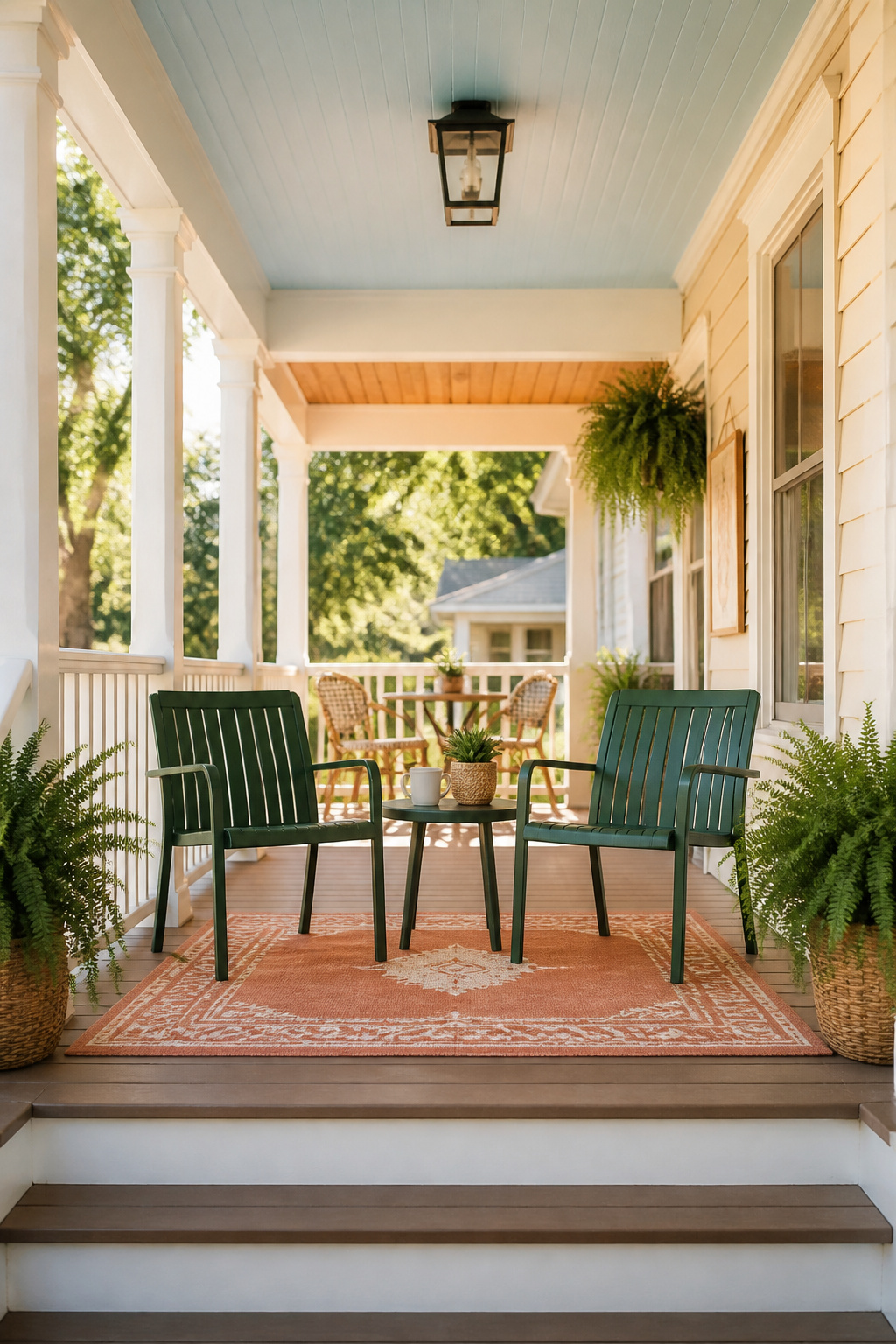
In front porch decorating, material selection matters for how long the space continues to look good. Teak is the premium choice. Natural oils resist moisture and insects without treatment. A quality teak set outlasts multiple rounds of cheaper alternatives. Powder-coated aluminum is the practical recommendation for most people. It’s rustproof even in coastal salt air. It’s light enough to reposition for seasonal changes. It holds its finish for a decade without intervention. HDPE recycled plastic lumber — brands like Polywood — is the sustainability-forward pick. It cannot rot, splinter, or absorb moisture. The manufacturing story matters too, if environmental impact guides your decisions.
Leave at least 18 inches of clear walkway around any furniture arrangement. Less than that and the porch starts to feel like an obstacle course. Deep-seat sectionals rarely work on porches under 10 feet deep. Choose chairs over sofas in constrained spaces. And put a side table within arm’s reach of every seat. Guests with nowhere to set a drink don’t stay long. For a broader look at how this outdoor-living mindset extends into backyard spaces, backyard decor for a mindful outdoor sanctuary covers the same conversation-first approach at larger scale.
6. String Lights and Lanterns That Make Evenings Feel Like an Occasion
After dark, a porch without intentional lighting is invisible at best. A 48-foot run of quality LED string lights costs $30-60. That investment changes how your home reads from the street at 8pm — from dark void to warm inhabited space. It’s one of the highest returns in front porch decorating.
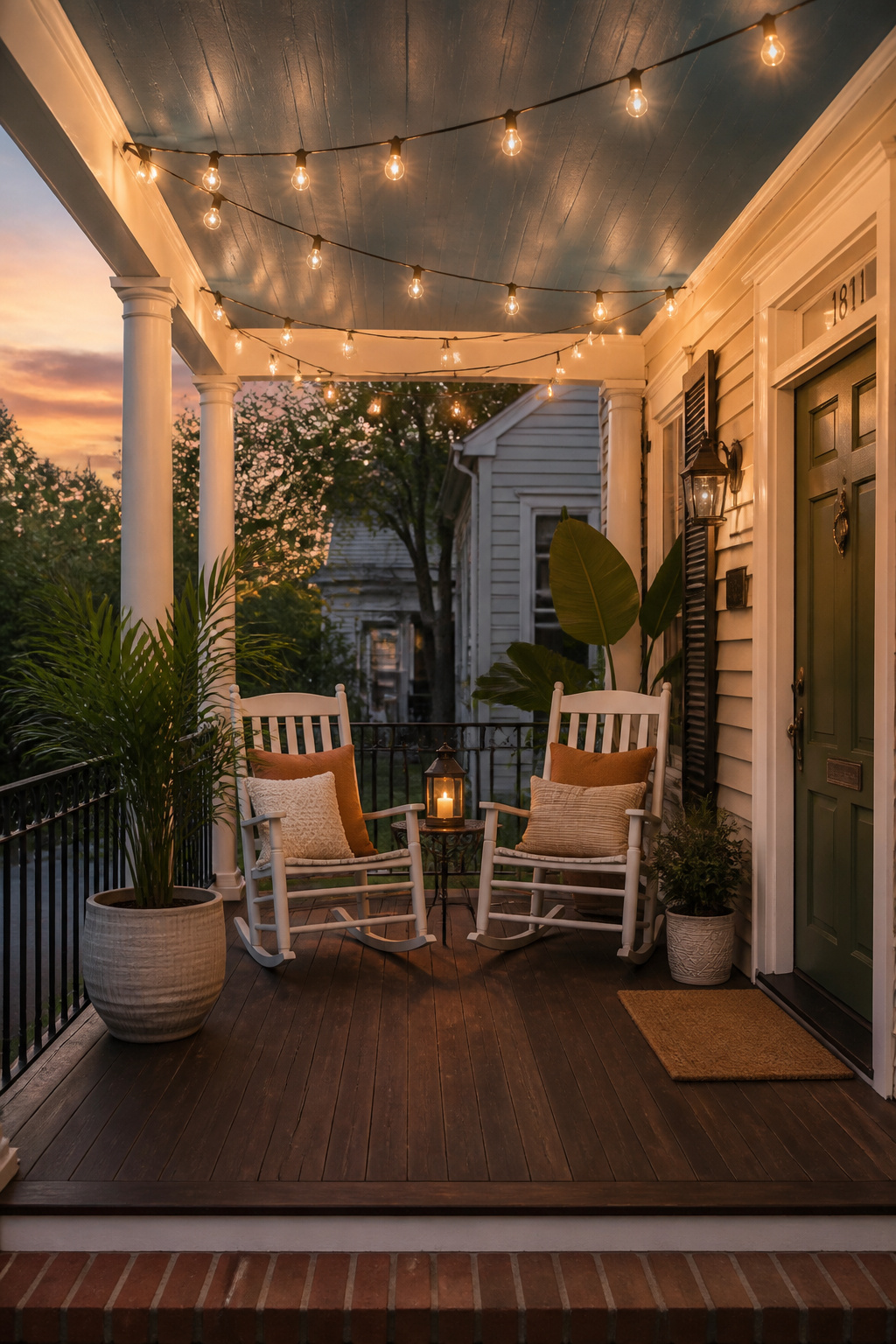
Solar string lights have improved, but they remain limited as primary porch lighting. Solar bulbs typically output 1 watt per bulb. Wired LED versions deliver 5-8 watts each. That’s a meaningful brightness difference. Solar works for railing accents or seasonal strands. For a porch to actually be lit rather than just suggested, hardwire your string lights or plug into a weatherproofed outdoor outlet. IP65 is the minimum weather resistance rating for a covered porch.
S14 and G40 Edison-style globes create large warm filament points of light. They read well from the street and feel festive overhead. Keep color temperature at 2700-3000K. Above 3500K becomes clinical and cold. The same layering principle that creates warmth in good outdoor kitchen lighting design applies here: multiple light sources at different heights beat one single overhead source every time. Combine string lights with two or three lanterns at different levels for a proper layered effect.
For installation, screw cup hooks into joists and run strands across the porch ceiling in gentle arcs. Skip adhesive clips — they fail with temperature changes. For railings, use clear outdoor railing clips sold specifically for this purpose.
7. Window Boxes Overflowing With Seasonal Color
Window boxes do two design jobs at once. They add architectural weight that grounds the windows — especially on homes with tall blank facades between window and grade. And they bring living organic softness against hard surfaces. The contrast between precise painted trim and overflowing blooms is what makes well-kept homes feel alive.
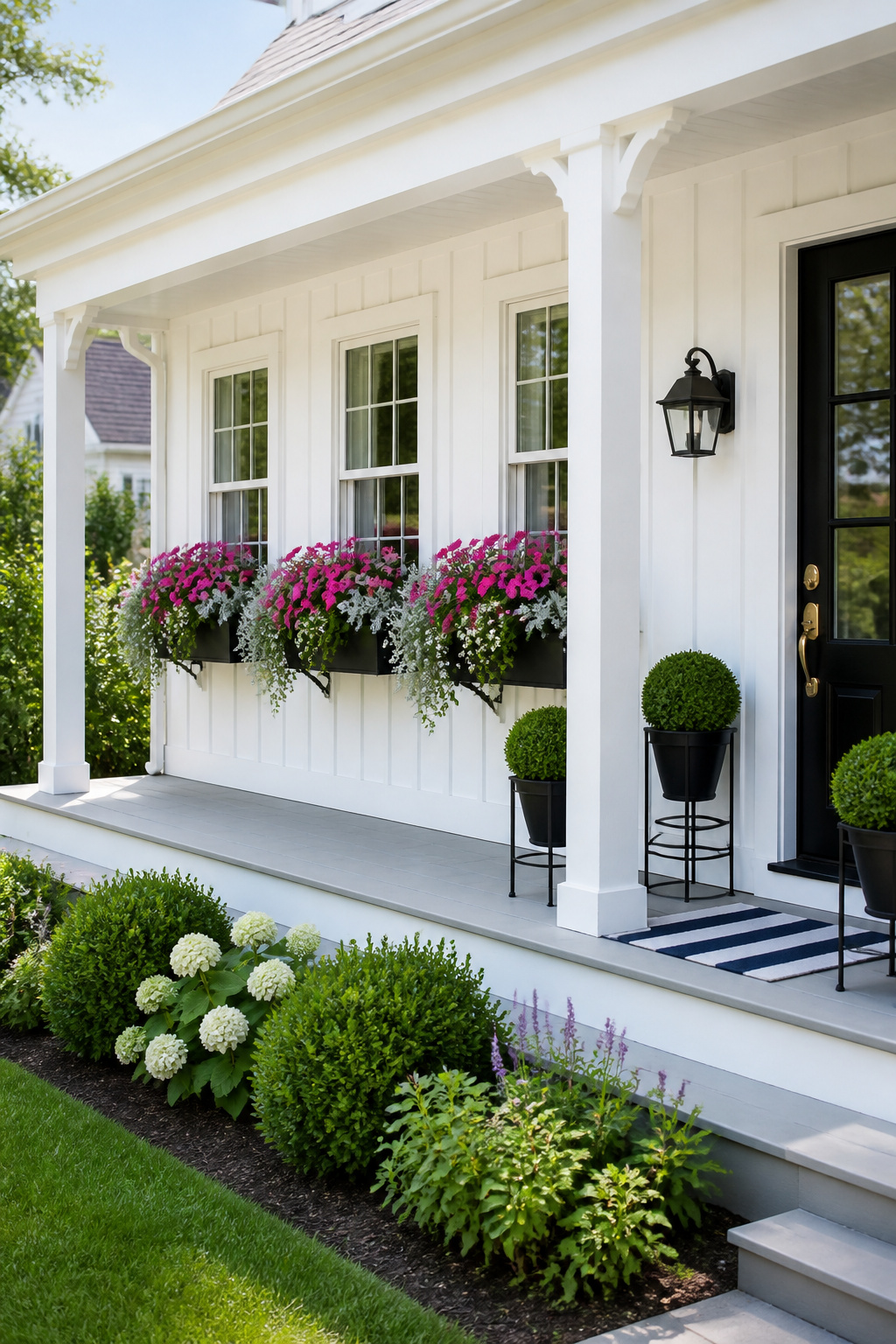
Weight is the practical consideration most people discover after installation. A fully planted and watered window box runs 15-25 kg. It must anchor to studs, not just siding. For wood siding, locate the studs and use L-brackets rated for at minimum 60 lbs per bracket for a standard three-foot box. For brick or masonry, use masonry anchors rated at twice the expected weight. Railing-mounted boxes are the easiest installation. Purpose-built railing hooks make them removable for seasonal replanting without any wall damage.
The seasonal rotation is what makes window boxes worth the installation effort. Spring: pansies and violas tolerate cold and arrive early. Pair with trailing lobelia for depth. Summer: petunias are prolific but need weekly feeding. Geraniums need less water. Fall: ornamental kale and cabbage create rich purple-green texture alongside mums. Winter: evergreen boughs, red twig dogwood stems, and pine cones last two to three months with no watering. Each seasonal swap takes about 20 minutes and $30-50 in materials.
8. Seasonal Front Porch Decorating Ideas That Change Year-Round
A porch that looks identical in February and October isn’t a designed space. It’s a room someone arranged once and forgot about. Seasonal front porch decorating doesn’t require complete reinvention every three months. It requires a permanent neutral base with a lightweight layer of seasonal personality swapped at each transition.
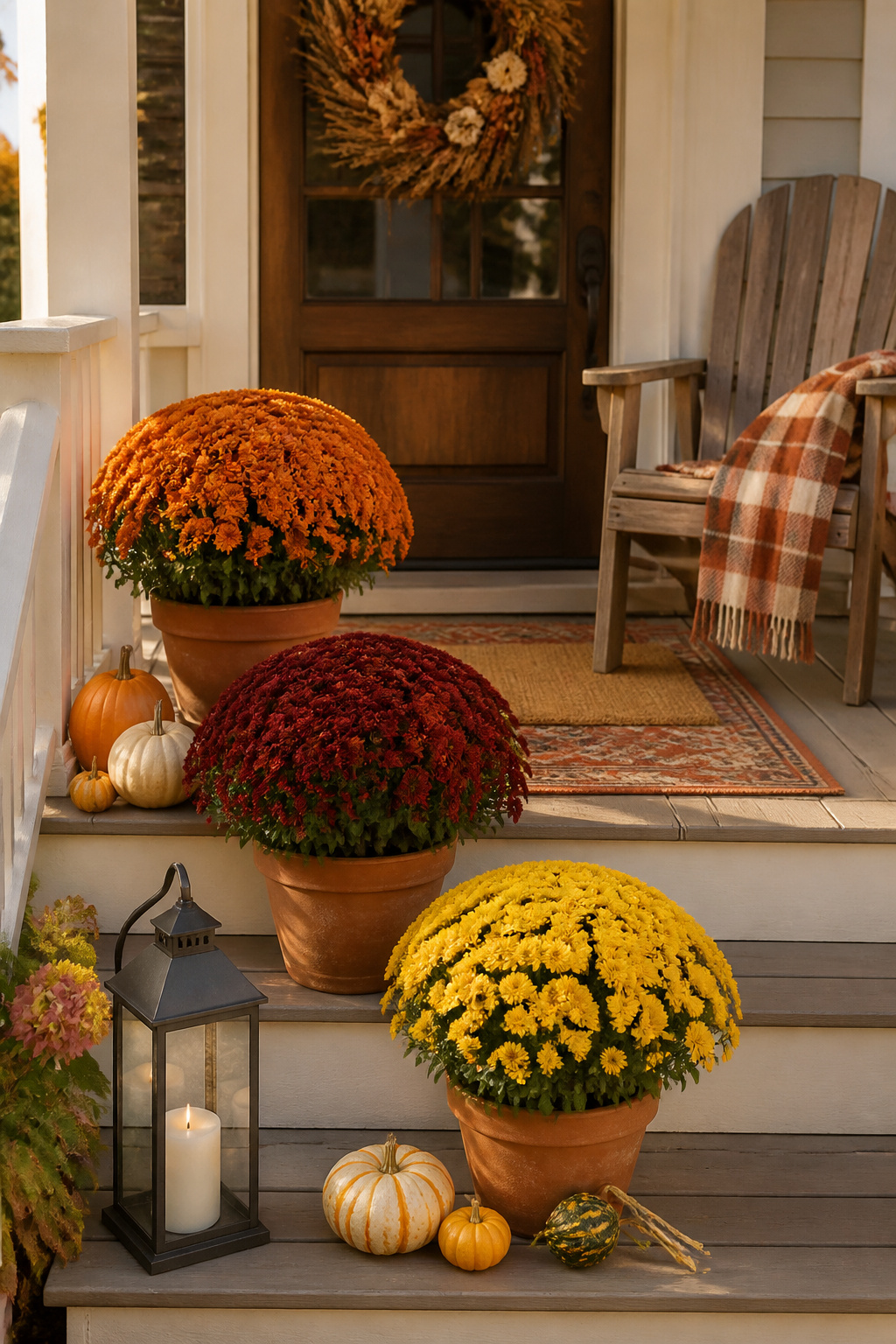
The permanent base stays year-round: furniture in neutral tones, an outdoor rug in a pattern that works across seasons, fixed lighting in a timeless finish. The variable layer consists of pillow covers (zip on and off existing outdoor-rated inserts), a seasonal wreath, and plants. Organized into labeled storage bins, the full swap takes under 30 minutes. Budget: $40-80 per transition, or less if you hold pieces from year to year.
Fall is the highest-stakes season. Ornamental mums, layered pumpkins and gourds in mixed sizes, a plaid or textured throw, and pillow covers in burnt orange or burgundy create the full effect. Don’t carve pumpkins more than a week before Halloween — carved pumpkins rot within days in temperatures above 60°F. Winter: strip fall pieces, add a simple evergreen garland, white lights, and a monochromatic wreath. Once explicitly holiday accents come down after December 26, the winter arrangement carries through February. For more front porch decorating ideas across different home styles and seasonal setups, front porch decorating ideas across home styles shows how these transitions look in practice.
9. A Haint Blue Ceiling That Connects You to Porch History
Paint your porch ceiling in a soft blue-green and you’re participating in a design tradition with genuine cultural depth. The practice comes from the Gullah Geechee people — descendants of enslaved Africans on the rice, indigo, and cotton plantations of South Carolina, Georgia, and Florida. They painted porch ceilings in a blue-green the color of water or sky. “Haints” are restless spirits caught between the living world and what lies beyond. The belief was that spirits couldn’t cross water. A ceiling painted to resemble it would keep them out. Whether or not you share that belief, you’re carrying forward a tradition rooted in one of America’s most important and underrecognized cultural heritages.
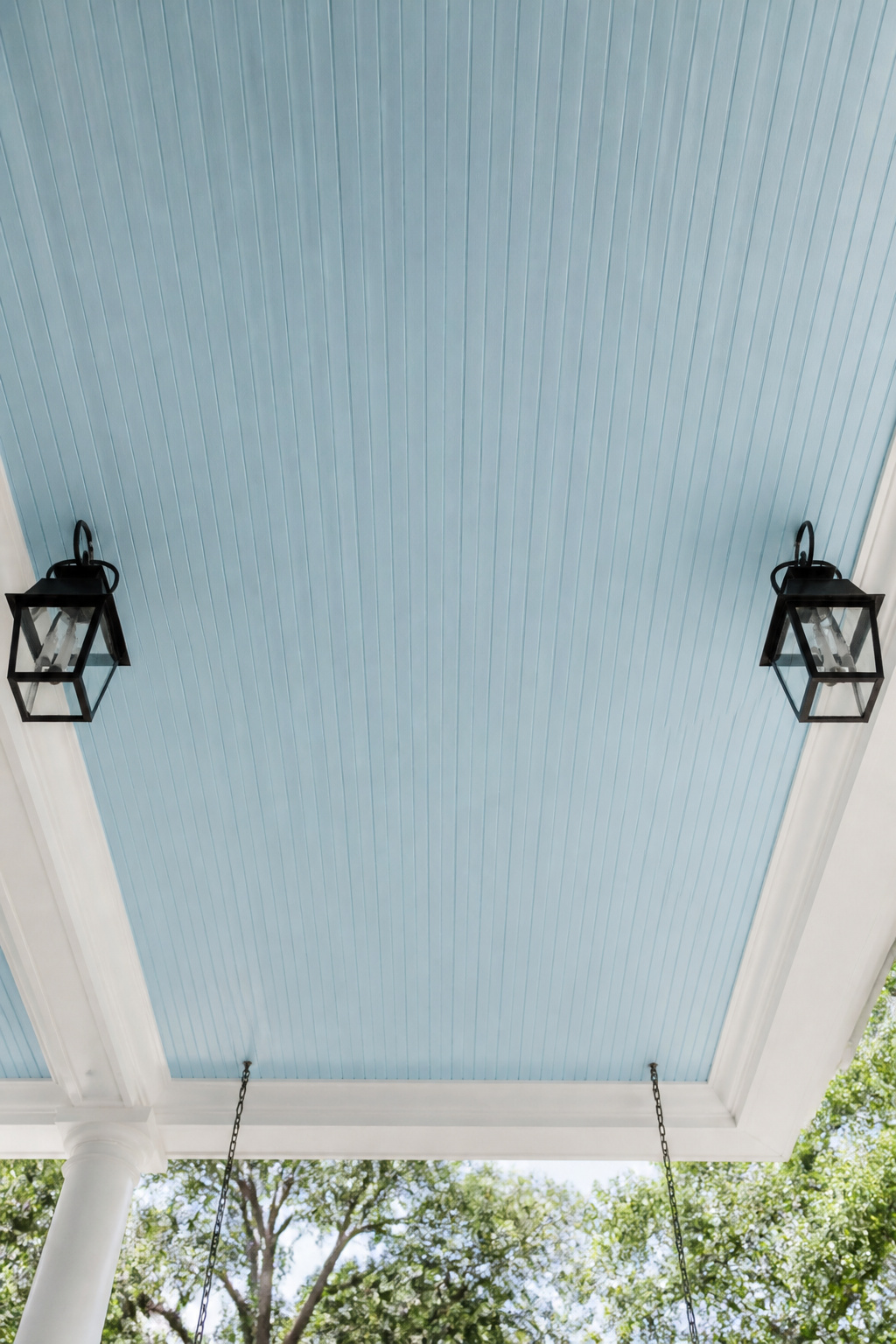
The original paint was made from indigo dye, lime, and milk. The lime had genuine insect-deterring properties. That practical benefit probably contributed to the tradition’s spread beyond its original cultural context. For color selection today, pale grey-blue like Sherwin-Williams Watery (SW 6211) or Benjamin Moore Blue Allure creates a sky-ceiling effect from below. It works with nearly any exterior color. Benjamin Moore Palladian Blue (HC-144) is the mid-range blue-green — the most recognizable “classic haint blue” that reads clearly as a color without overpowering. Farrow & Ball Dix Blue is the dramatic option. Use it on larger porches with strong white trim framing it cleanly.
One technical note: colors always read darker on a ceiling than on a paint chip. Test a large sample patch and evaluate from below at different times of day. Use exterior ceiling paint formulated specifically for porch applications — it includes mildew inhibitors and better adhesion for humid conditions. Satin sheen is right. Enough reflectance to bounce light back, not so glossy it shows every flaw. Materials for a 12×16 ft ceiling run $60-120. Few front porch decorating investments return more for less.
10. Pillows and Throws That Bring Your Front Porch Decor Together
Pillows and throws are the color story of a porch. They’re what the eye reads first from any seating distance. They’re the element that connects or fails to connect the door, rug, plants, and furniture into a coherent palette. And they’re the most affordable and easiest element to change — which means they’re where seasonal updates happen at the lowest risk.
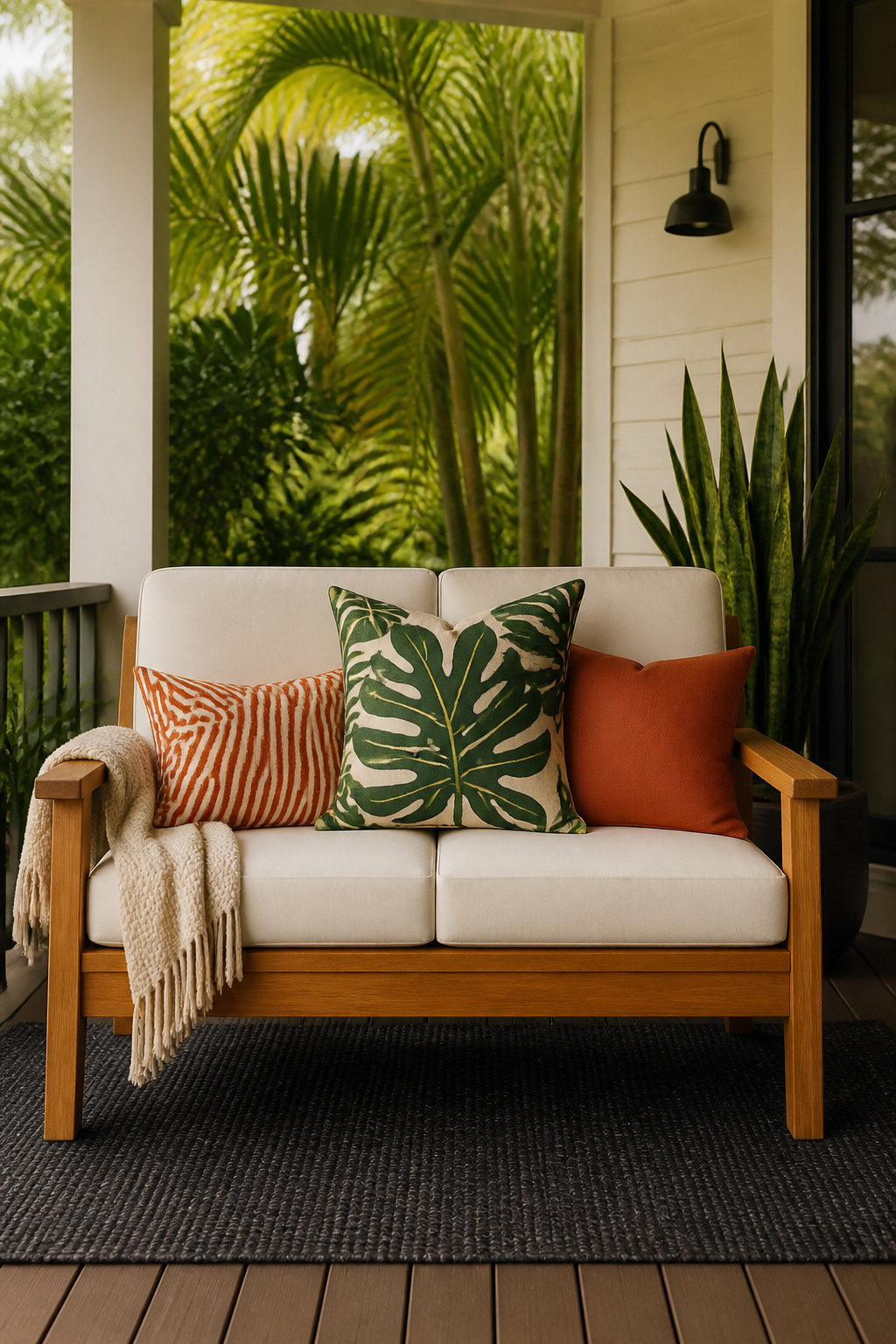
The one non-negotiable for outdoor textiles is solution-dyed acrylic. The difference between this and standard decorative fabric isn’t subtle. Solution-dyed means pigment is incorporated into the fiber before spinning — not surface-printed. UV exposure can’t bleach what’s embedded through the entire fiber. Sunbrella — the benchmark brand in front porch decor textiles — carries a 5-10 year warranty against fading depending on the line. Its tight weave leaves no space for mildew spores. It can be cleaned with diluted bleach without damage. Standard decorative pillows outdoors fade within weeks and mildew within a season.
Pattern mixing follows one rule: vary the scale. Mix a large-scale pattern with a medium-scale and a small-scale or solid. Keep all patterns within the same two or three color family. Place a solid pillow between every two patterned ones as a visual rest. Use odd numbers — three or five pillows per seating piece reads better than two or four. A throw draped asymmetrically over one chair arm or a swing rail signals that the space is genuinely used. That’s the detail that separates a styled porch from a lived-in one.
11. A Personality-Forward Doormat That Starts the Welcome Early
Every visitor steps on the doormat. It’s physically touched before they reach the door, and again as they leave. Yet it’s consistently the last thing people think about when designing their entry. A mat that’s too small, too faded, or wrong for its climate undermines everything else you’ve done to the porch.
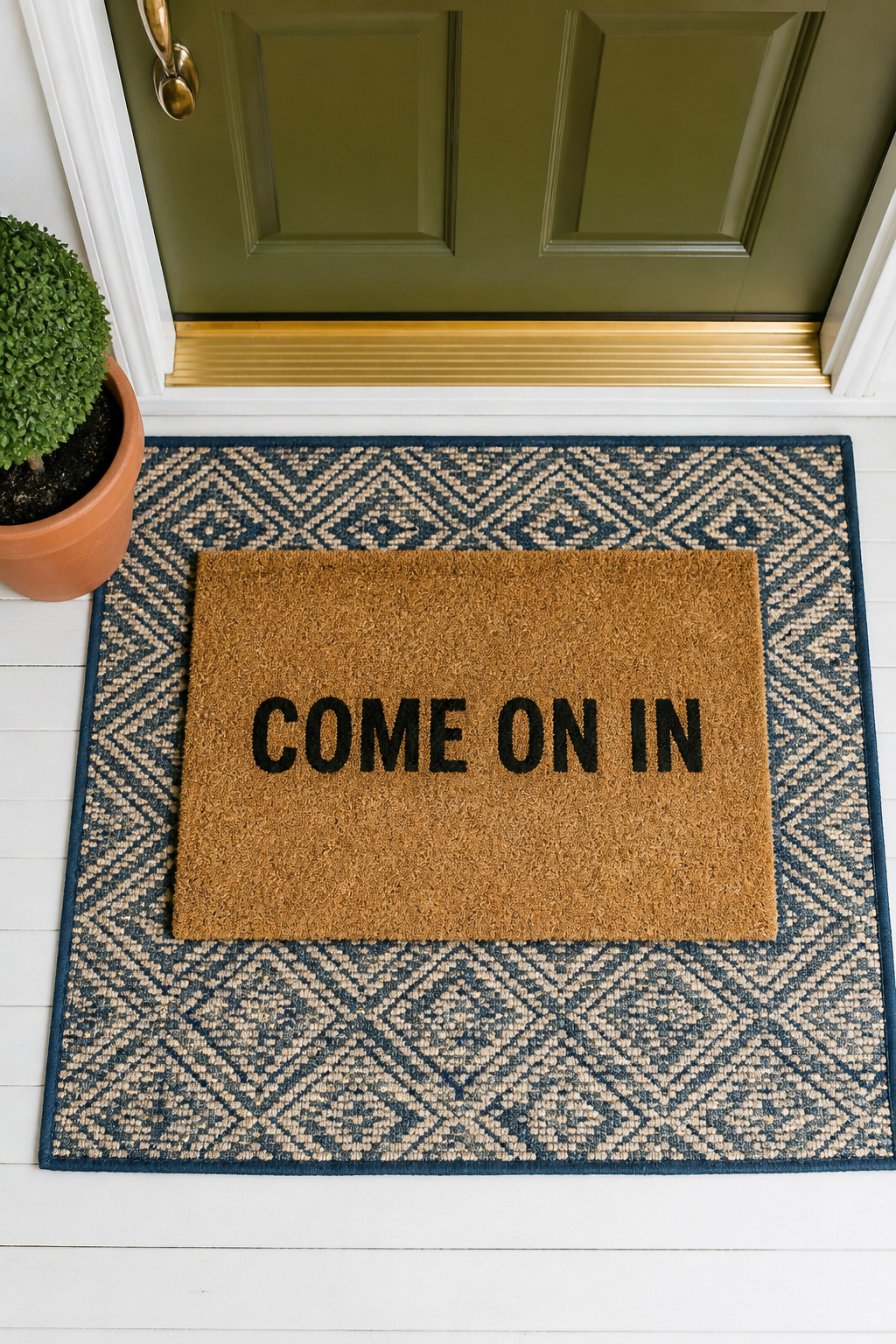
Sizing first. The mat should be at least as wide as the door. A 36-inch door needs an 18×30 mat at minimum. A 24×36 is better for single doors and required for doors with sidelights. The undersized mat is the most common and easiest-to-fix mistake on any otherwise well-composed porch. It always looks like a placeholder.
Material depends on climate and porch exposure. Coir — natural coconut fiber — has the best shoe-scrubbing action and looks beautiful. But it absorbs moisture slowly and dries even more slowly. On an exposed porch in a rainy climate, a coir mat stays permanently damp. In those conditions, faux coir (synthetic fibers in a coir-like weave) or rubber-backed synthetics are the correct choice. They resist water, hose clean in minutes, and last longer. For a covered porch in a dry climate, natural coir is excellent. The double-doormat technique is simple: place a large neutral mat as the base layer, then set a smaller personality mat on top closer to the door. For $30-50, the combination reads as deliberate design.
12. Climbing Plants and Vertical Greenery for a Lush Porch Entry
Vertical greenery is the design element that most clearly separates a decorated porch from a designed one. Adding climbing plants introduces a third plane beyond the floor and furniture level. It creates depth, frames the entry, and establishes a biophilic connection to living systems that no purchased decor can replicate. A well-established climber turns a flat facade into something dimensional and seasonal. This front porch decorating move is underused, underrated, and immediately visible from the street.
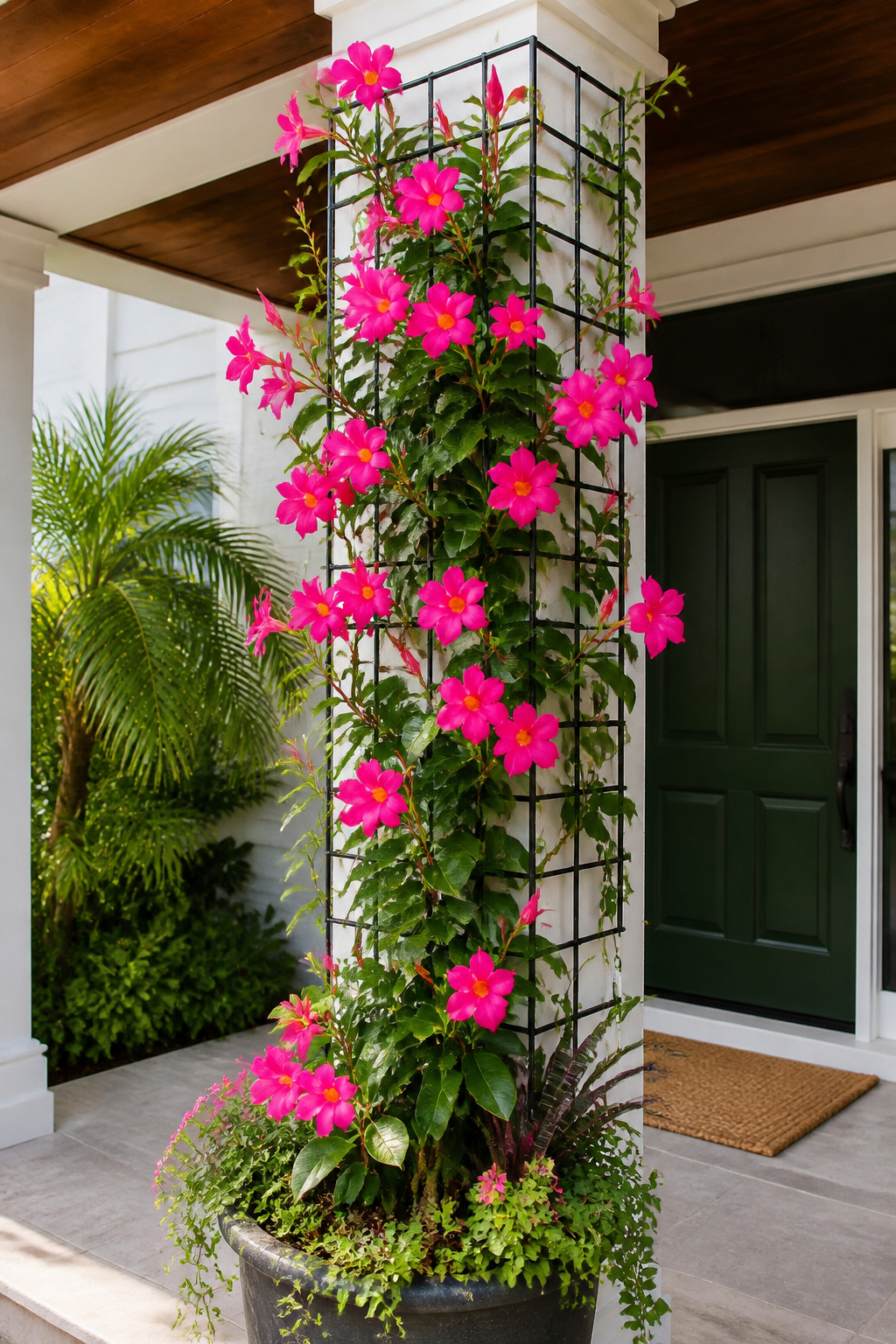
For container-grown climbers — the most practical approach where you don’t want permanent ground planting — mandevilla is exceptional. It grows 6-10 feet in one season in a large container with a trellis. It produces dramatic pink, red, or white blooms from late spring through fall. In zones below 9, treat it as a potted specimen: bring it in before frost or treat as an annual. Star jasmine is the subtler option for zone 8 and warmer. It’s powerfully fragrant in spring and more controlled in growth. Clematis climbs by wrapping leaf stems around thin supports — wire, twine, or narrow trellis slats. It comes in dozens of varieties for different seasons.
Avoid trumpet vine near any painted wood structure. It’s spectacular. It’s also invasive, roots into mortar and wood, and is nearly impossible to remove once established. For support, a freestanding trellis inside a large container has zero wall impact . You can move it seasonally. Wall-mounted trellises work well when held 1-2 inches off the surface with standoff spacers. That gap allows air circulation and protects the paint beneath. Never run vines directly against painted wood.
13. Porch Decor Lighting: Statement Fixtures That Work Day and Night
Hardwired porch fixtures are architecture before they’re decoration. They’re present in daylight as design elements and at night as functional anchors. An undersized or dated fixture quietly undermines everything else you’ve done to the entry. The professional guideline most homeowners don’t know: your porch light should be roughly one-third the height of the door. For a standard 80-inch door, that means a fixture about 26 inches tall. Two flanking fixtures should each be about one-quarter door height — roughly 20 inches.
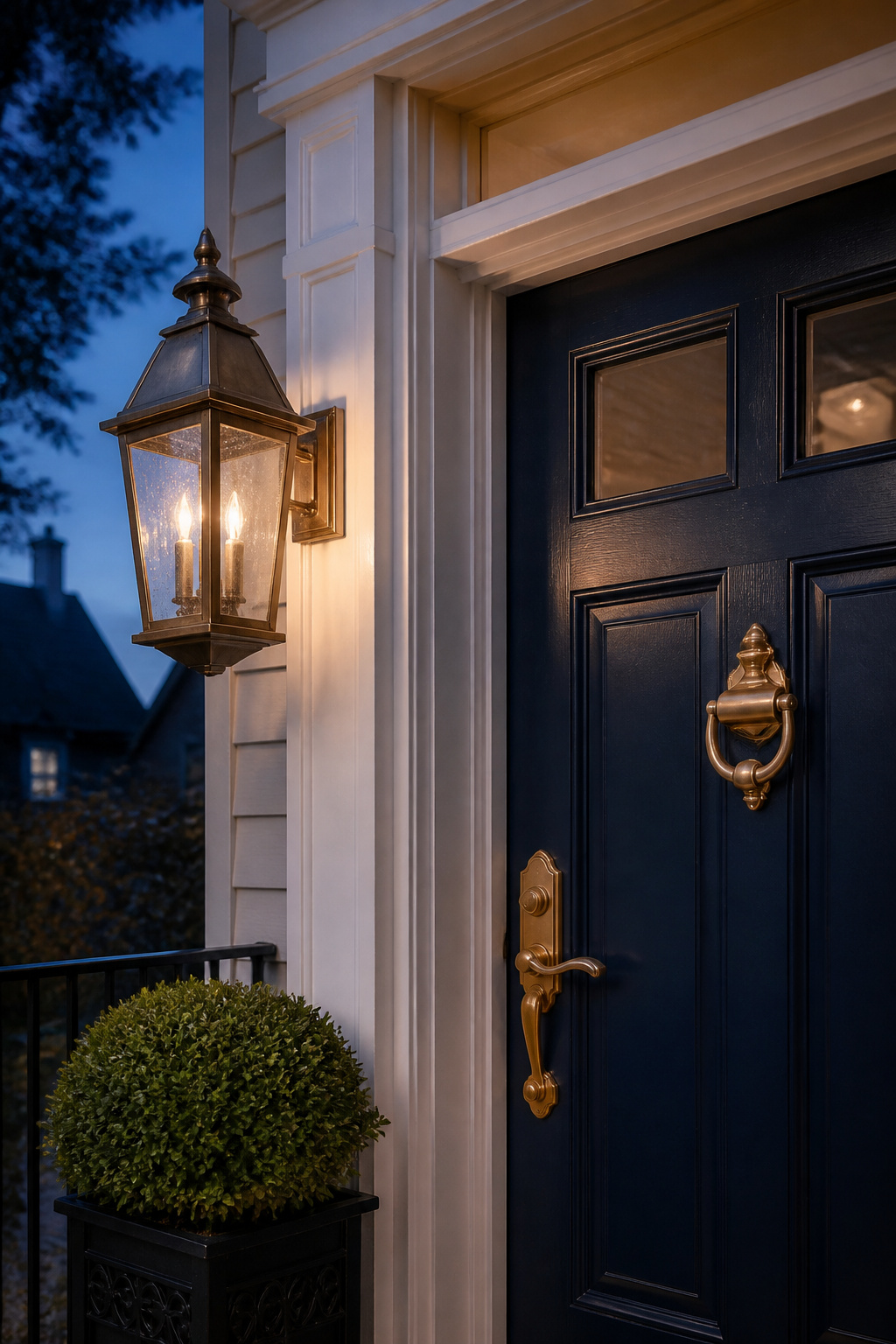
Finish coordination with door hardware is non-negotiable. A matte black fixture paired with polished chrome hardware reads as a mistake even when you can’t articulate why. Choose your fixture finish to match door hardware exactly — or replace both at once. Warm finishes (aged brass, oil-rubbed bronze, antique bronze) work with warm-palette facades. Cool finishes (matte black, satin nickel, brushed steel) suit cool-tone exteriors. Mount the fixture center at 60-65 inches from the floor, above shoulder height so it doesn’t shine directly into visitors’ eyes. IP65 minimum for covered porches.
Secondary porch decor lighting layers add depth. Step lights embedded in riser faces eliminate a safety hazard while adding ambient light at ankle level. Uplighting porch columns with low-voltage well lights creates drama that reads beautifully from the street. Solar path lights at 6-8 foot intervals frame the approach from the drive. Keep all sources at 2700-3000K — above 3500K reads as commercial and cold. When every lighting layer matches in color temperature, the whole porch glows as one cohesive warm space.
14. A Bistro Set or Side Table for a Genuine Morning Coffee Setup
A small table set for two is the most efficient signal that a porch is genuinely used rather than maintained. It transforms the entry from a threshold into a destination. That’s the difference: the porch where the morning coffee happens versus the porch that just exists. Front porch decorating for daily use , not just seasonal display — starts with giving yourself a reason to sit.
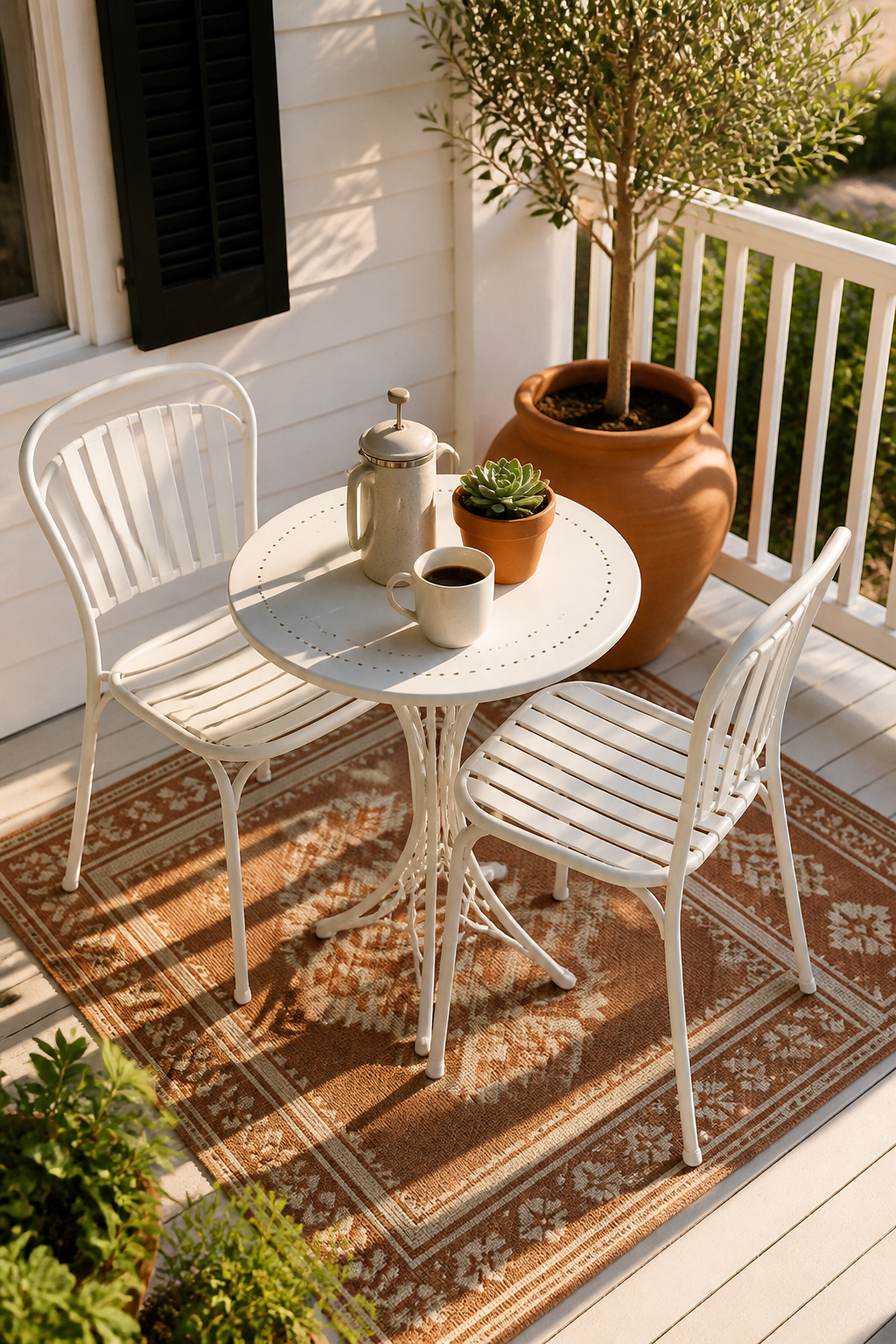
A standard 3-piece bistro set with a 24-inch round table fits in a 4×4 foot porch area. That means even small entry porches can accommodate one. Round tables work better than rectangular in tight porch spaces. They allow natural movement around them and have no corners catching people’s hips. For a porch too small for a full set, an 18-inch side table between two chairs creates the same functional effect.
Cast aluminum powder-coated in a durable finish holds up best with the least maintenance. It’s rustproof in coastal conditions. Lightweight enough to move easily. Looks as good in year seven as year one. A quality 3-piece cast aluminum set costs $200-450. Teak bistro sets run $600-1,200 but bring the same warmth and longevity teak delivers in any outdoor application. Wrought iron is beautiful but develops surface rust without annual treatment in anything but the driest climates. Check wicker frames before purchasing — steel frames rust at weld points in rainy climates; aluminum frames do not. For a broader look at how this outdoor-living mindset extends into larger outdoor spaces, patio pergola designs for mindful outdoor living shows how to apply the same approach at a full outdoor-room scale.
15. Architectural Details Revived With Paint, Hardware, and Trim
Before buying a single new piece of decor, look at what the porch already has. Most columns and railings are structurally sound for decades after they stop looking their best. The difference between a tired porch and a polished one is often a can of paint and an afternoon — not a renovation.
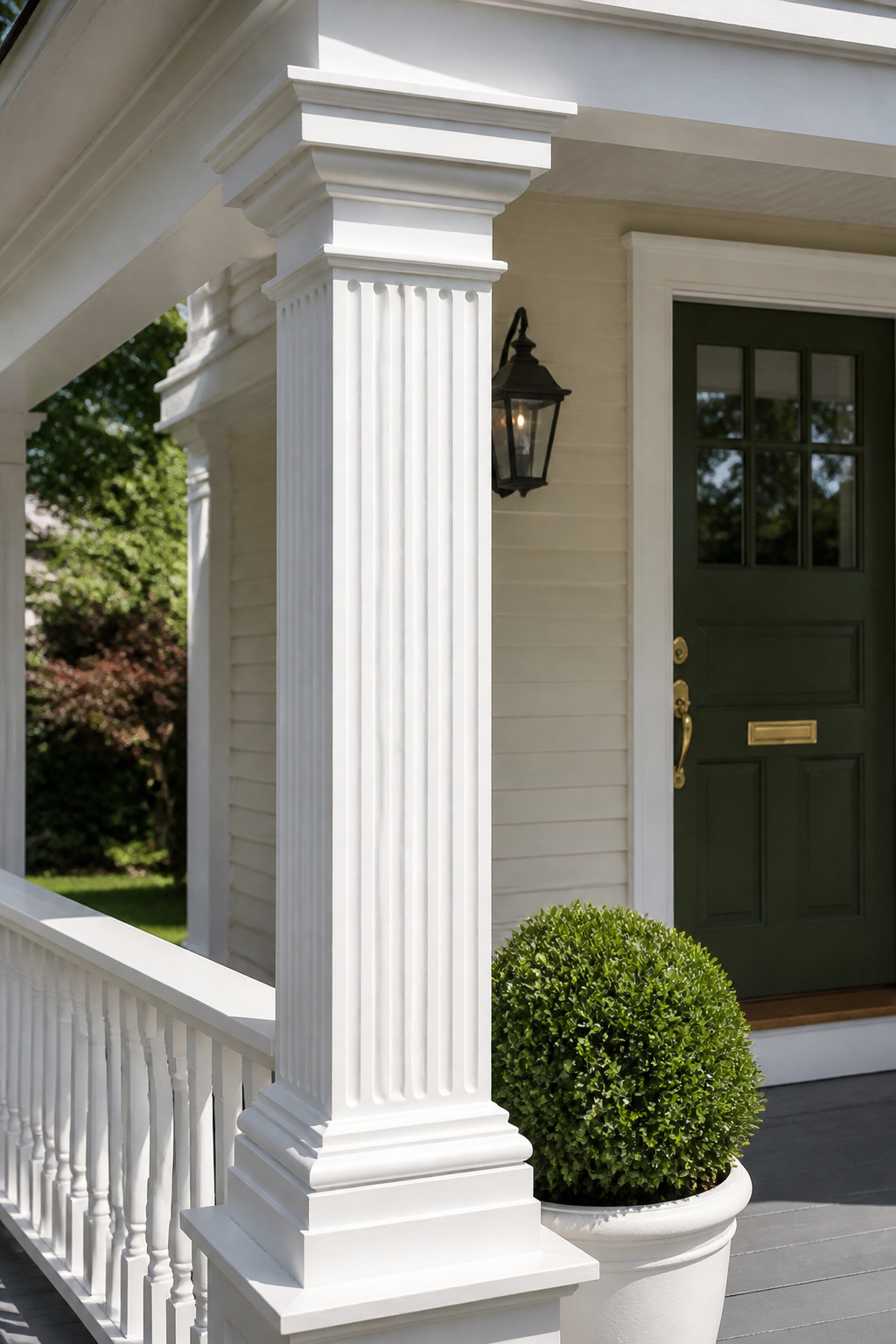
Fresh paint on trim and columns creates more visual impact per dollar than almost anything else in the exterior design toolkit. This is one of the best-kept secrets in front porch decorating. Use 100% acrylic latex exterior paint for all trim and millwork. It expands and contracts with temperature without cracking. It adheres properly to primed wood. It resists mildew. Quality formulations last 10-15 years.
For columns that have lost their shape to paint buildup or surface deterioration, PVC column sleeve wraps are a genuine solution. They slide over existing structurally sound columns in round, square, and tapered profiles. The result is a smooth fresh surface that never needs painting and never rots. Cost: $80-200 per column, versus $500-1,500 per column to replace. Pre-cast polyurethane column capitals and bases install with construction adhesive in under an hour at $30-80 per set. Decorative brackets under the porch soffit — $15-30 each in wood or PVC — add Victorian or Craftsman character in a Saturday-morning project. Choose a profile that matches the architectural era of your home and paint it in your trim color.
16. An Outdoor Mirror to Add Depth on a Narrow or Shaded Porch
Mirrors amplify light and create spatial depth indoors. They work by exactly the same principles outdoors. Yet almost no one uses them on porches. On a north-facing porch, a well-placed mirror can functionally double the perceived brightness. On a narrow porch, a mirror against the back wall creates an illusion of depth. Position it to reflect a planted area and it doubles your greenery for free.
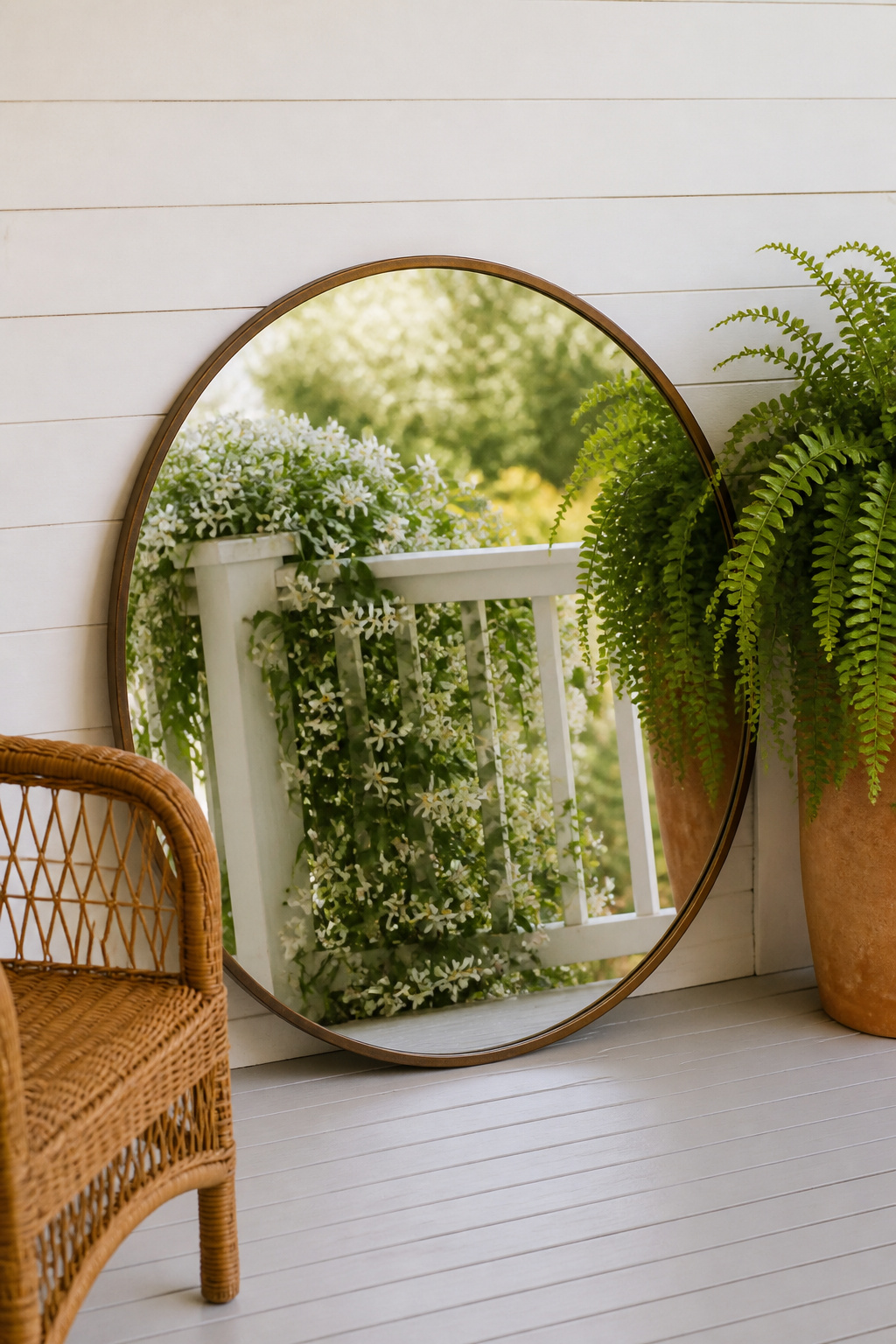
True outdoor mirrors use acrylic faces — vacuum-metallized from 99% pure aluminum. They’re shatterproof. UV doesn’t degrade them. Frames should be aluminum or powder-coated steel with corrosion treatment. Repurposed indoor glass mirrors in outdoor environments develop condensation between the glass face and the silver backing layer. This leads to black spotting — desilvering — within 1-3 years in humid conditions. An indoor mirror under a well-protected porch overhang in a dry climate might survive, but treat it as temporary.
For placement, orient the mirror to reflect a planted view or a light source. A mirror facing bare siding reflects nothing useful. Minimum size outdoors is 24×30 inches. Anything smaller gets lost against a porch backdrop. Lean rather than permanently mount where possible — the casual positioning looks intentional and avoids anchoring into exterior walls. Group it with a vertical planter or hanging plant for a living-wall vignette around the frame.
17. Tying It All Together With a Cohesive Front Porch Decorating Theme
The difference between a porch that looks designed and one that looks accumulated isn’t the number of elements or their individual quality. It’s whether those elements share a common thread. Cohesion doesn’t mean matching sets. It doesn’t require spending more. It means a visitor at the street can register a consistent palette, material language, and mood without consciously analyzing it. That quality of quiet intentionality is what front porch decorating ultimately builds toward.
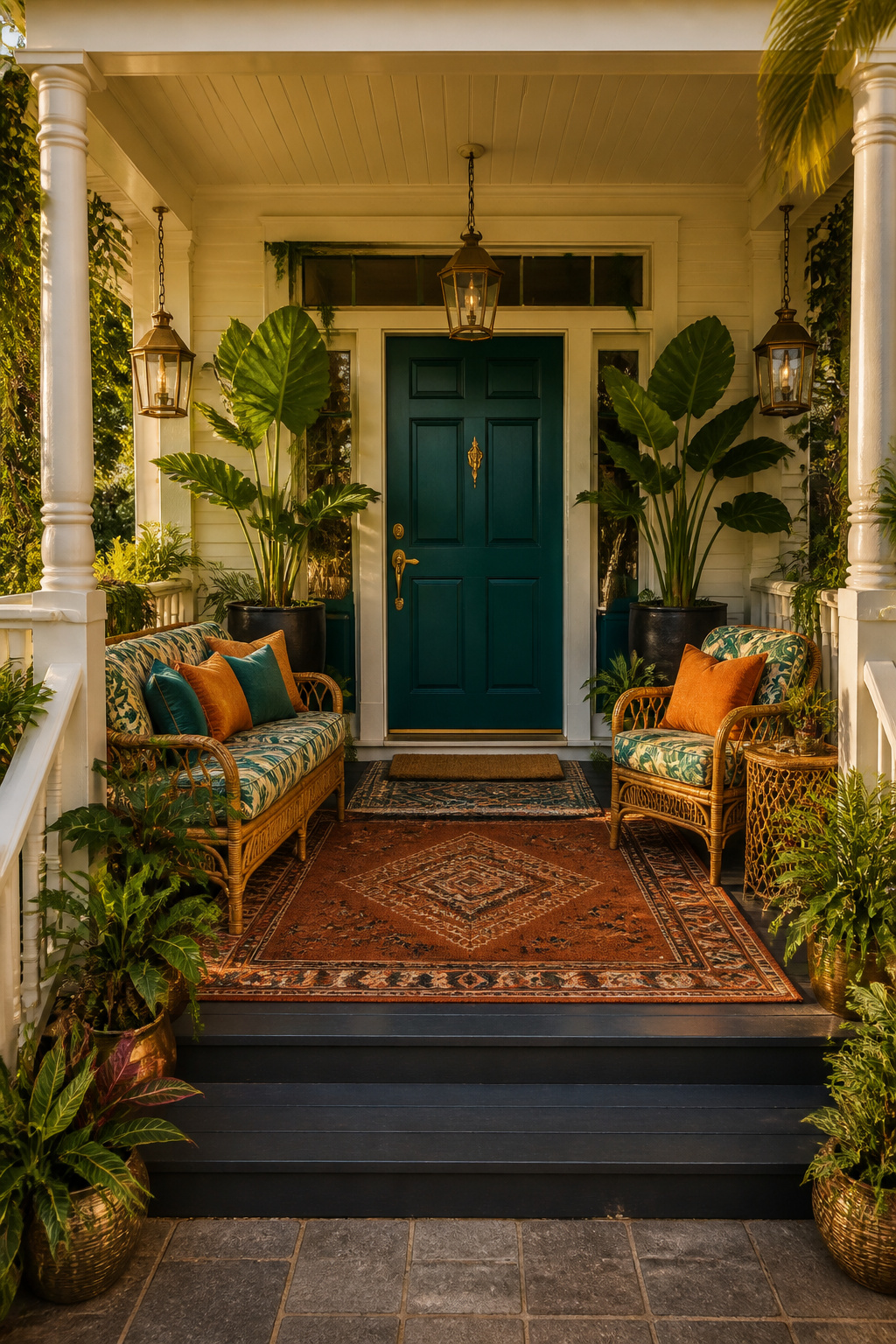
Three color rules before buying anything: maximum three colors plus neutrals, consistent undertone warmth or coolness throughout, and choose the palette from the rug before the pillows. One dominant material — natural wood, powder-coated metal, rattan and wicker — should appear in at least three distinct elements. Odd-number groupings in any display arrangement read as intentional. Even numbers read as paired objects.
Choosing Your Theme
Three themes execute cleanly across very different home styles. Coastal: whites and creams as base, navy or ocean blue as accent, natural rope and rattan textures, driftwood accessories. Works best on cape cod, cottage, and shingle-style homes. Farmhouse modern: black metal fixtures, hardware, and bistro set against natural wood tones, muted green plants, plaid textiles, galvanized planters. Versatile across craftsman, colonial, and farmhouse architecture. Tropical maximalist — the approach I return to most in my own practice — uses warm terracotta and deep greens with brass accents, large-leaf tropical plants in dark containers, woven rattan and bamboo, bold patterned pillows in jewel tones. It transforms any porch into a lush outdoor room.
The final step is the edit. After styling, remove one element. Then look again. Almost always the porch is better for what’s gone than for what remains. That subtraction reflex — remove rather than add — is the discipline that separates front porch decorating that looks professional from porch decorating that looks crowded.
Starting Your Front Porch Decorating Transformation: Priorities and First Steps
Every porch is different — different scale, different light, different architecture, different budget. But the sequence of decisions is consistent regardless.
Work in the Right Order
Start with structural and architectural elements first: paint the door, refresh the trim and columns, fix anything damaged. These decisions establish the bones everything else relates to. They’re the hardest to change once furniture and plants are arranged in front of them.
Lighting comes second. Hardwired fixtures are the anchor. String lights and secondary sources layer in around them. Get the permanent infrastructure in place before arranging furniture to obstruct it.
Furniture and rug create the room’s foundation. Choose materials that can live through your climate’s full annual range — a swing, bistro set, or two chairs and a side table establish what the porch is actually for. The rug defines the room boundary.
Plants, textiles, and seasonal accents come last. These evolve, rotate, and express the current season. They’re also the lowest-stakes choices. A pillow cover that doesn’t work costs $20 to replace. A structural decision costs a weekend to undo.
If you’re prioritizing by visual impact per dollar: door color and hardware for under $300 delivers the highest return of anything on this list. An outdoor rug and container gardens transform the space for $150-300. String lights and a haint blue ceiling together cost under $200 in materials and change how the porch reads at every hour of the day. From there, furniture, climbing plants, architectural refreshes, and seasonal displays build incrementally on a foundation that already looks considered.
The goal of front porch decorating isn’t a completed project. It’s a porch that becomes a daily ritual — the place where the morning coffee happens, where conversations extend later into the evening because the space is pleasant to stay in, where your neighbors slow down when they walk past. That’s what all of this is actually for.