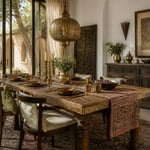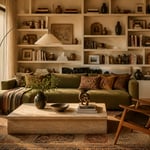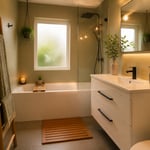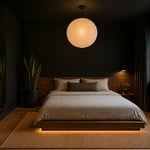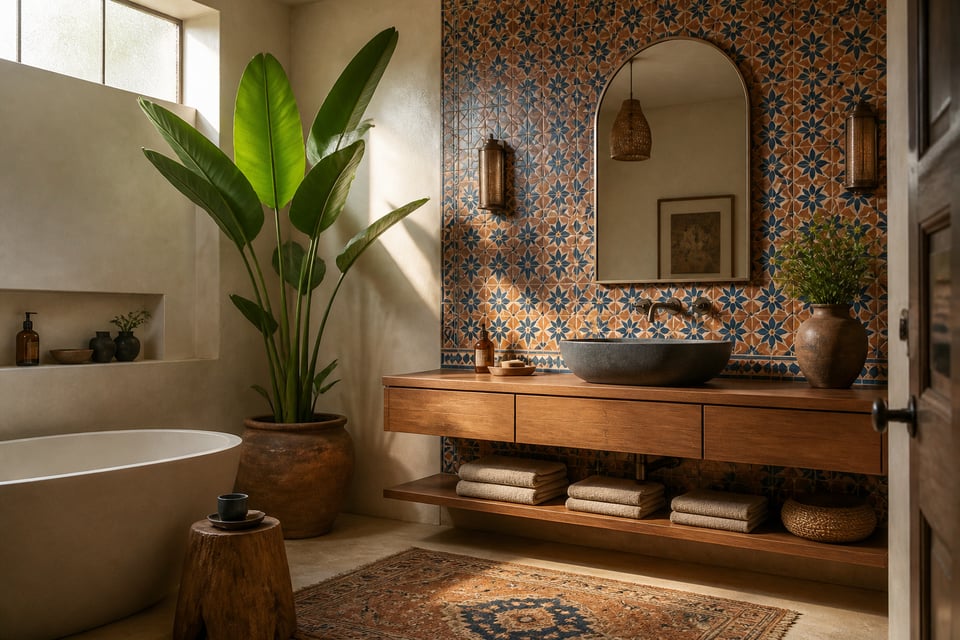
There is a particular kind of bathroom that stops you in your doorway. Not because it is expensive, or even especially large, but because it has a point of view. A considered set of bathroom decor themes does something that no amount of costly tile can do by itself: it gives a room a visual identity that feels designed rather than assembled. After years of helping clients weave global design traditions into spaces that genuinely work for contemporary life, I have come to believe that the bathroom is among the most rewarding rooms to commit to a theme. It is intimate enough that a single strong choice — a zellige feature wall, an apron sink, a botanical wallpaper — can carry an entire room. What follows is not a generic round-up. It is a curated guide to fifteen distinct bathroom decor themes, each with real roots, real materials, and real design logic behind it.
Mediterranean Bathroom Decor Theme: Terracotta, Warm Whites, and Mosaic Magic
A great Mediterranean bathroom does not try to recreate a Greek island villa or an Andalusian riad. Instead, it distils the emotional quality of those spaces — warmth, rootedness, the sense of a room lived in and loved — and expresses it through a handful of carefully chosen materials. Terracotta, limewash plaster, and hand-painted tilework are the primary vocabulary here, and each one rewards close attention to detail.
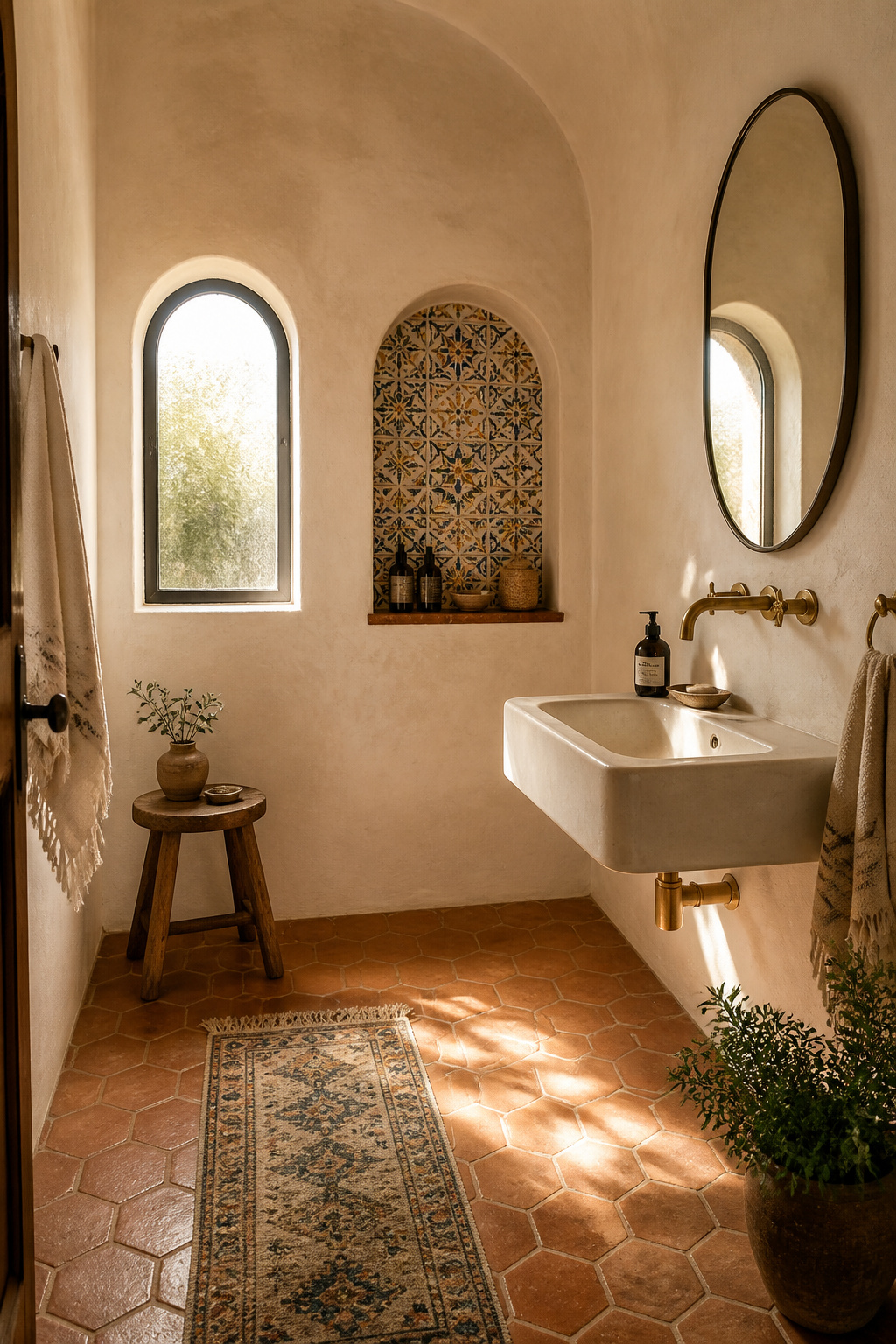
In practice, the first thing to understand about terracotta is that its warmth is structural rather than decorative. A terracotta hex floor in an unglazed, sealed finish absorbs and radiates heat differently from ceramic — it makes the room feel grounded rather than clinical. Pair it with limewash paint (a genuine lime-based finish, not a latex imitation) in a warm sandy white on two or three walls, and the Mediterranean bathroom theme begins to emerge before a single decorative tile appears.
Hand-painted Talavera tiles bring the room to life precisely because of their imperfections. Each tile is slightly different in colour, weight, and surface texture. Used as a niche surround, a single backsplash band, or a basin tile, they do the curatorial work that the rest of the room — more restrained in its patterning — allows them to do. Arched mirror frames and shallow arched niches pressed into plaster reinforce the architectural vocabulary without requiring major structural changes.
One crucial editing note: resist the pull of the themed bathroom shop. One bold Talavera moment, a well-chosen brass tap, and limewash walls will always outperform a room decorated with painted ceramics on every surface. The Mediterranean tradition is about warmth and honesty of material, not density of ornament.
Japandi Fusion: Where Japanese Wabi-Sabi Meets Scandinavian Simplicity
The Japandi bathroom is sometimes misread as simply a minimal bathroom — stripped back, white, empty. In practice, authentic Japandi is the opposite of empty. It is a room built from texture: rough-hewn stone, the visible grain of solid timber, the particular roughness of undyed linen. What it strips away is unnecessary decoration, not material richness.
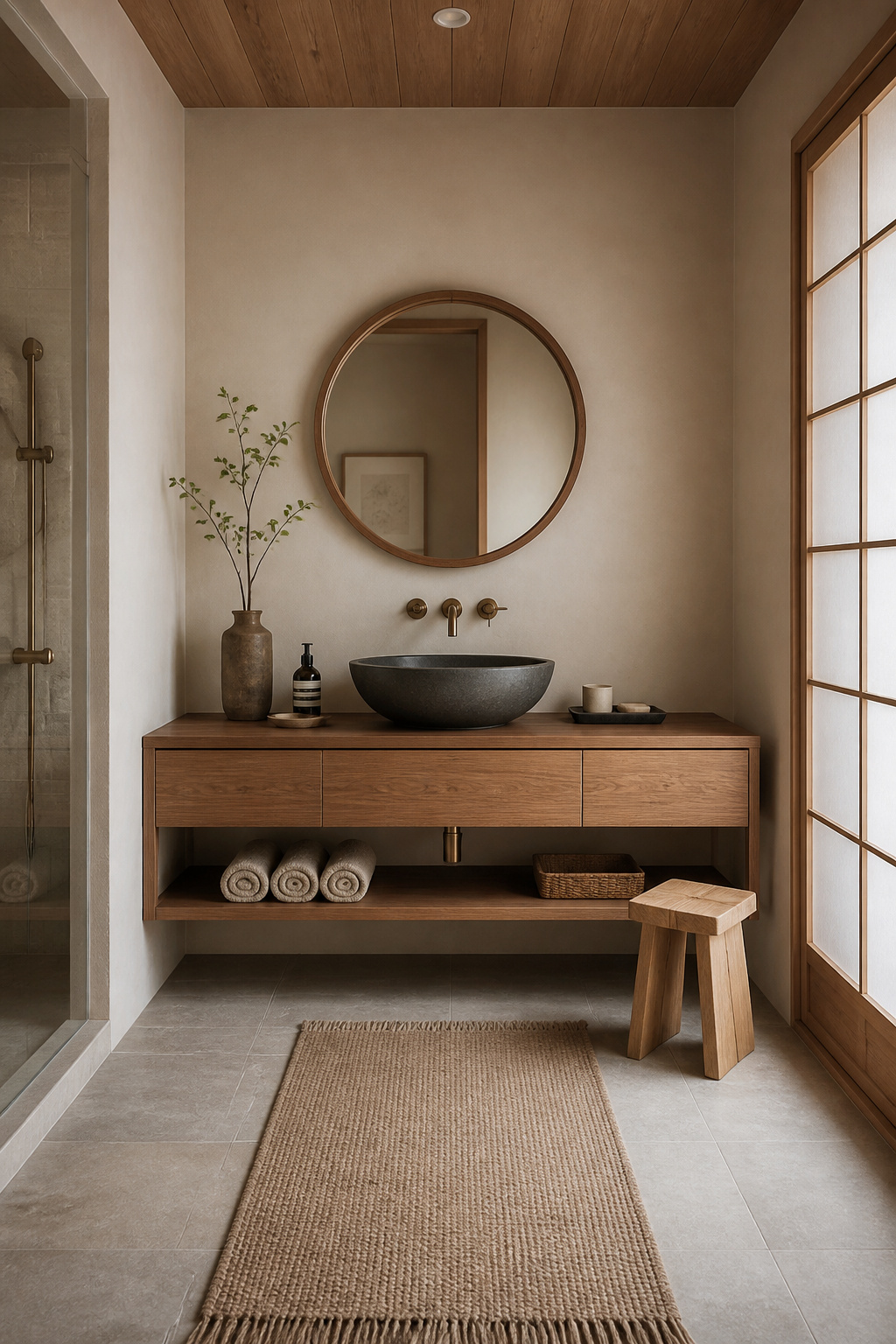
The philosophical meeting point of Japanese wabi-sabi and Scandinavian hygge is more coherent than it might first appear. Both traditions share a foundational respect for natural materials and a wariness of purely decorative accumulation. Wabi-sabi supplies the acceptance of imperfection — the hand-pressed irregularity of a matte stone basin, the slight unevenness of a plaster wall. Hygge, meanwhile, supplies the warmth that prevents those same rooms from reading as severe. You can explore the Scandinavian dimension of this bathroom aesthetic in depth through these Scandinavian bathroom design ideas that map the hygge influence clearly.
In practice, the Japandi bathroom pivots on a wall-hung vanity with a clean floor reveal, paired with a matte stone vessel basin that functions as a sculptural object in its own right. Hinoki (Japanese cypress) accessories bring both aroma and moisture resistance that other bathroom woods cannot match. Brushed warm brass or aged iron hardware sits closer to the tradition than matte black, which reads as a contemporary trend overlay. Texture, not emptiness, is the whole point — and that is the distinction that separates a genuinely Japandi bathroom decor scheme from a merely minimal one.
Vintage Parisian: Gilded Frames, Marble Floors, and Belle Époque Charm
The Parisian bathroom operates on a principle that very few contemporary interiors have the confidence to apply: the idea that imperfection, age, and patina are more beautiful than newness and polish. A slightly worn gilded trumeau mirror, a marble floor that has developed its own quiet history, a pedestal sink whose ceramic has warmed from clinical white to ivory — these are assets, not defects.
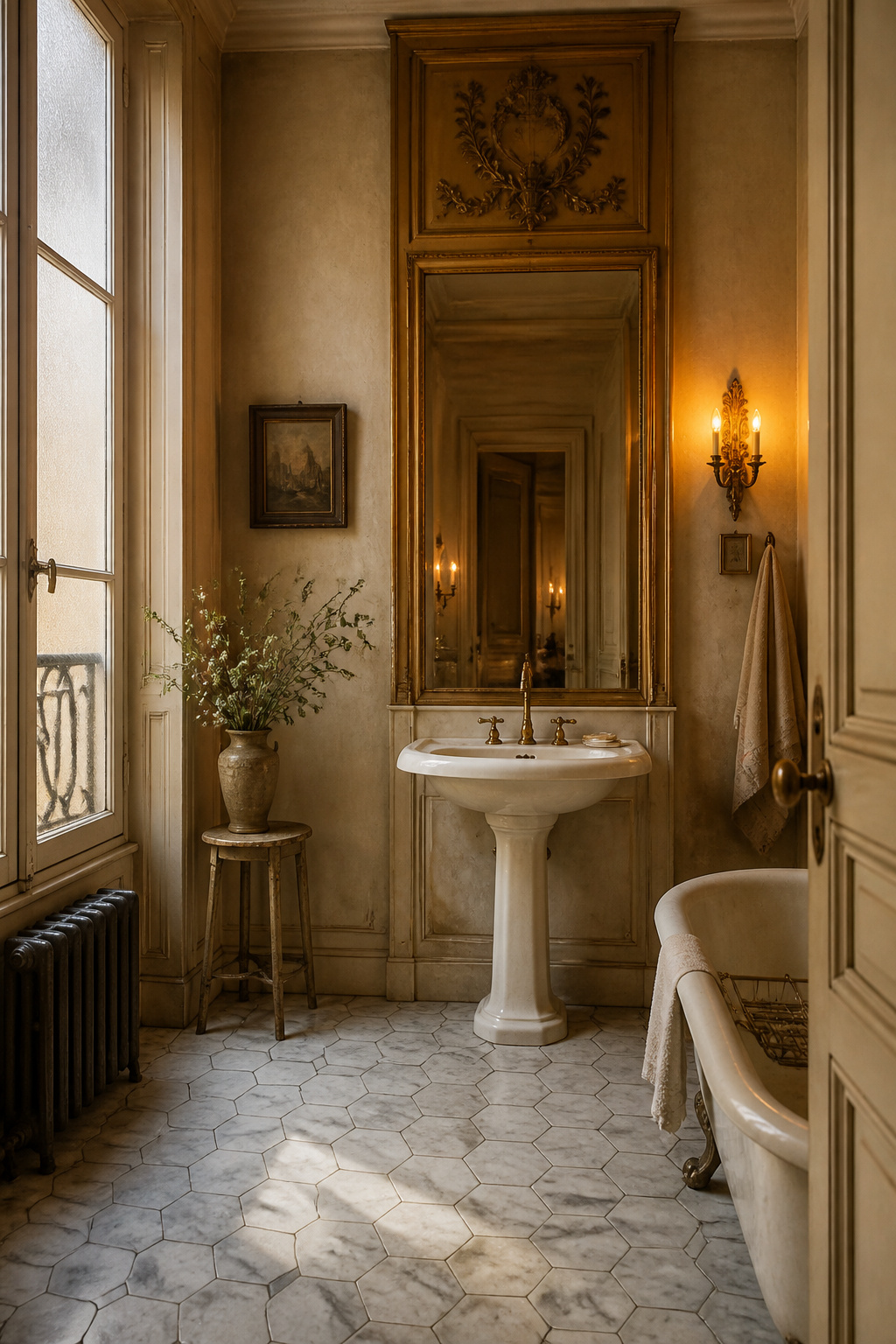
The architectural foundation is Carrara marble in hexagonal format, either one-inch or two-inch hex. The softer grey veining of Carrara suits the restrained Parisian palette better than the bolder drama of Calacatta, and it is significantly more affordable without sacrificing anything essential. A pedestal sink in the 24-inch width — the European proportion more authentically Parisian than the larger American formats — creates a visual lightness that a vanity unit never quite achieves. Above it, a trumeau mirror with a gilded frame anchors the room with unmistakable period character. For vintage bathroom design ideas layered with period character and honest material choices, this aesthetic rewards careful sourcing over speed.
A telephone-style bridge faucet in unlacquered brass or aged nickel completes the plumbing picture. These faucets patinate over time in exactly the same way as the rest of the room — darkening at points of contact, developing subtle variation. That quality of authentic aging is precisely what gives the Parisian bathroom its curated sense of history. Every fixture feels as though it has been there a while, quietly accumulating character.
Coastal Bathroom Theme: Linen, Bleached Wood, and Ocean-Hued Tiles
The coastal bathroom that works in 2026 has released its grip on the anchor, the rope coil, and the navy-stripe shower curtain. What replaces them is drawn from the shoreline itself: the nuanced ochres of bleached dune grass, the grey-green of sea glass tumbled smooth, the bone-white of a sun-dried shell. These are not decorating ideas so much as colour memory, and they create a very different kind of room from the nautical theme shop.
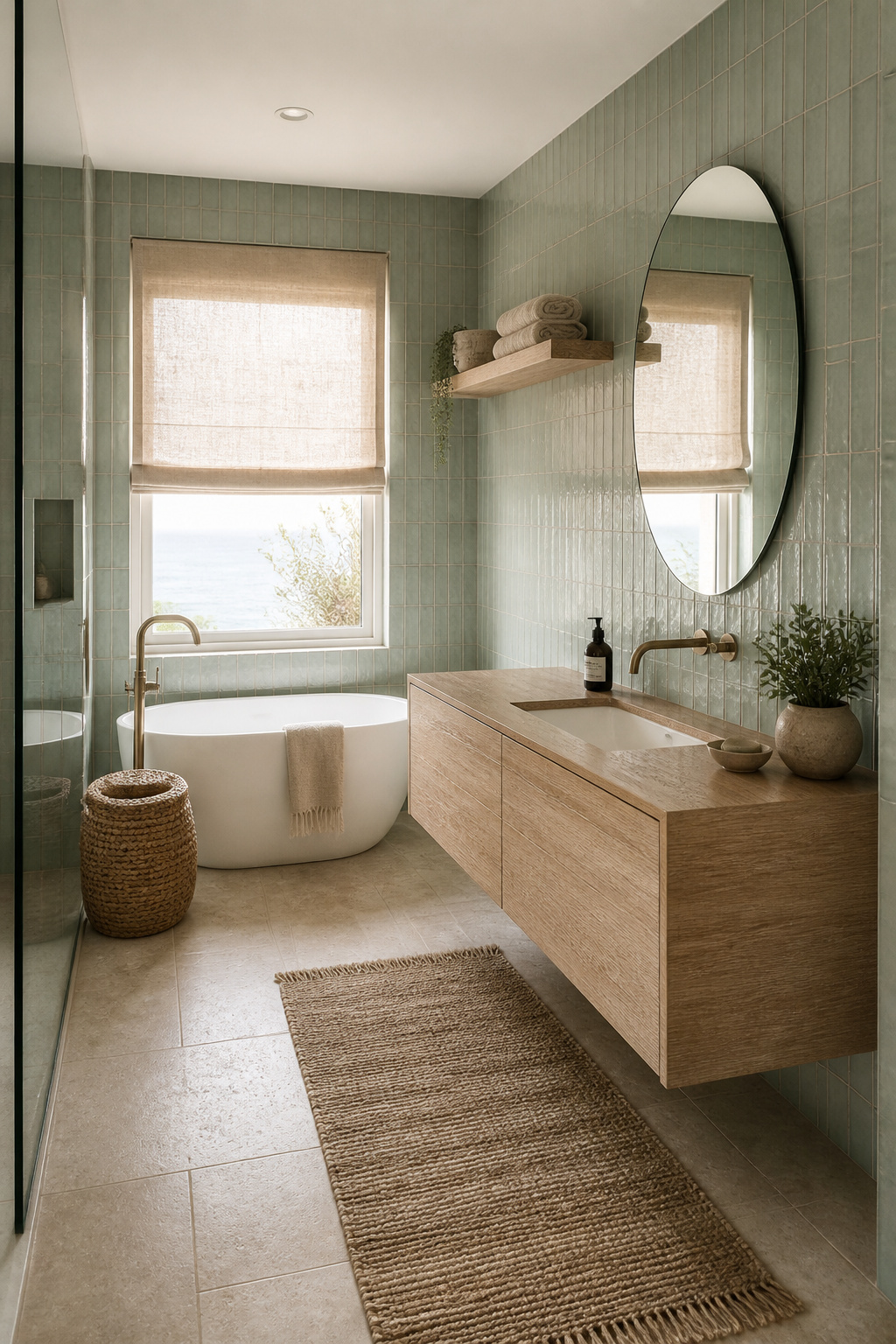
The material foundation for a refined coastal bathroom theme is teak — specifically, furniture-grade teak that has not been heavily varnished. Teak contains natural silica and oils that make it exceptionally mould-resistant without annual sealing interventions, and it improves in character as it weathers. Pair a teak vanity or floating shelf with sea-glass green wall tiles — seafoam, sea-mist, or chalky sage rather than pure aqua — and unbleached linen Roman blinds that diffuse light without blackout density. There are excellent executions of this palette in these coastal bathroom ideas that map the refined aesthetic clearly.
The final layer is light handling. A coastal bathroom’s success depends on its relationship with natural light — the quality of morning sun through a linen panel is central to the experience. If privacy is a concern, frosted glass in the lower pane of a window is far more sympathetic than a full blackout blind. The organic colour palette does the emotional work. The light lets it breathe.
Artisanal Moroccan: Hand-Hammered Brass, Zellige Tiles, and Riad-Inspired Arches
Zellige tile — handcrafted in Fes, Morocco using techniques refined over eight centuries — is one of the design world’s most distinctive materials, and one of the most frequently misrepresented. The characteristic that makes zellige worth specifying is also the characteristic that mass-produced imitations destroy: irregularity. Each zellige tile is hand-cut and hand-glazed, with deliberate variation in colour, surface angle, and size. When light moves across a zellige wall, the reflections shift constantly, creating a living surface that machine-made tile cannot replicate.
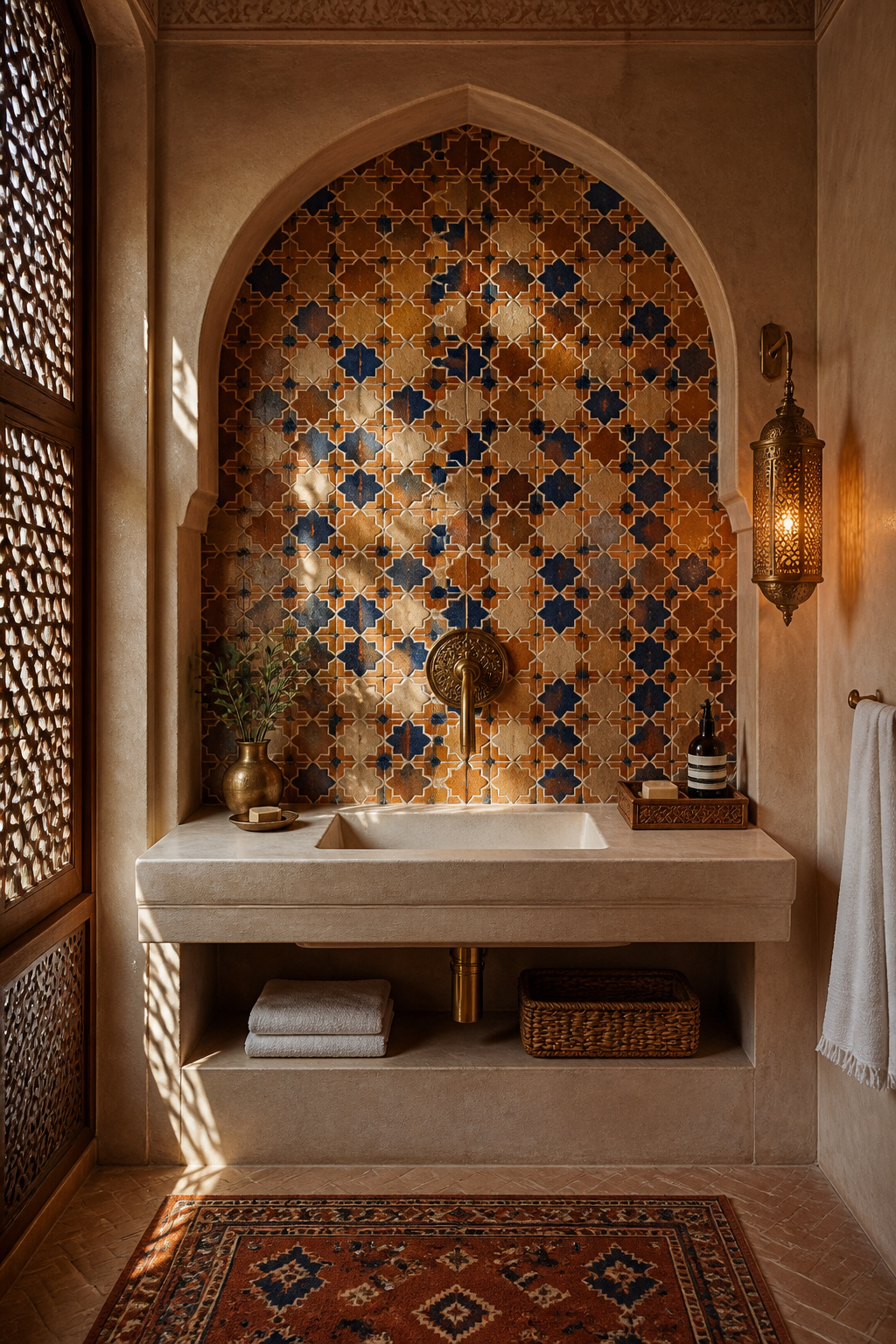
In a bathroom, zellige works best as a focused statement rather than an all-over treatment. A feature wall behind the basin, a shower enclosure, or a niche surround gives the tiles enough visual territory to perform without overwhelming a room that also needs to function as a calm morning space. Pair them with tadelakt — the traditional Moroccan polished lime plaster — on adjacent walls. Tadelakt is waterproof, beautifully textured, and has been used in hammam settings for centuries, making it one of the most functionally appropriate bathroom wall finishes available.
One installation note worth knowing: zellige must be soaked in water for one to two minutes before installation, and the grout line should be kept minimal. The deliberate variation in height between tiles is the point, and wide grout lines negate the handmade character immediately. Source from specialist importers rather than mass-market tile retailers. The difference in quality is visible from across the room.
Dark and Moody Victorian: Jewel Tones, Black Hardware, and Statement Wallpaper
The dark bathroom is a genuine act of curatorial confidence, and this bathroom decor theme suits the small-scale intimacy of most bathrooms better than any other room in the house. Dark walls — forest green, deep sapphire, ink navy, jewelled burgundy — feel cocooning rather than oppressive, provided the lighting does its part. The mistake that produces gloomy bathrooms is not the dark colour. It is the single overhead light fixture.
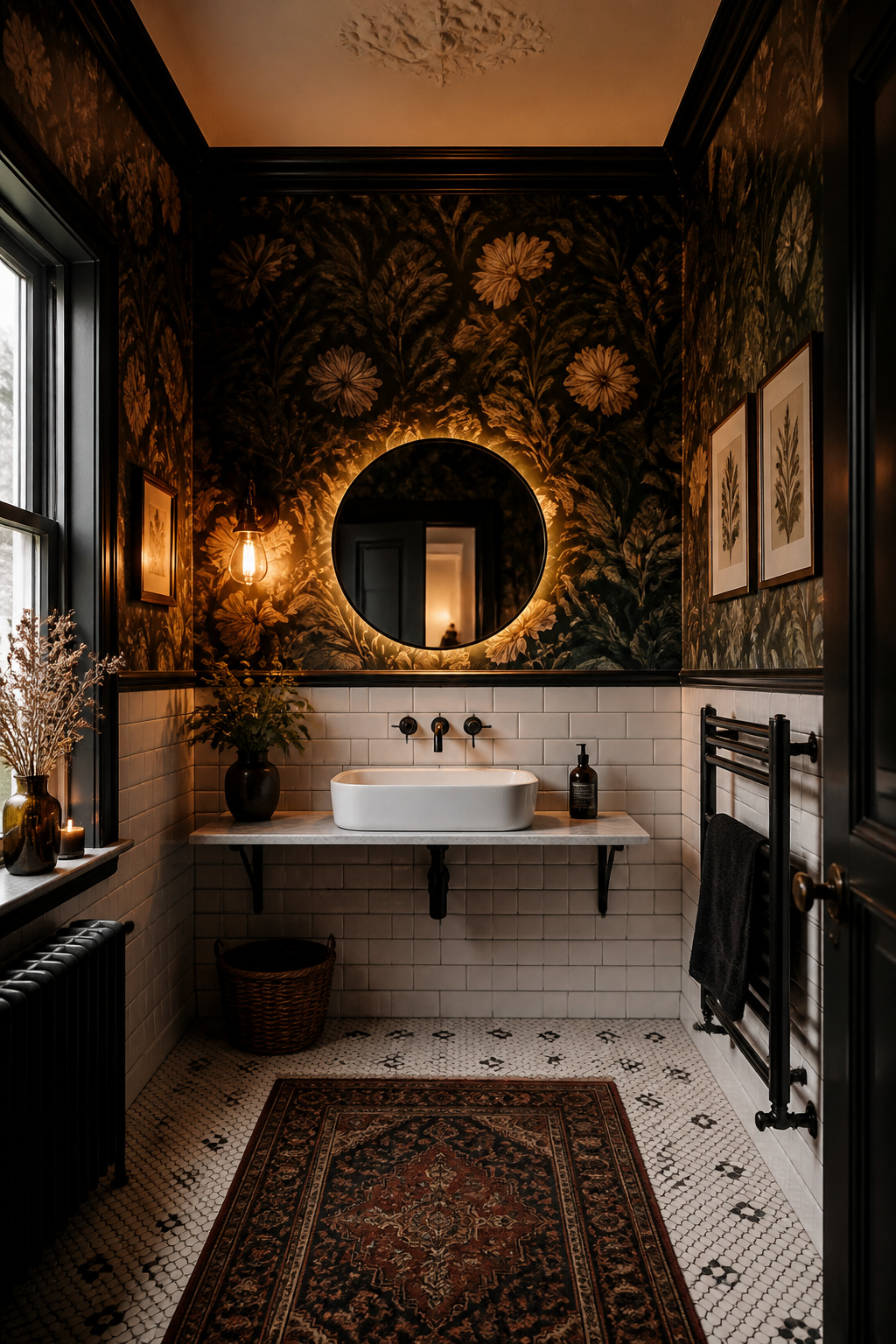
Victorian dark bathrooms deploy jewel tones with bold commitment: the ceiling painted in the same deep hue as the walls, turning the room into an immersive colour experience. Botanical wallpaper in a dark colourway works well in bathrooms when specified in a vinyl-backed, moisture-resistant format confirmed by the manufacturer for steam environments. Subway tile with charcoal or graphite grout below the dado, and wallpaper above, is the more practical alternative that still achieves significant period drama.
Matte black hardware — taps, towel rails, shower fittings, mirror frame — sits better against dark walls than polished chrome, which reads as a cold interruption. The lighting strategy must compensate: wall sconces at mirror height, warm-spectrum bulbs at 2700K or below, and LED strip lighting behind a mirror for glow. Layered at different heights, this transforms a moody room into a dramatically functional one.
Biophilic Bathroom Aesthetic: Living Walls, Stone Basins, and Natural Light
The bathroom finds its most natural application of biophilic design principles precisely because the room already has three of the six essential biophilic conditions: water, natural light, and air circulation. The goal is to work with those conditions rather than fighting them with clinical tile and synthetic finishes.
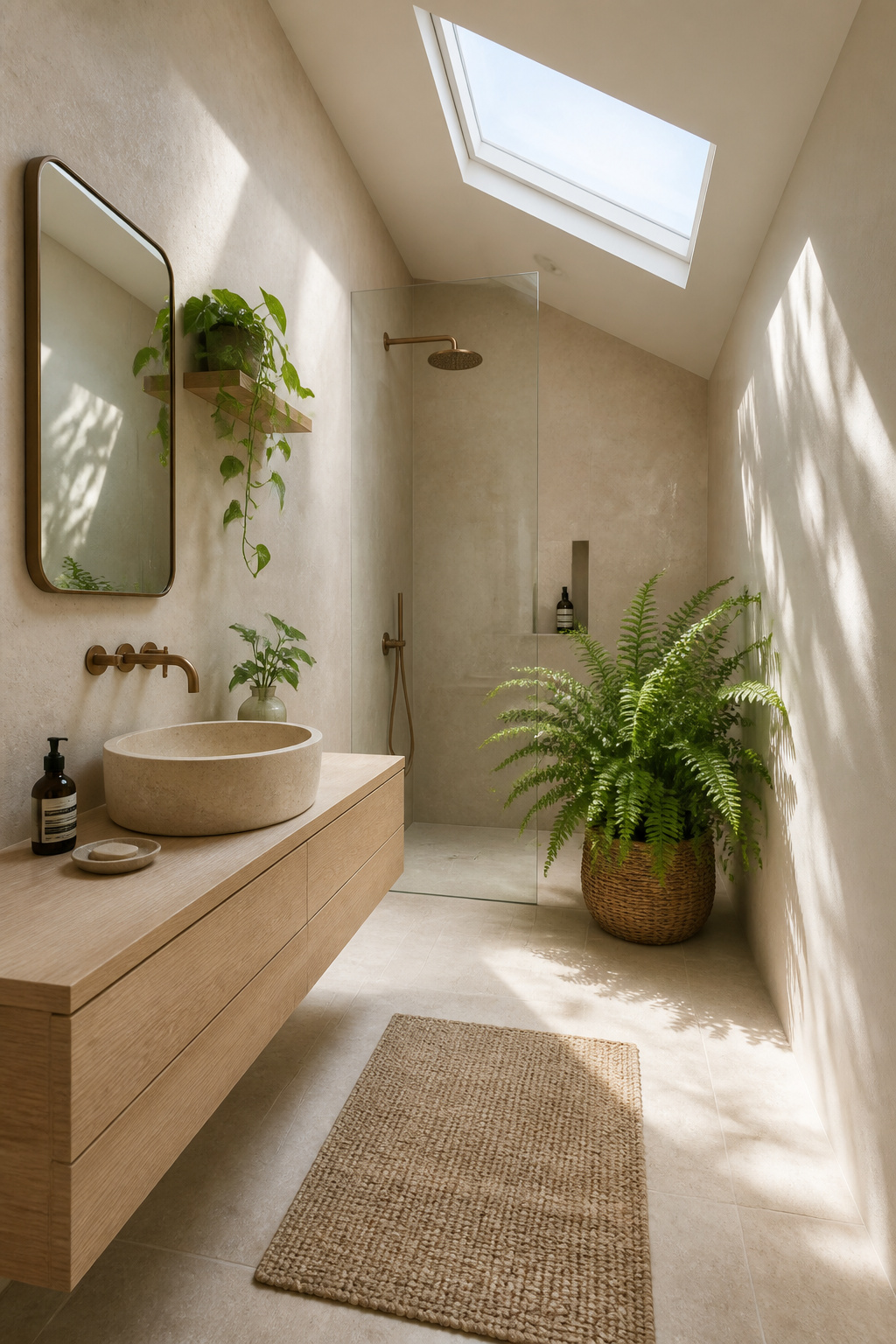
The single most impactful biophilic addition to a bathroom is also the most permanent: a skylight. Natural light exposure in the morning is a powerful circadian regulator, and the bathroom is where most people spend their first minutes of conscious daylight each day. If structural skylights are not possible, clerestory windows — set high on the wall — provide natural light without privacy compromise. From there, a honed basalt or raw limestone vessel basin introduces sensory texture that machine-cut stone cannot provide. Each piece is genuinely unique, fulfilling the biophilic principle of natural variability.
Plant selection matters more than most biophilic bathroom guides acknowledge. Pothos and peace lilies genuinely thrive in the humidity generated by a bathroom shower. Boston ferns are the classic high-humidity choice. Bird of paradise tolerates steam but needs strong light. What suffers, however, are succulents and cacti — their water-storing cellular structure is not adapted for sustained moisture. A single large, well-chosen plant positioned near the shower beats a collection of small, inappropriately chosen plants scattered across every surface.
Industrial Chic: Exposed Pipes, Raw Concrete, and Salvaged Materials
The industrial bathroom translates warehouse loft aesthetics to domestic scale with more authenticity than most people assume is achievable. This bathroom decor theme asks a specific question: which raw elements are worth introducing, and how do you warm them up enough that the room feels like a home rather than a converted car park?
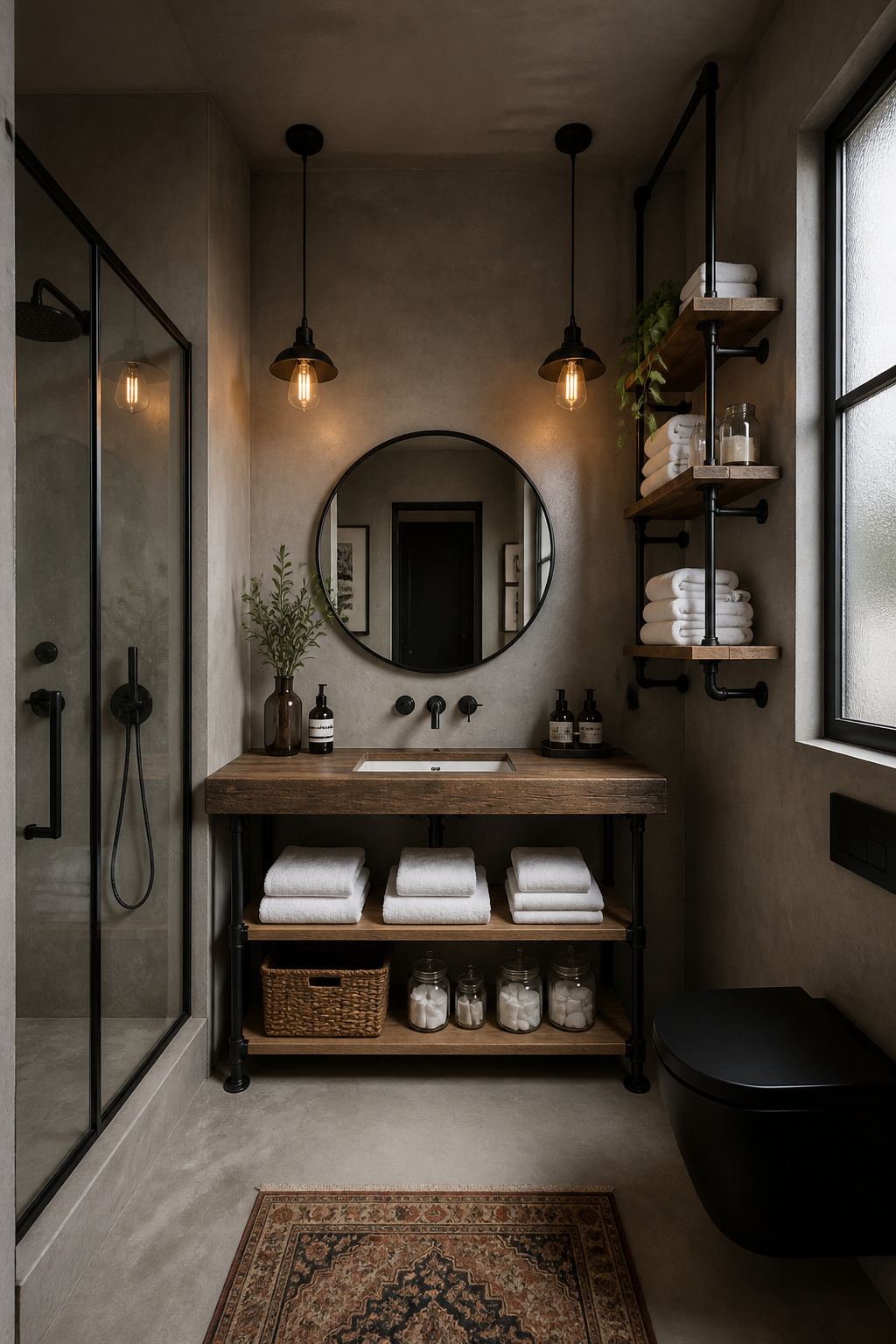
Microcement is the material that makes industrial bathrooms liveable. Applied at two to three millimetres thick over existing surfaces and sealed with at least two coats of waterproof sealant in wet zones, it creates the visual texture of poured concrete without the cracking risks of the real thing. Pair it with black steel pipe shelving — standard floor flanges and 3/4-inch pipe, fabricated at any plumbing supplier — and Douglas fir or reclaimed pine shelving boards. Factory-style pendant lights in matte black or aged brass, installed in groups of two or three above the vanity, replicate the scale of warehouse lighting in a domestic context.
The warmth challenge in industrial bathrooms is real and solved by material layering. One teak or salvaged-wood element cuts the grey visually; unbleached linen towels introduce organic warmth that white cotton towels do not. Warm-spectrum filament or Edison bulbs at 2200 to 2700K are non-negotiable — cool daylight LED amplifies the industrial grey. The formula is deliberate contrast: one warm, organic material for every two raw industrial ones.
Maximalist Eclectic: Pattern Mixing, Gallery Walls, and Curated Colour Chaos
The bathroom is the ideal room in which to attempt maximalism for the first time. The room’s small footprint limits financial risk while compressing the visual energy of bold choices into a space where impact is almost inevitable. A botanical wallpaper that would overwhelm a 400-square-foot sitting room creates pure delight in a 60-square-foot bathroom, where you are in close proximity to it every morning.
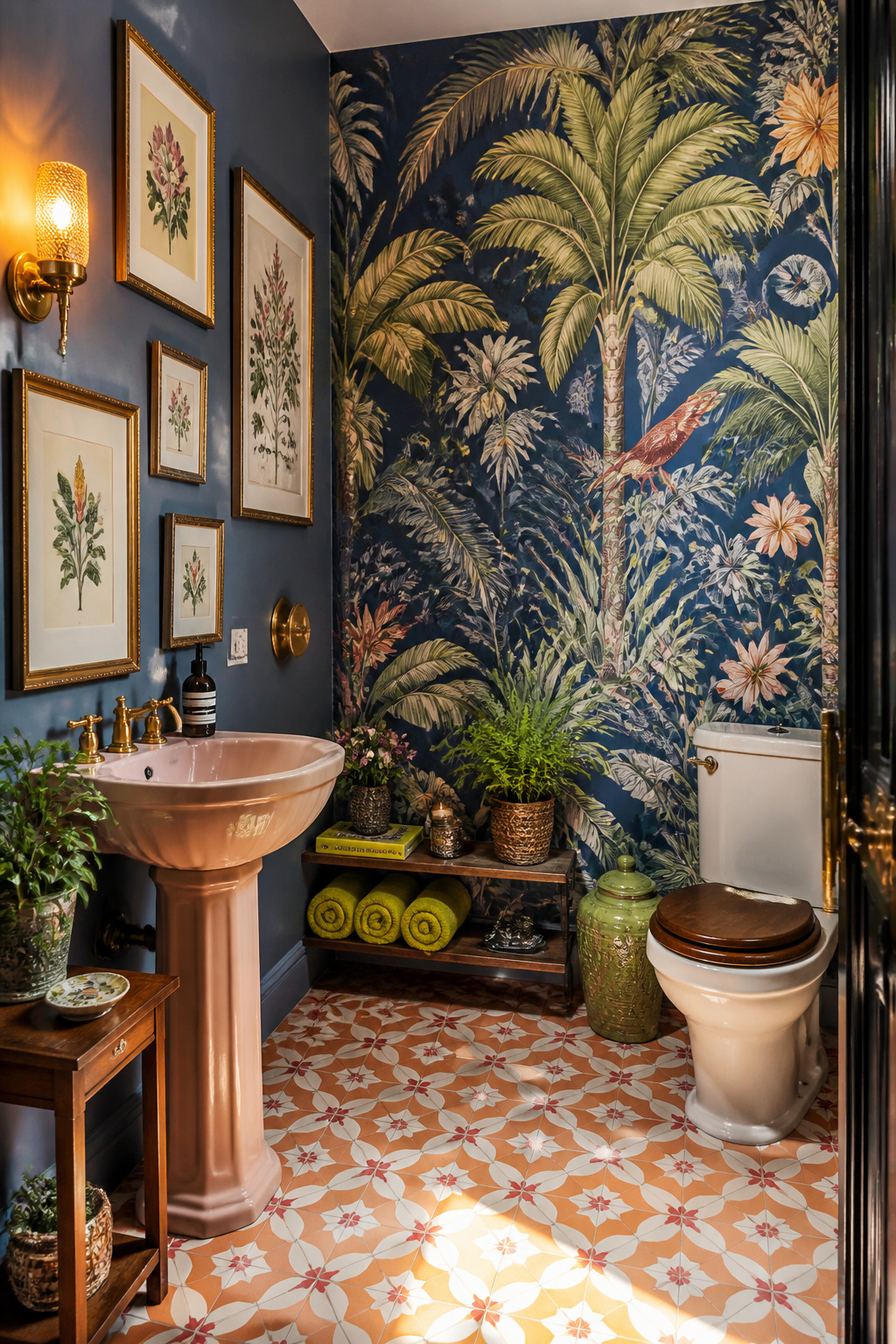
The rules of maximalist pattern mixing are not no rules — they are better rules. The approach that consistently works is a hierarchy of scale: one dominant pattern at the largest scale (typically the wallpaper or floor tile), then one smaller-scale complementary pattern in a textile. The second principle is the colour thread: a single hue appearing in both the wallpaper and the rug and the ceramic storage jar creates visual coherence across completely different patterns. Two patterns of similar scale in a small bathroom fight for dominance; two patterns of contrasting scale coexist easily.
Gallery walls in bathrooms require humidity-appropriate framing: prints behind glass with sealed or metal frames. Position art on walls opposite or adjacent to the shower rather than directly above the steam zone. A collection of framed botanical prints, vintage travel posters, or small abstract works arranged floor to near-ceiling on a single wall — varying frame sizes but consistent frame finish — creates the curated character that separates a maximalist bathroom from a simply cluttered one.
Modern Farmhouse Bathroom Decor Theme: Shiplap, Apron Sinks, and Antique Accents
The farmhouse bathroom has outlasted every prediction of its decline for a simple reason: it solves a genuine design problem. It makes a functional room warm. The materials that define this bathroom decor theme — painted wood panelling, fireclay farmhouse sinks, oil-rubbed bronze hardware, open shelving with wicker organisation — all look more characterful rather than more worn as they age.
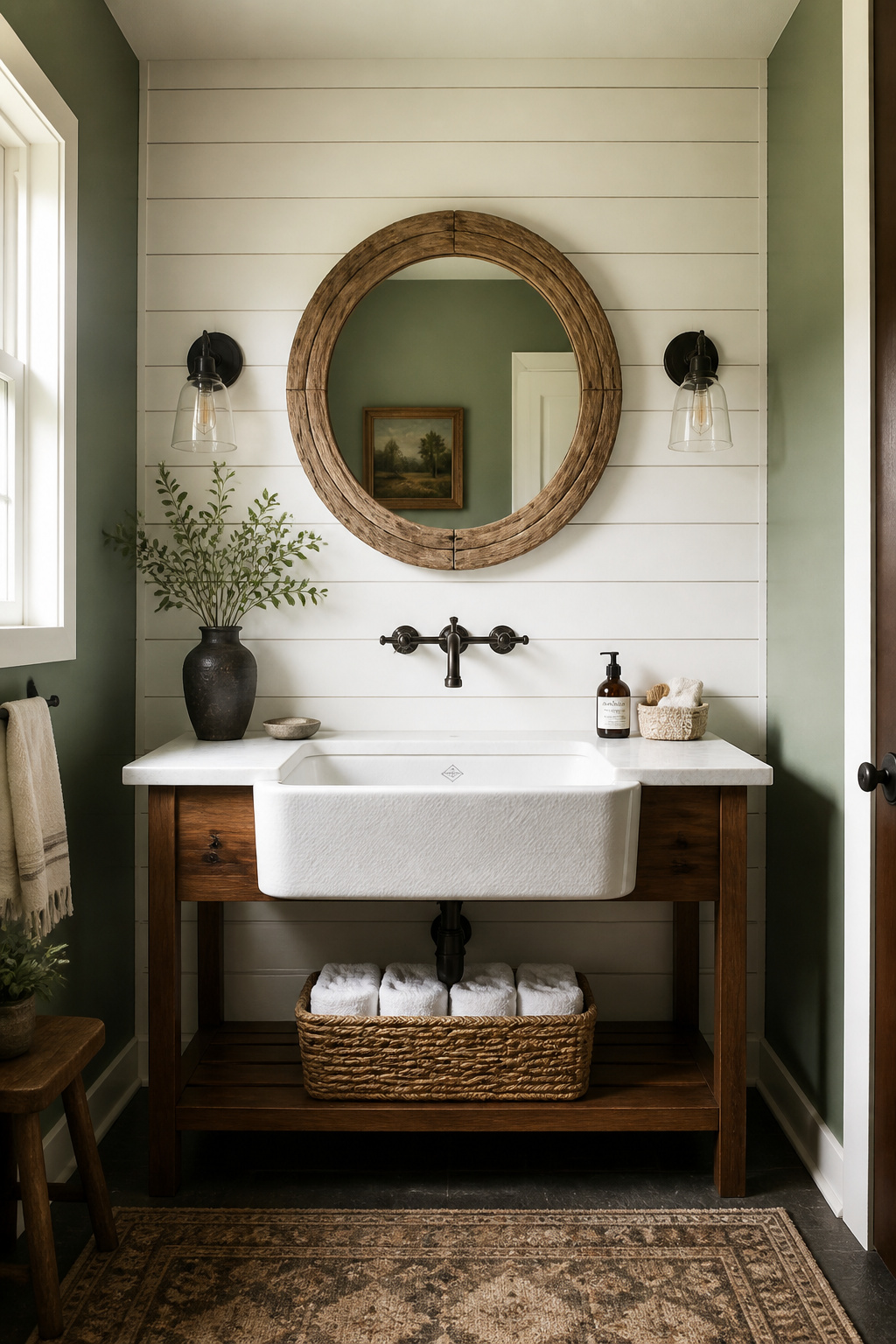
A genuine fireclay farmhouse sink — hand-fired at over 2,000 degrees Fahrenheit for twenty hours — is among the most durable and beautiful plumbing fixtures available. It is rust-resistant, scratch-resistant, and heat-resistant, with a physical weight and presence that ceramic reproductions do not carry. In a bathroom, a 24-inch farmhouse sink creates a focal point with real material authority. The farmhouse bathroom decorations that make this work are the ones that treat each element as functional first and decorative second: open shelves hold real towels in real baskets, not staged displays.
The farmhouse bathroom that avoids becoming a period cliché picks one or two signature elements and pairs them with something unexpected: a moody sage-green paint instead of universally applied white, a vintage Persian bath mat instead of a matching cotton rug set, a single antique medicine cabinet sourced from a salvage dealer rather than a reproduction bought new. Shiplap limited to one accent wall, not all four. Oil-rubbed bronze on the tap, not necessarily on every other fitting. Restraint within the theme is what gives it personality.
Mid-Century Modern: Geometric Tiles, Teak Accessories, and Clean Lines
The mid-century bathroom revival is not a nostalgia exercise. It is a recognition that the design principles behind the most beautiful bathrooms of the 1950s and 1960s — the conviction that function and form are inseparable, that warm materials improve a room more than cool ones, that rounded edges are more appealing than sharp corners — are simply good principles that happened to find their clearest expression in a particular era.
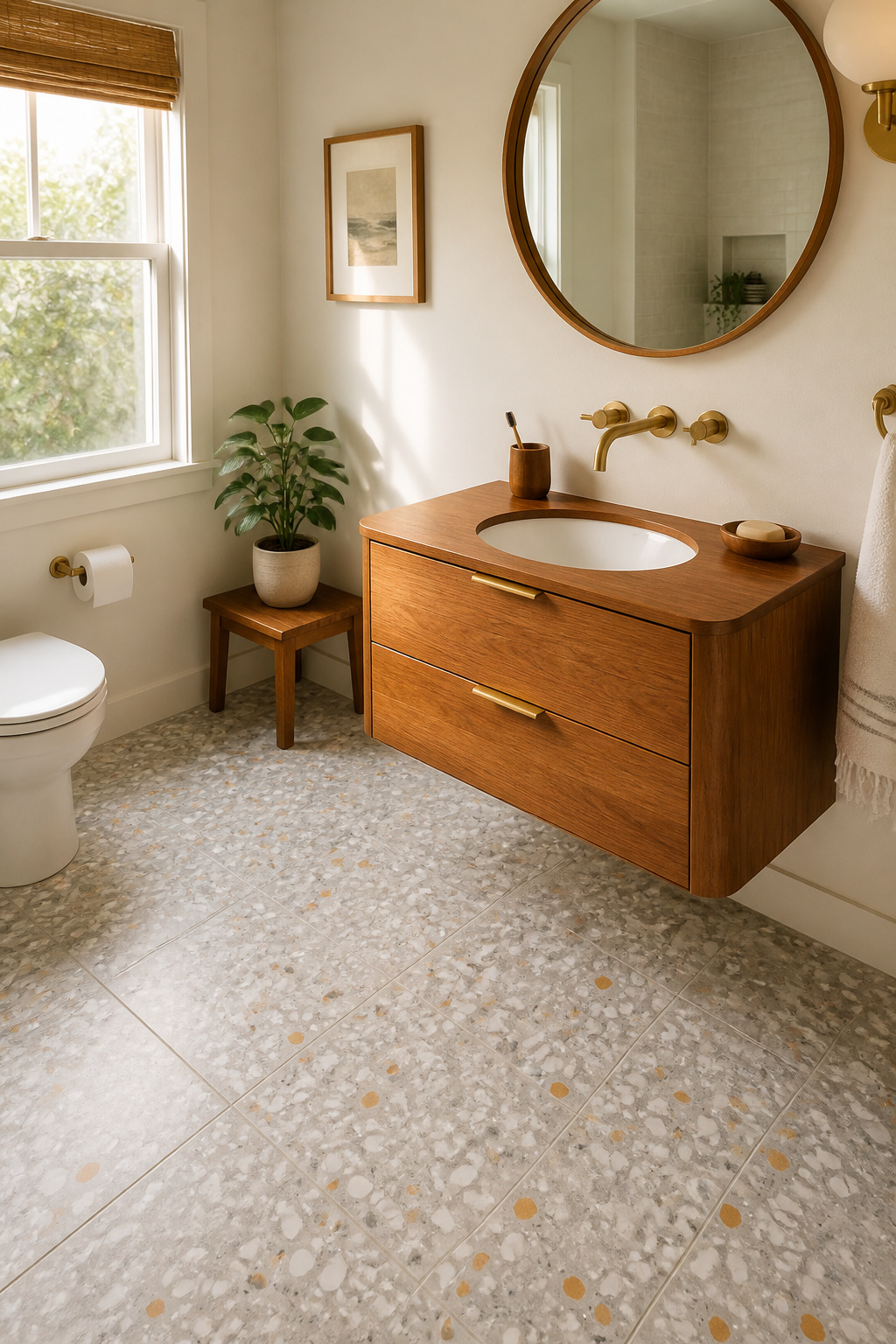
Terrazzo is the material that most completely defines the mid-century bathroom floor, and it is experiencing a genuine revival. Available today in tile format — 12-by-12-inch or 24-by-24-inch — it makes installation far more accessible than poured terrazzo while preserving the characteristic appearance of marble and granite chips suspended in a cement matrix. Pair a terrazzo floor with a teak floating vanity — the warm honey-gold grain set against a clean white wall is the strongest material contrast in the mid-century vocabulary — and a circular mirror with a natural wood or brushed brass frame.
The rounded edge is the single most period-specific detail in mid-century bathroom design. Vanity units with softened corners, oval or circular mirrors, round towel rings rather than square ones — these small decisions accumulate into a room that reads as intentionally mid-century rather than generically contemporary. The key sourcing principle is solid teak over teak veneer for any accessory that experiences regular water contact. Veneer edges lift and delaminate in sustained bathroom humidity; solid teak improves with age.
Spa Sanctuary: Wabi-Sabi Neutrals, Wet Rooms, and Ritual-Inspired Design
The design distinction between a luxurious bathroom and a true spa sanctuary is philosophical rather than material. A luxurious bathroom has expensive finishes. A spa sanctuary is designed around the ritual of bathing as a sequenced experience — undressing, warming, soaking, cooling, drying — and the room’s architecture supports each stage intentionally. The Japanese concept of ofuro, the deep soaking bath as a daily act of spiritual cleansing rather than simple hygiene, is the philosophical origin of everything a well-designed spa bathroom reaches for. Accordingly, this bathroom aesthetic is less about what you put in and more about what you leave out.
The Wet Room as Centrepiece
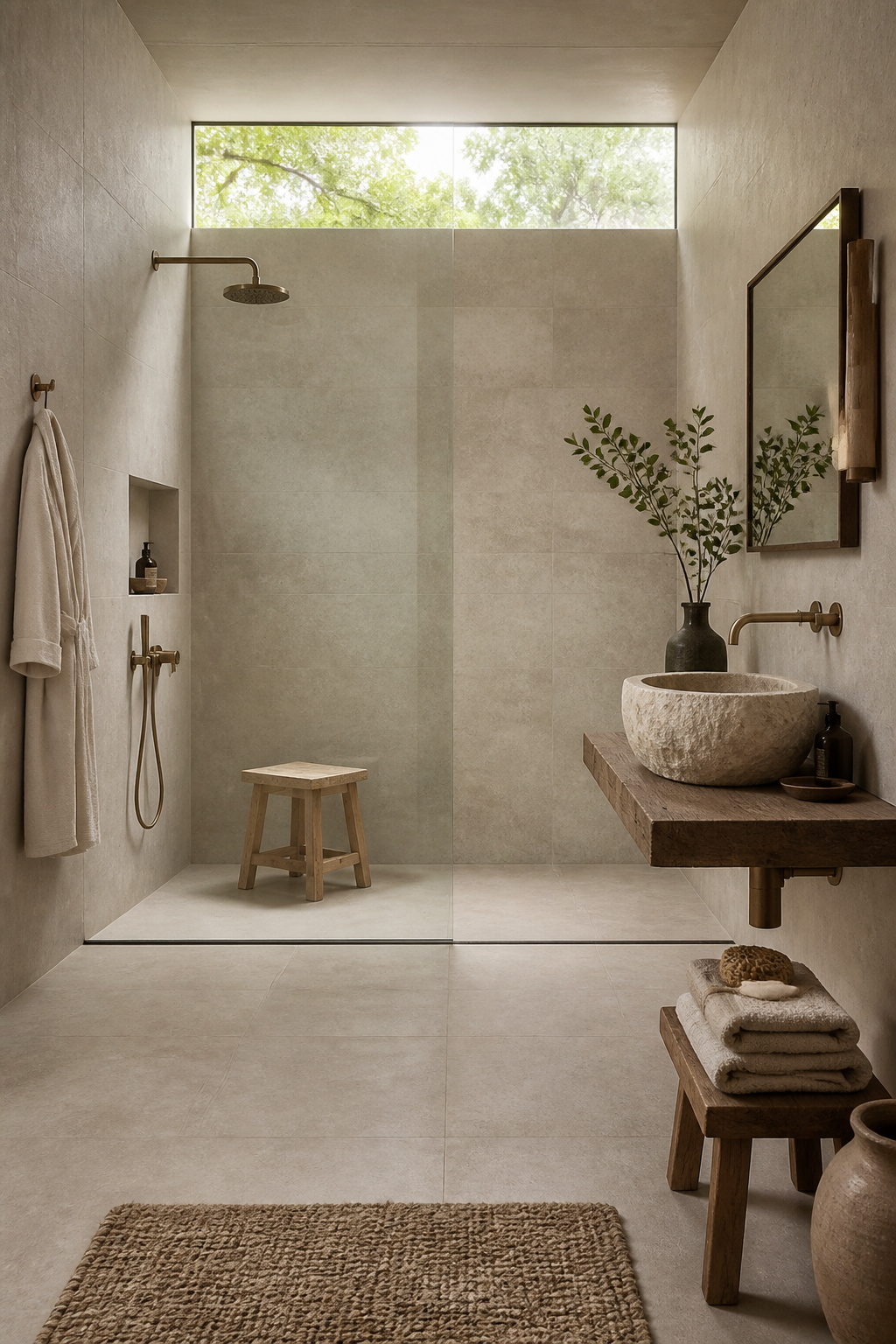
The wet room is the architectural centrepiece of the contemporary spa bathroom. Remove the shower enclosure entirely. Tank the floor and drain it via a linear drain. A frameless glass screen — not a door — defines the shower zone without closing it off. Electric underfloor heating, quicker to install than a hydronic system, transforms the experience of stepping onto stone or porcelain from a shock into a pleasure. Large-format stone-effect porcelain creates the most convincing sense of continuous material across the wet room floor, with minimal grout lines to interrupt the surface.
Texture, not colour, is the defining sensory quality of a genuine spa bathroom. Raw linen, rough stone, aged wood, and unhoned plaster provide a tactile richness that polished white marble cannot — they engage the hand as well as the eye, which is exactly what materials in a bathing space should do. The wabi-sabi principle that materials should age gracefully rather than resist aging is particularly relevant here: the spa bathroom improves as the teak stool deepens in colour, the unlacquered brass develops patina, and the stone basin wears to a satin finish. These bathroom design ideas for sanctuary-style spaces reward the long view. If you are planning a more significant renovation, these bathroom remodeling ideas explore the structural and material investments that elevate a bathroom to genuine retreat status.
South Asian Fusion Bathroom Theme: Block-Print Textiles, Carved Teak, and Warm Brass
This is, understandably, the bathroom theme I return to most often in my own practice. South Asian design traditions encompass an extraordinary range — the geometric precision of Mughal inlay work, the exuberant colour of Rajasthani block-print textiles, the carved teak screens of Kerala, the hammered brasswork of the Deccan — and all of it translates with remarkable ease into a contemporary bathroom setting. The challenge, and the point, is to draw from this heritage with genuine cultural curiosity rather than surface-level decoration.
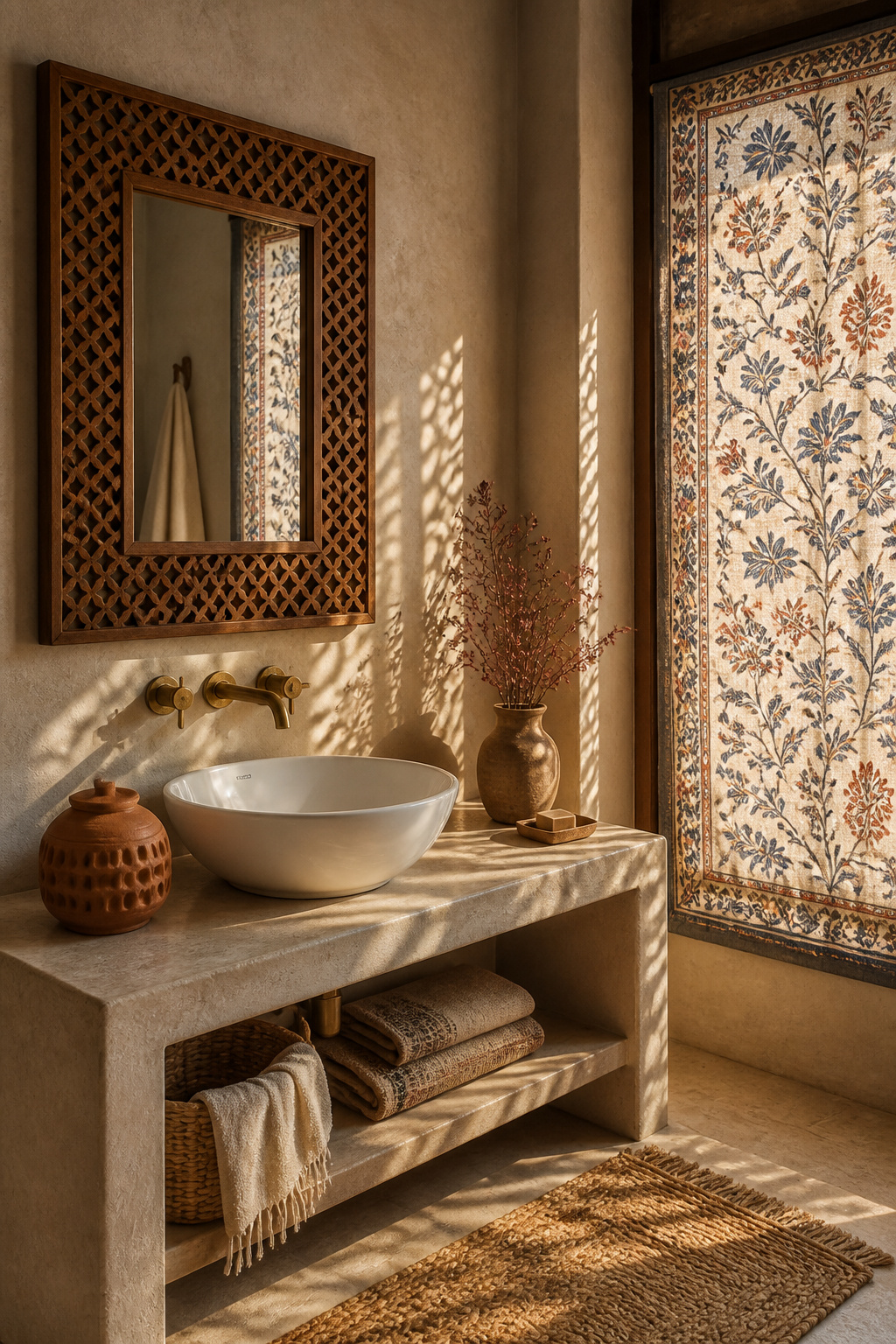
The jali screen — the perforated lattice carved in stone or teak in Mughal architecture — works hardest in a bathroom translation. A jali-carved teak mirror frame, positioned above a basin on a bare plaster wall, brings eight centuries of architectural tradition into a contemporary room without a single additional decorative object. Unlacquered brass taps and accessories introduce the same patina principle that defines so much South Asian metalwork: the brass begins bright gold and darkens at contact points over weeks and months, developing a living character that lacquered or PVD-coated brass simply refuses to do. Block-print linen panels — printed in Bagru or Sanganer using carved wooden blocks dipped in natural dye — bring the textile dimension of this tradition to a window treatment or shower curtain.
Sourcing from artisans rather than mass producers is the most important principle for this bathroom decor theme, and not only for ethical reasons. The mechanical regularity of mass-produced ‘Indian-inspired’ accessories is aesthetically counterproductive — the slight irregularity of a genuinely hand-made object is precisely what gives it its resonance. Indian craft platforms and specialist importers work directly with named artisans, and the difference in quality is immediately visible.
Art Deco Glamour: Geometric Inlays, Jewel Glass, and Polished Chrome
Art Deco design gives the bathroom designer a generous toolkit: bold geometry, bilateral symmetry, glamorous material pairings, and the principle of one dominant motif executed consistently rather than many patterns competing simultaneously. It is a theme that rewards discipline, because the moment two different geometric patterns appear at similar scales in a small bathroom, neither can assert its authority.
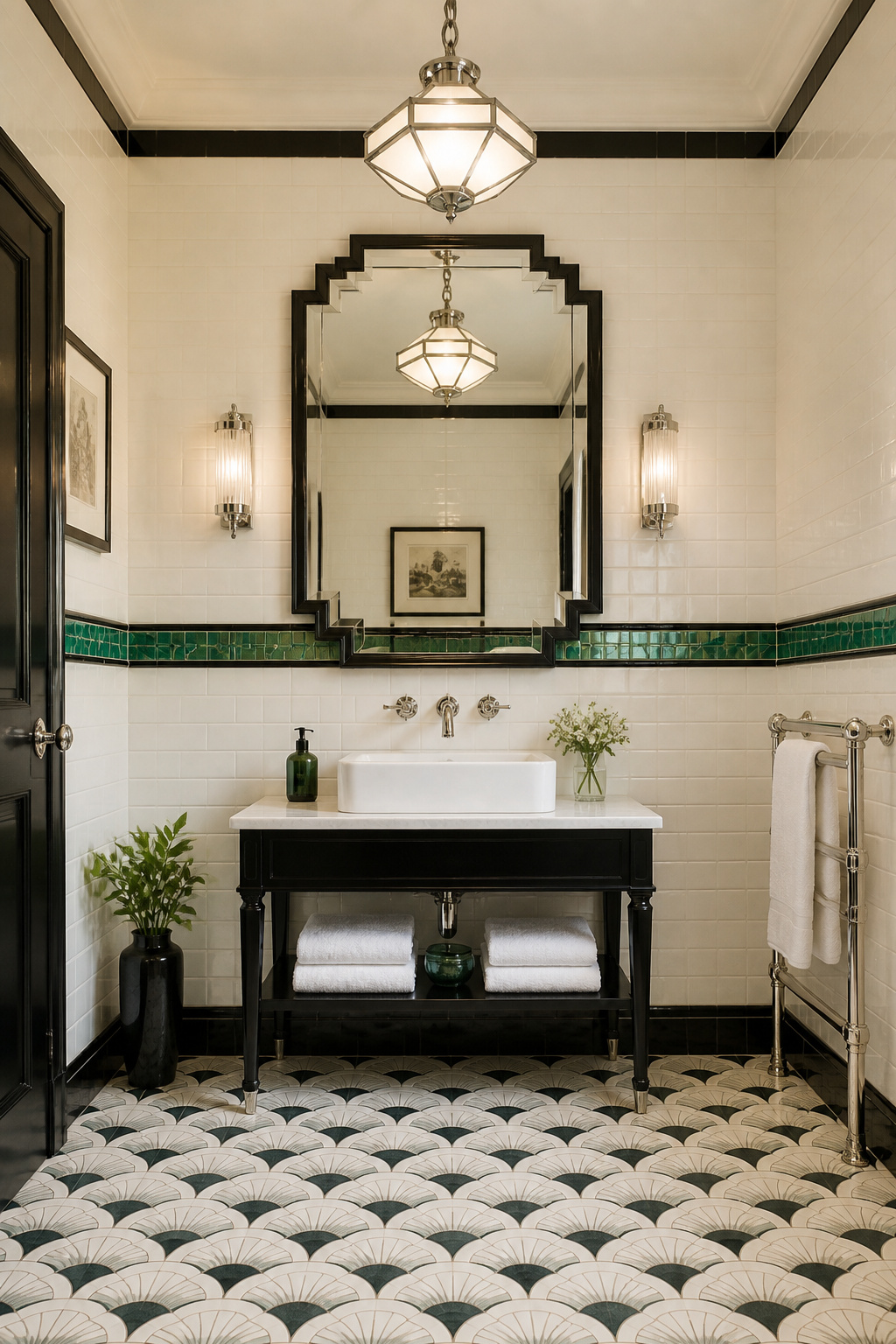
Fan-pattern floor tiles — also called scallop or fan mosaic, typically in two-inch format — are the most recognisably Art Deco floor format. In cream, warm white, or pale grey, with the fan geometry providing all the visual interest required, they allow the walls to operate at a simpler register: white subway tile in a standard bond pattern, punctuated by a border of jewel-toned glass mosaic at dado height. Emerald green, sapphire blue, or deep teal for the mosaic border; polished chrome for all fittings. The chrome must be polished, not brushed or matte — the reflective brightness is fundamental to the Deco material palette, which celebrated the glamour of modern industrial production.
The octagonal cross-handle tap is the period-correct fixture choice, widely reproduced at a range of price points. Paired with a stepped mirror frame in ebonised or gilt-lacquered wood, it creates a bathroom that reads as confidently Art Deco through a very small number of carefully chosen pieces. The restraint principle is not optional: one geometric motif, executed consistently, is the entire design strategy. The decorative choices that work best in an Art Deco bathroom are precisely those that support the architectural geometry rather than competing with it.
Tropical Retreat: Rattan Shelving, Tropical Prints, and Verdant Plant Styling
The tropical bathroom aesthetic in 2026 is a statement of considered abundance, not holiday kitsch — and the distinction is immediately visible. Where the themed bathroom resort shop gives you anchor-printed shower curtains and palm-leaf soap dishes, the genuinely tropical bathroom draws from the warm-climate residential traditions of Southeast Asia, Latin America, and the Caribbean: lush greenery treated as essential rather than decorative, natural materials that celebrate heat and humidity, and a layering of pattern and texture that rewards close attention.
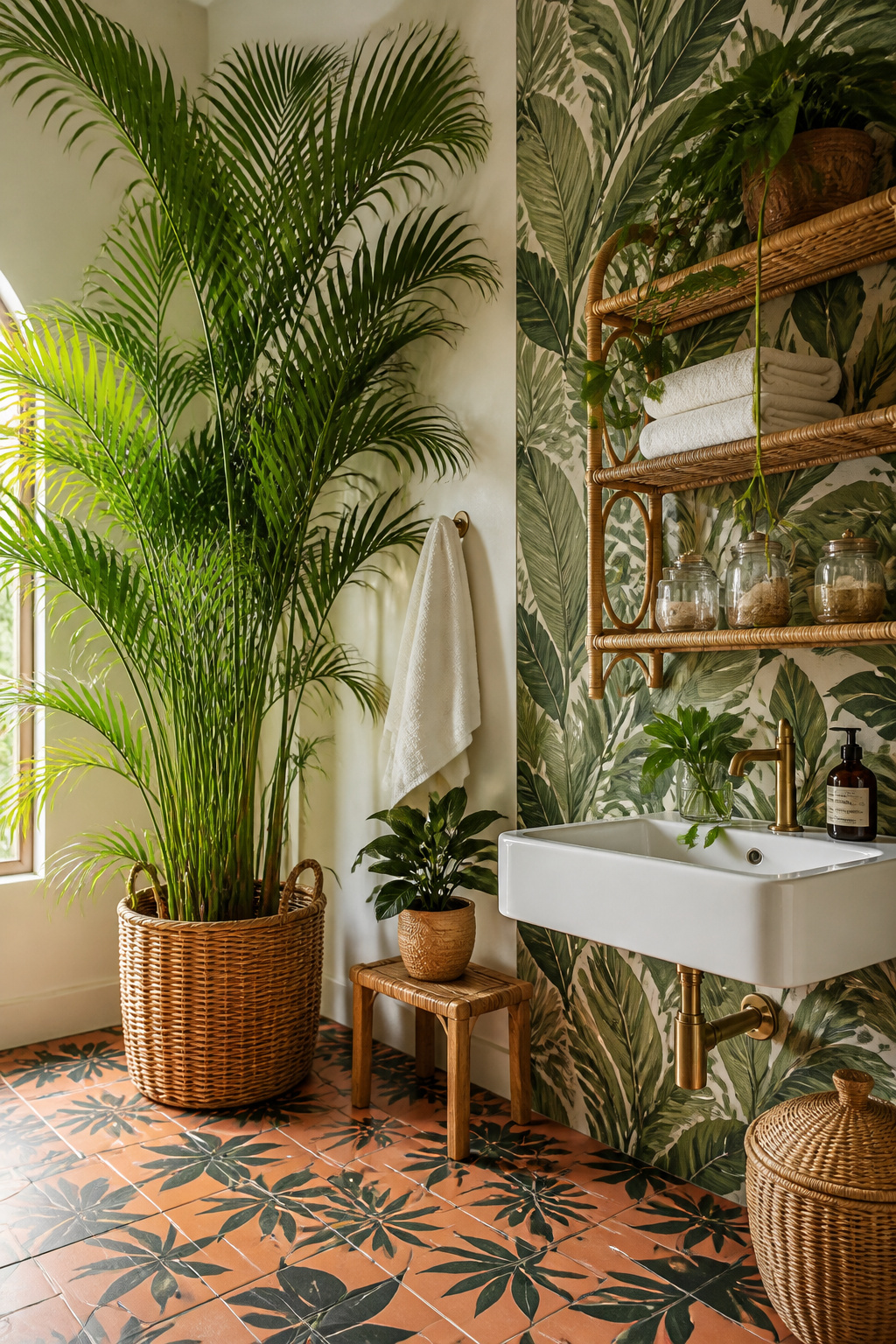
The entry point for this bathroom decor theme is almost always a large plant: a bird of paradise in a corner, an areca palm that reaches the ceiling, a Boston fern hung at shower height where the steam benefits it rather than harms it. One large statement plant creates a tropical atmosphere that five small plants scattered across every shelf cannot achieve. From there, the layering progresses: rattan shelving and accessories in natural unfinished or uniformly bleached finishes, a botanical-print wallpaper in moisture-resistant vinyl-backed format on one accent wall, and leaf-pattern encaustic tiles on the floor for pattern that tolerates wet conditions without wallpaper maintenance concerns.
The styling density principle for tropical bathrooms is to introduce elements one at a time and assess each addition before proceeding to the next. Rattan, plant, wallpaper, textile — in that sequence, pausing between layers. The room will tell you when it is complete, and it is usually earlier than you expect.
Finding Your Bathroom Theme: How to Choose the Right Aesthetic for Your Space
The bathroom theme that works best for a particular room is almost never the one that the owner found first on a mood board. It is the one that fits — the room’s proportions, its natural light, the architecture of the building it sits in, and the genuine preferences of the people who use it every day.
Start with the room’s bones. Victorian terraced houses have period architecture that supports Parisian, Victorian dark, or Art Deco themes with a coherence that a contemporary open-plan apartment cannot provide — and vice versa. Japandi, biophilic, and spa sanctuary themes sit more naturally in contemporary architecture than in rooms with ornate cornicing and original sash windows. Also consider the light: south-facing bathrooms can absorb darker palettes because they receive warm light for part of the day; north-facing rooms benefit from the warmer palettes — Mediterranean, Moroccan, farmhouse — that compensate for cooler ambient light.
Committing to a Theme Without Over-Decorating
The single-hero-piece rule is the most reliable guide I know for committing to a bathroom decor theme without over-decorating. Every successful themed bathroom has one piece that carries the design weight: the zellige feature wall, the fireclay apron sink, the Japandi stone basin, the Art Deco fan tile floor. Everything else serves that piece. In practice, spend sixty to seventy per cent of your decorative budget on surfaces and fixtures — where the theme lives in the room’s bones — and the remaining thirty to forty per cent on accessories.
Then, once the room is styled, remove two or three things. If it reads better, those items were clutter. If it reads worse, return them. The best bathroom decor themes land in a room that feels complete without feeling crowded, and finding that balance is always an act of considered editing as much as addition. Choose one bathroom aesthetic and commit to it fully — half-hearted themed bathrooms satisfy no one. The rooms that stop you in the doorway always belong to someone who made a decision and stuck with it.