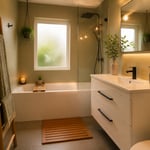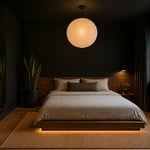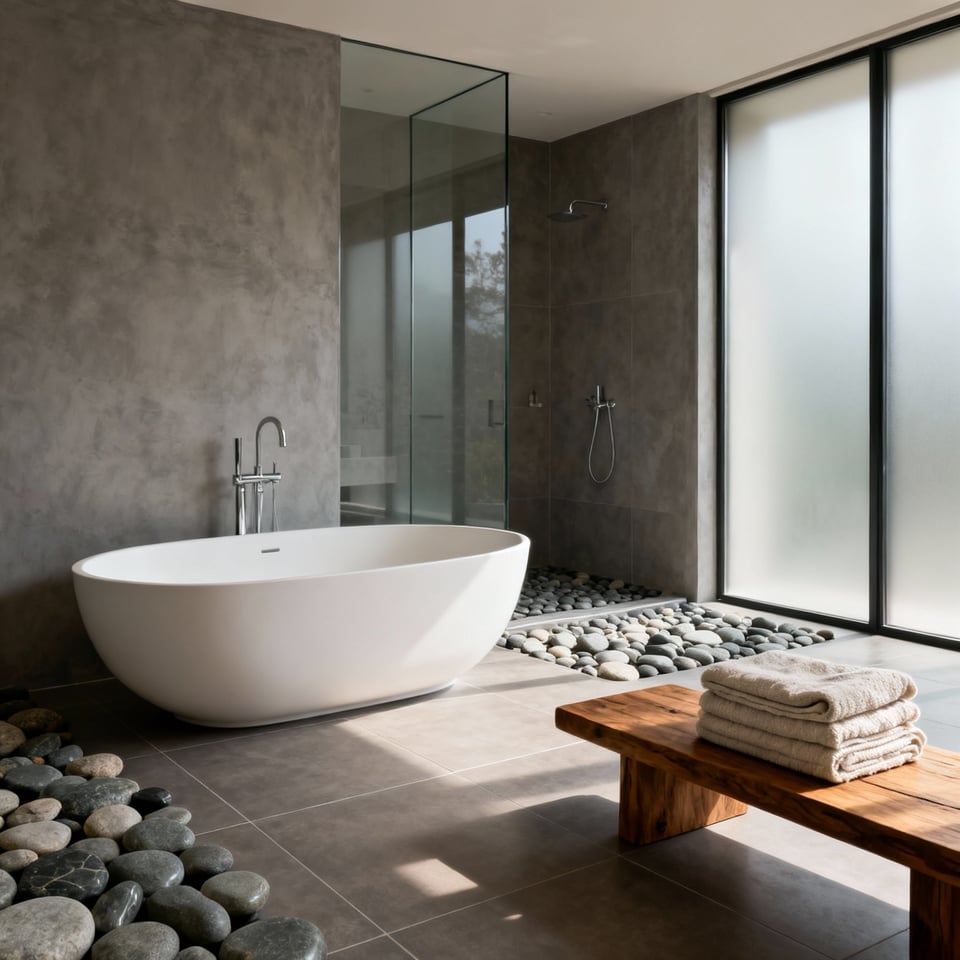
For discerning homeowners seeking to elevate their space, finding the perfect bathroom remodeling ideas is the first step toward creating a sanctuary. The concept of a “Modern Zen Sanctuary” moves beyond the purely functional, vanity-centric bathroom. Fundamentally, “Zen” implies quiet meditation and a peaceful mind. Therefore, this design evolution prioritizes psychological harmony alongside utility. The approach extends beyond visual minimalism to a full sensory experience.
True immersion requires tactile variation. Contrast smooth river rocks in a shower with soft, organic towels. Material selection often follows *wabi-sabi* principles. This Japanese concept finds beauty in imperfection and natural cycles. Thus, incorporating natural stone or unvarnished wood adds depth and warmth. Materials like bamboo ground the space with earth-friendly appeal.
However, maintaining this serenity requires strict architectural order. You must master the “illusion of absence.” Visible clutter disrupts mental peace. Therefore, utilize flush, built-in storage to hide daily items. This strategy keeps surfaces clear for a calming effect.
Additionally, lighting must shift from bright utility to a diffuse glow. Use matte finishes on fixtures to reduce harsh glare. Finally, rethink the water ritual itself. Ideally, separate the functional shower from the restorative deep-soak tub. These shifts transform a simple bathroom into a space for grounded renewal.
Introduction: The Sanctuary Shift
Historically, residential bathrooms prioritized strict utility and clinical hygiene. But a significant cultural evolution known as the “Sanctuary Shift” has fundamentally altered this perspective. Consequently, the bathroom is moving from a service space to a primary zone for restorative wellness. This pivot addresses the high stress of modern life by offering a private refuge. Conceptually, this mirrors the serenity found in traditional Japanese *onsen* bathhouses. For more overarching ideas on transforming your space, explore these modern bathroom renovation ideas.
Advanced technology enables this transition through multisensory immersion. Digital “emotional showers” now integrate hydrotherapy with chromotherapy lighting. Thus, the experience engages sight, sound, and touch simultaneously to reduce stress. Modern design incorporates psychological anchors like biophilic elements. Specifically, natural materials like wood and stone serve to reduce mental fatigue. Tunable LED lighting mimics natural sunlight to support circadian rhythms.
Ultimately, the aesthetic embraces minimalist luxury. Clutter is replaced by clean lines and hidden storage to minimize visual noise. Simultaneously, tactile features like radiant heated floors offer immediate physical comfort. The bathroom becomes a holistic sanctuary for both body and mind.
Hook: You have a bathroom that functions efficiently—the plumbing works, the tiles are clean, and the lighting is bright. Yet, stepping inside feels like a chore list rather than an exhale.
Often, this underlying tension stems from a purely utilitarian lighting design. Bright, single-source overheads mimic harsh commercial environments, triggering alertness rather than relaxation. Consequently, your brain remains in a high-beta state, fighting against natural circadian rhythms. To counter this, you must introduce the concept of layered illumination. Ambient warm washes and low-level accent lights allow for emotional equilibrium. This control shifts the room’s purpose from efficient cleaning to personal sanctuary.
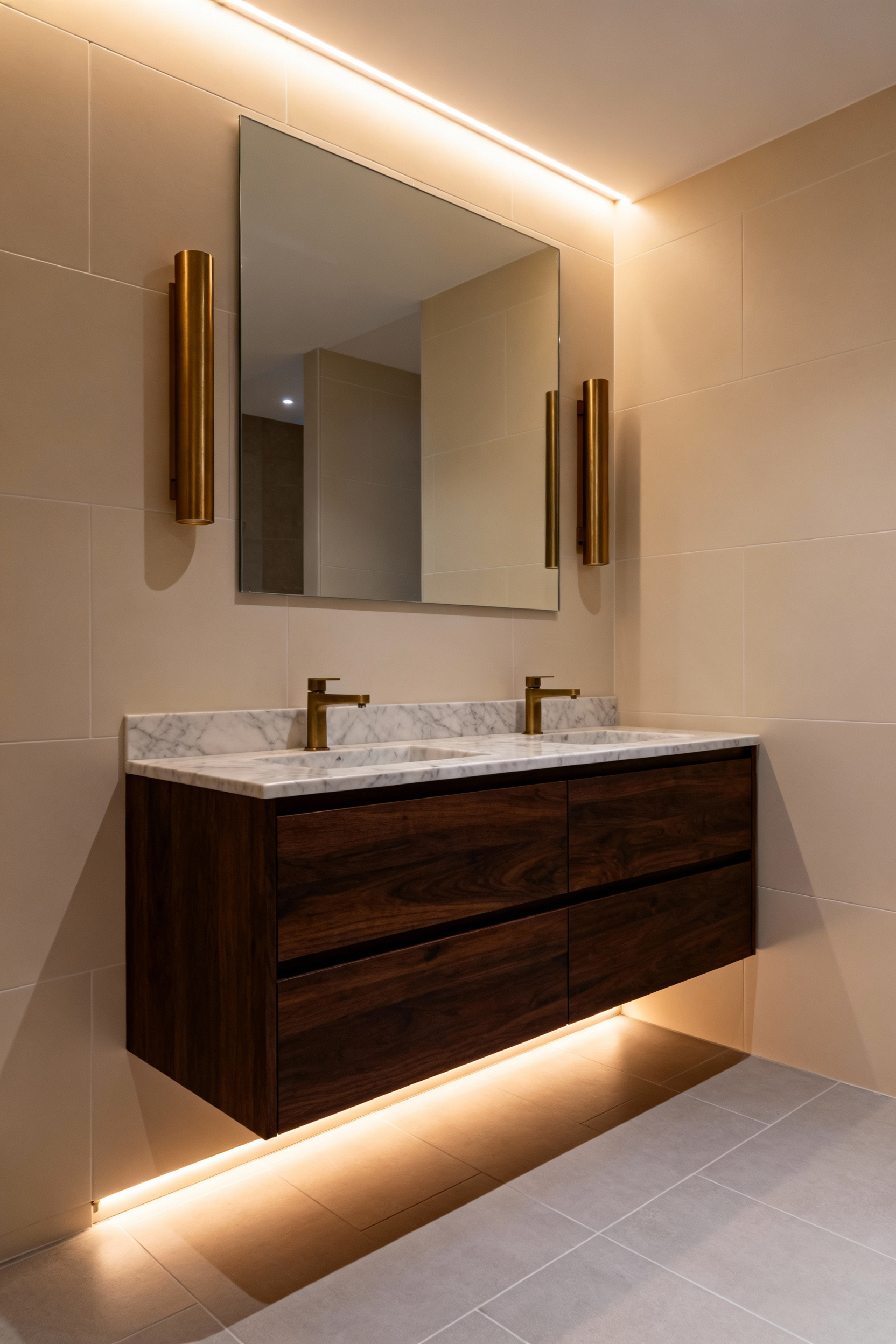
Furthermore, standard high-gloss surfaces contribute to a sense of clinical sterility. Psychologically, cold tiles and acoustic echoes signal the nervous system to remain guarded. Therefore, incorporating biophilic design elements becomes essential for genuine decompression. Consider replacing slick ceramics with textured stone or matte-finish clay. Integrating warm wood accents grounds the space visually and tactilely. These organic textures invite touch, reducing the subconscious stress of a “perfect” room.
Finally, visual noise transforms a clean room into a chaotic experience. Even when organized, visible bottles and tools demand attention and drain mental energy. Thus, achieving spatial harmony requires intentional negative space. Utilize hidden storage solutions like floating vanities to maintain clear sightlines. By obscuring the functional clutter, you allow the mind to rest. This architectural discipline turns a daily routine into a restorative ritual.
The Revelation: The secret to a truly restorative bathroom isn’t just about expensive marble or gold faucets; it’s about the seamless convergence of ancient mindfulness and invisible technology.
True luxury often hides in plain sight. The most restorative bathrooms move beyond superficial gold fixtures. Instead, they blend ancient mindfulness with invisible technology. Historically, rituals like the *Mikveh* focused on spiritual purification through meticulous cleanliness. Today, smart technology fulfills this mandate without visual clutter. Touchless faucets and self-cleaning toilets maintain perpetual hygiene effortlessly. Consequently, the space remains germ-free and visually serene.
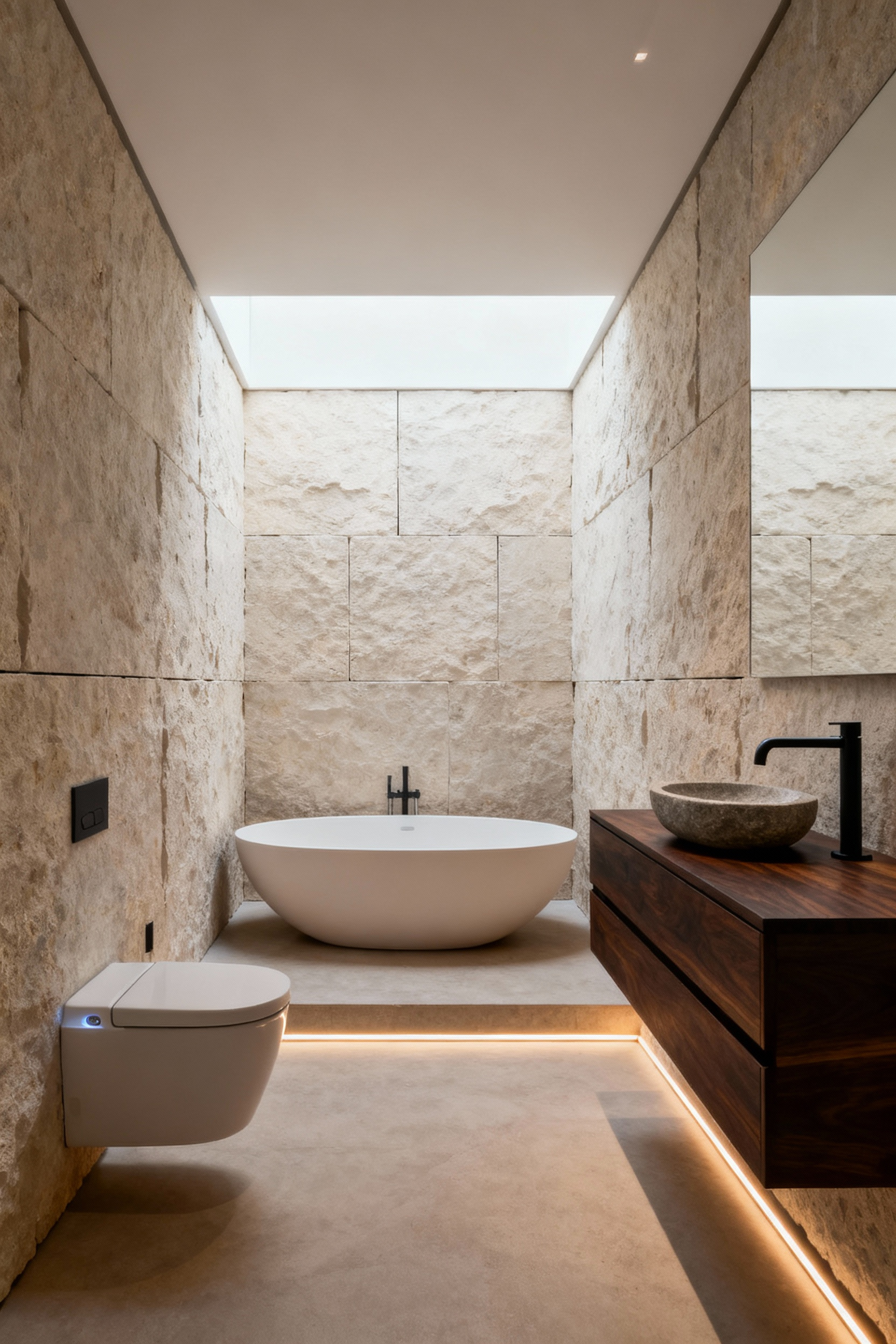
Designers are reimagining the ancient Roman *Thermae*. Previously, these spaces used steam and light to soothe the soul. Now, hidden digital systems create this sensory immersion on demand. Recessed hydrotherapy jets provide massages without visible bulk. Similarly, integrated chromotherapy lights alter the room’s mood instantly. Even scent is automated, infusing steam with essential oils like eucalyptus.
Ultimately, the goal is a minimalist “mind-temple.” Bulky plumbing vanishes behind walls to reduce visual noise. In this way, handle-free cabinetry preserves clean lines. Smart showers recall your specific Ayurvedic heat preferences automatically. Thus, the bathroom becomes a sanctuary of personal balance, not just a utility.
Thesis: These 16 remodeling principles bridge the gap between digital convenience and timeless serenity, transforming your bathroom from a utility station into a vessel for mental clarity.
Modern bathrooms must evolve beyond being mere utility stations. Indeed, they are becoming vital vessels for mental clarity. Achieving this transformation requires artfully balancing digital convenience with timeless serenity. Consequently, the core design philosophy shifts from strict efficiency to emotional experience. We must reduce cognitive load through intentional minimalism.
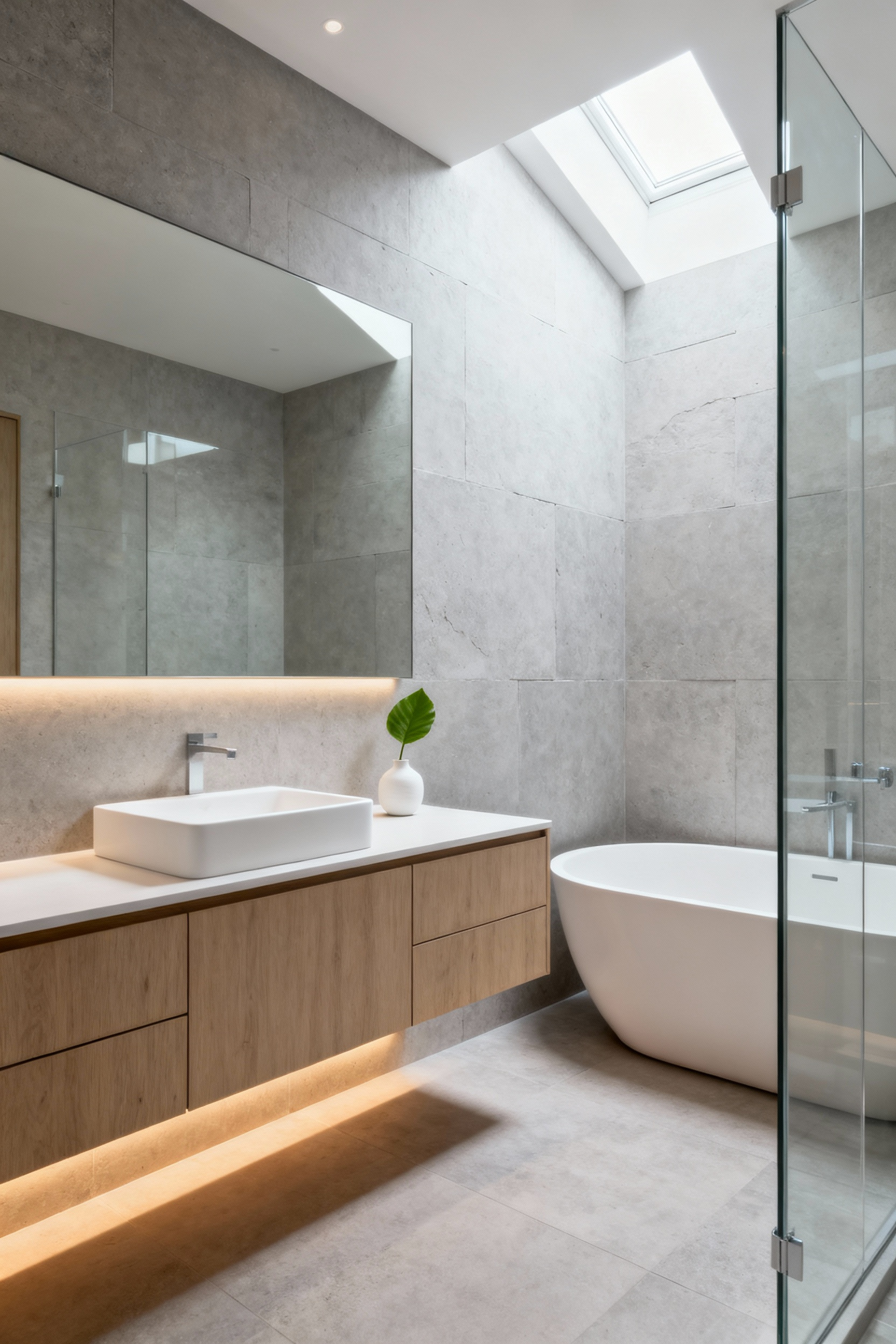
Concealed storage hides daily clutter, ensuring a calm visual field. Simultaneously, smart technology must integrate without creating visual noise. Smart toilets offer advanced functionality within classic silhouettes. Similarly, anti-fog mirrors embed digital interfaces subtly into the glass. Therefore, technology serves human comfort while remaining virtually invisible.
To ground this innovation, we rely on sensory anchors. Natural materials like veined marble or honed wood provide tactile permanence. Large-format tiles minimize distracting grout lines to visually expand the space. Additionally, layered lighting mimics soft natural glows to support contemplation. These principles bridge the gap between modern function and deep peace.
Phase I: The Foundation of Visual Silence (Architecture & Materials)
To cultivate profound calm, we must first establish a monolithic envelope. Fundamentally, this architectural strategy prioritizes uninterrupted continuity across all surfaces. To achieve this, designers utilize large-format tiles or full-slab materials. If you are tracking the latest in aesthetic and functional updates, these bathroom design trends are essential reading. Consequently, visual noise like grout lines virtually disappears. Wet rooms execute this perfectly by removing traditional barriers. Therefore, floor finishes flow continuously, creating a seamless, effortless aesthetic.
Next, the materials themselves must ground the space. Selecting matte or unpolished finishes is crucial. Unlike glossy surfaces that create sharp reflections, matte textures quietly absorb light. Thus, the focus shifts to the tactile quality of the material. Unpolished marble offers timeless elegance without feeling busy.
Furthermore, true visual silence requires “invisible” architecture. Ideally, functional elements should work quietly in the background. Wall-mounted taps conceal bulky plumbing within the structure. Similarly, handle-free vanity units maintain clean, unbroken lines. These choices create a sophisticated, neutral backdrop. By utilizing a restrained palette of warm whites or greys, light becomes a sculptural tool. It highlights texture rather than decoration, turning the room into a sanctuary.
1. The Curbless Wet Room: Removing physical barriers to create infinite spatial flow.
The curbless wet room is more than a current design trend. It reclaims the bathroom as a place of ritual. Drawing from the Japanese *ofuro* tradition, this design conceptually separates cleansing from soaking. Consequently, the wet floor becomes an expected, natural element rather than a hazard. By removing the shower curb, you erase visual interruptions. Sightlines extend to the farthest wall, creating a sense of infinite flow. Even small, confined spaces feel instantly airy and expansive.
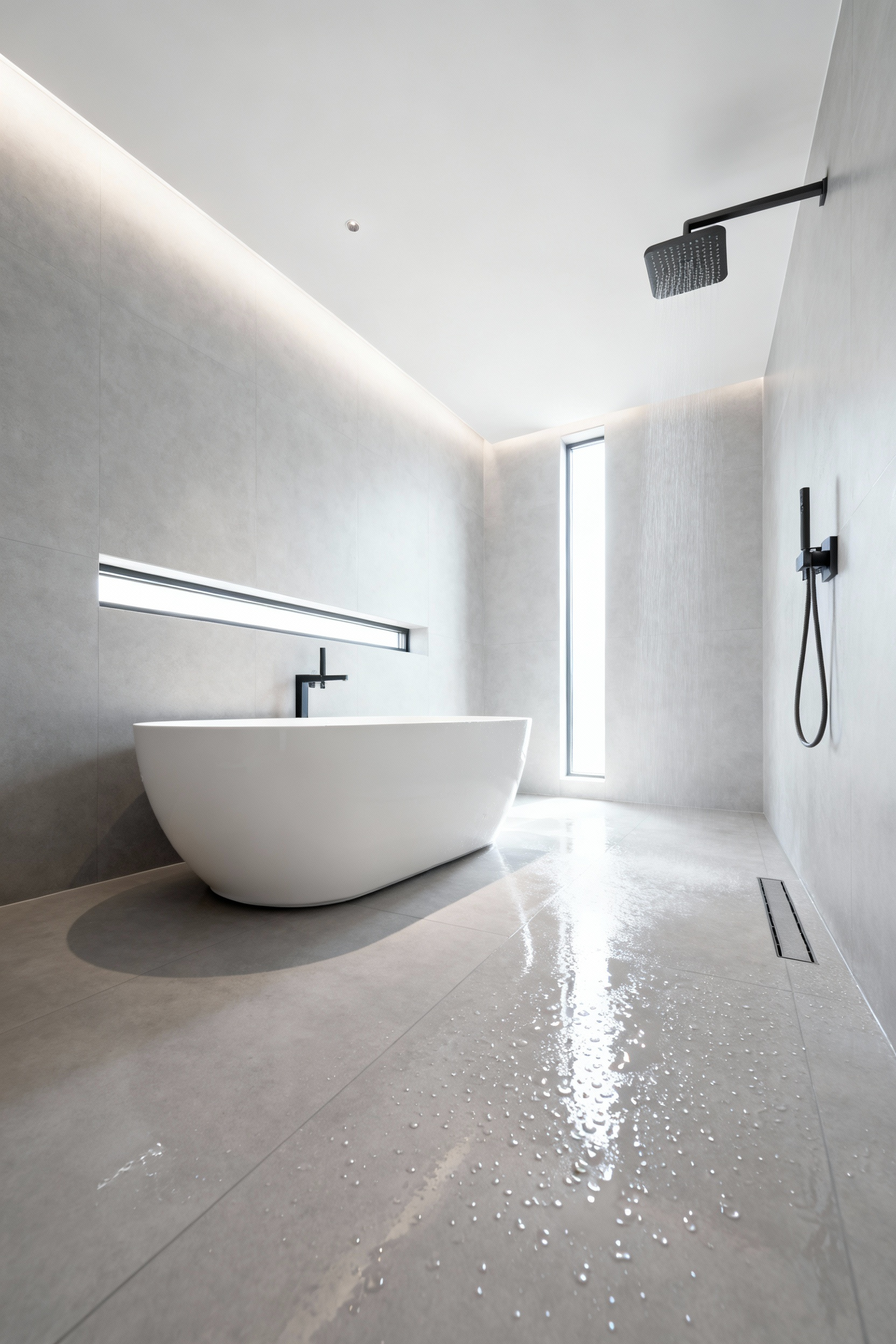
However, achieving this visual simplicity requires complex engineering. The “invisible” barrier relies on precision drainage. The floor must slope exactly 1/4 inch per foot toward the drain. To maintain a flush entry, contractors often recess the subfloor during installation. Linear drains act as critical design tools. Unlike traditional center drains, they require only a one-way slope. This allows for large, continuous tiles that maintain the serene, unbroken aesthetic.
Beyond beauty, this layout offers profound practicality. The zero-entry design creates a secure “forever home.” It adheres to universal design principles by eliminating common tripping hazards. Thus, the space adapts to all life stages. Whether for aging-in-place or accommodating mobility aids, the open floor plan provides essential maneuverability. Ultimately, the curbless room merges modern safety with timeless tranquility.
2. Large-Format Stone Slabs: Minimizing grout lines to reduce ‘visual noise’ and maintenance.
In the pursuit of modern serenity, visual clutter often acts as a significant distraction. Large-format stone slabs address this issue by creating a seamless, near-monolithic surface. Consequently, the drastic reduction of grout lines effectively minimizes “visual noise.” This uninterrupted flow mimics the restorative atmosphere found in ancient Roman baths. Moreover, the continuous material manipulates spatial perception, making modest bathrooms feel significantly more expansive. For specific material choices for your enclosure, view these bathroom shower tile ideas.
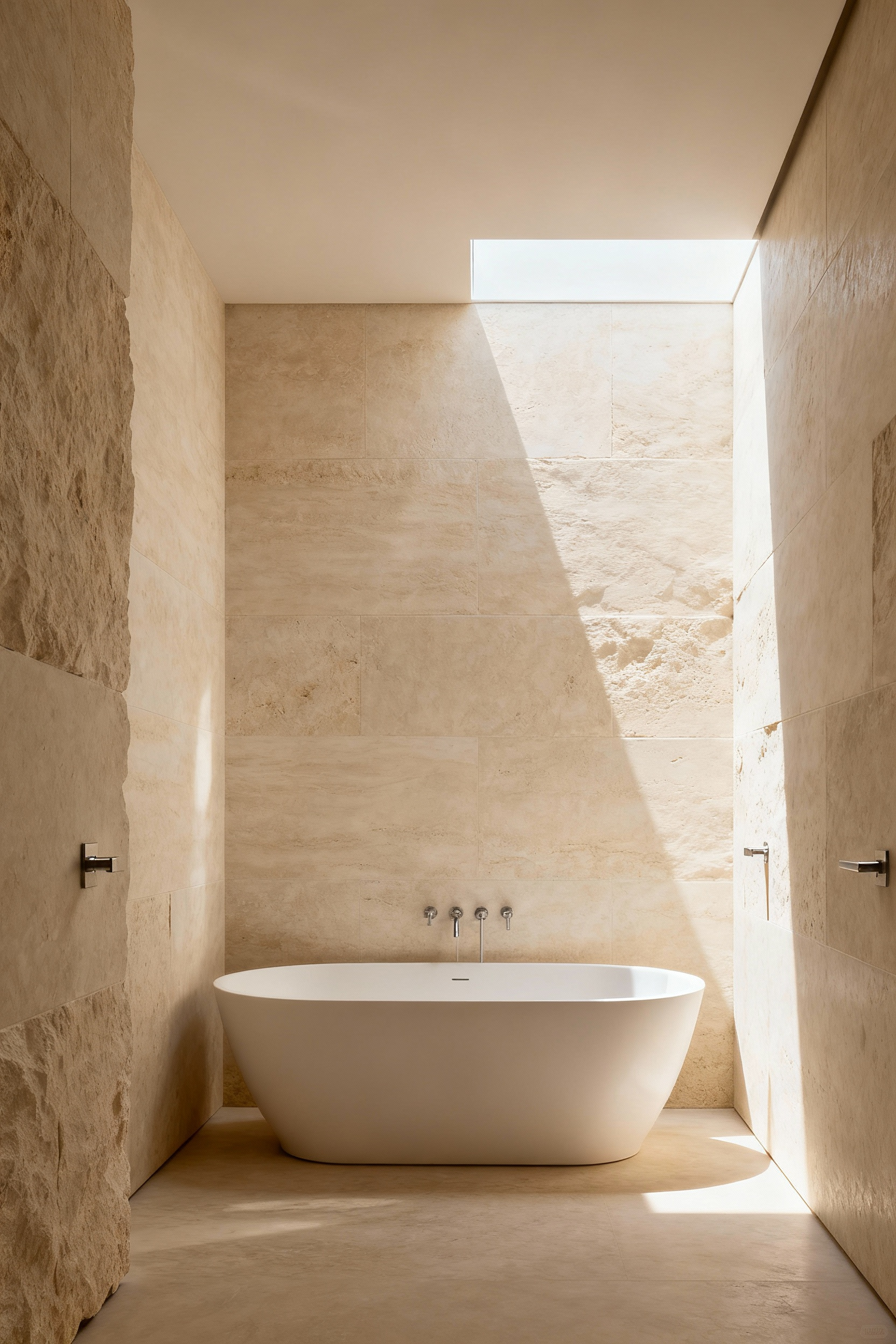
Beyond the aesthetic appeal, the practical benefits regarding hygiene are substantial. Traditional grout is inherently porous, often acting as a magnet for soap scum and bacteria. Therefore, minimizing these crevices reduces the potential for mold and mildew growth. Utilizing non-porous materials like high-performance porcelain ensures the walls are impervious to moisture. Thus, the bathroom becomes a self-contained sanctuary that is effortless to clean and sanitize.
However, achieving this level of architectural clarity requires technical mastery. The underlying substrate must be meticulously prepared to prevent “lippage,” where edges align unevenly. Industry standards demand a strict flatness tolerance of merely 1/8-inch over ten feet. Additionally, installers must employ “back-buttering” techniques to ensure nearly 100% mortar coverage behind the heavy slabs. This rigorous attention to detail yields a pure, enduring environment.
3. The Modern Ofuro: Deep soaking tubs that prioritize vertical immersion over sprawling footprint.
Traditional Western bathtubs often dominate floor plans with their sprawling length. Conversely, the modern *Ofuro* prioritizes depth to maximize spatial efficiency. These deep soaking tubs encourage vertical immersion rather than reclining. The water reaches the collarbone while the bather sits upright. This posture allows for a much smaller footprint, often just forty inches square. Therefore, they are ideal for compact urban apartments or streamlined master suites.
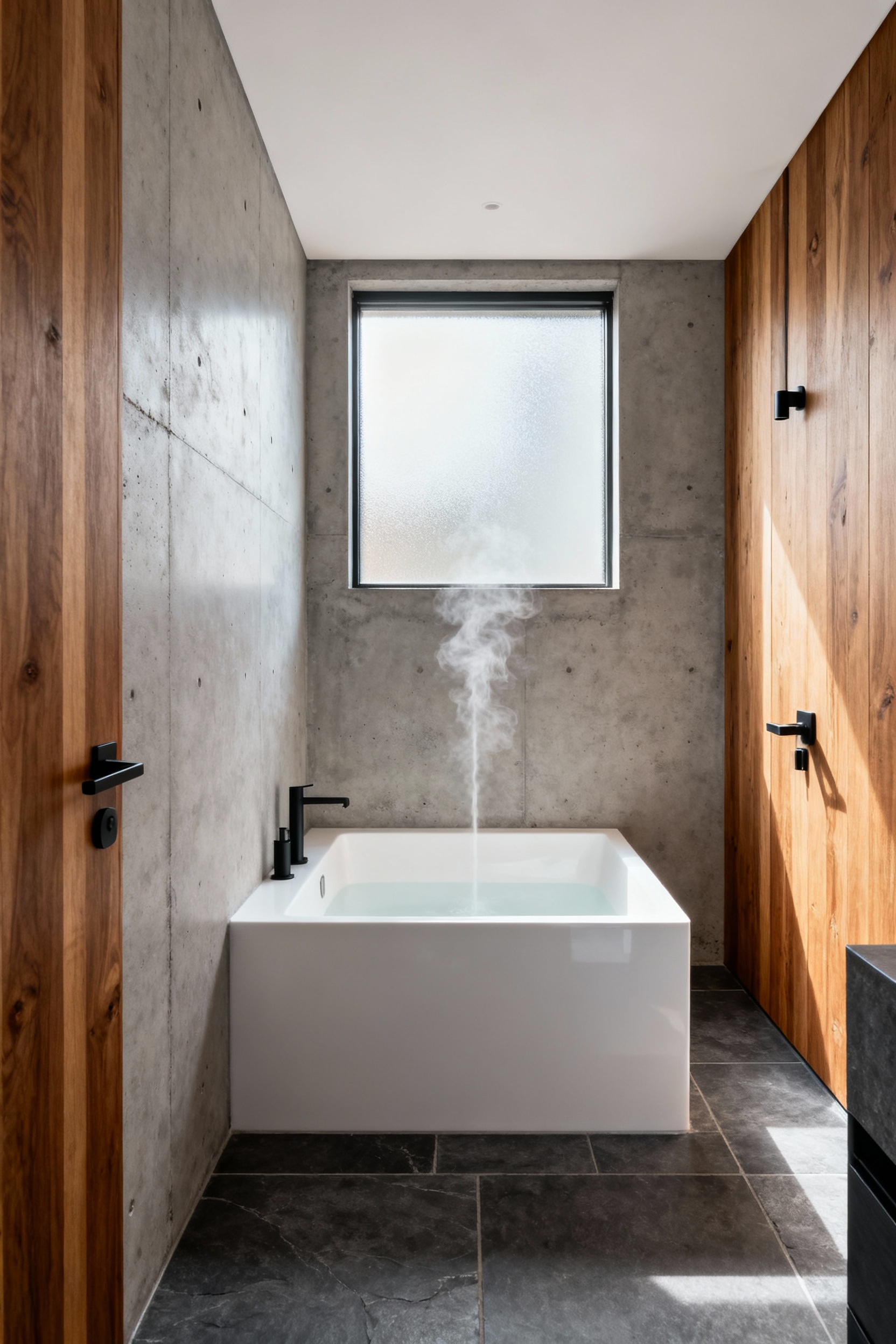
Beyond spatial economy, the *Ofuro* radically enhances the sensory experience. The reduced surface area significantly improves heat retention. Water stays hotter for longer periods compared to shallow basins. Historically, these vessels were crafted from fragrant Hinoki cypress. However, today’s designs utilize stone resin or high-grade acrylics. These materials maintain the meditative aesthetic while offering superior durability and hygiene.
Modern technology elevates this ancient ritual for the digital age. Integrated inline heaters, similar to traditional *oidaki*, maintain constant temperatures without refilling. Consequently, the bath becomes a sustainable sanctuary for decompression. It shifts the focus from simple cleansing to profound, meditative relaxation.
4. Floating Vanities with Hidden Grips: Elevating cabinetry to create a sense of weightlessness.
Floating vanities leverage an optical illusion to maximize spatial perception. By eliminating the traditional base, the design reveals a continuous expanse of flooring. The eye perceives the room as significantly larger and airier. This visual continuity is particularly effective in compact urban bathrooms. Furthermore, hidden grips are essential to completing this weightless effect. By utilizing recessed pulls or push-to-open mechanisms, the cabinetry appears as an uninterrupted, monolithic block. The unit resembles a sculptural element rather than a cluttered utility piece.
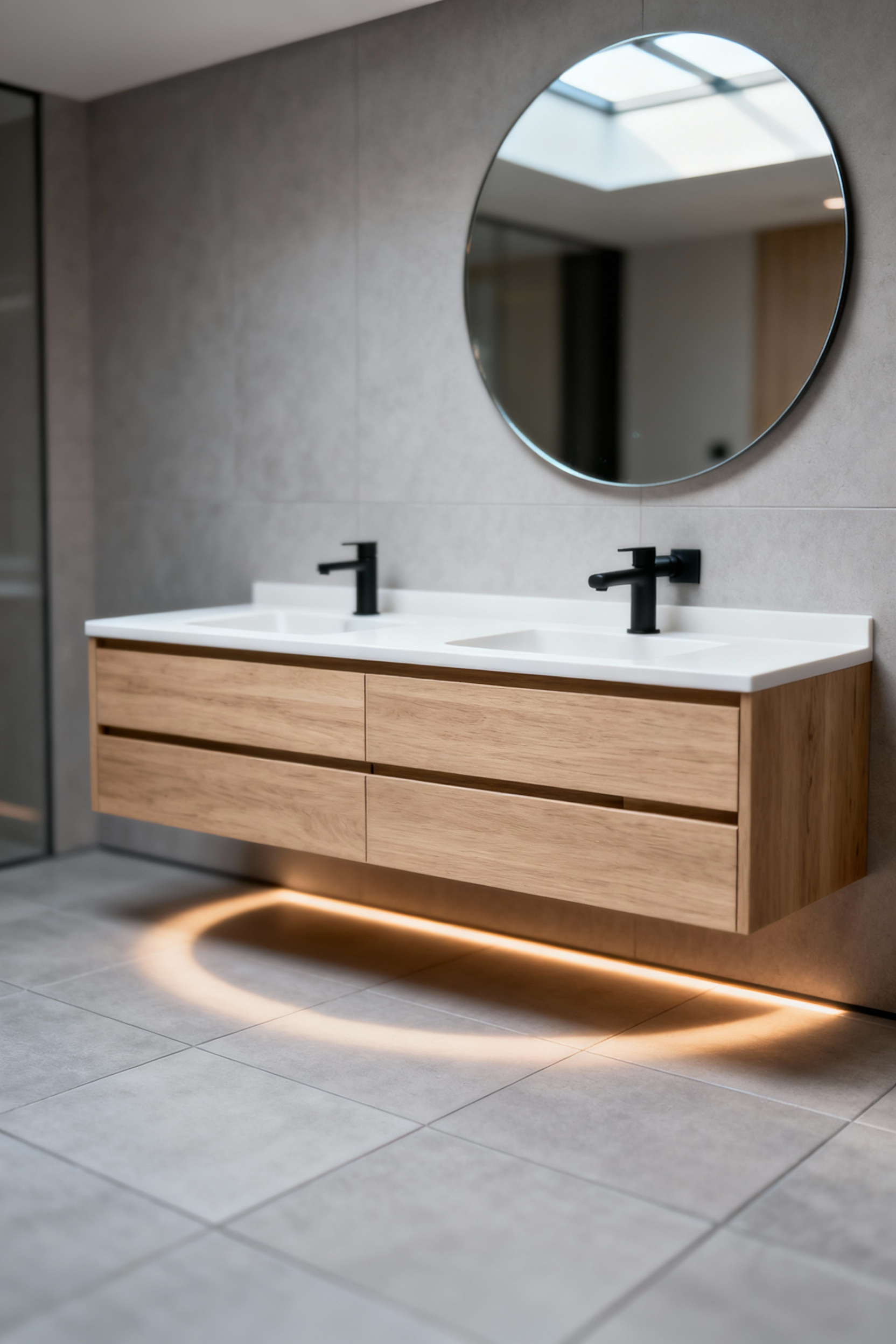
However, achieving this “impossible lightness” relies on meticulous behind-the-wall engineering. Unlike freestanding units, floating vanities transfer their entire weight to the wall structure. Installation must anchor securely into structural studs or reinforced internal blocking. Additionally, plumbing configurations require strict discipline. To maintain the minimalist aesthetic, the drain and supply lines must exit the wall, not the floor. Otherwise, visible piping would disrupt the serene, streamlined look.
Functionally, this design strategy offers distinct ergonomic refinements. Wall-mounting allows you to customize the height for personal comfort or accessibility needs. Moreover, the absence of protruding hardware improves safety by reducing snagging hazards. Finally, under-cabinet LED lighting can dramatically amplify the design. This addition casts a soft halo on the floor, effectively highlighting the void. This approach successfully blends modernist philosophy with precise functionality.
5. Warm Minimalism: Introducing heat-treated woods (Teak or Hinoki) to soften hard ceramic surfaces.
Modern bathrooms often risk feeling like cold, clinical boxes. Prevalent materials like porcelain and marble are hard, cool, and non-porous. To counter this, warm minimalism introduces a necessary tactile balance. Unlike icy ceramic tiles, wood offers a significantly warmer thermal experience underfoot. However, historical concerns regarding moisture have traditionally deterred designers from using timber here.
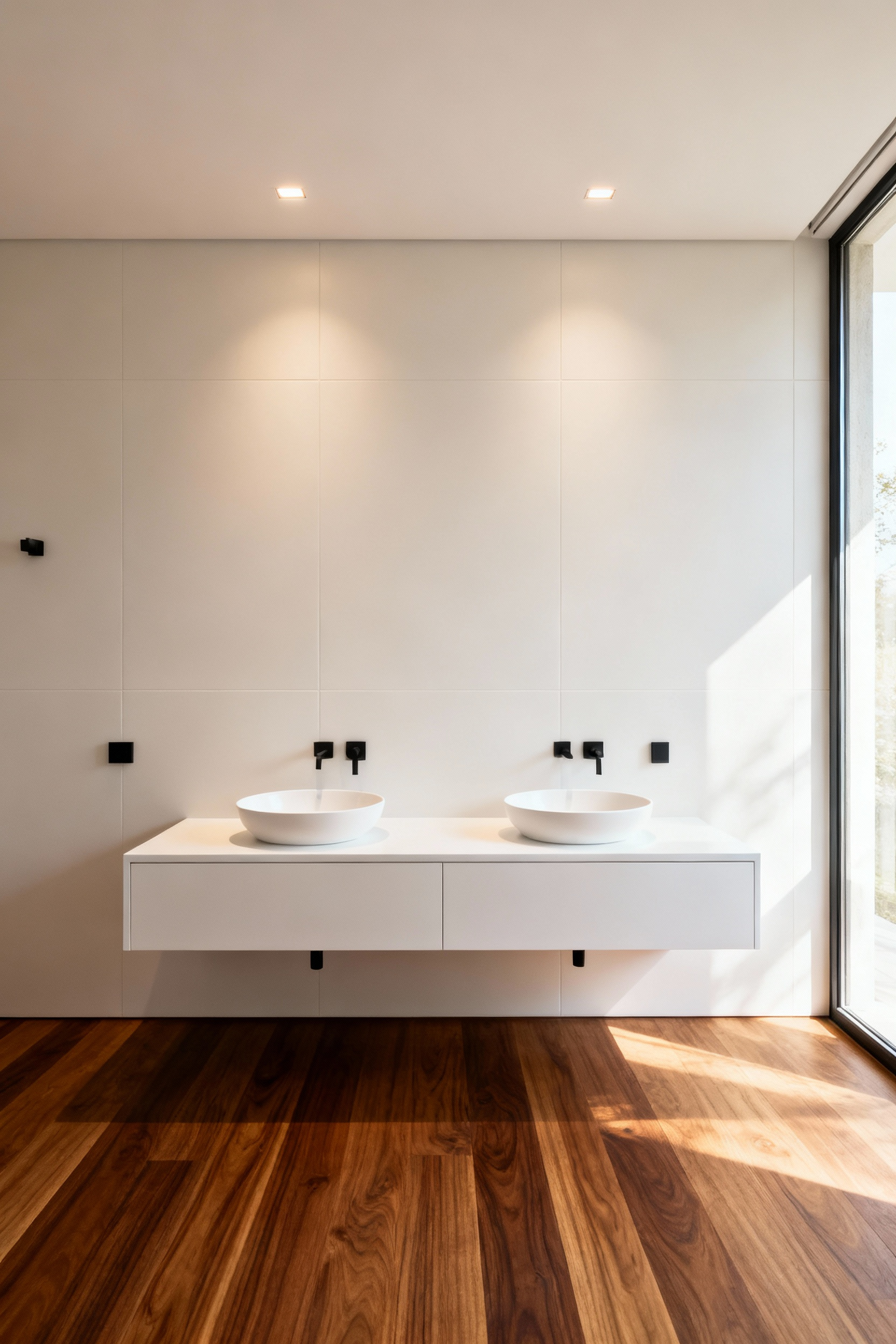
Fortunately, the integration of heat-treated woods provides a robust technical solution. This process, known as thermo-modification, fundamentally alters the wood’s chemical structure. Consequently, high temperatures degrade the hemicelluloses that typically feed mold and fungi. Thus, the material becomes highly resistant to decay without requiring chemical preservatives. Furthermore, this treatment significantly reduces water absorption, effectively preventing warping in humid environments.
Beyond durability, specific timber choices like Hinoki introduce profound sensory benefits. This Japanese Cypress releases a subtle, citrusy aroma when exposed to steam. Simultaneously, it possesses natural antibacterial properties ideal for damp spaces. Alternatively, Teak offers a rich grain that eventually softens into a silvery patina. Blending these organic elements with sleek surfaces transforms a functional space into a restorative sanctuary.
Phase II: Invisible Intelligence (Tech Integration)
True digital luxury requires silence. Therefore, Phase II focuses strictly on “invisible aesthetics.” Unlike early smart homes, modern technology should not demand attention. Instead, it must operate like a seasoned butler. Devices should blend into the architecture to reduce cognitive load. Consequently, the bathroom remains a sanctuary rather than a server room.
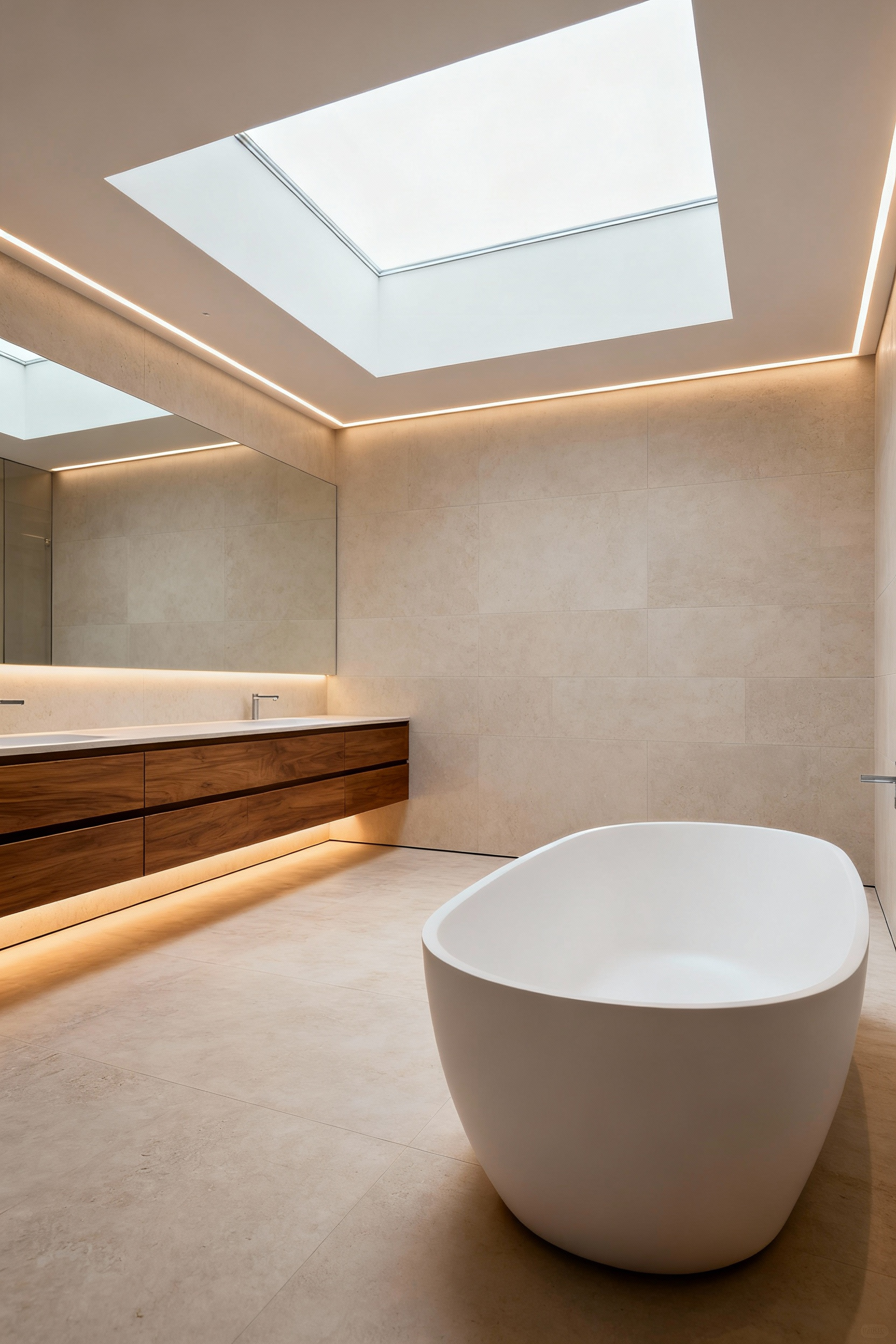
Consider radiant floor heating as the quintessential example. It maintains comfort invisibly. Moreover, it offers superior energy efficiency compared to traditional HVAC. Similarly, smart mirrors now feature embedded, invisible speakers and anti-fog capabilities. Intelligence moves beyond simple automation. Advanced sensors monitor air quality. Meanwhile, smart toilets provide health insights without invasive interfaces. Thus, the room cares for you silently.
Mechanically, this relies on decoupling controls from fixtures. Digital shower valves hide behind walls, managed by sleek, separate panels. As a result, users enjoy personalized water temperature profiles. However, deep integration brings challenges. Complex systems can become obsolete quickly or require expensive maintenance. Additionally, extensive data collection raises valid privacy concerns. Therefore, homeowners should prioritize foundational tech over fleeting trends.
6. Circadian Rhythm Lighting: Mirrors and overheads that shift from cool morning energizers to warm evening glows.
Modern bathroom design increasingly focuses on the non-visual effects of light. This approach targets the body’s internal clock, or circadian rhythm. Consequently, lighting systems now mimic the sun’s natural progression to support human physiology.
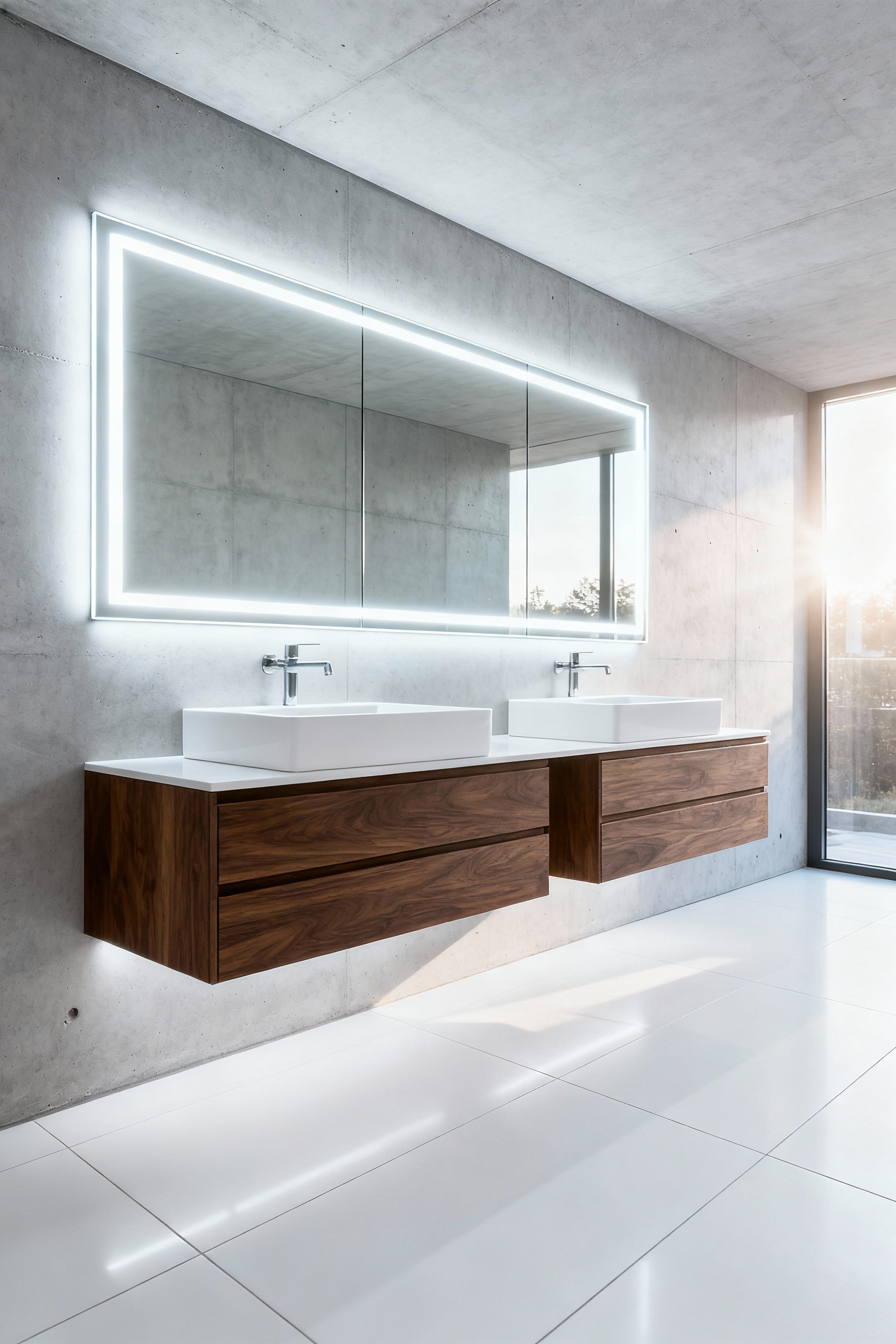
During the morning, fixtures should emit a cool, crisp light. Typically, this falls between 4000K and 6500K on the spectrum. Because our eyes detect this blue-enriched light, the brain suppresses sleep-inducing melatonin. As a result, the body produces cortisol to increase focus. Bright, front-lit mirrors act as natural energizers for early grooming tasks. Furthermore, a high Color Rendering Index (CRI) of 90 ensures accurate visibility.
However, the needs of the evening are vastly different. To promote relaxation, the system must shift to a warm, amber glow. Ideally, the color temperature drops to 2700K or lower roughly two hours before bed. This absence of blue light signals the body to wind down. Technically, this is achieved through Tunable White LED technology. These advanced systems blend warm and cool diodes for precise control.
Ultimately, customization remains essential for user wellbeing. Homeowners can manually override automated schedules. A dim, warm setting might be chosen for a calming meditation bath. Thus, smart technology harmonizes seamlessly with biological needs.
7. The Digital Detox Drawer: Integrated charging stations inside cabinetry to banish cord clutter.
The modern bathroom is evolving from a strictly utilitarian space into a sanctuary for well-being. However, the presence of tangled cords and scattered devices creates distracting “visual noise.” This clutter actively detracts from the room’s intended sense of calm. The “Digital Detox Drawer” resolves this conflict by integrating charging stations directly into vanity cabinetry. Therefore, homeowners can maintain their daily rituals without sacrificing the serene, minimalist aesthetic of the space.
Crucially, these installations require more than simple retrofit solutions. Safety standards must dictate the design process. Unlike standard power strips, legitimate in-drawer systems are UL Recognized or ETL Listed for furniture application. Furthermore, the most advanced units feature an integrated interlocking thermostat. This critical safeguard automatically cuts power if the internal temperature exceeds $120^\circ\text{F}$ ($49^\circ\text{C}$). Thus, the system actively prevents overheating risks common in enclosed, unventilated spaces.
Beyond safety, the design focuses on seamless tactile luxury. Premium systems utilize soft-close hardware, such as Blumotion slides, to ensure silent operation. Additionally, a dedicated mechanical arm manages the power cord behind the drawer. This prevents the wiring from pinching or tangling during use. Modern units offer a versatile mix of standard AC outlets and high-speed USB-C ports. As a result, technology remains fully functional yet completely invisible, perfectly balancing modern convenience with digital peace.
8. Intelligent Bidet Systems: Embracing the Japanese standard of hygiene with heated seats and auto-lids.
Intelligent bidet systems act as a sophisticated bridge between essential hygiene and high-end technology. Originally pioneered by TOTO as the “Washlet,” these devices are no longer mere novelties. In fact, they represent the modern “Japanese standard of hygiene.” Historically, this widespread adoption was driven by a cultural philosophy of “washing, not wiping.” Consequently, the utilitarian toilet transforms into a centerpiece of daily wellness.
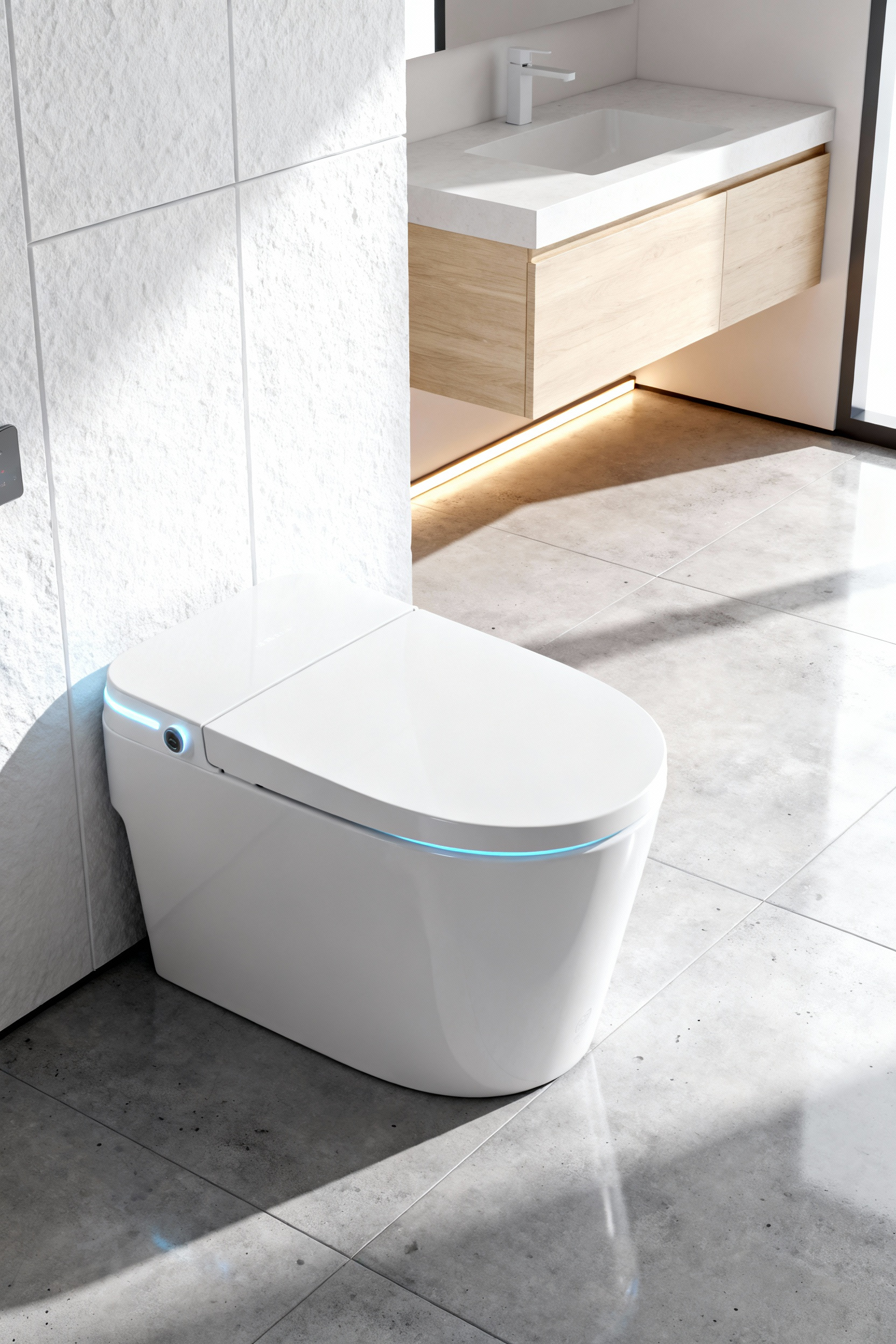
Technically, this comfort relies on absolute precision. The water spray targets a “golden angle” of approximately 43 degrees. Therefore, the cleansing process is both effective and gentle. Furthermore, the physical experience is intentionally soothing. Heated seats typically maintain a temperature between 90°F and 100°F. Thus, the jarring shock of a cold ceramic seat is instantly dispelled.
Additionally, automation preserves a serene, hands-free environment. Sensor-operated lids open automatically upon approach, eliminating the need to touch surfaces. As a result, users avoid common contact points for germ transfer. Moreover, the unit actively maintains its own cleanliness. PREMIST technology sprays a water film on the bowl before use. This prevents waste from sticking to the ceramic. Similarly, electrolyzed water sanitizes the nozzle after every cycle. Installing these systems boosts property value while ensuring a Zen-like, sanitary experience.
9. Invisible Radiant Heating: Warming floors and towel bars to engage the sense of touch subconsciously.
True luxury often operates unseen. Specifically, invisible radiant heating engages the haptic sense before the mind registers the source. Unlike the dynamic gust of forced air, radiant heat creates a static, immersive experience. Consequently, this fosters a deep, psychosomatic sense of well-being.
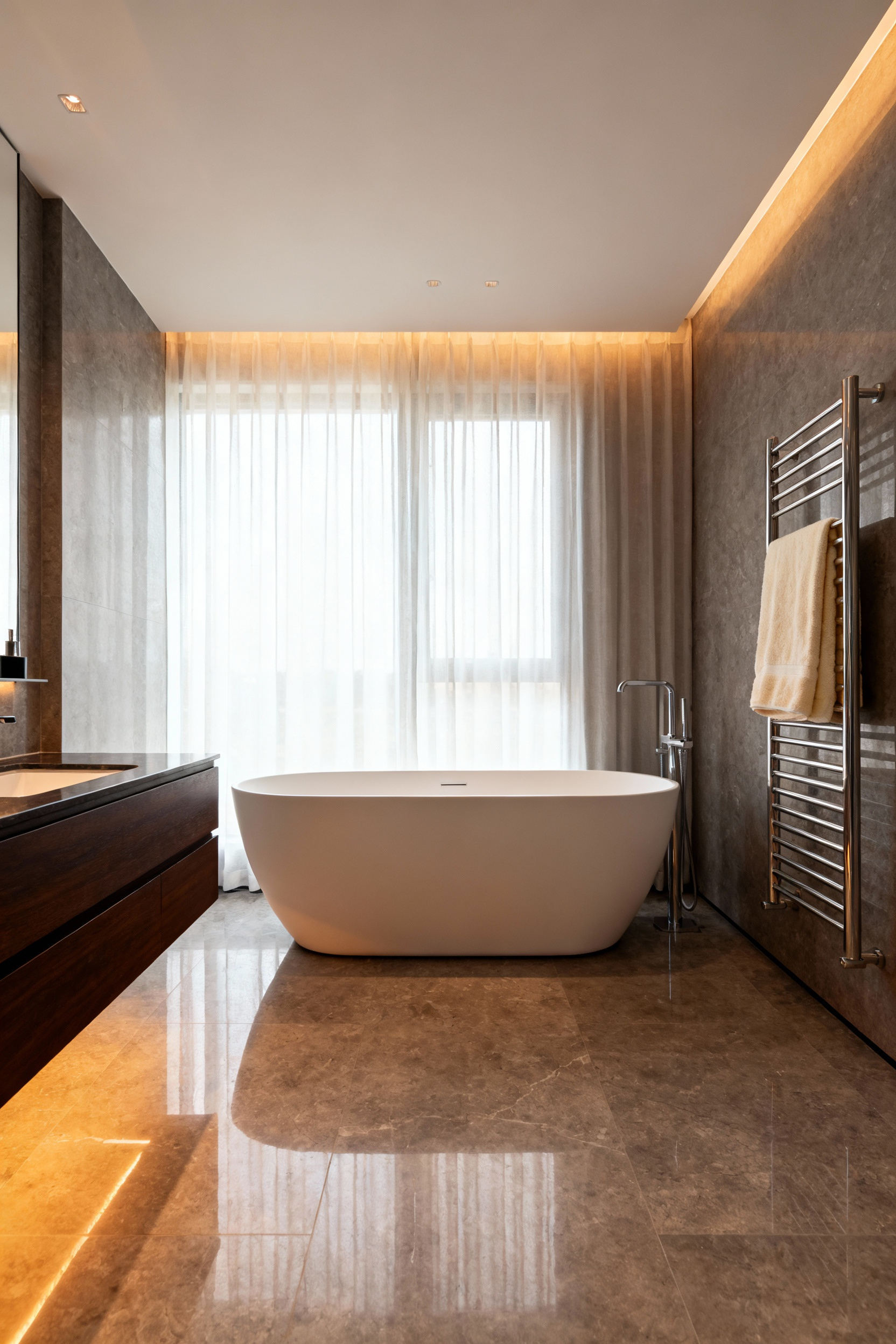
Ideally, this technology transforms cold materials like tile into sources of inherent warmth. Historically, this aligns with the Korean *Ondol* or Roman *Hypocaust*, where heat was a structural element. Modern systems aim for “thermal neutrality,” effectively removing the shock of cold surfaces. Precision is key to this sensation. For example, maintaining floor temperatures between 77°F and 84°F ensures barefoot comfort without overheating. Smart thermostats can even anticipate usage, pre-warming the stone to a physiological sweet spot of 90°F. Thus, the warmth feels instantaneous upon leaving the shower.
Beyond flooring, heated towel bars offer a secondary layer of sensory curation and engagement. They provide a tactile connection through warmed fabric. However, wrapping a bar in thick towels creates an insulating “Towel Effect.” As a result, professional installations must increase BTU output by 20% to compensate for this heat loss. This technical attention to detail ensures the bathroom remains a seamless sanctuary of warmth.
10. Voice-Activated Water Control: Pre-setting shower temperatures to streamline the morning ritual.
Mornings often involve a jarring negotiation with traditional faucet handles to find the right heat. However, voice-activated technology harmonizes this daily ritual by eliminating the “cold shock” entirely. Smart showers allow you to command a specific temperature from the comfort of your bed. Consequently, the water warms to a precise degree while you prepare your morning coffee, streamlining your routine.
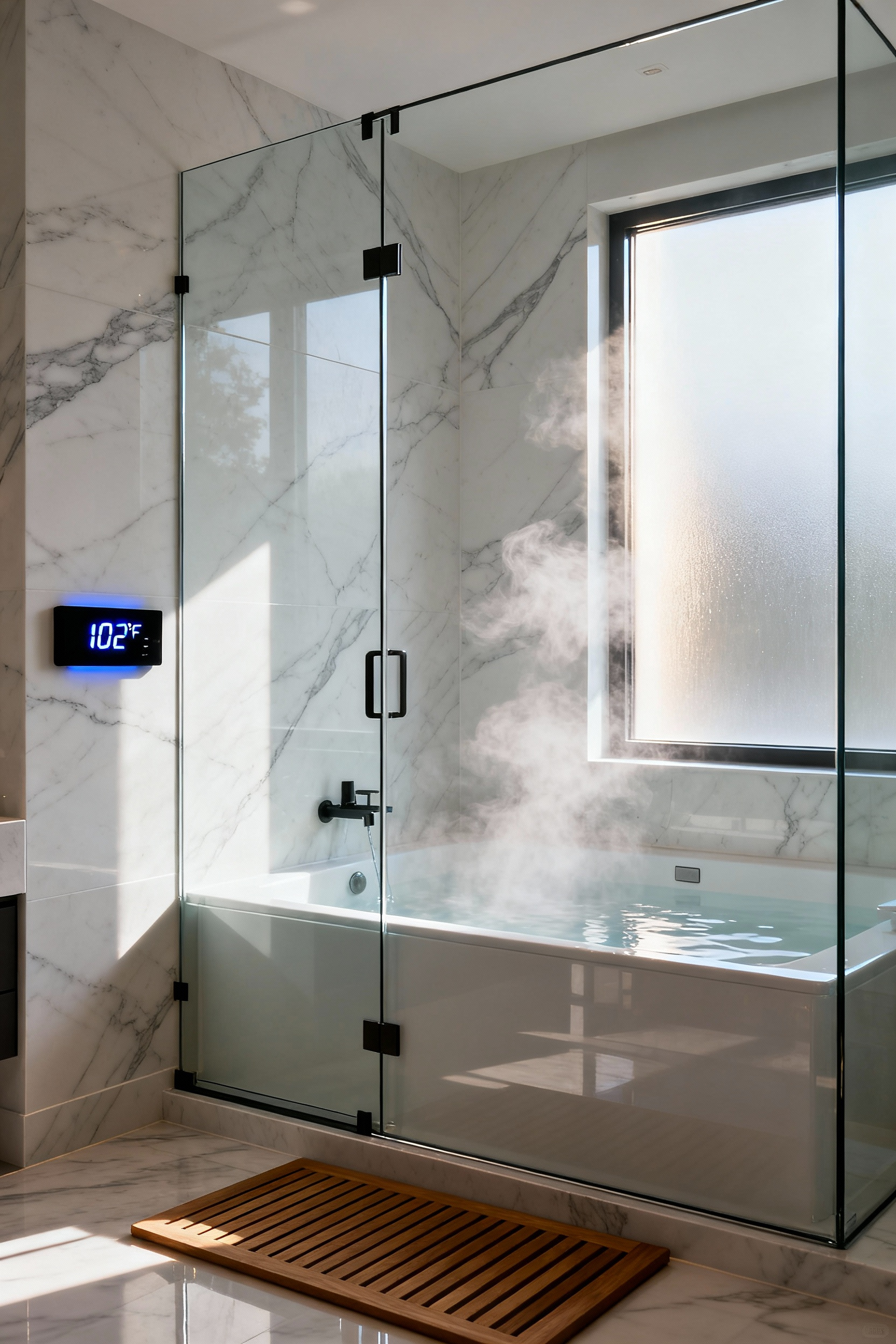
This innovation transforms the bathroom into a predictable thermal sanctuary. Digital thermostatic valves replace inconsistent mechanical mixers. Therefore, the water temperature remains stable, even if a toilet flushes elsewhere in the house. Visual cues, such as lighting shifting from blue to amber, softly signal when the shower is ready.
Additionally, the true value lies in personalized profiles. Users can save distinct settings, like a “Morning Wake-Up” or a “Relaxing Soak.” Thus, flow rate, temperature, and duration adjust automatically to your preference. Integration with smart home ecosystems allows for holistic “scenes.” A single phrase can simultaneously dim the lights, start a soothing playlist, and activate the steam. This precision fosters sustainability by reducing water waste, seamlessly merging modern efficiency with Zen-like tranquility.
11. Switchable Privacy Glass: Using electrochromic technology to maximize natural light without sacrificing seclusion.
Integrating technology into the bathroom should enhance, not disrupt, the sense of tranquility. Switchable privacy glass using electrochromic (EC) technology creates a seamless connection to the outdoors. Unlike common smart glass that turns frosted instantly, EC glass functions through dynamic tinting. The glass undergoes a gradual, reversible color change similar to high-quality sunglasses. Consequently, this slow transition preserves your view of the landscape while filtering out harsh glare.
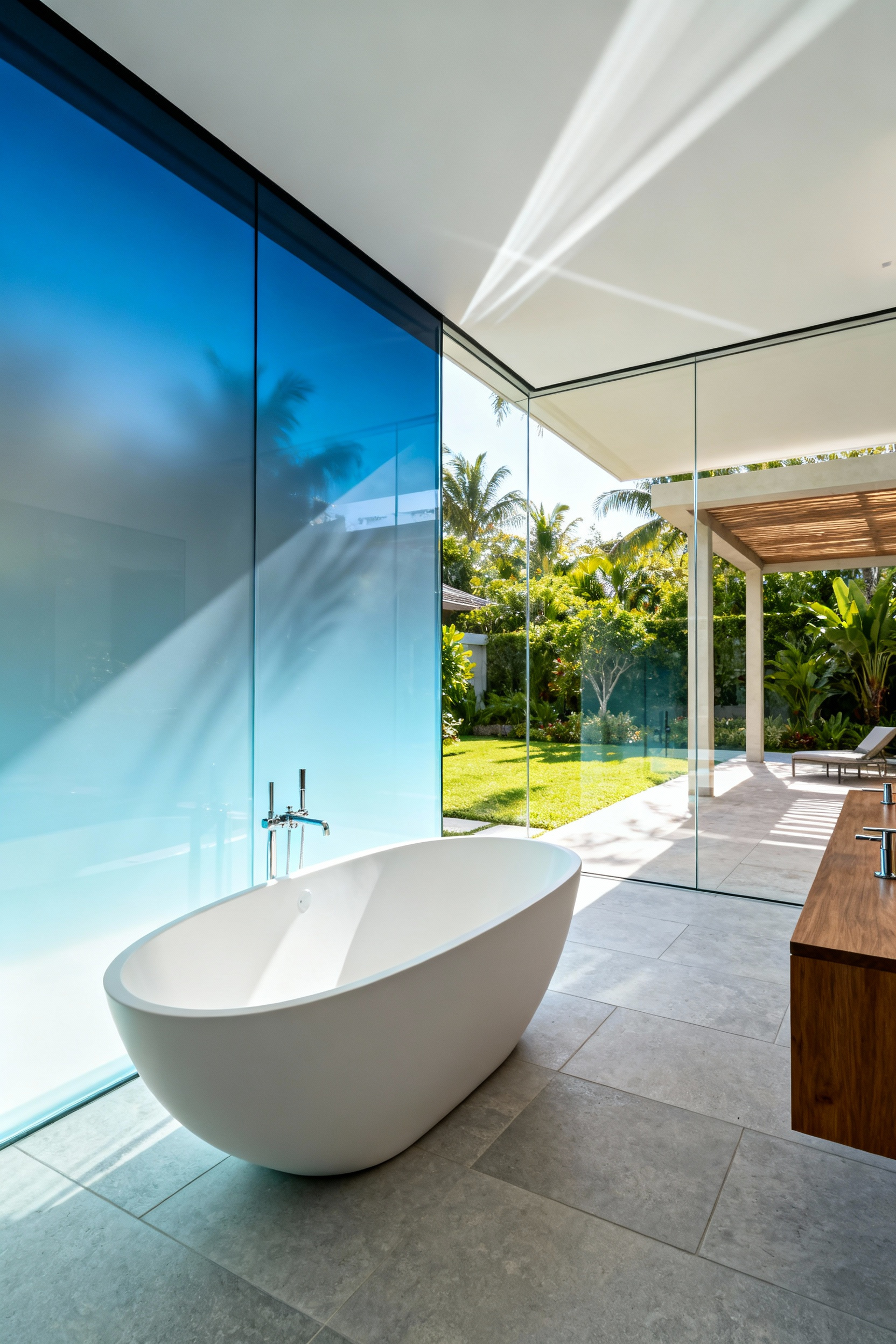
Historically, this “dynamic glazing” was reserved for elite aerospace applications like the Boeing Dreamliner. Now, it brings that same architectural pedigree to modern residential wellness spaces. Functionally, the system is highly energy-efficient due to its bistable nature. It only requires a low-voltage burst to change states, using zero power to maintain the tint. Therefore, it significantly reduces solar heat gain without increasing continuous energy consumption.
Furthermore, users can precisely adjust the tint level to suit the specific time of day. For instance, a lighter setting accommodates soft morning light, while a deep tint blocks peak afternoon sun. Additionally, this capability allows for a cleaner design by eliminating the need for blinds or curtains. Ultimately, electrochromic glass maximizes natural light while maintaining a serene, minimalist aesthetic.
Phase III: Sensory Curation (Atmosphere & Wabi-Sabi)
Previously, we addressed layout and basic aesthetics. Now, the focus shifts to curating a deeply restorative sensory curation experience. This transformation relies on *Wabi-Sabi*, a Japanese worldview celebrating authentic imperfection. Unlike the sterile, flawless showroom ideal, this philosophy values materials that age gracefully. Unlacquered brass fixtures develop a unique patina over time. Similarly, hand-crafted zellige tiles introduce organic asymmetry, rejecting mass-produced uniformity. Consequently, the space feels grounded rather than static.
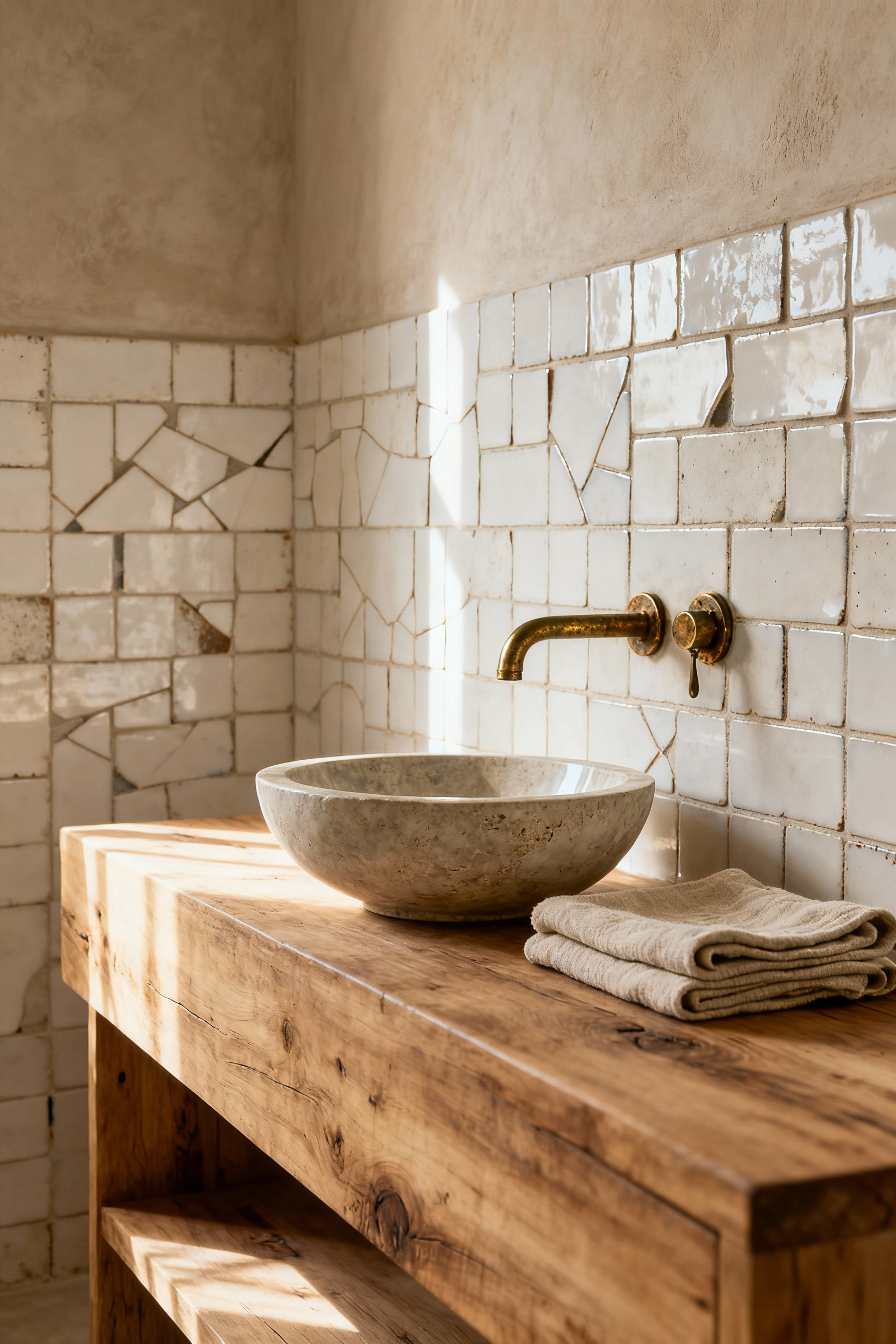
Beyond visuals, true serenity requires addressing sound and touch. Unfortunately, bathrooms often suffer from harsh acoustics due to hard surfaces. Therefore, acoustic engineering is essential for tranquility. Solutions include concealed cisterns to silence plumbing or cork flooring to absorb reverberation. Furthermore, haptic design creates immediate physical comfort. Heated floors, for example, transform stepping out of the shower into a soothing ritual.
Finally, lighting acts as a fluid, kinetic element. Instead of uniform brightness, use dimmers to create intimate, shadow-rich atmospheres. This approach highlights textured limewash walls or natural stone. Biophilic design integrates moisture-tolerant plants like bamboo. Engaging these senses shifts the room from a utility to a personal sanctuary.
12. Tactile Contrast: Pairing smooth smart glass with rough-hewn stone basins.
True design mastery often relies on intentional juxtaposition. Without distinct contrasts, modern spaces risk feeling flat or sterile. Pairing rough-hewn stone with smooth smart glass creates a profound philosophical opposition. The stone basin stands as a monumental, static element. It tells a story of geological permanence and ancient craft. Conversely, the smart glass is sleek, ephemeral, and active. Its surface represents the pinnacle of digital innovation. This pairing balances the grounding nature of earth with the dynamic potential of technology.
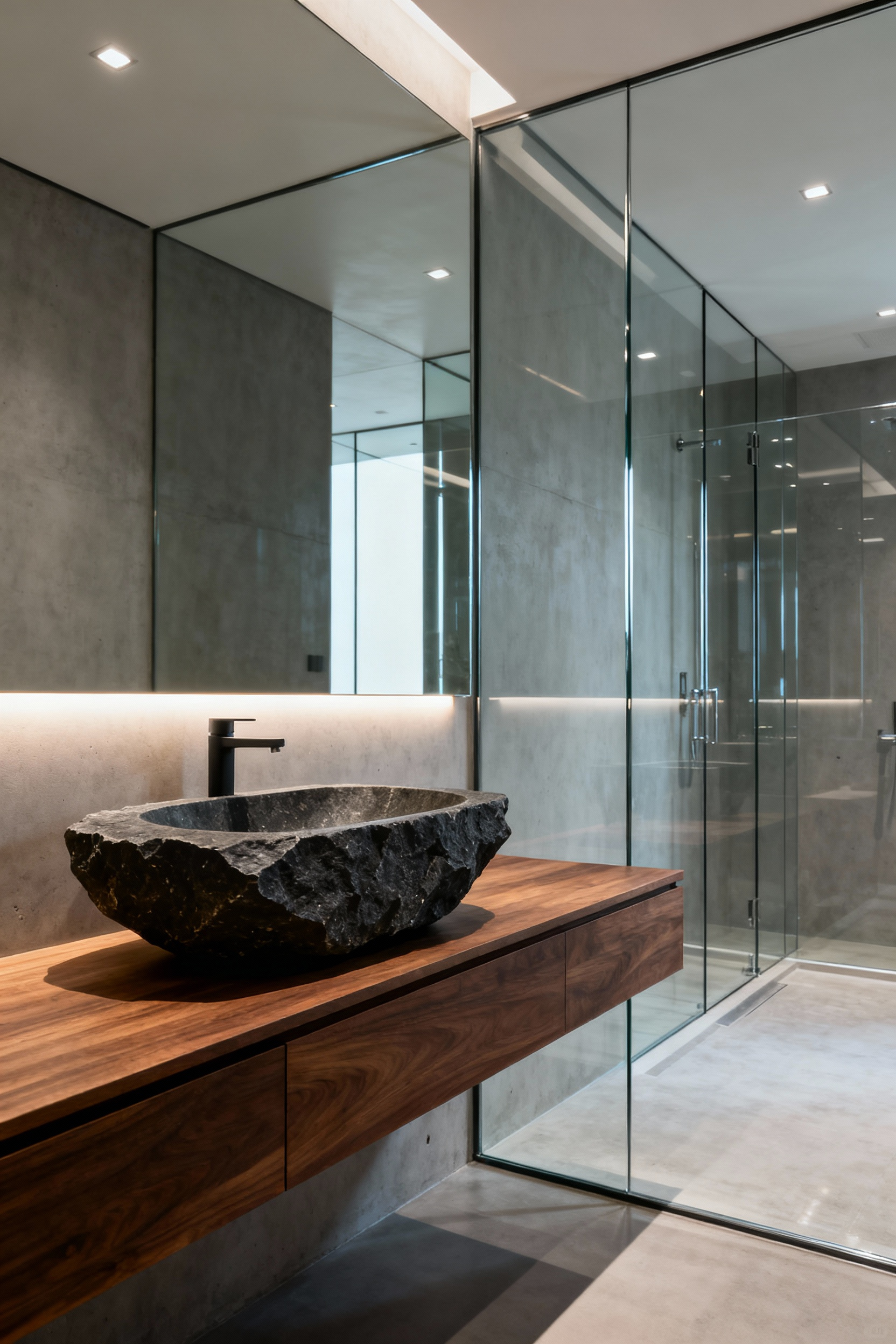
This combination engages multiple senses simultaneously. The stone basin acts as a tactile focal point. Its chiseled, irregular exterior actively invites touch. In fact, this friction connects the user to the physical world. Meanwhile, the smart glass appeals primarily to the eye. It offers a flawless surface that manipulates light and privacy. When activated, the glass transforms into a luminous, diffused veil. As a result, the technology visually recedes. This creates a backdrop that emphasizes the raw, manual drama of the stone.
Ultimately, this fusion defines the contemporary “Eco-Chic” luxury trend. It unites rustic, biophilic elements with clean, minimalist lines. Thus, a sophisticated tension emerges within the bathroom. The unpolished craft sits directly beside ultra-refined technical surfaces. Ideally, the stone honors the past, while the glass embraces the future. This holistic approach creates a sanctuary that is both timeless and innovative.
13. Shadow-Gap Architecture: utilizing recessed baseboards and ceilings for a floating, ethereal effect.
The shadow gap replaces traditional decorative trim with a crisp, continuous recessed channel. Fundamentally, this architectural detail visually detaches walls from floors, creating a sophisticated “floating” effect. By embracing negative space, massive architectural planes appear to dematerialize at their edges. Consequently, typically small bathrooms feel significantly more expansive and airy. This approach reflects a commitment to structural honesty, rejecting superfluous ornamentation for pure form.
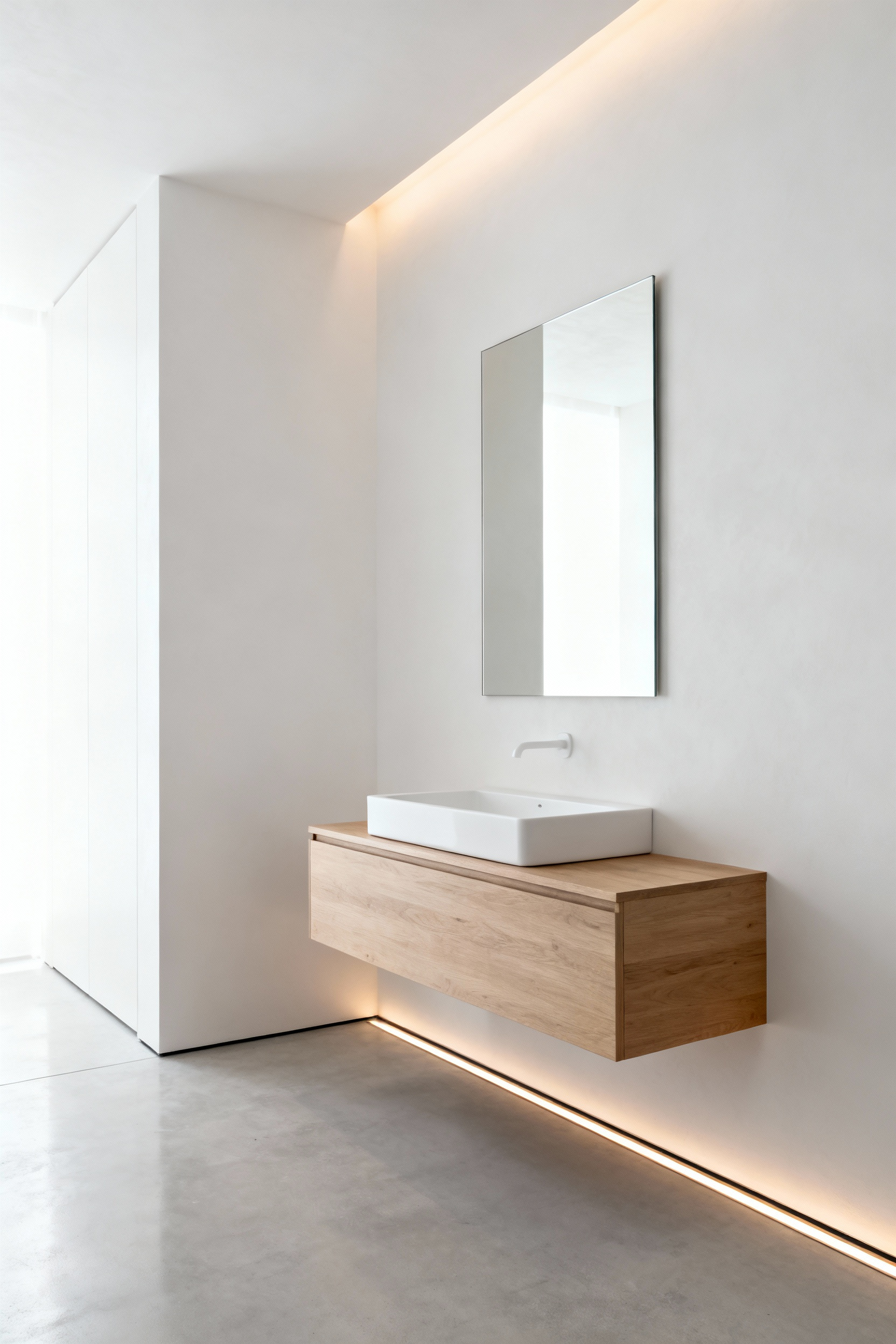
Achieving this look requires absolute precision. Unlike standard baseboards that hide rough joints, a shadow gap is an unforgiving detail. The underlying wall framing must be perfectly straight and true. Technically, this necessitates specialized aluminum or PVC profiles installed before the wall surface is finished. In wet environments, these non-porous materials are essential for resisting moisture damage. Furthermore, tile edges often utilize high-quality metal trim to define the sharp, recessed channel clearly.
To elevate the aesthetic further, many designers integrate LED strip lighting within the recess. Specifically, a wider gap of 20mm allows space for diffusers to create a soft wash of light. This indirect illumination instantly establishes a luxurious, spa-like atmosphere. However, note that these open channels can collect dust or moisture. Thus, regular cleaning is required to maintain the serene, ethereal appearance. This maintenance trade-off yields a uniquely modern, tranquil space.
14. Biophilic Niches: dedicated, lit recesses specifically designed for high-humidity plants.
Bathrooms are often defined by hard, engineered surfaces like chrome and tile. Consequently, they require organic elements to soften the atmosphere and restore balance. A biophilic niche provides a dedicated, illuminated home for high-humidity plant life. This feature acts as a visual anchor, significantly reducing cortisol levels through a direct connection with nature. However, success depends on precise engineering rather than mere aesthetics.
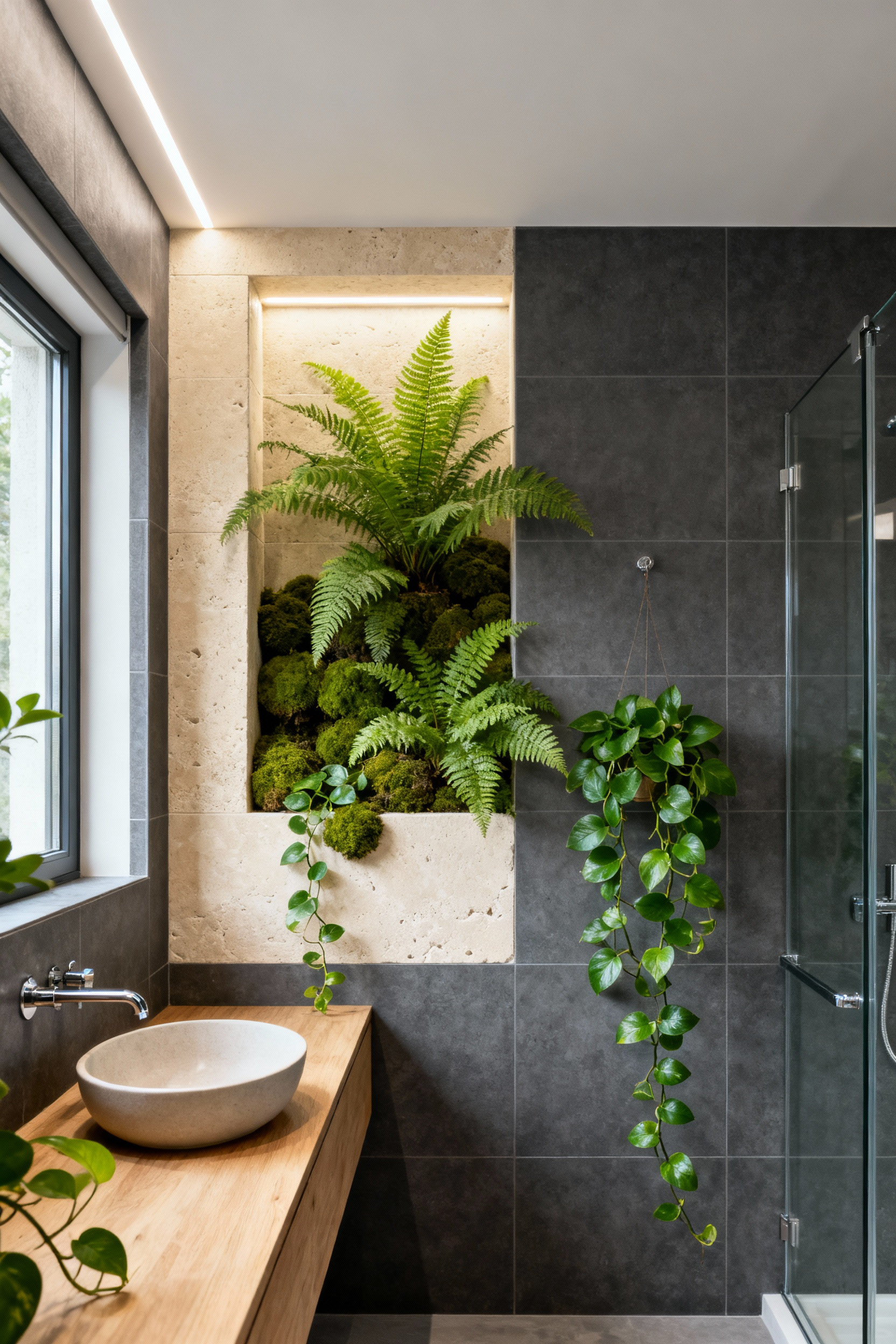
Crucially, plant health requires specialized lighting metrics beyond standard illumination. While human eyes rely on lumens, photosynthesis demands Photosynthetic Photon Flux Density (PPFD). For thriving tropicals, you must install full-spectrum LED strips delivering 40–150 µmol/m²/s. Furthermore, select a color temperature between 3000K and 4000K. This ensures the light appears natural to the eye while still fueling plant growth.
Functionally, water management is equally important for long-term maintenance. Historically, direct-soil planters caused drainage disasters within walls. Therefore, utilize the niche as a waterproof “cachepot” housing separate nursery pots. This allows for easy removal during watering. Alternatively, consider semi-hydroponic clay pellets for a clean, soil-free solution. This approach creates a modern micro-terrarium that honors the serenity of nature without compromising structural integrity.
15. Acoustic Softening: Integrating sound-dampening materials and hidden speakers for meditative audio.
Modern luxury bathrooms often rely on sleek materials like marble and glass. Unfortunately, these hard surfaces create harsh acoustic environments. They reflect sound, causing long reverberation times. Consequently, a relaxing soak is interrupted by jarring echoes from plumbing or fans. To counter this, we must introduce intentional “acoustic softening.”
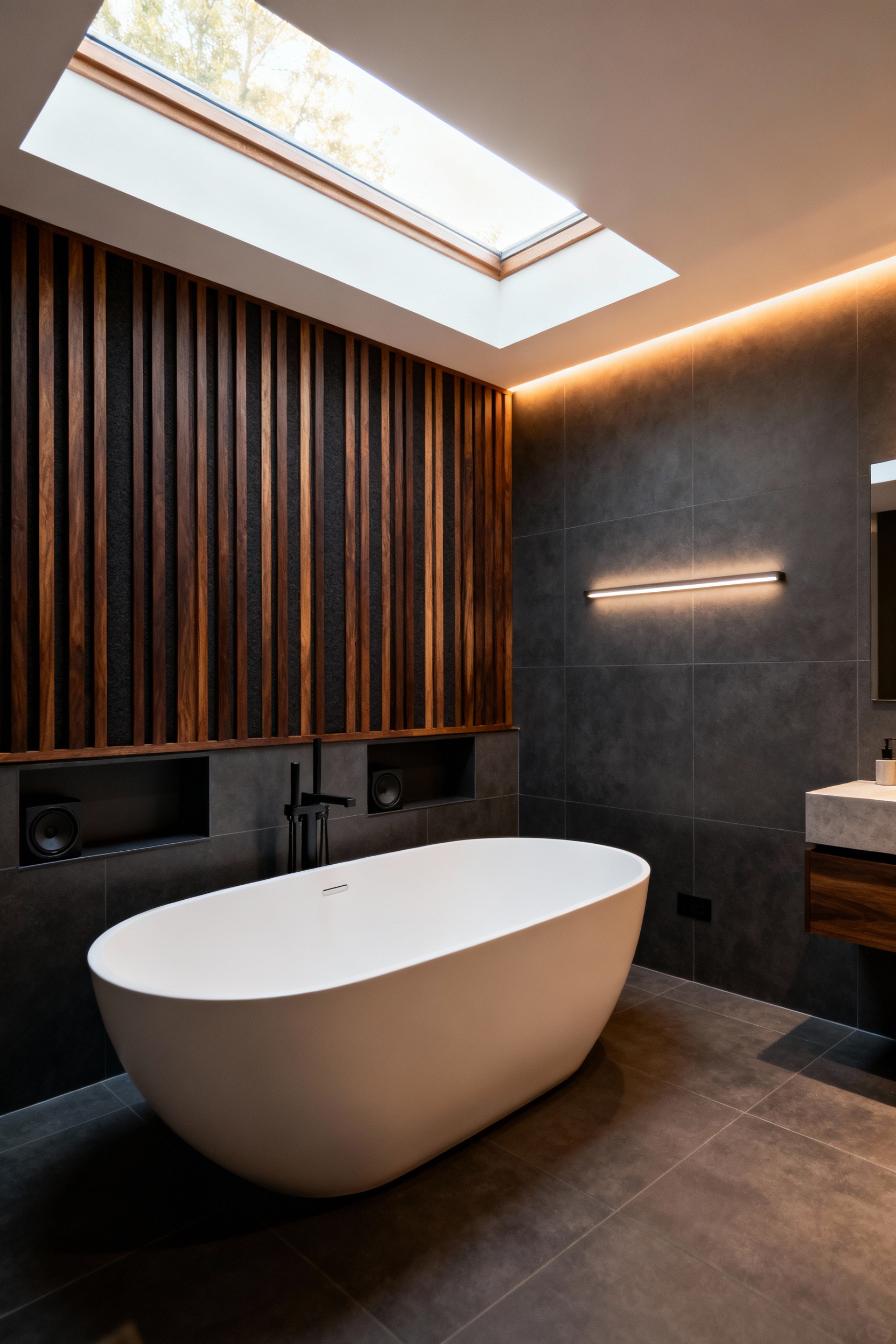
First, consider installing moisture-resistant acoustic materials. Commercial-grade panels with fiberglass cores effectively dampen noise. Furthermore, these are sealed in waterproof skins to withstand humidity. Additionally, simpler design choices offer immediate benefits. Placing plush towels on open shelving absorbs high-frequency sounds. Similarly, a rubberized underlayment beneath tile floors reduces impact noise.
Next, seamless technology enhances this tranquility without visual clutter. Standard speakers disrupt minimalist aesthetics with visible grilles. Instead, invisible plaster-over speakers offer a superior alternative. Technically, these units sit inside the wall cavity. Then, a skim coat and water-resistant paint conceal them completely. Thus, the wall itself vibrates to produce sound, making the source truly invisible.
Finally, this setup supports biophilic wellness. By playing natural soundscapes, such as gentle rain, you can actively lower cortisol levels. Moreover, the “spread-source” audio creates an immersive field. It feels as though the sound emanates from the air itself. Therefore, your bathroom becomes a true vessel for deep, meditative relaxation.
16. The Monochromatic Textural Palette: Using a single color tone but varying finishes (matte, gloss, rough) to create depth without chaos.
Adopting a monochromatic palette shifts the focus from color variations to the physics of light. Essentially, you use a single hue to establish tranquility while layering finishes to build depth. For instance, glossy surfaces function as expansive tools within the space. They reflect artificial and natural light, making compact areas feel fluid and architectural.
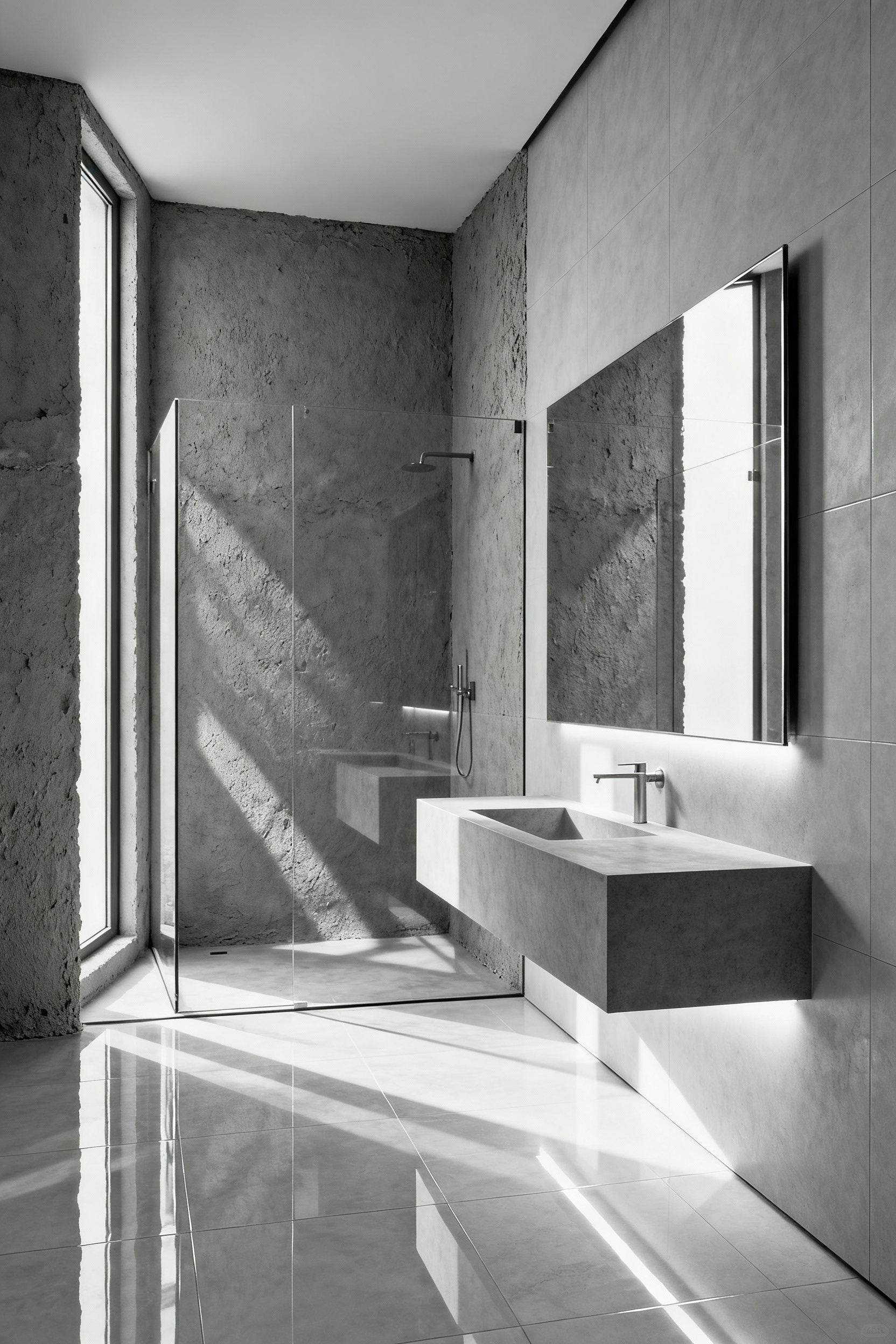
Conversely, matte finishes serve as absorptive tools. These surfaces absorb light to create shadow, providing a sophisticated visual rest for the eye. Furthermore, this selection process is often dictated by safety. Matte tiles provide slip-resistance, making them the standard choice for wet shower floors. Simultaneously, high-gloss finishes on vertical walls offer easier maintenance and cleaning.
However, a single-color space might feel sterile without organic interference. Therefore, introducing “roughness” via natural stone or woven textiles is crucial to prevent flatness. Even subtle geometric patterns in the same tone can effectively function as texture. This strategic interplay creates a dynamic, spa-like atmosphere. It achieves deep visual interest without introducing chaotic color shifts.
Conclusion: The Mindful Morning
Ultimately, the modern bathroom remodel represents a fundamental psychological investment. It transforms a utilitarian pitstop into a daily ritual chamber. Consequently, this architectural shift establishes a “Mindful Morning” routine. The room acts as a critical anchor for your daily emotional state. Reducing visual noise is essential for maintaining mental clarity. For instance, concealed storage eliminates clutter, keeping countertops completely clear.
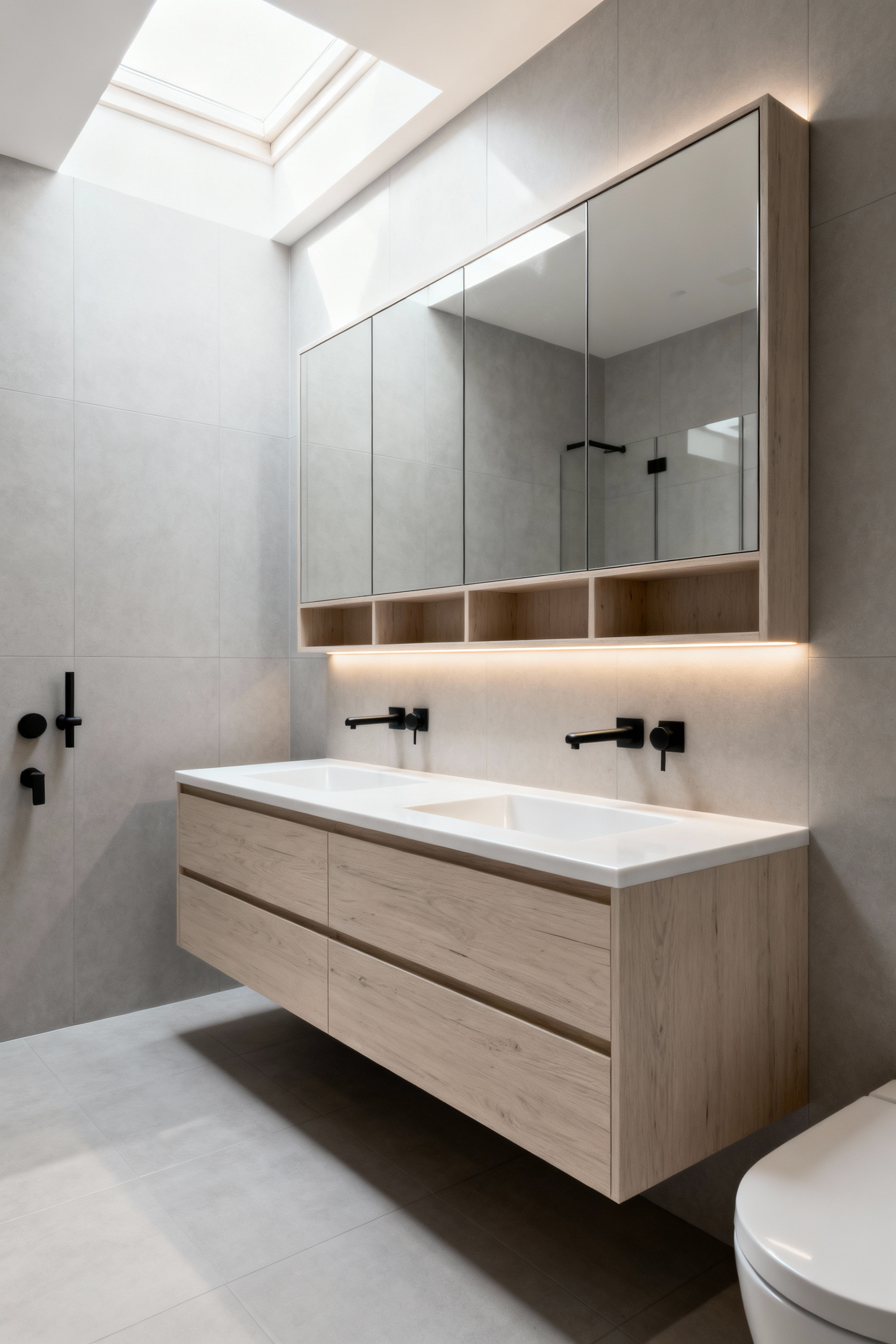
Furthermore, a mindful morning effectively engages the senses through “sensescaping.” Notably, circadian lighting systems mimic the natural wake cycle. Thus, cool, bright light boosts energy levels immediately upon waking. Simultaneously, tactile elements provide a gentle, grounding welcome. Heated floors transform the shock of a cold morning into an immediate luxury. Moreover, soft-close cabinetry reduces jarring noises, effectively preventing sensory disruption.
In addition to technology, biophilic design grounds the experience. Natural materials like slate or wood actively reduce stress. Indeed, humans possess an innate desire to connect with organic elements. Therefore, incorporating greenery offers a moment of intentional pause. Eventually, these design choices compound into a restorative lifestyle. In essence, the bathroom becomes a necessary buffer against the outside world.
Summary: A remodeled bathroom should not just look different; it should make you feel different.
Historically, bathing was a transformative ritual used for spiritual purification. However, modern design often reduces the bathroom to a mere utilitarian box. Therefore, a successful remodel revives the space as a sacred retreat. Psychologically, this room effectively bookends your mood each day. Visual “mental clutter” from poor layouts creates unnecessary stress. In contrast, a purposeful design facilitates a profound mental reset.
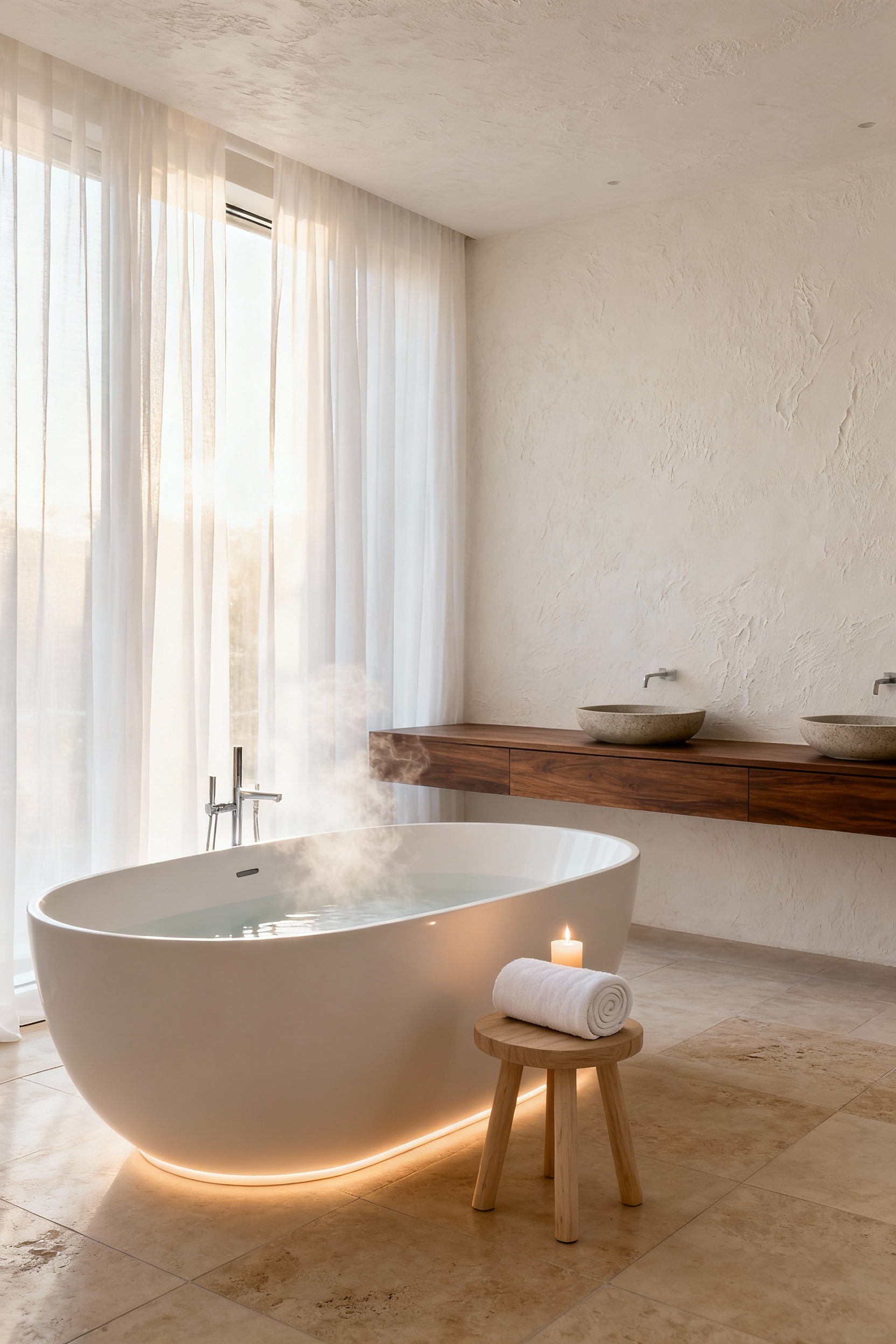
Specifically, we engineer this emotional shift through sensory details. Lighting profoundly impacts the human nervous system. Natural light regulates circadian rhythms, while dimmable LEDs allow for evening relaxation. Similarly, tactile elements ground the user in the present moment. Natural materials like teak or stone introduce warmth to the space. Additionally, heated floors remove the friction of cold, sterile surfaces.
Furthermore, we must address the acoustic experience. Whisper-quiet fans and soft-close drawers eliminate jarring, stressful noises. Thus, these technical choices actively alleviate anxiety and promote tranquility. Ultimately, a bathroom should not just look new. Instead, it must function as a tool for personal well-being. By prioritizing these sensory inputs, you create a space that truly heals.
Final Thought: By balancing high-tech function with Zen principles, we create spaces that don’t just clean the body, but clear the mind for the day ahead.
The modern “High-Tech Zen” bathroom functions as much more than a utility space. In fact, it serves as a private decompression chamber for the mind. Fundamentally, this design strategy relies on the principle of *Kanso*, or simplicity. By utilizing recessed storage and handleless vanities, we effectively remove visual noise. Consequently, this visual clarity translates directly into mental clarity. If you are exploring serious options for your next renovation, these bathroom remodeling ideas provide the ultimate framework.
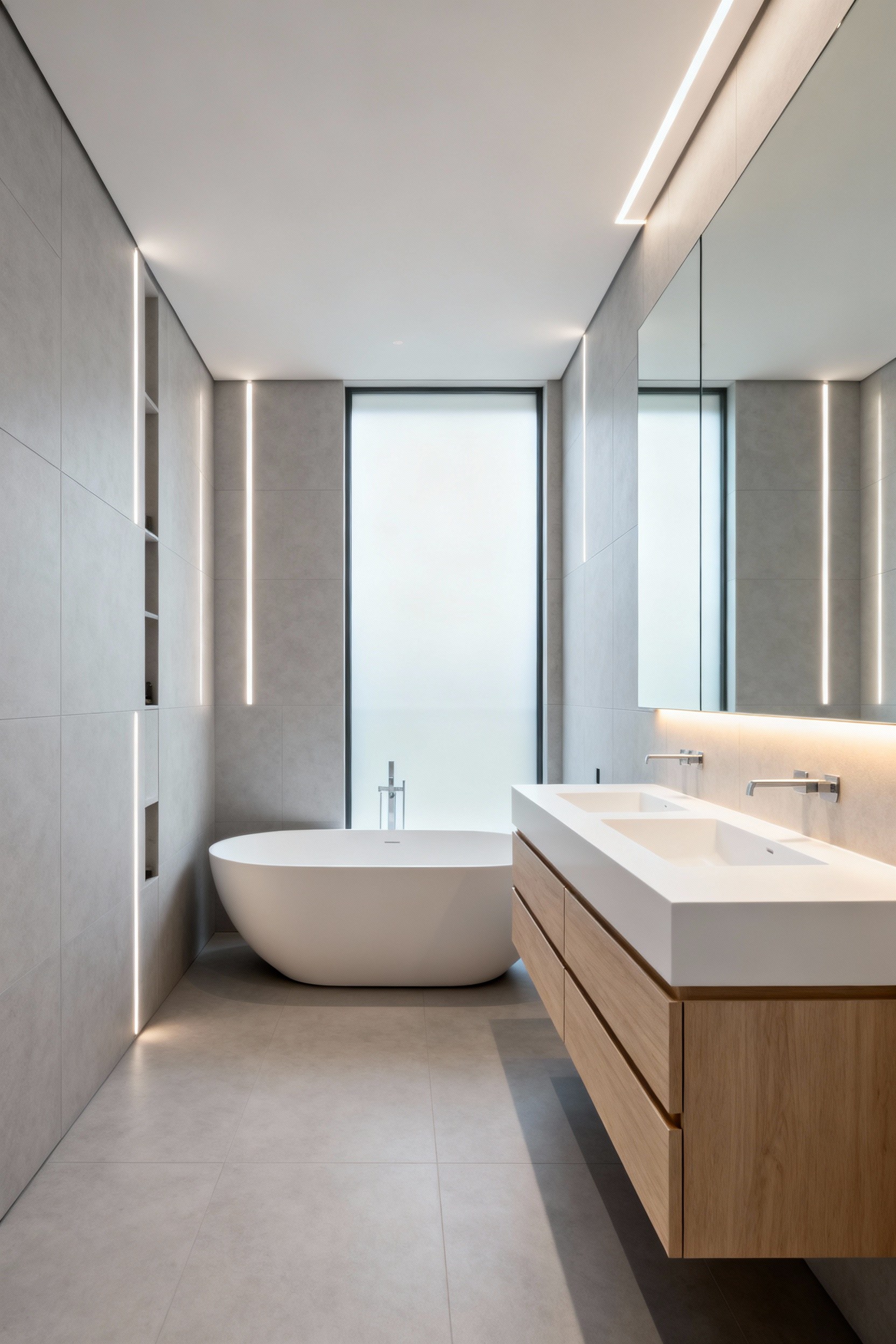
However, achieving this minimalism does not require sacrificing modern convenience. Instead, we integrate “invisible” technology to enhance the experience without creating distraction. Voice-controlled systems eliminate the need for cluttered wall switches. Furthermore, heated floors provide a luxurious comfort foundation that quiets the nervous system. Similarly, smart circadian lighting mimics the soft, rising light of dawn. Therefore, the body wakes up gently rather than reacting to harsh, overhead glare.
To prevent the space from feeling sterile, we must also incorporate organic elements. Specifically, we introduce *Wabi-Sabi* through raw materials like live-edge wood or textured stone. Moreover, a deep soaking tub positioned near natural light invites a moment of distinct pause. Ultimately, by balancing these high-tech functions with serene design, the room prepares the user for the day ahead.
Frequently Asked Questions
H3: How much should I budget for a luxury master bathroom remodel focused on Zen design?
Luxury bathroom remodels typically start at $35,000 for a small, high-end design, and can easily exceed $75,000 for a large master sanctuary incorporating advanced technology like radiant heat, smart showers, and premium materials such as full stone slabs or custom cabinetry. The primary cost drivers are specialized labor (plumbing, electrical work for hidden tech) and high-quality, long-lasting materials.
H3: What is the single most important design element for achieving a tranquil, Zen-like atmosphere?
The most critical element is the reduction of visual noise through intentional minimalism and concealed storage. A Zen bathroom prioritizes mental clarity, which is disrupted by clutter. This means utilizing floating vanities with hidden drawers, recessed niches, and handleless cabinetry to maintain clear sightlines and create a monolithic envelope of calm.
H3: Do high-tech smart toilets and bidets actually increase the resale value of a luxury home?
Yes, increasingly so, particularly in the discerning luxury market. While standard bathroom updates offer good ROI, advanced “perpetual hygiene” features like integrated bidet systems, self-cleaning functions, and voice-activated controls appeal directly to buyers seeking modern wellness and convenience. These features serve as high-value differentiators in competitive markets.