Since the 19th century, the bohemian way of life has been less about a specific look and more about an ethos—a quiet rebellion celebrating artistic freedom, global curiosity, and a life lived with intention. Evolving from European intellectual circles and deeply infused with the spirit of nomadic cultures and the astonishing richness of global craft, particularly from South Asia, it has become a philosophy for living expressed through design. Today’s most sophisticated spaces understand that authentic boho bedroom decorating isn’t a checklist of trends, but the art of weaving a personal story.
This understanding is rooted in a dual principle: the bohemian bedroom must be both a sanctuary deeply reflective of your personal journey and a space that resonates with a universal sense of comfort. It is about honoring the provenance of an object—the hands that block-printed a textile in Jaipur, the artisan who carved a wooden screen—rather than chasing a fleeting, mass-produced aesthetic. The twenty principles that separate a layered, soulful sanctuary from a common pastiche haven’t truly changed. Let’s move through them together, from the philosophical roots to their tangible expression in your own home.
1. Deciphering the Syncretic Roots: A Global Narrative
The very soul of bohemian design is its syncretism—a beautiful blending of different cultures and eras. It’s not a single style, but a rich dialogue between the free-spirited Romani travelers, the introspective Beat Generation, and the vibrant artisanal traditions spanning from Morocco to Rajasthan. The philosophical anchor is an appreciation for objects with a story, pieces that carry the whispers of their origins.
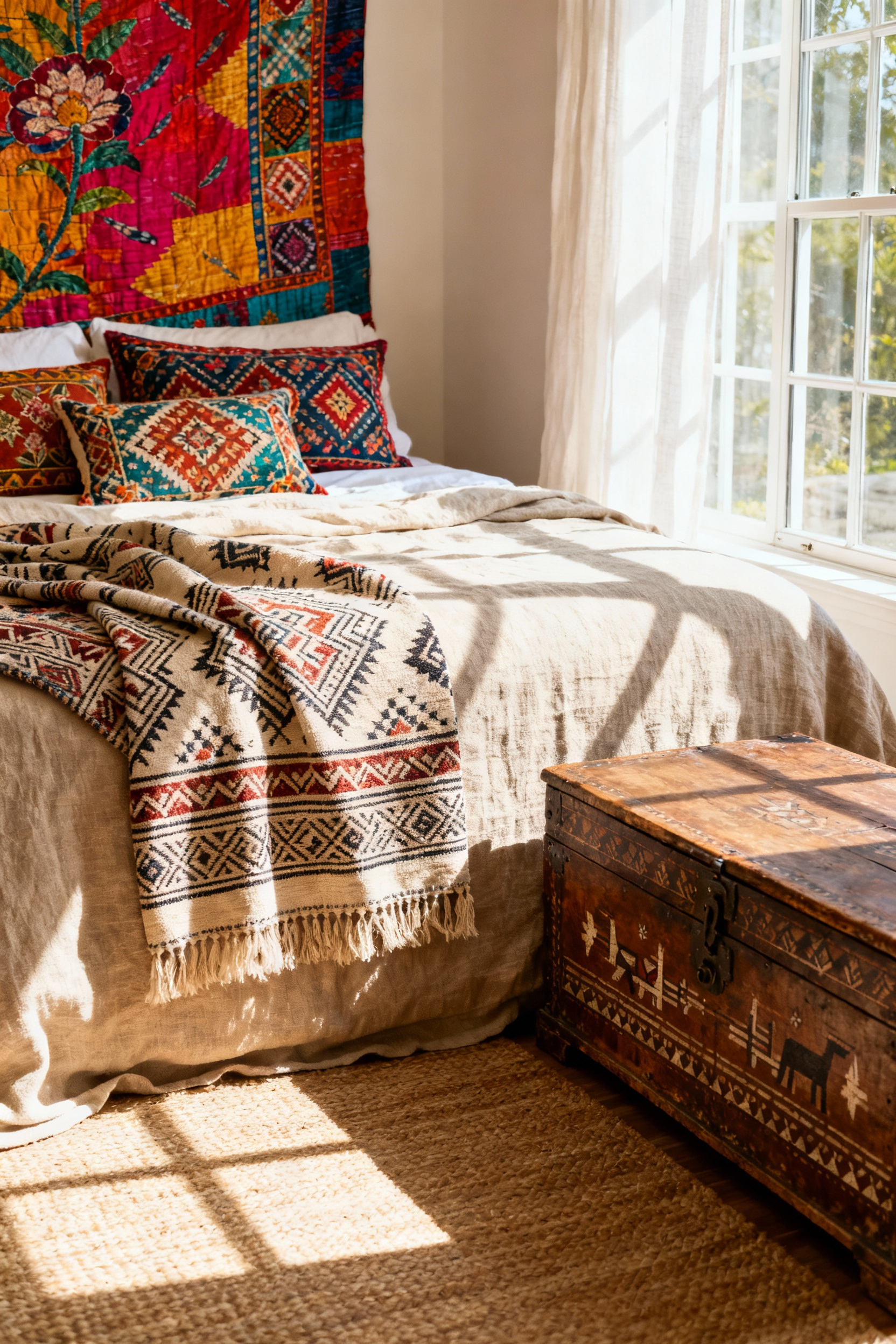
This means moving beyond decoration and toward curation. Imagine not just a rug, but a hand-knotted dhurrie whose geometric patterns tell the story of a weaver’s village. Consider a bedside table not as a mere surface, but as a repurposed antique chest from an English country house, its worn wood now holding your evening rituals. In my practice blending British and South Asian aesthetics, I’ve seen how a single, well-chosen piece—like an intricate Jali screen used as a headboard—can create a powerful narrative, linking a contemporary London flat to the architectural traditions of Mughal India. This is the heart of boho bedroom decorating: letting your space tell a story of connection, travel, and artistic admiration.
2. Cultivating Intentional Imperfection: Embracing Wabi-Sabi
From this appreciation for the authentic naturally flows an embrace of imperfection, a concept beautifully articulated in the Japanese philosophy of Wabi-Sabi. It is a quiet celebration of the beauty found in transience, in asymmetry, and in the marks of time and human touch. This perspective offers a gentle antidote to the Western pursuit of polished, flawless newness.
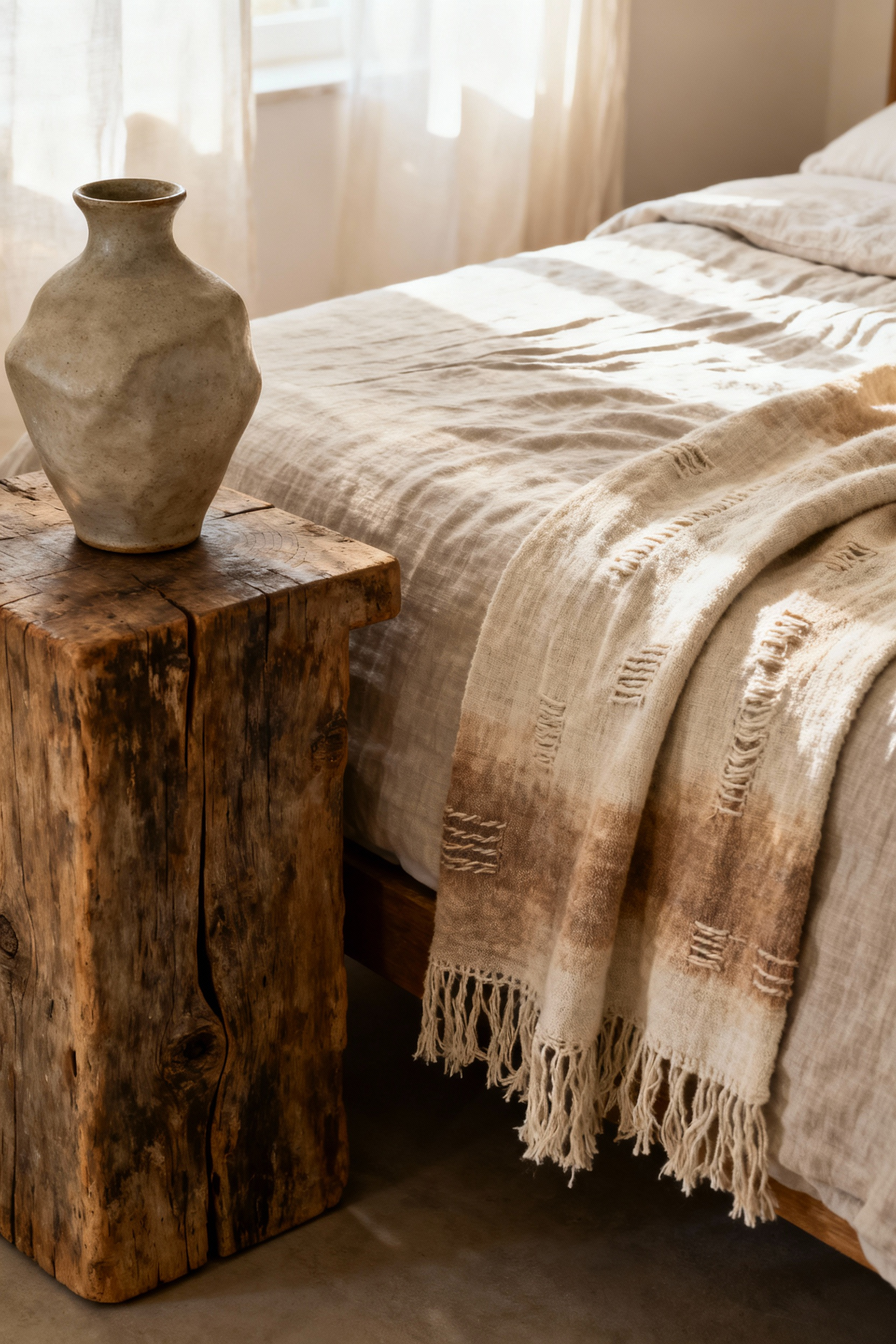
Think of materials that wear their history with grace: wood with a visible grain, hand-thrown pottery with slight irregularities in the glaze, or linen that softens and creases with use. These are not flaws; they are character. For the bedroom, this might mean choosing a slightly faded vintage quilt over a pristine new one, or allowing a brass lamp to develop a natural patina over time. It’s about creating a space that feels lived-in and real, a room that has permission to be beautifully, imperfectly human.
3. Harmonizing Diverse Textural Landscapes: The Art of Layered Tactility
A truly bohemian space engages all the senses, especially touch. Creating a rich textural landscape is about orchestrating a symphony of materials that invite you to slow down and connect with your surroundings. It moves beyond visual design into a fully sensory experience.
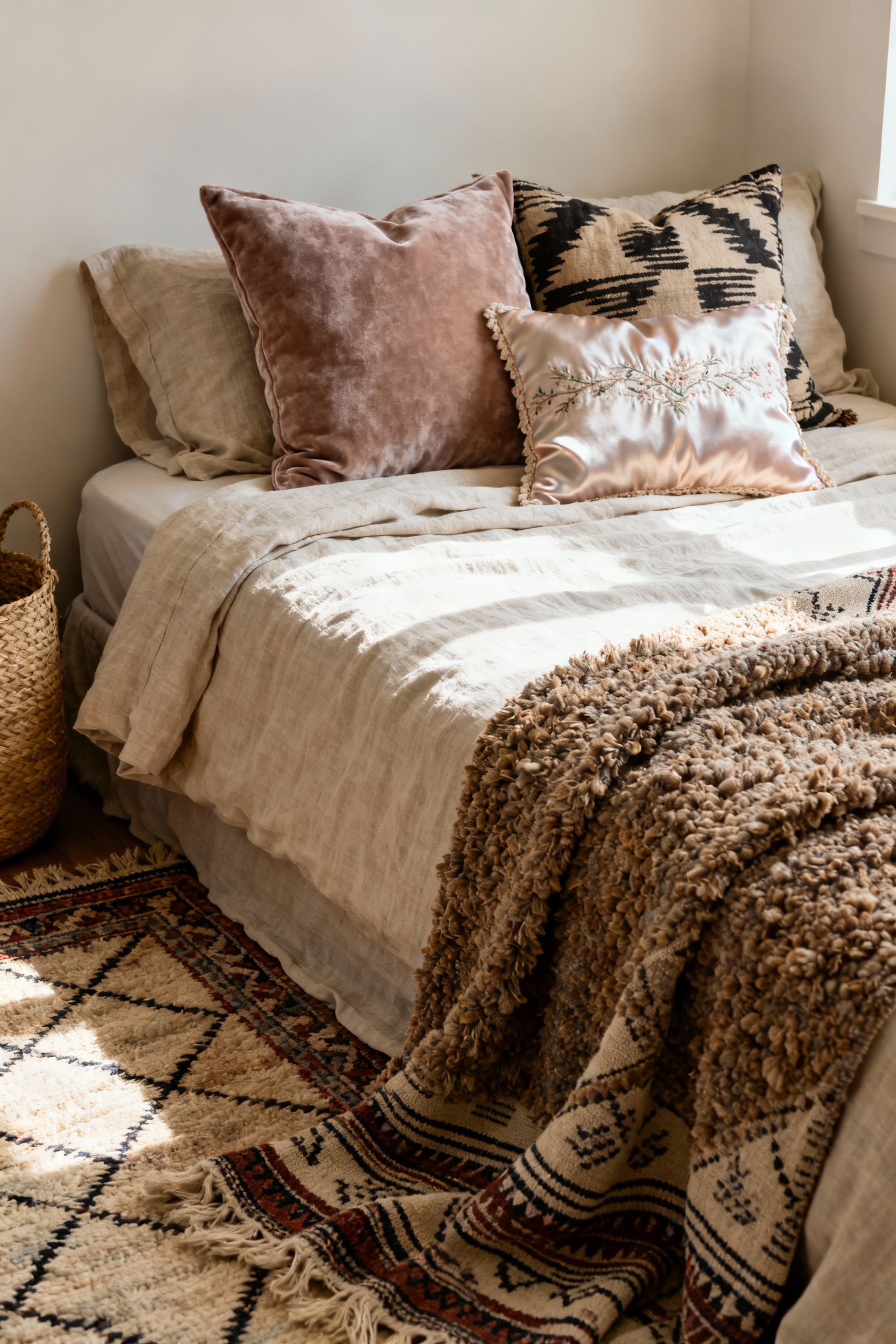
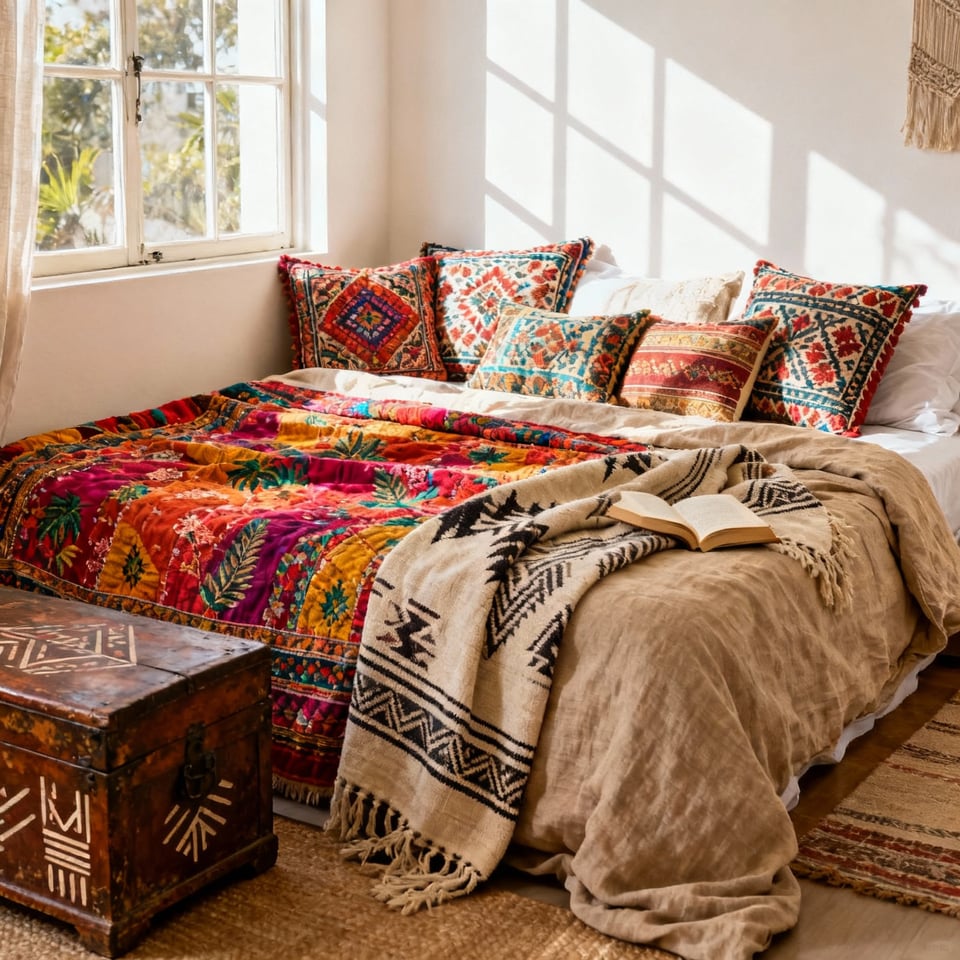
Layering is the key. Start with a foundation of something coarse and grounding, like a jute or sisal rug. Then, layer on top of that—perhaps a smaller, plush wool carpet or a soft sheepskin. Dress the bed with a tumble of textures: crisp, cool linen, a chunky hand-knit throw, and a collection of cushions in varying materials like raw silk, embroidered cotton, or soft velvet. What I always tell my clients is to think about contrast. The interplay between the rustic roughness of a woven basket and the smooth, cool surface of a ceramic vase creates a dynamic tension that is incredibly sophisticated and satisfying.
4. Invoking Biophilic Connections: Integrating Natural Verve and Vitality
Bohemian design inherently understands our deep, primal need to connect with nature—what is known as biophilia. Infusing the bedroom with living things is not just about aesthetics; it’s about fostering a sense of well-being and bringing the restorative energy of the outdoors in. A room without life feels static; a room with plants feels like it’s breathing with you.
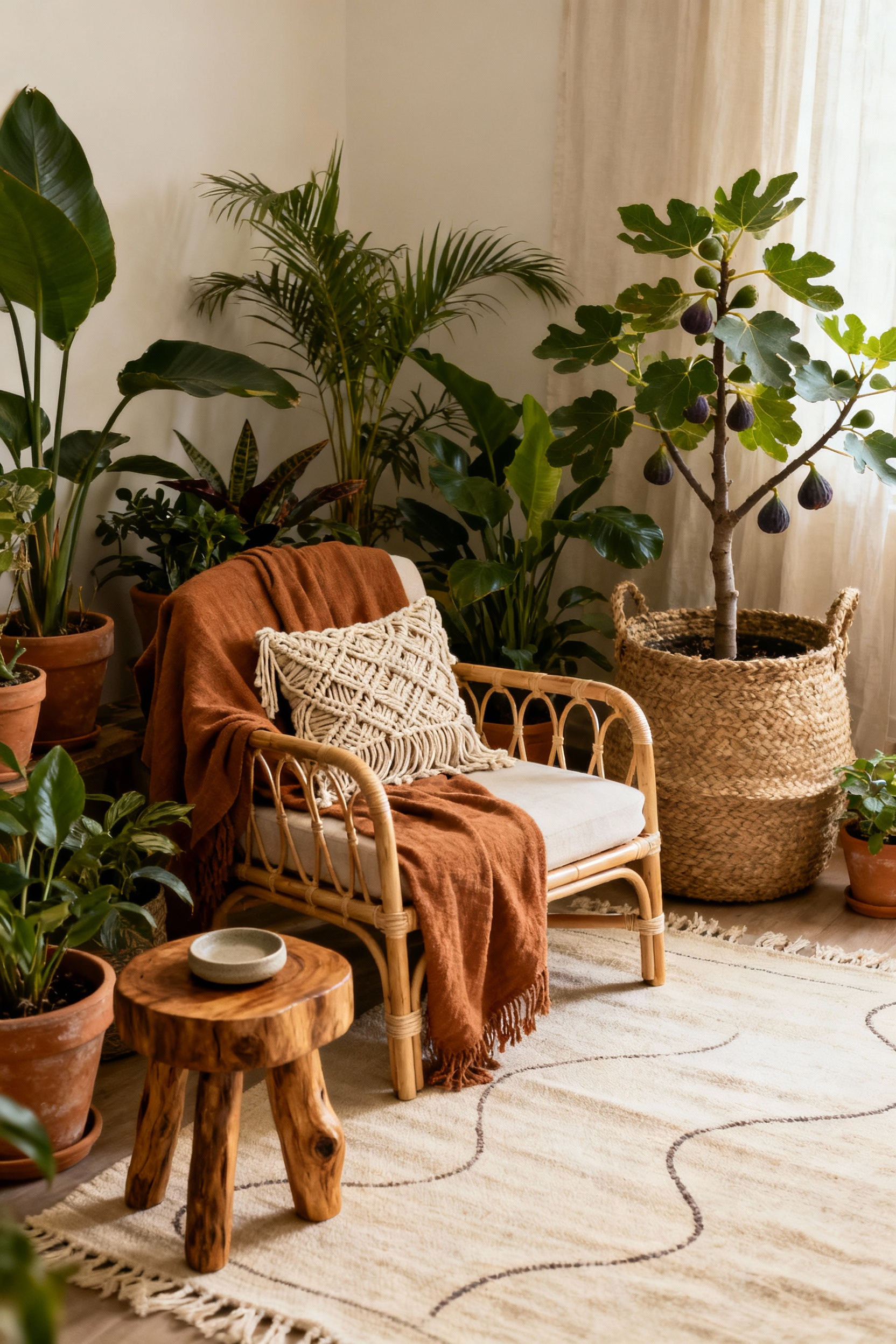
Of course, this means plants—lots of them. A tall fiddle-leaf fig can create a dramatic vertical line in a corner, while a trailing pothos can soften the hard edge of a bookshelf. But biophilic design goes further. It’s about maximising natural light with sheer linen curtains, incorporating natural wood in its rawest state, and using botanical prints in artwork or textiles. Place your green companions in artisanal terracotta or ceramic pots to maintain that connection to earthy, natural materials. This infusion of life is what elevates a space from simply decorated to genuinely restorative.
5. Curating Personal Narratives: Objects as Embodied Journeys
The most compelling bohemian interiors function as a kind of three-dimensional memoir. Every object has earned its place, not because it fits a trend, but because it holds a story—a memory of a journey, a connection to family, or a piece of your personal history. It’s about curation, not accumulation.
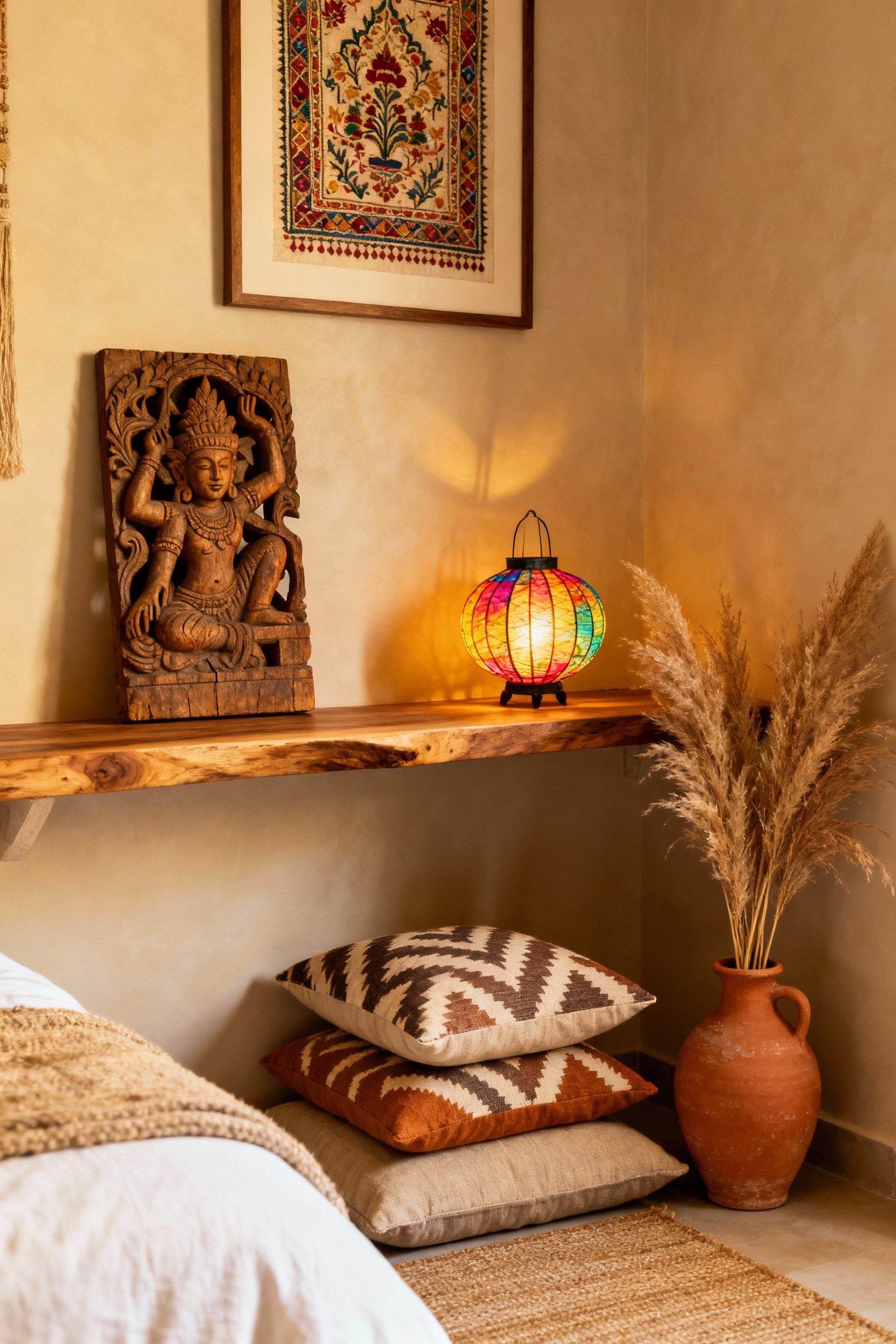
This is where you bring your life into your design. Frame a small textile you bought in a bustling market in Delhi. Display the collection of sea glass you gathered on a coastal walk. Let a hand-carved wooden box passed down from your grandmother have pride of place on your dresser. Years of working in British-Asian fusion have taught me that these objects, rich in provenance, lend an unparalleled authenticity. They transform a room from a styled space into a deeply personal sanctuary, where every glance reveals another layer of your unique story.
6. The Allure of Macrame and Woven Tapestries: Structural Elegance
Textile art, particularly macrame and woven tapestries, offers a beautiful way to introduce structural form using soft, organic materials. These crafts have an ancient lineage, from sailors’ knots to the grand tapestries of medieval halls, and they bring a sense of history and human touch into a space. They are art, but an art form that feels approachable and warm.
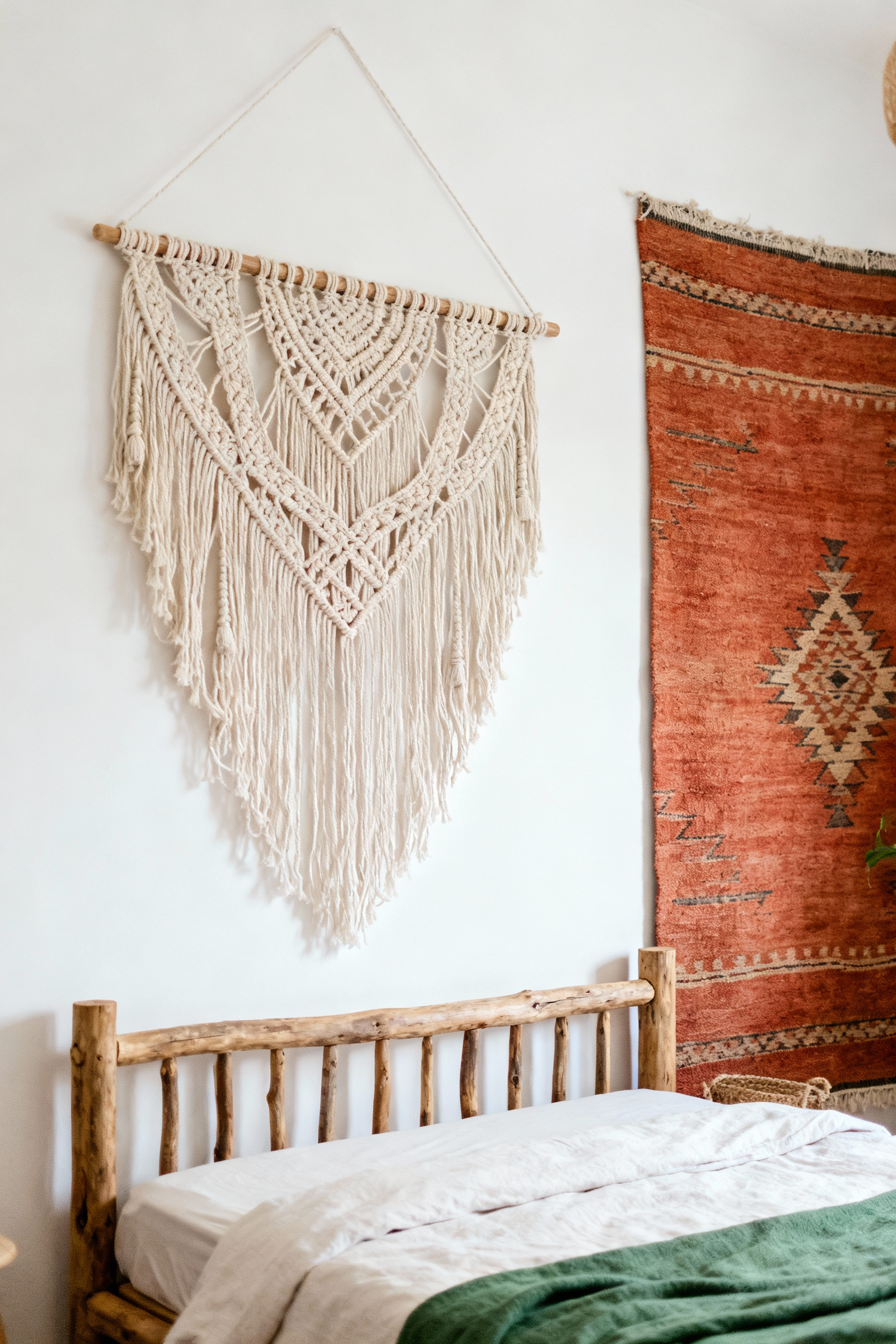
In the context of the bedroom, a large macrame wall hanging above the headboard can act as an ethereal, sculptural focal point, its intricate knots casting beautiful shadows. A dense, hand-woven tapestry, on the other hand, can provide a wonderful acoustic softness and a rich canvas for colour and pattern, creating an immersive backdrop. They provide architectural elegance without a single hard line, perfectly embodying the gentle, artistic spirit of a boho sanctuary.
7. Sourcing Ethically Crafted Textiles: The Soul of the Space
Beyond just appearance, the textiles you choose carry an energy and a story of their making. Sourcing ethically crafted pieces is a core tenet of the conscious bohemian ethos, representing a commitment to honouring craftsmanship and supporting artisan communities.
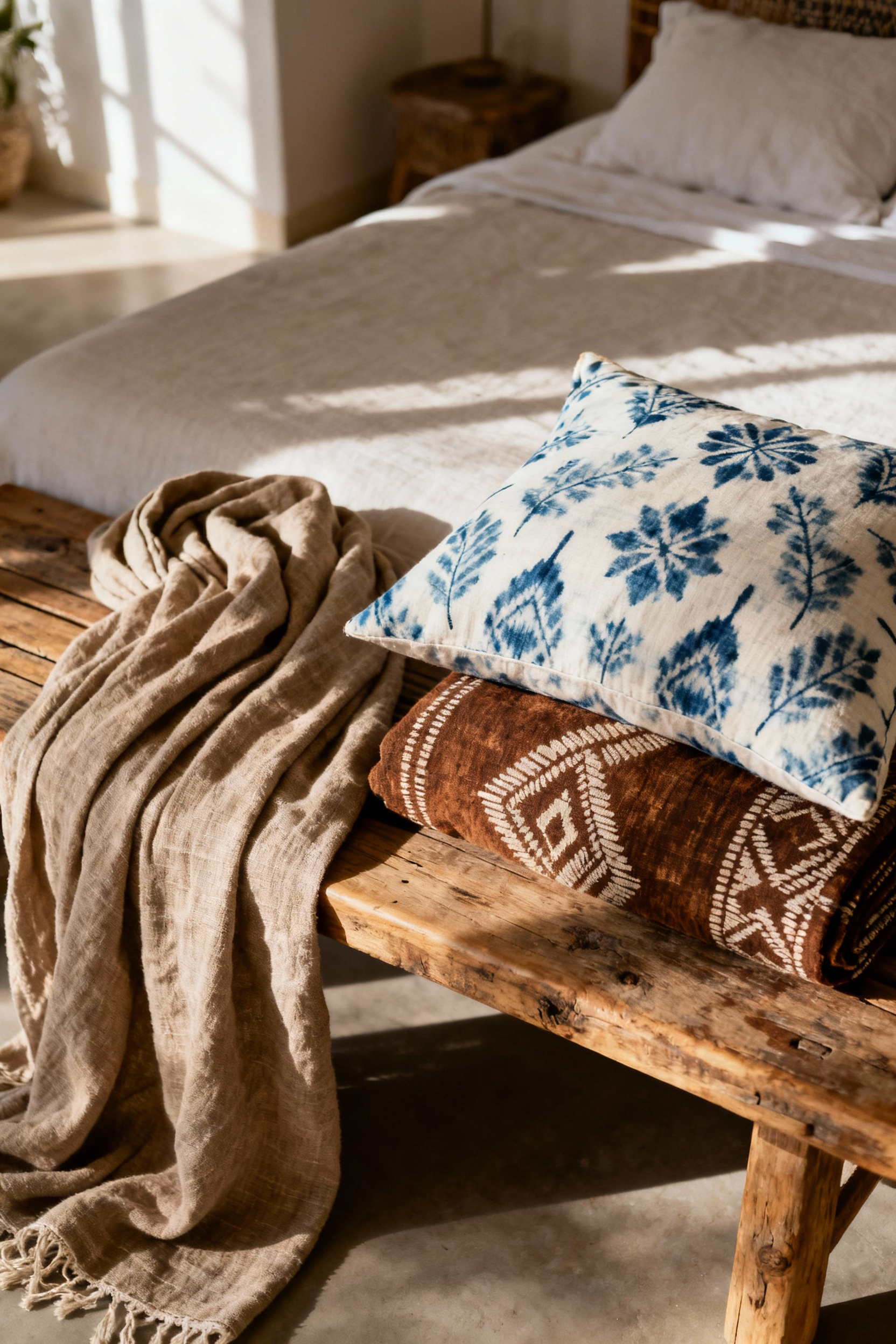
Look for hand-loomed linens whose subtle irregularities tell of the weaver’s hand. Explore the world of Indian block prints, where each small imperfection in the pattern is a mark of its handmade journey. Consider a Kantha quilt from Bengal, stitched together from layers of old saris, embodying a beautiful story of reuse and heritage. Draping a block-printed throw over a reading chair or using mudcloth as cushion covers infuses the room with an undeniable soulfulness that mass-produced textiles simply cannot replicate.
8. Unleashing the Earthy Sophistication of Rattan and Jute
There is an unpretentious elegance to materials like rattan and jute. They are humble, sustainable, and incredibly versatile, capable of bringing both sculptural form and grounding texture to a space. They act as a bridge between the wildness of nature and the comfort of the indoors.
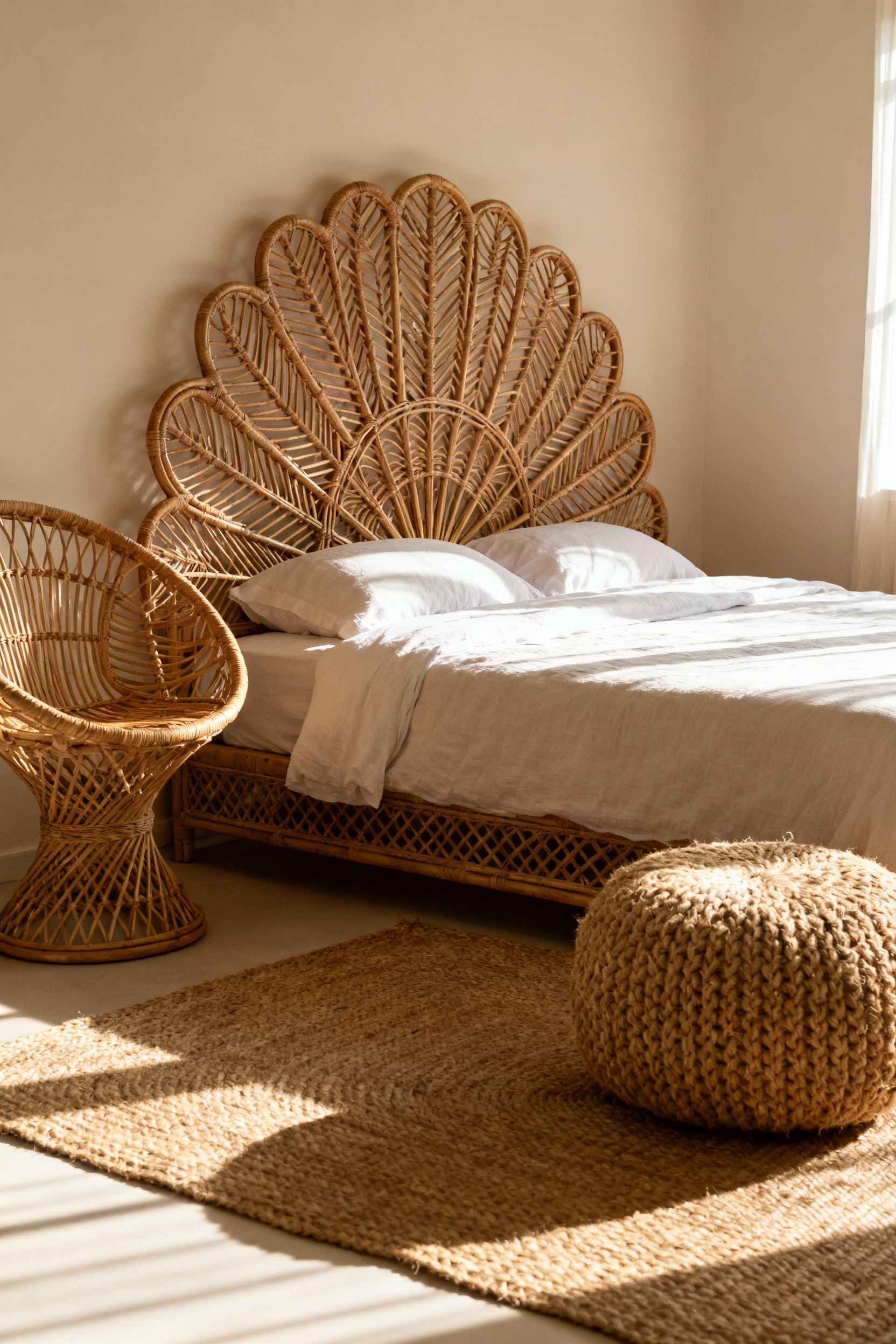
A rattan headboard can instantly evoke a sense of relaxed, worldly sophistication. Accent chairs woven from rattan are light and airy, adding seating without visual heaviness. Jute, with its robust and earthy texture, makes for a perfect grounding element as a rug, its natural colour providing a neutral canvas for the rest of the room. I love how these materials can be used in lighting, too—a woven pendant casts such wonderfully patterned light, adding another layer of texture to the room after dark.
9. Strategic Integration of Botanicals in Clay and Terracotta
Building on the principle of biophilia, the way you display your plants is just as important as the plants themselves. Clay and terracotta vessels are the natural companions for your greenery, their earthy, porous nature connecting directly back to the soil. They are humble yet beautiful, and their warm, grounding tones complement the bohemian aesthetic perfectly.
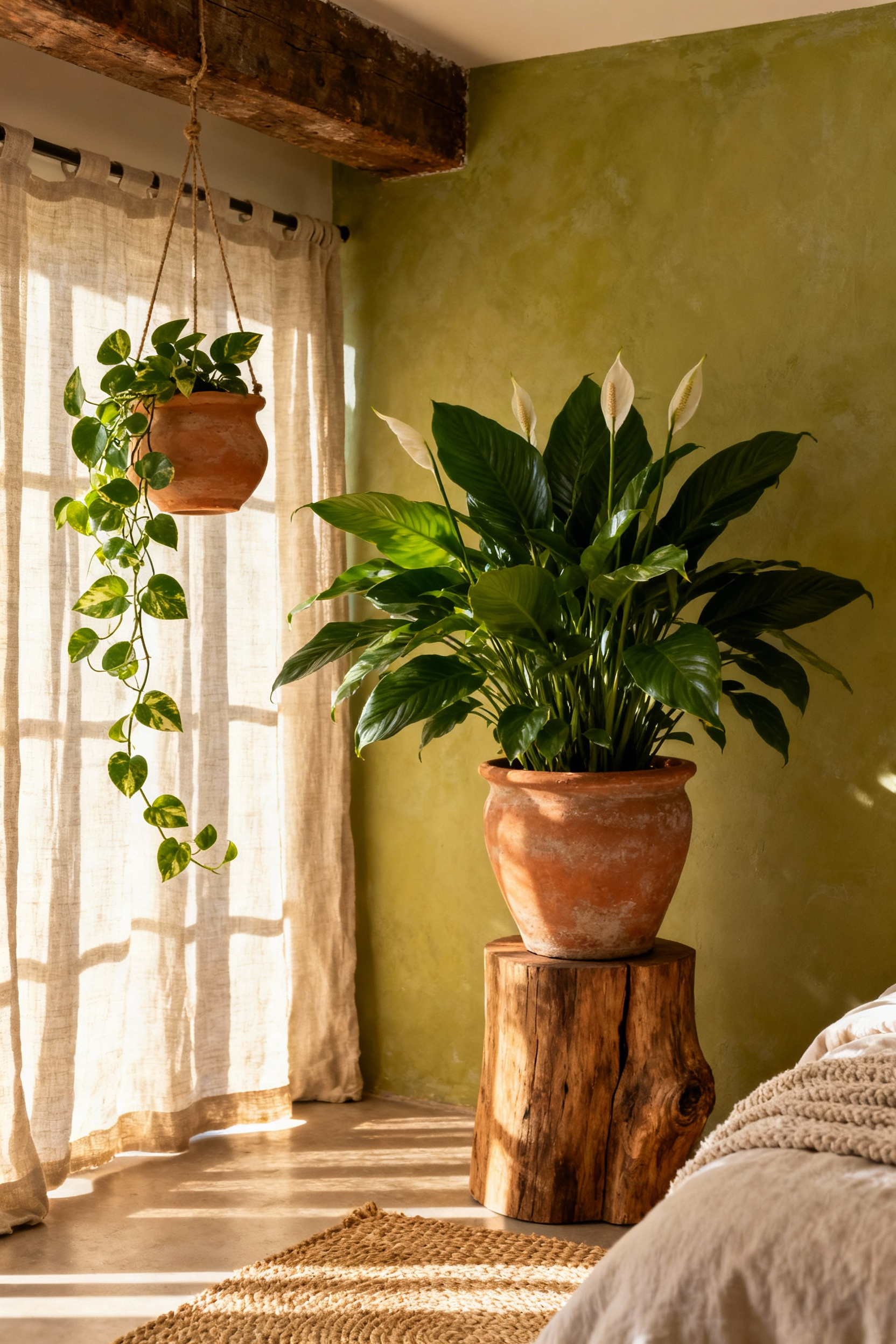
The application here is about creating living art. A grand fiddle-leaf fig in an oversized terracotta pot makes a statement, while a cluster of smaller succulents in varied clay pots on a windowsill creates a charming vignette. Using macrame hangers to suspend ferns or trailing plants adds vertical interest and draws the eye upward. This isn’t just about putting a plant in a pot; it’s about seeing the plant and its vessel as a single, cohesive sculptural element that breathes life and energy into your boho bedroom decorating.
10. Exploring the Patina of Antiqued Woods and Distressed Leathers
True character is often found in things that have lived a life. Antiqued woods and distressed leathers bring a sense of history, gravitas, and timelessness to a room. Their surfaces are maps of stories, inviting both the eye and the hand.
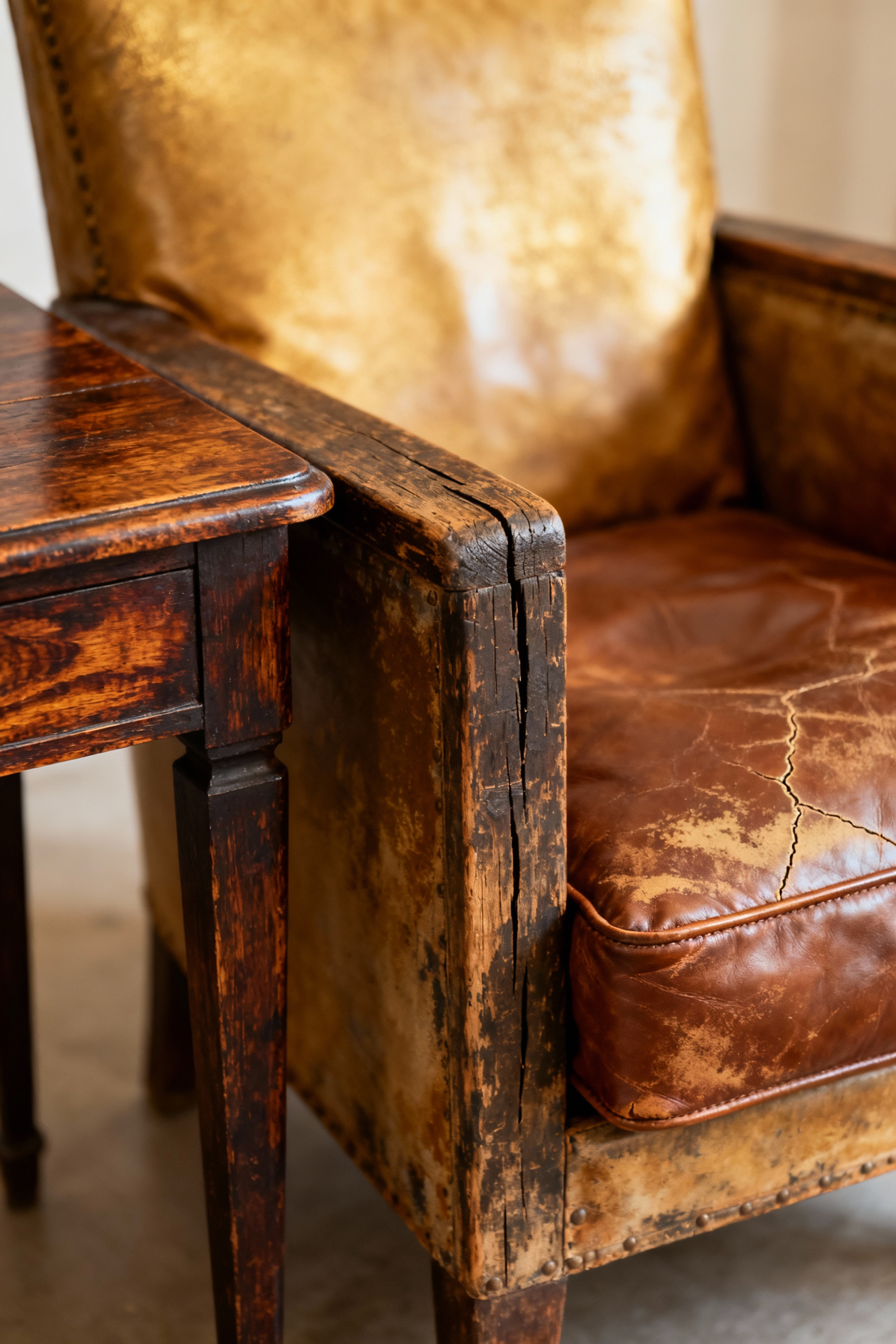
Look for a headboard made from reclaimed timber, its knots and grain telling a story of its previous life. A vintage trunk at the foot of the bed adds both storage and a tangible link to a bygone era of travel. Leather can be introduced through a classic armchair, an ottoman, or even in small details like drawer pulls or strap shelving. The unique patina these materials develop over time means they only become more beautiful, more yours, as they age with you.
11. Orchestrating Multi-Tiered Illumination: A Soft Glow
Light is one of the most powerful tools in design; it shapes mood, defines space, and brings texture to life. A sophisticated bohemian bedroom rejects the harshness of a single, central overhead light in favour of a layered, multi-tiered approach that creates a soft, ambient radiance.
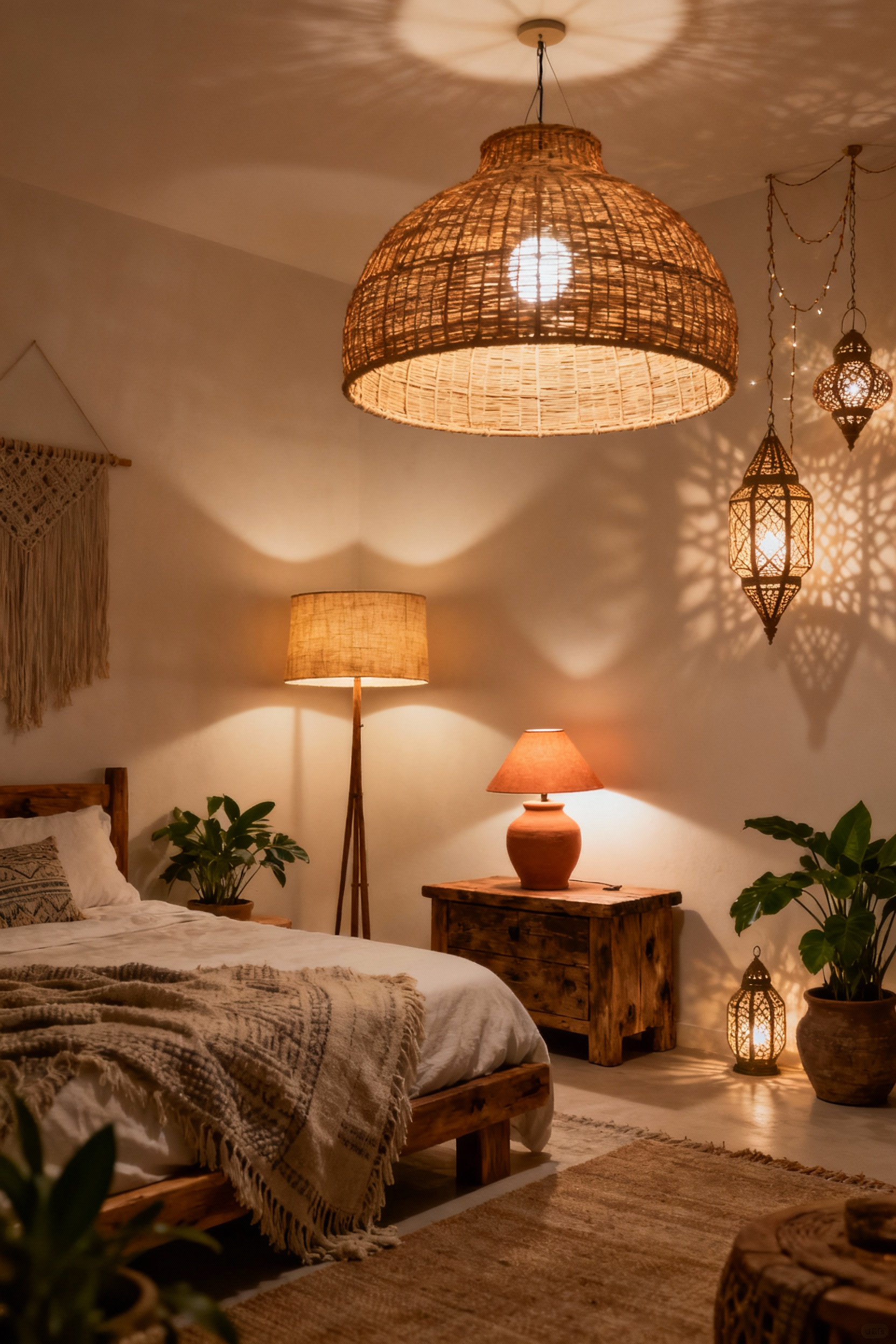
Start with a base layer of ambient light, perhaps from a beautiful rattan pendant or a floor lamp with a linen shade. Then, add task lighting where you need it, such as a reading lamp by the bed. Finally, introduce accent lighting to create pools of intimacy and magic—think string lights draped over a canopy, a Himalayan salt lamp casting a warm pinkish glow, or a cluster of candles on a dresser. This interplay of light sources at different heights creates a dynamic, comforting atmosphere that can be adapted to any mood or moment.
12. Establishing a Harmonious Colour Narrative: Earth and Jewels
The bohemian colour palette is a sophisticated conversation between calming, earthy base tones and vibrant, carefully chosen jewel accents. It’s a palette drawn from nature and global travels—the colour of sand and spice, of forests and precious stones.
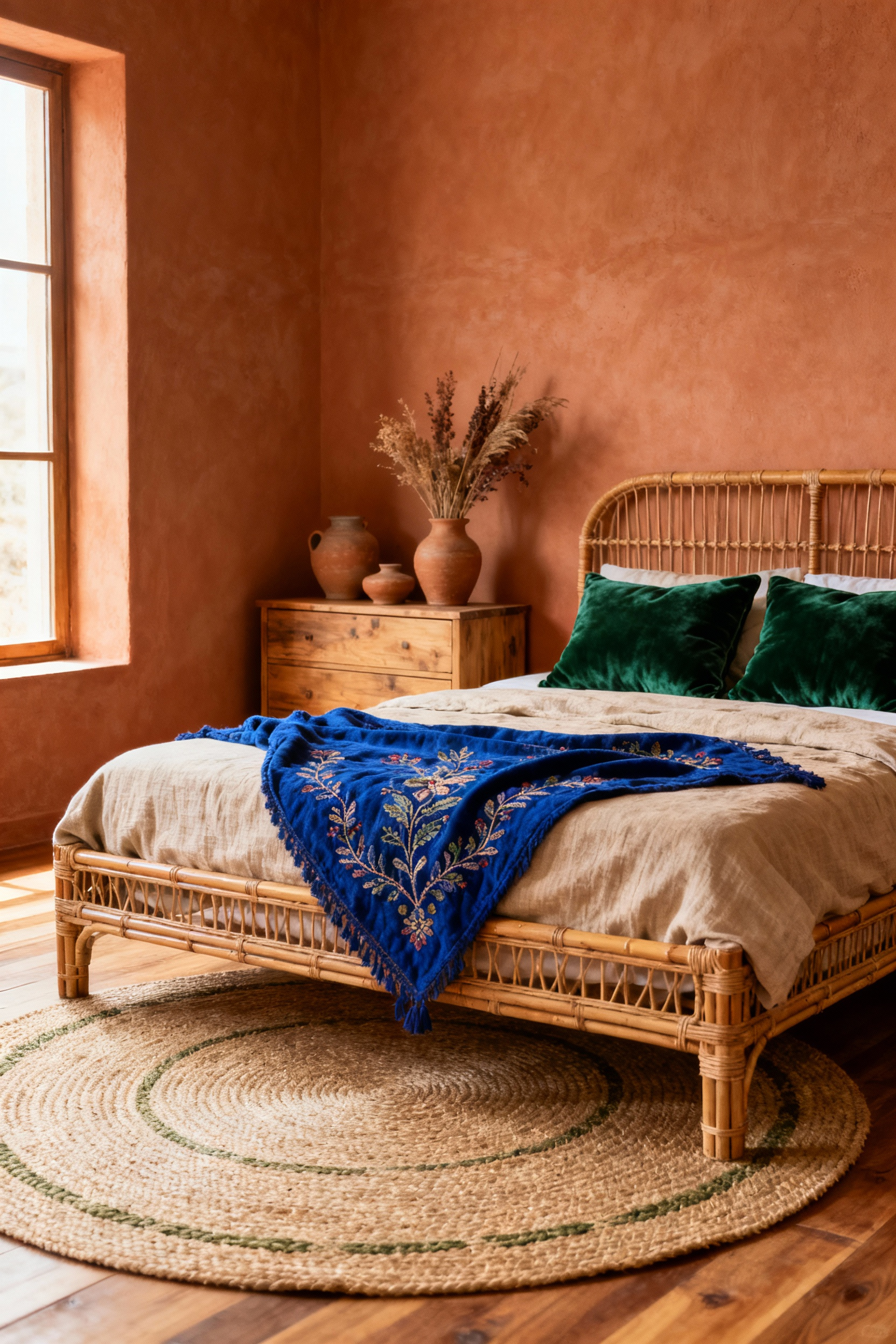
Establish a foundation of grounding earth tones: terracotta, ochre, soft sage, and warm creams on walls, bedding, or large rugs. These colours are inherently soothing and create a serene canvas. Then, punctuate this calm backdrop with rich jewel tones. In my experience with British-Asian fusion, this is where the magic happens. A single velvet cushion in deep sapphire, an embroidered throw with threads of emerald and ruby, or an indigo-dyed wall hanging—these accents bring the space to life, adding a layer of opulent, worldly sophistication without overwhelming the senses.
13. Designing Fluid Transitions: Open and Segmented Realms
A bohemian bedroom should feel both open and intimate. This is achieved by creating subtly defined ‘realms’ for different activities—sleeping, reading, meditating—without resorting to hard walls. The goal is a sense of fluid transition that guides you through the space.
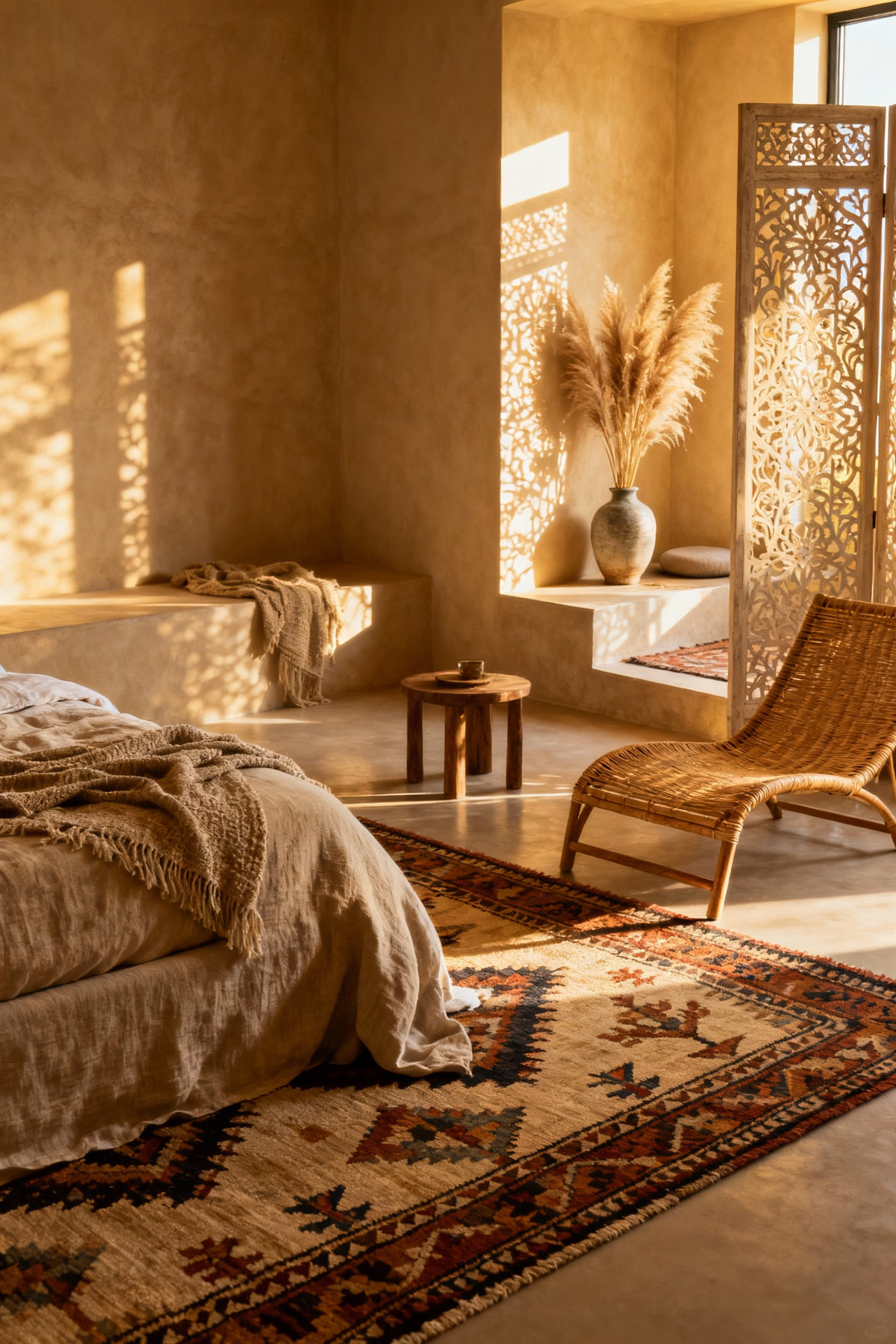
Use area rugs to anchor and define specific zones. A plush rug can create a soft landing around the bed, while a flatweave might define a small seating area. Open shelving, filled with books and plants, can act as a permeable screen. A beautifully carved wooden divider can also suggest a separation without closing off the space. This approach respects the multipurpose nature of a true sanctuary, allowing for both rest and gentle activity within a cohesive whole.
14. The Art of Eclectic Furniture Curation
Forget matching furniture sets. The bohemian spirit celebrates individuality, and this extends to furniture. Eclectic curation is about blending pieces from different eras, styles, and parts of the world to create a collection that is uniquely yours.
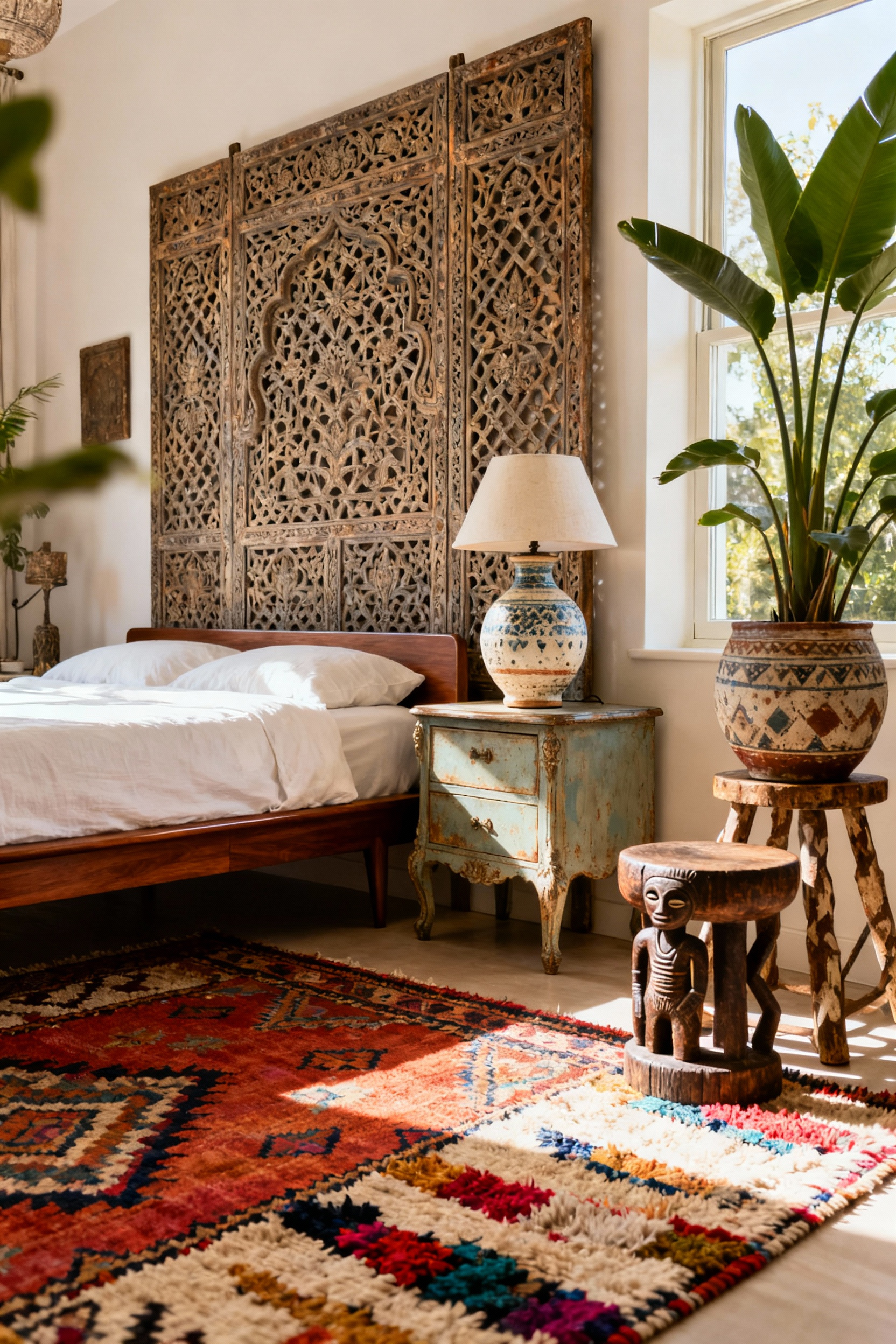
Pair a rustic, reclaimed wood bedframe with sleek mid-century modern bedside tables. Place a traditional British Chesterfield armchair, softened with a block-printed throw, next to an intricately carved Moroccan side table. The key to making eclecticism work is to find a common thread—perhaps a similar wood tone, a repeated colour, or a balanced sense of scale. The result is a room that feels collected and curated over time, reflecting a curious and well-travelled mind.
15. Elevating Function Through Artisanry: Carved Storage
In a thoughtfully designed space, even the most practical elements should have beauty and soul. This is particularly true for storage. Hand-carved pieces transform the purely functional into an act of artistry, becoming sculptural focal points in their own right.
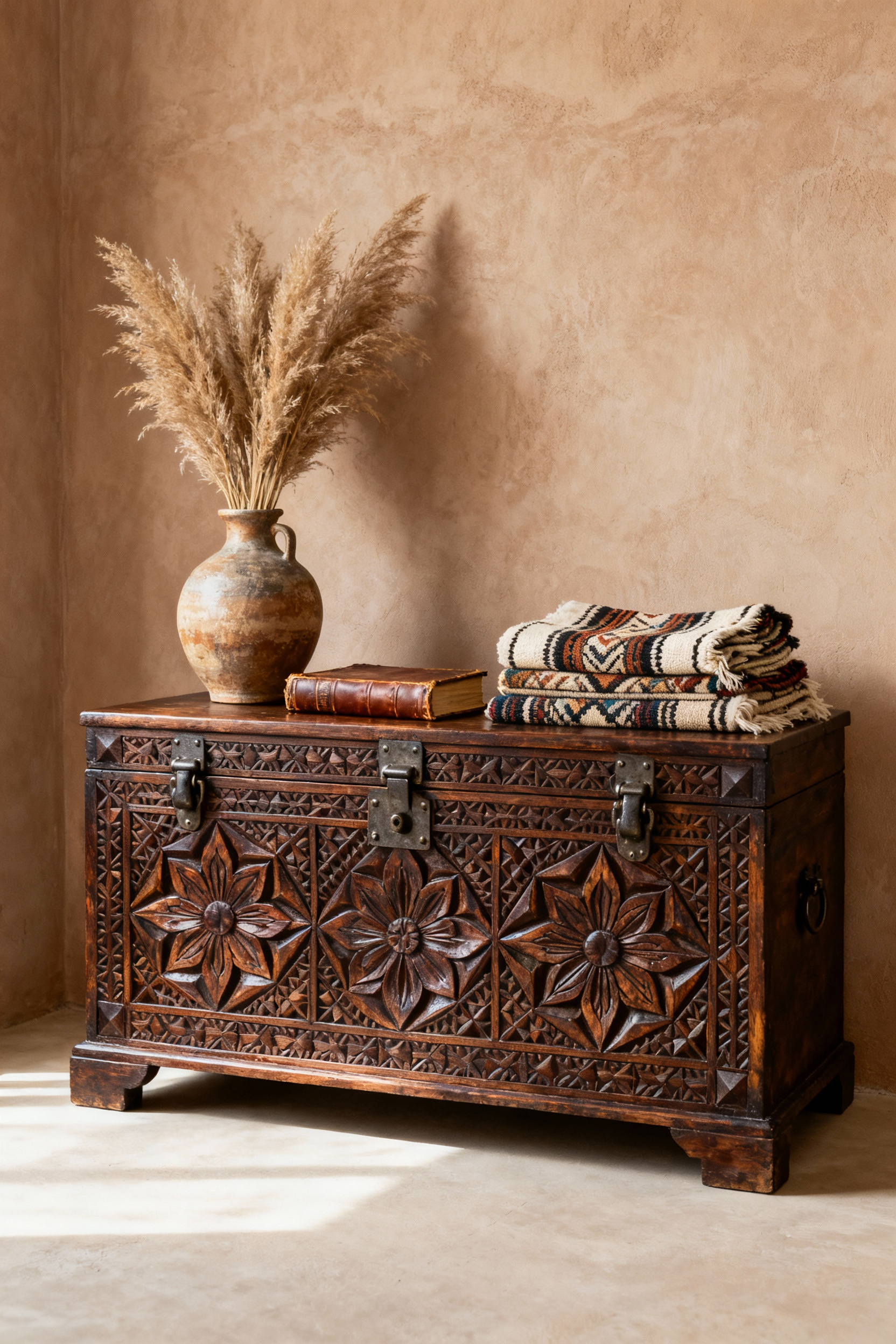
Think of an antique Indian damchiya or chest, its facade covered in detailed carvings and mirror work, serving as a beautiful storage solution for extra linens. A bedside cabinet with intricately carved doors from Indonesia or a bookshelf with subtle hand-carved details adds character and celebrates the skill of the artisan. These pieces turn the mundane act of storing things into a daily interaction with art and heritage.
16. Infusing Aromatic Sensibility: Scent Rituals for Serenity
Our sense of smell is powerfully linked to memory and emotion. A sophisticated sanctuary engages this sense deliberately, using fragrance to shape the atmosphere and signal a transition from the stresses of the day to a state of calm. This is about creating aromatic rituals.
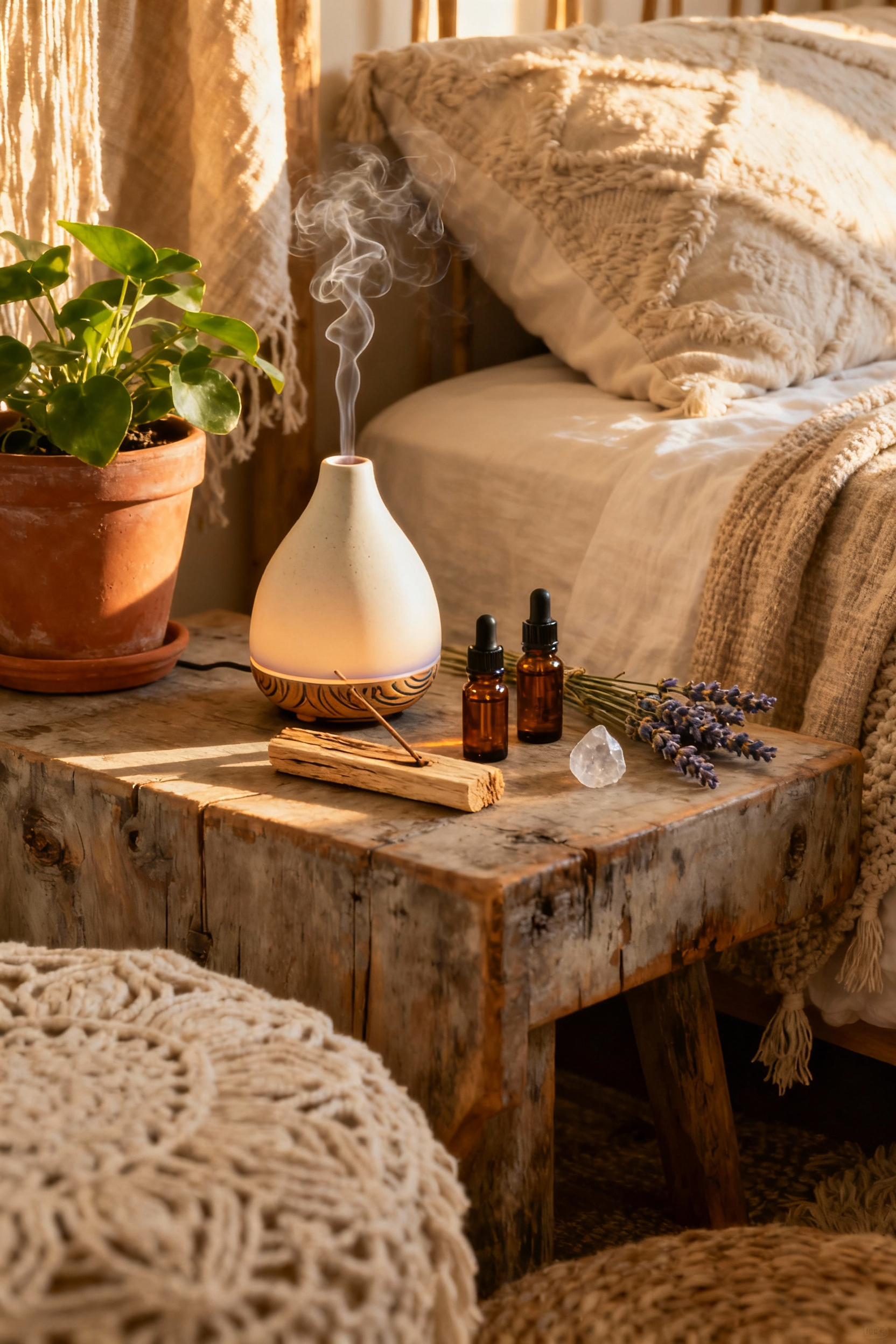
This can be as simple as diffusing essential oils—sandalwood for grounding, lavender for calm, frankincense for contemplation. The ancient practice of burning incense, like purifying Palo Santo or rich, resinous oud, can also elevate the space. I’ve found that integrating these scents into a routine, perhaps lighting incense as you prepare for bed, becomes a powerful cue to the mind and body that it is time to unwind and find peace.
17. Curating a Contemplative Reading Nook
In a world of constant digital noise, carving out a space for quiet, analogue reflection is an act of self-care. A reading nook is a sanctuary within your sanctuary, a physical commitment to nourishing your inner world.
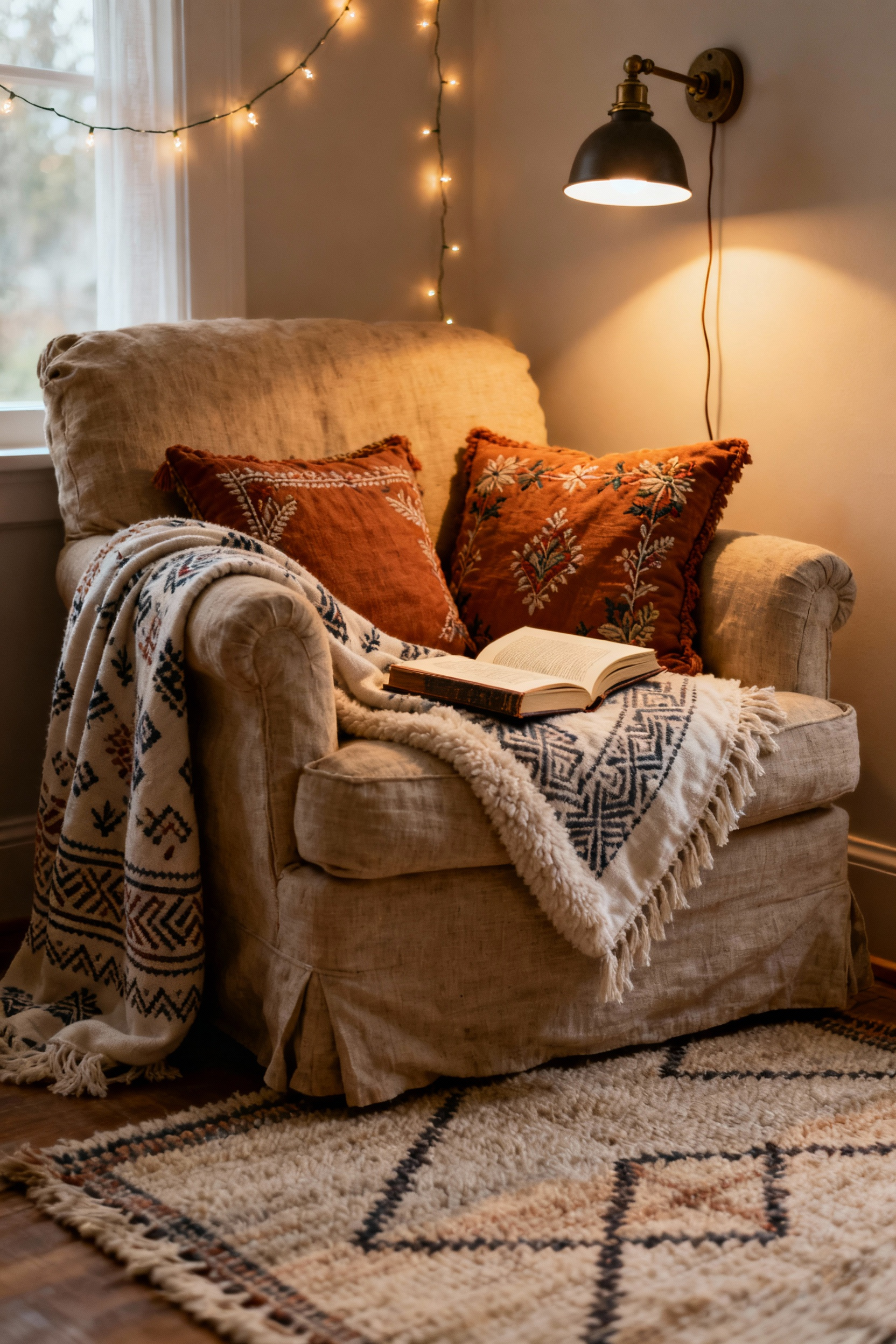
You don’t need a huge amount of space. A comfortable armchair—perhaps a plush velvet one—tucked into a corner, a soft sheepskin underfoot, and a good, focused reading light is all it takes. Add a small side table for a cup of tea and a stack of your current books. This dedicated spot is an invitation to unplug, to engage deeply with stories and ideas, and to honour the restorative power of quiet contemplation.
18. Honoring Sustainable Practices: Repurposing and Vintage Procurement
The bohemian ethos has always had an inherent respect for sustainability. It’s a philosophy that rejects throwaway culture in favour of objects with longevity and history. Honouring this means choosing pieces that are repurposed, upcycled, or vintage.
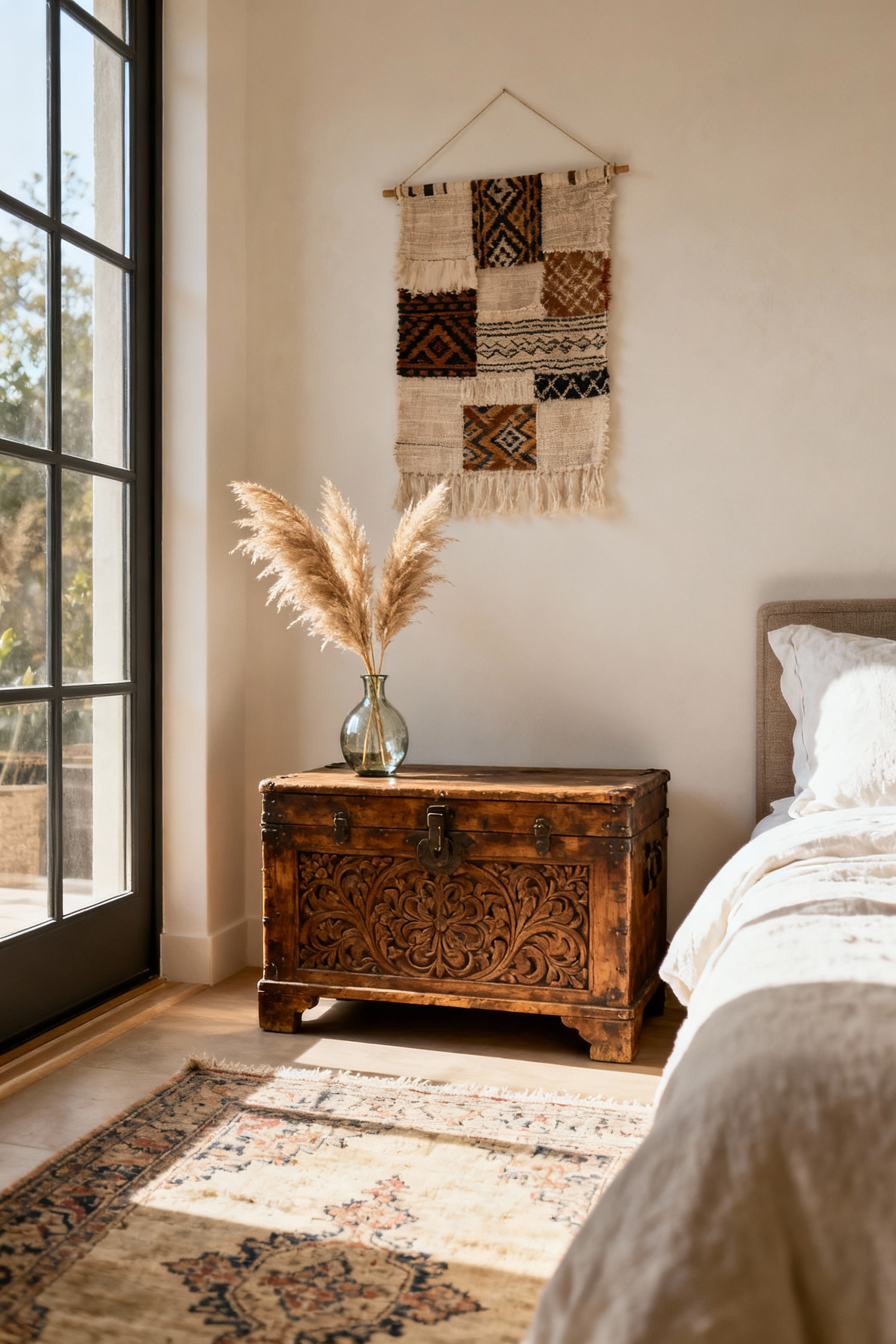
Scour flea markets and antique shops for furniture with a past. A weathered dresser or a set of vintage botanical prints brings an instant sense of history. Learn to see the potential in old things. That old wooden ladder can become a unique place to hang blankets. Those beautiful fragments of an old Indian sari can be framed as art. This approach is not only better for the planet, but it also ensures your space is filled with one-of-a-kind pieces that are rich with character.
19. Personalizing Through Collected Artefacts
Your home should be a museum of your life. This principle is about moving beyond generic decor and personalizing your space with artefacts that hold genuine meaning. These are the touchstones of your memories, travels, and passions.
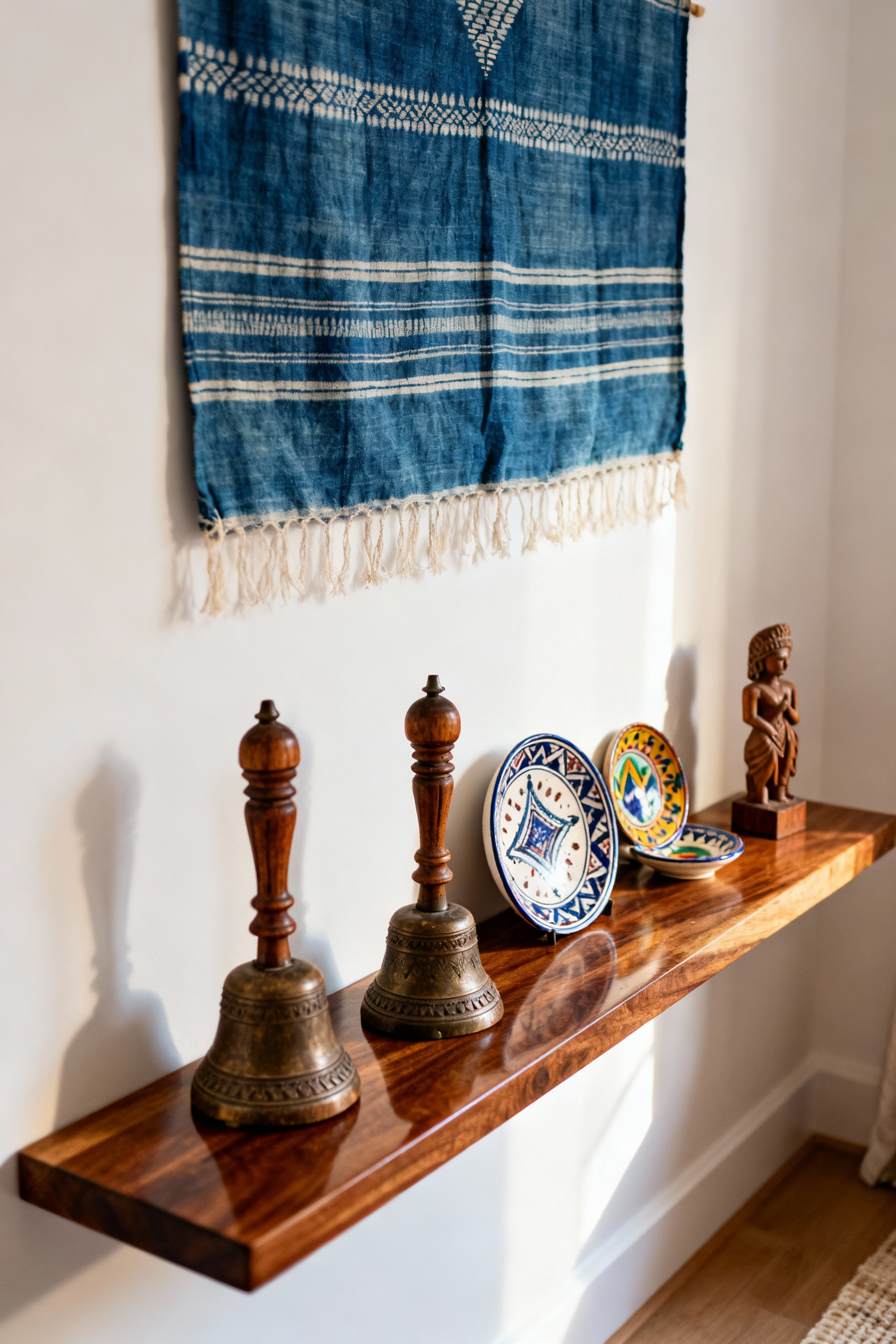
Display that piece of pottery you bought directly from the artisan on holiday. Frame a handwritten letter from a loved one. Arrange a collection of stones or shells from a meaningful place on a shelf. The pedigree of these objects isn’t about monetary value; it’s about their personal significance. It’s this layer of deep personalization that transforms a well-decorated room into a truly soulful home.
20. Embracing Fluidity and Adaptation: An Evolving Gallery
Finally, a true bohemian sanctuary is never truly ‘finished.’ It is a living, breathing space that evolves as you do. Embrace the idea that your room is a gallery of your life, one that should be updated and rearranged as you move through new seasons and chapters.
This means not being too precious. Lean art against the wall instead of permanently hanging it, so it can be easily rotated. Periodically rearrange your collected artefacts to create new vignettes. Swap out cushion covers and throws to reflect the changing seasons or your current mood. This approach keeps your connection to your space active and dynamic, ensuring it always feels like a true reflection of who you are, right now.
Conclusion
Our journey through these twenty principles reveals that a sophisticated bohemian bedroom is far more than an aesthetic—it is a practice of intentional living. We’ve seen how boho bedroom decorating, at its most authentic, is a rich and respectful dialogue between cultures, eras, and personal stories. It’s an approach that celebrates the hand of the artisan, the patina of time, and the deep comfort of a space that is a true reflection of the self.
Let these ideas be a gentle guide, not a rigid set of rules. The most beautiful spaces are those that are curated with love, curiosity, and a sense of adventure. Begin the process of layering textures, collecting stories, and creating a sanctuary that not only looks beautiful but feels deeply and authentically yours. A sophisticated bohemian bedroom, in the end, is a testament to a life lived with an open heart and a curious mind, a timeless haven that nourishes and inspires, day after day.