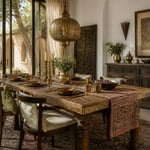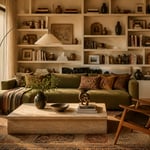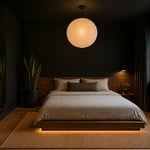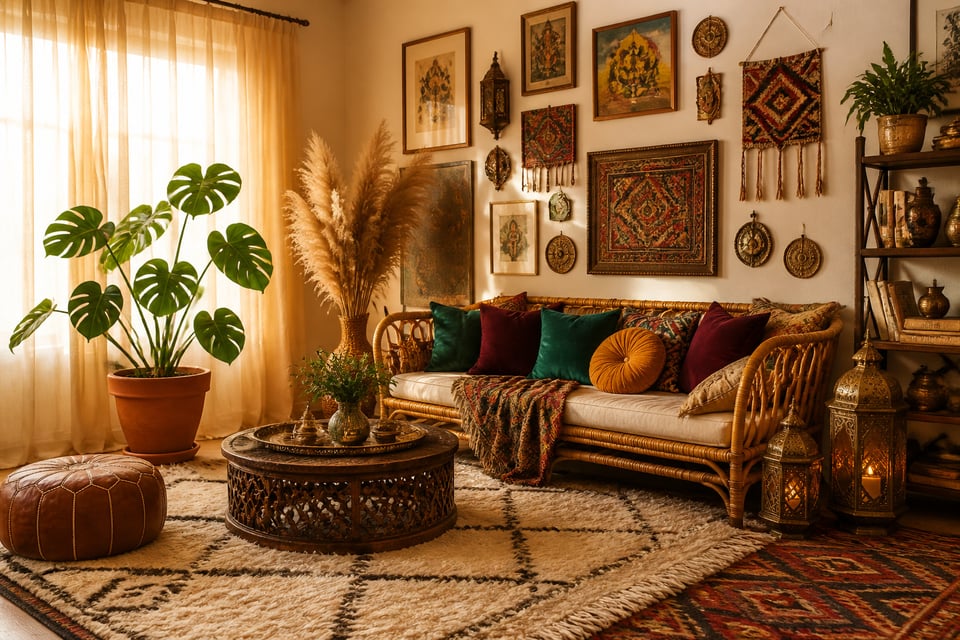
Walk into a room that gets boho living room decoration right, and the first thing you notice isn’t any single piece — it’s the feeling. The way a kilim sits under a plush ivory rug, the soft glow of a brass lantern through pierced metalwork, the particular warmth of terracotta pottery grouped in the corner beside a trailing monstera. Nothing matches, yet everything belongs. That quality — the sense of a space collected rather than decorated — is what separates genuine boho decoration from a Pinterest mood board brought to life in one frantic weekend.
Boho draws from living craft traditions: Moroccan weaving, Indian block printing, West African basket-making, South American textile arts. Understanding those roots is what lets you layer them together without tipping into cultural chaos. After years of working with clients on fusion interiors that blend global influences with contemporary living, I’ve learned that the best boho rooms have clear principles beneath their apparent freedom. These 16 boho living room decoration ideas walk through the room from floor to ceiling, offering you a sequence that builds naturally rather than all at once.
1. Layered Moroccan Rugs as the Boho Living Room Decoration Foundation
Everything in a boho living room sits on the rug — literally and visually — so it makes sense to start here. Beni Ourain rugs, hand-knotted by Berber weavers in the Atlas Mountains of Morocco, are among the most versatile foundations you can choose. Made from natural undyed wool in ivory with dark geometric diamonds, they sit beneath almost any colour scheme because their palette is essentially neutral. The geometric motifs carry symbolic meaning specific to each weaving community, which means every authentic piece is genuinely one-of-a-kind.
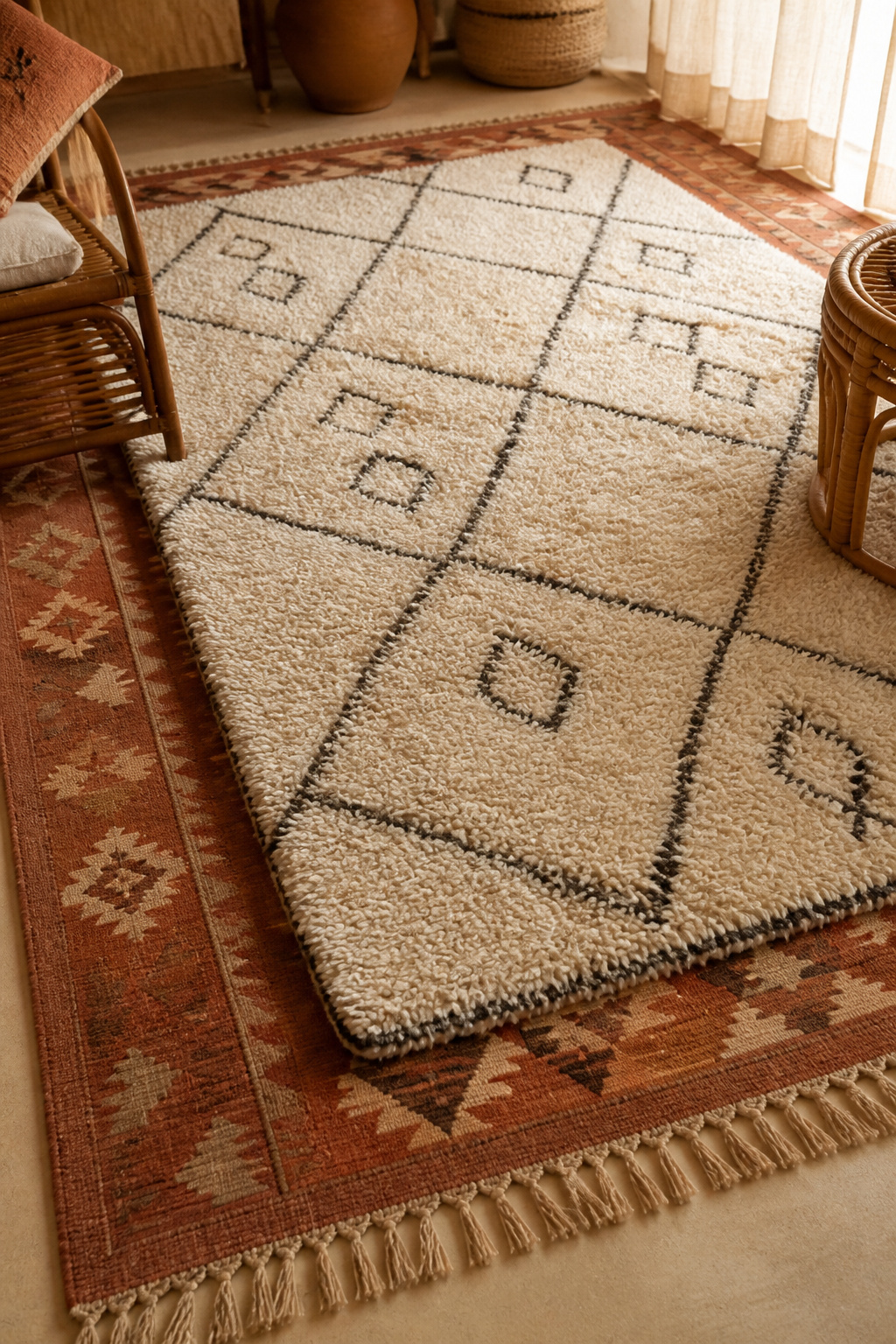
The layering technique that makes a boho rug arrangement special is straightforward: place a flat-woven kilim or a natural jute base rug at least 12 inches larger on all sides underneath, then lay the Beni Ourain on top so the base frames it like a mat around artwork. The contrast between flat weave and pile creates visual depth that a single rug never achieves. For a more casual effect, try the patchwork approach — overlapping the edges of two rugs by 4-6 inches gives the impression of a space where textiles have simply accumulated over time.
To distinguish an authentic hand-knotted piece from a machine-made lookalike, check the back: hand-knotted pile shows irregular knot spacing; machine-made versions have perfectly uniform, factory-stamped rows. Genuine Beni Ourain rugs run £300-£800 for a 6×9, with vintage kilims available from specialist Etsy sellers for £150-£500 in good condition. Both are worth the investment as the boho living room decoration foundation you’ll keep building on for decades.
2. Macramé Wall Hangings That Add Texture Without Overwhelming the Wall
Macramé has a longer history than the 1970s associations suggest. The word derives from the Arabic “migramah” — a fringed veil — and the knotting techniques spread through Europe via Moorish influence centuries before the counterculture revival. Today’s artisan macramé makers are working in that same craft lineage, and the best pieces carry a genuine weight that mass-market versions made from synthetic cord simply cannot replicate. As boho living room decoration goes, a well-chosen macramé piece ages into the room rather than dating it.
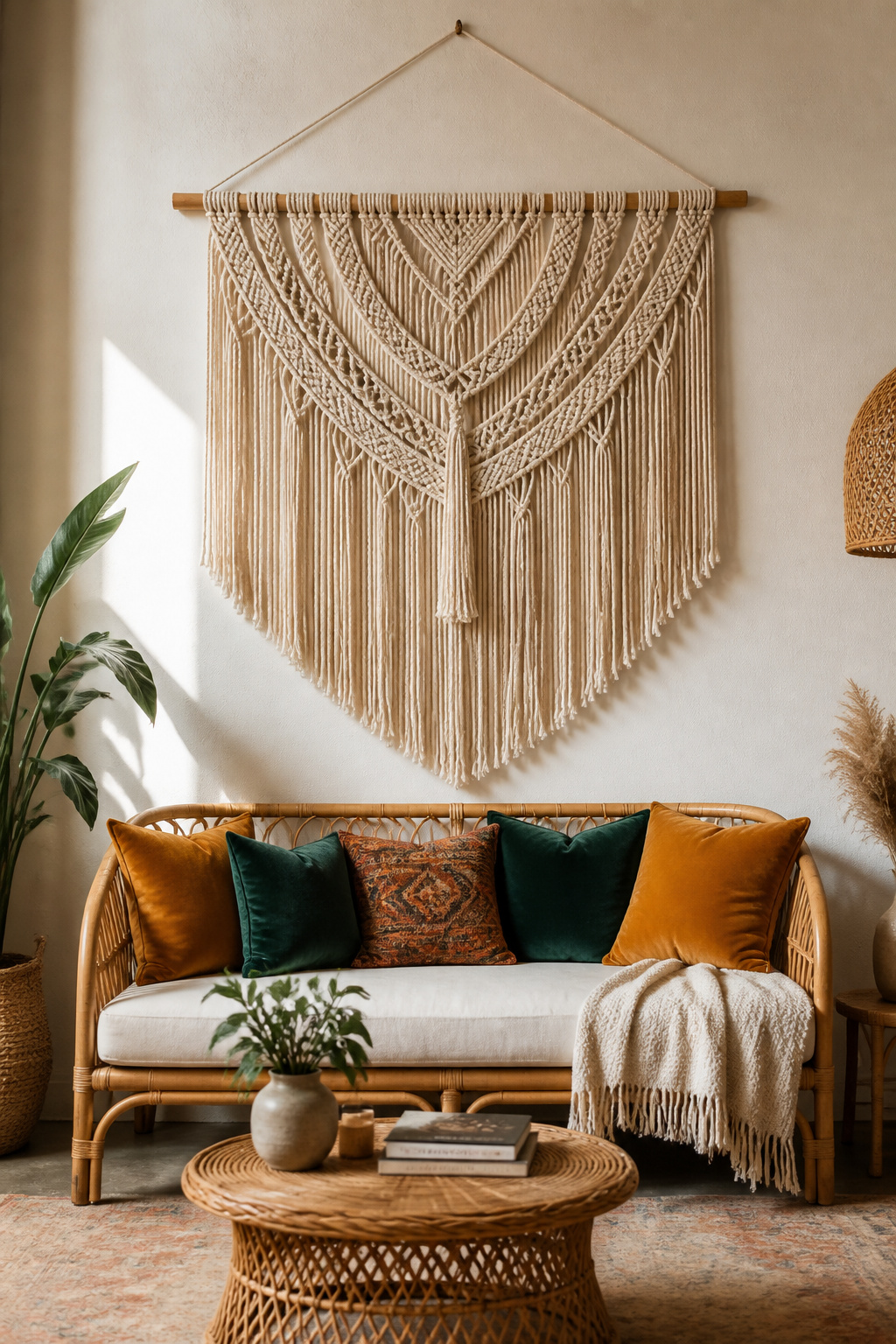
For a living room, sizing matters more than pattern. A statement piece for above a sofa should span roughly two-thirds the width of the sofa below it — above a 90-inch sofa, aim for a hanging between 55 and 65 inches wide. Pieces made from 5mm natural cotton rope have the visual heft to hold a wall; thinner 3mm cord works for more delicate accent pieces but can read as insubstantial on a large wall. If the wall space is genuinely wide, three smaller hangings grouped at varied heights fills it more intentionally than a single oversized piece.
Quality markers worth checking: tight, consistent knot density; a natural cotton or jute cord that will age to warm cream rather than synthetic cord that yellows; a hardwood dowel rather than cheap bamboo that warps with humidity. Expect to pay £80-£250 for a well-crafted artisan piece in the 24×36-inch range — it’s a piece you’ll keep for many years, unlike the £25 equivalent that begins to look tired within two seasons.
3. Low-Slung Rattan Sofas and Wicker Chairs for a Grounded Aesthetic
The design logic of low furniture in a boho room is borrowed from Japanese and Moroccan interior traditions: when seating sits closer to the floor, ceilings appear higher, rooms feel more spacious, and the atmosphere shifts from formal to genuinely relaxed. Boho-specific rattan furniture typically runs 17-18 inches in seat height versus the standard 18-19 inches — a small difference in dimension that creates a significant difference in atmosphere.
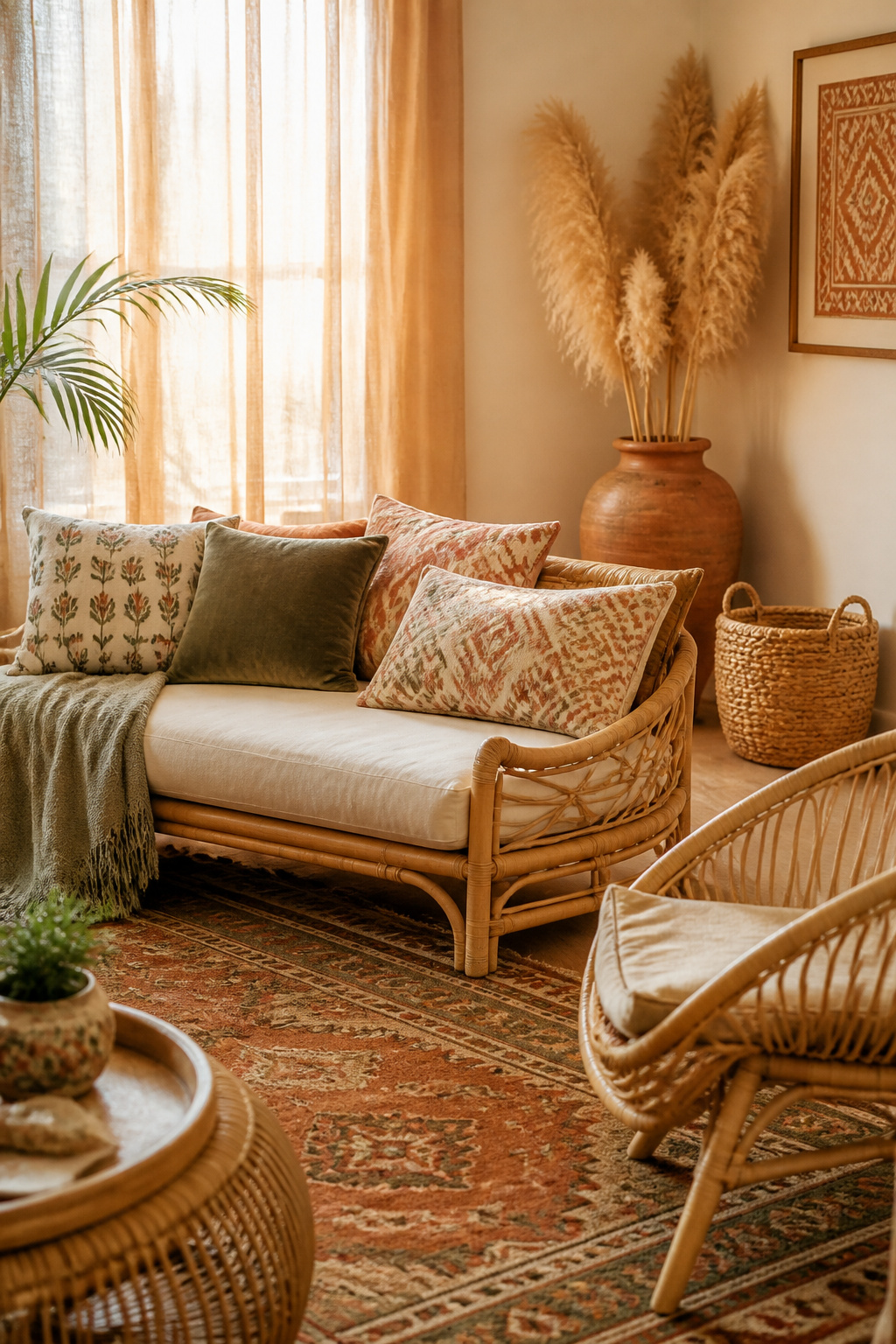
Rattan is the right material here because it genuinely ages well. A solid palm vine bent into furniture frames, rattan deepens from honey-gold to warm amber over the years, which means a 10-year-old rattan sofa often looks better than a new one. When choosing between rattan, seagrass, and bamboo, note the differences: seagrass suits occasional chairs rather than primary sofas because the hollow grass stems can compress under sustained daily use; bamboo has a cooler, more architectural quality and works well if you want the rattan look with slightly more graphic structure. For guidance on living room furniture that balances style and comfort, the distinction between these materials becomes especially practical.
The cushion arrangement is where rattan furniture can either sing or fall flat. Down-feather 60/40 fills give the most natural, relaxed appearance — foam pads look too stiff and commercial. Use at least five cushions on a rattan sofa: two 22-inch solids at the back, two 18-inch patterned pieces in front, and a 12-inch lumbar or round accent at the front. Set them asymmetrically rather than in a balanced line. The goal is that comfortable disorder that says the room is genuinely lived in.
4. Gallery Walls Mixing Global Art and Textiles as Bohemian Living Room Decor
The gallery wall is one of the most forgiving surfaces in a boho living room, but it requires one discipline that most people skip: a single tonal anchor shared across every piece. A collection of West African masks, Indian block prints, European vintage botanical illustrations, and a small kilim fragment can absolutely coexist on one wall — but only if they share a coherent tonal relationship. Terracotta, ivory, and dark wood is one such anchor. Warm ochre, cream, and aged brass is another.
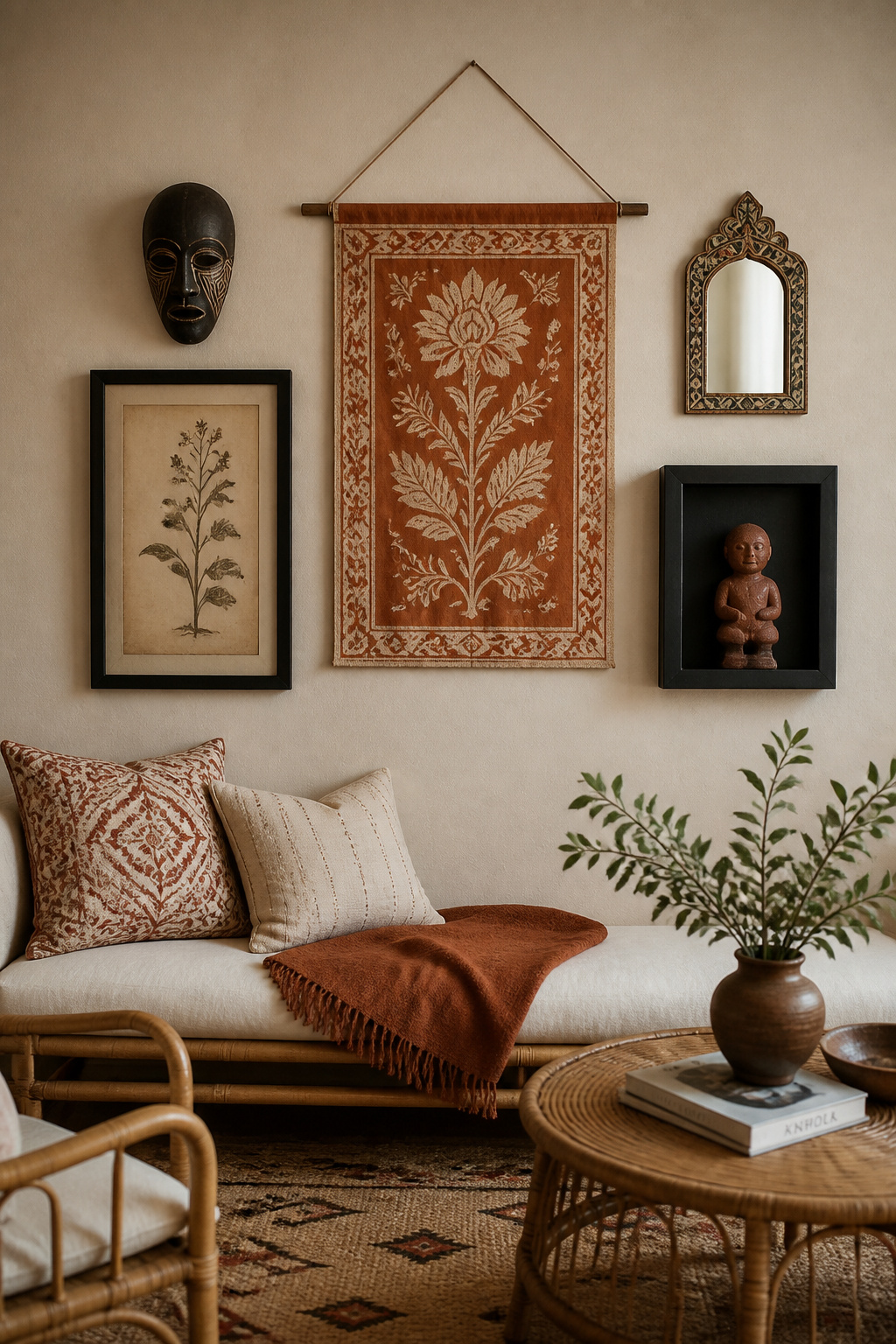
Lay everything on the floor before touching the wall. This is the saloon hang method, borrowed from how galleries curate temporary exhibitions: trace each piece’s outline on paper, tape the templates to the wall, live with the arrangement for a day, then commit to it with a drill and hooks. Vary frame depths deliberately — a 1-inch flat frame, a 2-inch shadow box, and an unframed textile panel hung with gold clips create a three-dimensional arrangement rather than a flat grid of prints. Unframed textiles can be hung with a slim dowel through a sewn sleeve or two bulldog clips; the raw edge adds to the collected quality of the wall.
The 70/30 rule is at the heart of coherent bohemian living room decor: 70% of pieces share the anchor palette, and 30% are outliers that create productive tension. A single deep indigo piece in a warm-toned collection draws the eye and prevents monotony. Leave 3-4 inches between pieces — enough space for each to breathe and be seen as an individual object, not part of a mosaic.
5. Jewel-Toned Velvet Cushions Layered for Depth and Warmth
The relationship between jewel tones and boho decoration is rooted in natural dye history. Indigo, saffron, madder, and weld — the dye plants that produced the deep blues, golden yellows, reds, and greens of South Asian and North African textile traditions — created saturated tones that velvet’s pile structure amplifies particularly well. When you see an emerald velvet cushion set against a terracotta wall, you’re looking at a colour pairing that has existed in craft traditions across two continents for centuries.
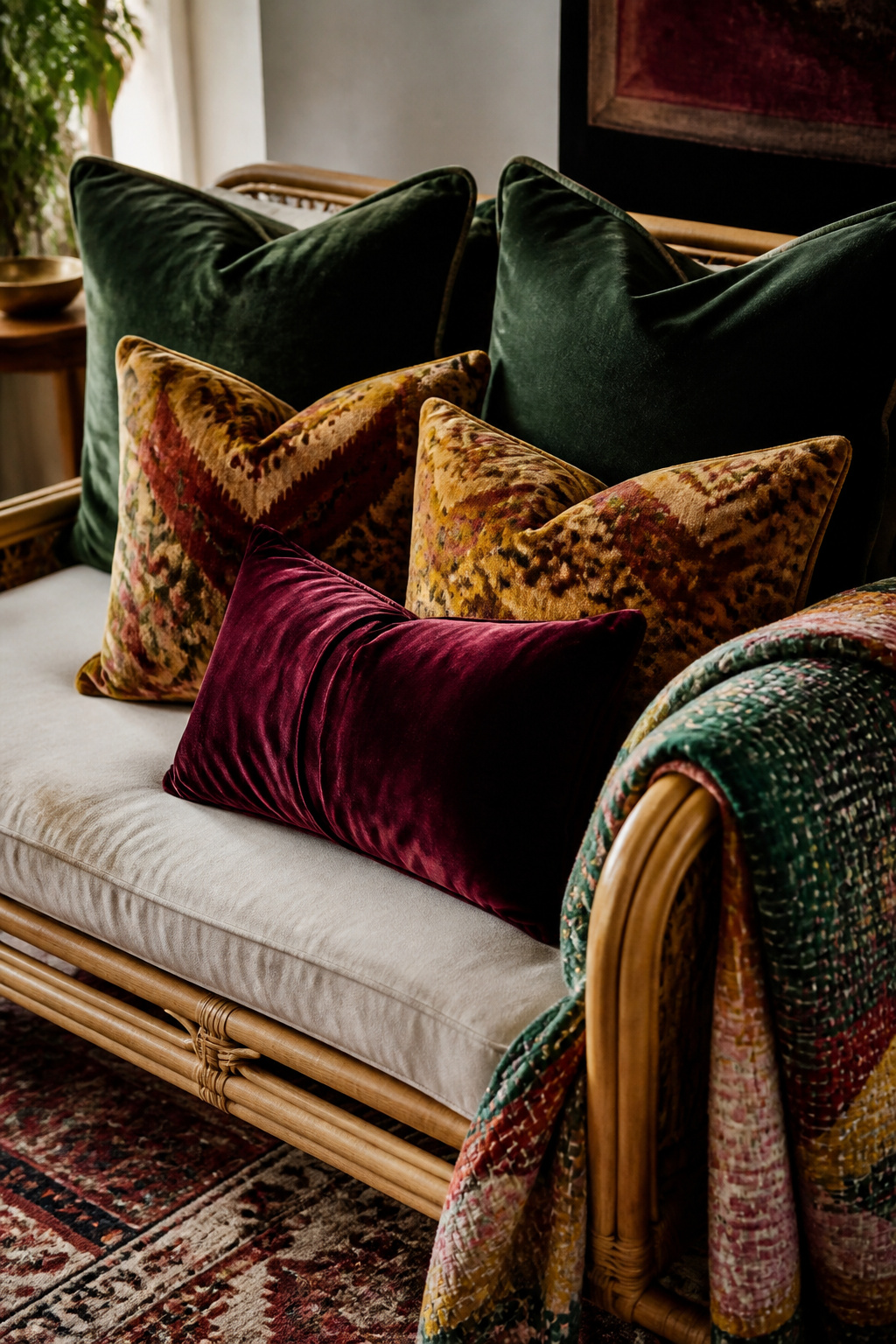
The professional layering formula works in odd numbers: 3, 5, or 7 cushions, never 4 or 6. Start with two 22-inch solid squares at the sofa’s back — these are your foundation, ideally in a neutral that echoes the rug or wall. Add two 18-inch patterned pieces in the middle layer: a block-print cotton, an ikat weave, or a kilim-look jacquard all work well here. Finish with one 12-14-inch accent — a small velvet round, a 12×20-inch lumbar, or an embroidered piece — placed slightly off-centre at the front. The graduated scale creates depth; the textile variety creates interest.
Velvet care is simpler than most people assume: always brush in the direction of the pile after washing or handling; going against the pile flattens the fabric and dulls the luminous quality that makes velvet worth having. Steam from six inches lifts compressed areas back to life. Mixing one or two linen or chunky-knit cushions into an otherwise velvet arrangement softens the formality — the rougher-textured pieces make the velvet look intentional rather than precious.
6. Dried Botanicals and Pampas Grass for Organic, Natural Movement
There’s a philosophy embedded in dried botanicals that fresh flowers don’t carry: they embrace the beauty of change. Pampas grass begins as lush cream-gold plumes, fades over months to a muted warmth, and continues to look interesting at every stage. That willingness to let things age gracefully — to find the aesthetic in the natural process rather than fighting it — is fundamental to boho living room decoration done well.
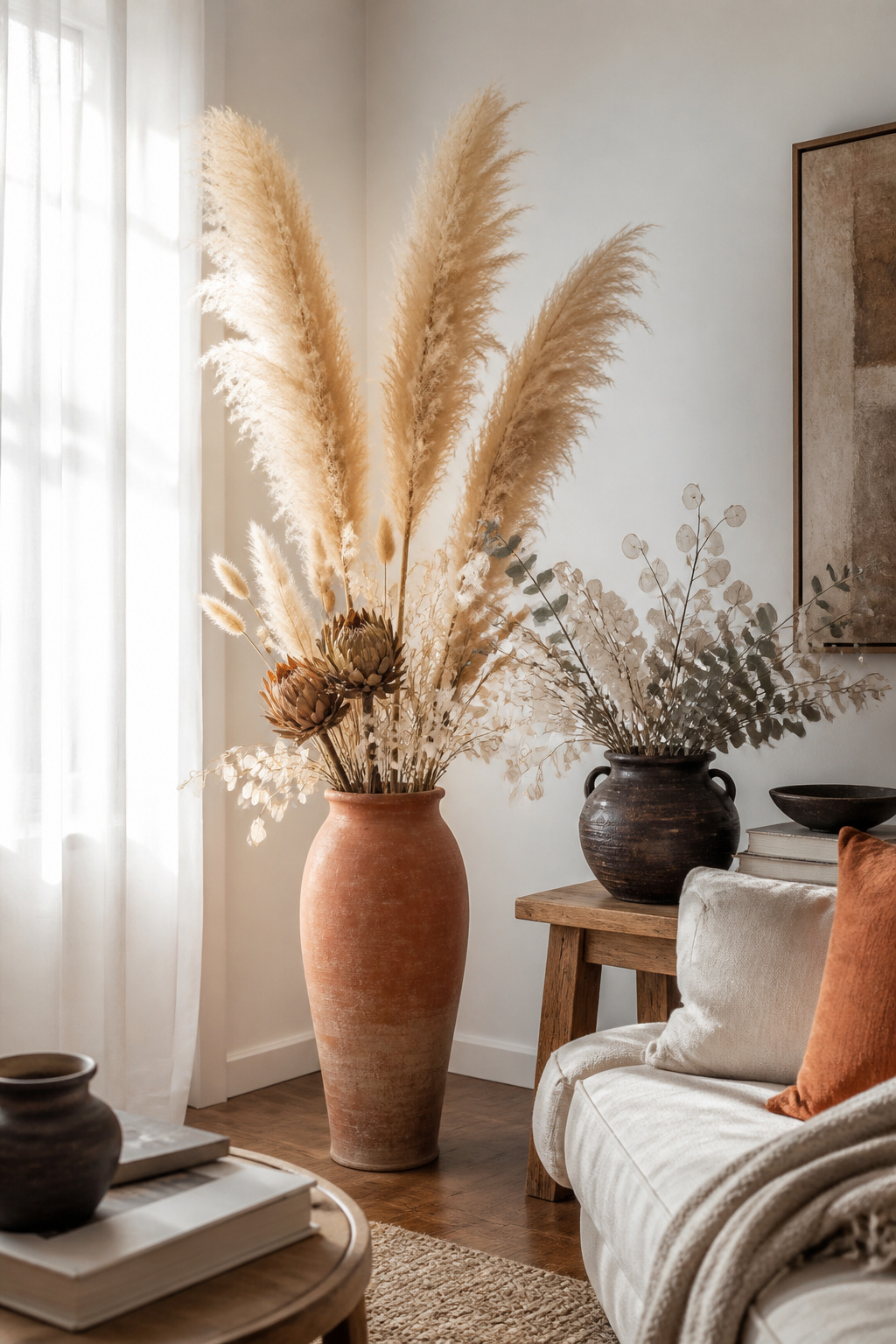
The species palette for a boho dried arrangement draws naturally from the earth-tone world: pampas grass (Cortaderia selloana — feathery ivory to champagne plumes), bunny tail grass (Lagurus ovatus — small, soft, endlessly touchable), dried protea (structural rust-brown flower heads with real architectural presence), lunaria (translucent silver seed pods that catch light beautifully), and preserved eucalyptus for a note of grey-green. Mix them in a 1:2:1 ratio — one architectural statement plant, two textural fillers, one linear element — and the arrangement reads like a meadow rather than a florist’s accident.
Choose floor vessels at 18-24 inches for pampas grass; table-height terracotta or dark glazed ceramics work better for smaller mixed arrangements. Place arrangements in bright indirect light away from south-facing windows — UV exposure bleaches botanical pigments within 6-12 weeks; indirect light preserves them for 2-3 years. For pampas grass maintenance, shake gently to remove dust, leave in direct sun for 3-6 hours to refluff compressed plumes, then fix with a light spray of hairspray. On sourcing: choose stems with certificates of agricultural cultivation rather than wild harvesting, as pampas grass is considered invasive in several regions including California and parts of New Zealand.
7. Vintage Brass and Copper Lanterns That Anchor Your Boho Room Decor
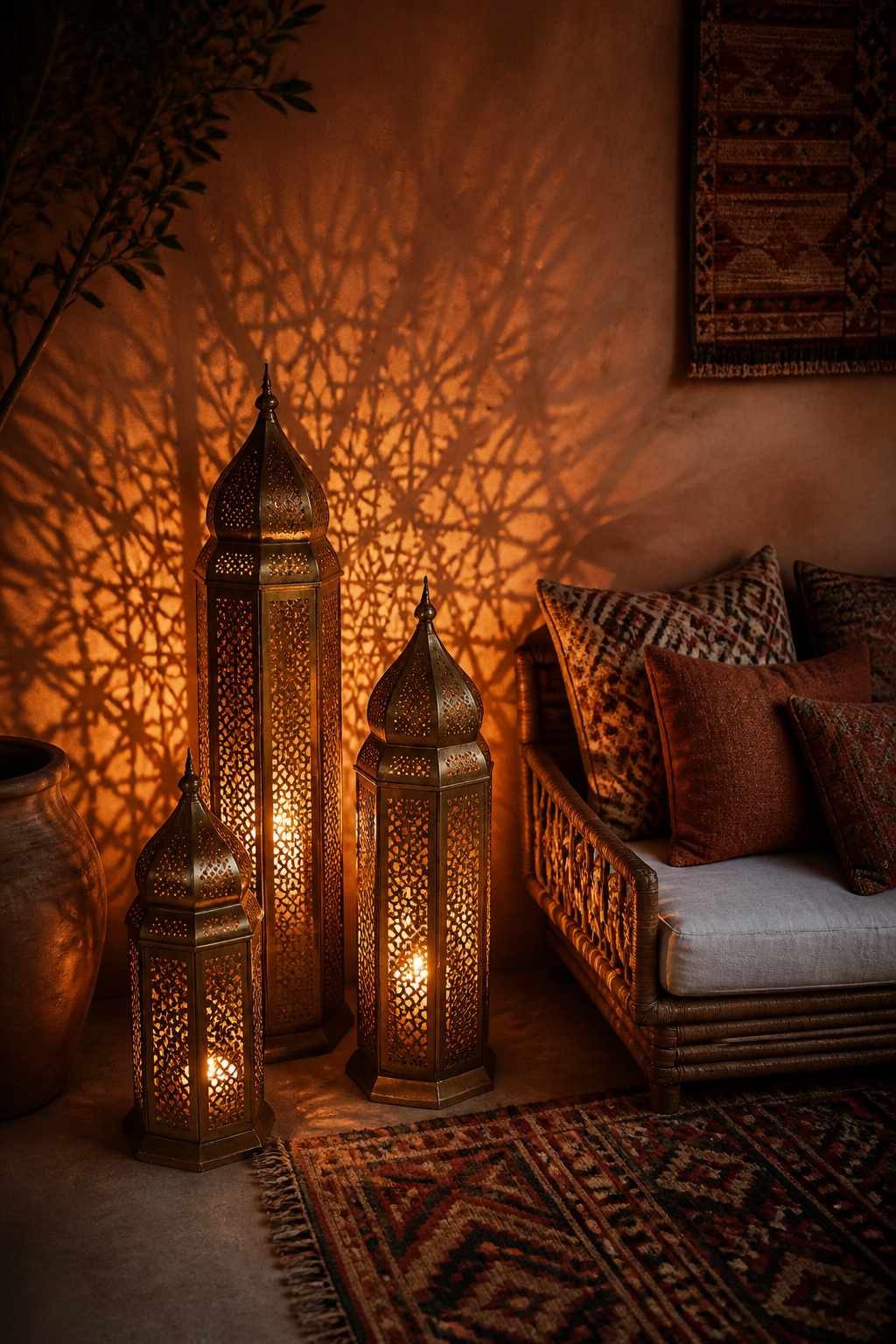
The shadow patterns cast by a lit Moroccan brass lantern are unlike anything an electric shade produces: sharp geometric stars and arabesque interlace thrown across pale walls, shifting slightly as the flame moves. This is the dinanderie and serrouj tradition — Moroccan metalworkers who hammer, engrave, and pierce brass using techniques practised continuously in the Fes medina for centuries. Indian kandil lamps work similarly, using a thinner gauge brass with more delicate engraving derived from temple and courtyard traditions. Both carry the same essential quality: they make light into an event.
Patina, Weight, and How to Group Them
Quality is readable immediately in the patina. New brass is bright, almost gold-coloured; quality pieces develop a warm oxidized matte finish over 2-5 years that polished brass can never match. A weight test helps identify solid brass versus brass-plated steel: a 12-inch quality lantern should weigh 800g-1.2kg; plated versions are noticeably lighter and the plating chips at contact points within a few years to reveal grey steel underneath. For floor lanterns in a boho room decor grouping, choose 3 pieces at heights differing by at least 4 inches — an 18-inch, 24-inch, and 14-inch lantern together create a composition. For table clusters, 3-5 small-to-medium lanterns (6-14 inches) on a coffee table with varied heights and slightly different facing directions creates the impression that they arrived in the room at different times. If the connection between atmospheric lighting and boho aesthetics interests you, boho bedroom lighting that creates a magical ambiance applies the same logic in a different setting.
To restore over-tarnished patina without stripping it entirely: mix equal parts white vinegar and water, apply with a soft cloth, leave 10 minutes, then buff gently. Never use abrasive polishes on pierced Moroccan work — they clog the cutwork that creates the shadow patterns and are nearly impossible to remove.
8. Oversized Floor Cushions and Poufs for Casual Boho Seating
Cultures that have maintained floor seating traditions — Moroccan, South Asian, Japanese, Central Asian — share an understanding that proximity to the floor changes how people behave in a room. Upright chair-height seating positions the body for departure; floor seating positions it for staying. The social atmosphere that boho living rooms aspire to — gathered, unhurried, genuinely welcoming — is supported by floor seating in a way that a formal sofa arrangement cannot fully deliver.
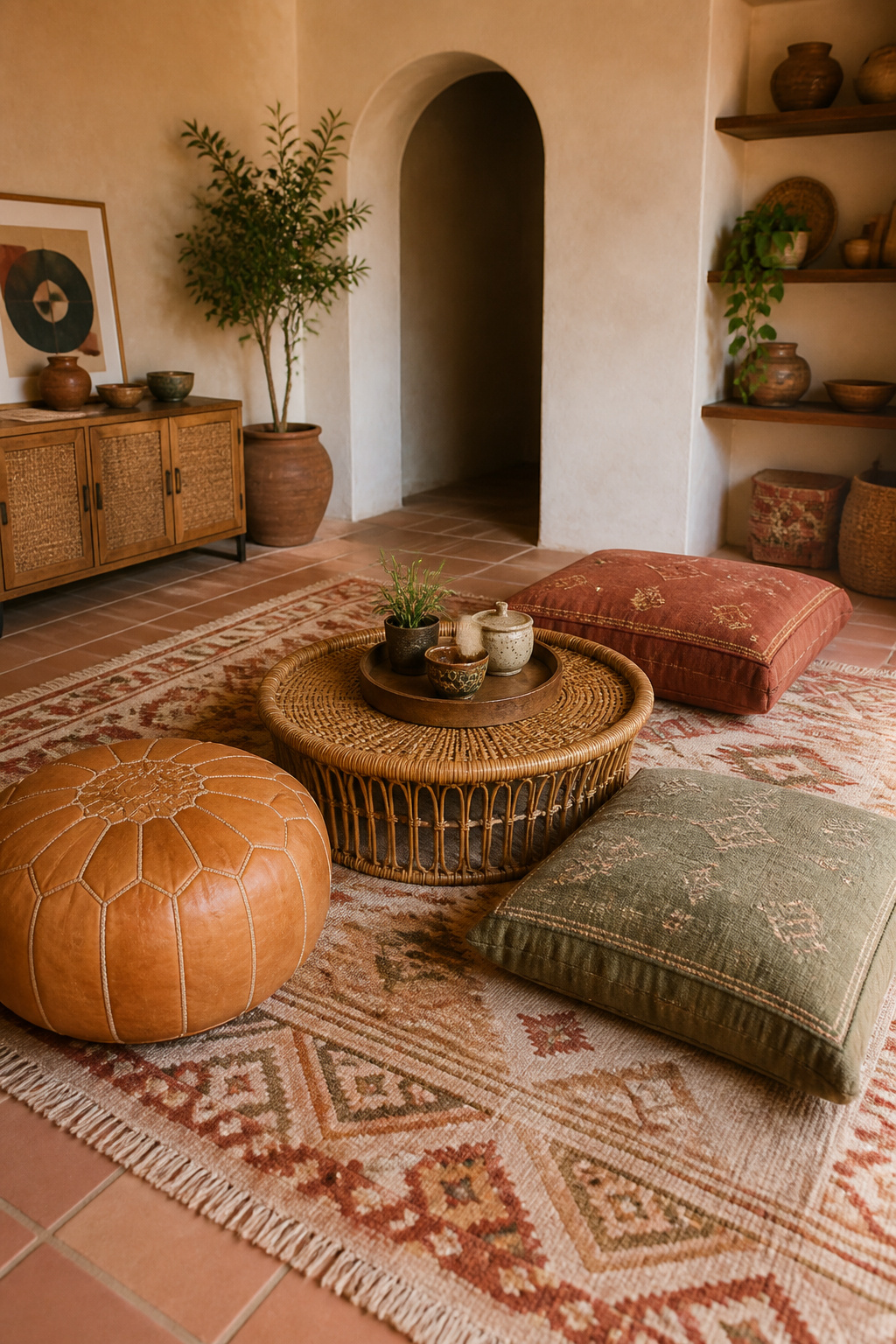
Genuine Moroccan leather poufs are hand-sewn from vegetable-tanned goatskin in the tanneries of Fes, arriving unstuffed and filled on arrival with old clothes, buckwheat hulls, or shredded foam. Standard dimensions are 18-20 inches in diameter and 14-16 inches tall — substantial enough to use as a footrest, impromptu coffee table (place a 16-inch round wooden tray on top), or additional seating for guests. Kilim-covered poufs offer pattern variety that plain leather cannot: the woven geometric motifs in Turkish or Moroccan kilim work naturally alongside the other global textiles already in the room. Large cotton floor cushions — the Indian gaddi cushion style at 24-36 inches square and 4-6 inches thick — sit lower and are better for full floor lounging; stack two for more elevation.
Avoid matching. One round tan leather pouf, one kilim-patterned pouf, and one large square cotton floor cushion creates far more layering than three matching versions of the same piece — and that instinct to avoid matching is at the heart of boho living room decor. The variety should feel like each one arrived separately, over time, from different places.
9. Handwoven Global Textiles and Throws Draped Casually Over Furniture
The test of a throw in a boho room isn’t whether it’s beautiful — it’s whether it carries a story. A kantha quilt stitched over weeks in West Bengal from layers of recycled vintage cotton saris carries a provenance that a machine-printed fleece cannot. The running stitch lines are hand-sewn through 3-5 layers of old sari fabric by women artisans in rural collectives; the slight irregularity in the stitch rows is visible in raking light and creates a quilted texture that no machine can replicate. For textile layering beyond the living room, cozy bedroom textiles for layered comfort explores how the same principles translate to other spaces.
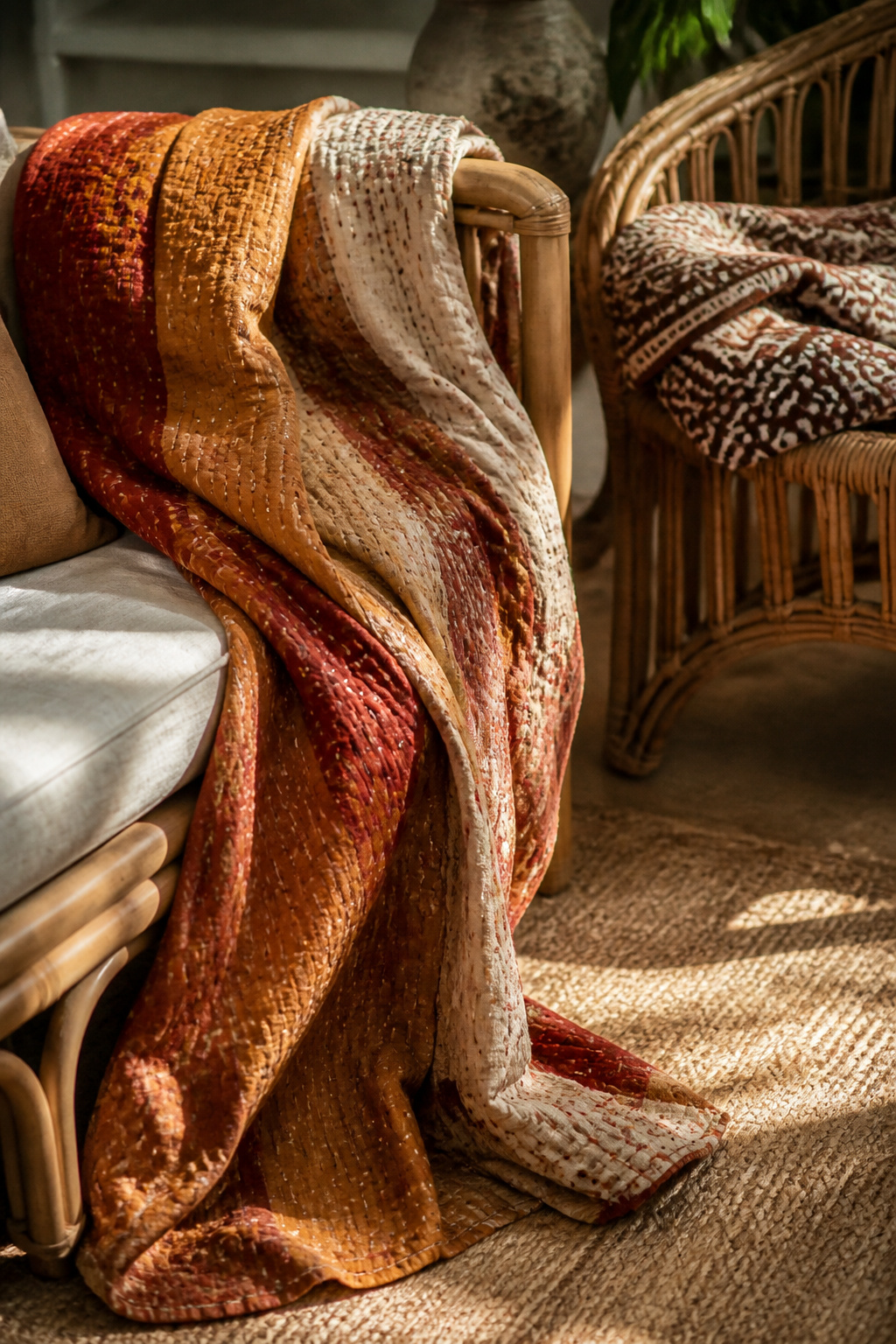
The global vocabulary of boho throws is broad and worth knowing. Kantha quilts come from West Bengal and Bangladesh, typically in irregular dimensions around 50×70 inches; ethical sources include Anchal Project and Jaipur Handloom. Mexican Saltillo serapes are flat-woven striped blankets in bright polychrome with a diamond centre medallion; look for the irregular warp tension marks that distinguish hand-woven from factory-produced versions. West African mudcloth (bogolan) from Mali uses fermented mud pigments painted onto hand-woven cotton to create geometric patterns in brown, black, ochre, and cream — a colour palette that requires no adjustment to fit a boho earth-tone room.
The Art of the Casual Drape
How you drape a throw matters as much as which throw you choose. Don’t fold it — bunch it loosely in one hand and let it fall over the sofa arm or across the seat in the direction it naturally wants to go. On a rattan chair, let one end touch the floor and the other pool on the seat; the floor contact is important. Anything hovering 6 inches off the ground looks placed rather than lived in, and placed is the opposite of what good boho living space decor should feel like.
10. Terracotta Pottery and Artisan Ceramics as Boho Living Space Decor
Unglazed terracotta gets its warm orange-red colour from iron oxide in the clay body — the same iron that makes the soil of Mediterranean coastlines, Rajasthan, and central Mexico look the way they do. It is one of the oldest continuously used vessel materials on earth, appearing in virtually every ancient culture simultaneously, which means a terracotta pot in a boho living space decor scheme carries an archaeological weight that a white mass-produced planter simply doesn’t.
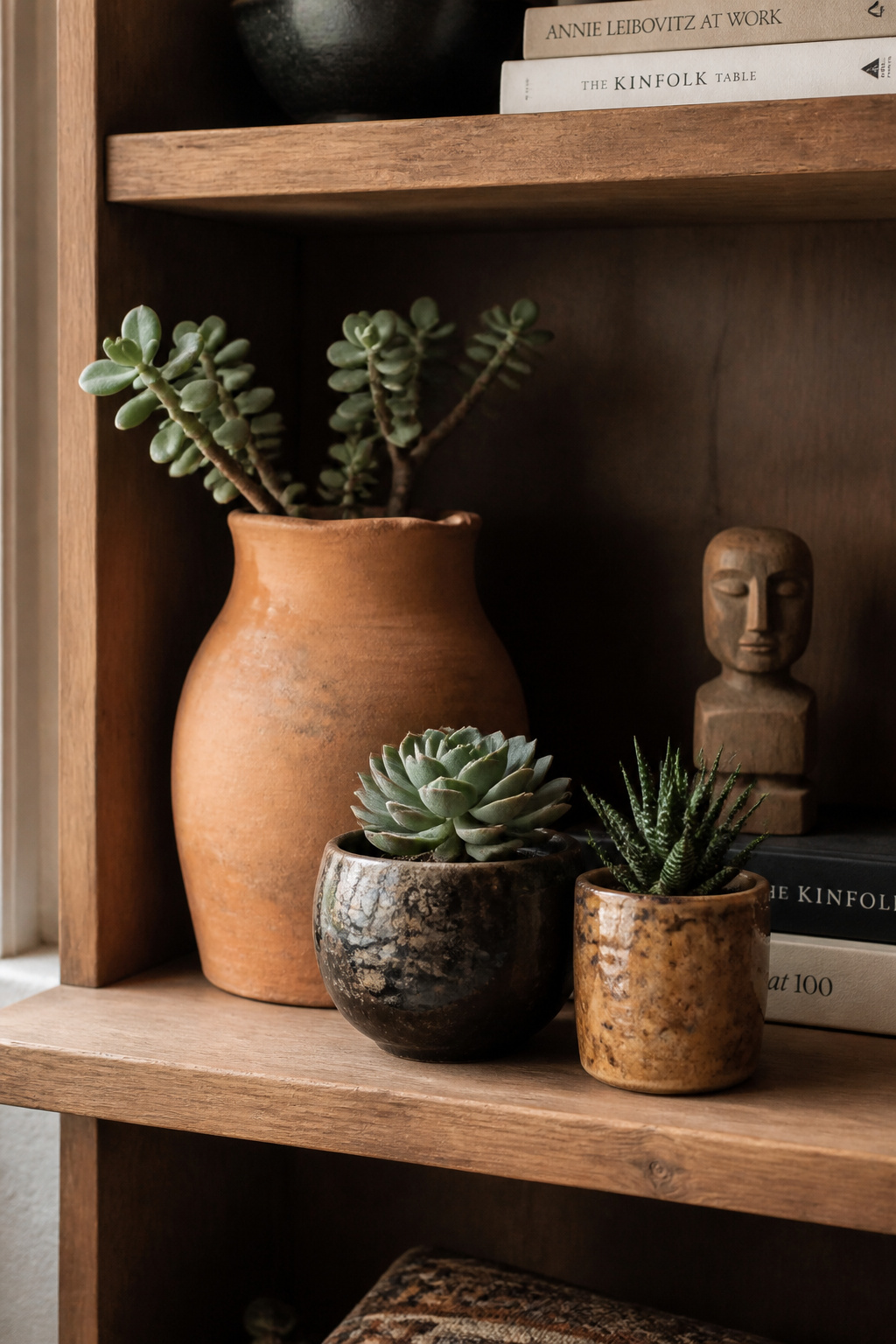
Artisan ceramics add the specific human quality that production removes: hand-thrown walls show the potter’s fingerprints in subtle ridges; rims and bases are subtly uneven; glaze drips and variations make each piece unique. These imperfections are the quality indicator, not a flaw to work around. When grouping pottery on a shelf or console table, use odd numbers (three or five pieces), vary heights by at least 30% — a 12-inch tall vessel beside an 8-inch wide bowl beside a 4-inch low planter — and mix surface treatments. A raku-fired glazed vessel next to an unglazed terracotta pot next to a soda-fired piece with its unpredictable atmospheric colour creates textural variety while sharing the earthy palette.
For sourcing, independent studio potters on Etsy and Instagram produce the most interesting boho-compatible work — search terms like “terracotta vessel,” “hand-thrown earth tones,” and “wabi-sabi ceramics” find it reliably. Price range for studio pottery: £25-£150 per piece, versus £8-£30 for mass-produced pieces that look like studio pottery but feel like neither. These small handmade objects are often the ones that give boho living space decor its soul — the pieces that reward looking at closely, that you still notice after years.
11. Woven Wall Baskets Grouped as Living Sculptural Art
The Bolga basket tradition from the Upper East region of Ghana grew from utilitarian origins — these woven elephant-grass vessels were carrying and storage tools — into decorative objects precisely because their visual complexity was impossible to ignore. Tonga baskets from the Binga area of Zimbabwe, woven primarily by women in a matrilineal craft tradition, bring a more graphic flat-plate quality with bold geometric patterns in natural earth tones. Together on a wall, these two African traditions create a composition that moves bohemian room decoration from two-dimensional to fully spatial — no framed print can match the three-dimensional presence and textural richness.
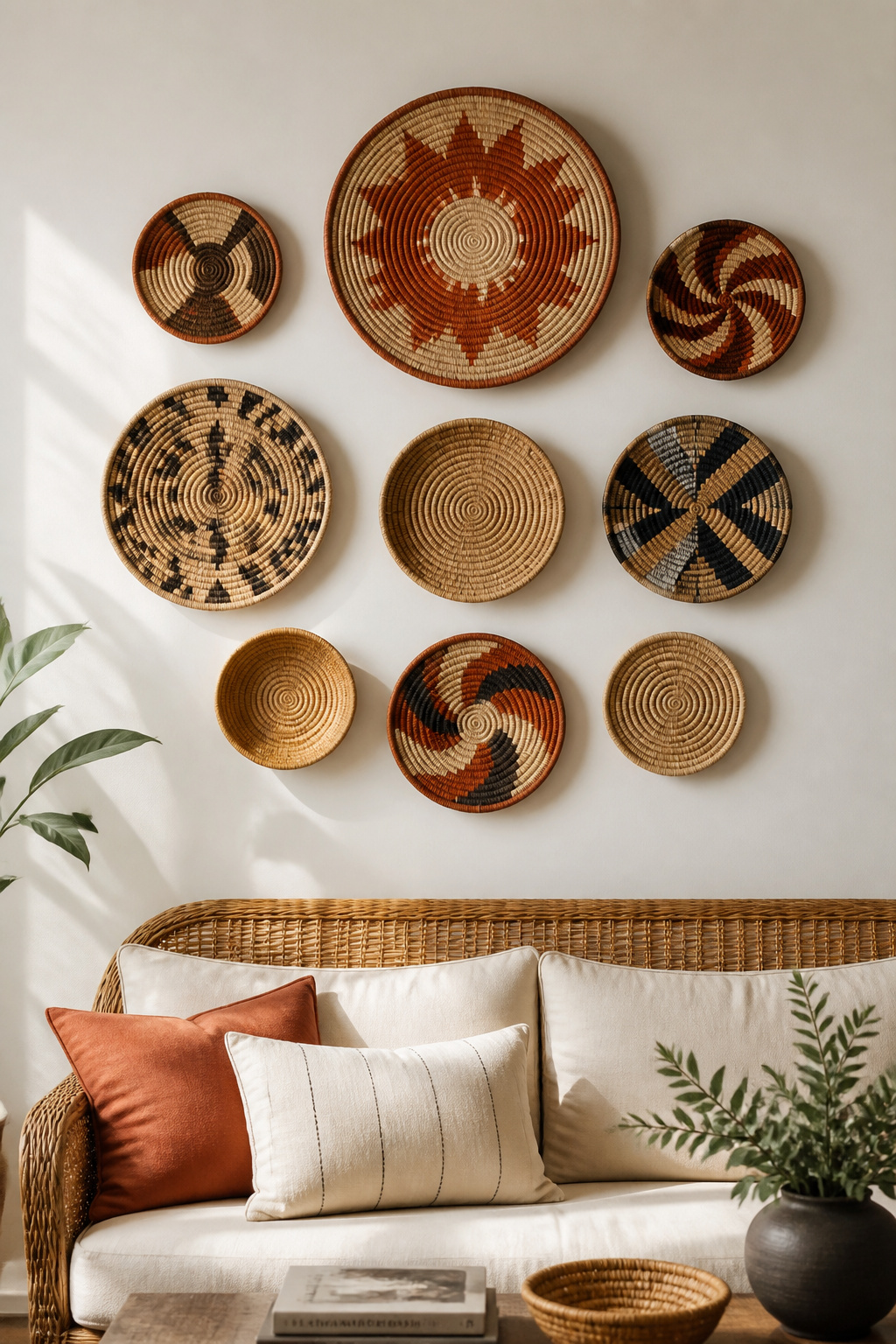
Arrange on the floor before hanging. This cannot be overstated. Trace each basket’s outline on paper, cut out the templates, tape them to the wall, and live with the arrangement for a day before committing to hooks. Start with the largest basket — 18-24 inches — as the visual anchor in the upper centre, then work outward and downward with decreasing sizes. Leave 2-4 inches between pieces: tighter than 2 inches reads as crowded; wider than 4 inches disconnects the arrangement into individual objects rather than a composition. For a wall above a 90-inch sofa, a total arrangement width of 55-65 inches creates the correct visual proportion.
Mix at least three distinct forms for depth: a flat-woven plate (no dimensional depth), a shallow bowl form (1-2 inches), and a fully dimensional basket (3-4 inches). The graduated depth creates a shadow play as natural light changes through the day. Seagrass and rush baskets from East Asian traditions make excellent smaller accent pieces in a cluster dominated by bolder African forms — their finer, quieter weave provides visual relief between the more graphic patterns.
12. Sheer Boho Curtains and Window Treatments for Dappled, Filtered Light
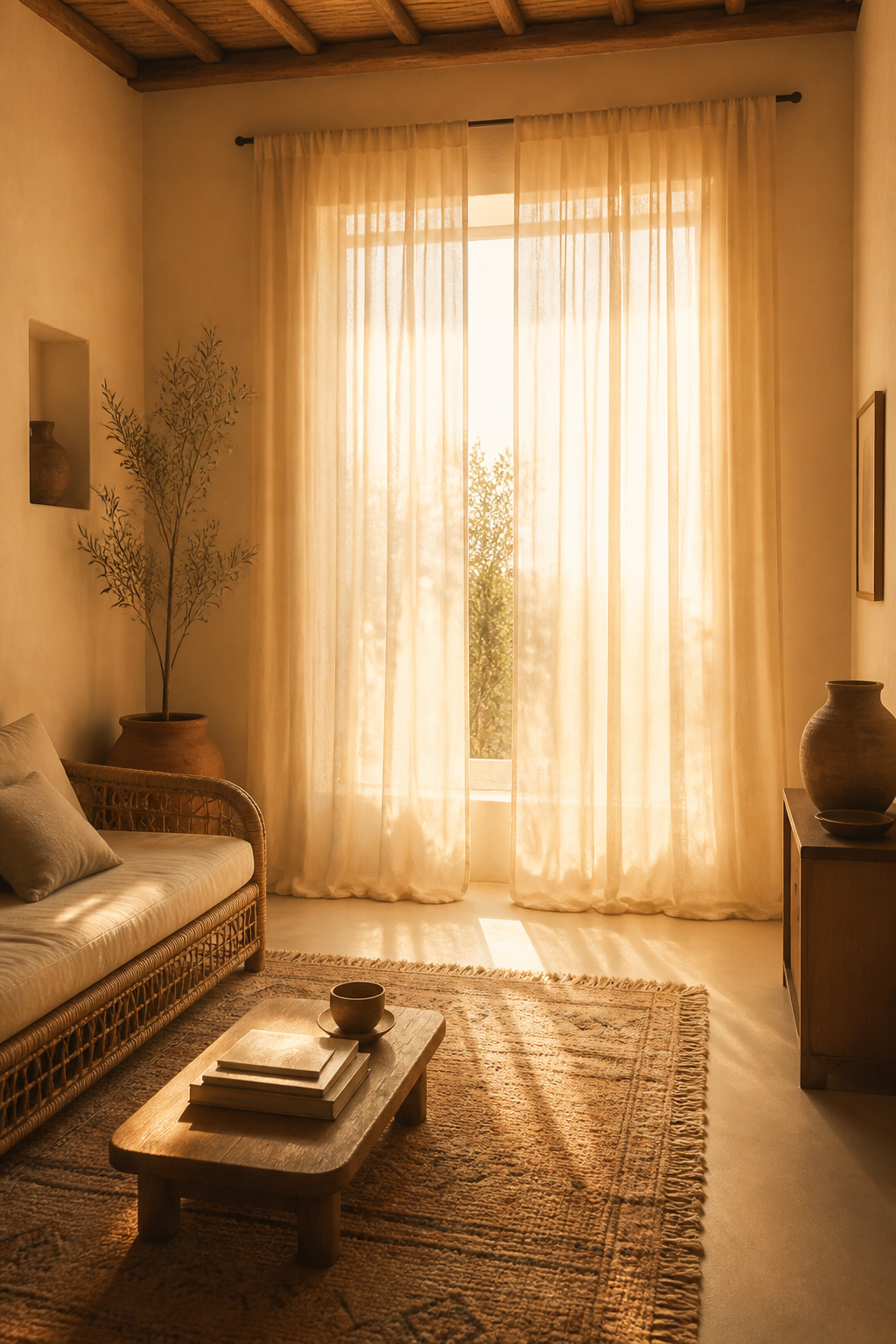
Every boho interior photograph that makes you want to redecorate has the same quality of light. It isn’t sunlight — it’s filtered sunlight, the warm diffuse luminosity that passes through sheer linen or cotton voile and spreads evenly across everything it touches. Direct sunlight creates harsh shadows that flatten the tonal richness of layered textiles and earthy walls; filtered light deepens them. The window treatment decision is not primarily a privacy question — it’s an atmospheric one.
Fabric Choice and Hanging Height
Linen sheer and cotton voile diffuse light differently. Linen sheer has a slightly nubby texture that creates a faint shadow grid in the fabric when backlit; it’s heavier, more textured, and ages beautifully with washing, developing the relaxed drape that makes boho curtains look effortless. Cotton voile is finer and creates a more ethereal quality — ideal for romantic boho interiors in rooms with adequate natural light. For north-facing rooms (which get less direct sun), voile transmits more light and compensates better for the deficit; in bright south-facing rooms, linen’s heavier diffusion is more useful. For a comprehensive guide on perfect living room curtains for any boho aesthetic, the full range of options is worth exploring before you commit.
The hanging height is where most people miss an easy improvement: mount the rod 4-6 inches above the window frame — or as high as 2 inches below the ceiling cornice in a room with good ceiling height — and extend it 6-12 inches beyond the frame on each side. This single adjustment makes windows appear taller and rooms feel more generous, at zero cost beyond the extra curtain length. Choose floor-length panels with 1-2 inches of puddle at the floor: fabric that just rests on the floor looks permanently settled; fabric that hovers above it looks recently installed. The difference is exactly the quality that separates a room that appears decorated from one that appears inhabited.
13. An Indoor Plant Collection as a Boho Living Room Decoration Anchor
Plants do more structural work in a boho room than any other decorative element — they fill the vertical space that furniture and textiles cannot, soften the hard geometry of walls and ceiling, and introduce the organic irregularity that no manufactured object can replicate. A mature Monstera deliciosa in a corner draws the eye upward and creates the impression of a canopy, establishing the biophilic connection to living things that is foundational to boho living room decoration at its best.
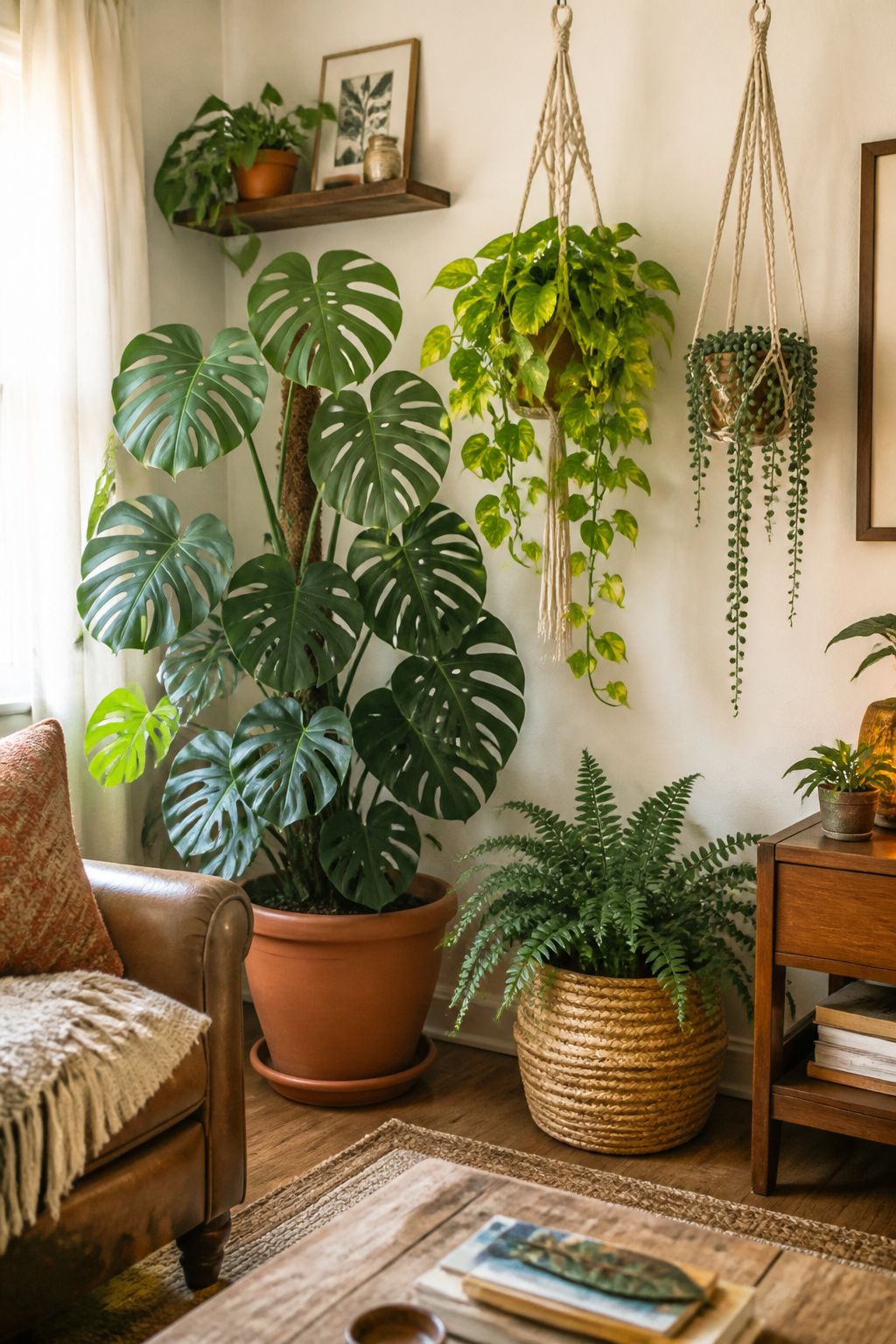
The boho plant palette is worth choosing carefully. Monstera deliciosa earns its central role — the fenestrated leaves develop fully only in mature plants with stems 3-4 feet tall or more; a small young monstera has intact leaves and none of the drama. Trailing pothos is the workhorse of the arrangement: it tolerates low light, trails 6-10 feet in a season, works in hanging macramé planters and on high shelves, and costs almost nothing. String of pearls is the most photogenic option for hanging planters — perfectly spherical cascading leaves — but requires bright indirect light and minimal water; overwatering turns the pearls to mush within days. For expanding the plant philosophy beyond the living room, boho bedroom plants that bring nature’s touch to your space offers the same styling approach in a more intimate setting.
Container Styling for Your Boho Living Room Decoration
Container choice completes the picture. Terracotta pots are always right: their warmth complements every earth-tone palette, their porosity benefits the plants, and they age beautifully with white salt deposits and green moss on the exterior. Woven basket planters need a waterproof inner pot — keep plants in their nursery plastic pot and hide it with a layer of bark or moss on the soil surface; the contrast between artisan basketry and clinical plastic is immediately visible and worth eliminating. Macramé hanging planters bring plants to eye level and above: hang at three different heights (18, 30, and 48 inches below ceiling) and vary the species — trailing pothos at the top, string of pearls at mid-height, and a small succulent at the lowest — for a staggered indoor canopy.
14. Eclectic Bookshelves Layered With Global Artifacts and Found Objects
A well-curated boho shelf is read by the edit as much as the collection. The distinction between a shelf that looks sophisticated and one that looks cluttered often comes down to a consistent tonal palette across all the objects, enough negative space for the eye to rest, and the disciplined removal of whatever was added to fill a gap rather than because it deserves to be there. Well-edited shelves are the quieter side of boho living room decoration, but they reward close attention.
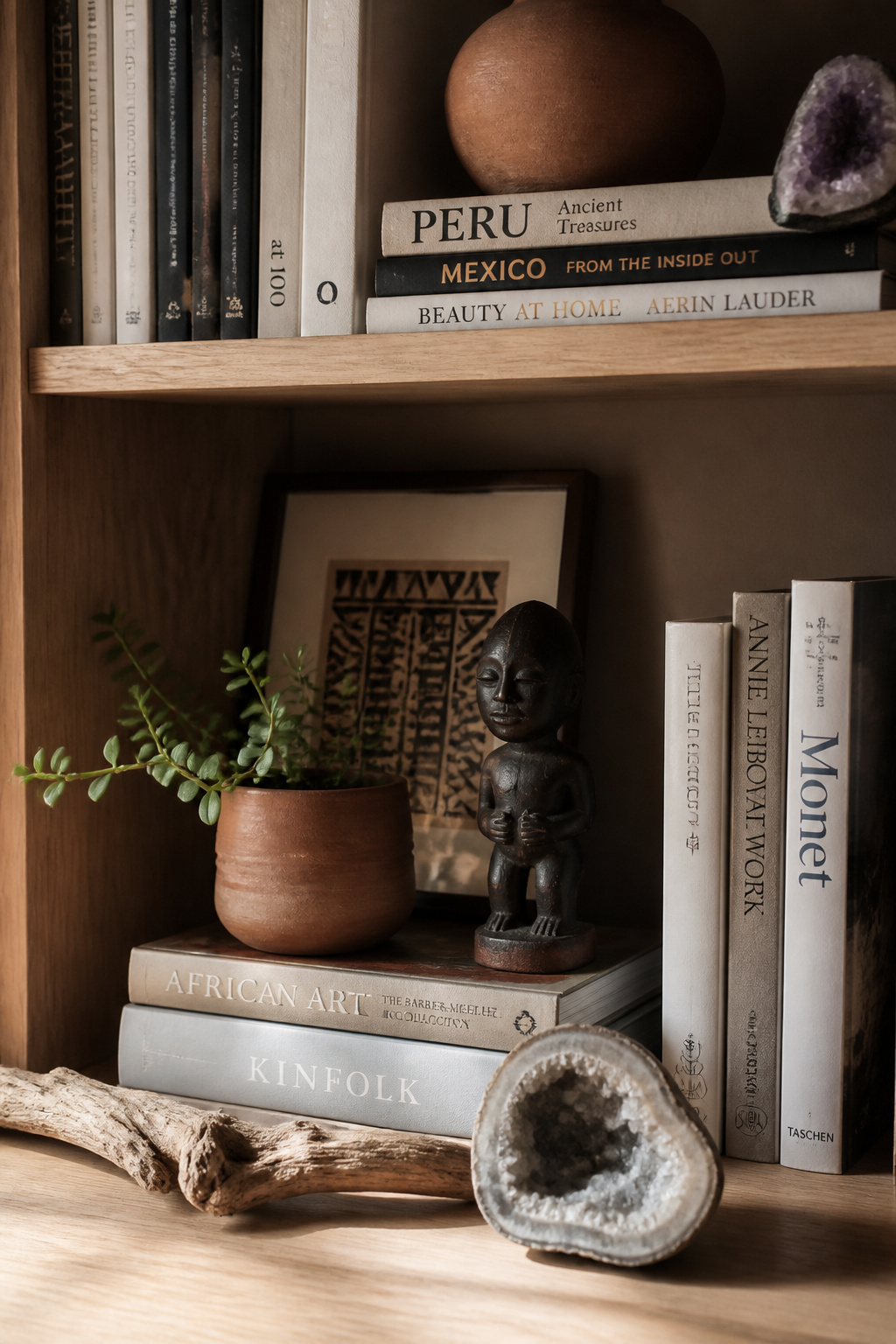
The front-to-back layering technique creates the depth that makes a bookshelf worth looking at: tall pieces at the back, medium objects in the middle, small flat items at the very front edge. Add horizontal book stacks to break up the uniform vertical rhythm of spines — a stack of three or four books at one end of a shelf bay creates a plinth for a small object and relieves the monotony without removing the books. Lean small framed prints casually against the back panel rather than hanging them on the wall above: the informal lean implies thoughtful placement and gives you the freedom to swap pieces as your collection grows.
Within each shelf bay, use a three-category rule: one textural object (a ceramic, a woven piece), one natural object (a geode, a piece of driftwood, a small stone specimen), and one narrative object (a vintage find, a travel-sourced figurine, a small carving). African carved wooden figures, Indian ganesh figures, Mexican alebrijes, and South American pottery fragments all carry specific craft traditions and add narrative weight that generic decorative spheres cannot match. After adding a new object, remove what contributes least — the pieces that survive that edit are the ones genuinely worth keeping.
15. Rattan and Bamboo Pendant Lights for Warm, Textured Ambiance
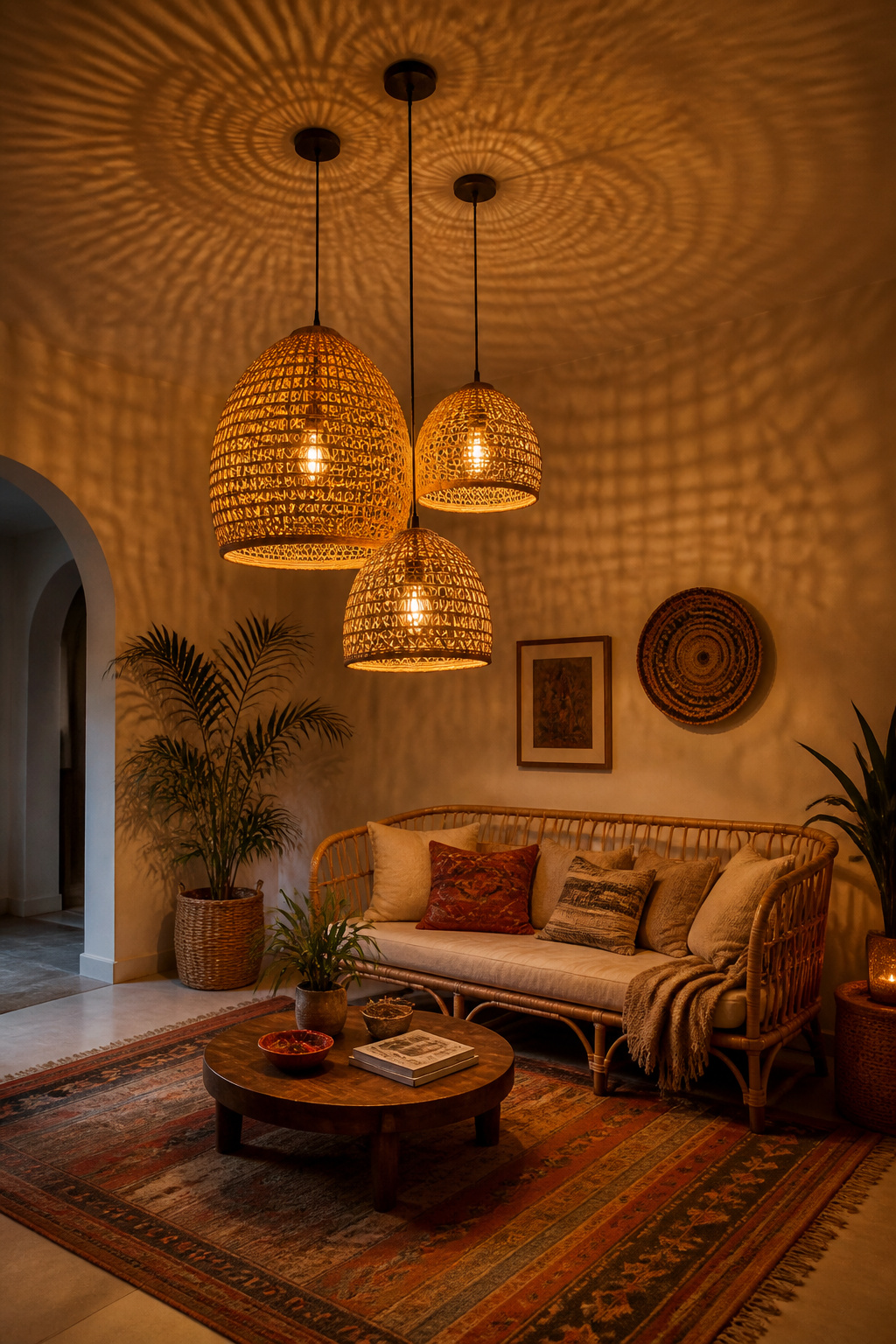
The quality of light through a woven rattan or bamboo pendant shade is distinct from any glass or fabric equivalent. The gaps between weaving elements cast light as a pattern rather than a cone — walls and ceiling receive a mesh of warm light and soft shadow that shifts subtly with air movement. This patterned light tradition appears independently across Southeast Asian rattan craft, Moroccan pierced metalwork, and Indian woven cane verandah pendants; its presence in contemporary boho living room decoration is not coincidence but a recognition that organic material, warm light, and cast pattern is one of the most atmospherically powerful combinations you can create for a relatively modest investment. For a broader perspective on living room ceiling lights that anchor your design, the range of options shows how pendant choice affects the entire room’s atmosphere.
Sizing, Height, and Bulb Choice
Sizing should be proportional to the seating area below: roughly 1 inch of pendant diameter for every foot of seating width — above a 10-foot-wide arrangement, a 10-12-inch pendant sits correctly; above a dining table, choose a shade 12 inches narrower than the table width. For living room placement without a dining table, hang so the bottom of the pendant is 60-66 inches from the floor. A group of two or three woven pendants at slightly staggered heights (6-8 inches between each) creates more visual interest than a single pendant while maintaining the same warm effect.
Bulb specification matters more than most people realise: 2700K warm-white LED, E27 base, 4-8W is the correct specification. Anything cooler than 3000K — neutral white or daylight — strips the warmth from the rattan and from the earthy room below. A dimmable version on a smart or manual dimmer is one of the highest-return investments in boho atmosphere: the ability to shift from functional midday light to intimate evening glow changes how the room feels every single evening, without moving a single piece of furniture.
16. Earth-Toned Color Schemes That Ground Your Bohemian Living Room Decor
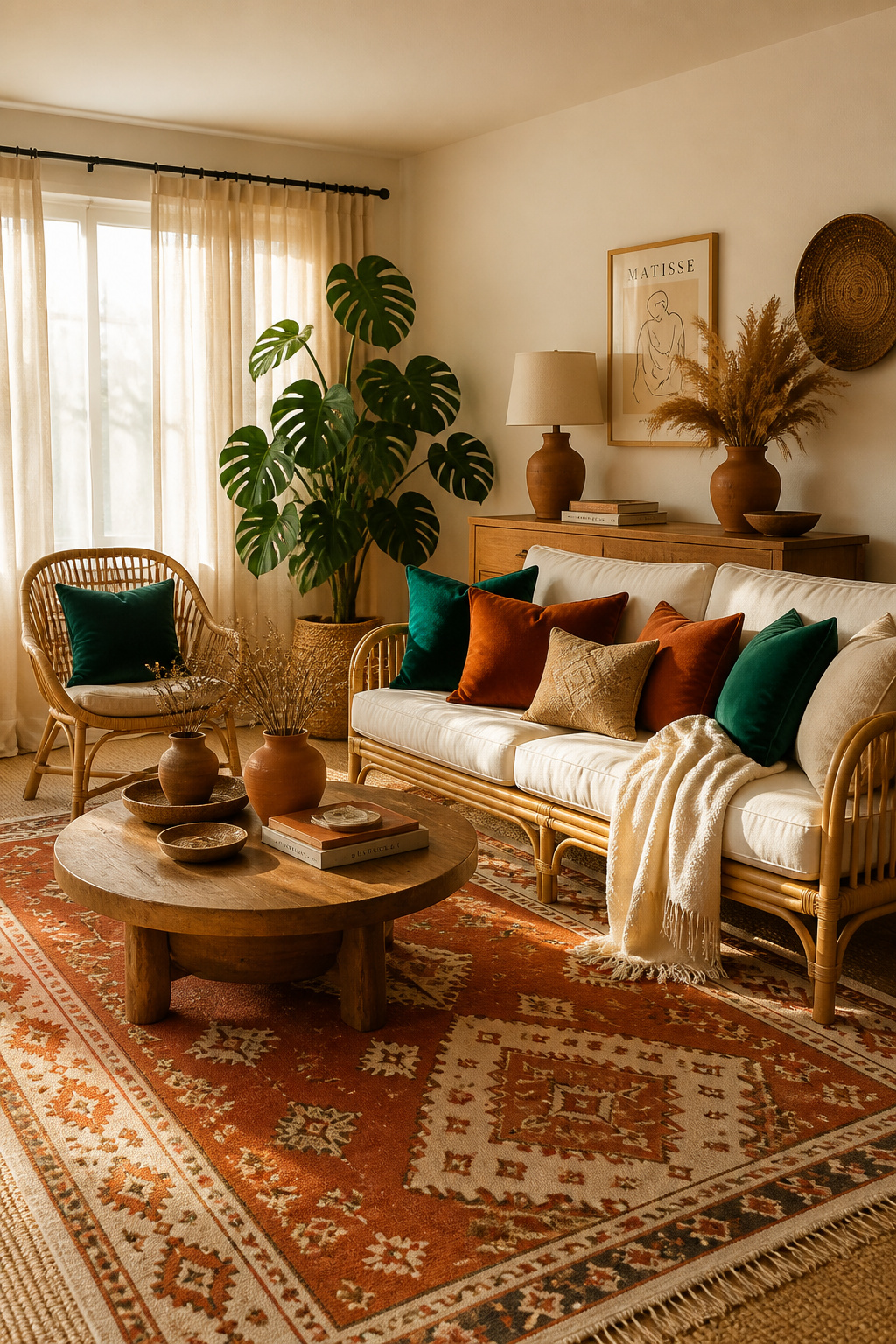
The earth-tone palette of a boho living room references a coherent natural environment: the terracotta of sun-baked clay, the warm sand of bleached cotton, the amber of filtered light through organic material, the sage green of drought-resistant Mediterranean herbs. These are colours found in unprocessed materials, which is why they work together instinctively — they share a physical origin rather than an arbitrary aesthetic one. That coherence is what separates a boho palette that feels authentic from one that merely looks brown.
Building the Palette in Sequence
Build the palette in a specific order. Start with the floor: the rug sets the dominant tone for the whole room, and every other decision should relate to it. Add the largest textile — the sofa upholstery or primary throw — choosing colours that share two or three tones with the rug. Choose wall colour last, and treat it as a supporting player: a warm white like Benjamin Moore White Dove OC-17 or Farrow & Ball String No.8 serves any earth-tone palette without committing to a statement. If you want a wall colour with presence, Farrow & Ball Terre d’Egypte No.321 (warm terracotta) and Benjamin Moore Healing Aloe 2146-40 (sage green) are both proven boho-compatible choices. The 60/30/10 principle applies: 60% dominant neutral (rug, sofa, walls), 30% supporting mid-tones (curtains, cushions, ceramics), 10% jewel-tone accent (one or two velvet cushions, a glazed vase).
The most common error in earth-tone bohemian living room decor is over-warming: terracotta walls, rust cushions, amber lighting, brown rattan, and ochre rug piled together create a room that feels heavy and fatiguing rather than warm and welcoming. The corrective is cool relief — sage green plants, pale linen curtains, or a cooler white ceiling; the warm-cool tension that results is what creates life. And if nothing else: always keep ceilings in a cooler neutral than the walls. A terracotta wall with a warm white ceiling recedes appropriately. A terracotta wall with a terracotta ceiling creates a paprika jar. The ceiling rule costs nothing to follow and prevents one of the most common mistakes in boho decoration.
Building Your Boho Living Room: How to Pull It All Together
The most useful sequencing for boho living room decoration is also the most counterintuitive for people who want to start with the beautiful objects: begin with the floor and work upward. The rug defines the palette, the zone, and the scale of everything that follows — it’s the most expensive piece to change and the one with the most influence. Sofa and seating come next, chosen to echo the rug’s tones. Then lighting, which sets the evening atmosphere. Then textiles — curtains, cushions, throws — which add layer and colour. Then ceramics, baskets, and botanicals. Plants last, as the living layer that animates everything else. Invest proportionally too: roughly 40% of the budget on rug and sofa, 30% on lighting and curtains, 20% on textiles and ceramics, 10% on plants and found objects. The foundation pieces are the hardest to change and deliver the most lasting impact.
Knowing when to stop is the skill that separates a well-edited boho room from an overwhelmed one. After completing your arrangement, try removing three objects and living without them for a week. If the room feels clearer and more focused in their absence, don’t put them back. A genuinely good boho living room decoration has 3-4 clear focal points — the rug zone, the gallery wall, the plant corner, the lantern cluster — and generous negative space between them. The objects that survive the edit are the ones that carry real meaning: pieces you still notice, still feel something about, still want to know the story of. Everything else can wait until it finds its right place, even if that place turns out to be someone else’s room entirely.