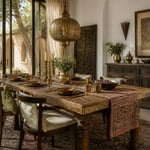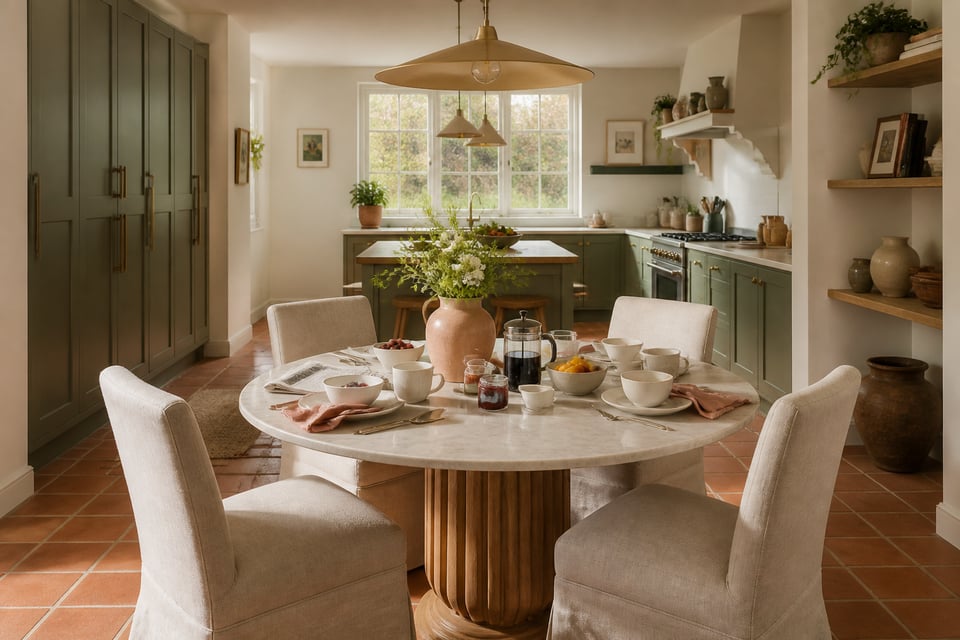
The kitchen table is the most honest piece of furniture in your home. Unlike a sofa buried under throws or a sideboard dressed with artful arrangements, a table simply sits there — used, touched, gathered around — and the choices you made when selecting it become unavoidably visible every single day. After working with kitchens from London terraces to open-plan family spaces, I’ve become genuinely convinced that kitchen table ideas deserve far more attention than they typically receive. Most people spend longer choosing a worktop than they do their dining table, and then wonder why the room never quite coheres.
What follows are 17 kitchen table ideas that reflect the full range of what’s possible — from investment-grade marble pedestals to wall-mounted foldables that disappear when not needed. Some are statement pieces. Others are practical transformations of tired furniture. All are chosen because they make a real difference to how a kitchen feels to live in.
1. Marble-Top Pedestal Table for an Effortlessly Elegant Kitchen
There is something almost unfair about marble’s visual effect on a kitchen. A single round pedestal table in white Carrara or warm Emperador brown does more for the room’s apparent sophistication than any amount of backsplash tiling or cabinet hardware. The material is a genuinely ancient choice — its cultural weight is legitimate, not borrowed.
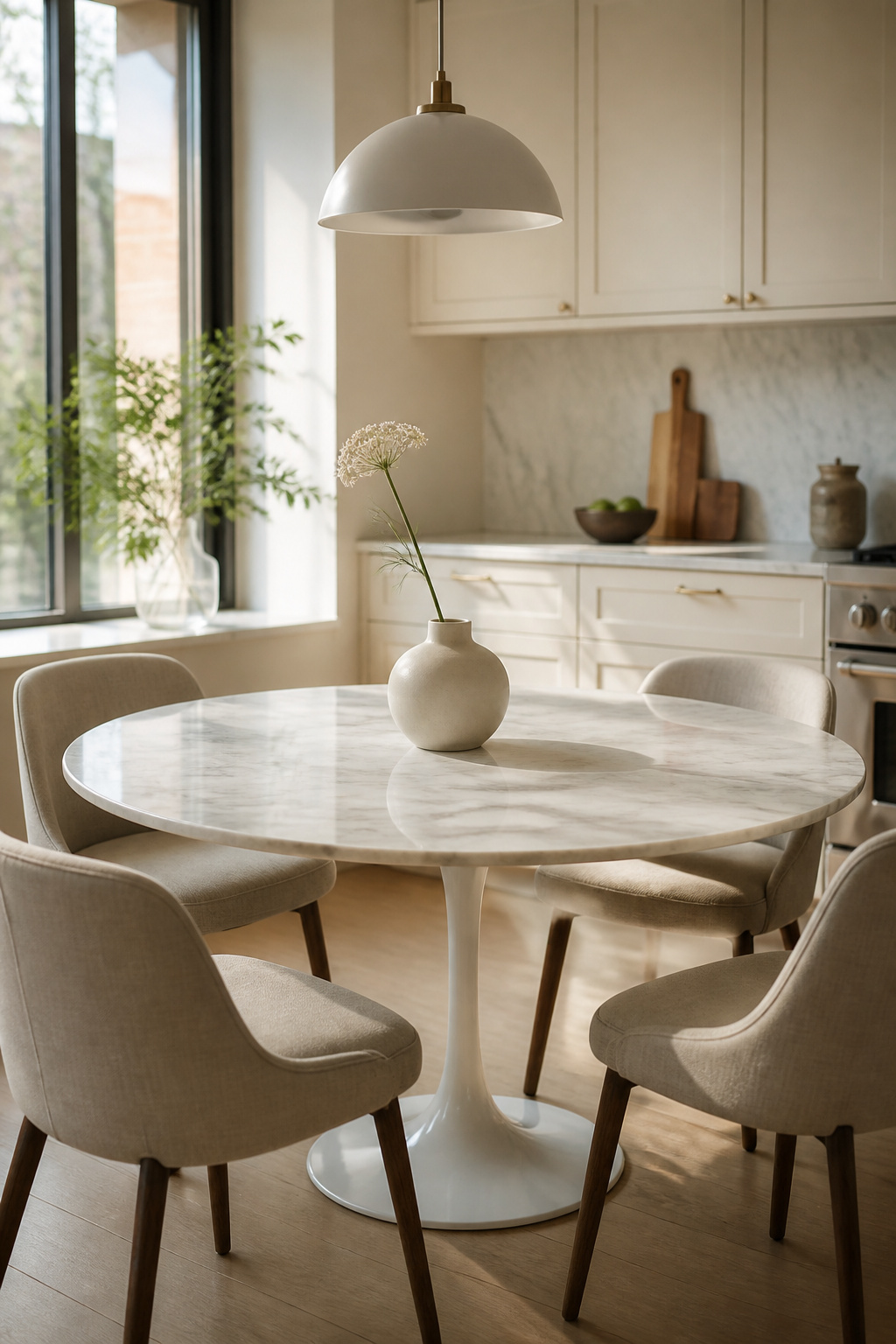
The pedestal base earns its place here for practical reasons too. Because there are no corner legs to navigate around, chairs tuck in from every angle — a 48-inch marble pedestal comfortably seats five where a four-leg table of the same diameter seats four. The tulip-style pedestal, popularised by Eero Saarinen in 1956, remains the cleanest silhouette for contemporary kitchens; a fluted mango-wood column adds warmth for those who find pure minimalism cold.
Seal the surface with a penetrating stone sealer before first use and reapply every 12-18 months; wipe wine, citrus, and coffee immediately. If the maintenance commitment gives you pause, sintered stone composites offer near-identical aesthetics with dramatically better resistance to staining, at roughly 30-40% lower cost. For inspiring ways to dress the surface, kitchen table centerpiece ideas are worth exploring before your table arrives.
Pro Tip
Avoid buying marble without confirming it’s been sealed at the factory — many aren’t, and etching begins immediately on contact with citrus or wine.
2. Kitchen Table Idea: Artisan Carved Wood for Warmth and Character
If you’ve ever put your hand on a mass-produced dining table and then on a piece of hand-carved sheesham, you understand why one commands ten times the price. The difference isn’t primarily visual — it’s tactile. The carved surface has texture, warmth, and the unmistakable quality of something that took hours of human attention to make.
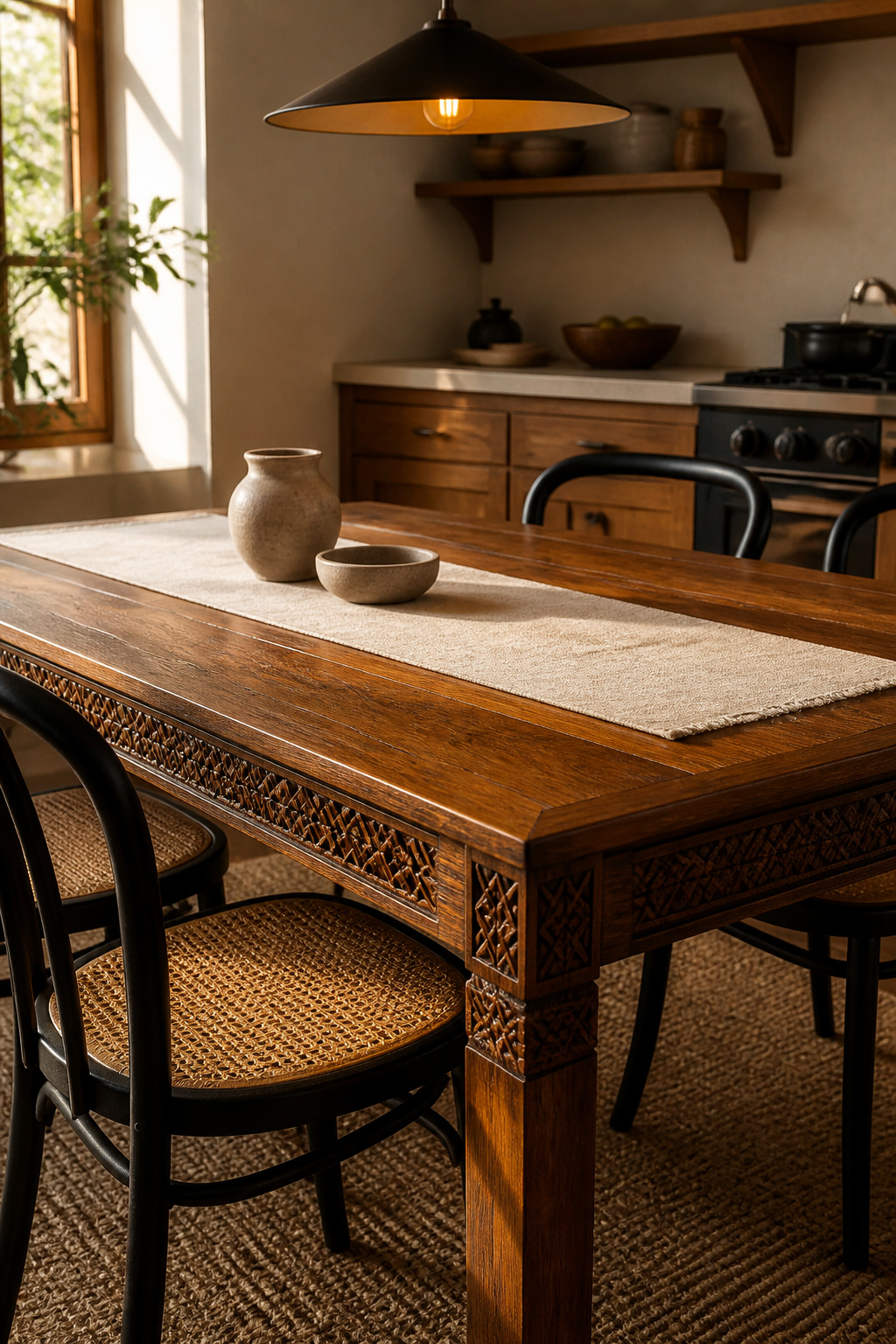
Sheesham (Dalbergia sissoo, Indian rosewood) has a Janka hardness rating of around 1660 lbf — harder than American black walnut — with natural oils that resist moisture and warping without heavy chemical treatment. Artisan makers in Rajasthan hand-chisel geometric and floral relief patterns directly into the wood surface, a process taking 8-12 hours per table. Each piece is individually hand-joined, which means the graining and colour distribution are genuinely unique.
Styling these tables requires restraint. The carved surface already has pattern; patterned placemats or a busy runner fight with the grain. Simple linen in a solid warm neutral, plain ceramic, and chairs in matte black metal or natural rattan let the wood be the room’s singular statement. Avoid polyurethane varnish — it seals the oils that give sheesham its natural protection and coats everything in a plastic sheen that kills the warmth. A hard wax oil finish (Osmo and Rubio Monocoat are the benchmark products) keeps the surface tactile and repairable.
3. Extendable Dining Table That Grows With Your Gathering
The extendable dining table has a reputation problem. Many people associate it with a slightly awkward process — clearing the surface, finding storage for the separate leaf, realigning everything — that makes spontaneous entertaining feel effortful. The butterfly leaf mechanism solves this entirely. The stored leaf folds inside the table body and unfolds as the two halves pull apart. One person, no cupboard, ten seconds.
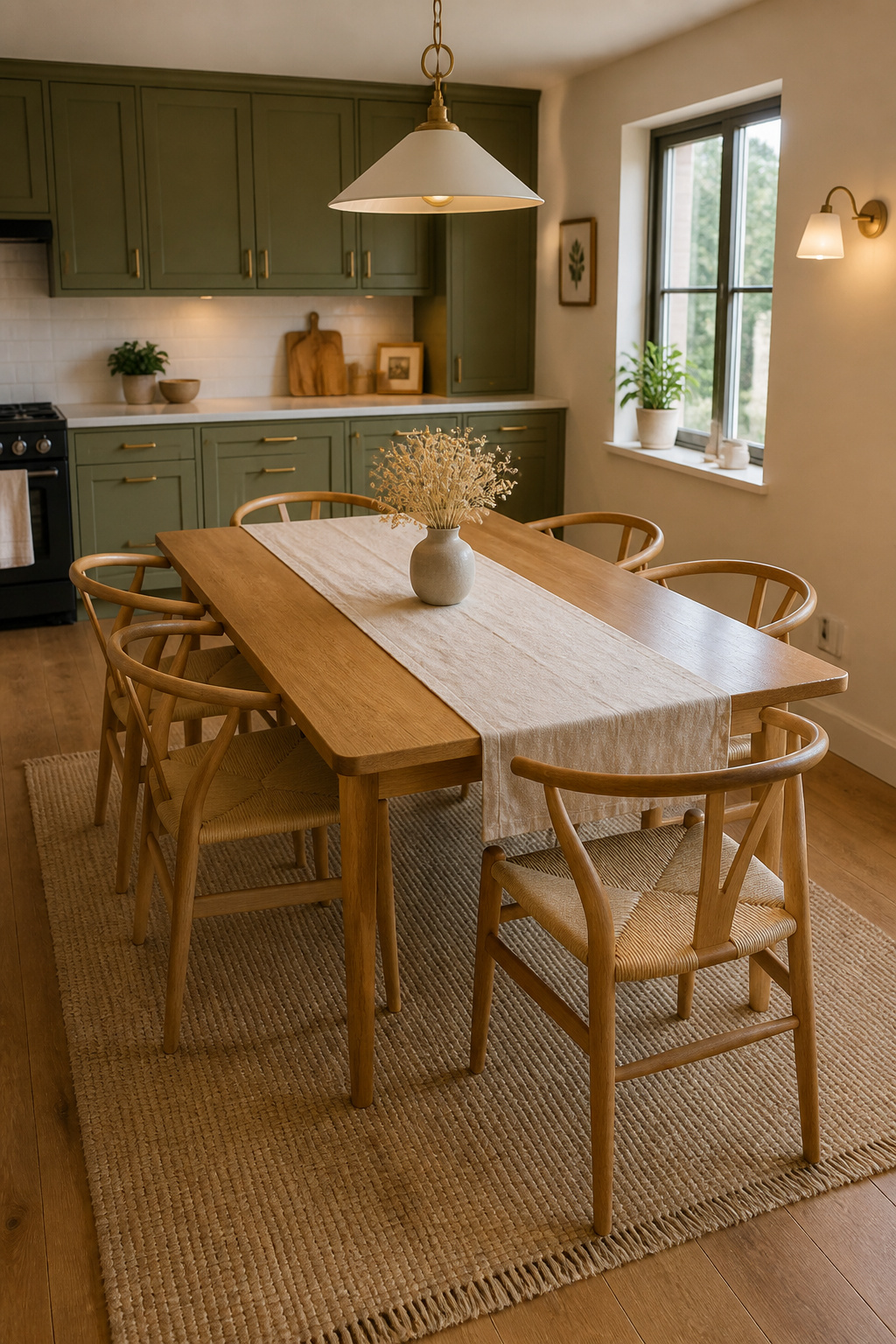
For kitchen placements, a butterfly-leaf table in solid oak or walnut is the most sensible investment. The mechanism requires consistent material thickness across both the table and leaf, and solid hardwood maintains that consistency through seasonal humidity changes in a way that veneer over MDF simply cannot over years of use. The powder-coated steel frame is the most durable base choice — it resists the twisting forces that extension puts on the structure.
The styling consideration most people overlook: a table that looks proportional in both its retracted and extended states. Some extendable tables look too thin when closed — aim for a width-to-length ratio of at least 1:2 in the shorter configuration. A central pedestal base handles this better than four legs, which can look oddly wide-spaced when fully extended.
4. Industrial Steel-and-Wood Kitchen Table for Urban Kitchens
In a city kitchen with exposed brick, concrete floors, and high ceilings, a farmhouse pine table looks entirely wrong. The industrial steel-and-wood table belongs here — its visual language was literally built for these spaces. The design works because it plays opposing qualities against each other: the precision of matte black powder-coated steel against the irregularity of timber, cold grey against warm brown.
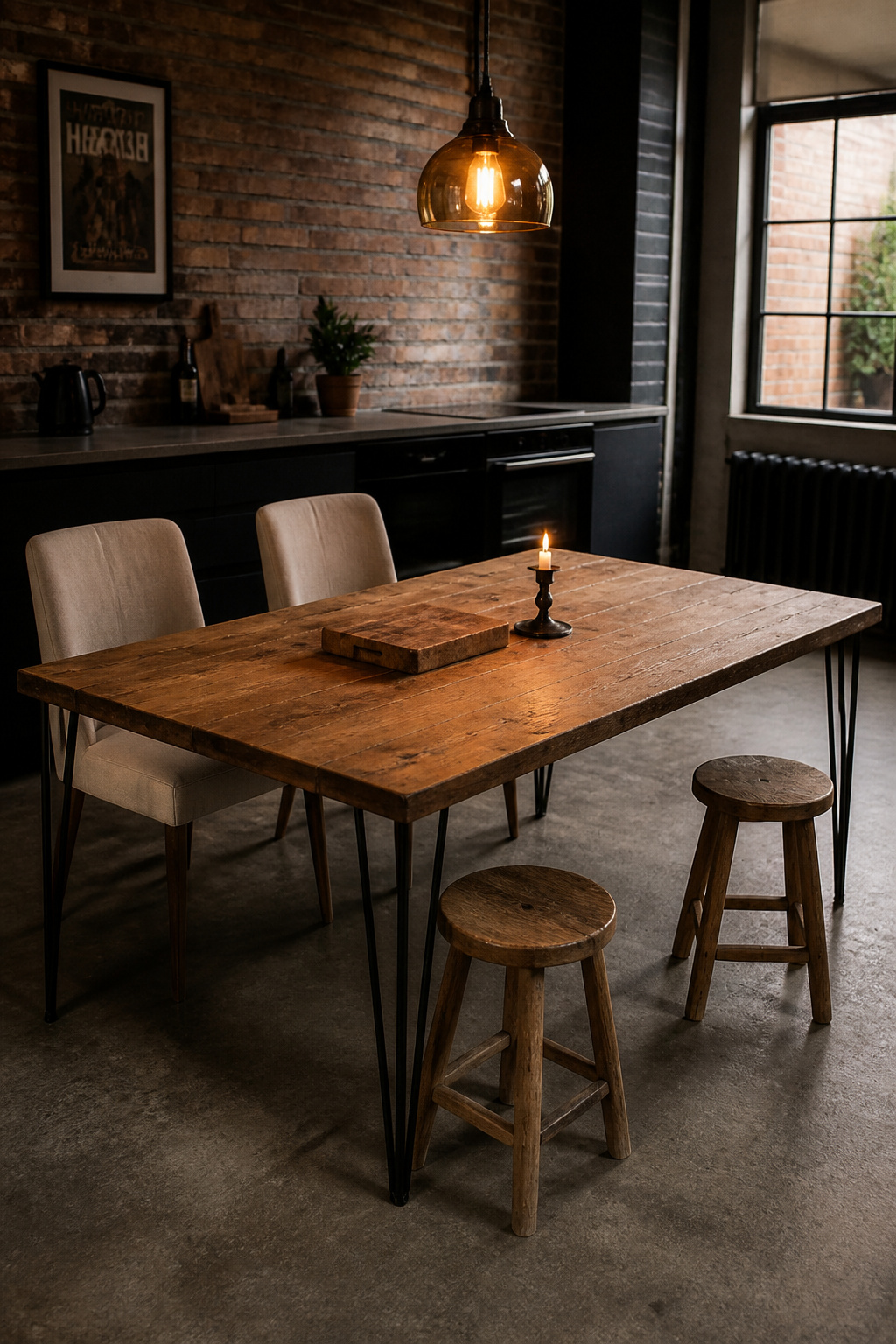
Powder coating outperforms painted finishes in durability — applied electrostatically and cured under heat, it resists chips and scratches at a level that brush-on paint cannot approach. Reclaimed timber tops add something new oak cannot replicate: the patina of previous use, marks that tell a history. If commissioning, ensure the timber top is attached with a floating mechanism for wide solid slabs — wood expands and contracts seasonally, and rigid attachment to steel causes cracking in boards over about 10 inches wide.
The single most common mistake is the chairs. A full set of steel-frame chairs with a steel-frame table produces a hospital canteen rather than a considered urban kitchen. The material contrast that makes the table work also requires contrast in the chairs: upholstered seats in linen or natural weave, warm-toned pendant lighting (2700K bulbs), and a natural fibre rug beneath the dining area to add the softness that the steel frame cannot provide.
5. Japandi Kitchen Table Ideas: Minimalist Form, Maximum Warmth
Japandi is not a passing aesthetic. What began as a social media collision of Japanese wabi-sabi and Scandinavian hygge has matured, by 2026, into a coherent design philosophy with its own material vocabulary, proportional rules, and genuine craft tradition. Japandi kitchen table ideas are perhaps its most eloquent expression — pieces where every decision (species, joint, finish, proportion) is deliberate and nothing is decorative.
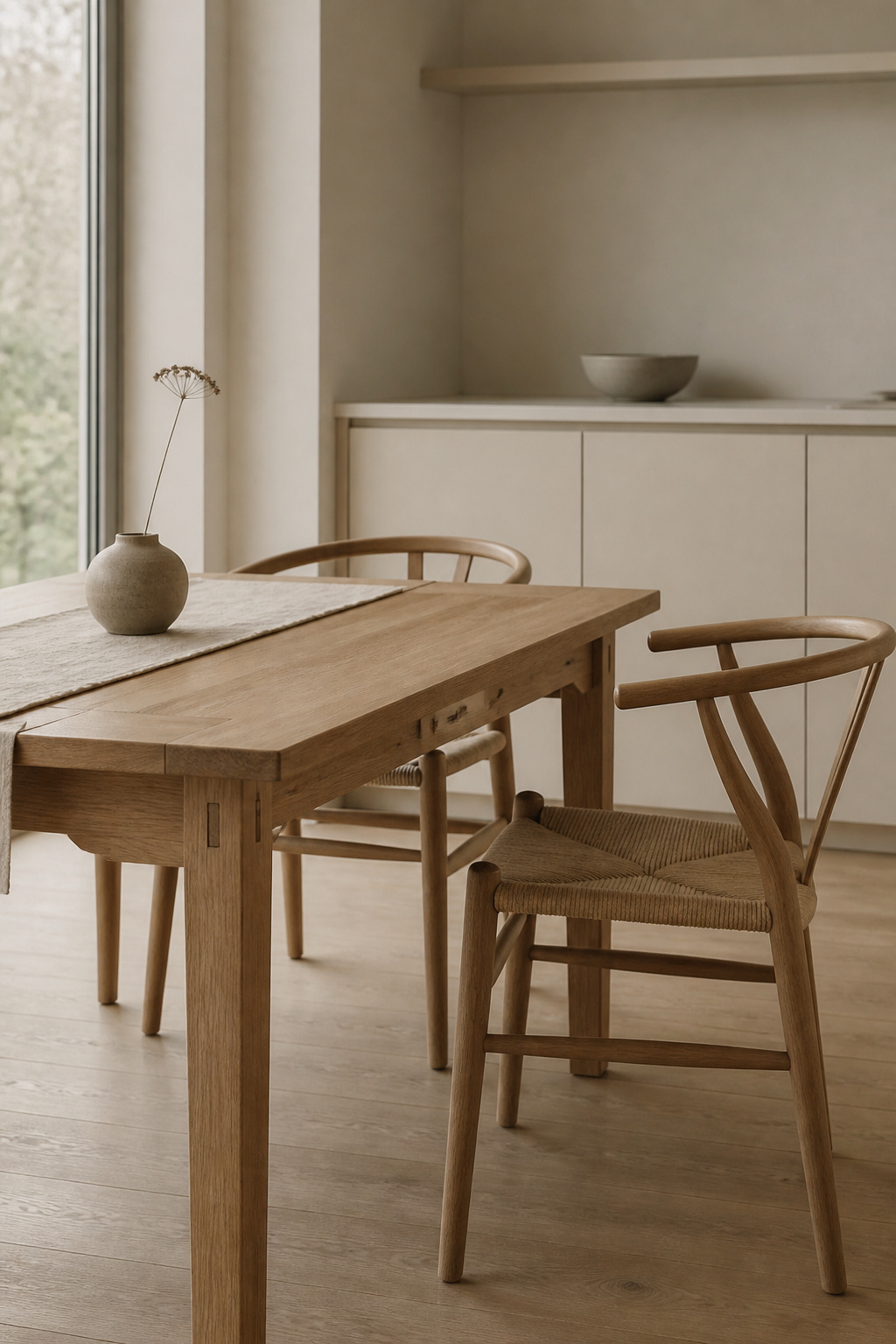
The philosophy centres on “functional tranquility”: furniture that is beautiful because it works perfectly, not despite it. In kitchen table terms, this means slimmer profiles (tops 25-35mm thick rather than the chunky 40-50mm of farmhouse styles), matte oil or wax finishes that let the surface feel like wood rather than glass, and visible joinery — mortise-and-tenon joints, finger joints — as design features rather than engineering concealed beneath a surface. The ultimate expression is Kigumi, traditional Japanese woodworking where precisely interlocking joints hold the furniture together without a single nail or screw. For those drawn to the broader Japandi aesthetic throughout the kitchen, minimalist kitchen ideas provide useful context for how the table fits within a larger approach.
Species choice shapes the mood entirely. Oak and ash are the Nordic contribution — strong, neutral-toned, warm. Walnut is richer, more Japanese in character. Accessorise with discipline: a single ceramic vase, a linen runner, perhaps one small sculptural object. Japandi is genuinely hostile to accumulation, and a surface crowded with objects misses the point entirely.
6. Drop-Leaf Table for Small Kitchens That Need Double Duty
A good drop-leaf table is the small kitchen’s most practical kitchen table idea. Folded down, it takes up 14-22 inches of floor depth — barely wider than a console table. Both leaves raised, it seats four adults comfortably. In a studio flat or galley kitchen where every square foot matters, this difference is effectively the difference between having a kitchen and having a dining room.
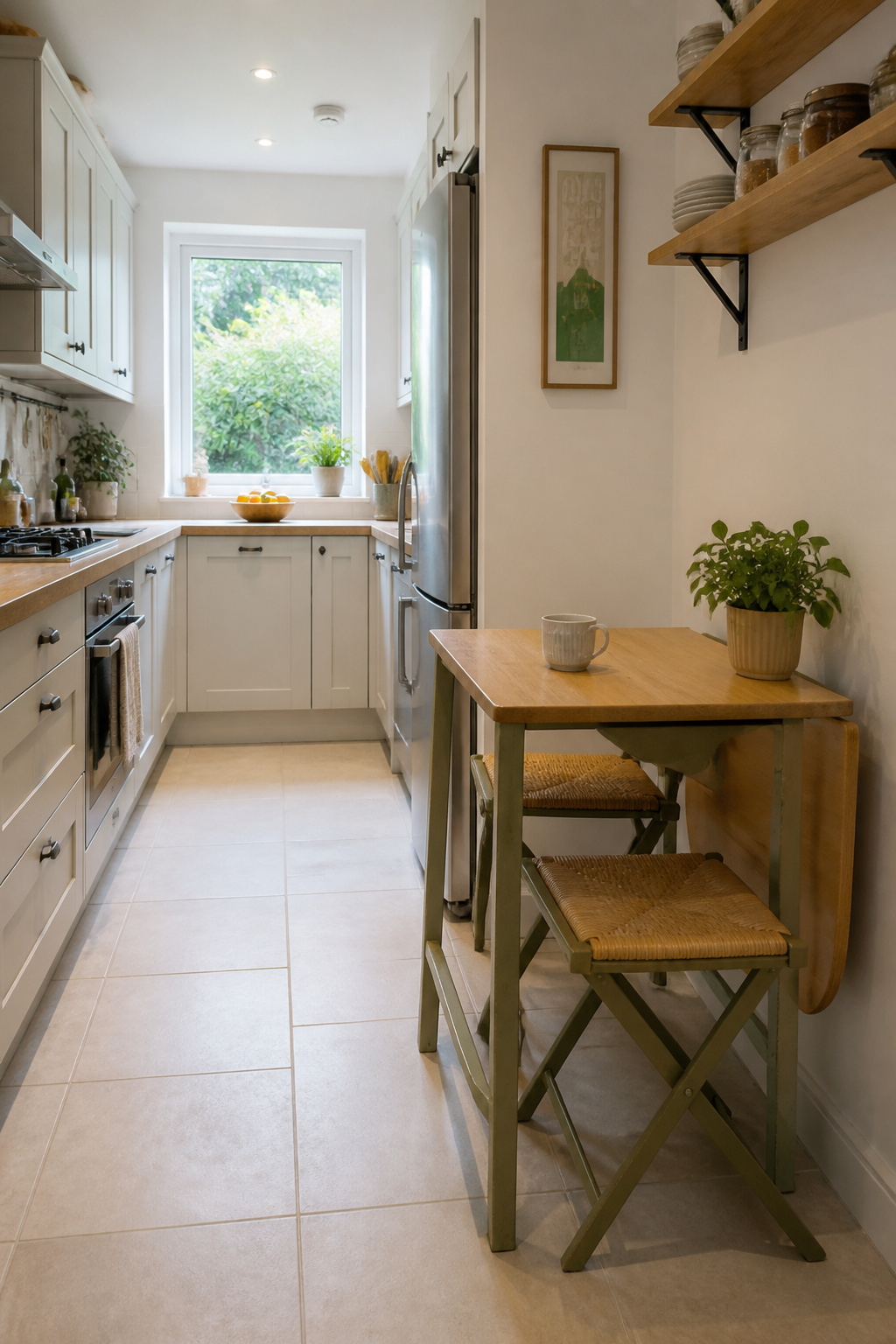
The gate-leg variant is worth seeking out for regular use — the support swings out from beneath on a pivot, providing more stability than simple folding brackets. The measurement most buyers overlook is the leaf swing radius. When the leaf moves from vertical to horizontal, it sweeps through an arc requiring 8-10 inches of clear space from any wall. If the table is stored 6 inches from a wall, every use will scuff it. Plan the permanent position before buying and leave that clearance deliberately.
In its folded state, treat the surface as a deliberate vignette: a small plant, a ceramic bowl, a book. The table should look intentional in both modes — the space-saving kitchen table ideas that work best are the ones that look considered even when not in use.
7. Live Edge Slab Table as the Kitchen’s Statement Centerpiece
A live edge dining table preserves what every other woodworking tradition removes: the natural outer profile of the tree — the bark line, the undulating curves, the voids and inclusions that straight-cut timber discards as imperfection. Each slab is a direct record of a specific tree’s growth history. No two are alike in any meaningful sense.
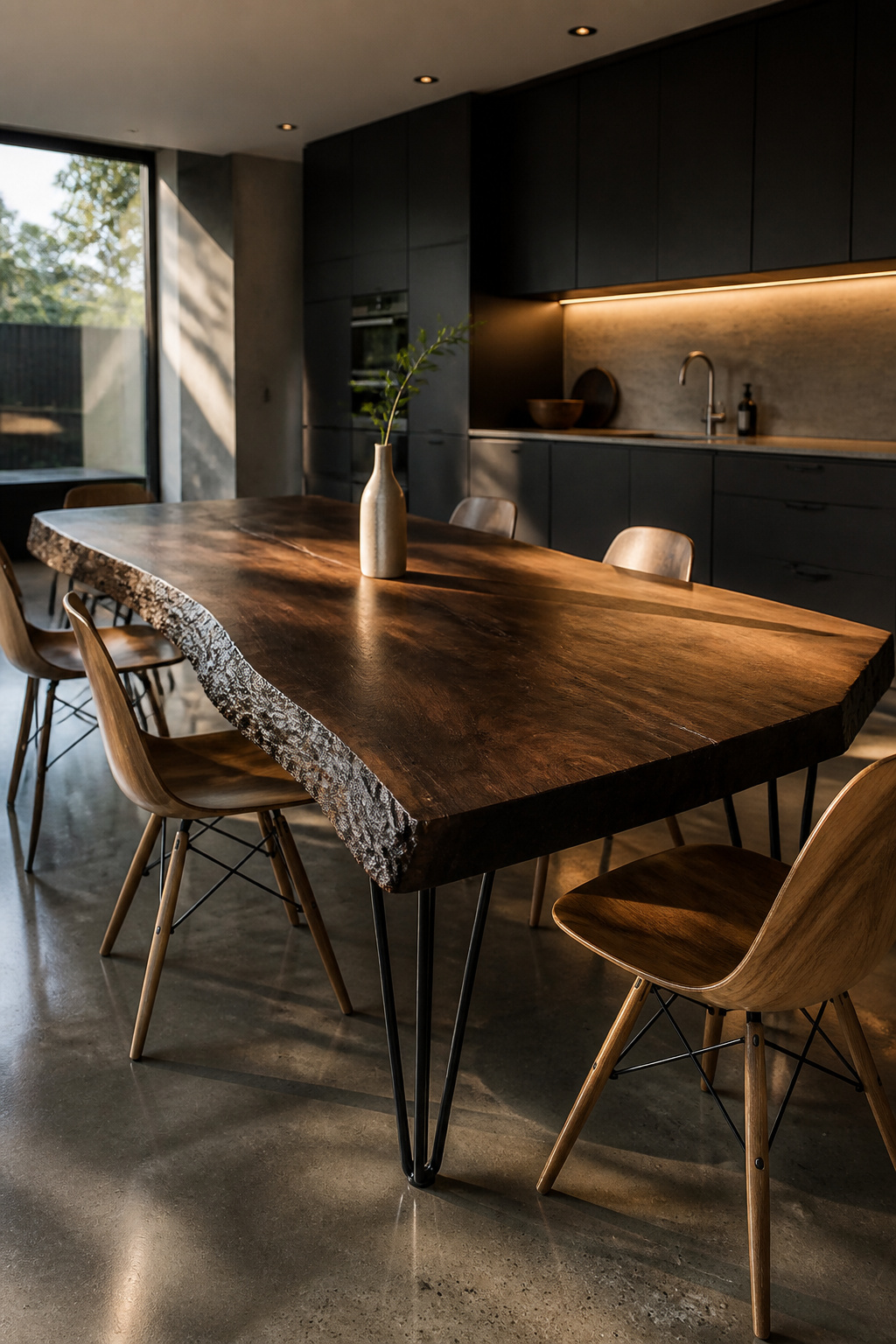
American black walnut is the species most sought after for kitchen table ideas of this kind: rich chocolate-brown with purple undertones, dramatic figure patterns, and a Janka hardness of 1010 lbf that combines usability with genuine longevity. Maple offers the opposite character — creamy white to light tan, subtle grain, the quiet Scandinavian option for pale-cabinetted kitchens. Natural voids and cracks in the slab are typically filled with clear epoxy resin; clear fills that preserve the organic edge work better than the dramatically coloured river aesthetic of a few years ago.
The ‘hiking lodge’ failure mode is worth naming directly. It happens when a live edge table is surrounded by other rustic elements — knotty pine cabinets, antler pendants, exposed stone walls. The solution is contrast: live edge slab on slim hairpin legs in blackened steel, in a kitchen with flat-front cabinetry and a single architectural pendant fitting. One organic element anchoring a contemporary room — that’s the correct ratio.
8. Kitchen Table Idea: Mix Materials for a Modern-Meets-Artisan Look
The dominant direction in kitchen dining furniture for 2026 is material contrast — not matching sets, not tonal uniformity, but the considered collision of two materials that each reveal what the other lacks. A marble top that would feel cold in isolation, warm and anchored on a brass geometric base. A raw walnut top that might read as too rustic in isolation, immediately contemporary on a powder-coated steel frame.
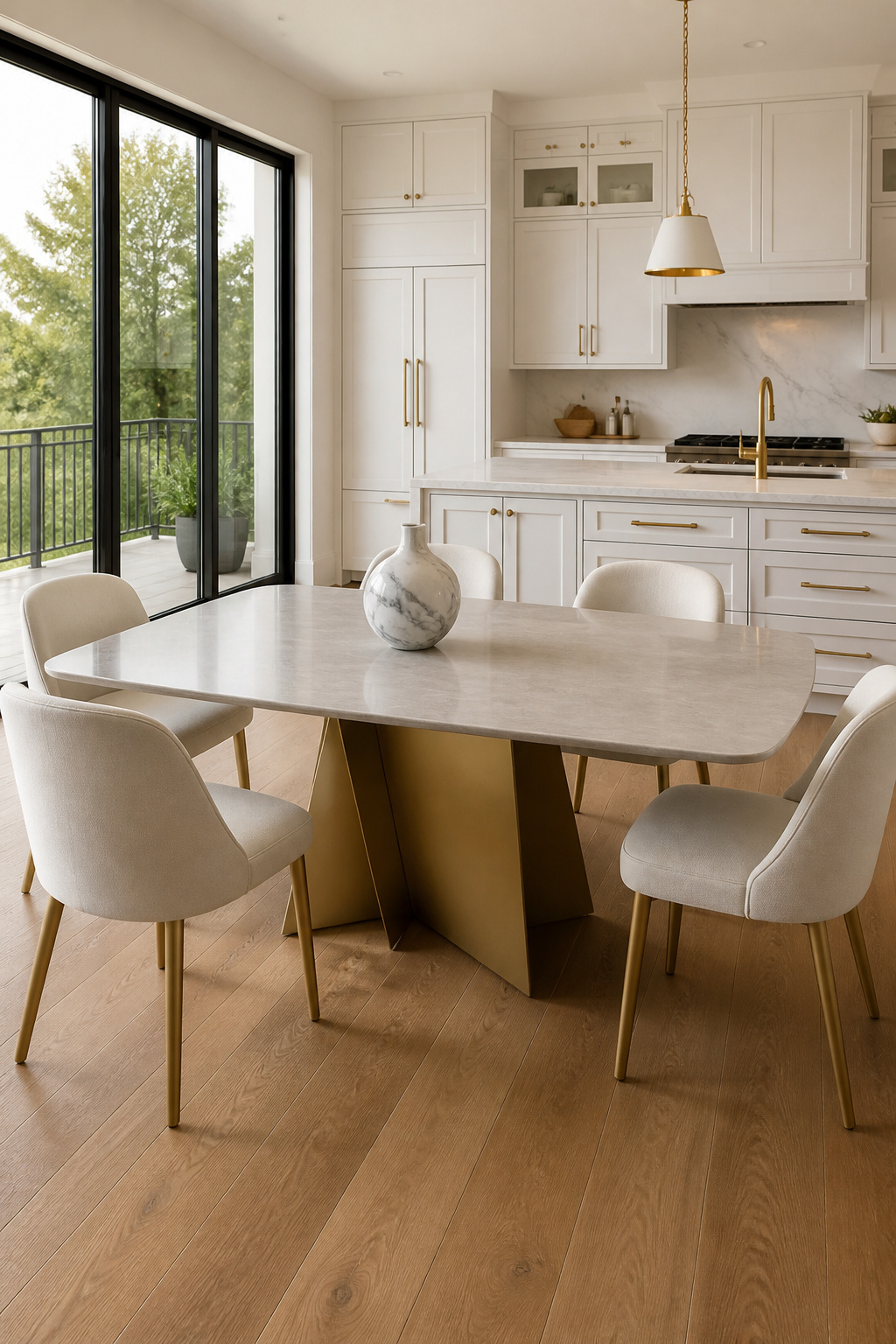
The principle governing these combinations is simple: pair materials that are visually opposite. Warm against cool. Rough against smooth. Matte against reflective. Proportion matters too — if the top is dramatically textured (stone, live edge, terracotta tile), the base should be quieter. The most credible combinations of the moment: stone top with brass-toned steel base; solid oak or walnut top with rattan-wrapped legs; terrazzo surface with matte black steel frame. The rattan-wrapped leg is the freshest — natural material applied at the exact visual level where it creates texture without adding bulk. For understanding how material choices work across the entire kitchen, modern kitchen materials and surfaces provides excellent context for making decisions that cohere across worktop, cabinetry, and furniture.
Limit to two hero materials per table. Three or more usually produces complexity that reads as indecision rather than richness.
9. Glass-Top Dining Table to Keep Tight Kitchens Feeling Open
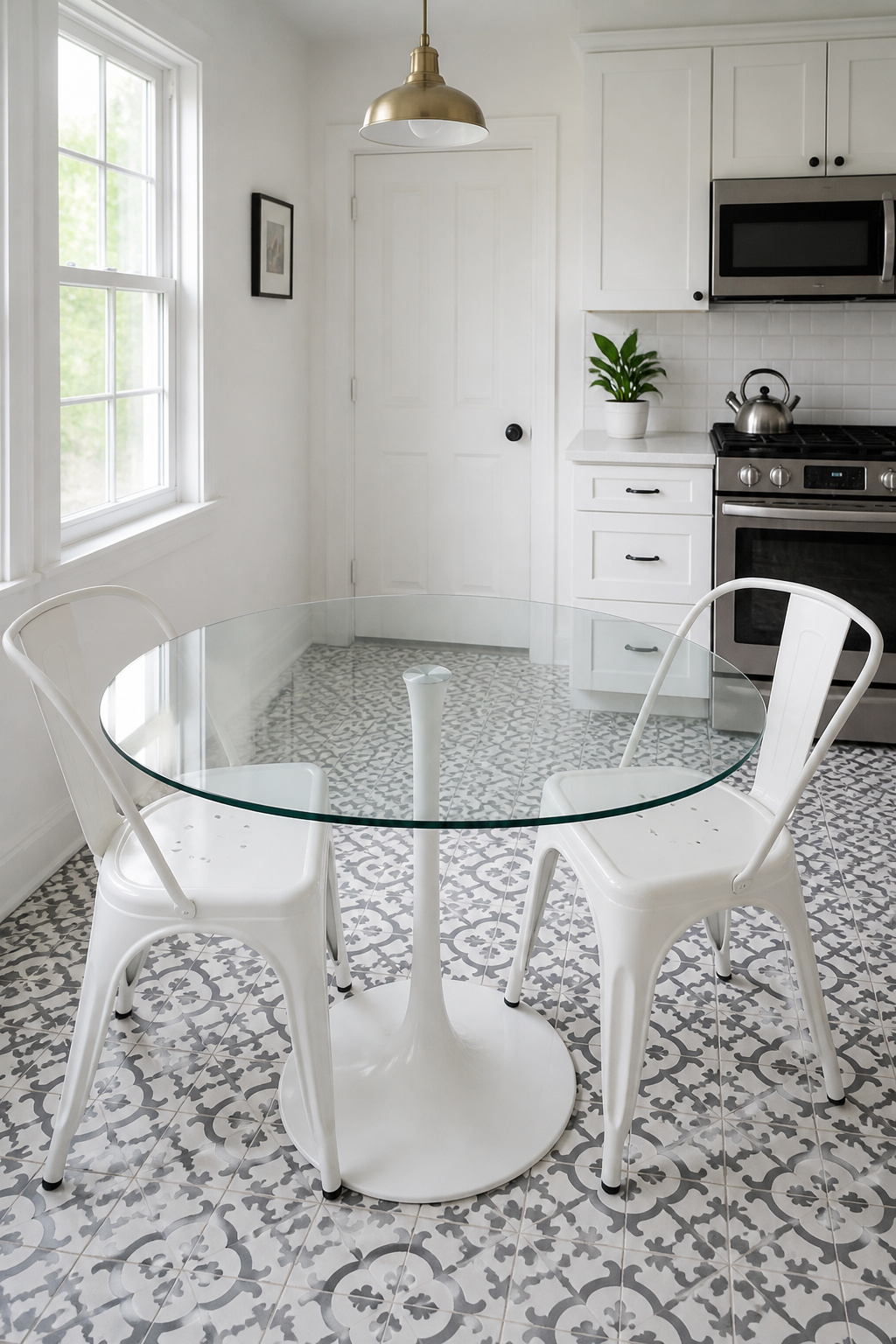
A solid table top creates a horizontal visual barrier. The eye reads it as an obstacle, a surface that stops the room from continuing. Glass eliminates this — the floor pattern below remains visible, the room reads as deeper and wider, and light reflects upward rather than being absorbed. In a kitchen under 150 square feet, the perceptual difference is significant.
Why Glass Works
The effect is strongest over interesting flooring: original parquet, encaustic tile, or a patterned rug that would otherwise be entirely obscured. If the floor is plain concrete or a single-tone tile, the transparency advantage is reduced — something to consider before choosing glass. Pairing the glass table with attention to small dining room paint colours that expand space doubles the optical effect without structural changes.
Tempered glass is the only appropriate choice. For standard dining table use, 3/8 inch (10mm) is the industry benchmark — strong enough for everyday use, light enough not to stress a typical base. Tables wider than 60 inches should use 1/2 inch (12mm). Edge profile affects perceived quality: a polished flat edge reads as contemporary; pencil-ground (slight rounding) is the most practical as it resists chipping.
For base choice, a single pedestal under a glass top is the most space-amplifying combination. The single point of floor contact preserves maximum floor visibility, and the Saarinen tulip reference remains the most visually refined interpretation. Avoid X-frames or trestle bases — the structural members become the visual focus and defeat the transparency advantage entirely.
10. South Asian-Inspired Table with Brass Inlay and Rich Tones
The brass inlay technique practiced in Jaipur, Rajasthan, dates to the Mughal period and has never really fallen out of production — it simply became invisible to Western interiors for several decades before renewed global interest in craft and provenance brought it back into view. This kitchen table idea speaks directly to that appetite for meaning-rich furniture.
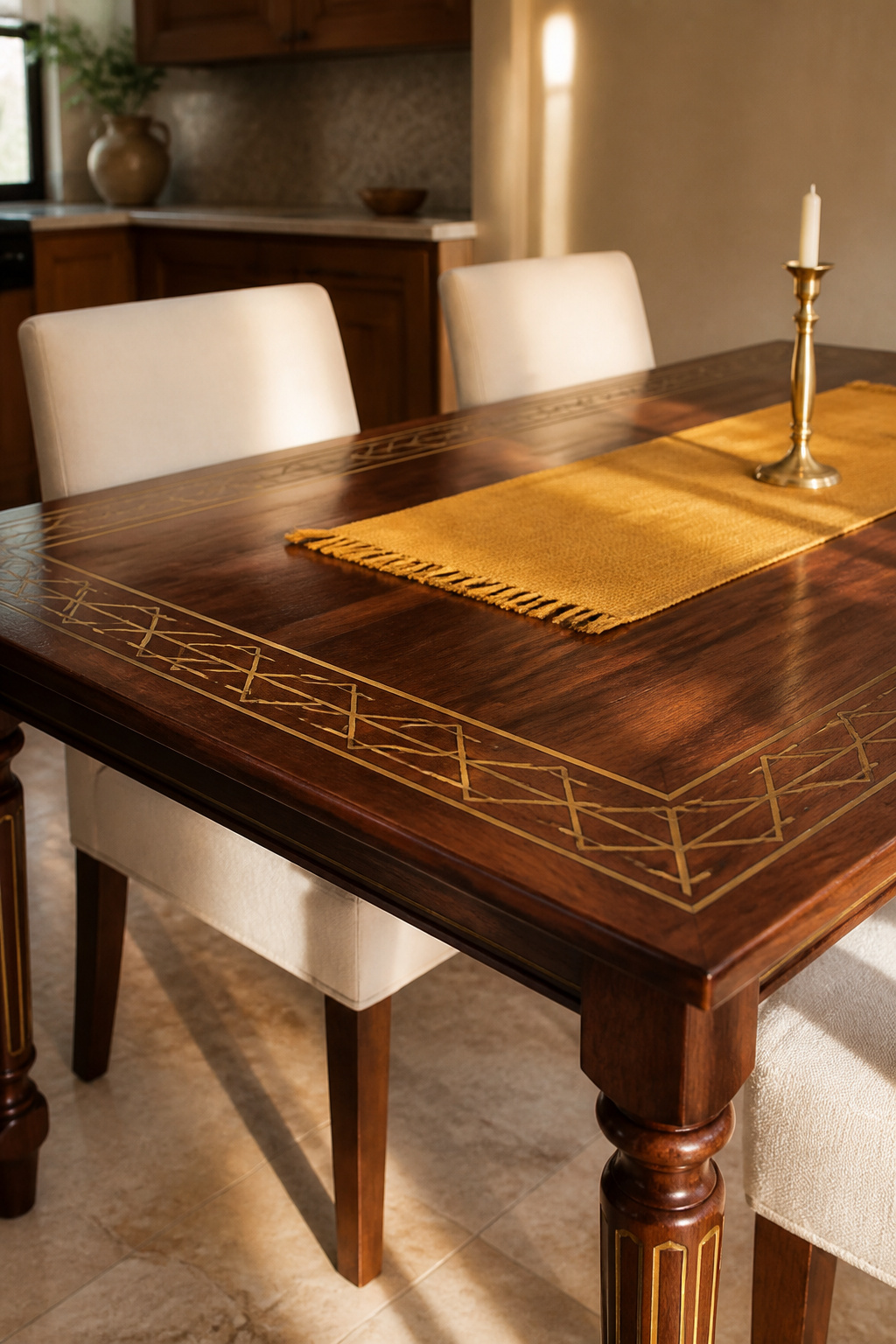
The process is called tarkashi: thin brass wire hammered into channels carved into the wood surface, creating a pattern that cannot be replicated by printed or applied decoration. Quality inlay is flush with the surface — run a fingernail across it. Raised brass will catch table linen and lift over years of use. Sheesham is the preferred base wood; its higher density holds the carved channels more precisely than mango.
Contemporary interpretations simplify the design vocabulary: a single geometric border around a clean tabletop rather than all-over coverage. The surrounding room needs corresponding quiet — neutral cabinet fronts, plain tile or stone, simple chairs in linen or natural cotton. Jaipur pieces “blend most easily into contemporary interiors” precisely because the inlay adds craftsmanship without demanding a specific aesthetic around it.
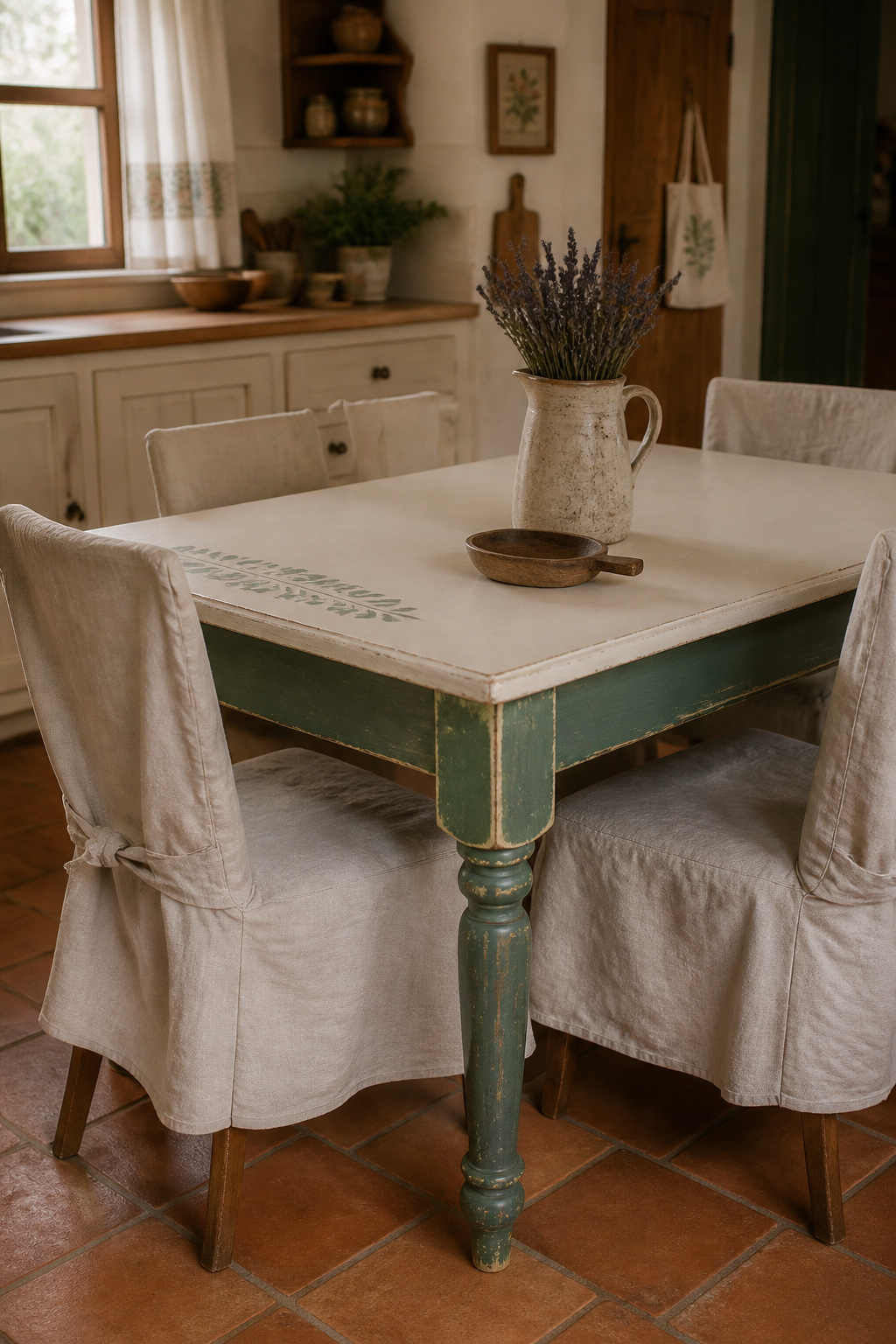
11. Painted Farmhouse Kitchen Table with Pattern and Personality
The painted kitchen table is one of the better-kept secrets of interior design on a real budget. The starting material costs almost nothing — a solid wood table from a charity shop or salvage yard, typically 1950s-1970s, with proportions no current manufacturer seems to produce. The transformation requires one afternoon and roughly £50 in paint and materials.
Choosing the Right Paint
Chalk paint (Annie Sloan, Rust-Oleum Chalked) adheres to most surfaces without sanding or priming, producing a genuinely beautiful matte finish. Two coats give full coverage with a soft, aged quality; three for a crisper result. The single non-negotiable: the topcoat. Chalk paint is porous and will absorb grease, wine, and moisture within weeks without protection. Two coats of hard wax oil or water-based varnish over all painted surfaces — minimum on the tabletop — is what separates a finish that lasts years from one that looks tired within months.
Colour-blocking the legs is the simplest approach with the biggest return. The tabletop in off-white, the legs and apron in terracotta or forest green reads as designed rather than painted. Distress the edges with 120-grit sandpaper after the final coat — these are the surfaces that would naturally wear first — and the ageing looks honest rather than forced.
12. Kitchen Table Ideas with Bench Seating for Relaxed Gatherings
Bench seating does something that chairs cannot replicate: it makes the act of gathering physically easier. You slide along, make room, pull someone in. There is no moment of the chairs being wrong, the spacing awkward, the table too full to seat one more. Among the kitchen table ideas in this list, the bench configuration changes the social dynamic of eating at home most profoundly.
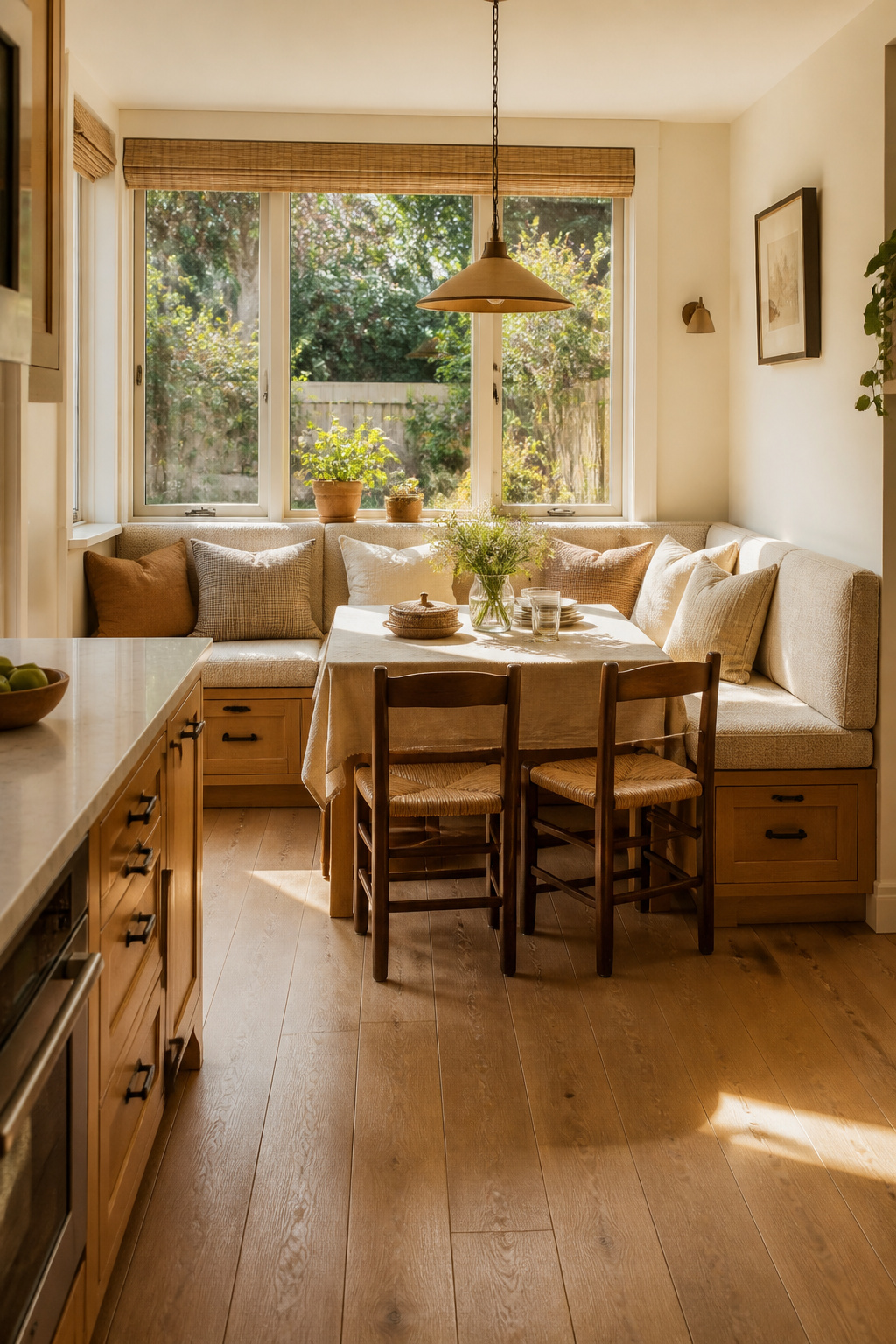
The ergonomic standards matter and are often ignored. Seat height: 18 inches from floor to top of cushion. Seat depth: 17-20 inches for dining specifically — allows sitting close enough to the table without leaning forward awkwardly. Width: a minimum of 24 inches per person. A backrest of 16-20 inches above the seat, angled at 5-10 degrees, is the difference between a bench comfortable for a quick breakfast and one that works for a two-hour Sunday lunch.
The corner banquette in a kitchen bay window is, in my view, one of the highest-value design interventions available at any budget. Natural light, a view, storage beneath the seat, and seating for six in the footprint of a four-person table. For mixed bench-and-chair configurations, dining room chairs and bench seating options cover the pairing logic in useful detail.
13. Rattan and Cane Table for Organic Texture in Your Kitchen
This kitchen table idea has the longest cultural history of any on this list. Rattan furniture has been woven and shaped across Southeast Asia for centuries, and its return to contemporary kitchens is not merely a trend — it is a rediscovery of a material that is genuinely excellent at what it does.
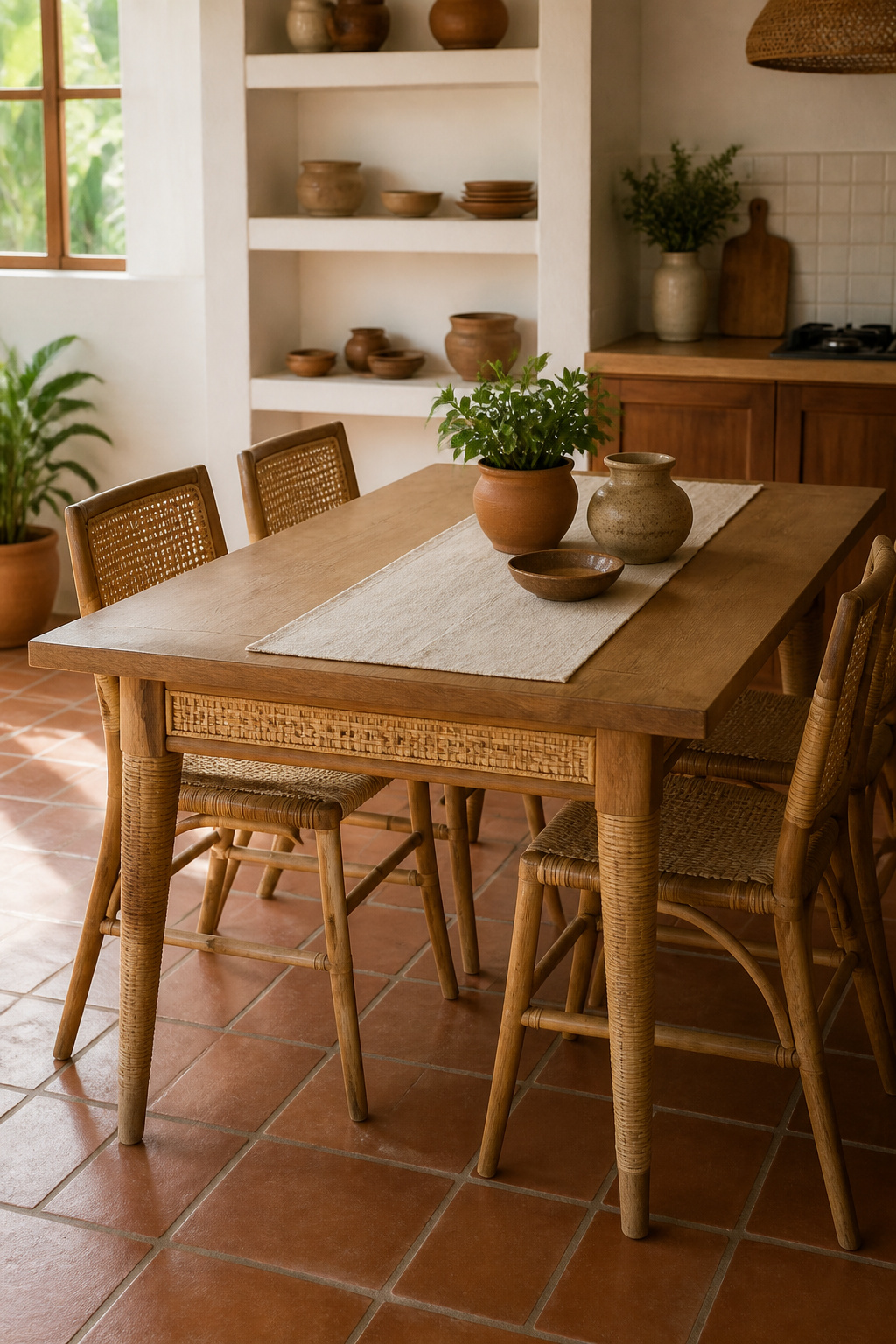
Rattan is the structural vine; cane is the split outer skin. For dining tables, the most durable contemporary option is a solid wood or metal frame with cane panel inlay on the apron or a lower shelf. This limits the cane’s exposure to kitchen humidity — the primary risk — while delivering the natural material texture where it reads most clearly. Full rattan-frame tables are beautiful but better suited to spaces without significant steam exposure; a permanent position near a hob or kettle dries out cane faster and can cause cracking.
Flat-weave cane on a matte black metal frame is the freshest 2026 interpretation — natural material against industrial metal at a price point that doesn’t require the investment of a full artisan piece. Care is straightforward: a barely damp cloth for cleaning, a soft brush for the weave crevices, and an annual treatment of light linseed oil to maintain the cane’s flexibility through dry winter interiors.
14. Colour-Blocked Kitchen Table for a Bold, Playful Statement
Kitchen furniture has spent approximately thirty years in a neutral holding pattern — oak, white, grey, repeat. The colour-blocked table is the most accessible exit. It requires no architectural intervention, no new cabinetry, no budget beyond a few tins of paint. And because the colour is contained to the furniture rather than the walls or cabinets, it remains reversible in an afternoon.
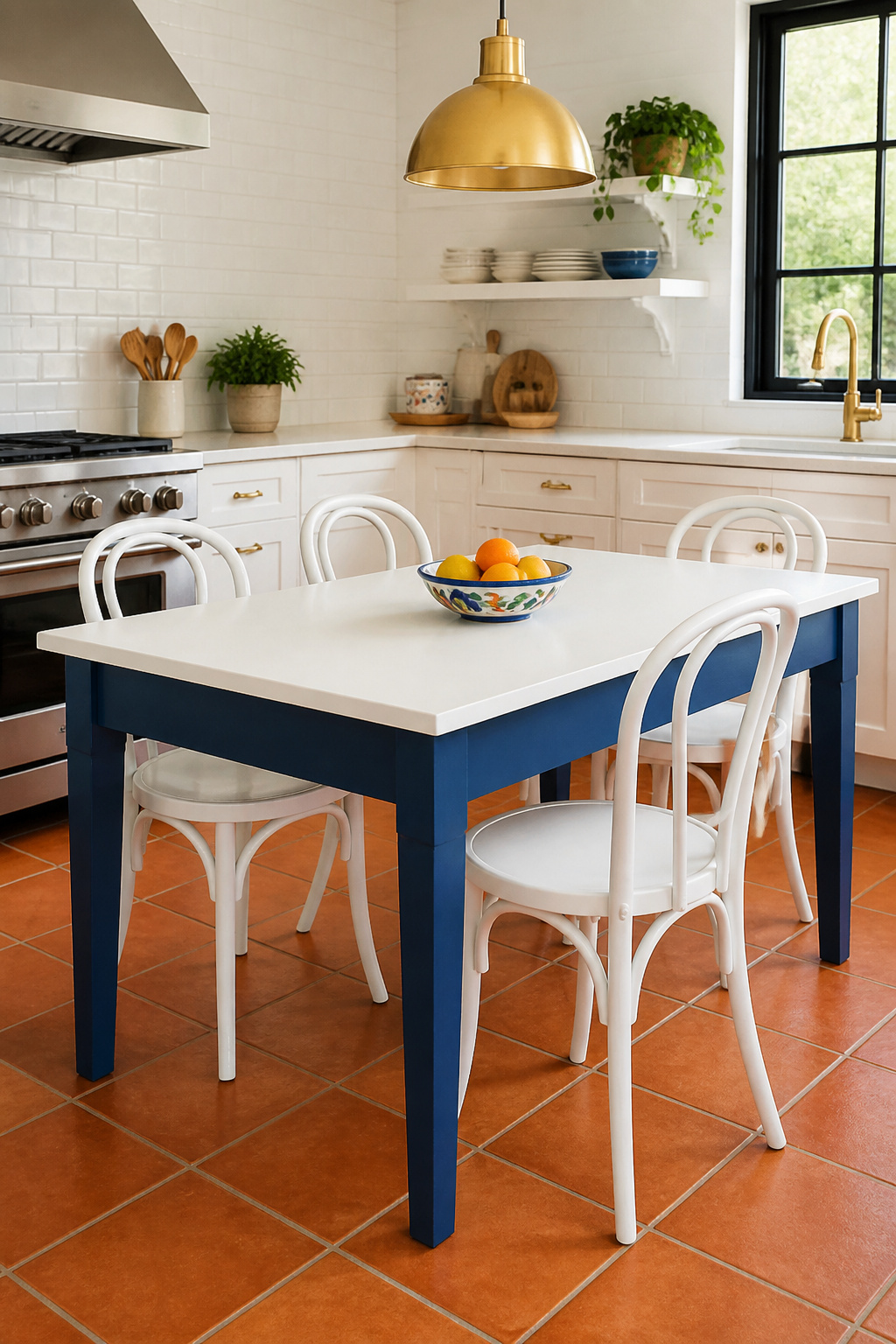
The three zones of a standard kitchen table are the top, the apron (the horizontal band between top and legs), and the legs. The most graphic approach: top in off-white or natural wood, apron and legs in a single bold colour. Forest green, terracotta, and cobalt blue are the most established choices for 2026 kitchen furniture — all three pair naturally with brass hardware that has become near-universal in contemporary kitchens. Apply masking tape firmly along the colour transition line; peel while the final coat is still slightly tacky, not after it has fully dried, which tears the edge. Seal with hard wax oil or varnish. For kitchen table ideas that sit alongside other considered furniture choices, luxury kitchen furniture ideas provides useful context for the full approach.
15. Kitchen Table Idea for Tiny Spaces: Wall-Mounted Foldable Designs
There is a class of living situation — the studio flat, the galley kitchen, the home where a dining table would take up more floor than can be spared daily — for which the wall-mounted fold-down table is the correct answer rather than a compromise. When folded, it exists as a panel against the wall. When needed, it becomes a full dining surface.
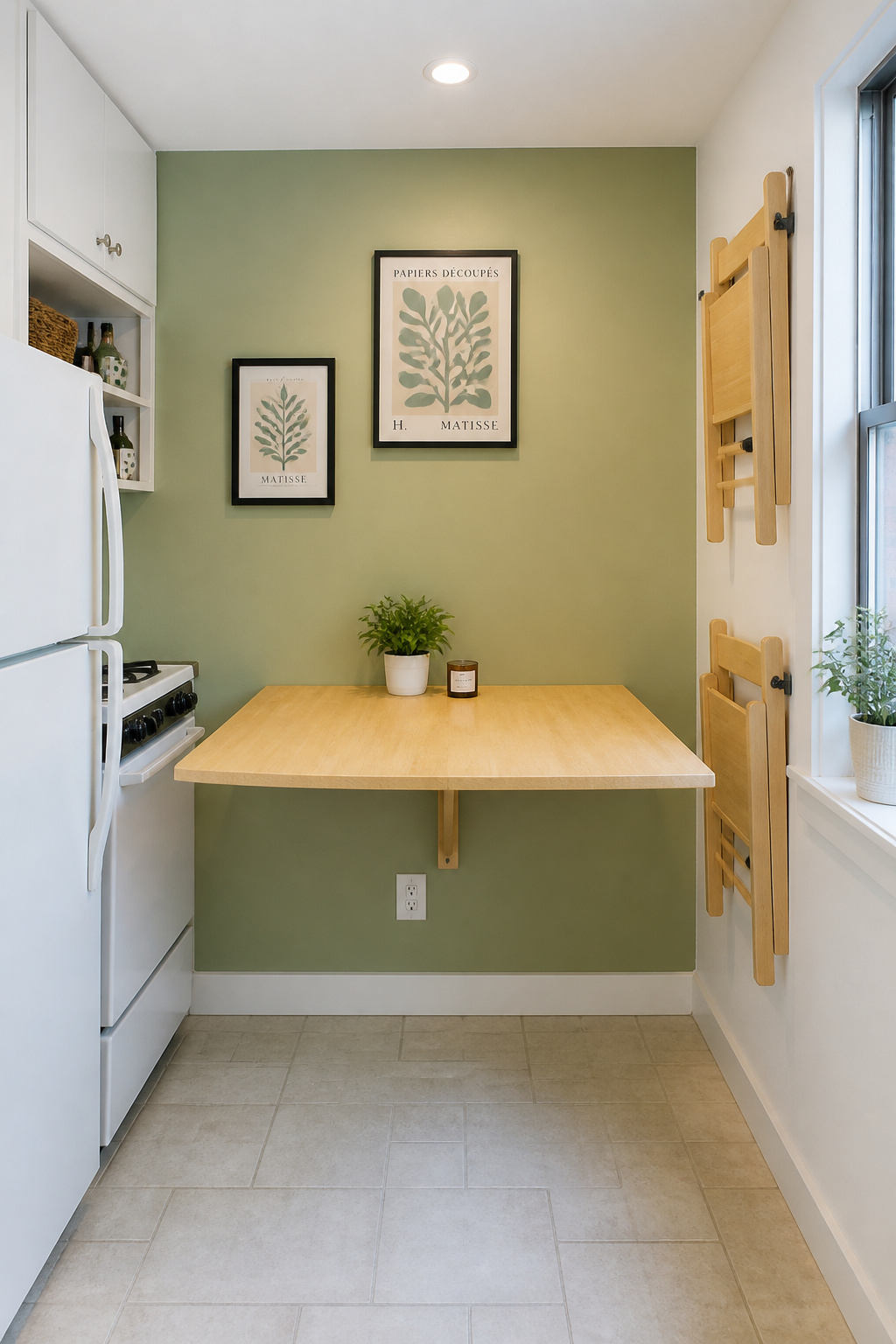
The mechanisms vary considerably in quality. Murphy-style tables fold the top vertically against the wall and are fully hidden when not in use — some integrate into a shelving unit or decorative panel so the “table” is invisible until needed. The shock-absorber bracket, a gas-piston damper, controls the lowering motion instead of allowing the table to drop suddenly — important for households with children. Weight capacity: a single-leg system safely supports around 100 pounds (adequate for two); a two-leg system holds up to 200 pounds.
Installation is non-negotiable about one thing: wall fixings must reach solid timber studs or masonry. Plasterboard alone will not hold a loaded dining table. Material quality signals intent — a solid oak or birch-ply top reads as a considered design choice; MDF with white melamine reads as an afterthought, however well-installed.
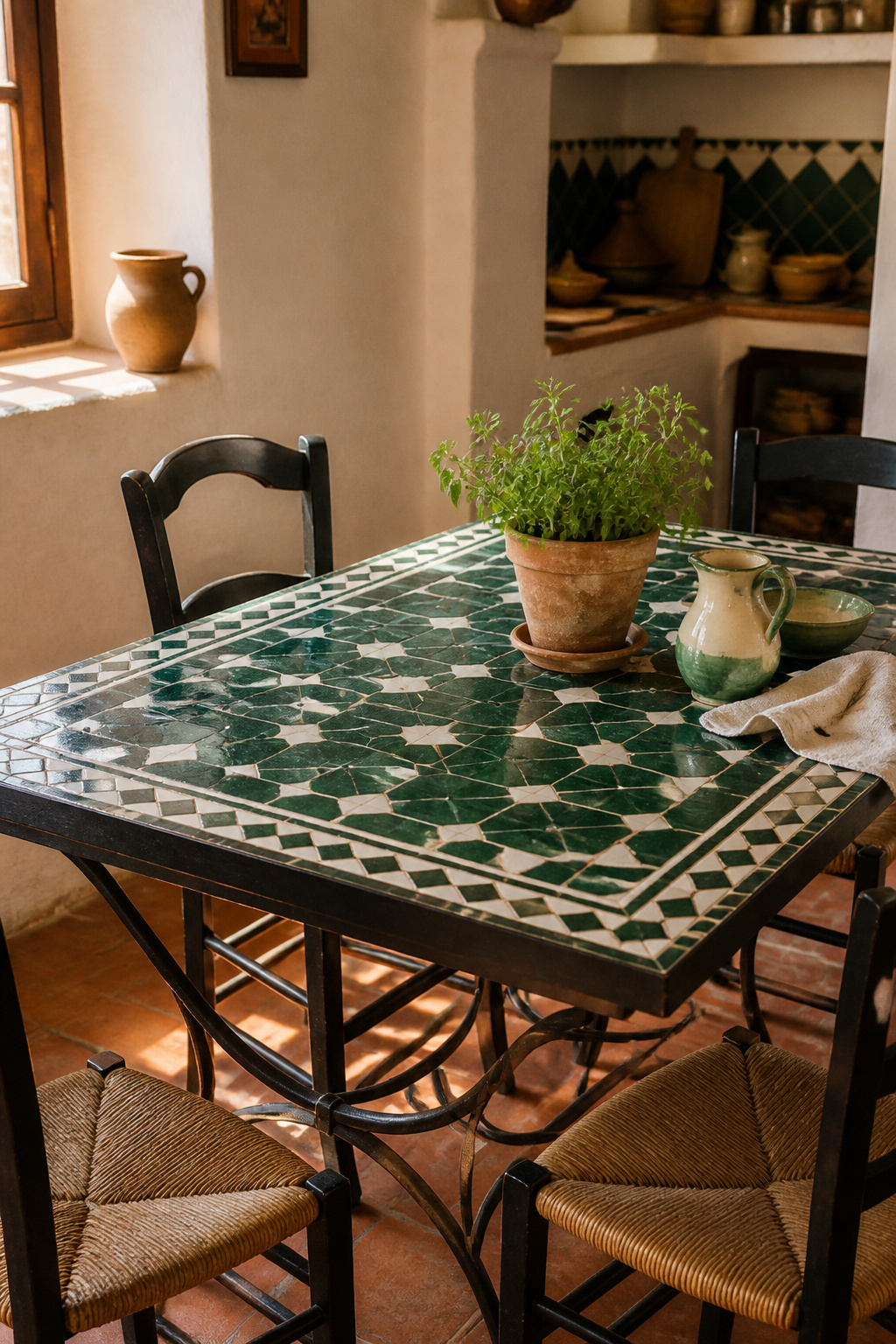
16. Ceramic Tile-Top Kitchen Table for a Mediterranean Character
These kitchen table ideas are genuinely under-used — perhaps because people associate tile with flooring and walls rather than dining surfaces. This is worth correcting. A tile-top table is heat-resistant (a hot pan placed directly on zellige won’t mark it, where the same pan would crack marble or burn timber), scratch-resistant to most kitchen implements, and cleans with a wipe.
Zellige, Encaustic, or Maiolica?
Zellige — handmade Moroccan terracotta tiles with hand-applied mineral glaze from Fez — has a slightly uneven surface and colour variation that is the mark of authentic handcraft. The certified Zellige de Fès mark indicates pieces made by master artisans using traditional techniques and mineral glazes. Spanish and Portuguese encaustic tiles offer bold geometric patterns in cement-based tiles where the pattern is structural and will not wear away with use. Italian hand-painted maiolica is the most decorative and most fragile of the three.
Wrought iron frames are the traditional pairing for Moroccan-style tile tables. Seal all grout lines with a penetrating silicone impregnator before first use and reapply annually — unsealed grout in a kitchen absorbs grease immediately.
17. Bold Kitchen Table Ideas: Statement Bases That Define the Room
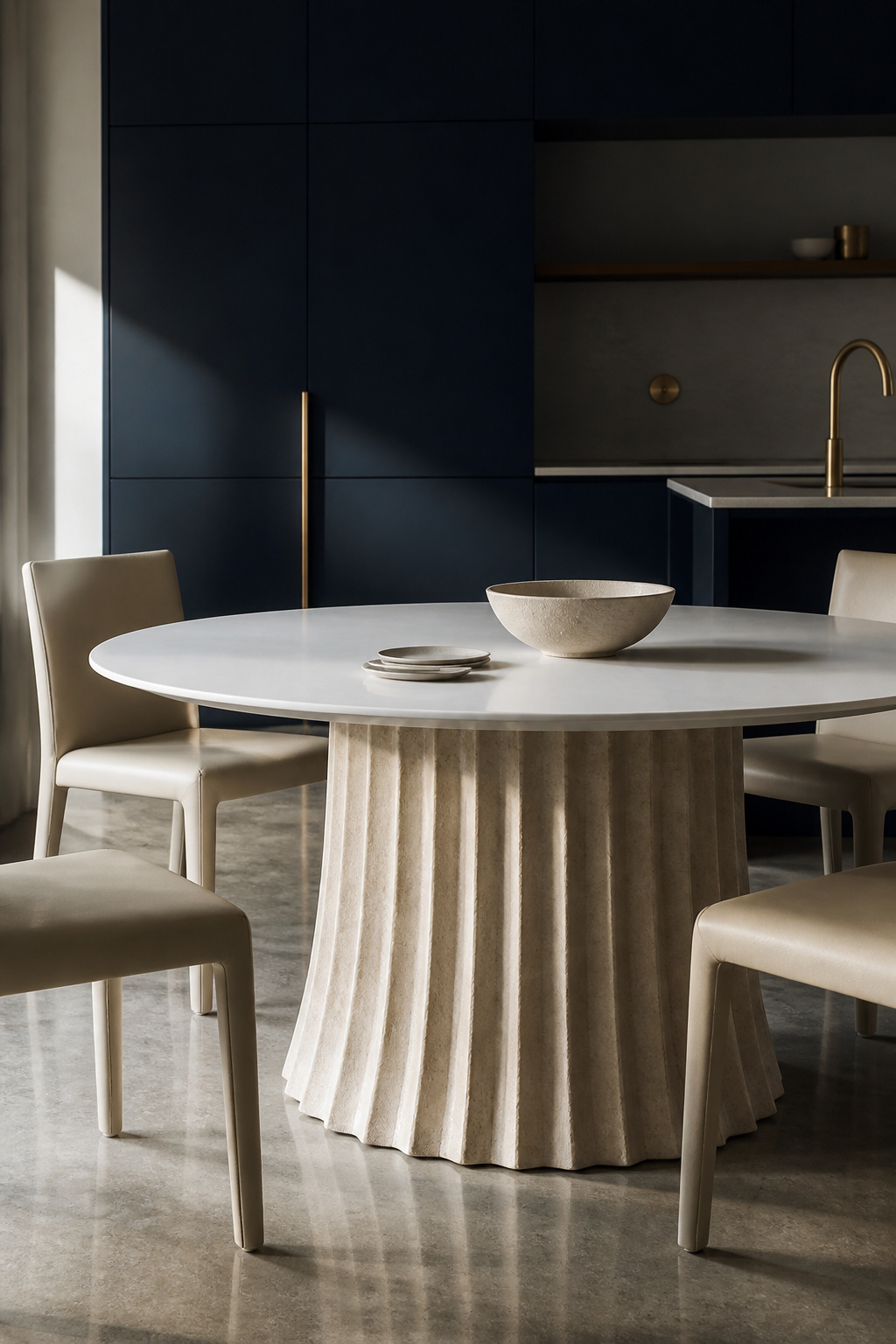
The most interesting direction in dining furniture for 2026 is what design writers have started calling the “anti-rectangle shift” — a movement away from the standard four-leg wood-slab table toward pieces where the base is the design, and the top is simply the functional surface that sits upon it.
Statement Base Options
Most kitchens have cabinets along every wall, appliances with clean rectangular profiles, countertops in plain stone or timber. Against all that geometry, a table with a conventional four-leg frame disappears visually. A sculptural base — a flared concrete pedestal, a geometric X-frame in blackened steel, a lathe-turned solid walnut column — creates a deliberate visual anchor that the room’s eye returns to.
Material options span a wide range. Cast iron is experiencing a design revival — contemporary foundries now produce pieces that retain the visual weight of Victorian bistro furniture while speaking a current formal language. Fluted stone pedestals (limestone, travertine, or architectural concrete) bring column architecture into the kitchen. Geometric welded steel — triangulated frames, faceted X-legs, blackened metal structures — suits urban and loft aesthetics. Turned wood pedestals are the craft furniture movement’s contribution: lathe-worked oak or walnut with bold proportions that feel sculptural and warm simultaneously.
The balancing principle: one statement, one quiet surface. A sculptural base needs a restrained top. A bold-coloured base (terracotta, cobalt, forest green) needs a neutral top in natural wood or white stone. Statement bold kitchen table ideas work best at standard dining size — 48 to 72 inches long — where the proportions of base to surface read as intended.
How to Choose the Right Kitchen Table for Your Home
After 17 kitchen table ideas, the question is how to choose. The process is more straightforward than it might appear, because the constraints narrow the options naturally before taste enters the picture.
Start with clearance. A minimum 36 inches of free space around all sides of the table is the practical baseline; if the route also functions as a walkway to another part of the kitchen, increase that to 42-48 inches. Measure this before considering any table at all, because it eliminates a significant proportion of what you might otherwise want. Seating allocation is 24 inches per person minimum — measure your current chairs at their widest point for an accurate calculation.
Shape follows footprint. Round and oval tables are the right choice for kitchens under roughly 150 square feet — no corners to navigate, and the full perimeter is usable for seating. Rectangular tables suit longer, narrower kitchen-diners. Square tables work in genuinely square rooms and struggle everywhere else.
Once the constraints are set, prioritise by household reality. If you have young children, surface durability and rounded corners matter more than material luxury — ceramic tile, stone, and hard-wax-oiled timber are all more forgiving than marble or painted wood for daily family use. If the table doubles as a home office, a plain smooth top (glass, clean timber, laminate) serves better than a textured or carved surface. If you entertain regularly, an extendable table or corner banquette maximises capacity at minimal everyday footprint. If you’re renting, avoid built-in solutions entirely — a freestanding table and bench combination is the most adaptable arrangement for a home you may not be in indefinitely.
The best kitchen table ideas are the ones that fit how your actual life happens in a space, rather than how an imagined life might look from the outside.