For decades, the design industry viewed the kitchen strictly as a laboratory. Architects prioritized clinical efficiency and sterile, high-gloss surfaces above all else. This legacy, rooted in the historical “Frankfurt Kitchen,” treated cooking as mere manufacturing. But a profound shift is currently reshaping our domestic landscapes. Today, we are actively dismantling this “machine” model to reclaim the living hearth. As homeowners seek to blend artisanal craftsmanship with modern utility, exploring sophisticated kitchen furniture ideas becomes essential. We are creating elemental sanctuaries that balance high-end aesthetics with physical grounding.
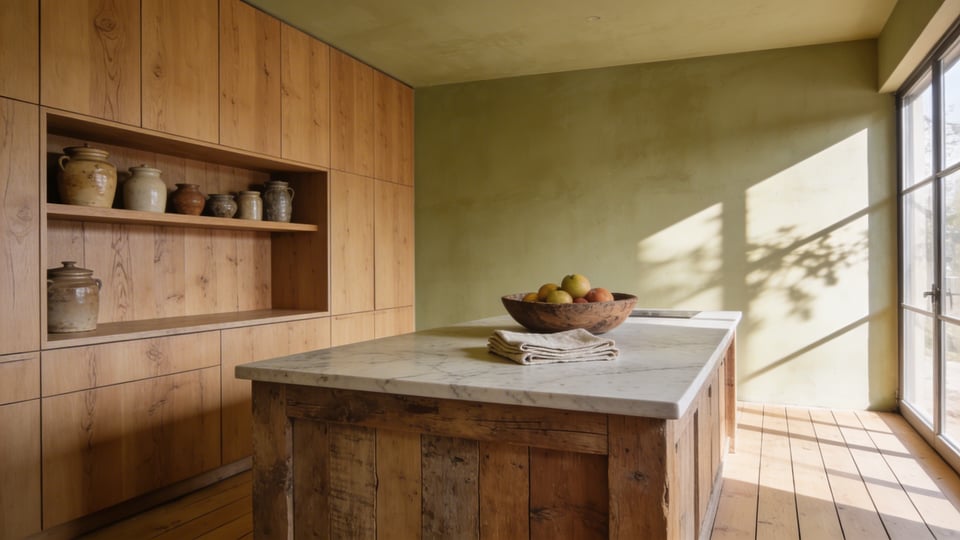
Furniture choices now prioritize emotional permanence over simple storage capacity. We are seeing a return to “unfitted” pieces with distinct souls. Rather than sterile built-ins, designers select materials that age gracefully with use. Honed stone and raw wood offer a tactile, “wabi-sabi” resonance. The central island has transformed into a monolithic, gravity-defying altar where the daily rituals of fire and water take center stage. Even the acoustics are changing, as curved forms replace harsh angles for visual softness.
This guide reveals how to curate a space of sensory refuge. First, we examine the role of “living finishes” in creating a visual diary. Next, we explore how ambient lighting transitions the room for evening restoration. We also discuss the importance of “pocket systems” in hiding mechanical clutter. Ultimately, these elements collaborate to turn necessary tasks into grounding, communal experiences.
Philosophy: The Shift from Sterility to Warm Minimalism
For decades, the modern kitchen attempted to mimic a clinical laboratory. This era of “Hygiene Theater,” defined by high-gloss lacquers and hidden appliances, is vanishing. Homeowners are rejecting the concept of “erasure,” where spaces look perpetually unused. instead, the design philosophy is shifting toward a “Soft Sanctuary.” This approach prioritizes intentionality over sterility, effectively transforming the kitchen from a cold showroom into a functional workshop. Many designers are now looking toward Scandinavian kitchen furniture to find that perfect balance of clean lines and organic warmth.
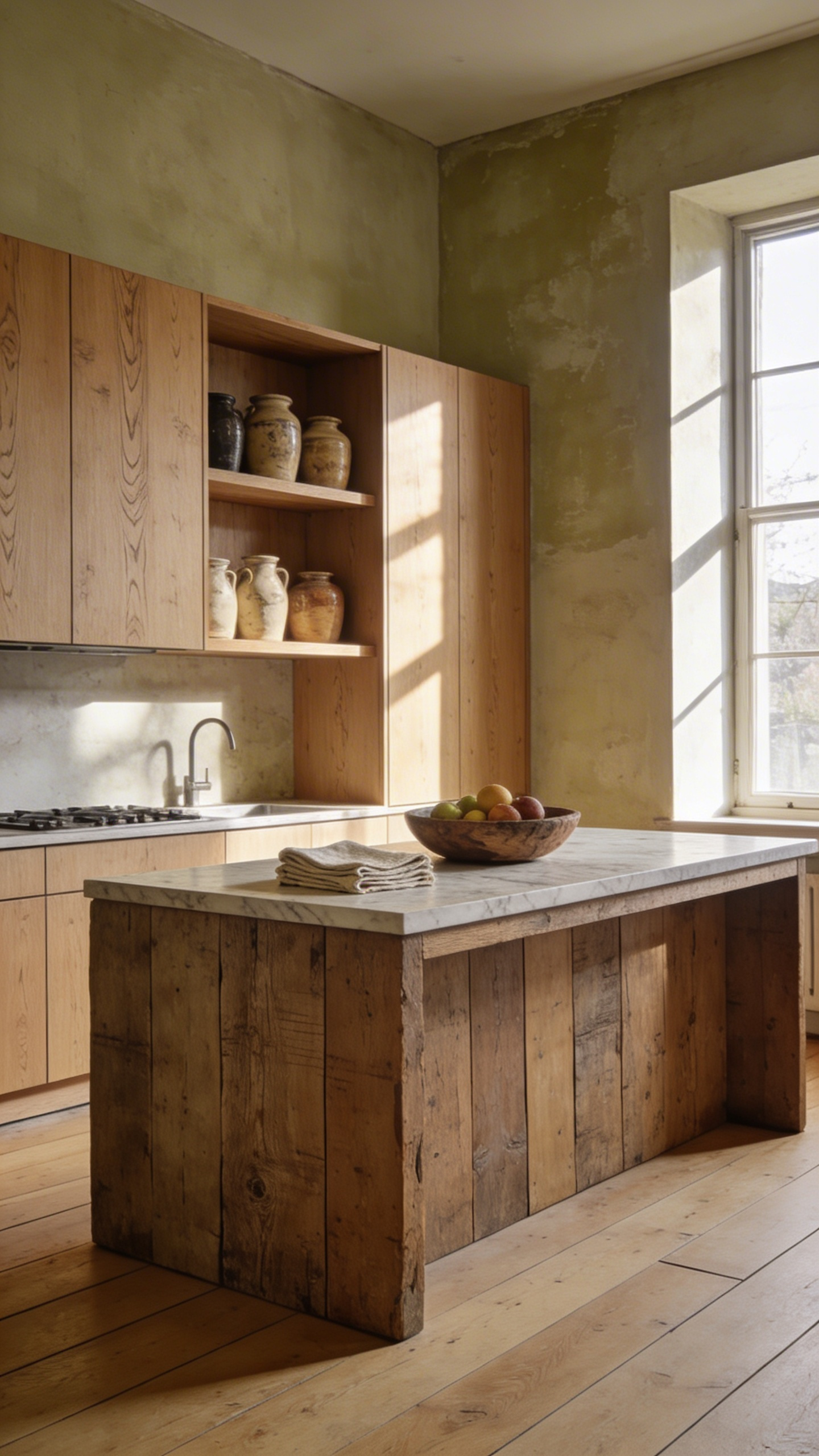
Crucially, this evolution represents a move from visual perfection to haptic experience. Sterile minimalism was designed strictly for the eye. In contrast, Warm Minimalism is designed for the hand. Architects now favor “living” materials like wire-brushed oak and honed marble. These finishes possess “tooth,” feeling organic and grounded to the touch. We are embracing the “patina” of daily life. Unlacquered brass hardware changes over time, telling the story of a family’s movements.
Structurally, the furniture itself is becoming “unfitted.” We are moving away from monolithic, wall-to-wall cabinetry blocks. Designers are introducing freestanding pieces, such as islands that resemble trestle tables. This allows light and air to pass underneath, making the room feel human-scale. The color palette has warmed significantly as well. Stark whites are being replaced by oatmeal, terracotta, and sage to lower cortisol levels. This shift acknowledges that the kitchen is no longer a machine for cooking, but a culinary sanctuary for living.
Theme 1: Materiality and Grounding Elements
Current kitchen design is shifting significantly. We are moving away from viewing the kitchen as a mere collection of appliances. Instead, we now treat it as a cohesive architectural object. This perspective emphasizes physical weight to create psychological stability.
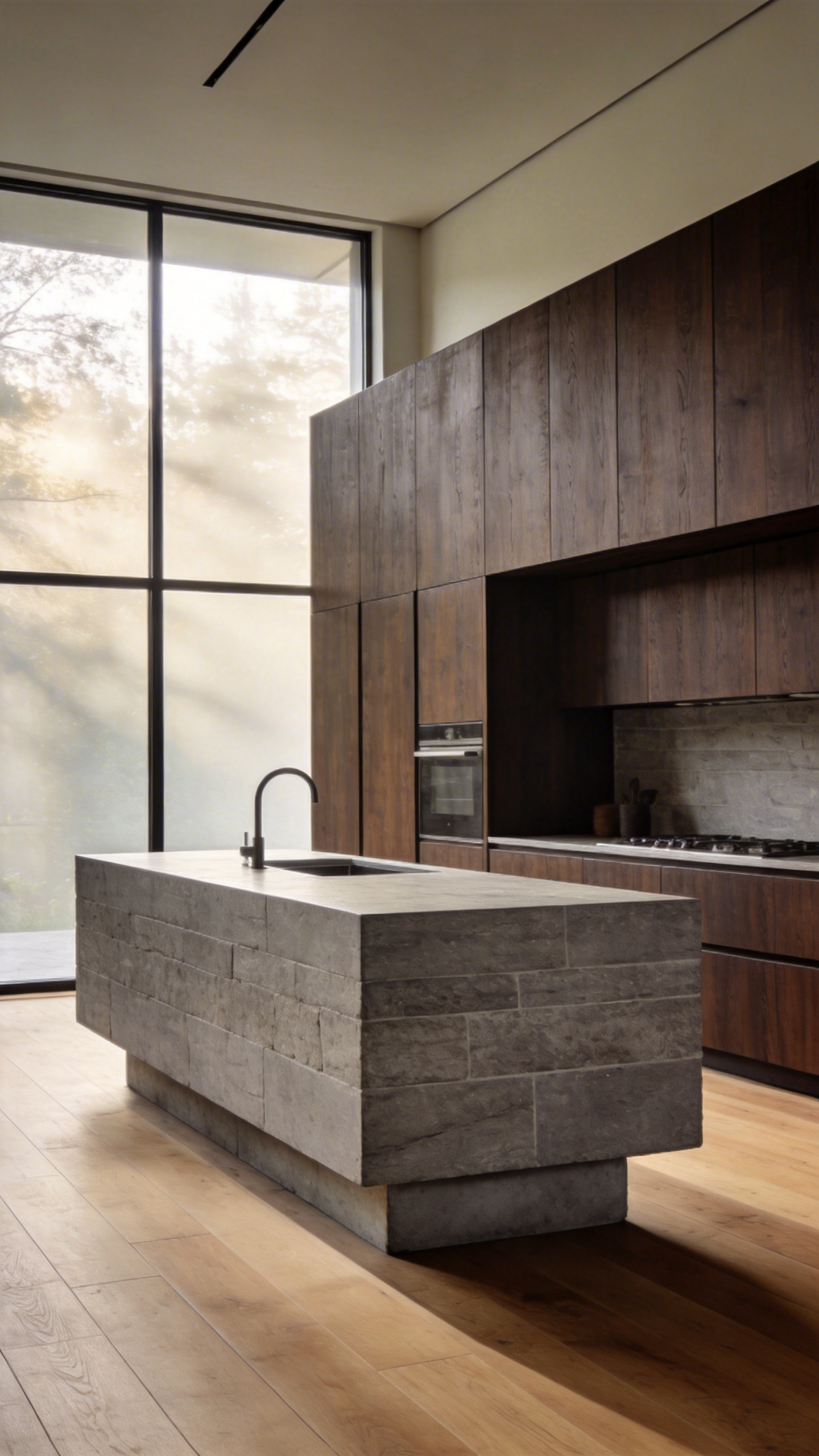
Consider the humble plinth. Historically, this element protected Greek columns, yet today, designers are rejecting the standard recessed toe-kick. By utilizing a solid, floor-touching base, cabinets transform into heavy “socles.” The furniture feels rooted rather than floating or temporary.
Similarly, the central island is evolving into a “monolith.” Through precise miter-folding techniques, thin stone slabs appear as solid, ten-thousand-pound blocks. Designers currently prefer honed or leathered finishes over high-gloss polish. This lack of reflection emphasizes mass, acting as a domestic bedrock for social interaction.
True grounding requires haptic engagement. Drawing from Juhani Pallasmaa’s philosophy, the “eyes of the skin” matter deeply. Unlike sterile plastics, materials like unlacquered brass and reclaimed oak develop a patina. This “temporal grounding” connects us to the passage of time. These elements prioritize permanence over ephemerality, creating a space that feels honest and enduring.
1. The Anchoring Power of Monolithic Stone Islands
The modern kitchen has evolved beyond simple utility. The monolithic stone island represents a tectonic shift in design philosophy. It moves away from modular cabinetry toward a concept of “sculpture-as-utility.” Historically, the hearth was a fixed stone structure. These massive forms tap into the primal archetype of a “domestic altar.” Many luxury homeowners are exploring innovative kitchen island ideas to serve as the structural and social centerpiece of their floor plans.
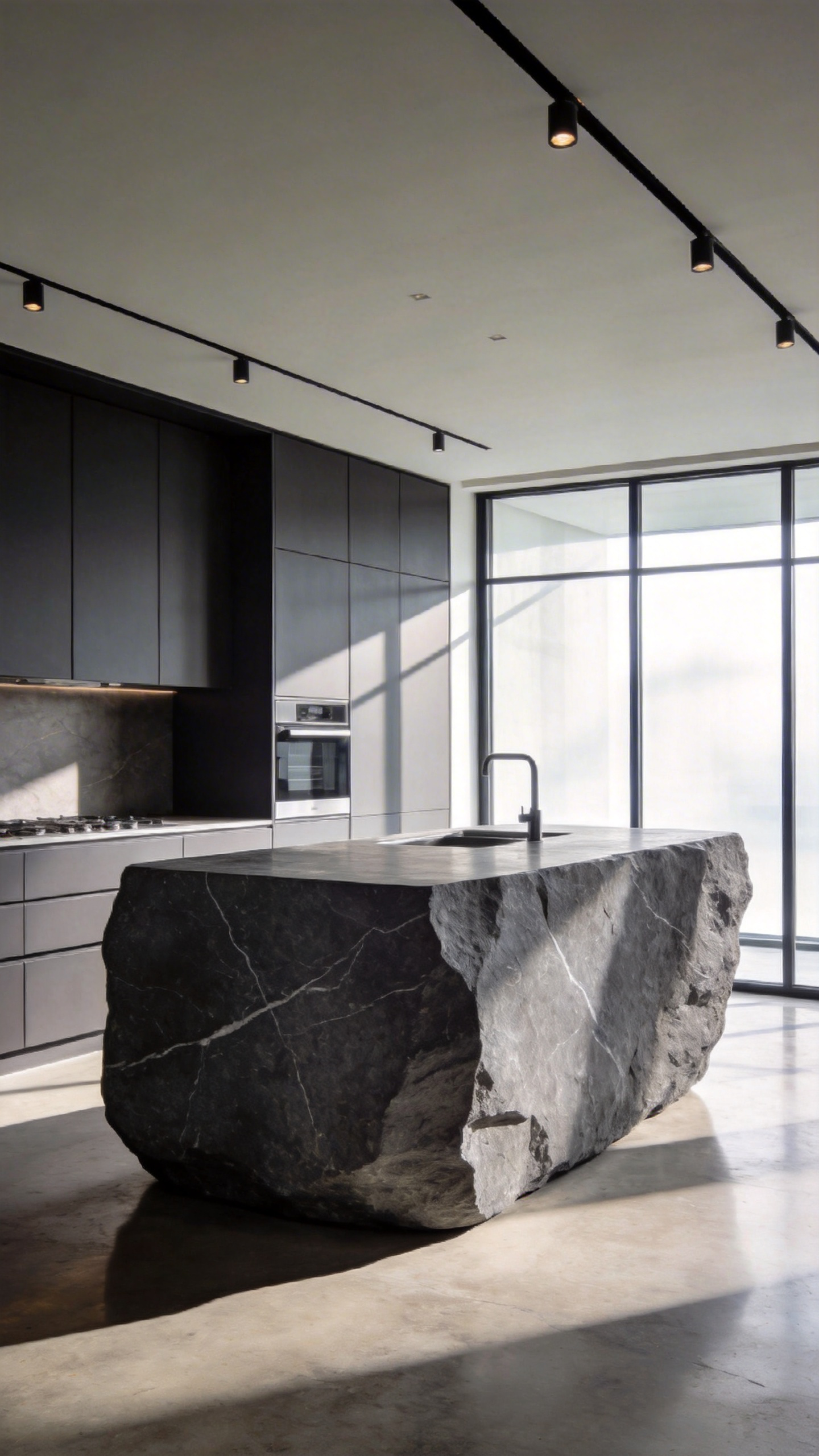
Achieving this grounded look requires precision engineering. Fabricators use 45-degree mitered aprons to create the illusion of a solid block. Crucially, the veins of marble or quartzite must wrap seamlessly around corners. This continuous flow tells the story of a single geological event. The island becomes a curated piece of history rather than mere furniture.
Beyond aesthetics, the monolith acts as a spatial stabilizer. In open-plan living, the stone provides necessary visual ballast against ethereal glass walls. The experience is deeply tactile. The cool touch of stone offers a sensory contrast to the stove’s heat. This “subtractive” aesthetic creates a calm, enduring center for the home.
2. Reclaimed Timber: Integrating History into Cabinetry
Reclaimed timber offers more than just a rustic aesthetic; it provides a unique form of material storytelling. This wood often originates from “old-growth” forests felled centuries ago. As a result, the timber is significantly denser than modern plantation lumber. We prize its “wormy” texture, which was created by beetles long before harvest. The sensory experience extends beyond the visual. Neuroarchitecture suggests these natural imperfections can actually reduce stress.
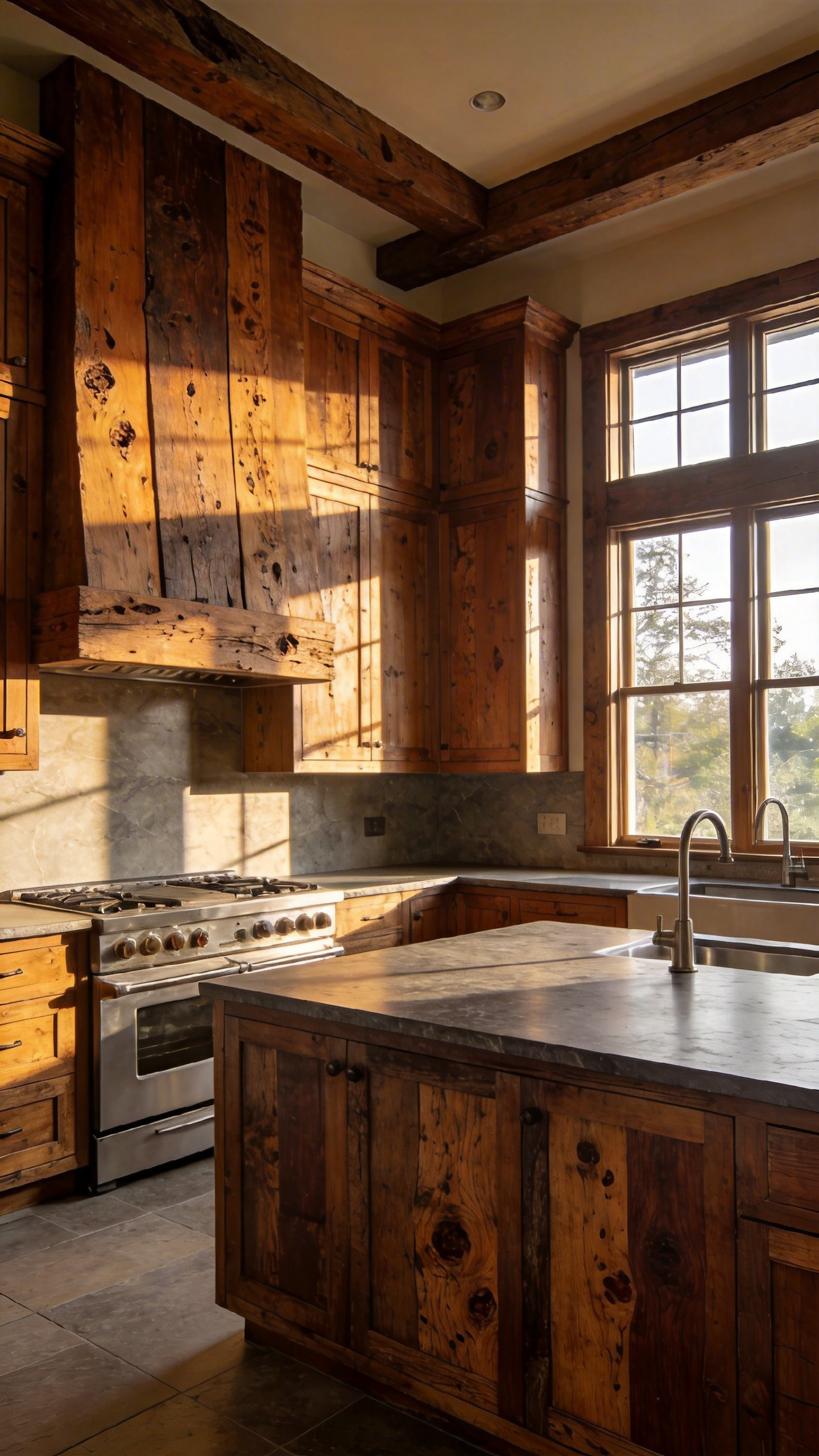
Integrating history requires technical precision. When considering smart kitchen cabinet ideas, using stabilized reclaimed wood ensures longevity without compromising the heirloom quality. The wood must undergo modern kiln-drying to eliminate dormant pests. This process brings the moisture content to a stable 6–8%, ensuring the cabinetry resists warping despite extreme kitchen humidity. Once stabilized, the wood possesses a settled “cellular memory.” It becomes ideal for precise joinery, distinct from new wood’s volatility.
Currently, the design trend favors “Refined Reclamation” over a heavy cabin look. Designers now pair statement islands with sleek, matte perimeter cabinets. Alternatively, they use “slim-shaker” profiles to frame the historic grain cleanly. To finish the look, experts recommend pairing this timber with raw brass hardware. This combination ensures the furniture feels like a modern heirloom rather than a static museum piece.
3. Raw Plaster and Limewash: Texture as a Backdrop
Unlike standard latex paints, raw plaster and limewash offer a distinct optical experience. The calcite crystals within limewash act like microscopic prisms. Light refracts rather than reflects, creating a soft, atmospheric glow. This “luminous matte” quality is crucial for balancing modern kitchen aesthetics. It dampens the harsh glare often bouncing off stainless steel appliances or polished stone islands. The earth pigments used in these materials provide chromatic depth. As the sun moves, the wall color shifts subtly, adding “quiet movement” behind your cabinetry.
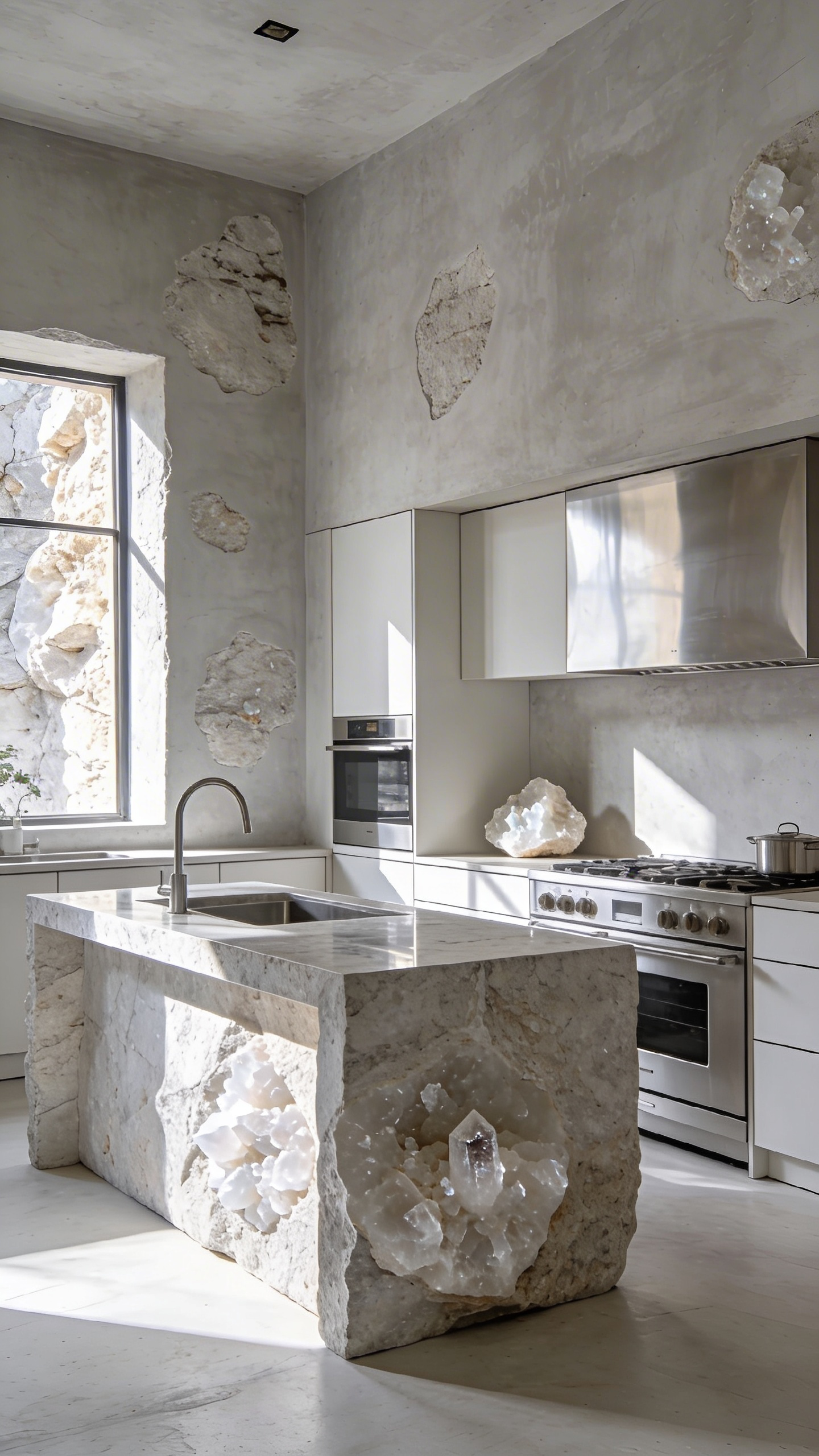
Beyond lighting, these materials introduce a vital tactile juxtaposition. Modern kitchen furniture often features laser-cut precision and monolithic finishes. Placing these sleek elements against hand-troweled plaster creates a compelling visual tension. The subtle irregularities of the plaster highlight the sharp lines of the joinery. Without this raw backdrop, luxury cabinets can often feel sterile or clinical. With it, the space feels grounded and curated.
Choosing lime-based finishes is a highly functional decision for culinary environments. Uniquely, these materials are hygroscopic, meaning they naturally regulate humidity. They absorb steam and prevent the “sweating” common on painted drywall. The high pH level makes limewash inherently antimicrobial, offering natural defense against bacteria. Additionally, these walls age gracefully alongside your home. Instead of peeling, they develop a patina, allowing for seamless spot repairs that blend perfectly into the existing texture.
4. The Resurgence of Terracotta and Clay in Functional Decor
The resurgence of clay in kitchen design represents a sophisticated return to “living” materials. This trend bridges the gap between high-tech efficiency and ancestral wisdom. Beyond mere nostalgia, materials like terracotta offer profound thermal intelligence. Designers are utilizing clay’s naturally porous nature to create built-in storage modules. These “breathing” compartments preserve root vegetables by regulating humidity without electricity. This functional approach aligns perfectly with the principles of “slow design.”
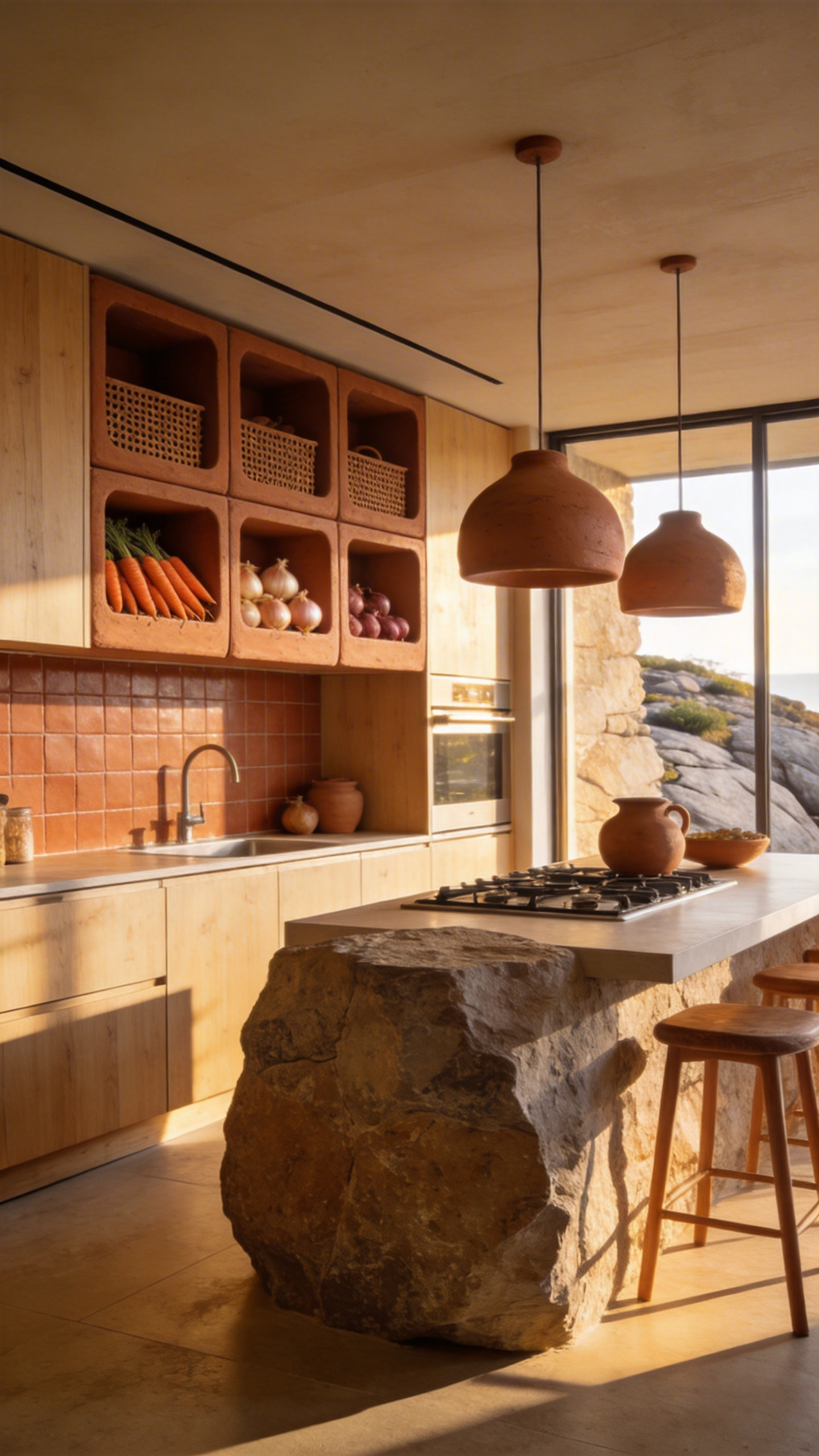
The appeal is not solely functional. The tactile nature of unglazed clay counters the sterile feel of modern appliances. Unlike synthetic surfaces, terracotta develops a unique patina over time. The furniture begins to tell the story of the household through subtle color shifts. We see this materialized in the rise of monolithic, clay-clad kitchen islands. Here, terracotta acts as a structural neutral, effectively replacing cool greys with grounded, earthen warmth.
Moreover, the material interacts beneficially with food chemistry. Because clay is naturally alkaline, it neutralizes acidic environments that often encourage mold within cabinetry. Recent advancements in refractory clay blends ensure these pieces withstand modern mechanical stress. This shift honors both historical durability and modern eco-longevity. Choosing clay creates a circular design narrative that is visually stunning and environmentally responsible.
Theme 2: Form and Fluidity in Furniture Selection
Historically, the kitchen functioned as a clinical laboratory designed strictly for efficiency. Modern design principles are shifting toward a “furniture-first” philosophy. We are moving away from static, floor-to-ceiling cabinetry blocks. Instead, designers now select pieces with unique “visual gravity,” such as islands raised on tapered legs. Light flows underneath the furniture, allowing flooring to run uninterrupted. The room feels significantly larger and less like a workspace.
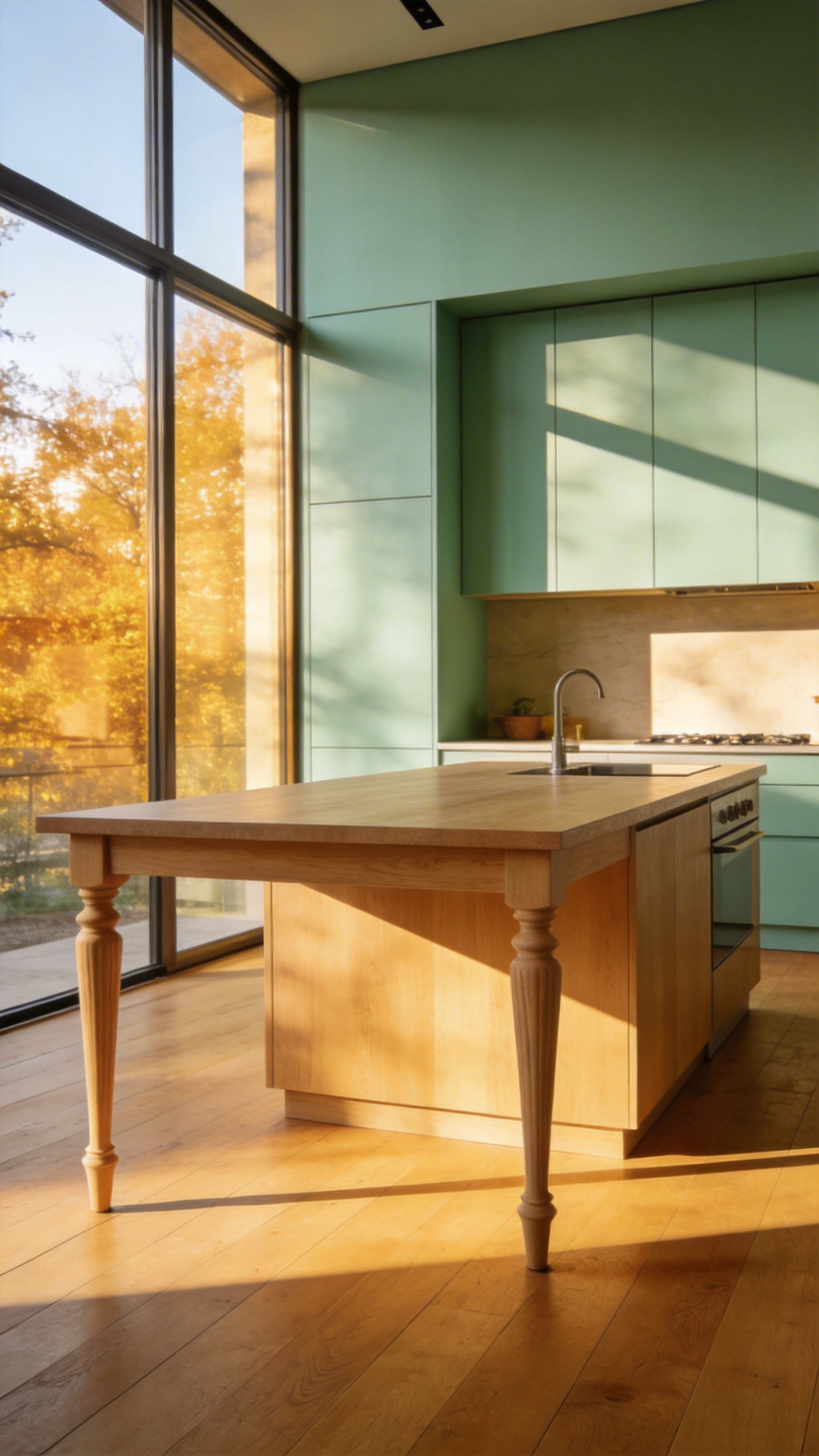
The actual geometry of these pieces is evolving. Traditionally, kitchens relied on sharp, 90-degree angles. Yet, human bodies move in natural arcs, not rigid right angles. Designers are embracing biomorphic forms to improve physical navigation. For example, a curved “pill-shaped” island edge offers a tactile, inviting transition. It allows family members to pass each other without the friction of sharp corners, creating a “slipstream” effect that encourages movement.
Material selection plays a crucial role in this fluidity. By using “tactile thresholds,” furniture blends seamlessly into the home’s architecture. Matching an island’s walnut finish to living room bookshelves creates a “material bridge.” As a result, the eye scans the open space without stuttering. This approach dissolves the visual boundary between cooking tasks and social living.
5. Sculptural Bar Stools: Balancing Ergonomics with Organic Lines
Designing sculptural bar stools requires balancing biomorphic art with rigid human physiology. Historically, these organic lines descend from the Biomorphism movement of the 1930s. In modern kitchens, such curved silhouettes act as visual punctuation marks against linear cabinetry. They break the hard dominance of quartz countertops with shapes that feel grown rather than manufactured.
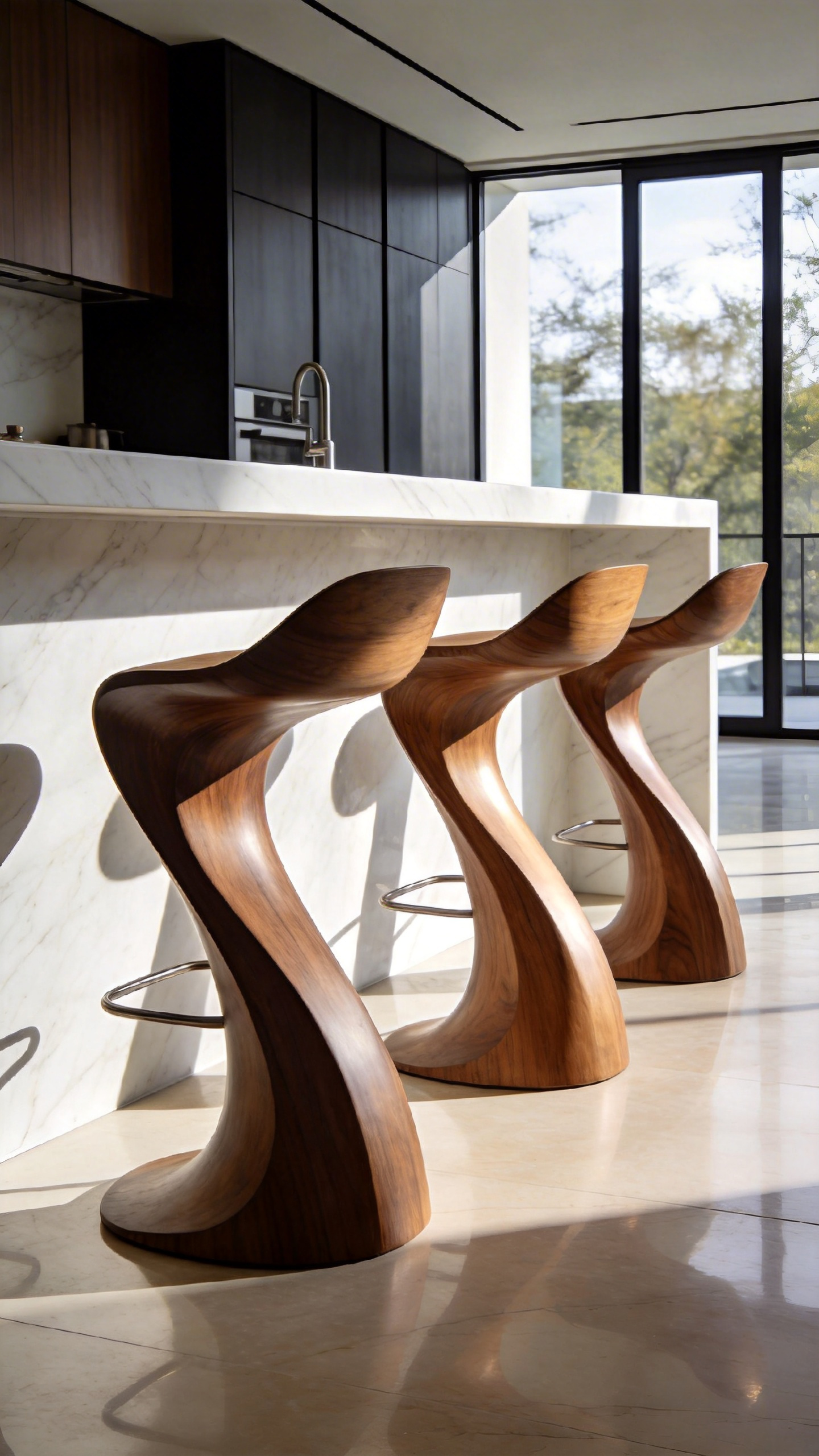
Aesthetics cannot outweigh comfort in these elevated seats. Successful designs often hide an “S-curve” to mimic natural spinal curvature. Subtle depressions provide ischial relief, preventing the sliding sensation common on sleek surfaces. An integrated footrest stabilizes the pelvis, allowing the back to support the lumbar region effectively.
Beyond shape, material innovation drives this sector forward. Additive manufacturing and steam-bent wood allow for seamless, “monobloc” designs. These techniques create stools that appear delicate but possess immense structural integrity. These hollow or pierced forms offer essential visual transparency. Light passes through the furniture, preventing the kitchen island from feeling like a heavy barrier. The stool becomes a porous hub where conversation flows as easily as the design lines.
6. The ‘Un-Kitchen’ Table: Choosing Dining Surfaces that Feel Like Heirloom Furniture
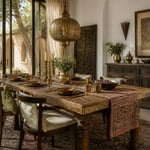
The “Un-Kitchen” design philosophy rejects the clinical uniformity of modern built-in islands. Instead, it favors freestanding, character-rich surfaces. The kitchen’s central anchor becomes a piece of furniture that carries a soul. We prioritize “living materials” that evolve through daily use. High-end designs often feature zinc or copper tops. Over time, these reactive metals transition from bright silver to deep, mottled grey. Every spill becomes a recorded memory rather than a defect. Similarly, using reclaimed timber adds an immediate layer of storytelling to the room.
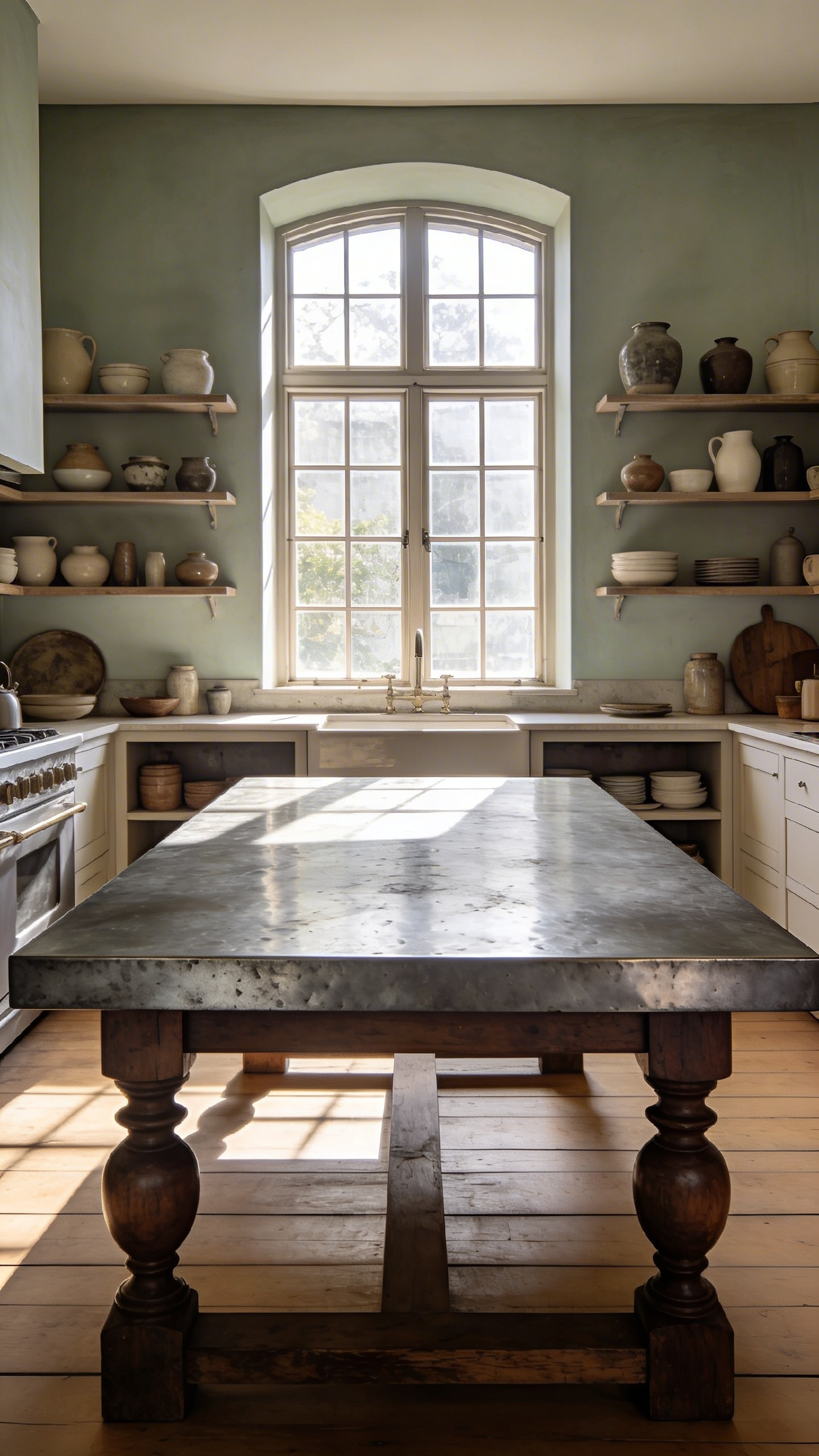
Historically, kitchens were rooms of separate furniture, not fitted blocks. We often revive forms like the “Dairy Table,” originally found in English manor sculleries. Unlike a solid island, these tables are open underneath. Light flows through, making the space feel lighter and more curated. True heirloom quality demands the “human mark.” Machine-sanded wood often feels unnaturally plastic. Conversely, hand-planed surfaces offer a subtle, undulating texture. We finish these pieces with breathable beeswax rather than thick polyurethane, allowing the wood’s natural scent to persist warmly.
This choice changes the social chemistry of the home. Standard islands often feel like service counters where guests simply order. In contrast, a table-height surface brings everyone to the same eye level. This turns food preparation into a democratic, communal act. There is psychological comfort in the heavy “thunk” of solid oak. In a world of flat-pack furniture, this physical mass provides a sense of permanence. The table acts as a social anchor for lingering conversations.
7. Softening Edges: Curved Banquettes and Rounded Cabinetry Profiles
The shift toward softened edges marks a departure from sharp, clinical minimalism. This trend prioritizes “emotional ergonomics,” ensuring spaces feel psychologically supportive. Neurologically, sharp angles can trigger subtle stress responses in the brain. In contrast, organic curves promote a sense of “cognitive calm.” Replacing sharp island corners with rounded, pill-shaped profiles reduces visual tension.
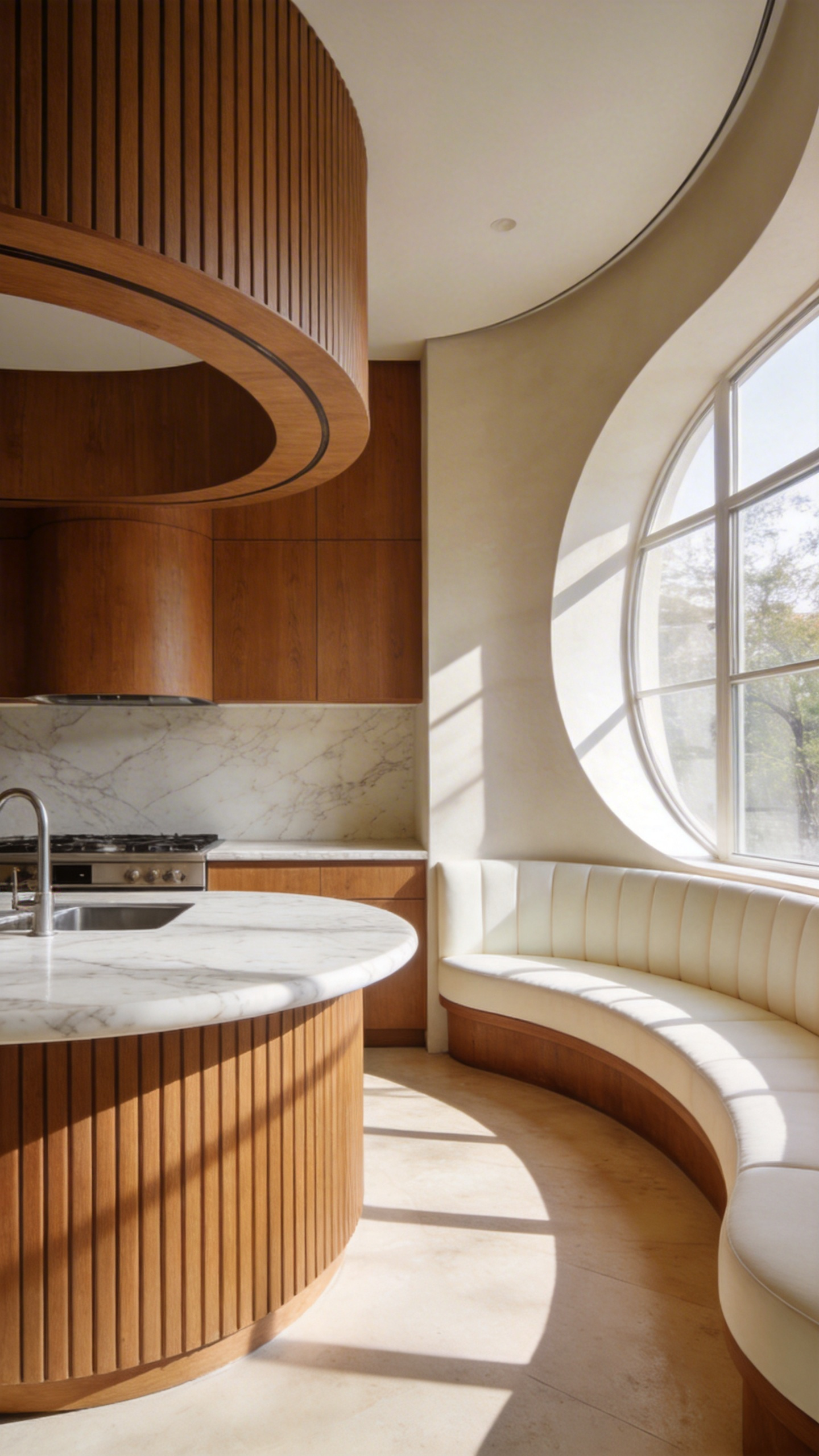
Achieving this aesthetic requires significant craftsmanship. Master joiners utilize “true curves,” where the wood grain follows the arc seamlessly. Often, designers wrap these forms in reeded or fluted profiles. These textures hide vertical joints, creating a monolithic, furniture-like appearance. This approach balances order with the warmth of organic texture.
Beyond aesthetics, rounded elements transform social dynamics. Curved banquettes foster “democratized” conversation, allowing better eye contact than linear seating. They also improve physical flow in high-traffic zones. Rounded cabinetry ends effectively eliminate painful “hip-knocks” in narrow galleys. The kitchen becomes a safer, more forgiving environment for active families.
These features invite tactile engagement. In a world of flat screens, touching a rounded wooden edge feels grounding. Although curves introduce material complexity, they successfully humanize the modern home.
8. Mixed Metals: The Warmth of Unlacquered Brass and Bronze
Unlike static lacquered finishes, unlacquered brass and bronze serve as “living finishes.” The kitchen becomes an evolving element of the home rather than a frozen showroom. The metal tells a narrative of use. Oils from frequent handling keep high-touch areas bright, while untouched surfaces oxidize naturally. A deep patina develops in corners, adding a softness that absorbs harsh modern lighting.
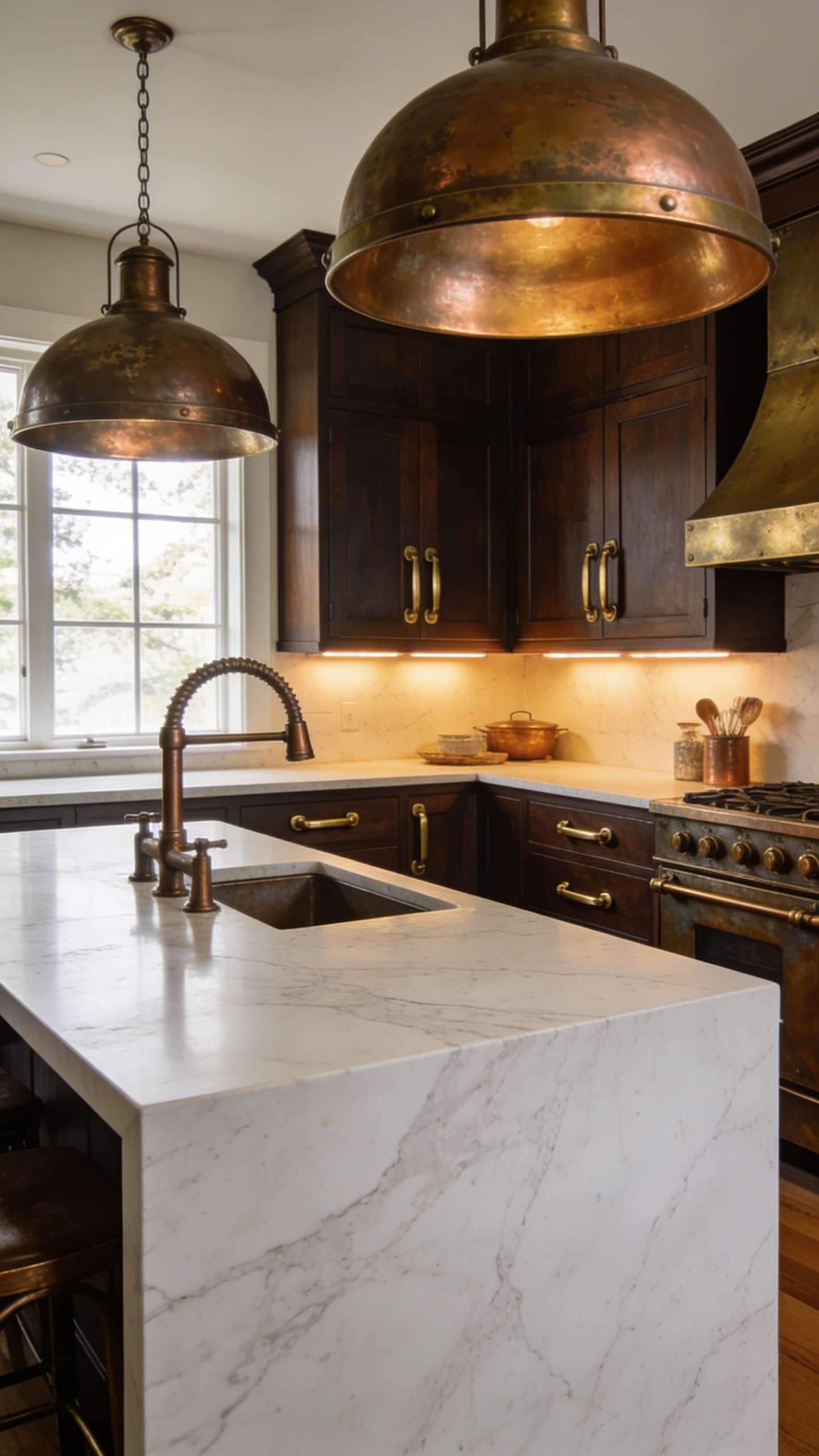
To achieve this bespoke look, designers often mix these tones intentionally. This requires a strict hierarchy to avoid visual chaos. Typically, bronze functions as the structural anchor for heavy elements like island legs or mesh inserts. Brass acts as the highlight, accenting delicate features like hinges or gallery rails. This “warm-on-warm” approach mirrors the honest materials of historical estates. Ideally, a 70/30 ratio between the dominant anchor and the bright accent creates a curated feel.
These materials offer distinct technical benefits beyond aesthetics. Because they are copper alloys, they possess the oligodynamic effect. This natural chemistry kills bacteria and viruses on contact. Unlacquered hardware provides a self-sanitizing surface that creates a healthier environment. Scratches eventually darken and blend into the patina. The hardware “self-heals,” becoming more beautiful with daily wear.
Theme 3: Spatial Harmony and Light
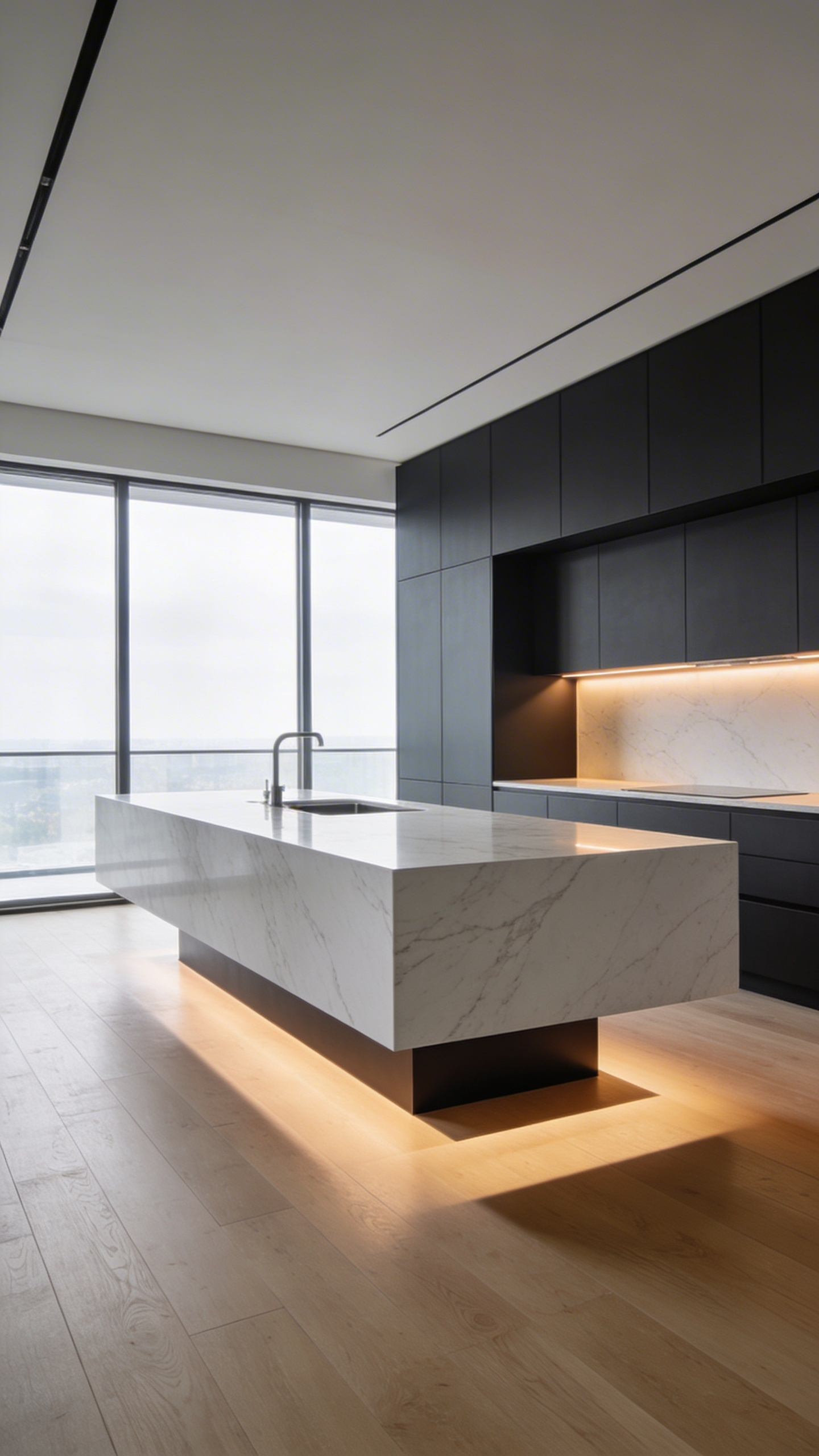
Modern kitchen design increasingly prioritizes “visual silence” to reduce cognitive load. Cabinetry is evolving into something akin to refined living room furniture. Designers are eliminating visual noise by removing handles and hardware. Instead, we use “shadow gaps” to make heavy stone surfaces appear to float. The kitchen feels less like a workspace and more like a calm sanctuary.
Material selection now relies heavily on lighting science. Designers utilize Light Reflectance Value (LRV) to actively balance a room’s atmosphere. In sun-drenched spaces, matte, anti-fingerprint finishes absorb harsh glare. Conversely, high-gloss surfaces act as mirrors in darker corners, bouncing light into deep recesses. The furniture itself becomes a sophisticated light-modulating tool.
Spatial harmony also relies on uninterrupted flow. Traditionally, islands were solid blocks that created visual barricades. Current trends favor “furniture-leg islands” raised on tapered supports. Because light travels underneath the cabinetry, the floor area appears continuous and expansive. This approach mimics a traditional hearth table, adding warmth to the minimalist aesthetic.
Lighting strategies must support our natural circadian rhythms. Rather than relying on a single overhead source, cabinetry now features integrated internal LEDs. Lighting the kickplates creates a “halo effect,” making units feel weightless. Moreover, layouts are shifting fundamentally. By placing prep areas on islands facing windows, we align the user with natural light. This ensures the kitchen remains a place of sensory balance.
9. Solar-Conscious Window Treatments for Natural Light Control
Solar-conscious window treatments represent a crucial convergence of technical precision and aesthetic luxury. Designers now treat these systems as specialized kitchen furniture rather than simple decor. Their primary function involves the physics of preservation. High-performance fabrics engineered with low openness factors block up to 99% of UV radiation. This mitigation acts as insurance for expensive custom millwork. It effectively prevents the “sun-bleaching” or “ambering” often seen on unprotected cherry or oak cabinets.
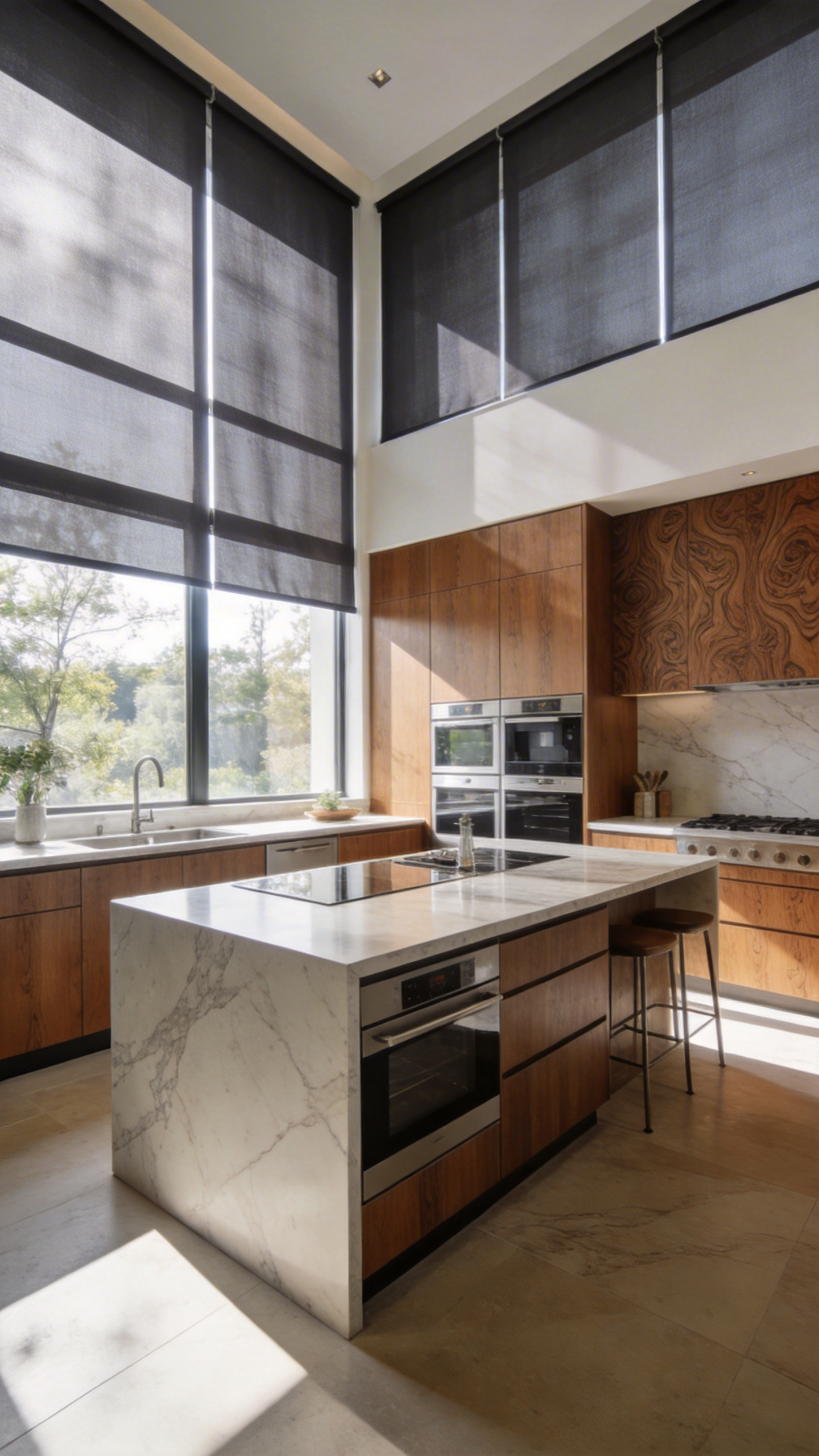
Beyond protection, the current architectural goal is “stealth.” Instead of mounting visible hardware, architects frequently build “blind pockets” directly into ceiling soffits. The treatment becomes a seamless extension of the room’s clean lines. These integrated systems are usually motorized for necessary hands-free operation. Automated sensors lower shades based on heat gain to regulate the climate without human intervention.
Material evolution has finally bridged the gap between visual softness and hygiene. Unlike traditional drapes that trap cooking odors, modern “grease-proof” textiles are easily wiped down. Simultaneously, they prioritize light diffusion over total darkness. These shades eliminate glare on stainless steel appliances while maintaining a view-through effect. This creates a visually comfortable environment that remains connected to the natural world.
10. Open Shelving as Curated Display: A Minimalist Approach
Open shelving transforms the kitchen from a utilitarian service area into a gallery of intentionality. Historically, designs favored the “Laboratory Kitchen,” which concealed the work of cooking behind heavy, uniform cabinetry. Modern minimalism rejects this closed-off aesthetic. Removing upper cabinets lowers the room’s visual center of gravity. The space feels less like a clinical workstation and more like a warm, inviting living room.
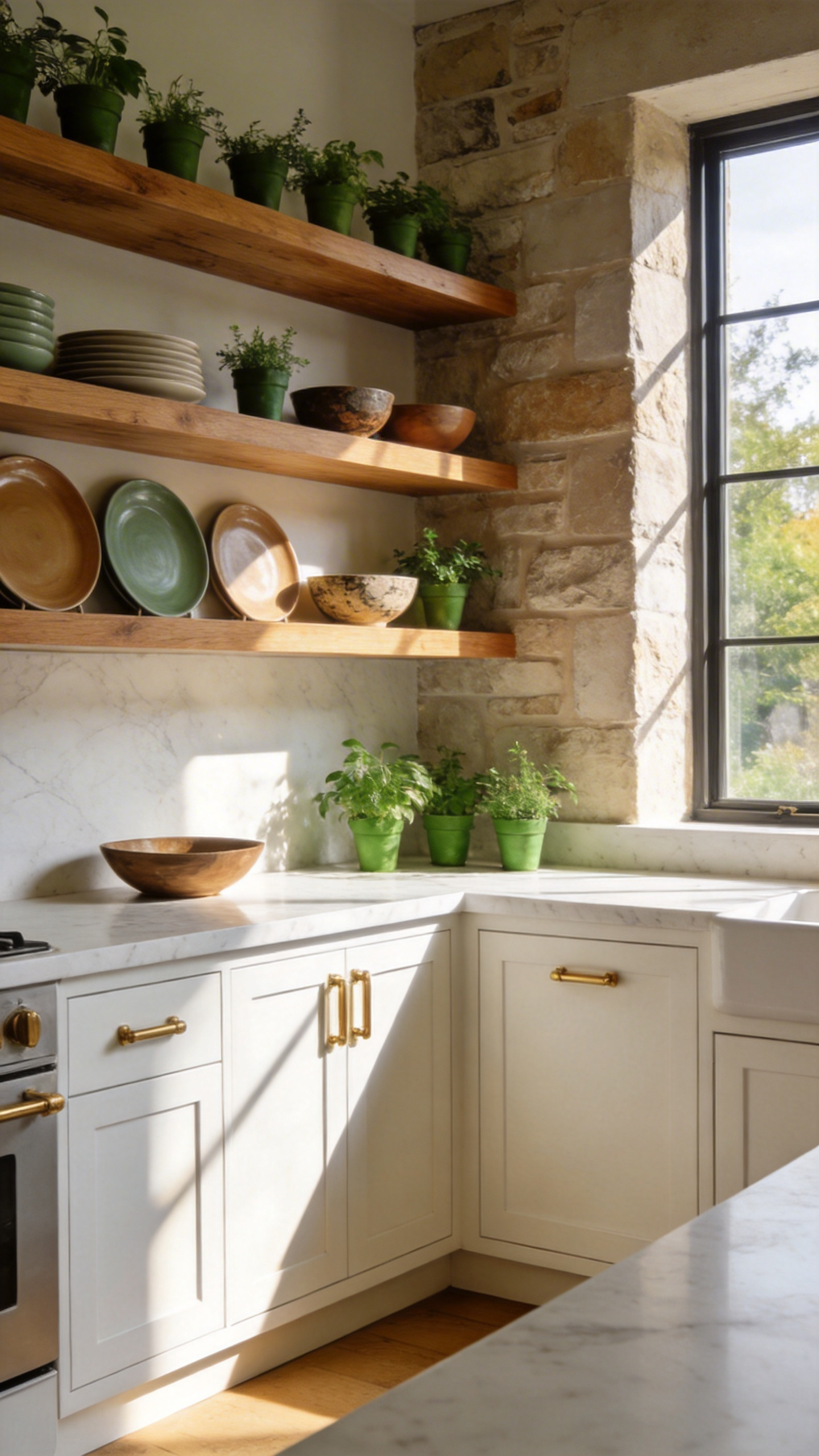
This design choice demands a rigorous selection process known as “The Edit.” You cannot hide clutter behind a floating oak plank. The shelf utilizes negative space to allow the eye to rest. There is a distinct tactile quality to this approach. Placing a ceramic bowl on solid wood promotes a sense of domestic mindfulness that hidden storage lacks.
Technically, achieving this effortless look requires “invisible engineering.” Blind steel supports anchor deep into studs, allowing shelves to seemingly defy gravity. We often pair these warm timber shelves with cool quartzite backsplashes to create a grounding sensory balance. Integrated linear LED lighting acts as a curatorial tool. At night, everyday items like glassware become glowing artifacts. This approach blends precise architecture with the honest rhythm of daily life.
11. Integrated Hidden Storage: Maintaining the Visual Silence
Integrated hidden storage is more than a trend; it is an architectural philosophy centered on “Visual Silence.” Historically, spaces like the 1920s Frankfurt Kitchen prioritized compact efficiency. Modern design aims for a different goal: total invisibility. The kitchen transforms from a utility room into a living sanctuary.
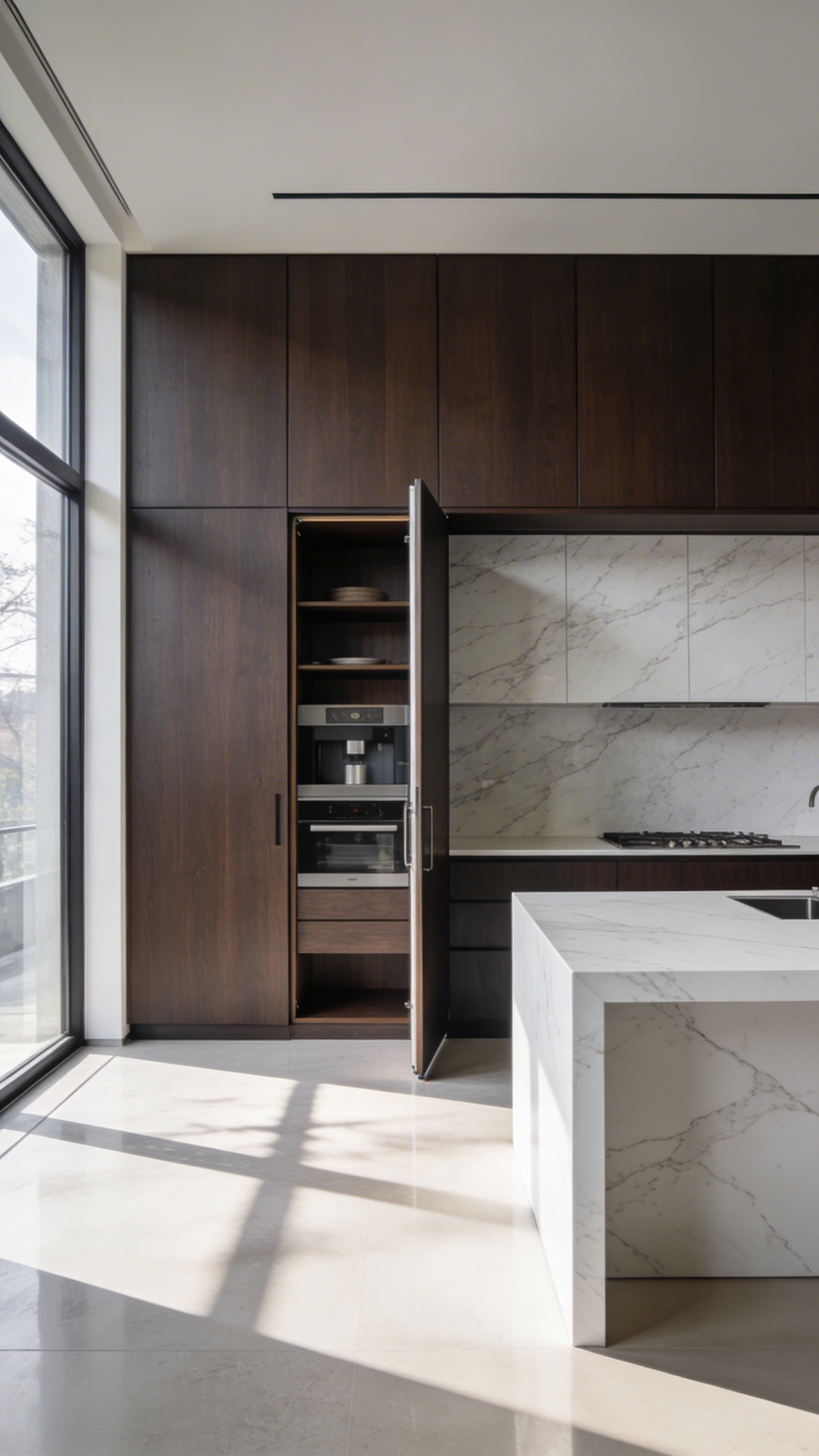
Achieving this silence requires precision engineering. Pocket and coplanar doors slide seamlessly to maintain a flush, wall-like appearance. Invisible hinges from leaders like SOSS eliminate the visual clutter of traditional hardware. The eye rests on clean lines rather than functional gaps. Beyond optics, acoustic control is equally vital. Motorized servo-drive systems replace the sharp “clack” of cabinetry with a muffled, luxurious silence.
Psychologically, this reduction of sensory noise directly manages cognitive load. Environmental psychology suggests that visible clutter triggers low-level stress responses. Hiding appliances creates a restorative atmosphere. Nevertheless, extreme minimalism carries a risk of sterility. To counter this “hospital effect,” designers incorporate tactile warmth. Using heavily grained riven oak or honed stone ensures the space retains its soul. Innovations like slide-to-hide worktops turn the kitchen into a piece of sculpture when not in use.
12. Lighting as Sculpture: Pendants Using Woven or Mineral Materials
Modern kitchens often feel dominated by cold, hard surfaces like quartz and stainless steel. These spaces require a bridge between clinical utility and natural warmth. Lighting serves as the essential “humanizing” element.
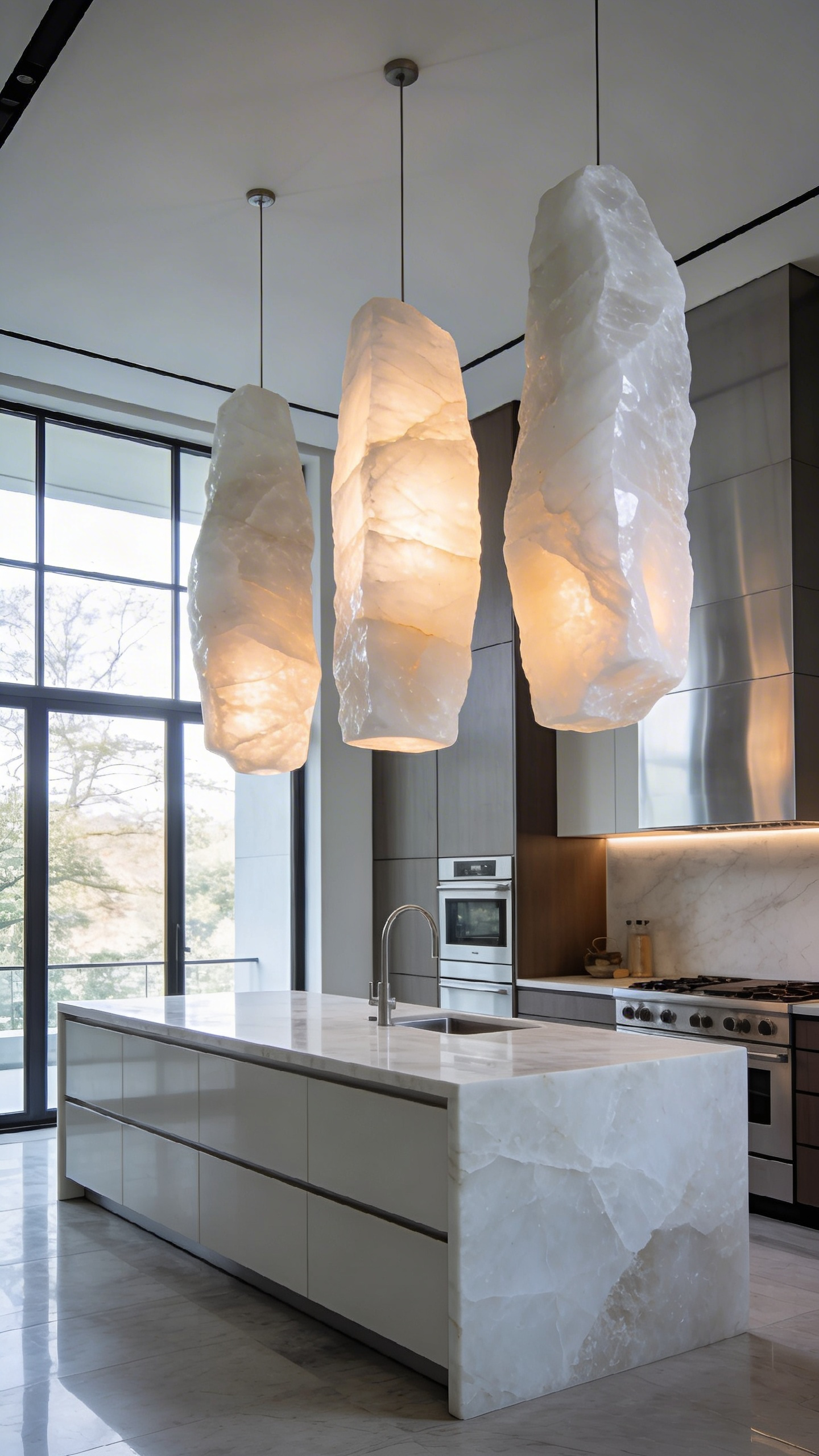
Consider mineral pendants crafted from alabaster, selenite, or rock salt. Unlike glass, which merely reflects beams, these semi-translucent stones trap light within their crystalline structures. They function as “glowing monoliths.” This creates a soft, ethereal counterpoint to the sharp, directional task lighting required for food prep. Historically, materials like alabaster were used to diffuse harsh sunlight. Today, however, they act as “static fire,” changing the emotional gravity of the room.
Alternatively, woven fixtures offer a distinct architectural advantage. Materials like rattan and abacá function as kinetic sculptures. During the day, they provide organic, tactile texture. At night, they perform *chiaroscuro*, projecting dappled shadow patterns across flat cabinetry. Woven fixtures solve spatial issues in high-ceilinged rooms. Because they are physically light, a large 48-inch dome occupies volume without requiring heavy structural reinforcement.
Currently, the trend is shifting away from repetitive triplets of small lights. Ideally, designers now favor a single, massive sculptural piece to anchor the island. This revival is powered by modern LED technology. Previously, incandescent bulbs generated heat that damaged natural fibers. Now, low-heat engines allow delicate materials to thrive safely. These imperfect, natural textures transform a kitchen from a laboratory into a soulful gallery.
Theme 4: Living Ecosystems
Ideally, the modern kitchen moves beyond the concept of a sterile laboratory. Historically, designs like the Frankfurt Kitchen prioritized clinical efficiency above all else. However, contemporary furniture design treats the room as a “metabolic organ.” Cabinetry is evolving from static storage into active biological hubs.
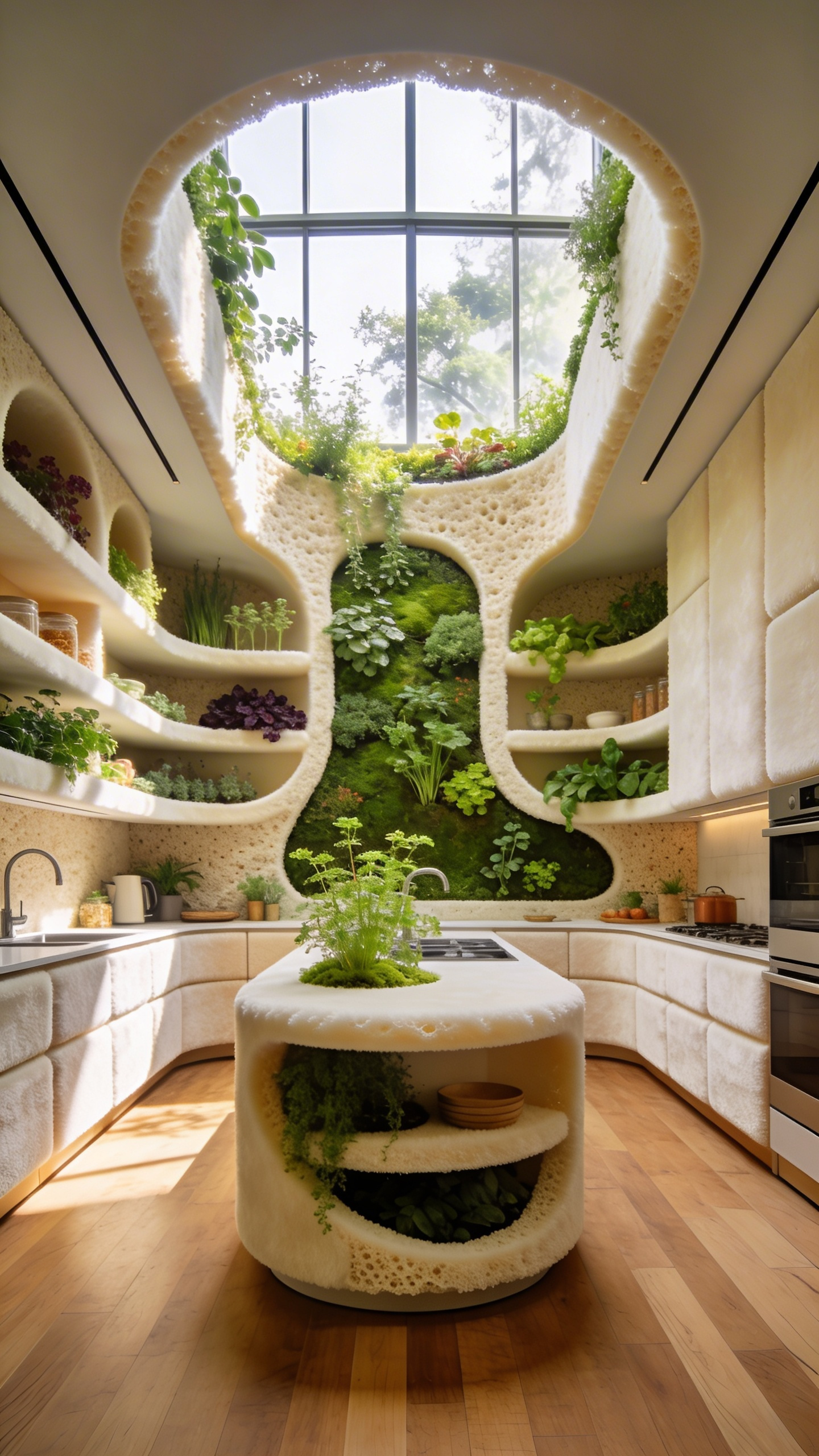
Manufacturers are innovating with mycelium, the root structure of fungi. Unlike cold stainless steel, these “grown” materials offer a warm, velvety-earthy touch. Mycelium composites are naturally fire-resistant and void of harmful toxins. They bridge the gap between high-tech function and biophilic design.
In addition to sustainable materials, the functionality supports a “farm-to-cabinet” lifestyle. Upper cabinets now often integrate hydroponic racks with specialized LED lighting. Inhabitants can harvest fresh herbs directly from the backsplash. Hidden irrigation systems often provide a soothing, rhythmic background sound.
The design cycle concludes with responsible waste management. Notably, brands are embedding Bokashi fermenters directly into workstations. Food scraps are processed in-situ without odors, thanks to activated charcoal filtration. This creates a circular system where the kitchen breathes, grows, and decomposes.
13. Bringing the Outside In: Drought-Resistant Botanical Styling
Modern kitchen architecture is shifting toward integrated “micro-xeriscapes.” Designers are carving planting troughs directly into stone islands. These lined niches transform furniture into living geological landscapes. This approach creates a “tactile tension” between polished quartz and structural flora. The kitchen is a thermally volatile environment. However, xeric species like the *Pencil Cactus* are evolutionarily suited for this. Their unique metabolism allows them to withstand flash heat from ovens.
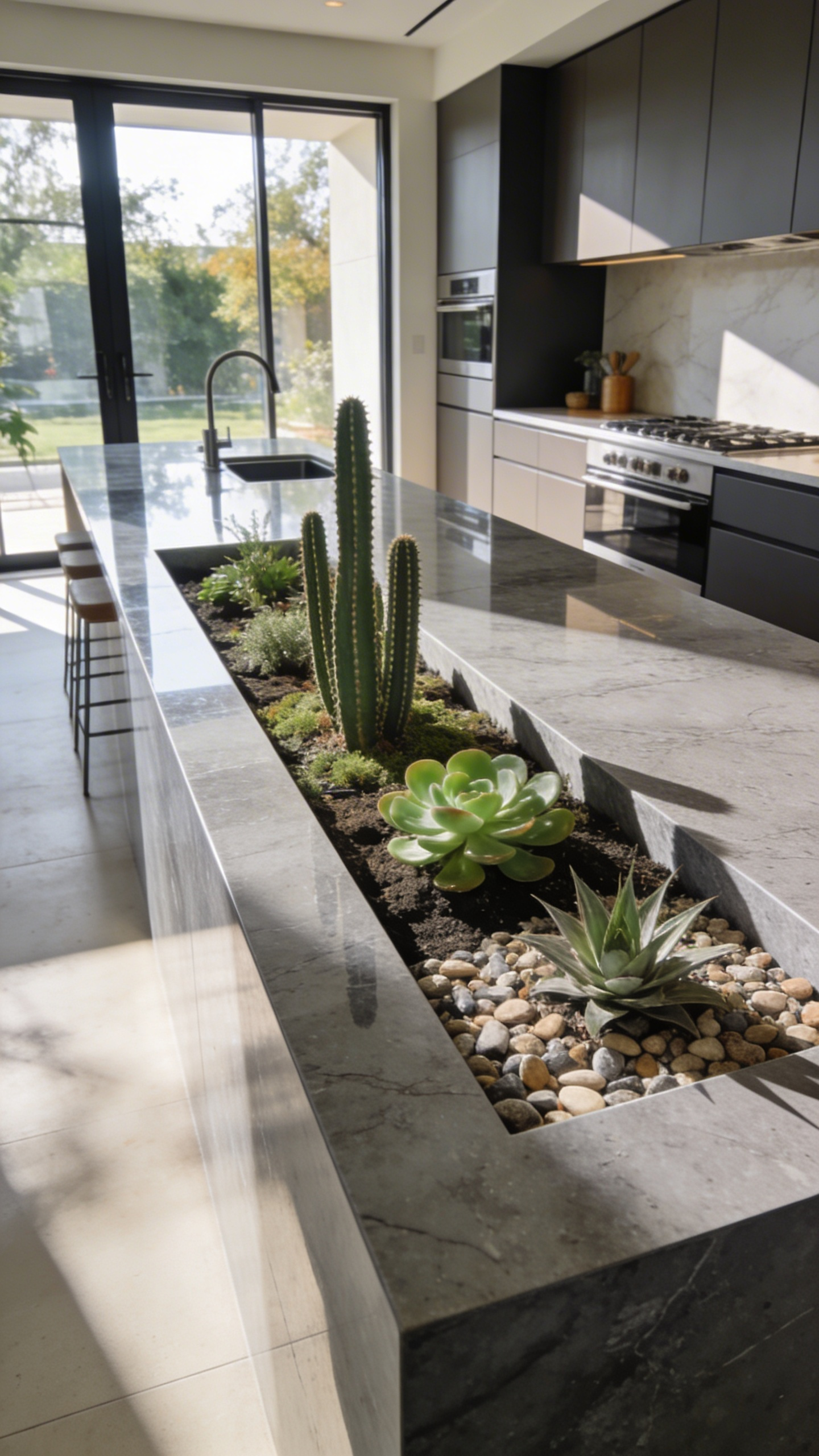
To support this, the material palette must echo arid environments. Porous terracotta vessels prevent root rot by mimicking desert drainage. Similarly, light-oak furniture complements the sun-bleached aesthetic of *Agave*. Functionally, woody herbs like rosemary bridge the gap between gardening and cooking. Integrating them into mobile kitchen carts optimizes sunlight exposure. This setup allows for easy movement between window and prep station.
Vertical space offers a canvas for “skeleton forest” styling. Notably, air plants mounted on wire-mesh cabinetry require absolutely no soil. They eliminate dirt spills on food-prep surfaces. This results in a clean, sculptural aesthetic that honors the minimalist lifestyle.
14. Indoor-Outdoor Transitions: Furniture that Flows to the Patio
The modern kitchen creates a seamless dialogue with the outdoors. Designers prioritize “Material Mimicry” to blur architectural boundaries. High-performance ultra-compact surfaces allow islands to extend outward without weather damage. Similarly, textiles play a crucial role in this sensory continuity. Advanced solution-dyed acrylics now mimic the soft hand of Belgian linen. Comfort remains consistent whether dining inside or lounging on the terrace.
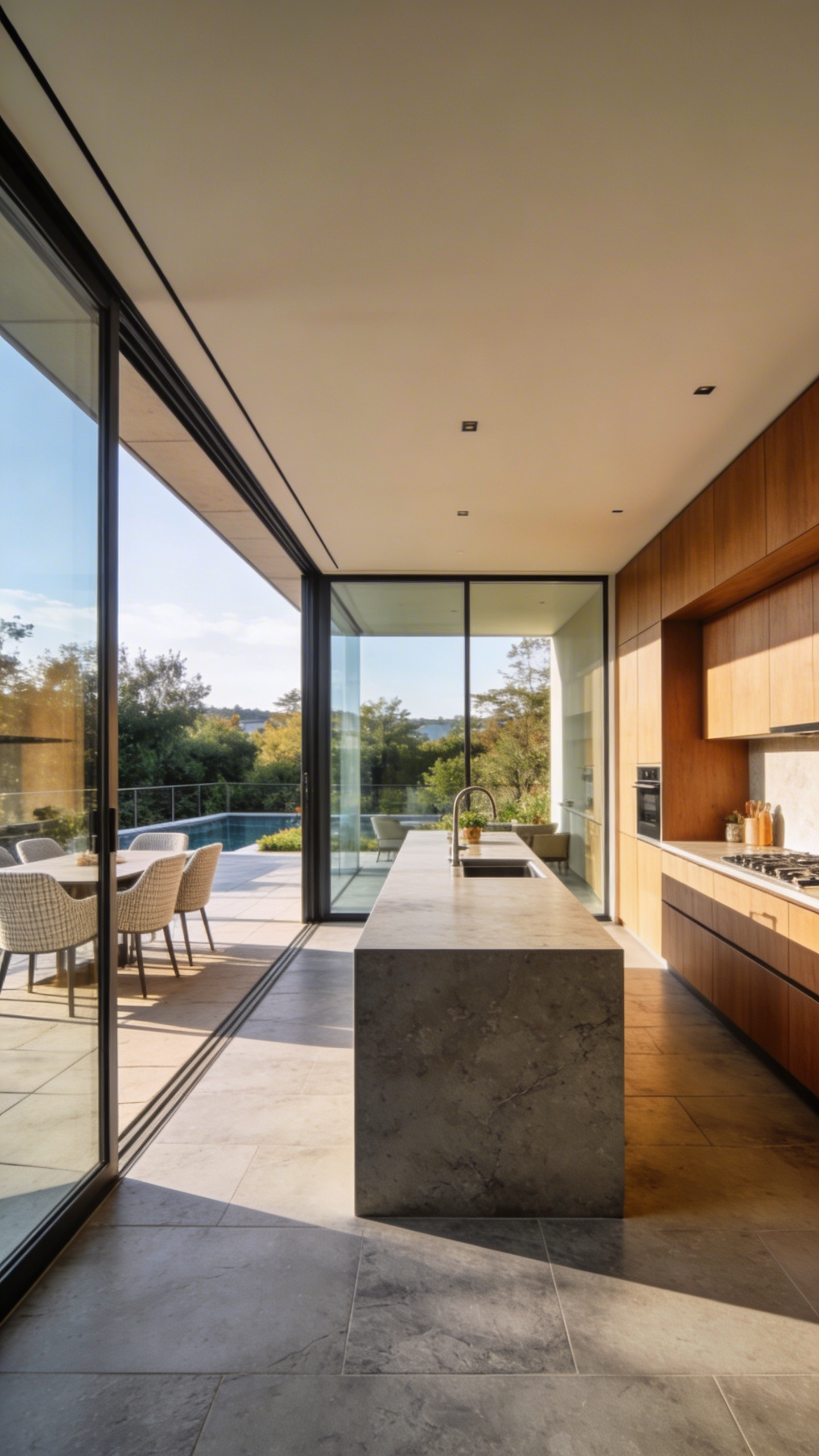
Beyond materials, structural furniture acts as a vital bridge. The “Passthrough Bar” effectively anchors both zones together. By integrating stool seating on both sides, this element becomes a social hinge. Additionally, the physical arrangement of furniture impacts visual flow. Designers often utilize cabinetry with slender legs to create a “floating” aesthetic. Ideally, this alignment works with flush flooring to guide the eye outward.
Texture bridges the gap between raw nature and interior architecture. Woven accents like rattan signal that two zones are functionally one. Conversely, visual clutter can disrupt this calm atmosphere. Experts recommend hiding industrial outdoor appliances behind matching cabinetry panels. This ensures the patio feels like a warm domestic extension.
15. Sustainable Textile Integration: Linen and Hemp Seat Cushions
Selecting the right textile for kitchen seating requires looking beyond mere aesthetics. Linen and hemp offer superior structural integrity compared to cotton or synthetics. This durability exists because of pectin, a natural glue-like carbohydrate found in the plant walls. Constant friction does not cause the fabric to thin or pill. Instead, the fibers realign and become more supple with daily use. These cushions function as “living textiles” that actually improve physically over time.
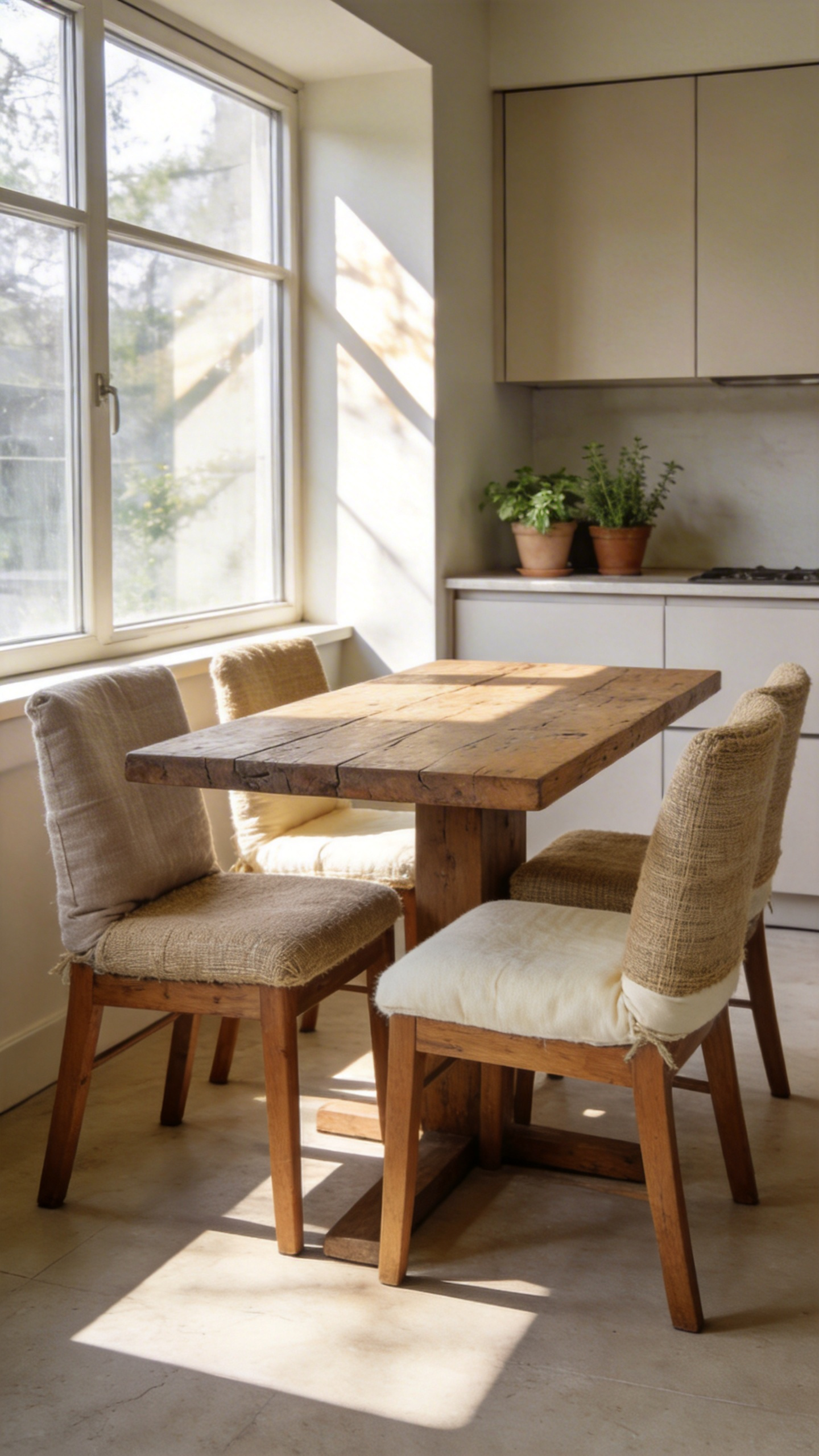
Beyond durability, these bast fibers provide essential thermoregulation for the kitchen environment. Because the fibers are naturally hollow, they create a “micro-chimney” effect within the weave. As a result, air circulates freely, keeping the surface 3–4 degrees cooler than the ambient air. This haptic cooling is vital in sun-drenched breakfast nooks. Conversely, synthetic foams often trap heat and feel clammy. Hemp and linen ensure hygienic comfort even in high-humidity cooking spaces.
Visually, these materials introduce a refined “wabi-sabi” element to modern interiors. Designers favor hemp-linen blends to balance structural weight with an elegant sheen. The natural “slub” or uneven texture effectively hides minor spills and stains. These textiles support a regenerative environmental narrative. Hemp acts as a bio-accumulator, sequestering significant carbon during its growth cycle. Incorporating heavyweight hemp canvas transforms furniture into a functional carbon sink, blending performance with clean, minimal design.
16. The Curated Countertop: Functional Ceramics and Stone Artifacts
Modern kitchen design frequently prioritizes sleek, hidden surfaces. Yet, a sterile environment often lacks soul. Consequently, the “Curated Countertop” movement is gaining traction, shifting focus toward the “living kitchen.” This design philosophy champions the intentional placement of artisanal objects to create a narrative-driven space.
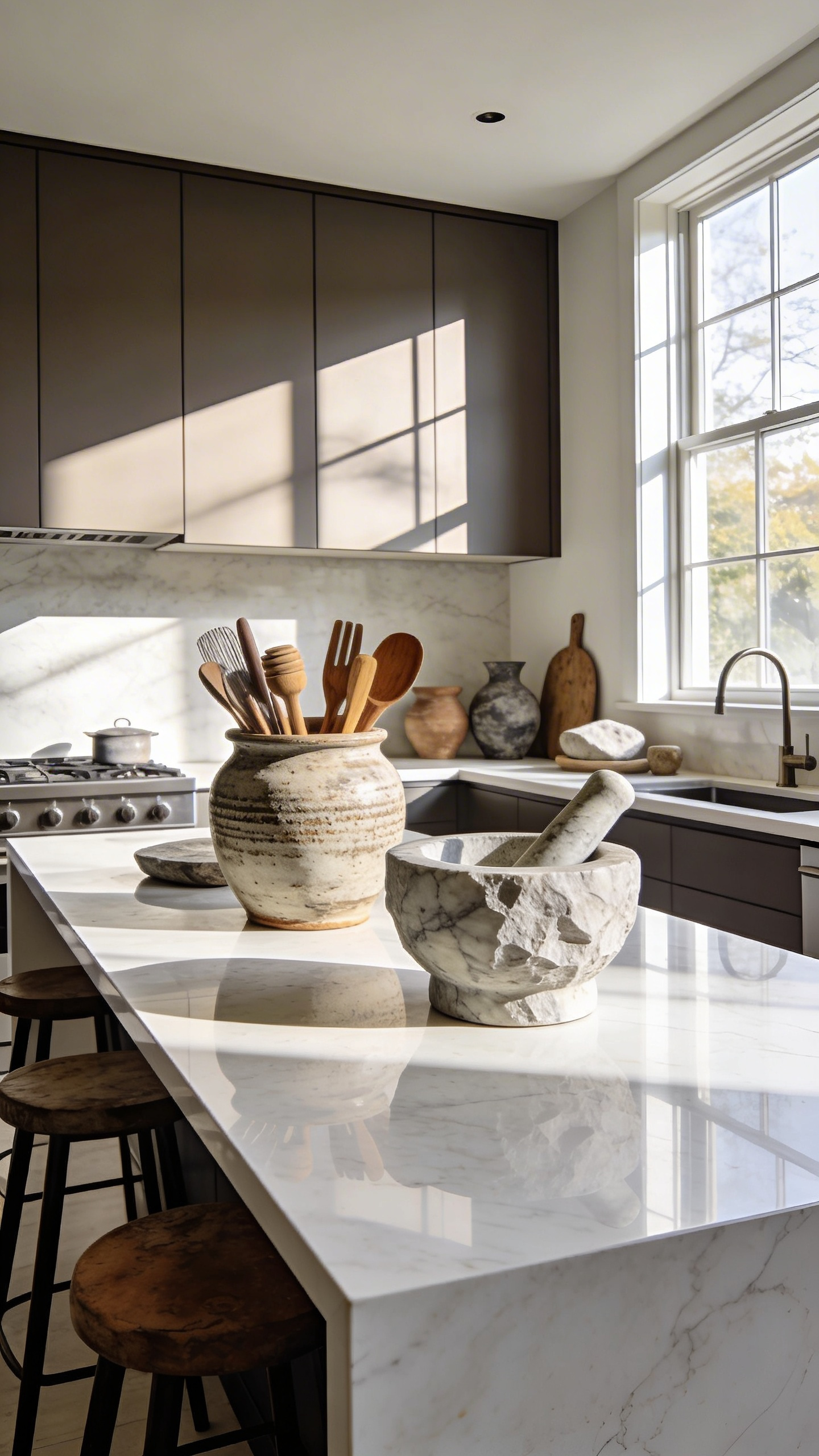
Specifically, this approach introduces a concept known as “Material Tension.” Imagine a hand-thrown stoneware crock placed against polished quartz. The rough, unglazed *shino* texture provides necessary haptic feedback. Therefore, the kitchen feels grounded rather than merely manufactured. This sensory contrast breaks the visual monotony of smooth, non-porous furniture planes.
These objects serve as functional history. A heavy basalt pestle offers a “weight of utility” that mass-produced metal tools cannot replicate. Visually, designers often employ an “Apothecary Aesthetic.” In this style, tools remain visible and accessible, rejecting the “appliance garage” mentality. Stone artifacts like soapstone weights provide essential thermal mass for culinary tasks.
Curation requires discipline to avoid simple clutter. Ideally, utilize “Material Foundations” like a raw marble slab to stage items together. This creates a composed “micro-landscape” rather than a random scattering. Over time, these natural materials develop a unique patina. An oil-stained mortar or crazed ceramic pitcher tells a story of nourishment. Stone and high-fired ceramics are sustainable “forever materials.” The countertop transforms from a workspace into a gallery of human experience.
Frequently Asked Questions
What are the best furniture ideas for a luxury kitchen?
Luxury kitchen design currently prioritizes “bespoke cabinetry” and monolithic stone islands. Key furniture elements include “unfitted” pieces like freestanding dining tables and sculptural bar stools that utilize living materials such as unlacquered brass and reclaimed old-growth timber.
How do I choose materials for kitchen furniture that will last?
For longevity, focus on high-density materials with a high “Light Reflectance Value” balance. Reclaimed hardwoods like American Chestnut and natural stones like quartzite or marble are ideal because they develop a beautiful patina rather than deteriorating with use.
What is the trend of “unfitted” kitchen furniture?
The unfitted kitchen trend replaces monolithic, wall-to-wall cabinetry with individual, character-rich pieces. This includes islands on tapered legs, freestanding “Dairy Tables,” and open shelving, all designed to make the kitchen feel like a curated living room rather than a sterile workspace.
Conclusion: Designing for Longevity and Environmental Connection
Ultimately, designing a kitchen is not merely about aesthetics, but about long-term stewardship. By prioritizing living materials and adaptive systems, we transform the room into a restorative sanctuary. The space shifts from a sterile laboratory to a vibrant, breathing environment. This approach embraces the “patina of use,” proving that natural imperfection is actually a strength. To explore how these elements look in practice, you can view various kitchen aesthetic ideas that highlight the beauty of organic transitions.
This philosophy ensures your kitchen remains relevant for decades, not just seasons. As a result, the “disposable” renovation becomes obsolete in favor of lasting heritage. We build personal legacies rather than generating waste. Begin by auditing your current material palette for tactile warmth and structural integrity. Seek out surfaces that deepen with age and joinery that allows for simple repair. Let these kitchen furniture ideas serve as a permanent bridge to the natural world, ensuring your home heals and endures alongside its inhabitants.