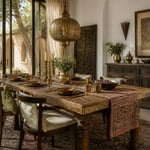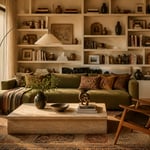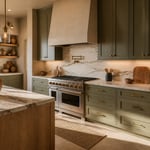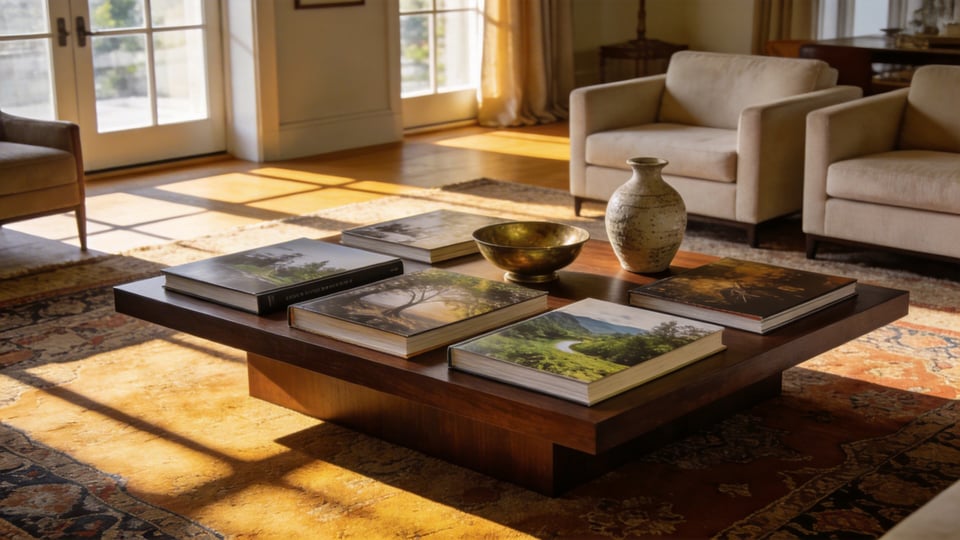
Too often, the coffee table is treated as a simple, peripheral utility. For many, it serves merely as a landing pad for mugs or remote controls. Yet, this unassuming surface has quietly transitioned into the “silent protagonist” of the modern home. Finding the right coffee table ideas involves more than selecting a flat surface. Instead, it functions as a curated microcosm where social ritual and design converge. Ignoring its potential represents a missed opportunity for profound spatial storytelling and a reflection of your aesthetic values.
Historically, the concept of low-surface living fostered intimacy. From the communal warmth of the Ottoman *korsi* to the Japanese *chabudai*, these pieces were designed for lingering. Today, the modern table acts as a “mini-museum” of the self. Indeed, environmental psychologists argue that your curation here serves as a psychological “tattoo for the home.” Whether displaying “sumptuous” volumes or ancestral heirlooms, these objects signal specific values and cultural capital.
This guide reveals the art of transforming a table into a canvas for cultural narrative. We explore how “material honesty”—from wabi-sabi wood to Oaxacan clay—creates a multi-sensory experience. Next, we analyze the role of the “coffee table book” as a strategic tool for identity display. Finally, we contrast the safety of strict curation with the authentic, lived-in warmth of “cluttercore.”
Philosophy: Moving Beyond Surface Decoration to Storytelling
At its core, the coffee table serves as a stage for “narrative curation” rather than simple utility. This furniture piece evolved from low tables like the Ottoman *korsi* to facilitate intimate gatherings. Consequently, when exploring sophisticated coffee table design ideas to elevate your living room style, remember the history. The drop in height signaled a cultural shift from stiff ceremony to relaxed conversation. To maintain this depth, we must look beyond superficial decoration.
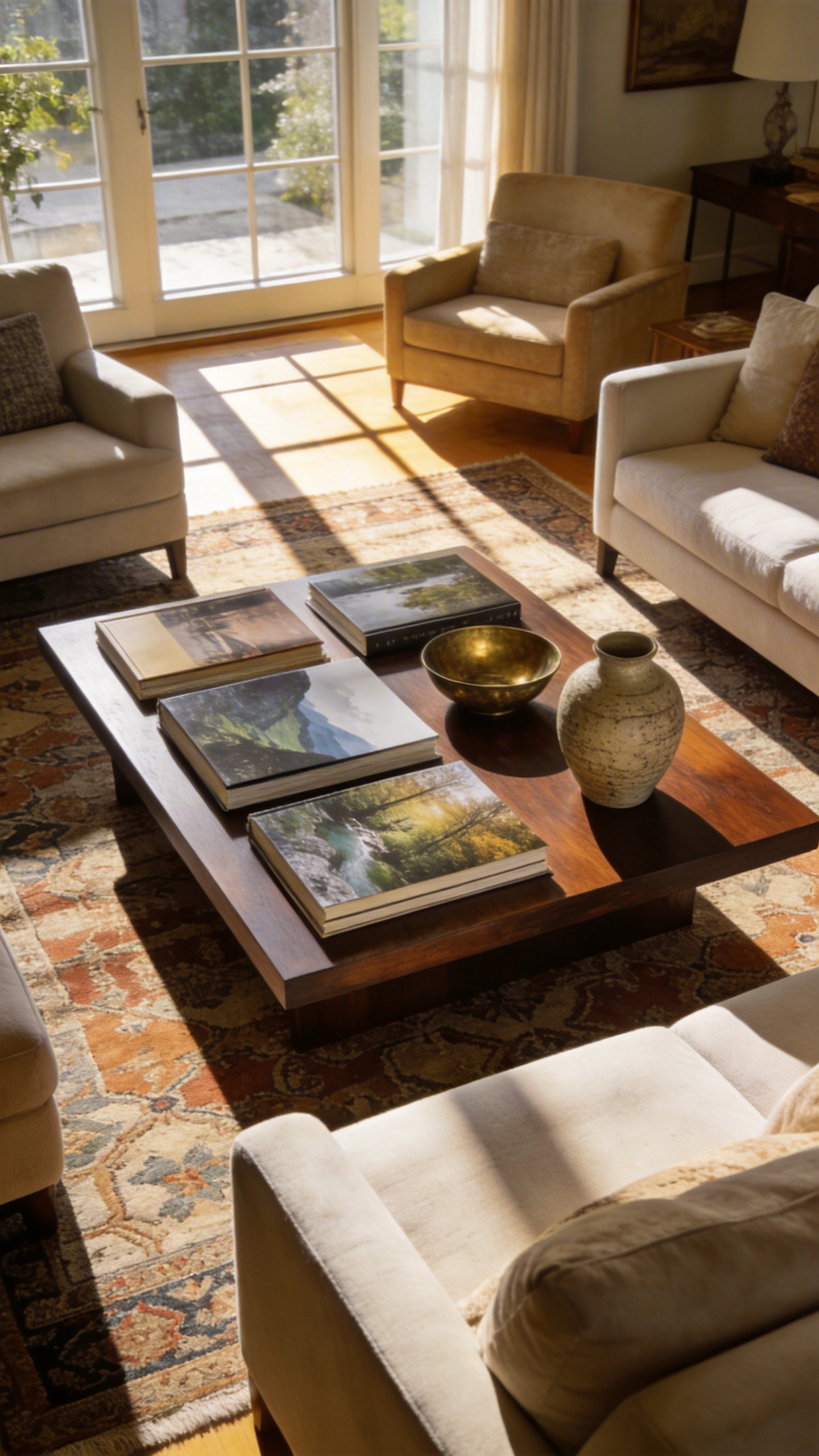
Specifically, the original “coffee table book” was created by the Sierra Club for environmental activism. Therefore, books should act as heavy, physical anchors of your identity, not just color-matching props. Renowned designer Axel Vervoordt suggests incorporating “objects with a soul” to deepen this narrative. This approach embraces *wabi-sabi*, finding distinct beauty in the imperfect, aged, or incomplete.
Instead of “instant room reveals,” the “slow decorating” movement encourages collecting meaningful pieces over decades. Thus, a truly sophisticated arrangement rejects the mass-produced in favor of the “found.” A curated vignette engages the senses through contrasting textures, like cold marble against rough wood. In doing so, the table becomes a visual journal, telling the authentic story of its owner.
Foundation: Selecting Sculptural Silhouettes that Command Space
To truly command space, you must first reject the traditional “four-legged” norm. Eero Saarinen famously described the underside of standard furniture as a “slum of legs.” Consequently, he introduced the pedestal base to clear this visual clutter. By reducing support to a single fluid stem, the design creates a “negative space vacuum.” The floor breathes, and the tabletop appears to float effortlessly.
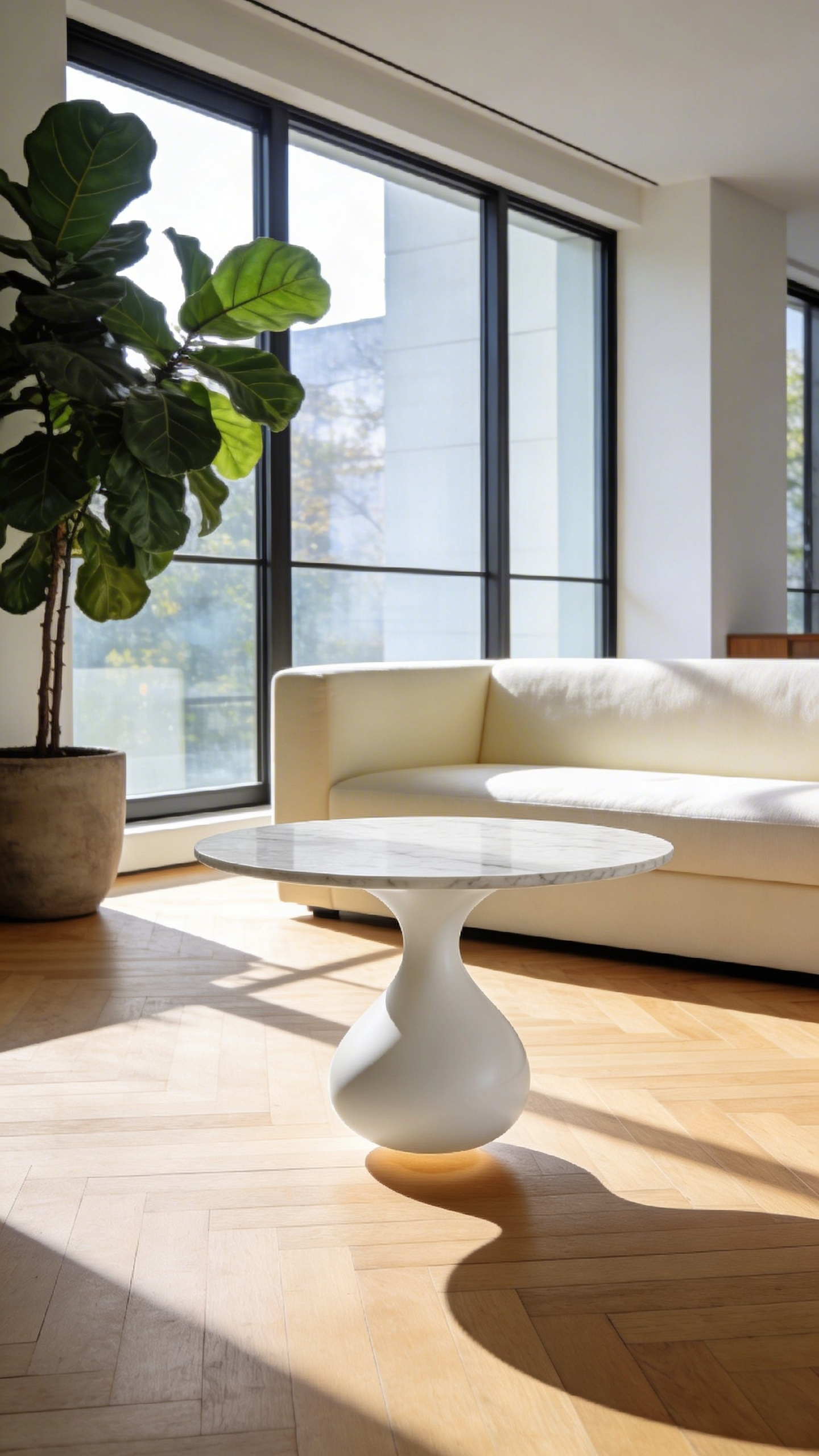
A commanding silhouette often relies on dynamic movement. Isamu Noguchi’s biomorphic designs, for instance, utilize asymmetric balance. As a result, the table’s base changes shape depending on your viewing angle. This fluidity prevents the eye from resting. It forces a constant re-engagement with the object.
Conversely, current design trends are shifting toward “monolithic mass.” Brutalist-inspired tables, often carved from single blocks of travertine or fiber concrete, serve as grounding anchors. In open-concept spaces, this heavy, hard-edged silhouette provides necessary visual friction against soft textiles. It effectively defines the seating zone through sheer perceived weight.
Finally, the most daring silhouettes utilize the cantilever. These architectural designs feature overhangs with no visible support, creating powerful visual tension. The viewer’s brain instinctively questions the balance, ensuring the table commands absolute attention.
Materiality: The Art of Mixing High-Gloss Metals with Raw Woods
Fusing high-gloss metals with raw woods creates a fascinating study in materiality. Specifically, this combination transforms a functional coffee table into a complex sensory narrative. Designers leverage this “sensory dialogue” to influence human psychology. Polished chrome, for instance, appears “restless” because it reflects light energetically. Conversely, raw, open-pore wood feels “rooted” and inherently safe. Therefore, combining them creates a “balanced anchor.” The metal prevents a rustic look, while wood softens clinical sterility, a hallmark of luxury living room furniture choices.
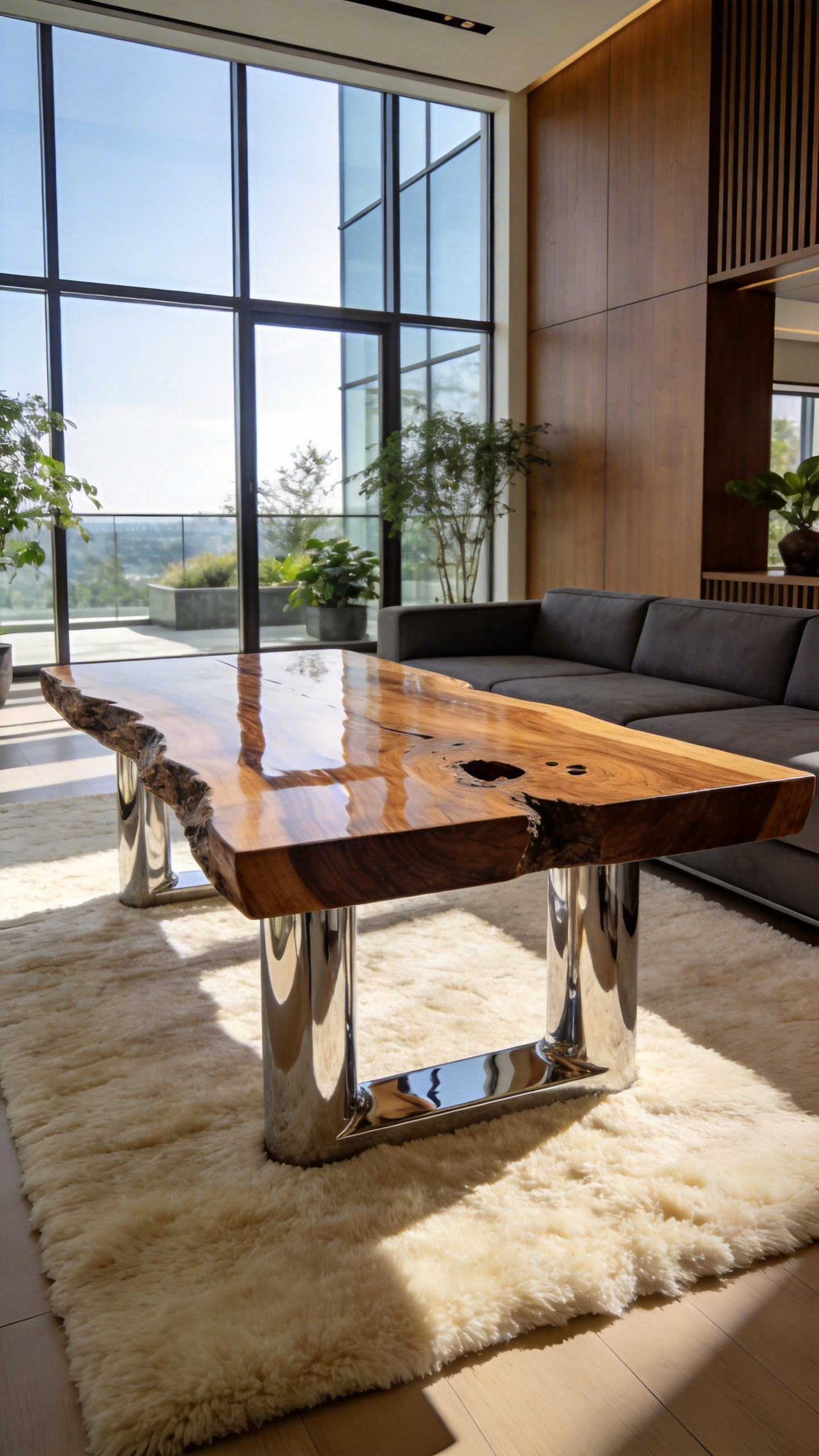
However, this pairing requires overcoming a conflict between organic movement and industrial rigidity. Solid wood breathes. It expands and contracts with daily humidity changes. In contrast, metal remains structurally static. Consequently, master craftsmen must utilize slotted mounting holes rather than simple screws. This hidden engineering allows the wood to “slide” laterally as seasons change. Without this, the tension would inevitably cause warping.
Modern techniques elevate this union beyond structural necessity. Artisans now use cold-spray “liquid metal” finishes to fill natural wood voids. Similarly, high-gloss brass “butterfly” joints turn repairs into luxury statements. Ultimately, this aesthetic celebrates the harmony of opposites, blending the ancient with the futuristic.
The Anchor Piece: Using Artisanal Trays to Define Boundaries
Think of an artisanal tray as a rug for your furniture. Fundamentally, it transforms scattered objects into a cohesive vignette. Without this boundary, a remote and candle look like clutter. Placing them within a tray signals belonging to the brain. Specifically, this “zoning” reduces visual anxiety in high-traffic areas. A sharp rectangular tray offers a sense of mathematical stability. Conversely, organic shapes like Japanese *Wagatabon* trays encourage social flow by softening the room.
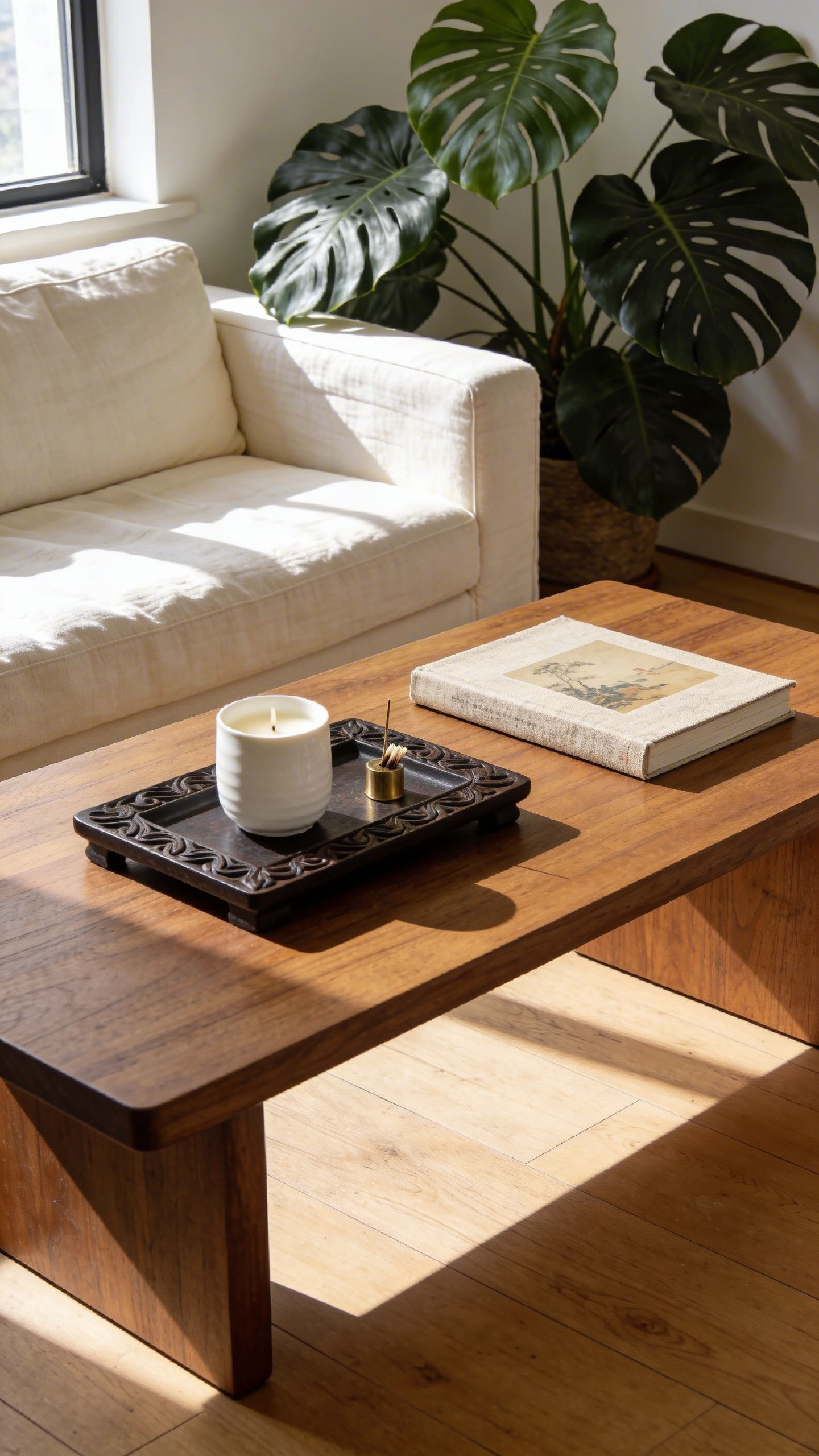
Beyond visuals, the material dictates the room’s sensory narrative. Consequently, the tray acts as a physical anchor. A heavy white marble tray suggests permanence through its solid sound. In contrast, a hand-hammered brass tray adds an energetic, metallic layer. Finishes like Japanese lacquer evolve over time. Eventually, they reveal under-layers, creating a unique story of *wabi-sabi* on your table.
To effectively anchor the space, scale is critical. Ideally, follow the “Two-Thirds Rule” for proper proportions. The tray should occupy roughly two-thirds of the table’s surface. Subsequently, this foundation supports the “Visual Triangle” styling technique. Simply place a tall vase, a flat book, and a sculptural object inside. This intentional asymmetry keeps the arrangement curated, maintaining beauty amidst daily chaos.
Verticality: Creating Architectural Height with Stacked Art Books
Transforming a flat coffee table requires a deliberate exercise in verticality. Essentially, art books function as architectural pillars that break a room’s dominant horizontal lines. Decorators stack heavy volumes to create “miniature skyscrapers.” These structures draw the eye upward, adding authority to low surfaces.
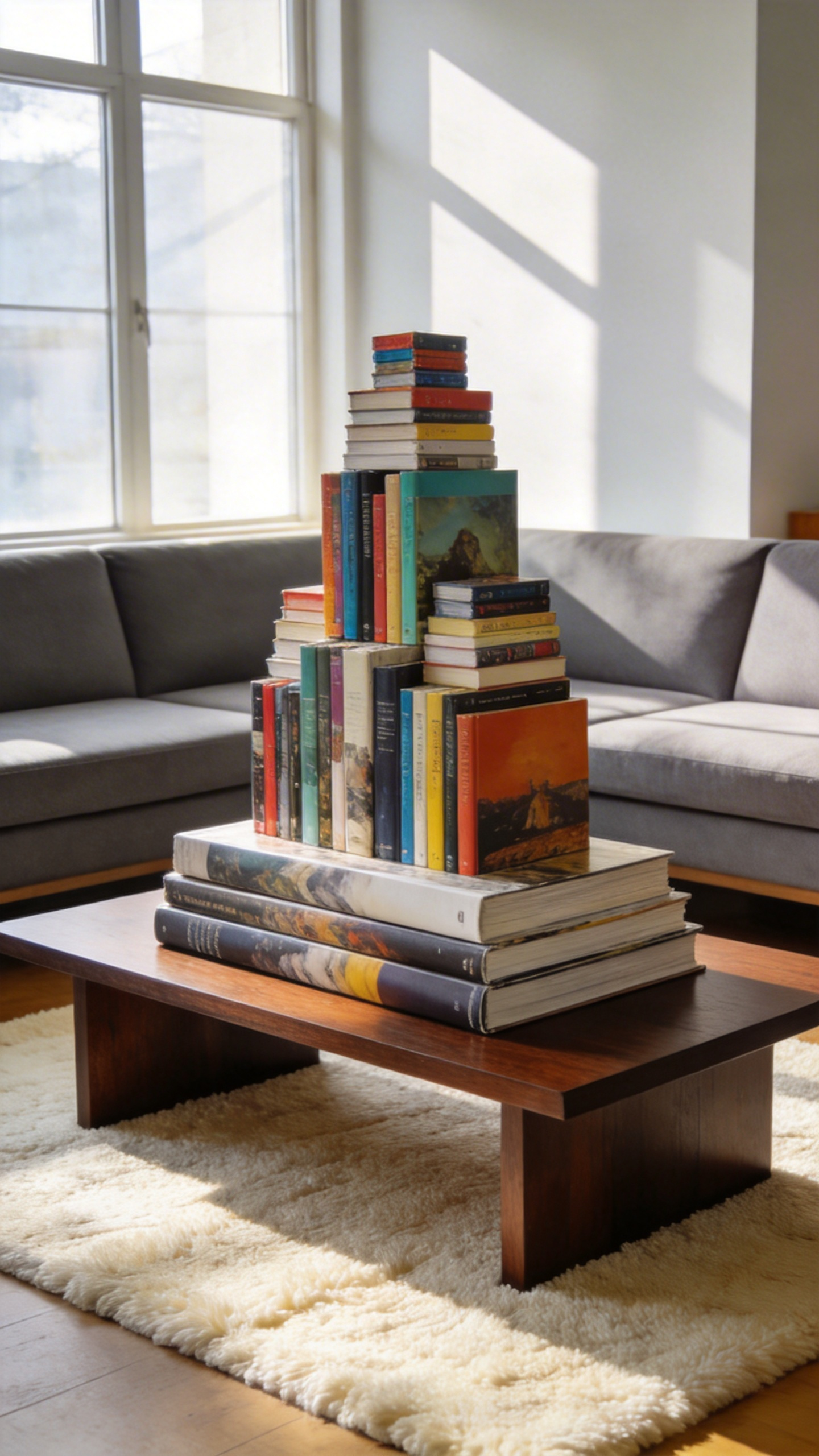
To achieve structural integrity, you must apply the “Pyramid Principle.” Start with a large “anchor” book, like a landscape-format Taschen monograph. Subsequently, layer smaller volumes on top to form a stable, visual pyramid. Aim for a stack of three books. This odd number creates movement without overwhelming the table.
Moreover, the materials themselves contribute to this architectural weight. Matte covers absorb light, resembling solid stone blocks. In contrast, glossy finishes reflect light, creating visual noise. Therefore, designers often favor the “suede” texture of matte lamination to emphasize volume. Additionally, heavy paper weight adds necessary “heft” to the structure.
Finally, consider the alignment of the spines. Precisely aligning them creates a sharp, Modernist vertical line. Alternatively, staggering the books mimics the setbacks of a skyscraper. This “Brutalist” approach adds dynamic shadow and texture. Crown the stack with a “capstone” object, like a brass bowl. This final touch acts as a spire, completing the vertical narrative.
The Rule of Odd Numbers: Asymmetry as a Design Principle
The “Rule of Odd Numbers” is more than a simple decorating trick. It is rooted in ancient philosophy. Specifically, the Japanese aesthetic of *Fukinsei* celebrates asymmetry over perfection. Unlike Western symmetry, which often feels static, odd numbers introduce “dynamic equilibrium.” Consequently, a grouping of three or five items feels organic rather than staged. It mirrors nature, where branches grow unevenly and rivers curve naturally.
Science explains why these arrangements engage us. Neuro-aesthetics suggests that perfectly symmetrical displays are easily ignored by the brain. Conversely, odd groupings create necessary “cognitive tension.” Because there is no center line to split the image, the eye is forced to move. This visual movement keeps a guest’s gaze lingering on your curated collection.
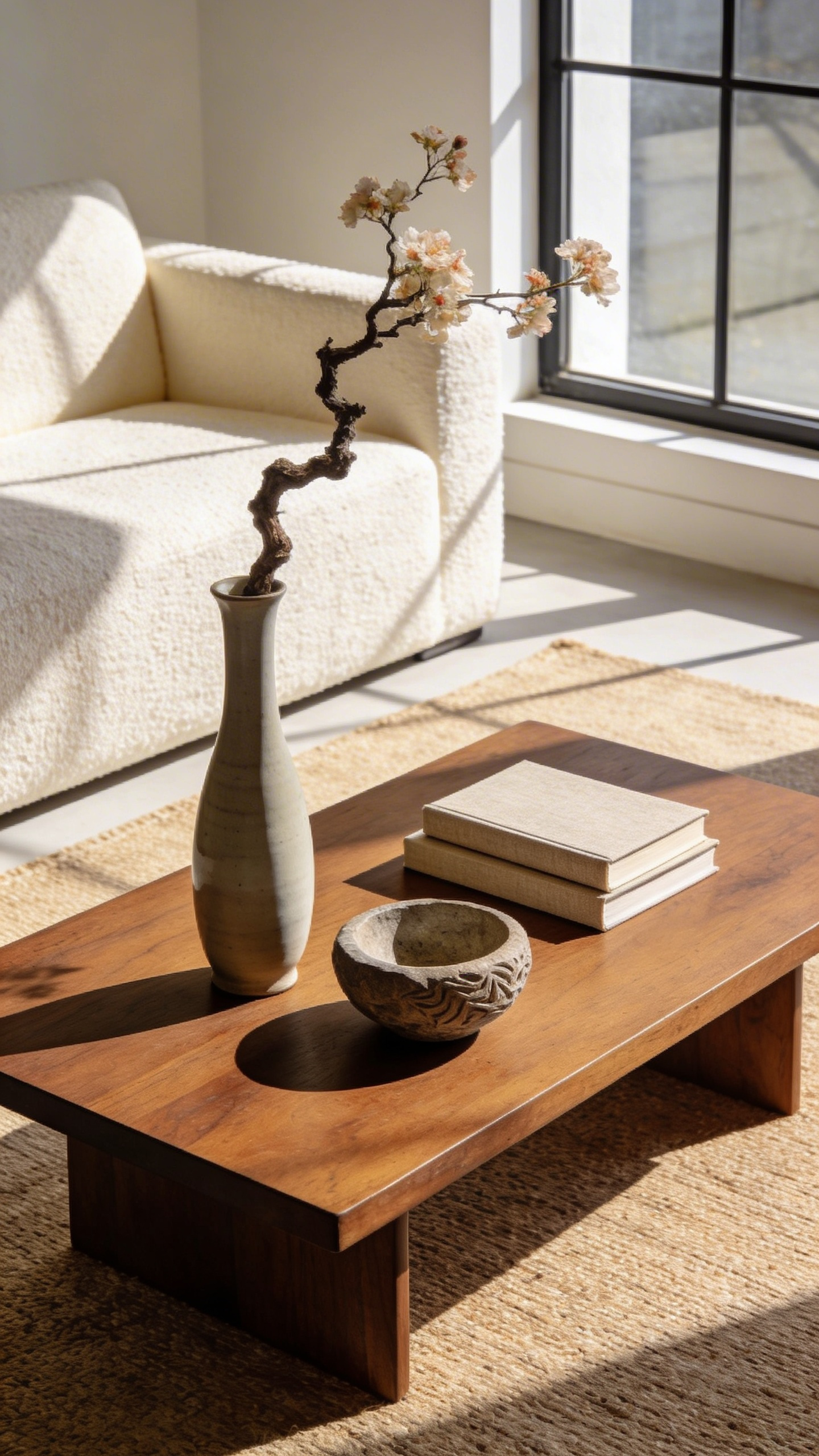
To master this on a coffee table, you must understand the “Footprint” methodology. A stack of books topped with a magnifying glass counts as just one unit. Therefore, aim for three distinct footprints rather than counting every single item. First, place a low, wide anchor, such as a substantial tray. Next, add a vertical element, perhaps a vase with organic branches. Finally, introduce a small curio or bowl to add texture. This distinct “high-medium-low” silhouette creates a stable yet energetic visual triangle. This approach transforms a flat surface into a compelling, lived-in story.
Heirloom Integration: Honoring Provenance in Modern Contexts
Think of the coffee table as a “secular altar” within a living space. Unlike seating, which focuses on comfort, this central piece demands visual engagement. Consequently, integrating heirloom pieces creates a powerful psychological anchor. Materials like Burl Walnut or aged mahogany introduce sensory depth that mass production cannot replicate. The “chaotic” grain patterns of these character woods provide tactile relief against flat, modern surfaces.
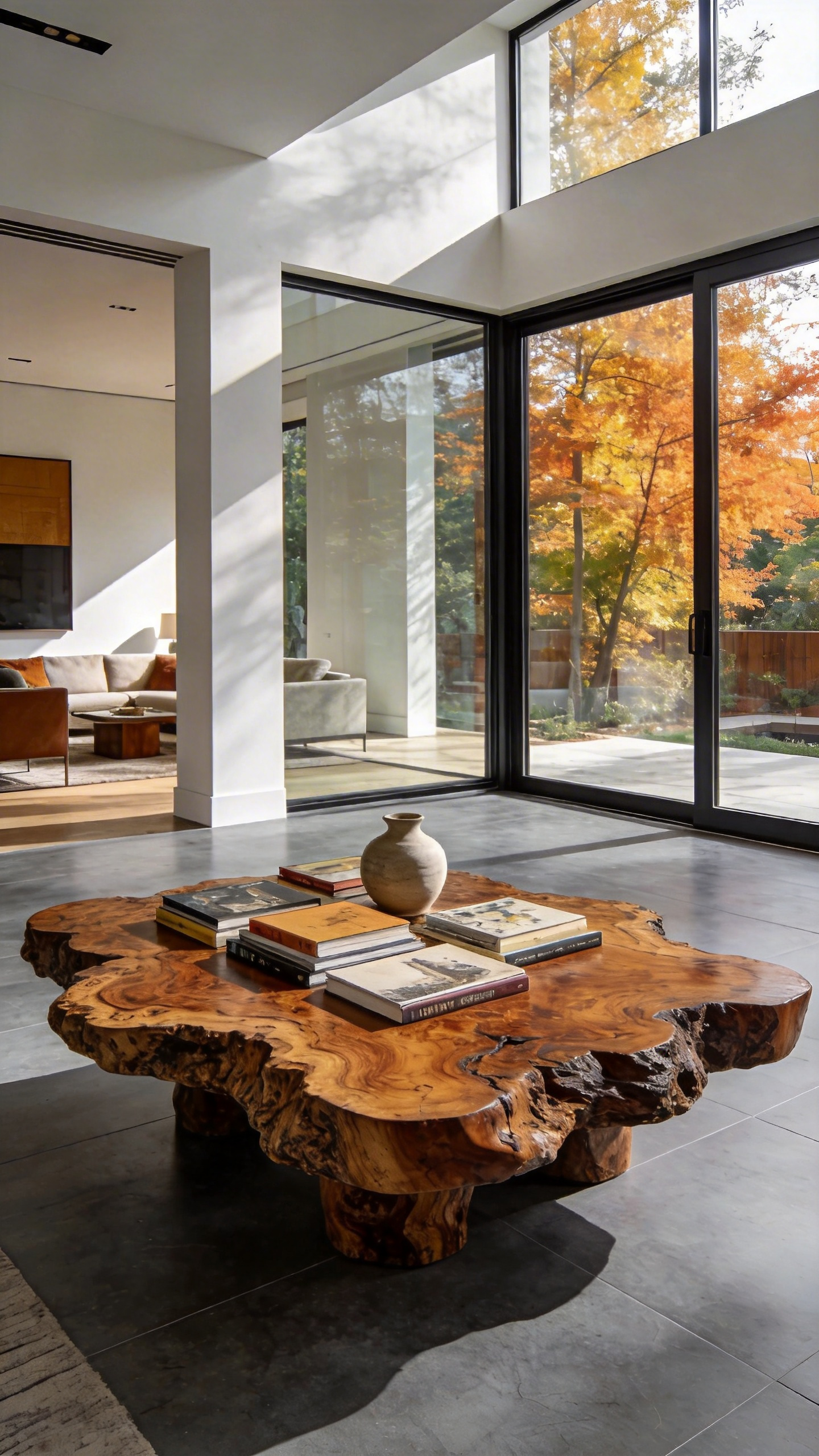
However, to prevent heavy woods from overwhelming a room, rely on material juxtaposition. Pair a heavy 19th-century table with clear acrylic chairs to “lift” its visual weight. Furthermore, true provenance is authenticated by patina rather than perfection. Resist the urge to use chalk paint. This erases historical value. Instead, embrace the “poetry of use,” where scratches or rings become part of the object’s ongoing narrative.
If the table itself is modern, curate “micro-provenance” directly on the surface. An ornate antique silver tray gains significant visual power when placed on a stark, black marble top. This contrast creates a dialogue between eras. This approach honors the hands that built the piece. It transforms a transient space into a home with a lasting sense of place.
Global Fusion: Pairing Contemporary British Ceramics with South Asian Brass
Pairing these materials requires viewing the table as a dialogue between “Altered Earth” and “Living Metal.” Specifically, this design strategy relies on a “tactile symphony” to balance visual weight. Contemporary British ceramics, often featuring soda-fired surfaces, provide a matte, “absorbent” texture that feels geological. South Asian brass, on the other hand, introduces a reflective, conductive brilliance that evolves over time. Placing a high-shine Urli bowl alongside a rough-textured stoneware vase creates a dynamic interaction.
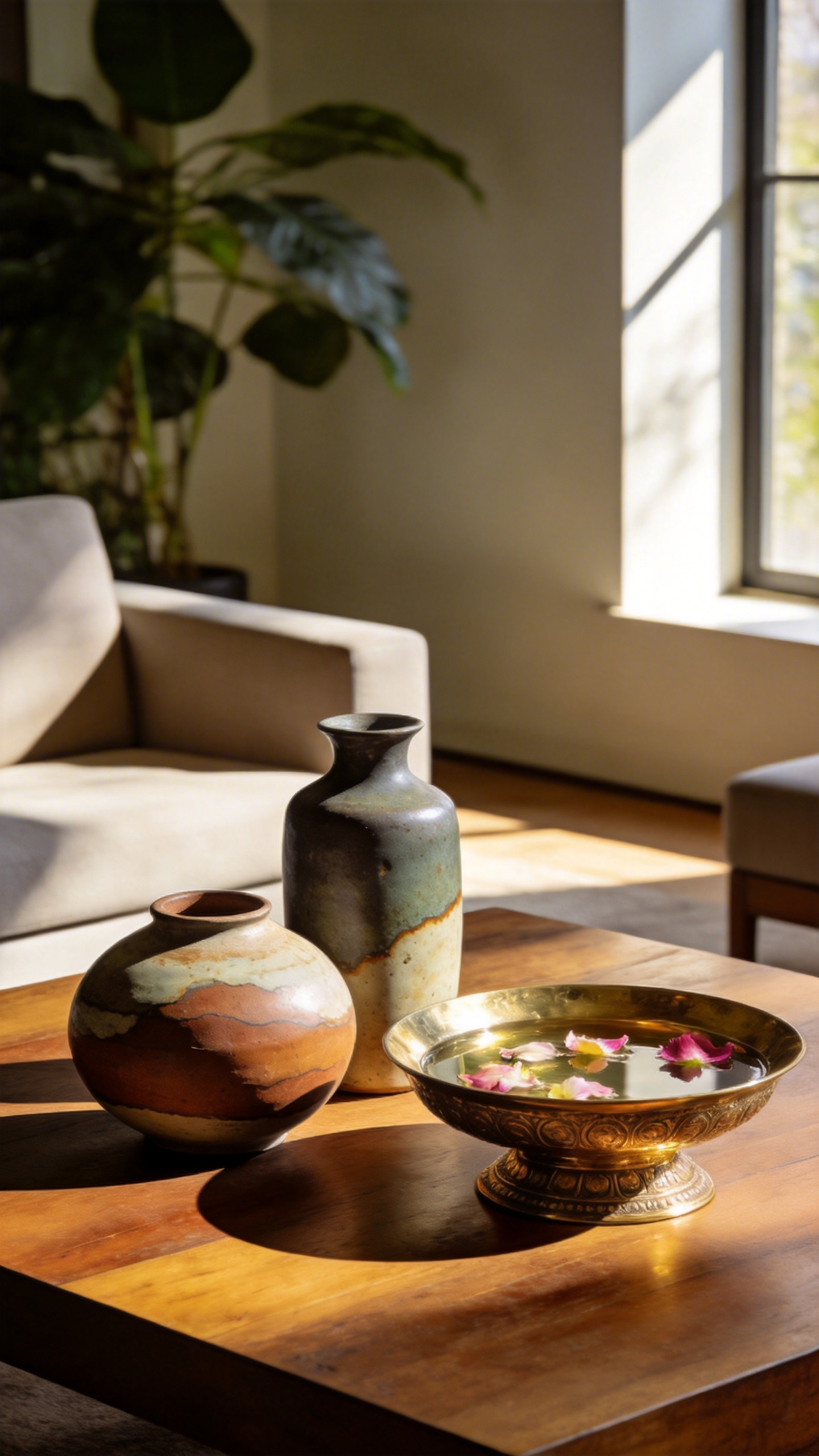
This contrast prevents a display from feeling flat by establishing a “Yin and Yang” of light. Beyond aesthetics, this combination honors a deep historical lineage of cross-cultural exchange. Modern designers like Maham Anjum actively bridge the gap between British luxury and traditional craftsmanship. Consequently, styling these items requires a curated, narrative approach.
To master this look, effectively utilize the “Rule of Three.” First, establish a foundation with a wide brass tray to anchor the arrangement. Next, add a vertical British ceramic vessel to provide necessary height and stability. Finally, allow for ample “negative space” around these distinct objects. This breathing room ensures the intricate cultural narrative shines without overwhelming the viewer.
Textile Layers: Softening Hard Edges with Vintage Runners or Swatches
We often treat styling as a purely visual exercise. However, introducing textile layers transforms this centerpiece into a multisensory experience. Specifically, this technique softens the psychological hardness of modern furniture. Often, living rooms feature sharp angles and cold, reflective surfaces like glass or stone. Adding vintage runners offers a sense of “soft fascination.” Naturally, textures like wool or aged linen stimulate tactile receptors. These soft touches can trigger calming brain responses by grounding the senses.

Additionally, specific textiles inject rich narrative into a contemporary space. Indian Kantha and Japanese Boro are excellent choices for this purpose. Kantha, hailing from Bengal, traditionally repurposes old saris with intricate running stitches. Similarly, Boro highlights the beauty of survival through patched, indigo-dyed fabric. Placing a nubby Kantha swatch on a smooth marble table creates a striking material dialogue. It makes the stone feel approachable while highlighting the fabric’s history.
This layering also serves a practical acoustic purpose. Hard surfaces typically reflect sound waves, contributing to auditory clutter. Thus, a porous textile absorbs the sharp “clink” of a glass or book. Ideally, avoid rigid placement when styling these delicate pieces. Instead, try asymmetrical draping to break the table’s geometric lines. Let a runner trail off one corner to mimic a natural flow. This approach shifts the aesthetic from sterile to “Warm Minimalism,” turning a surface into a sanctuary.
Organic Interludes: Incorporating Imperfect Botanicals and Driftwood
Modern coffee tables often feature high-sheen, manufactured surfaces like glass or marble. However, this perfection can feel sterile without a deliberate disruption. Consequently, designers introduce “organic interludes” to create necessary material friction. This approach creates a visual pause rooted in the philosophy of *Wabi-sabi*. Experts call this “biophilic friction,” offering psychological relief from our digital lives.
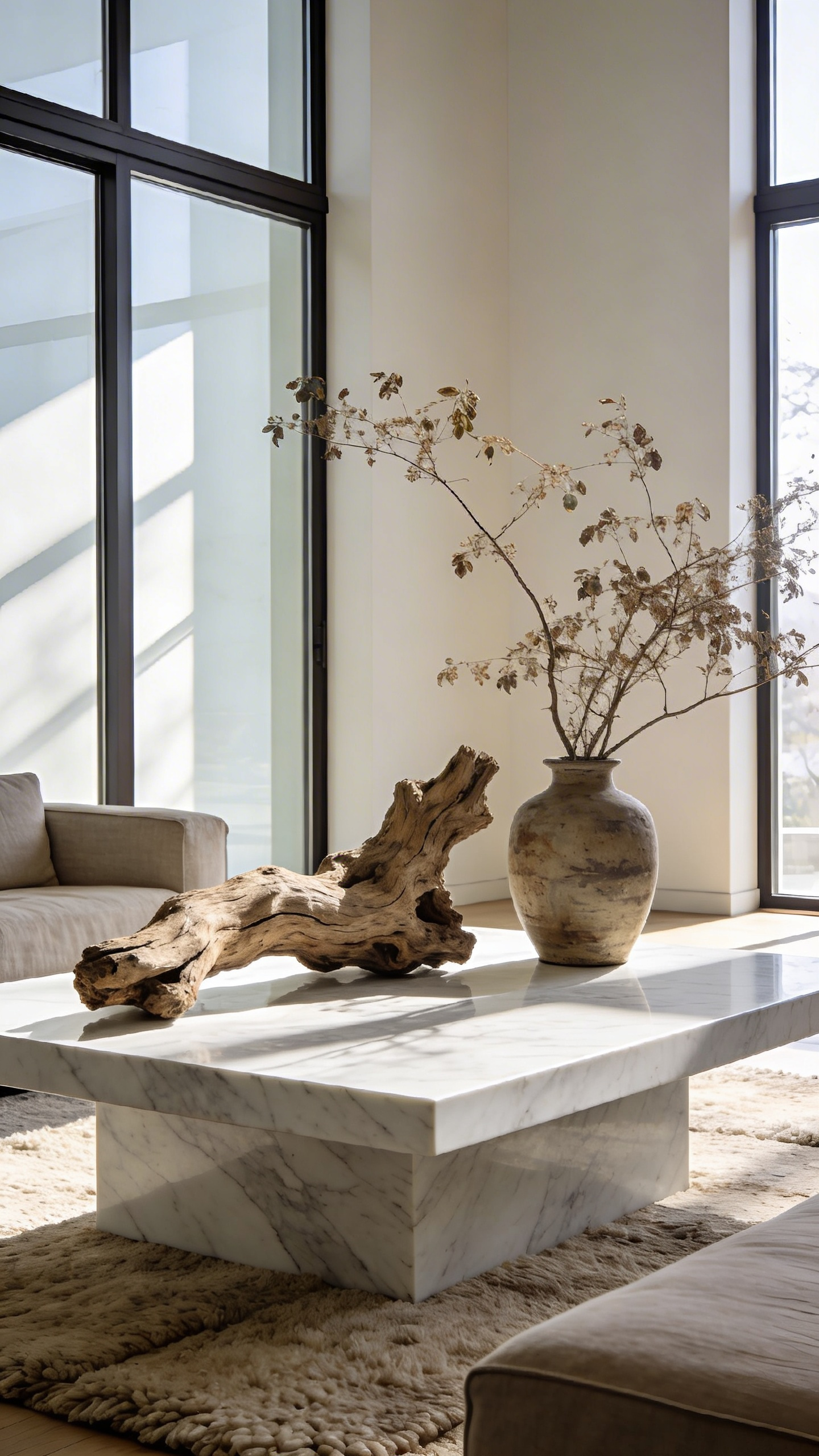
The traditional fresh bouquet is increasingly replaced by “botanical skeletals.” For instance, dried lotus pods or charred branches serve as static sculptures. Unlike fleeting blooms, these elements prioritize negative space and complex silhouettes. Furthermore, they introduce unique textures, such as the brittle crunch of a seed pod.
Driftwood acts as a bridge between the aquatic and the terrestrial. Essentially, it is the tree’s mineralized exoskeleton, shaped by salt and sun. Therefore, a piece of silver-grey wood creates a narrative of provenance. To successfully execute this, use “contained contrast.” Simply place a gnarled branch inside a minimalist bowl to signal intentionality. Finally, apply a matte wax to preserve the wood without adding artificial shine. Thus, the arrangement remains a sophisticated reminder of the natural world.
The Olfactory Dimension: Styling with Sculptural Incense Holders and Candles
Your coffee table functions as the “geographic center” of social life. Therefore, effective styling must go beyond visual weight to include “sensory grounding.” Specifically, scent acts as a powerful pacing mechanism. Lighting incense marks the essential transition from a busy workday to a restorative evening. Consequently, expert designers now favor “vessel-led” design over standard branded glass jars.
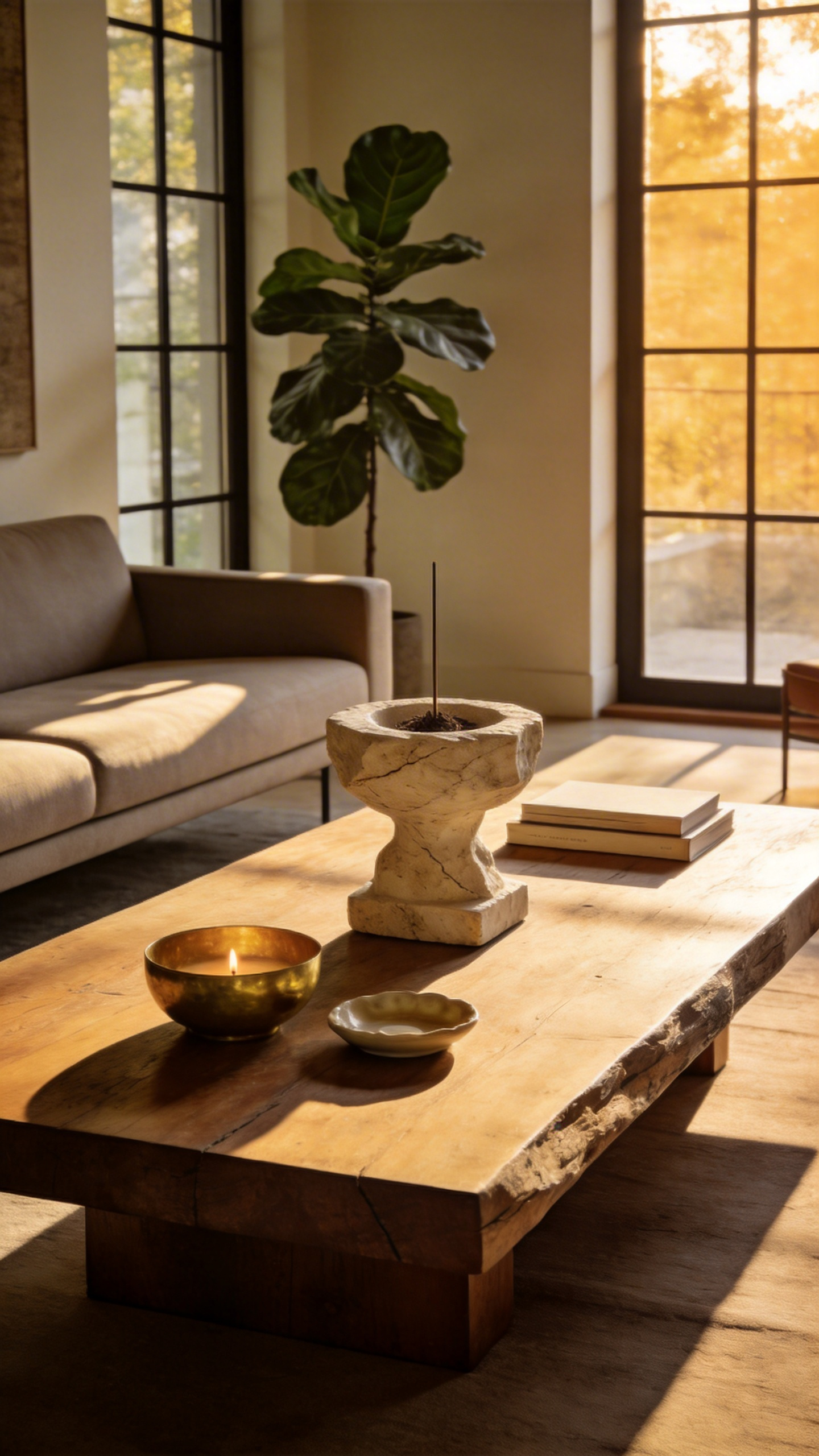
Materials like heavy travertine or hand-cast brass offer a sophisticated tactile contrast to smooth books. Moreover, these objects serve as kinetic sculptures. Drawing from the tradition of *Kōdō*, or “listening” to incense, the smoke creates a “living painting.” Unlike static candlelight, the visible air currents provide a soothing visual rhythm. Additionally, a tall, thin burner creates a necessary “skyline” effect. This vertical element creates balance against the horizontal nature of stacked literature.
Focus on atmospheric scents like resins or woods rather than edible notes. Finally, embrace the “patina of use” inherent in these materials. Heat inevitably changes the color of brass or stone over time. Thus, these imperfections act as “scent memories.” This natural aging process transforms a showroom display into a deeply personal narrative.
Reflective Surfaces: Utilizing Mirrored or Metallic Objects to Catch Light
Reflective tables act as sophisticated instruments of light. Specifically, they utilize specular reflection to manipulate a room’s architecture. When light hits smooth chrome or glass, it bounces perfectly. Consequently, this creates a mirror image that expands perceived space. Furthermore, curved metallic surfaces produce caustics. These intricate, dancing light patterns mimic the shimmering depth of a swimming pool. Placing a reflective table in low-angled afternoon light complements your broader living room lighting ideas to illuminate your space stylishly.
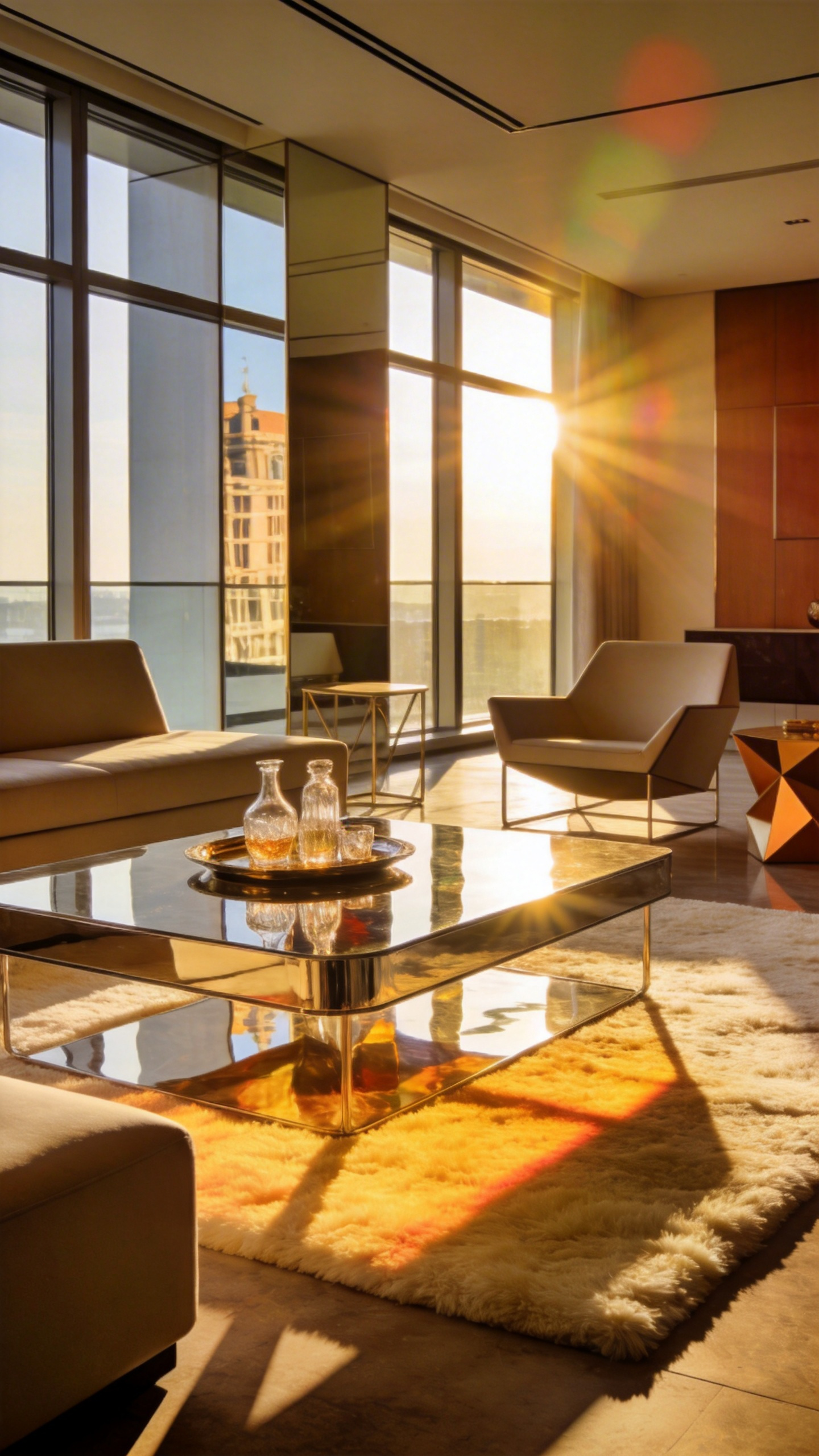
Beyond physics, these pieces serve as visual chameleons. In fact, they resolve the tension between presence and absence. A mirrored table reflects the rug beneath it, effectively vanishing. Thus, it doubles the floor area and avoids the “black hole” effect of solid wood. However, this clarity comes with a warning. Because mirrors reflect everything, they also double visual clutter. To counter this, designers recommend the “Rule of Three” for styling. Simply anchor the surface with a tray, a vase, and a book stack.
Currently, trends are shifting toward warmth. While Art Deco emphasized cold speed, modern interiors favor “living finishes.” Unlacquered copper and aged brass develop a patina over time. This creates a soft luster rather than a sharp glare. Additionally, pairing these metals with “tactile opposites” creates balance. Place a polished steel table atop a shaggy mohair rug, for example. This mix of cold reflection and soft texture ensures the space feels sophisticated yet inviting.
The Curiosities: Small-Scale Conversation Starters and Travel Finds
Historically, displaying small objects mimics the 16th-century *Wunderkammer*. These “Cabinets of Wonders” once showcased royal dominion over nature. Today, however, the coffee table serves as a micro-version of this concept. It acts as a stage for personal narrative rather than power.
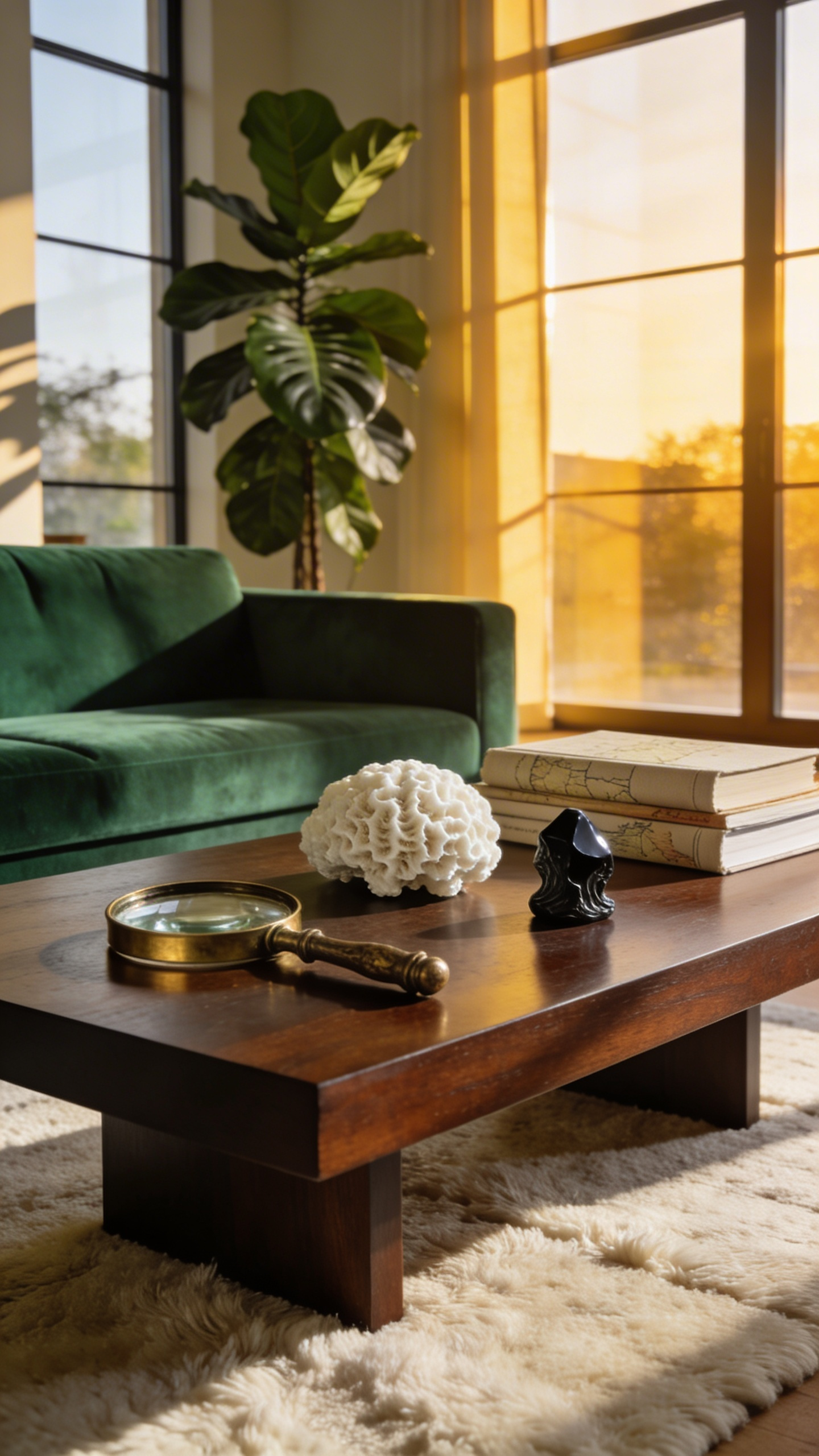
Psychologically, these curiosities function as vital “social anchors.” In fact, they significantly lower the barrier for conversation. A guest might struggle with stagnant small talk. Yet, a tangible object invites a natural “rejuvenation question.” For example, a vintage astrolabe instantly sparks specific inquiry about its origin.
The true allure lies in tactile contrast. A successful curiosity is not just visually complex; it is tactilely interesting. Consider the heavy, cold sensation of a pyrite cluster. Conversely, a hand-carved wooden bowl offers organic warmth. This physical sensory data grounds the moment, making interactions feel richer and more human.
Therefore, you should treat these items as “intellectual jewelry.” Prioritize careful curation over simple accumulation. Ideally, use a glass cloche to elevate delicate items like a rare butterfly specimen. This technique “museum-ifies” the object, signaling its significance to the viewer. By placing a piece of sea glass near an antique compass, you successfully bridge historical weight with personal memory.
Negative Space: The Sophistication of Restraint and Breathing Room
We often dismiss negative space as simple emptiness. However, this concept is a deliberate design tool known as the “active void.” Rooted in the Japanese philosophy of *Ma*, this approach treats space as a vital bridge between objects. Consequently, leaving ample “breathing room” allows a sculptural vase or linen-bound book to truly speak. This restraint showcases the table itself, highlighting the grain of hand-rubbed walnut or cool marble.
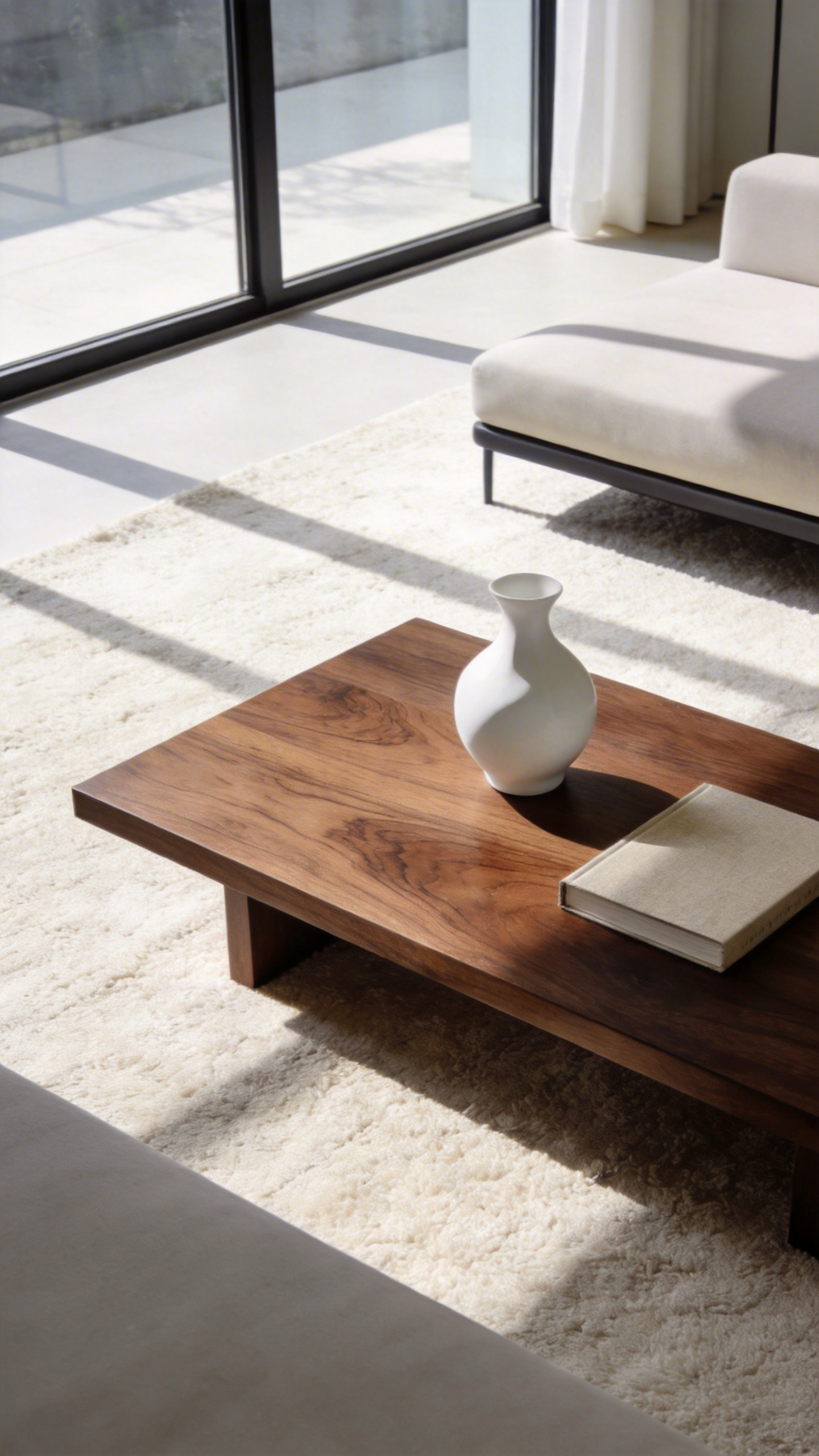
Additionally, an uncluttered surface becomes a dynamic canvas for light and shadow. Light flows around objects rather than hitting them flatly, creating sensory depth. The absence of clutter draws the eye to texture and patina. Beyond aesthetics, this practice significantly reduces cognitive load. In fact, the brain craves this “visual rest” to process the environment calmly.
To master this look, apply a disciplined approach to editing. Ideally, you should leave nearly 70 percent of the surface unoccupied. Thus, the table shifts from a chaotic storage unit to a curated gallery. Ultimately, this sophistication is also practical. Indeed, true luxury provides space for a guest’s drink, balancing high design with functional comfort.
Seasonal Rotation: Evolving Your Vignettes with the Calendar
Evolving your vignette transforms static furniture into a living narrative. Specifically, environmental psychology views this practice as a vital mental anchor. In a digital world, these intentional decor shifts help us track the passage of time. Consequently, this ritual fosters a sense of grounding akin to natural cycles. Experts in the “Slow Living” movement suggest that resetting your table acts as a mindfulness practice. Simply clearing the slate improves mood and cognitive clarity.
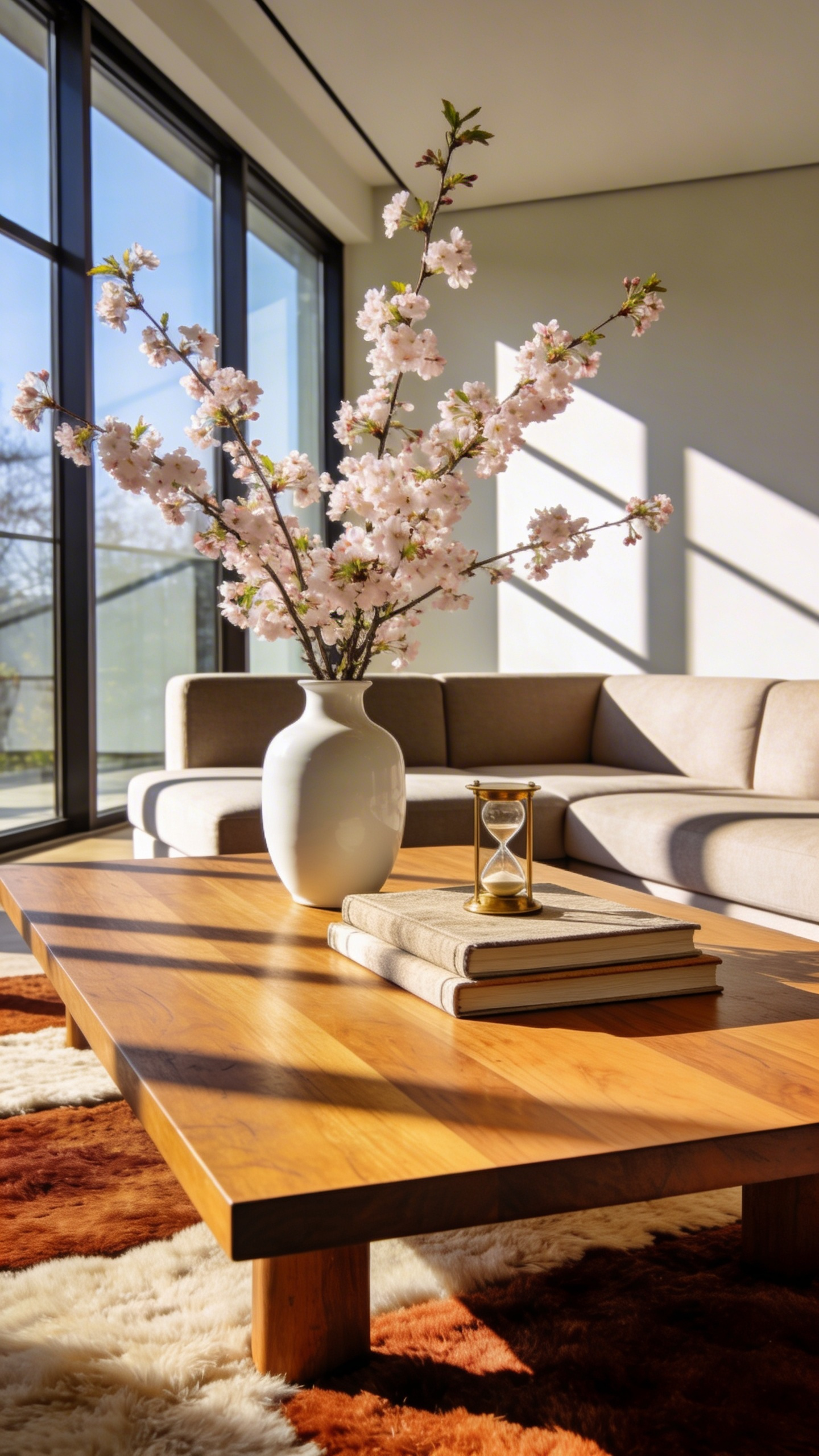
Beyond visuals, an authoritative vignette engages all five senses through “Sensory Layering.” Summer demands cool textures like polished marble or smooth glass. In contrast, winter invites touch through warm materials like raw wood or textured ceramics. Furthermore, consider the concept of “Lustre.” A silver tray brightens a room by catching low winter light. Alternatively, a matte rattan tray absorbs harsh summer sun, creating a softer, organic feel. Scent also acts as a powerful trigger for memory. Transitioning from summer citrus to autumn sandalwood signals the season immediately upon entering.
Successful composition relies on the “High-Medium-Low” formula. First, place a vertical item, like a sculptural branch, to create a skyline. Next, bridge the gap with a stack of books. Finally, anchor smaller items on a shallow tray. However, technical perfection requires a soul. Expert consensus dictates adding a “personal spark,” such as a found seashell or heirloom. Thus, your table becomes a gallery of visual anecdotes rather than a sterile showroom display.
Function Meets Form: Transitioning from Display to Entertaining
The coffee table is where your home’s private “museum” meets its social “theatre.” Historically, this piece evolved from the upright Victorian tea table to the low-slung altar of cocktail culture. Consequently, modern design requires a seamless shift from decorative pedestal to functional hub.
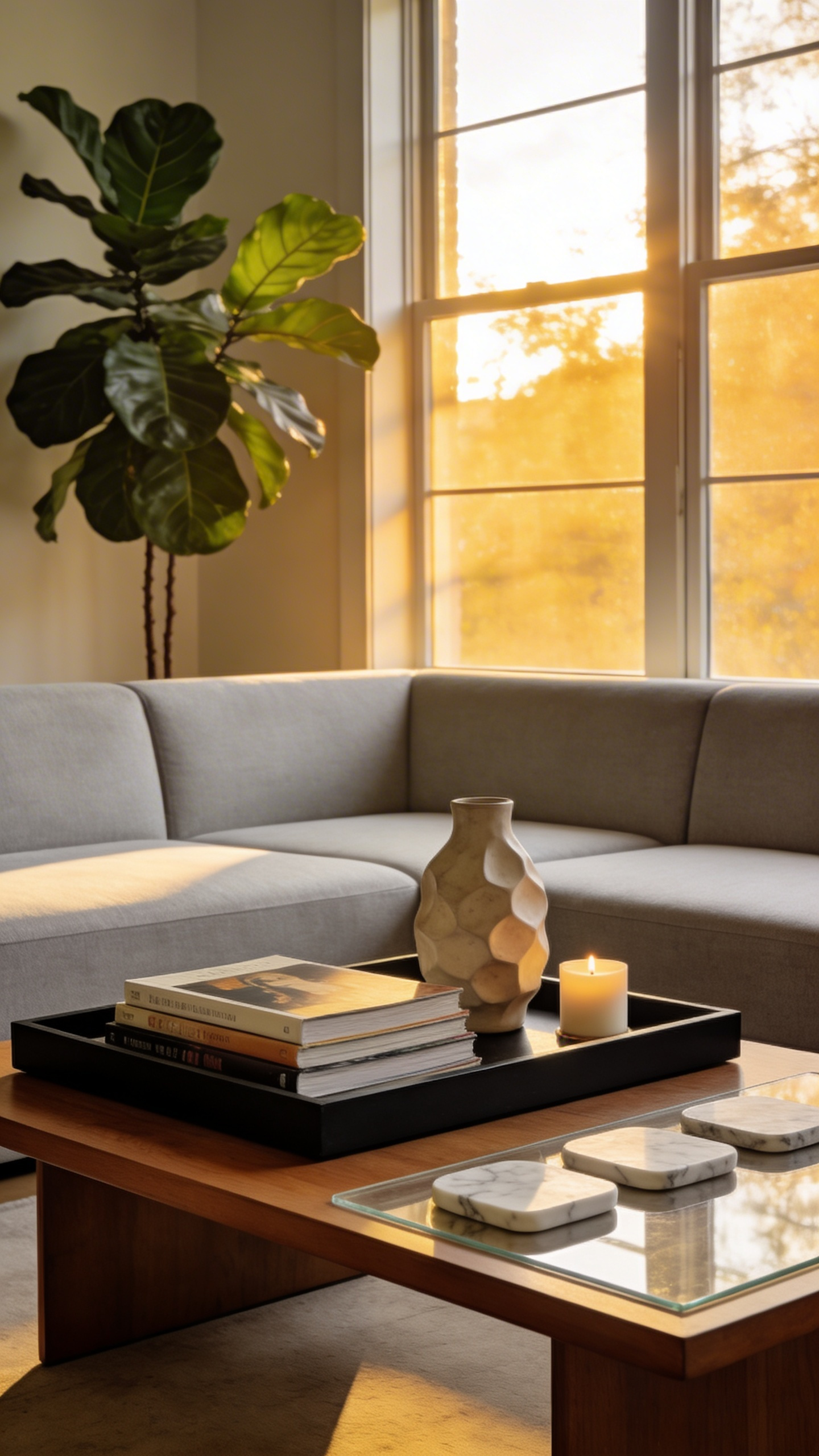
Central to this transition is the strategic “tray method.” Functionally, a styled tray acts as a modular operating system for your surface. When guests arrive, it effectively “zones” the table. Keeping decor contained preserves active territory for drinks without dismantling your established aesthetic. Therefore, you can clear space in one motion, instantly pivoting from display to hospitality.
Aesthetics mean nothing without proper ergonomics. Surface heights should sit one to two inches lower than your sofa cushions. Furthermore, maintaining eighteen inches of legroom clearance is one of the smart strategies for choosing living room furniture that works for both flow and aesthetic.
Finally, consider the tactile experience of your materials. While marble is elegant, it remains prone to etching from acidic spills like wine. Conversely, “living finishes” like reclaimed wood or unlacquered brass embrace the social patina of gatherings. Every scratch tells a story, turning a pristine surface into a beloved artifact of connection.
Frequently Asked Questions
How do I style a coffee table for a luxury living room?
Luxury styling focuses on “material honesty” and high-contrast textures. Combine sculptural silhouettes—like a pedestal base—with curated vignettes involving high-quality art books, artisanal trays, and organic interludes like driftwood or hand-fired ceramics.
What is the rule of three in coffee table decor?
The rule of three is based on the principle that odd-numbered groupings are more visually engaging and organic. For a coffee table, this usually means styling a tall vertical element (like a vase), a flat horizontal element (like a stack of books), and a unique sculptural curiosity.
Should a coffee table be lower or higher than the sofa?
For optimal ergonomics and luxury appeal, a coffee table should be roughly one to two inches lower than the seat cushions of your sofa. This ensures easy access for drinks and maintains a low, sophisticated profile in the room’s architecture.
Conclusion: The Living Table—A Reflection of a Well-Traveled Life
The “Living Table” transforms a static surface into a dynamic narrative of identity. It is no longer simply about aesthetics. Rather, it serves as a rotating museum of personal history. By blending material honesty with global textures, we move beyond the curated perfection of a showroom. Instead, we embrace a space that values tactile memory and the “collected layers” of a journey. This design philosophy invites us to view our homes as evolving entities, not fixed displays.
Looking ahead, your home should reflect where you have been and where you are going. The coffee table becomes an anchor, grounding fleeting travel memories within your daily rituals. To cultivate this, begin by auditing your current arrangement for items that lack personal resonance. Implementing these coffee table ideas ensures that this central piece remains as vibrant and worldly as you are.