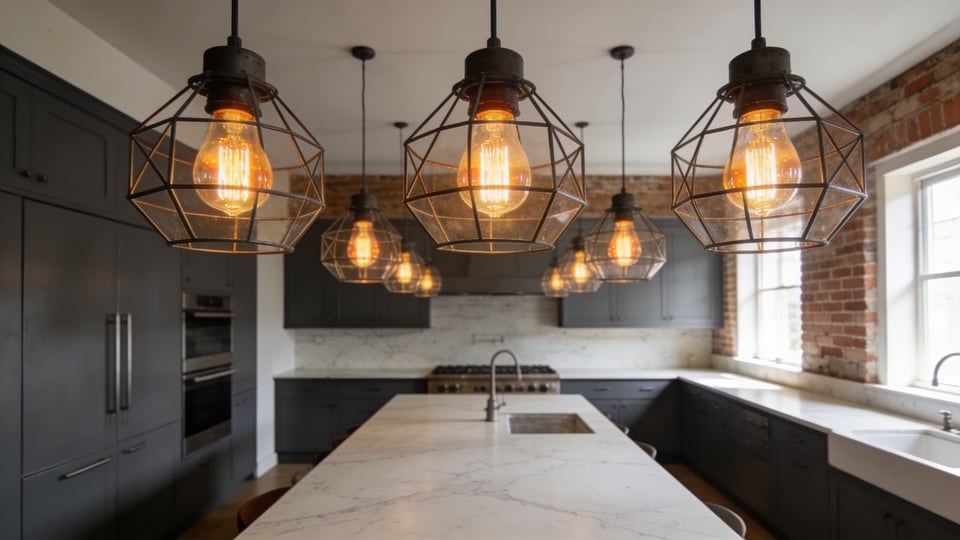
Many homeowners believe industrial design feels cold or impersonal. They often associate metal fixtures only with sterile, “command and control” factory environments. So, they avoid these elements when designing cozy living spaces. This hesitation typically stems from the style’s roots in safety and productivity.
However, the right industrial kitchen light serves as more than a functional tool. It is a statement of architectural integrity. In a digital world, these fixtures provide a refreshing honesty. Originally, they symbolized relentless utility. Today, though, they represent the bespoke craftsmanship that luxury markets crave.
Modern industrial style actually flips this script. The aesthetic has evolved from the factory floor to become a “nostalgic anchor” for the home. Designers now leverage industrial pieces to provide warmth and character. For instance, materials like unlacquered brass feature “living finishes” that age beautifully. This natural oxidation creates a patina acting as a soft visual filter.
Rough textures, like sand-casted metal, also add a necessary sensory grip to smooth interiors. Indeed, they often form the backbone of sophisticated kitchen decor ideas that prioritize authenticity.
This guide explores the psychological and technical shifts behind “Industrial Elegance.” We analyze how low Kelvin temperatures mimic the intimacy of candlelight. Next, we examine why heavy materials foster a perception of safety. We also discuss how “living finishes” transform clinical spaces into creative sanctuaries. You will learn to balance rugged function with high-end comfort.
Most people believe industrial lighting makes a kitchen feel cold, unfinished, or overly masculine. Mainstream catalogs often market it as mere ‘steampunk’ decoration.
The reputation of industrial lighting as “unfinished” often stems from basic psychology. Specifically, the “law of closure” in Gestalt theory suggests our brains crave completeness. When we see exposed filaments or open cages, we instinctively try to mentally “finish” the object. This cognitive friction creates a sense of raw energy.
Sometimes, this feels unsettled in a domestic space. However, this lack of casing was originally an intentional Modernist choice. It celebrates honest labor, much like the stripped-back aesthetic found in farmhouse kitchen lighting. Industrial design, however, focuses more on mechanical precision.
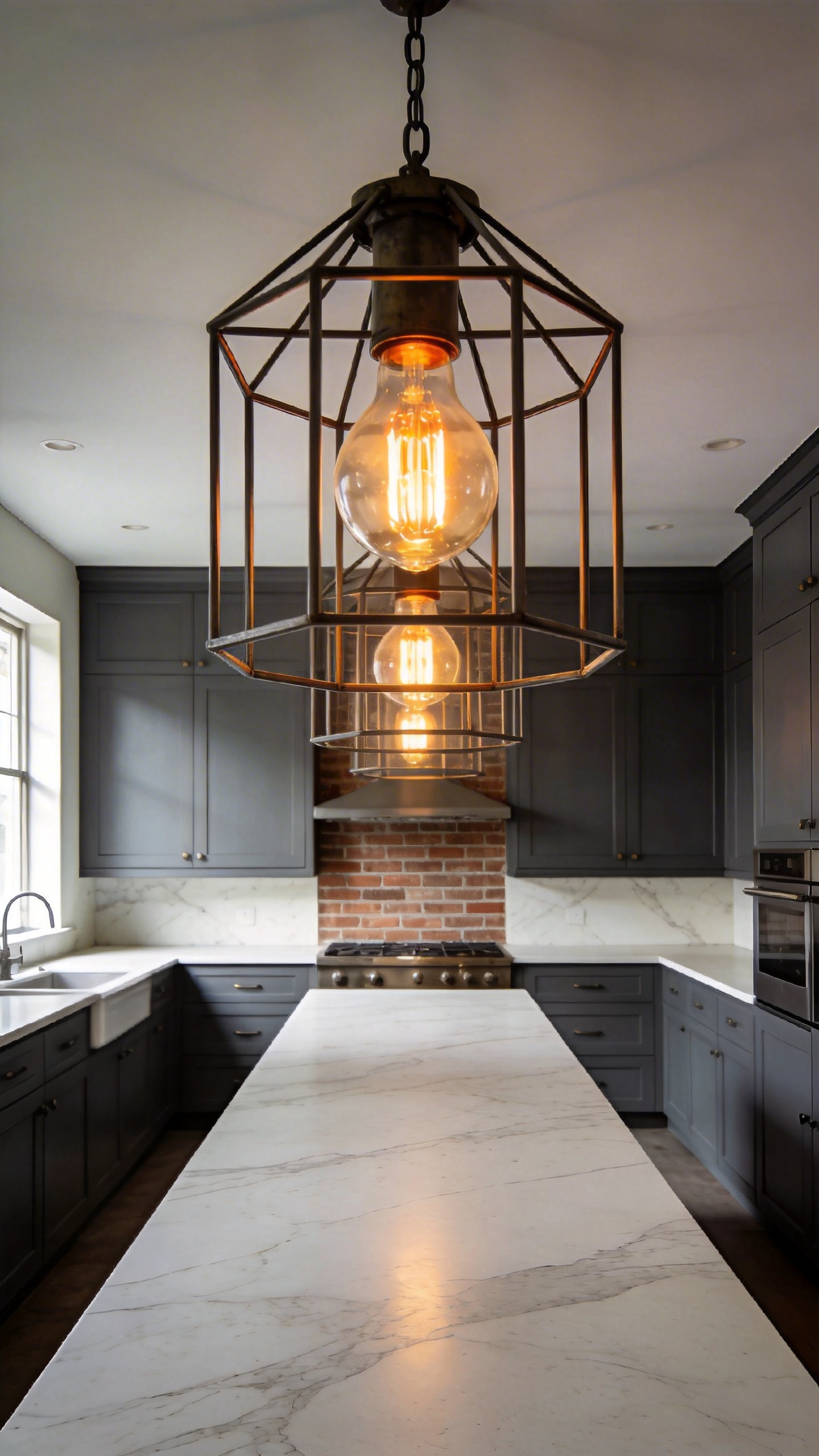
In fact, the “coldness” attributed to these fixtures is frequently a technical error. It isn’t a design flaw. Originally, factories utilized high-Kelvin “Daylight White” to keep workers alert. Replicating this color temperature in a kitchen triggers a sterile, institutional response. In contrast, authentic warmth requires high-CRI carbon-filament bulbs. These render food rich and appetizing rather than grey.
Similarly, marketing often mislabels these elements as purely masculine or “steampunk” decor. Unfortunately, this conflates fantasy with history. True industrial style originates from the 1970s artist loft movement in places like Soho. Artists didn’t choose heavy-gauge steel fixtures for a “tough” aesthetic. Rather, they salvaged them out of financial necessity.
Therefore, authentic industrial design is not about adding non-functional gears. Instead, it prioritizes a curated aesthetic and the specific light “throw” needed for creative work. Stripping away the decorative mask reveals a tool for living, not just a cold machine.
Here’s what they’re not telling you: True industrial design isn’t about looking rough; it’s about ‘Honest Utility.’ It treats the kitchen as a creative workshop.
Real industrial design acts as an inheritance of survival tools, not a costume. We must view the kitchen as a high-stakes creative workshop. Historically, the RLM standard codified this “Honest Utility” by using spun-metal geometry. These fixtures reclaim wasted light and fire it directly onto the task at hand.
This precision acts like a chef’s knife. It creates a focused beam of high-CRI light. Specifically, it isolates the vibrant green of herbs from the room’s ambient noise.
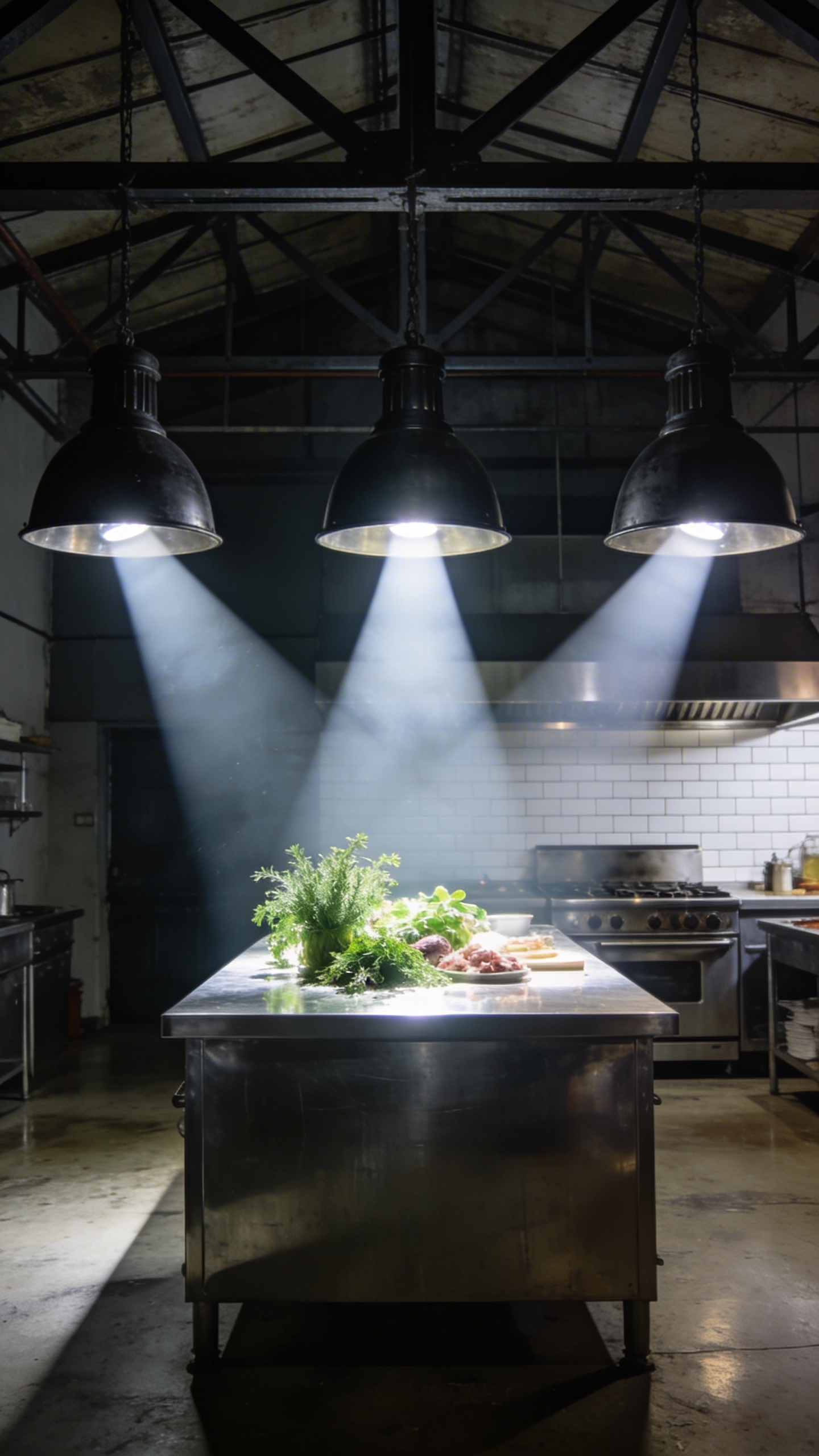
Similarly, the heavy cages on bulkhead lights serve a protective function. They are not just aesthetic. Originally built for ship hulls, these cast-metal guards shield the glass. Thus, they allow lighting to survive in “splash zones” prone to high heat.
Functionality extends to movement through articulated arms. Derived from machine shops, these adjustable fixtures treat the counter like a draughtsman’s bench. As a result, a cook can pivot light seamlessly from a chopping board to a scale.
Finally, honest utility dictates that materials must age naturally. Unlike “distressed” paint, solid brass and galvanized steel develop a genuine patina. This subtle darkening creates a visual logbook of the heat and moisture the kitchen has endured.
The Studio Mindset: Why Artists Treat Kitchens Like Ateliers
Adopting a studio mindset changes the kitchen’s function entirely. It shifts the space from a domestic utility to a creative workshop. German designer Otl Aicher championed this concept in the 1980s. He argued against hidden cabinets, favoring the open “kitchen workbench” instead. Naturally, lighting is central to this “atelier” philosophy.
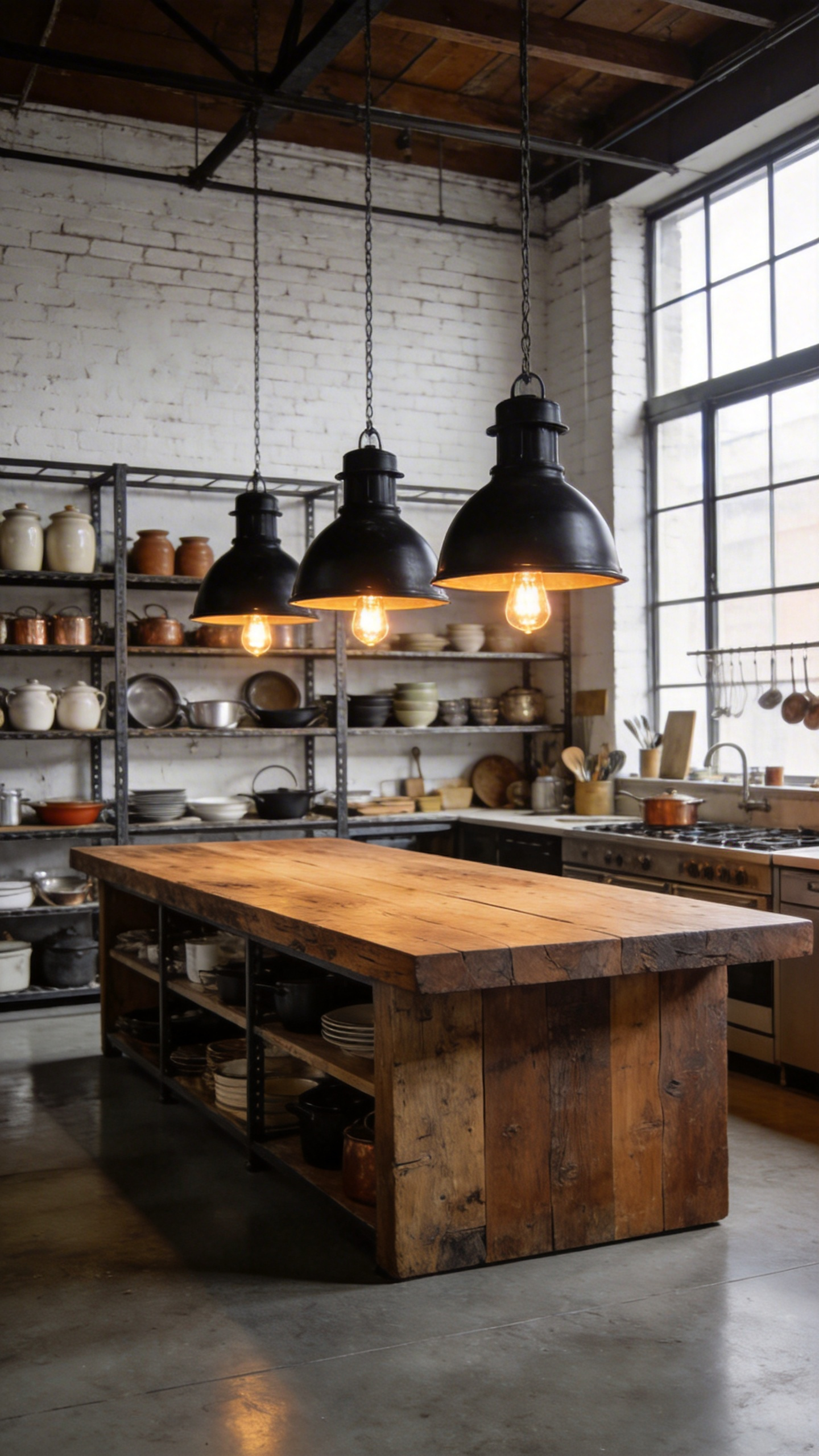
The industrial pendant light acts as a psychological prompt. It bridges the gap between messy production and refined art. For example, artists rely on “North Light” or high-CRI sources for color accuracy. Similarly, culinary creators utilize industrial bulbs to strictly audit their materials.
Under a daylight-balanced 4000K glow, the marbling of meat becomes clearly visible. Thus, the light provides a necessary clinical honesty. This often outperforms the generalized glow of standard modern kitchen lighting.
Moreover, this specific illumination supports a creative flow state. When a heavy-duty fixture hangs low over an island, it effectively creates a stage. Consequently, the cook enters an experimental mindset. The harsh glint of light against stainless steel signals a time for craft.
Ultimately, this lighting transforms the final plate into an installation. It allows the chef to sculpt with beams, revealing the texture of a sear. The kitchen ceases to be a background room. It becomes a site of active, purposeful creation.
Theme 1: Precision & Flexibility (The Draftsman’s Approach)
The Draftsman’s Approach reimagines the kitchen as a high-stakes creative studio. Fundamentally, this style treats light as a dynamic, mechanical tool rather than static decoration. Historically, it is rooted in automotive engineering and the invention of the equipoising spring.
Consequently, fixtures do not merely hang in place. They “float” alongside the chef. An articulated lamp allows for precise micro-adjustments during preparation. For instance, a cook can pull the light down to inspect steak marbling. Afterward, they simply flick it away to illuminate the wider prep area.
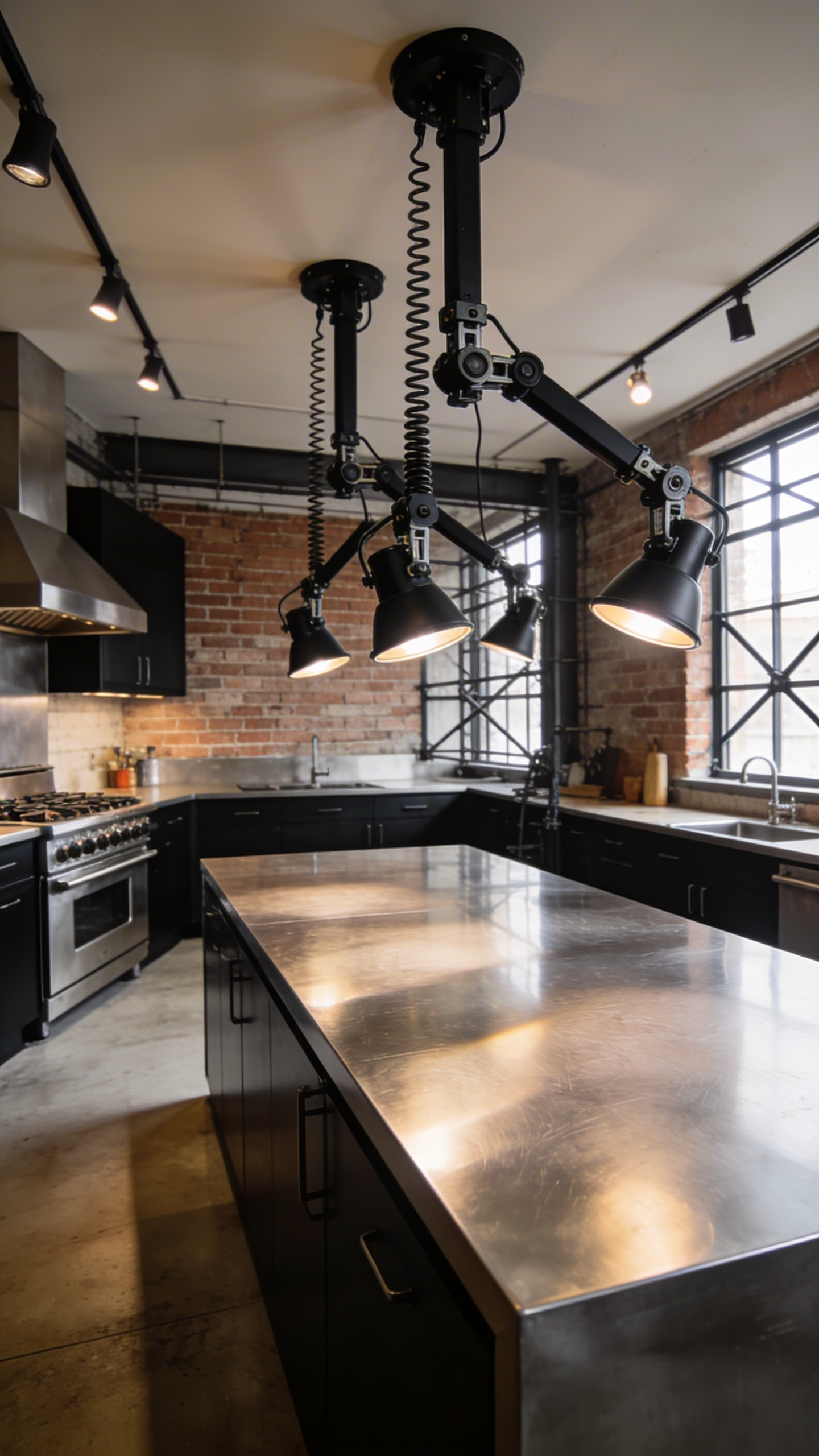
Beyond movement, this approach prioritizes clinical clarity. Specifically, experts recommend fixtures with a high Color Rendering Index (CRI) of 90 or above. This accuracy ensures deep reds in beets or subtle greens in herbs render perfectly. Furthermore, a cool-neutral temperature between 4000K and 5000K reduces eye strain.
Achieving this precision requires shifting away from central overhead fixtures. Instead, the design utilizes a layered system of wall-mounted “swing-arm” lamps. This avoids dead space. Thus, the light source bypasses the chef’s shoulders to eliminate frustrating shadows. These fixtures deliver the necessary 75–150 foot-candles required for detailed work. This flexibility allows the kitchen to transition from a technical workspace to a social hub.
1. The Articulating Draftsman Sconce: Bringing ‘drawing board’ precision to countertop prep work.
The articulating draftsman sconce transforms a standard counter into a precision workspace. These fixtures rely on the “constant-tension” spring mechanism developed in 1932. Unlike standard swing-arm lights that sag, this design utilizes complex parallelogram linkages.
So, the lamp maintains perfect mechanical equilibrium. You can pull the fixture down inches from a sea bass to inspect for pin-bones. It stays exactly where placed without needing to tighten wingnuts with greasy hands.
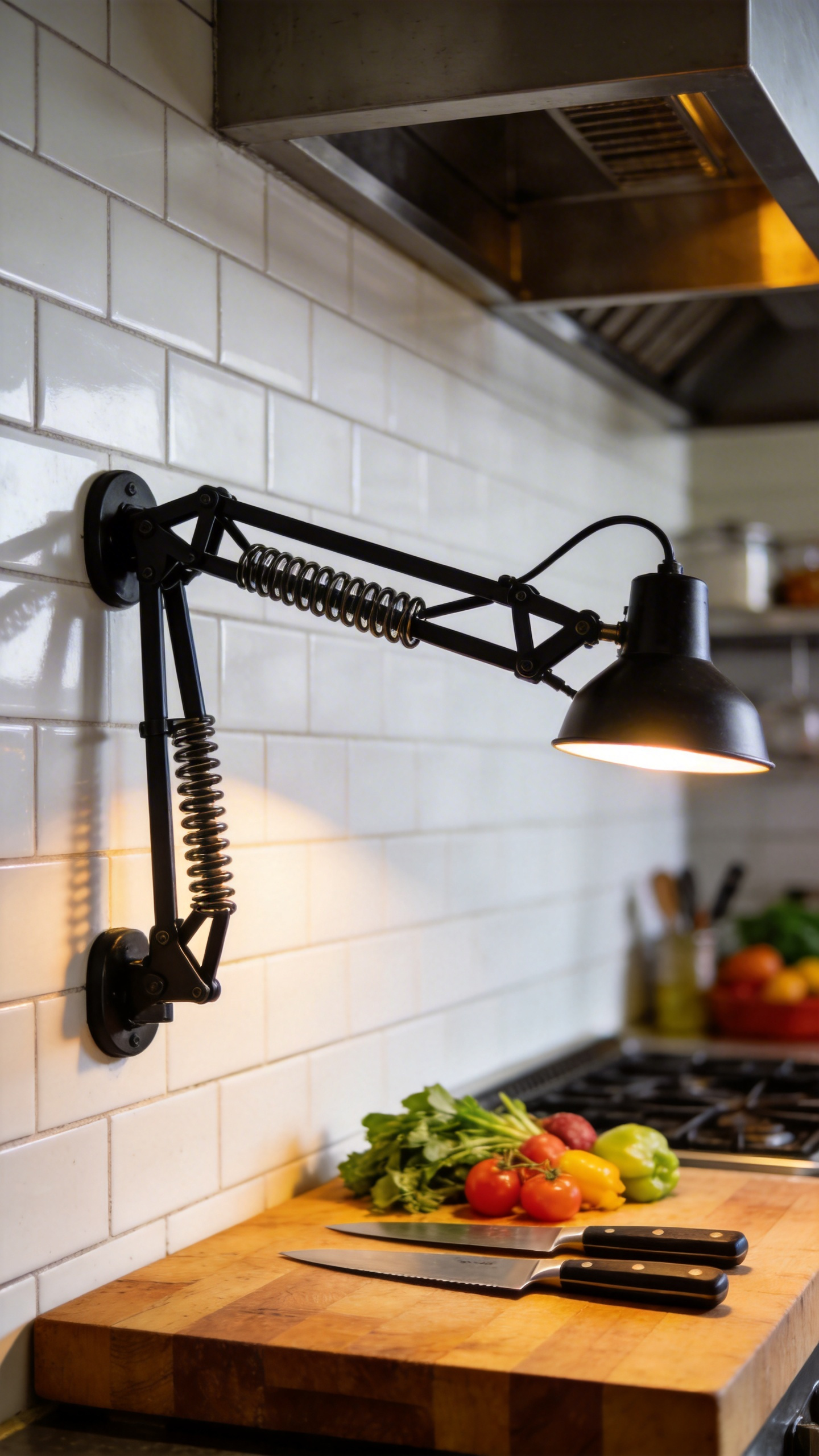
Beyond mechanics, the quality of light alters the culinary experience. Standard under-cabinet LEDs often provide a flat, clinical wash. In contrast, a draftsman sconce delivers high-intensity, point-source illumination. This creates necessary shadow definition.
Therefore, when julienning vegetables, the knife edge becomes hyper-visible. Just as a draftsman reads fine print, a cook can read a weathered recipe card without strain.
Aesthetically, these fixtures introduce a tactile “tool-room” atmosphere. Materials like knurled solid brass offer a secure grip. They also develop a unique culinary patina over time. Furthermore, this approach solves lighting challenges for open shelving where hiding LEDs is impossible. Installing professional-grade gear shifts the mindset from chores to craft.
2. The Retractable ‘Pulley’ Pendant: Adjusting vertical height for intimate dining vs. general tasks.
The retractable pulley pendant, or “Rise and Fall” fixture, is a versatile tool. Originally, this mechanism helped French bistros accommodate varying service speeds. It then transitioned into industrial factories. Today, this intersection of engineering and lifestyle offers a practical solution. Specifically, it bridges the gap between a culinary workshop and a dining sanctuary. Finding the right kitchen table pendant lights requires balancing scale and mechanical output.
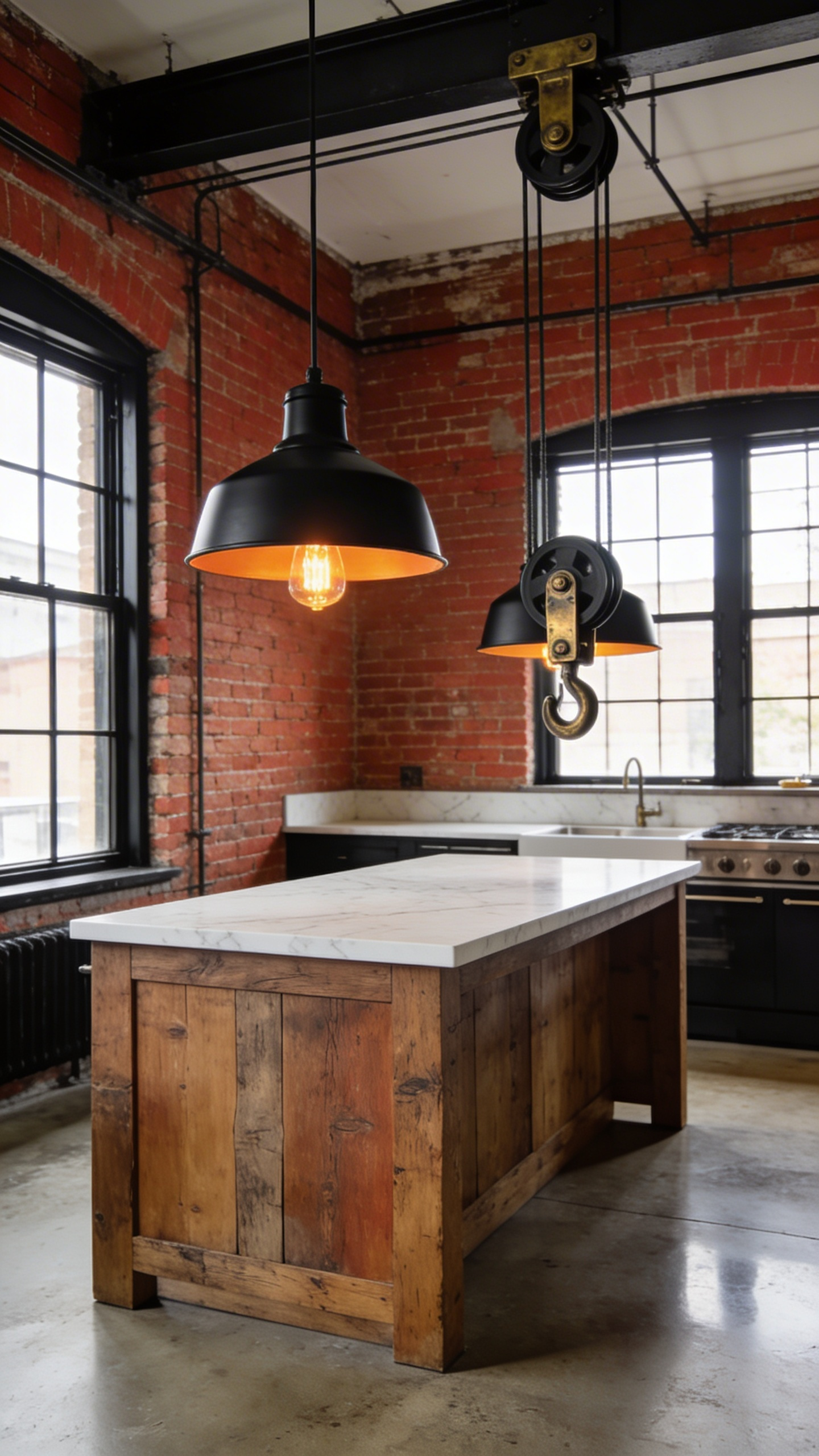
Mechanically, the authority of this fixture lies in equilibrium. Unlike spring-loaded cords, authentic industrial pendants rely on a counterweight system. Often, these weights contain lead shot to balance the shade perfectly. Consequently, the movement feels smooth and deliberate.
In fact, the friction of the cloth-covered cord against brass wheels creates a unique tactile experience. Therefore, aged brass materials are preferred. They develop a patina from frequent handling.
Functionally, changing the vertical height alters the room’s psychology. Lowering the shade creates a focused “pool of light” roughly 30 inches above the surface. This creates a high-contrast environment ideal for prep work. In a dining context, this lowers the visual ceiling to create an intimate enclave. Conversely, pushing the light up creates an ambient wash. However, gravity dictates a vertical hang, making sloped ceilings a challenge.
3. The Scissor-Arm Wall Lamp: Dynamic reach that extends light exactly where the recipe demands it.
Far from being a mere vintage accent, the scissor-arm lamp represents a pivotal moment in design. Originally, German engineer Curt Fischer invented this to aid precision mechanics. Light became a movable tool rather than a static fixture.
In a modern culinary space, this “tractable motion” is incredibly valuable. Unlike swing-arm lamps that move in an arc, the scissor frame extends linearly. Therefore, the light travels across the counter without losing its horizontal plane.
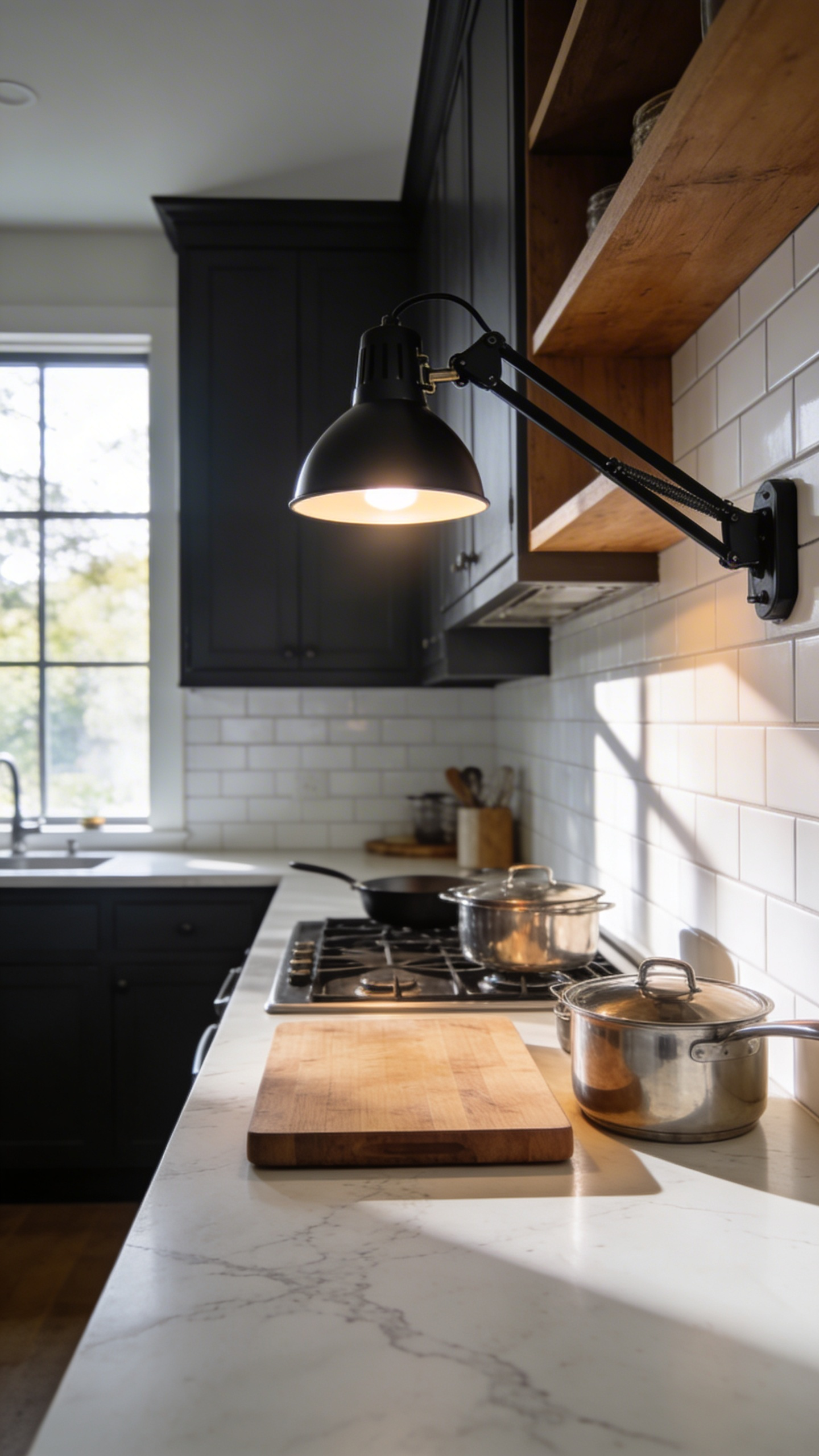
Specifically, this solves the issue of “shadow zones” created by overhead cabinetry. A chef can pull the fixture forward for delicate tasks like deboning. Then, they push it back flush against the wall. Because the arm extends over the shoulder, it eliminates head-shadows cast by ceiling lights.
Beyond function, the material quality adds a distinct sensory layer. The friction-based joints provide a satisfying, weighted resistance during adjustment. Furthermore, unsealed steel often develops a “living finish” over time. Eventually, a dark, matte patina forms. This protects the metal while adding visual history. Ideally, users should apply beeswax to maintain these joints. Designers favor this lighting for its blend of sculpture and accuracy.
4. Track Lighting Reinvented: Using gallery-grade directional heads to spotlight culinary zones.
Track lighting has evolved since its 1961 inception in art galleries. Its reinvention within industrial kitchen design signals a major shift. We are no longer simply illuminating a utility room. Instead, we are curating a live exhibition of craft.
Specifically, this approach treats prep zones like valuable sculptures. Designers are abandoning the “sea of recessed cans” that flattens a room. By utilizing gallery-grade directional heads, you create a deliberate visual hierarchy. Thus, the kitchen transforms into a moody, intimate stage.
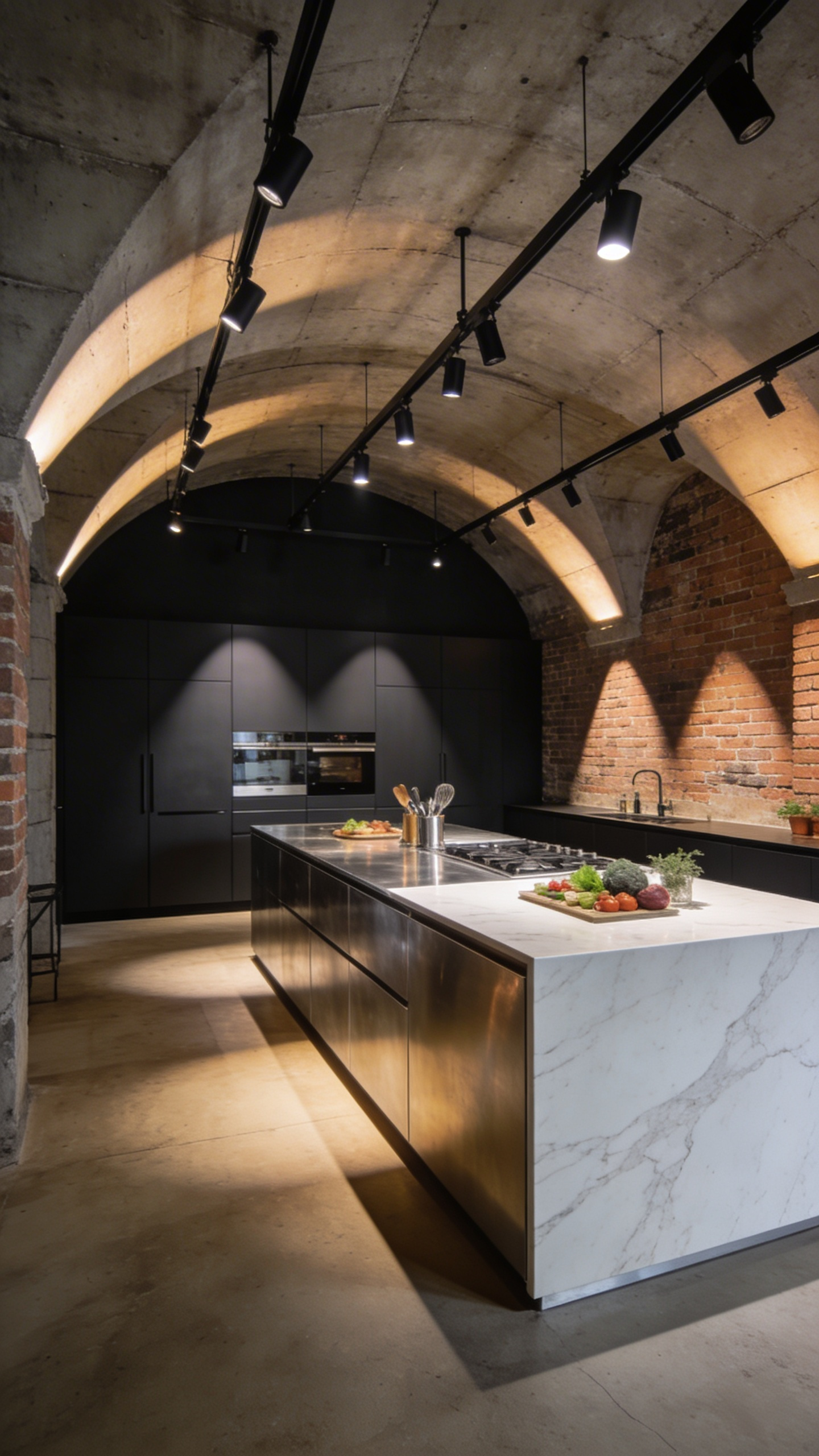
The magic lies in technical precision, particularly regarding the Color Rendering Index (CRI). A CRI of 95+ ensures ingredients look vibrant. Under this light, a steak’s sear appears rich rather than muddy. Furthermore, the hardware enhances the industrial narrative through tactile feedback.
Modern magnetic systems offer a satisfying, heavy “click” during adjustment. Features like knurled textures provide a grippy feel. This reinforces the concept of the kitchen as a workshop.
Beyond aesthetics, these systems offer unparalleled control. Honeycomb louvers eliminate side-spill glare to protect the chef’s eyes. “Barn doors” crop the light to focus strictly on the island. Moreover, distinct beam angles help narrate the space. Narrow beams highlight the cooktop, while wide floods wash brick walls. Finally, dim-to-warm technology shifts the light from crisp to nostalgic.
Theme 2: Material Honesty (The Raw & The Refined)
Material honesty represents a commitment to structural integrity. This design philosophy explores the tension between historical grit and modern precision. For instance, authentic pendants often utilize sand-casting. Molten metal poured into sand molds creates a granular, heavy texture.
In contrast, refined elements rely on cold-rolling techniques. This process occurs at room temperature, resulting in smooth finishes. When these textures meet, the fixture feels both grounded and perfected.
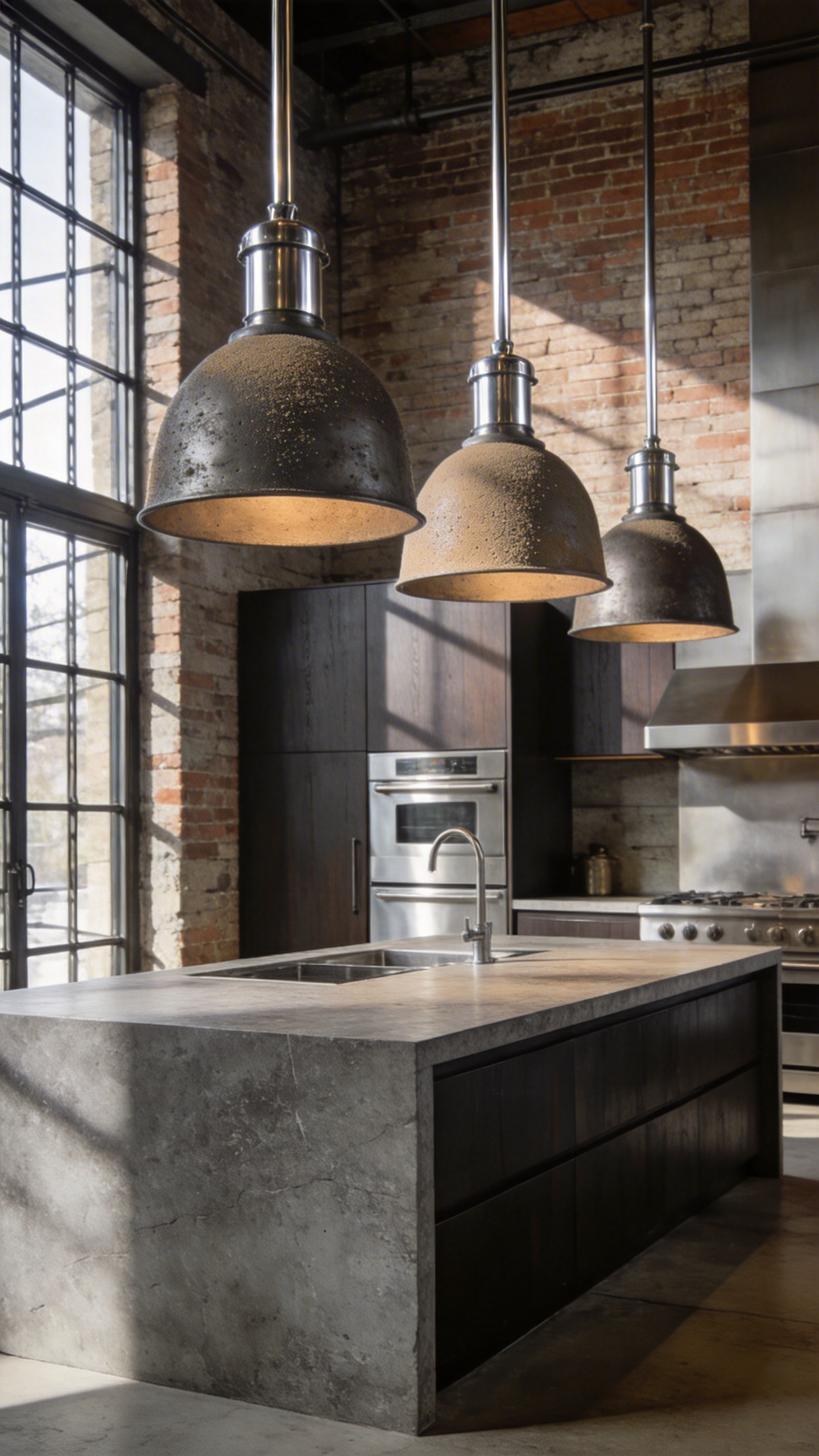
Furthermore, this aesthetic champions the exposure of functional mechanics. Instead of hiding rivets, designers showcase them. Thus, the hardware becomes the ornament. Ideally, these materials also introduce a sensory duality. A warm Edison bulb softens the weight of concrete.
Additionally, the use of unsealed “living finishes” allows surfaces to age naturally. Over time, copper and brass develop a unique patina. Choosing solid, honest materials ensures the lighting endures heat and heavy use.
5. Concrete & Filament Hybrids: Combining brutalist weight with the warmth of amber glow.
Concrete lighting draws inspiration from the Brutalist concept of *béton brut*, or raw concrete. This aesthetic champions honesty over perfection. Designers like Stefan Gant celebrate air bubbles as the fixture’s unique skin.
Yet, introducing such industrial weight into a home requires balance. Specifically, the visual gravity of concrete acts as a spatial anchor in open-plan kitchens.
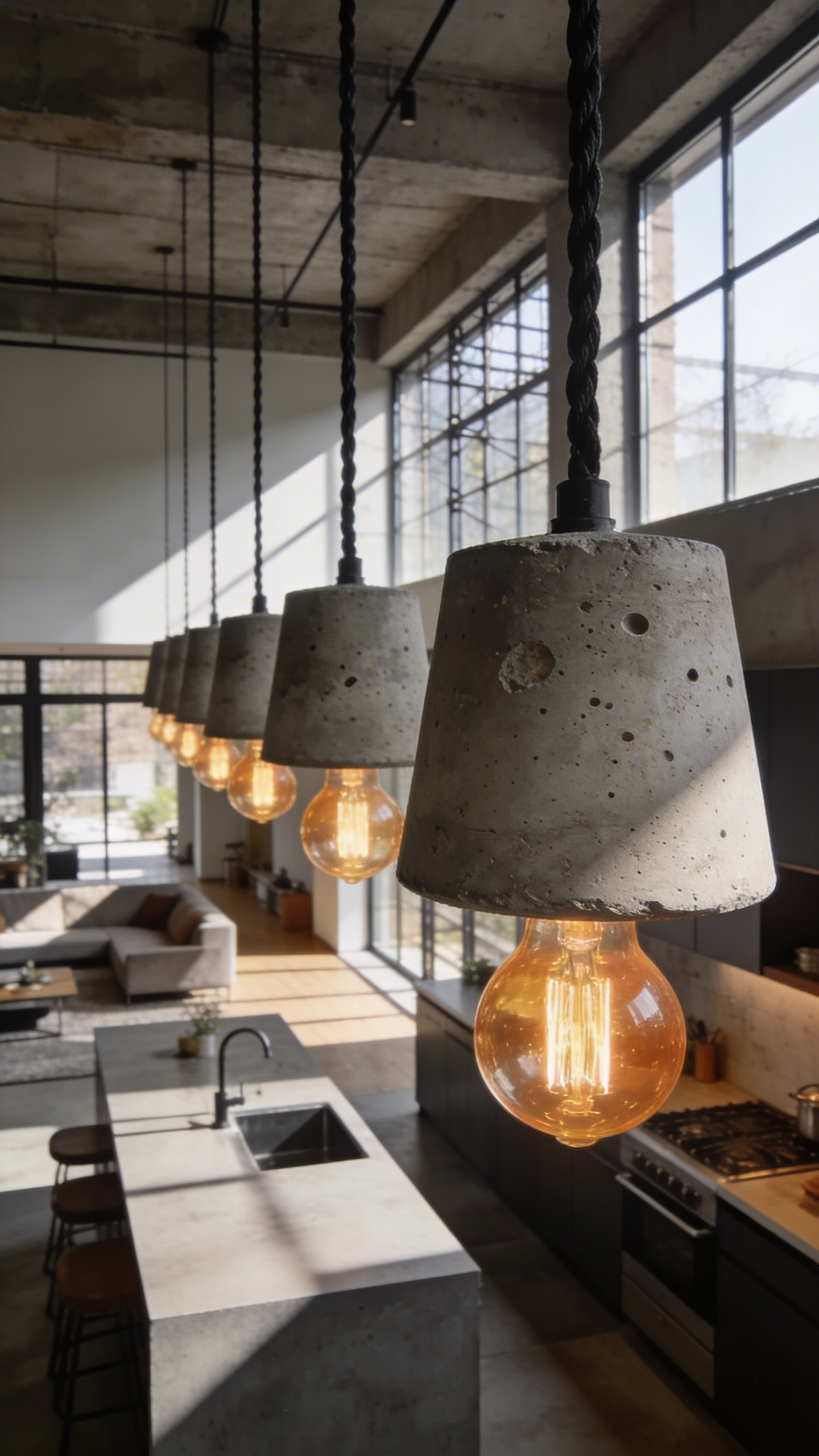
To counteract this density, designers use the warmth of amber LED filaments. Typically ranging between 2200K and 2700K, these bulbs create a necessary paradox. In fact, the porous texture of concrete absorbs rather than reflects harsh beams. As a result, illumination clings to the shade’s interior, creating a smoldering effect.
Furthermore, innovations like Glass Fiber Reinforced Concrete (GFRC) allow for surprisingly slim profiles. Manufacturers often line these raw shells with gold leafing. Therefore, the light reflects warmly before diffusing. This combination transforms a sterile workstation into an inviting space.
6. Raw Copper Piping Fixtures: Celebrating the infrastructure rather than hiding it behind drywall.
Modern industrial design has shifted away from concealment. Instead, it embraces “Honest Architecture.” Consequently, exposed copper piping has moved to the forefront. These fixtures serve as a building’s visual nervous system. They allow residents to trace the path of electricity, transforming infrastructure into art.
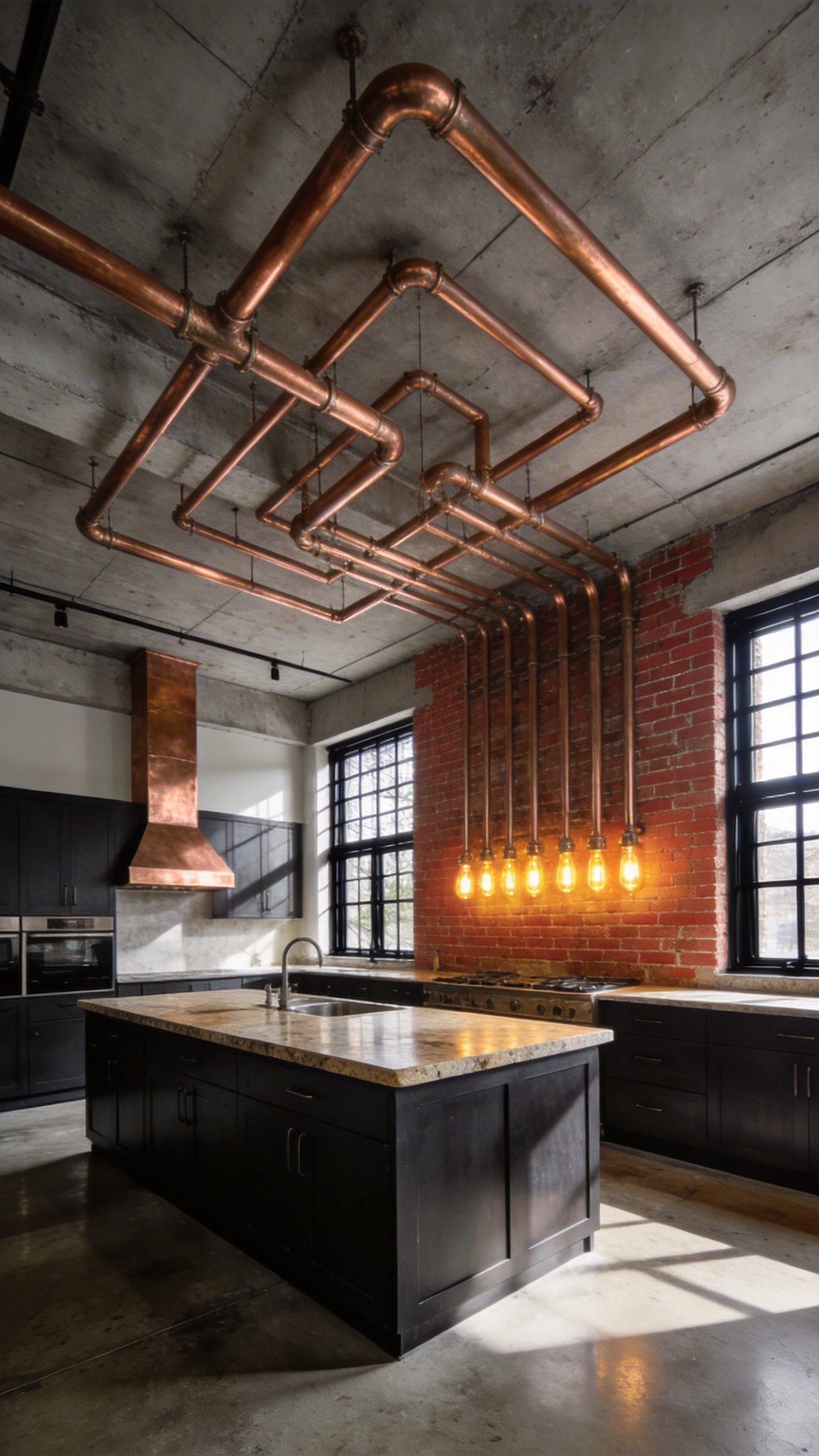
Unlike static chrome, raw copper is a “living” surface. It visually records the kitchen’s environment. Heat and humidity accelerate natural oxidation. Initially, the metal appears bright. Over time, however, it deepens into a rich russet-brown.
Furthermore, copper possesses high thermal conductivity. It physically radiates warmth. When paired with warm LEDs, the internal copper walls amplify the light. This creates a “firelight” glow that softens concrete or steel.
Regarding construction, the joint style defines the aesthetic. Soldered joints offer a seamless appearance. Conversely, compression fittings add mechanical weight with visible brass nuts. Crucially, safety remains paramount. Since copper is conductive, the pipe acts as structure and conduit. Therefore, professional installation requires proper earthing.
7. Prismatic Glass Shades: Utilizing vintage ‘Holophane’ science to diffuse harsh bulbs without losing brightness.
Prismatic glass represents a rare intersection of physics and design. The “Holophane” style uses early 20th-century science to solve lighting problems. Unlike frosted glass, which blocks light, prismatic glass refracts it.
In fact, these shades employ vertical and horizontal ribs to bend light rays. Consequently, you receive a powerful downward beam for task work. You do not sacrifice overall room brightness.
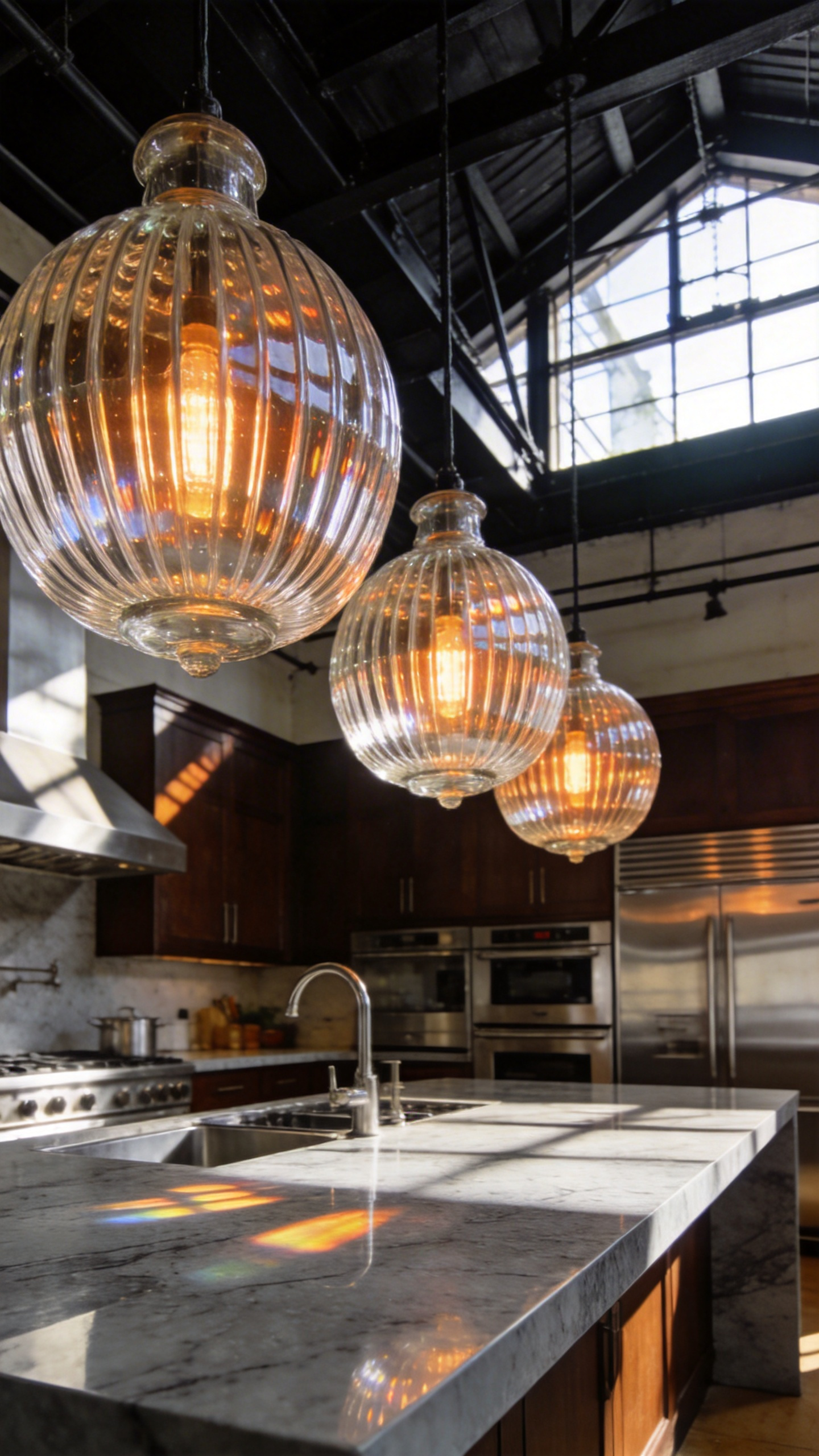
This engineering creates a uniform glow that eliminates harsh “hot spots.” Therefore, the glass surface acts as the single light source. For chefs, reducing glare is critical for visual comfort. It prevents retinal fatigue during precision tasks.
Additionally, material composition plays a vital role. Authentic vintage shades are incredibly dense. Originally cast from heavy borosilicate glass, they withstand thermal shock. As a result, they repel grease and dust better than rough finishes. Tapping the rim even produces a clear ring. The high refractive index adds a distinct “sparkle,” ensuring the kitchen never feels clinical.
8. Enamel ‘Factory’ Shades: Introducing high-gloss utilitarian color (whites, greens, blacks) to soften the metal.
The factory shade acts as a storied artifact. Yet, a unique finish called vitreous enamel radically redefines its character. This process fuses powdered glass to steel at temperatures exceeding 800°C.
Consequently, it creates a protective “glass skin.” This softens the cold aesthetic of raw metal. Unlike powder coatings, enamel possesses a ceramic quality similar to fine china.
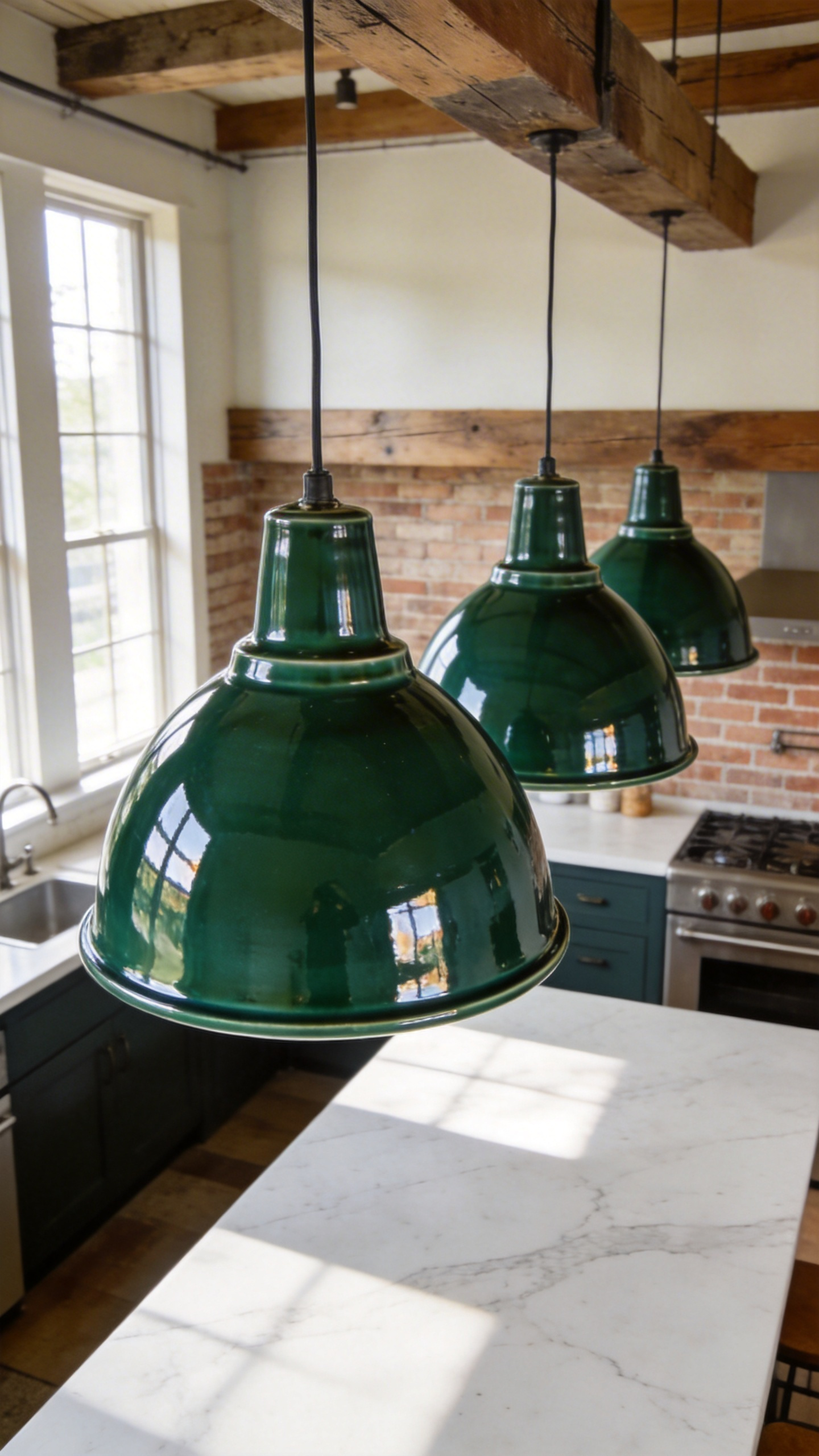
The high-gloss finish reflects light, creating highlights that make the heavy fixture feel ethereal. Historically, standard colors like “Reseda Green” were chosen to reduce eye strain. In a modern kitchen, this hue acts as a bridge between stainless steel and nature.
Additionally, authentic shades feature a brilliant white interior. This amplifies light downward without glare. It creates a sharp, graphic rim where the exterior color meets the inner reflector. Vents on “Coolicon” styles cast a soft halo upward, preventing a dark ceiling effect. Finally, this surface resists grease, offering a luxury finish that never fades.
9. Mixed Metals (Brass & Steel): Creating the ‘Found Object’ narrative that implies a space curated over time.
Using mixed metals establishes a sophisticated design strategy. Fundamentally, pairing brass and steel creates “functional dissonance.” Black steel acts as the utilitarian backbone. Simultaneously, brass serves as the “jewelry” of the room.
Historically, engineers selected brass for its mechanical intelligence. Therefore, combining these materials implies a space curated over decades.
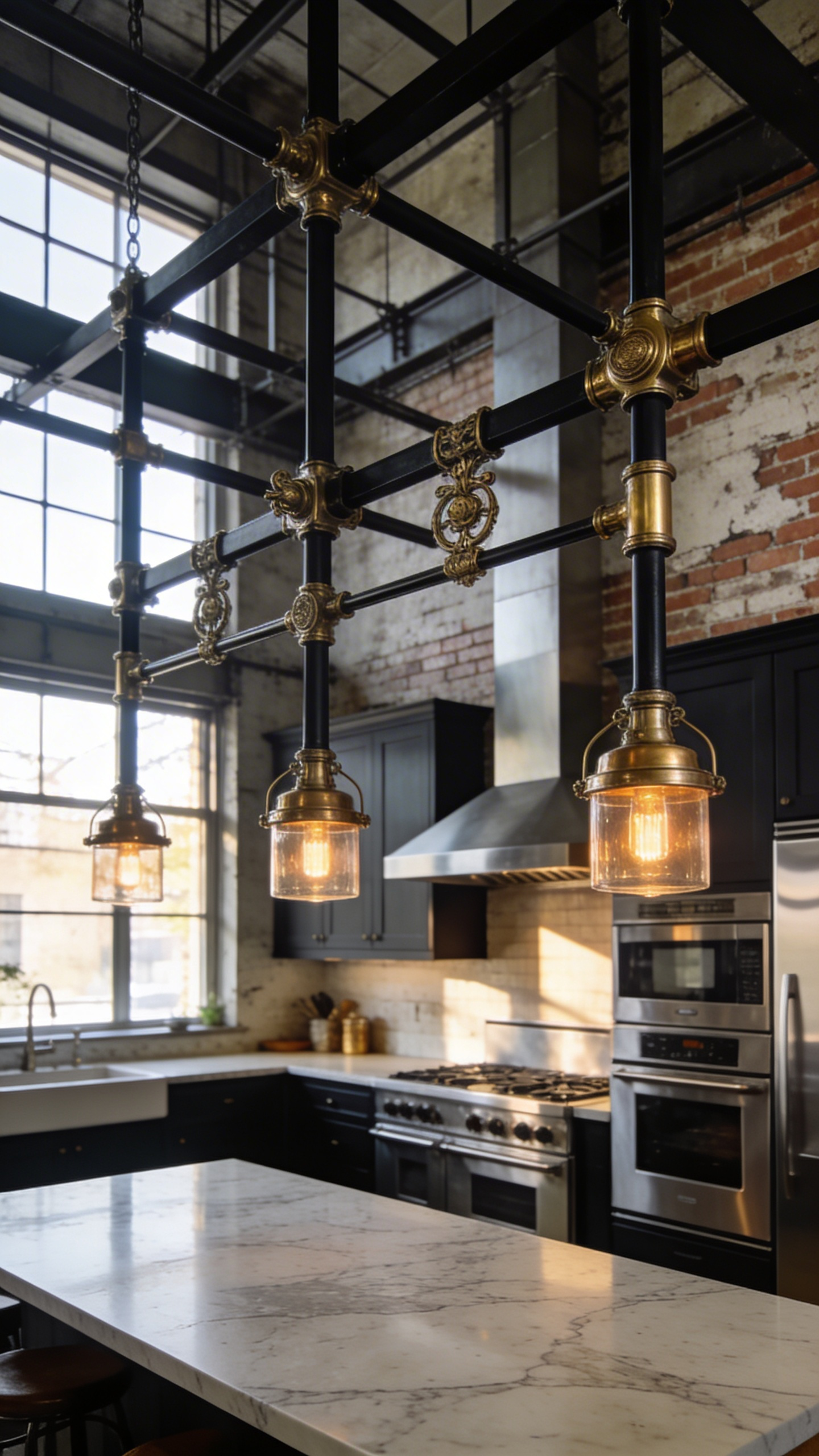
This combination suggests the fixture is a “found object” rather than a mass-produced unit. Specifically, the assembly method reinforces this. Visible joinery, like rivets, mimics 19th-century machinery. Consequently, these “scars of construction” tell a story of manual craftsmanship. The fixture appears retrofitted.
Moreover, the finish evolution is critical. Modern designs often utilize living, unlacquered brass. Over time, this surface reacts to the environment. It develops a patina that absorbs and diffuses light. Unlike high-shine lacquers, this aging process softens the ambiance. Thus, the lighting becomes a physical record of the home’s history.
Theme 3: Scale & Volume (The Warehouse Effect)
Managing cavernous spaces requires a strategy known as the “Warehouse Effect.” Designers use this to claim vertical volume. This prevents high-ceilinged kitchens from feeling unfinished. Historically, this aesthetic is rooted in the RLM standard.
These fixtures were designed to force light downward. In modern settings, using RLM-style shades replicates this theatrical environment. Therefore, they create a “room within a room” effect that grounds the kitchen island.
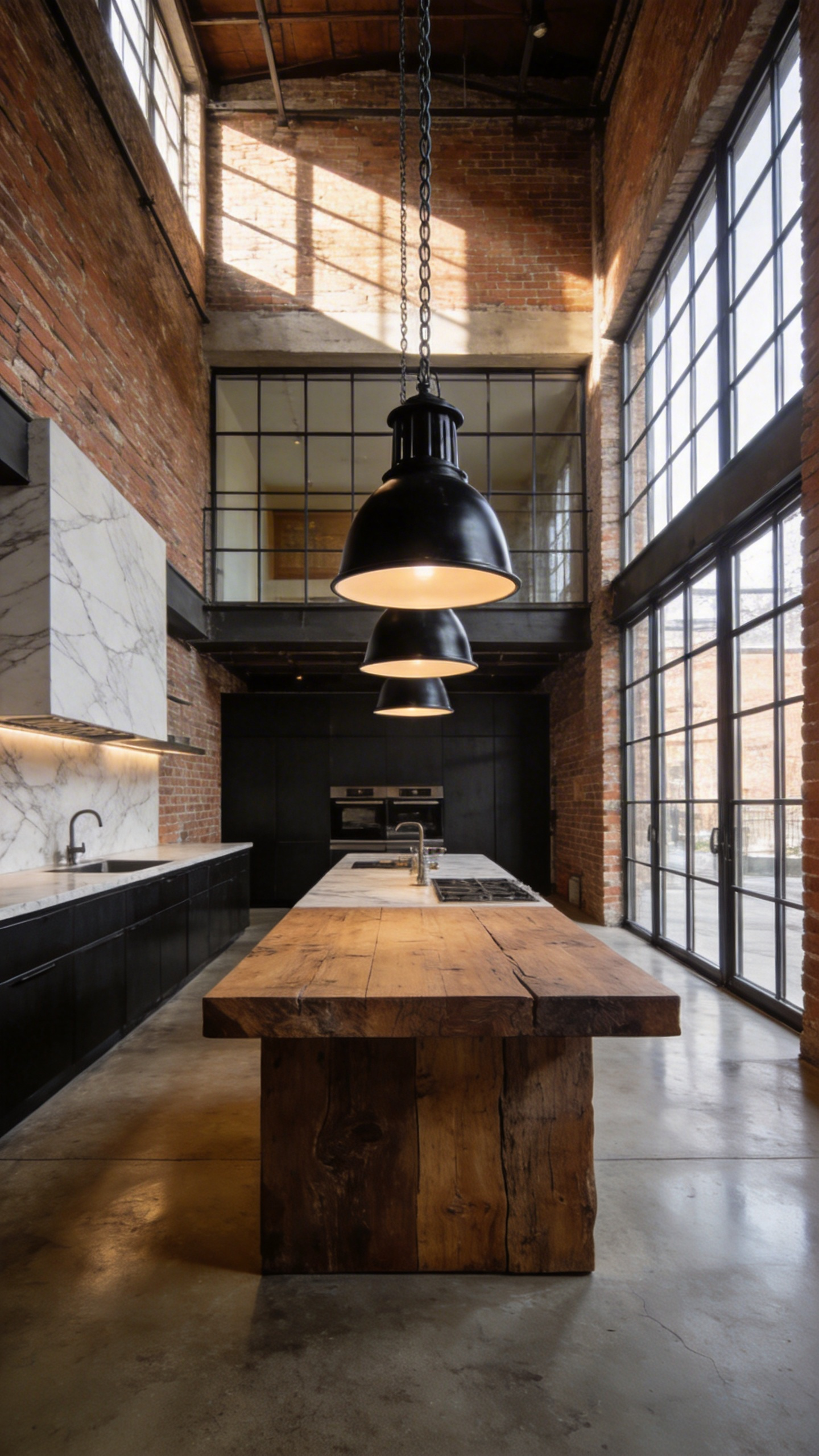
Furthermore, successful industrial lighting leverages Proportion Bias. Small pendants often look lost in open-plan spaces. In contrast, oversized domes act as visual anchors. This creates an “Alice in Wonderland” effect. Skewing the scale upward makes residents feel sheltered.
Additionally, this technique influences sound perception. Surprisingly, warm, low-hanging light softens harsh acoustics. By establishing a low visual canopy, the space feels quieter.
Finally, mastering this effect requires managing the “Vertical Void.” Designers often shift to narrower beam angles. This prevents light from washing out high walls. Thus, the upper ceiling remains in shadow, emphasizing the room’s scale while keeping the workspace focused.
10. Oversized Dome Pendants: Playing with proportion to anchor the kitchen island as a central workbench.
Oversized dome pendants transform a kitchen island into a creative workbench. Historically, these fixtures originated in textile mills. Today, bringing that scale into a home creates a theatrical shift. It signals that the island is a serious place for craft.
Architecturally, large domes serve as powerful spatial anchors. They effectively fill the empty vertical space. Consequently, this creates a “room within a room” without physical walls.
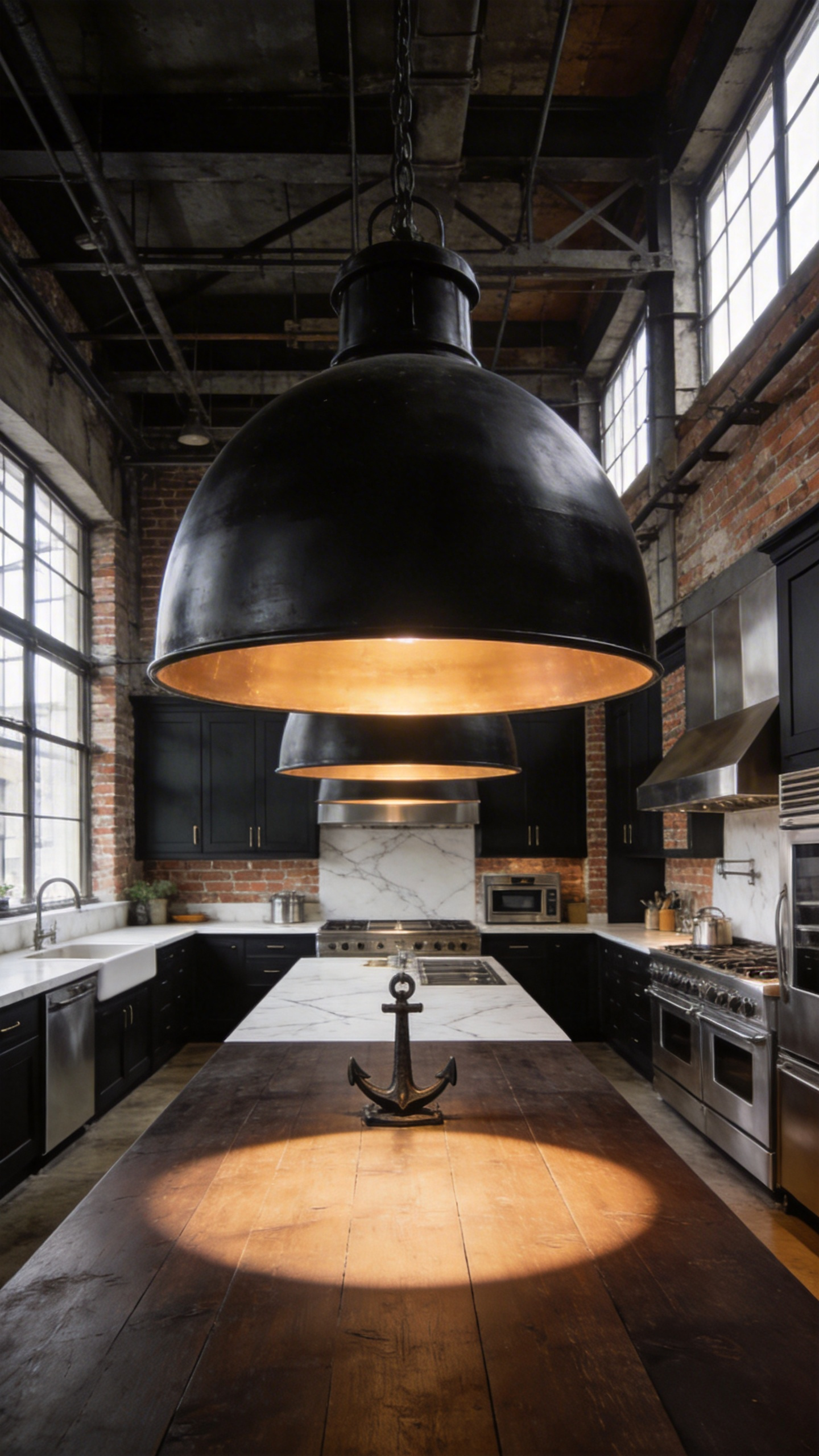
Beyond aesthetics, the dome shape offers functional benefits. Opaque metal shades direct light strictly downward. This eliminates distracting side-glare. It creates an intimate pool of light.
For the interior, matte white provides crisp clarity. Conversely, hammered copper or gold leaf warms the light. This softens cold industrial materials. True authenticity comes from heavy-gauge spun metal. Ultimately, the tactile weight adds permanence to your culinary studio.
11. Linear Suspension Bars: The ultimate solution for long islands, mimicking assembly line illumination.
Linear suspension bars represent the peak of industrial lighting. These fixtures bridge the gap between factory utility and modern elegance. They solve ergonomic challenges posed by massive islands. Historically, this design mimics the “assembly line” aesthetic. Therefore, installing one shifts a space from casual dining to a high-performance “Chef’s Pass.”
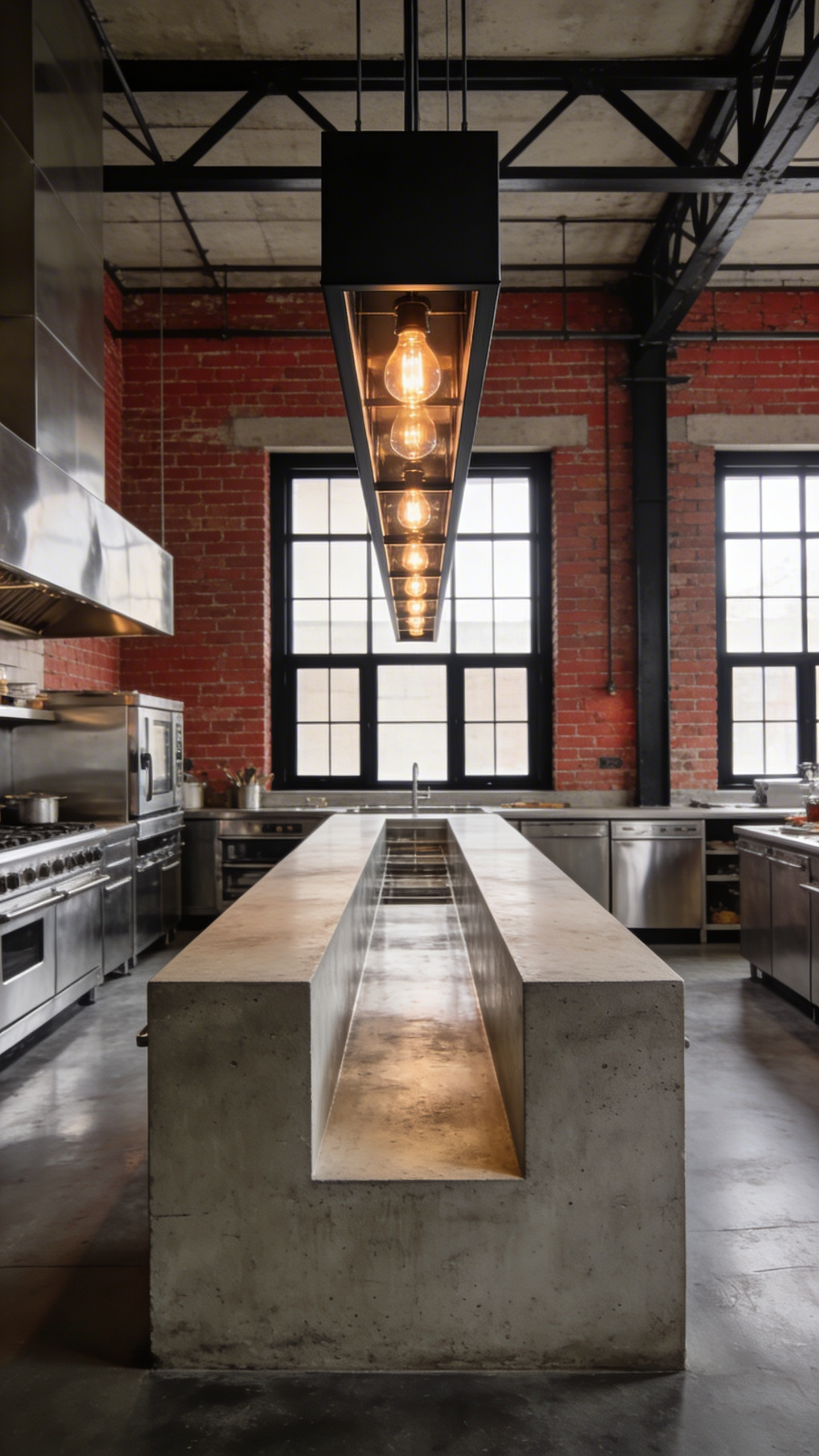
Unlike individual pendants, a linear bar creates a continuous pool of light. Consequently, you eliminate “convergence zones” and shadows. Furthermore, a single horizontal fixture visually declutters the room. Multiple large pendants can block sightlines, but a linear bar establishes a clean horizon.
Technologically, the best versions utilize extruded aluminum. This material allows for slim profiles that dissipate heat. Regarding proportion, apply the “two-thirds rule.” The fixture should measure approximately two-thirds the length of the island. This scale prevents the bar from looking like a floating stick.
12. The ‘Spider’ Multi-Light: A decentralized canopy allowing you to drape light across a wider ceiling span.
Ideally, lighting should adapt to your workspace. Historically, this concept traces back to Serge Mouille’s “Araignée” lamp. Modern spider lights utilize this “kinetic minimalism” to solve architectural headaches. Specifically, they address the fixed junction box issue common in lofts.
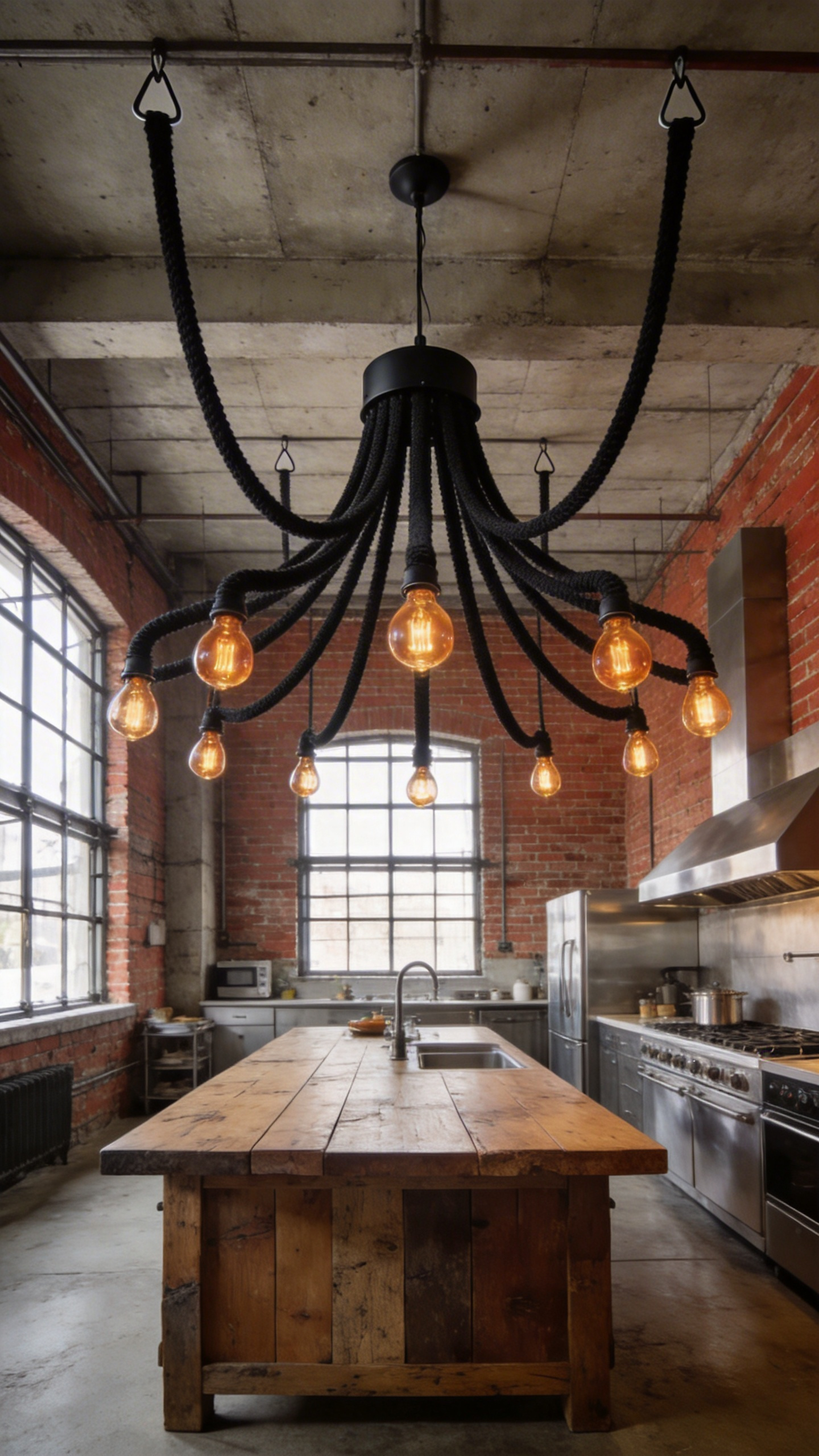
Instead of expensive rewiring, a single central canopy acts as the hub. Fabric-covered cables then radiate outward to hooks. Therefore, you can re-map your lighting plan without invasive construction. Adjusting cable slack controls visual weight. A tight layout feels clinical; a loose drape adds softness.
Functionally, this distributed array eliminates harsh shadows. A single pendant often causes a cook to cast a shadow on their work. Conversely, the spider light hits the counter from multiple angles. This fills in dark spots.
Furthermore, materials introduce contrast. Braided cables add textile warmth to cold surfaces. Finally, proper placement is key. Aim for bulbs to hover 28 to 34 inches above the island.
13. Wire Cage Guards: The ‘Safety-First’ aesthetic that adds texture and shadow play.
Wire cage guards represent an intersection of history and design. Originally, these fixtures served a “Safety-First” function. They acted as protective roll-cages for bulbs in mills. Today, this necessity has transformed into a tool for atmospheric depth.
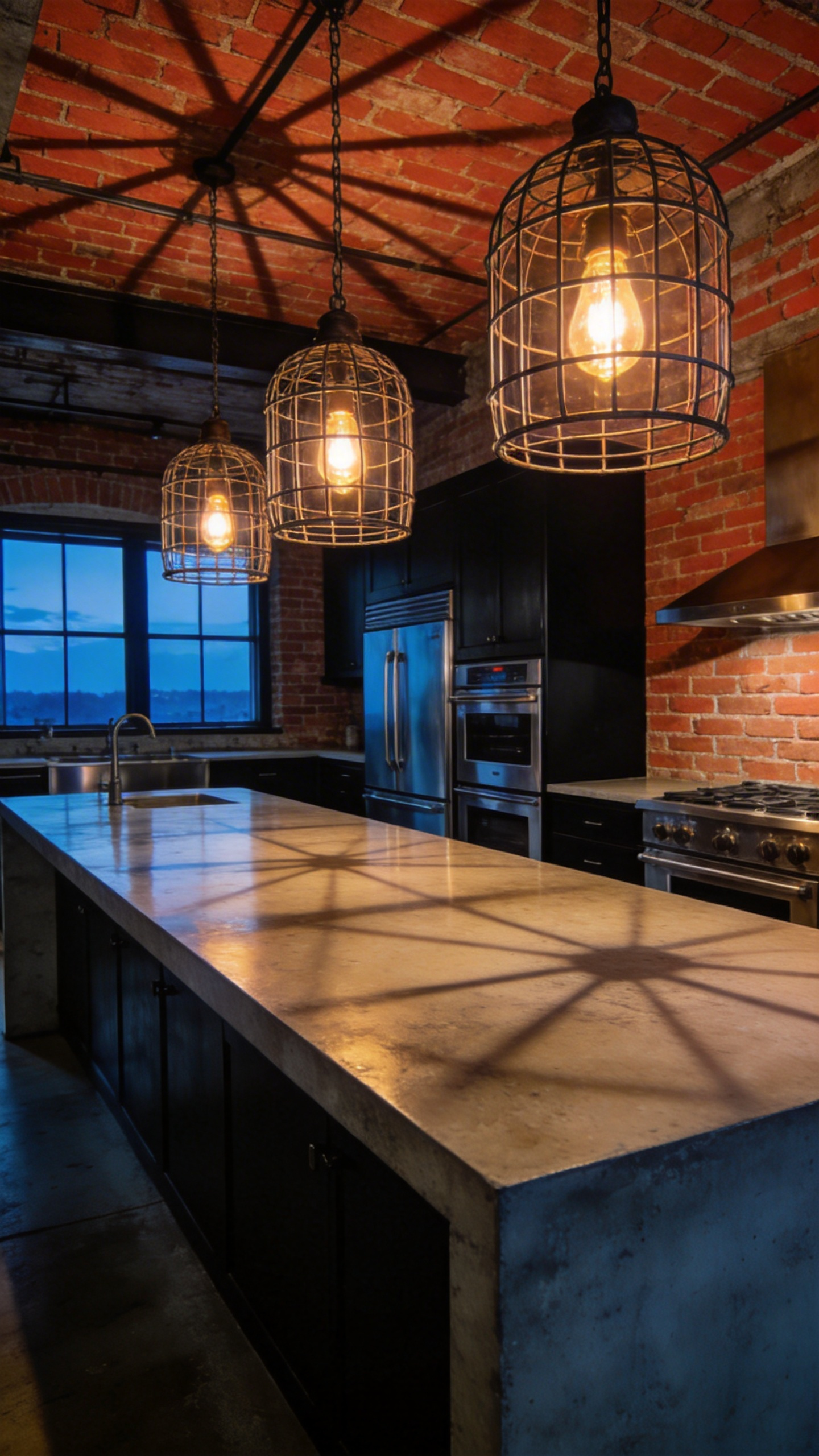
The aesthetic appeal lies in shadow play. Unlike solid shades, the wire grid creates a unique sensory envelope. The bars break up harsh light, casting rhythmic shadows. Designers describe this as adding visual texture to flat surfaces.
Material choice dictates the mood. Galvanized steel offers an honest, industrial look. Raw brass cages reimagine the hardware as refined jewelry.
Ideally, these fixtures should be part of a layered scheme. Because the grid shadows create visual noise, they serve best as ambient lighting. Simultaneously, install clean under-cabinet lighting for focused tasks. This prevents distraction during knife work. Furthermore, the open-air design allows heat dissipation, extending the life of LED bulbs.
Theme 4: Modern Integration (The Digital Workshop)
The kitchen has evolved into a “digital workshop.” Consequently, lighting design now balances industrial aesthetics with automation. Visibility is governed by “precision lab” standards. Active task zones require 50 to 75 foot-candles for safety. Furthermore, color accuracy is non-negotiable. Professional kitchens utilize High-CRI LEDs to render ingredients perfectly.
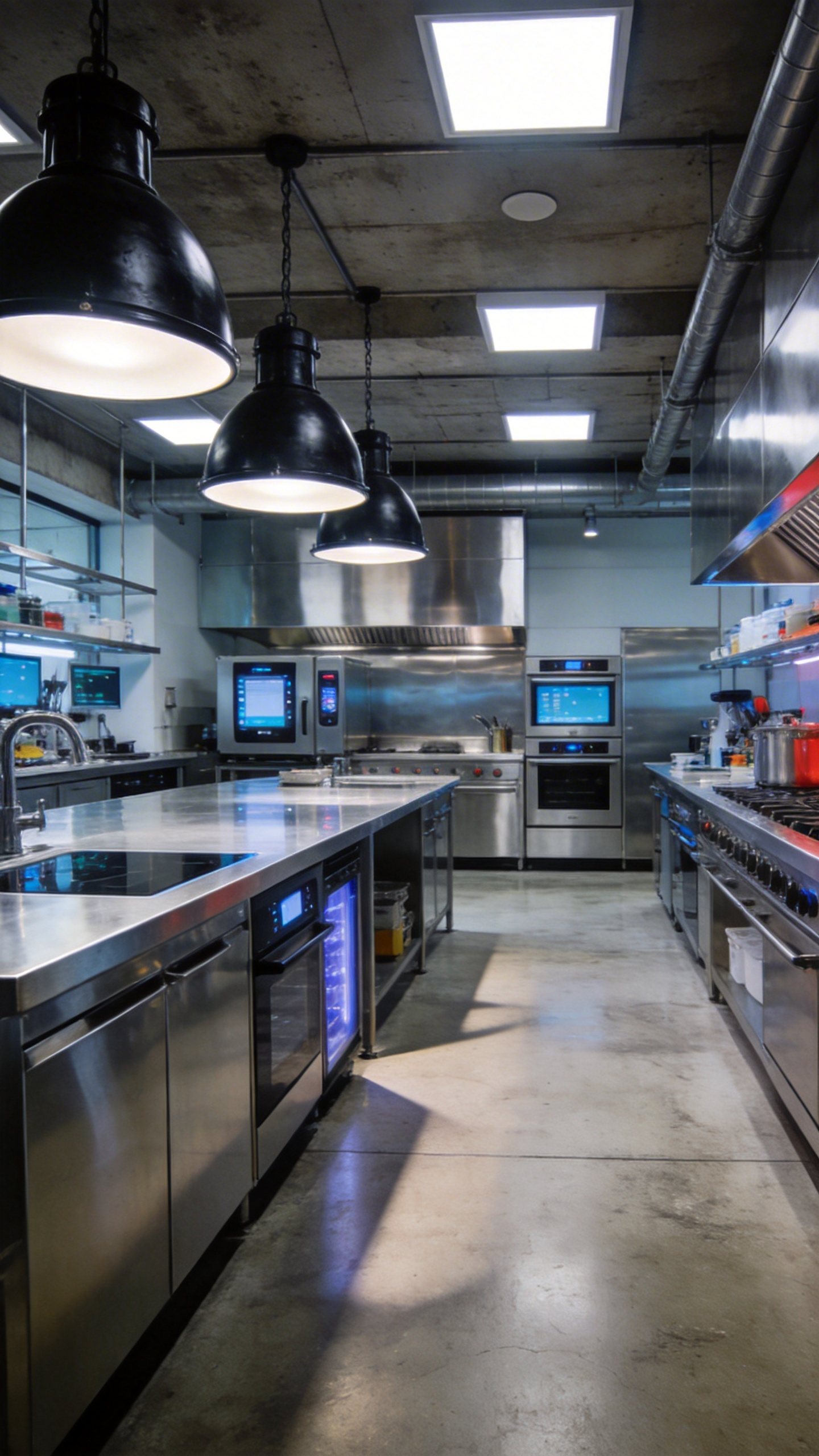
Beyond visibility, technology prioritizes biological synchronization. Experts refer to this as “Integrative Lighting.” Automated systems transition from blue-enriched morning light to warm evening tones. Thus, the workspace aligns with circadian rhythms.
To achieve this, infrastructure relies on invisible intelligence. Fixtures utilize Bluetooth Mesh or Matter protocols. Unlike older motion detectors, advanced sensors can detect micro-vibrations, ensuring lights remain on during delicate tasks.
Aesthetically, this theme represents a “rugged soul with a digital brain.” Imagine a heavy pendant that appears salvaged from a shipyard. Inside, however, sits a sophisticated driver. The light becomes a communication tool, pulsing subtly to signal completion.
14. Smart-Tech in Vintage Housings: Pairing Hue or Wi-Fi bulbs with antique sockets for adaptive color temperatures.
Pairing modern technology with vintage lighting is a unique challenge. It represents a collision between 19th-century design and modern wellness. In industrial kitchens, raw materials dominate. However, integrating smart bulbs requires navigating electrical history.

Antique factory fixtures often utilize oversized bases incompatible with standard LEDs. Installing porcelain adapters acts as a necessary bridge. Furthermore, solid metal shades can inadvertently function as Faraday cages. This conductive enclosure blocks Wi-Fi signals.
To mitigate this, consider using vintage wire-cage fixtures. These open designs allow radio waves to escape. Additionally, users may encounter “ghosting,” where bulbs glow faintly when off. This occurs because drivers harvest leakage current. Fortunately, installing a bypass capacitor absorbs this energy. These adjustments allow for adaptive color temperatures within a historic shell.
15. Milk Glass Globes with Industrial Hardware: A nod to mid-century institutional design that reduces glare for screens/tablets.
This lighting choice represents a masterclass in “Transitional Utility.” Historically, milk glass defined the design of mid-century hospitals. Therefore, it brings a clean pedigree to modern spaces. However, the current resurgence is ergonomic. Specifically, milk glass eliminates “veiling glare” on tablets. Unlike clear glass, the opaque material scatters light waves. Thus, digital screens remain readable.
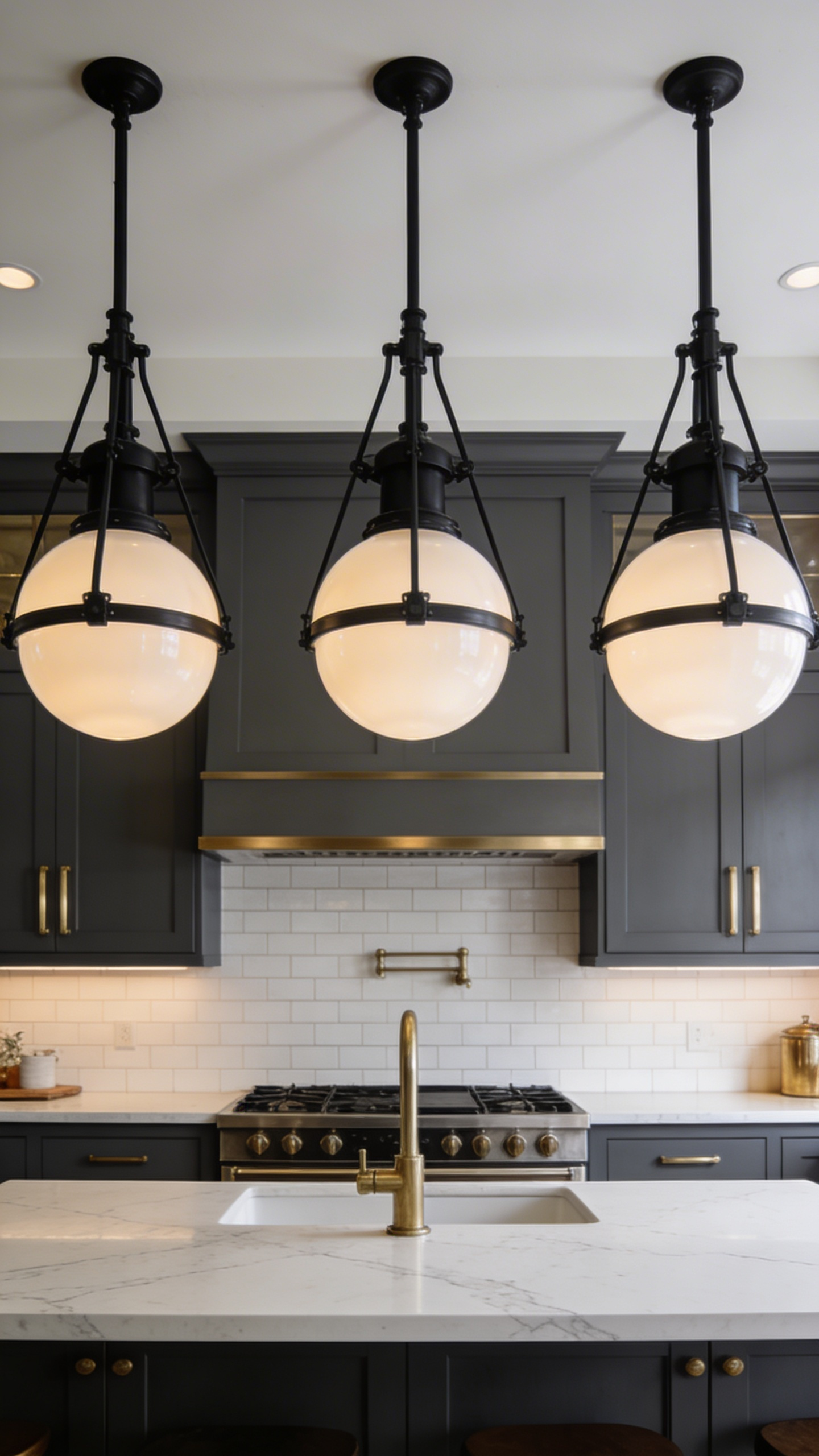
The “industrial” character comes from the supporting hardware. Authenticity lies in the “gallery,” often featuring visible thumb screws. These metal accents suggest durability. Furthermore, the spherical globe softens the rigid geometry of quartz. Consequently, the fixture warms the room’s atmosphere. To achieve the correct scale, look for a 12-inch or 14-inch globe. This pairing balances historical authority with modern digital needs.
Frequently Asked Questions
What makes a kitchen light “industrial”?
An industrial light is characterized by raw materials like steel, brass, and concrete. It often features exposed mechanical components like pulleys, rivets, or cages. These fixtures prioritize “honest utility.” Their design is dictated by function rather than decoration.
Are industrial lights too harsh for a home kitchen?
Original factory lights were bright and clinical. However, modern versions utilize warm Edison-style LED bulbs. By layering industrial task lighting with softer ambient sources, you achieve a cozy atmosphere without sacrificing visibility.
How high should industrial pendants hang over an island?
Generally, industrial pendants should hang 30 to 36 inches above the countertop. For oversized dome fixtures, hanging them slightly higher prevents the space from feeling cramped. Retractable pulley systems allow for manual adjustment based on the task.
Conclusion: From Cooking Space to Culinary Workshop
Transforming a kitchen requires more than just installing vintage metal fixtures. It demands a functional mindset rooted in performance. A premium industrial kitchen light acts as a precise tool, not mere decoration. It establishes a curated aesthetic that bridges raw history and modern luxury.
This design shift involves prioritizing high CRI and intentional layering. By doing so, you banish the dim glow of nostalgia in favor of architectural clarity. The space becomes a true atelier for creation.
Creating this environment elevates daily cooking into a focused ritual. The kitchen evolves from a service area into a creative stage. To begin, audit the color fidelity of light currently hitting your prep stations. Upgrade to neutral LEDs that reveal the true vibrancy of your ingredients.