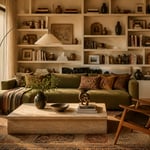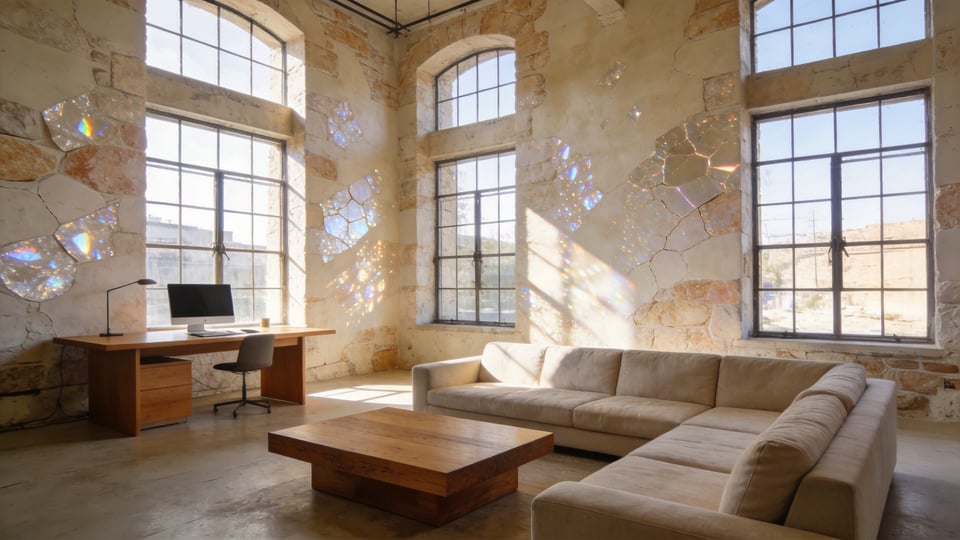
Most people look at a blank living room wall and just see a standard structural boundary. I genuinely disagree with that approach. As an artist, I see this vertical space as the main storyteller of your home. Exploring different living room wall ideas isn’t just about making things look pretty. It’s about figuring out how you actually want to live.
Historically, living room walls were just static monuments to wealth. But modern design treats the wall as a living, breathing biography. Indeed, your walls reflect your personal history. They dictate how you relax and work every single day.
The impact of living room wall decor goes way beyond basic visual appeal. Scientifically, it triggers powerful physiological responses in your brain. In fact, nearly 90 percent of visual cues process incredibly fast. Therefore, your wall directly sets your biological baseline for comfort. Viewing art actually activates your brain’s reward system. Warm hues naturally increase your energy for social interactions. Conversely, blue-toned gallery walls lower your blood pressure. They also sharpen your daily focus.
Ultimately, intentional decor creates functional spaces for creative work. Proper spatial proportions encourage natural social dynamics. This guide reveals how to curate your own living archive. We will explore the tension between minimalism and maximalism. Next, you can design a space balancing order and vitality. Finally, you will learn to thread your unique life chapters into a cohesive vision.
1. Architectural Limewash: Treating Your Wall as a Breathing Backdrop
Architectural limewash is nothing like standard modern paint. Actually, it relies on a natural chemical process called carbonation. Slaked lime reacts directly with carbon dioxide in the air. As a result, the liquid petrifies into a thin layer of real limestone. This creates a microscopic crystalline structure right on your wall. Naturally, it reflects light in a beautiful, prismatic way.
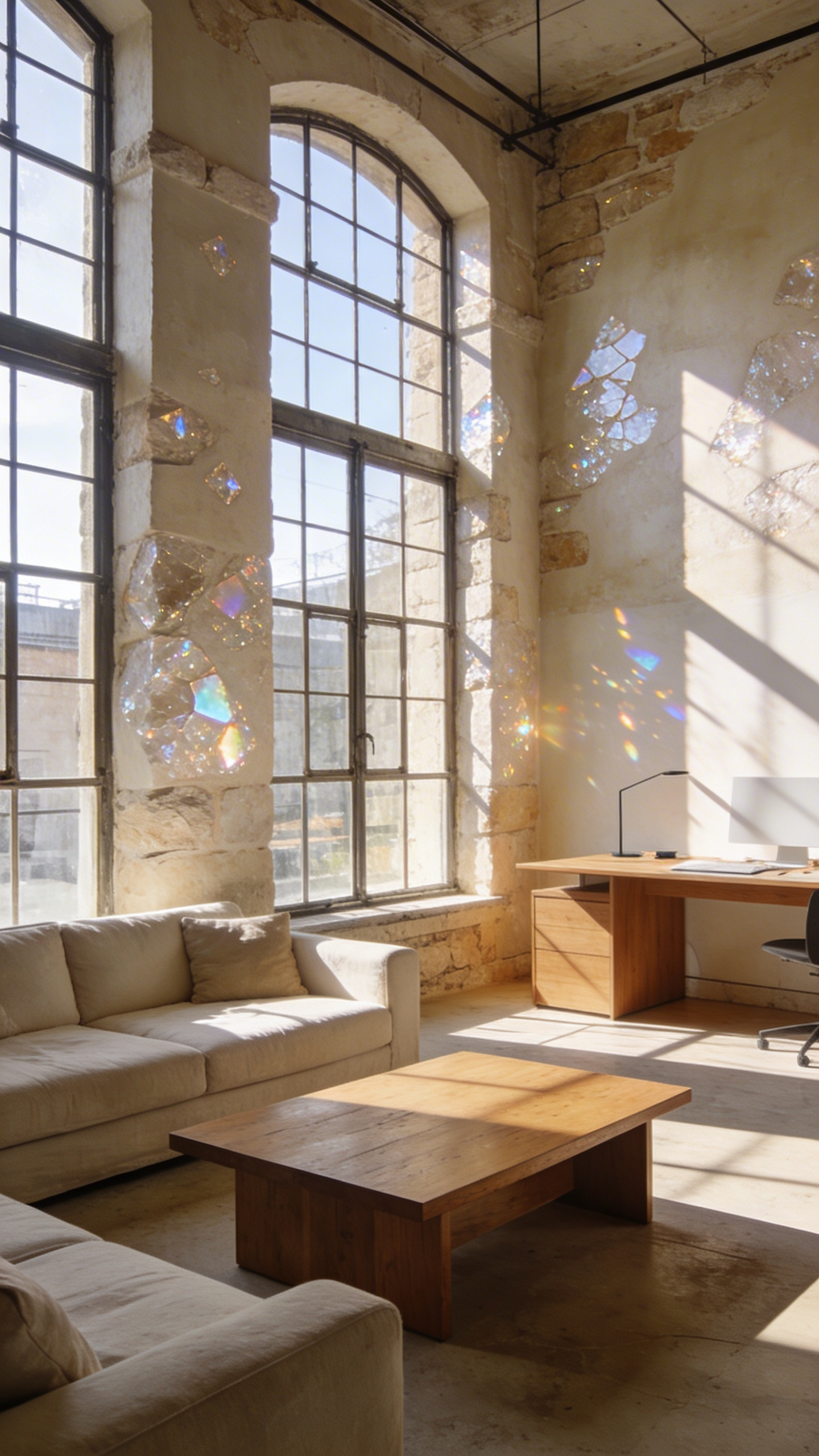
For a living area, this provides a soft, atmospheric glow. Natural mineral pigments absorb directly into the lime base. Specifically, this creates the optical Tyndall effect. Light scatters differently across the surface throughout the day. Therefore, the wall shifts from a morning matte to a twilight texture.
Surprisingly, this mineral finish acts as the third lung of your home. It features an incredibly low vapor diffusion value. This means the wall breathes and continuously regulates ambient humidity. Honestly, this is essential for everyday comfort. Additionally, the high pH level makes it naturally hypoallergenic. In fact, it is completely antifungal.
Achieving this tactile depth requires some real effort. First, you need a large, long-haired masonry brush. Next, you apply the limewash in an overlapping cross-hatch pattern. These precise strokes ensure the lime carbonates completely evenly. Ultimately, this slow process creates a truly unique mural. It transforms a flat partition into a grounding presence.
2. Exposed Raw Materials: The Art of Uncovering Brick and Concrete
Exposing raw materials is rarely just about simple demolition. Rather, it is a careful process of architectural investigation. I always say that uncovering brick reveals a building’s true canvas. Historically, these structural bones were hidden away behind thick plaster. Now, professionals use surface mapping to assess hidden masonry.
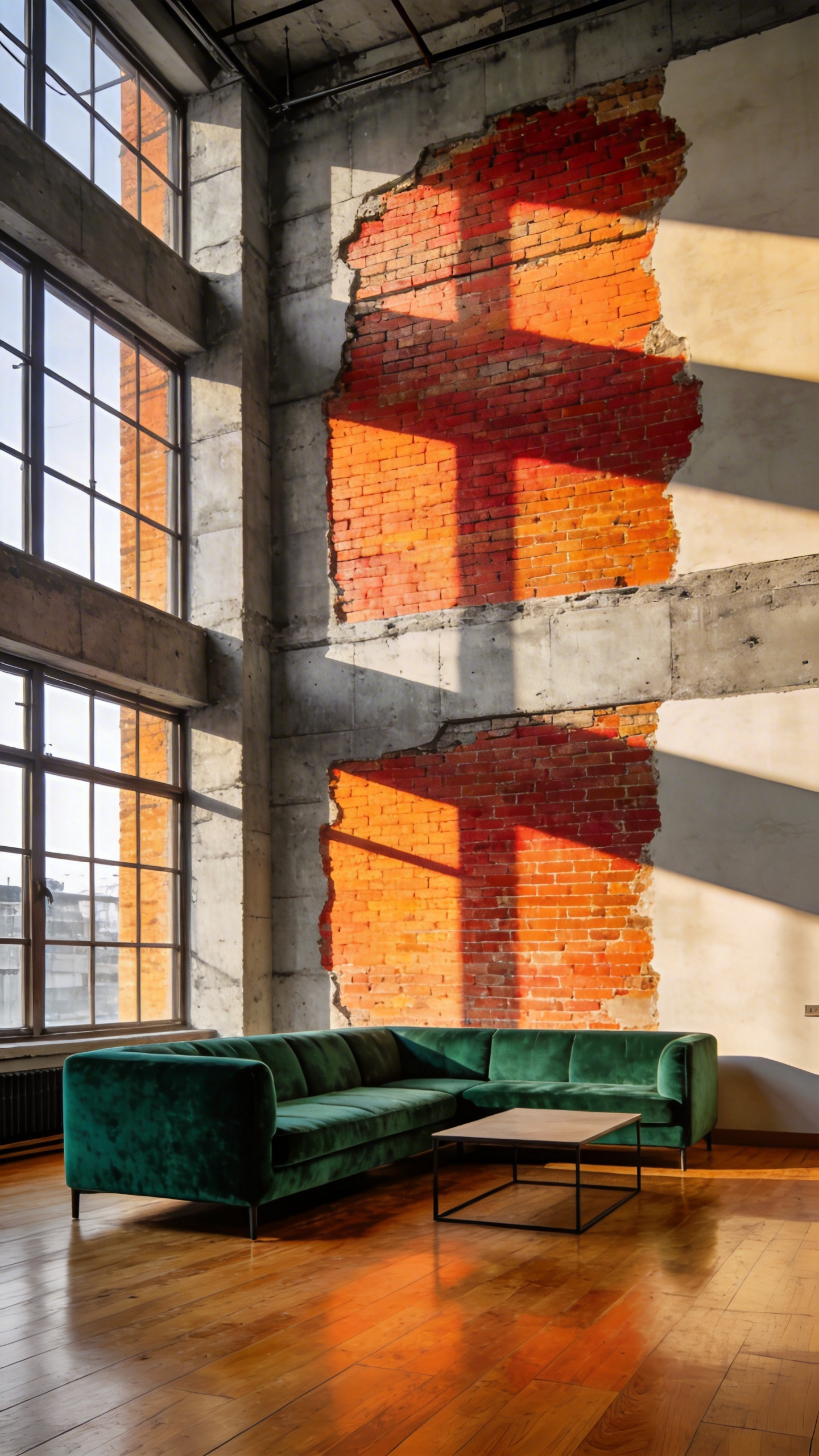
Specifically, hand-chiseling plaster protects the brick’s delicate fire skin. Otherwise, damaged bricks become spongy and prone to crumbling. Furthermore, these raw walls act as active thermal batteries. Dense masonry absorbs daytime heat and releases it slowly. This radiant comfort stabilizes the room perfectly.
However, raw surfaces radically change a space’s sensory physics. For instance, hard concrete easily reflects sound waves. This often causes unwanted, harsh echoes. Therefore, I always pair raw walls with heavy linen drapes. These soft anchors prevent the room from feeling cold.
Finally, exposing materials embraces the honest aging of a home. Indeed, an exposed wall beautifully records the building’s historical ghosts. Importantly, you must balance this aesthetic with proper preservation. Penetrating sealers are infinitely better than glossy, suffocating plastic films. Naturally, these breathable barriers prevent dusting. Ultimately, this tactile space feels incredibly grounded and permanent.
3. Color-Drenching: Creating an Immersive, Monochromatic Base
Color-drenching offers a sophisticated alternative to the tired accent wall. Specifically, this practice involves saturating every room surface in a single hue. Walls, ceilings, trim, and even radiators become a cohesive canvas. Personally, I absolutely love how this creates a functional, monochromatic base.
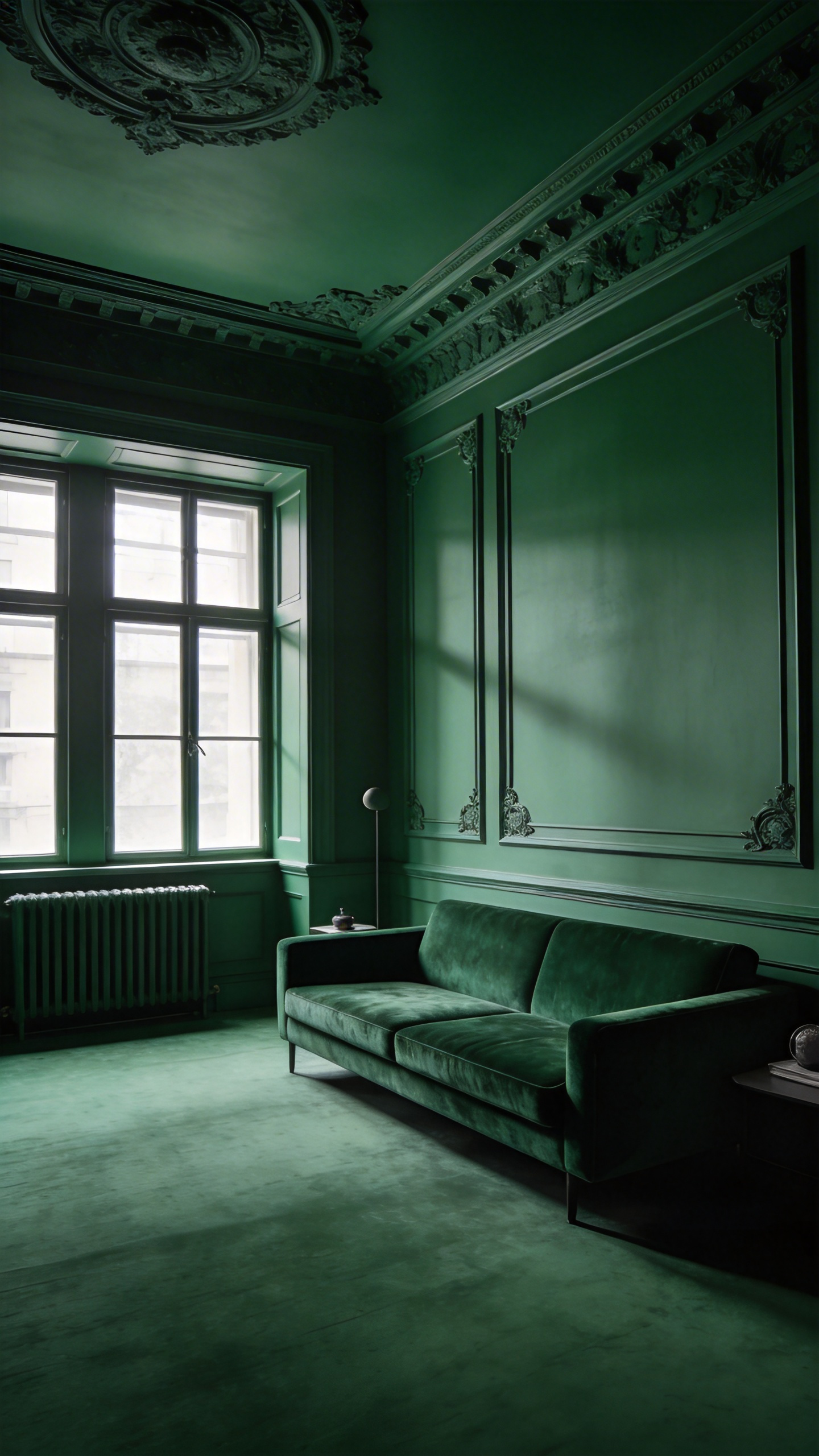
Furthermore, this technique produces the famous infinity effect. By painting the ceiling and baseboards identically, the eye never stops at hard edges. Therefore, the architecture suddenly feels completely limitless. Additionally, typical visual eyesores easily vanish into the background. Thus, your furniture and artwork become the true focal points.
A frequent misconception is that these monochromatic spaces look flat. But you can easily prevent this by using a smart sheen strategy. For instance, applying an ultra-matte finish on walls absorbs light beautifully. Conversely, painting architectural trim in a high-gloss version reflects light. Ultimately, this gloss creates subtle shadow lines that define the room.
Moreover, this uniform approach drastically reduces sensory interruptions. The human brain can gently rest when visual input remains consistent. In fact, deep earthy terracottas transform a living room into a restorative sanctuary. Finally, the burden of visual interest shifts toward tactile contrast. A drenched room truly comes alive when velvet fabrics meet raw linen.
4. Linen and Canvas Wall Coverings to Soften Acoustics
I often view wall coverings as highly functional architectural filters. Specifically, linen and canvas masterfully manipulate both light and sound. These materials push far beyond mere decoration. Under a microscope, irregular linen fibers resemble rolling hills. This means incoming light scatters across the fabric at unpredictable angles.
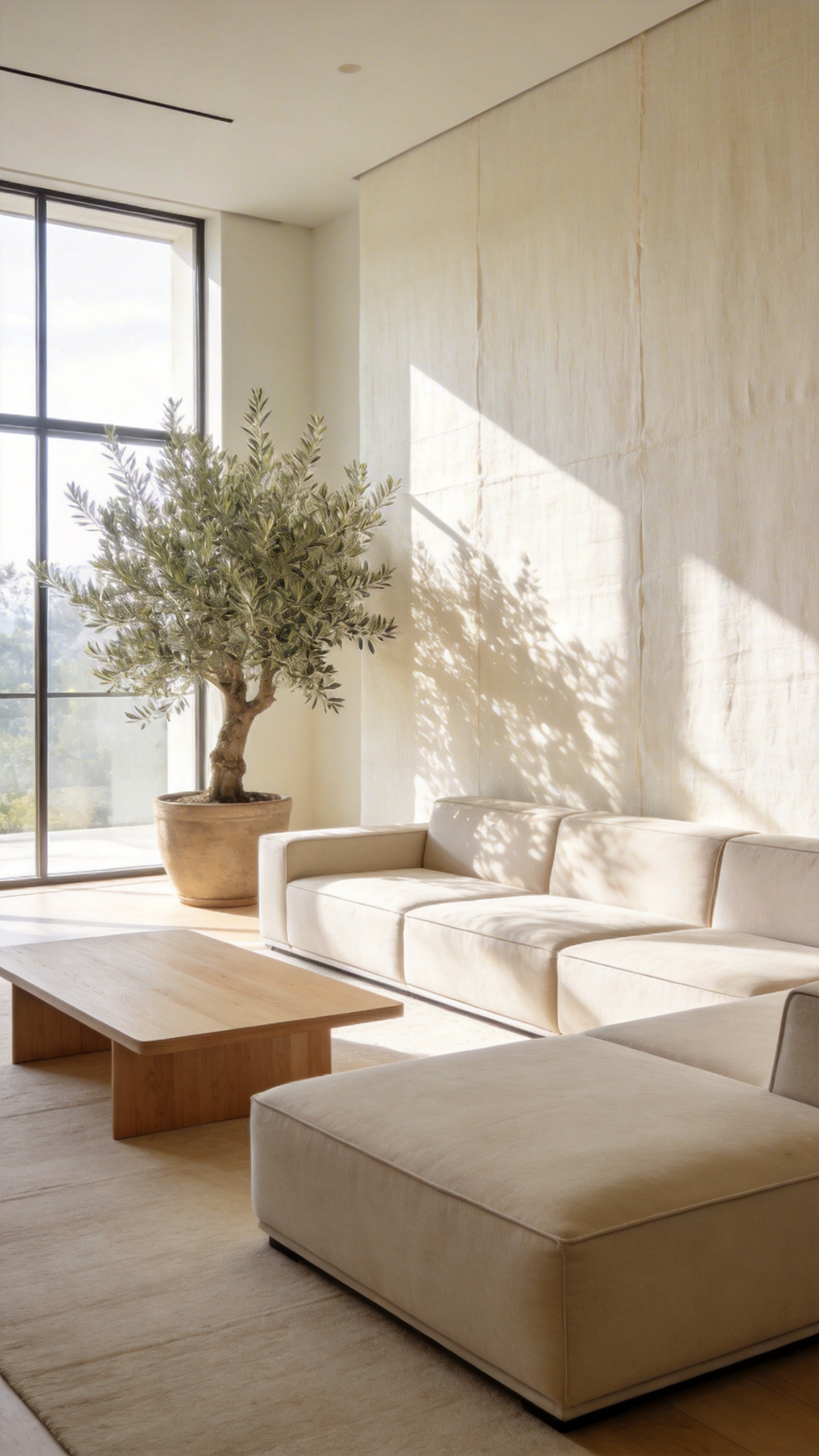
This diffuse reflectance entirely eliminates harsh sunlight glare. Furthermore, it establishes a soft glow known as balanced luminance. Such gentle lighting is absolutely essential for a relaxing space. Additionally, these haptic fabrics perform remarkably well regarding room acoustics. Professional installations use the fabric as an acoustically transparent membrane.
Sound waves pass effortlessly through the organic, breathable weave. Then, a specialized underlying padding layer effectively traps the ambient noise. In fact, this traditional system absorbs heavy room echoes beautifully. Therefore, sharp conversational clatter is instantly muffled.
When designing, you must also carefully consider specific material nuances. Naturally, pure linen provides excellent dimensional stability. Conversely, canvas offers a heavier, highly resilient cotton duck weave. This durability makes canvas perfect for large, high-traffic living spaces.
Ultimately, these tactile surfaces deliver a profound psychological balm. Visually, a living room wrapped in woven fabric feels physically warmer. Thus, this organic softness drastically reduces our daily perceptual load. The space quickly becomes a true sanctuary for living.
5. The Floor-to-Ceiling Salon Wall: An Asymmetrical Narrative
Historically, the salon wall began in 1667 at the Louvre. Academic painters packed heavily framed art from floor to ceiling. Naturally, they placed prestigious pieces at eye level and pushed lesser works upward. Today, modern asymmetrical designs playfully subvert this rigid hierarchy.
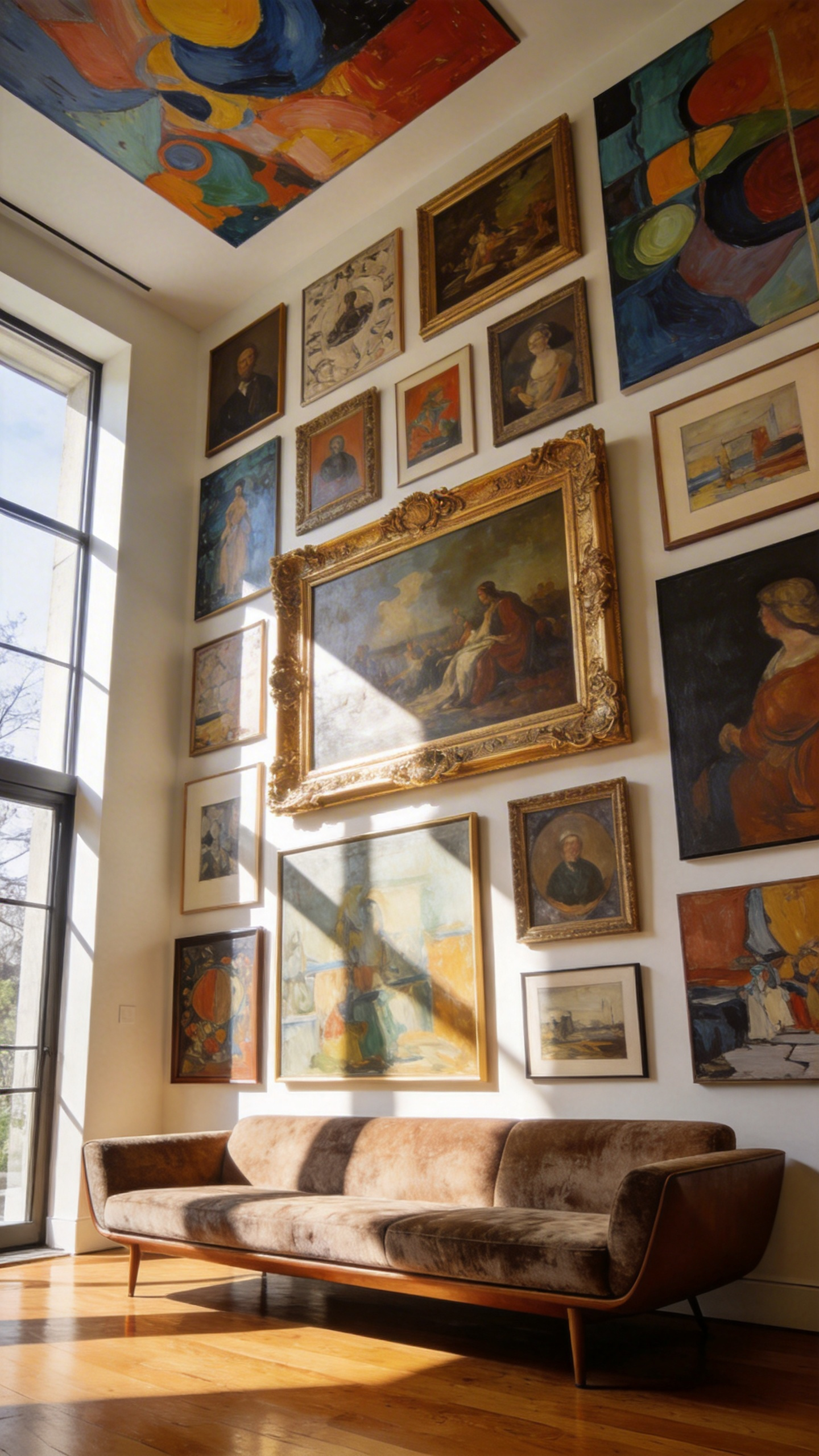
For instance, you might place detailed heirlooms at eye level. Then, you can try “skying” bold abstracts higher up. Therefore, the ceiling-height pieces act as atmospheric living room wallpaper. Meanwhile, the intimate lower works invite guests to lean in.
I often use asymmetrical balance to introduce dynamic tension. Essentially, this ordered chaos makes a living space feel truly alive. Furthermore, you must balance visual weight rather than physical size. Often, a small, dark oil painting holds more gravity than a large watercolor.
Architecturally, a floor-to-ceiling display dramatically transforms a room’s volume. In high-ceilinged rooms, it grounds the dead zone above your furniture. Conversely, filling a small room’s vertical real estate makes it feel much larger. Additionally, drawing the gaze upward emphasizes height. Moreover, mixing hard glass frames with soft canvas dampens harsh acoustics.
Executing this narrative requires careful physical planning. Naturally, every layout needs an anchor piece to set the tone. Next, create narrative dialogue between contrasting items. Place a 19th-century portrait beside a modern neon sign. Finally, map your exact layout on the floor with painter’s tape first. Maintain a consistent two-inch gap between frames to unify the elements.
6. Floating Studio Ledges for Rapidly Evolving Exhibitions
I genuinely prefer a living room that feels like a dynamic gallery. Specifically, floating studio ledges offer a huge upgrade over the traditional picture rail. Historically, this concept originates in the 19th-century artist’s atelier. Masters like Rembrandt used shallow wooden rails to prop up drying canvases. Bringing this element home actively shifts your role from decorator to active curator.
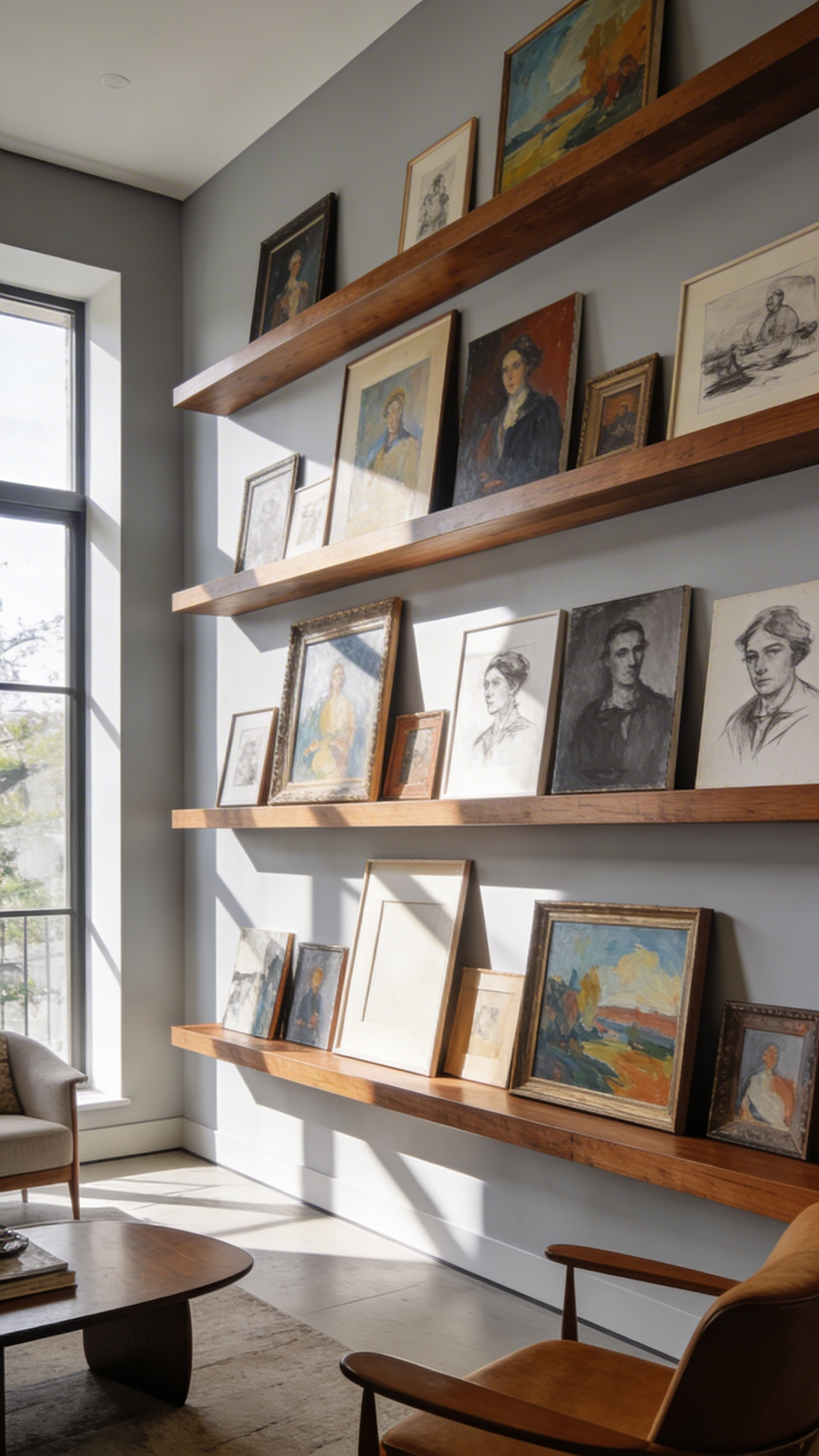
Technically, a true studio ledge is distinct from a generic floating shelf. Professional-grade ledges feature a landing between 3.5 and 5 inches deep. Furthermore, they often include a subtle recessed groove or raised lip. As a result, this smart design prevents frames from sliding off.
Anchoring solid hardwood ledges into wall studs supports heavy weights. Therefore, you can safely display ceramic vessels alongside heavy frames. Psychologically, there is a profound benefit to this evolving exhibition style. Human brains eventually filter out static images due to visual fatigue.
Conversely, rotating your artwork regularly significantly lifts mood and sparks creativity. Naturally, the ledge facilitates this regular pulse. It completely removes the annoying barrier of hammers and nails. Stylistically, an evolving exhibition requires a unifying thread. First, place one large hero piece slightly off-center.
Then, build outward by overlapping smaller frames. This creates wonderful three-dimensional depth. Additionally, choosing a ledge with a shadow gap allows for integrated lighting. Ultimately, this fluid approach replaces static walls with lived-in luxury.
7. Sculptural Integration: Moving Beyond Flat Artwork
Many designers traditionally treat walls as canvases for flat paintings. However, modern living spaces increasingly embrace true sculptural integration. The wall itself physically becomes the actual three-dimensional artwork. Therefore, it is no longer just a simple decorative layer.
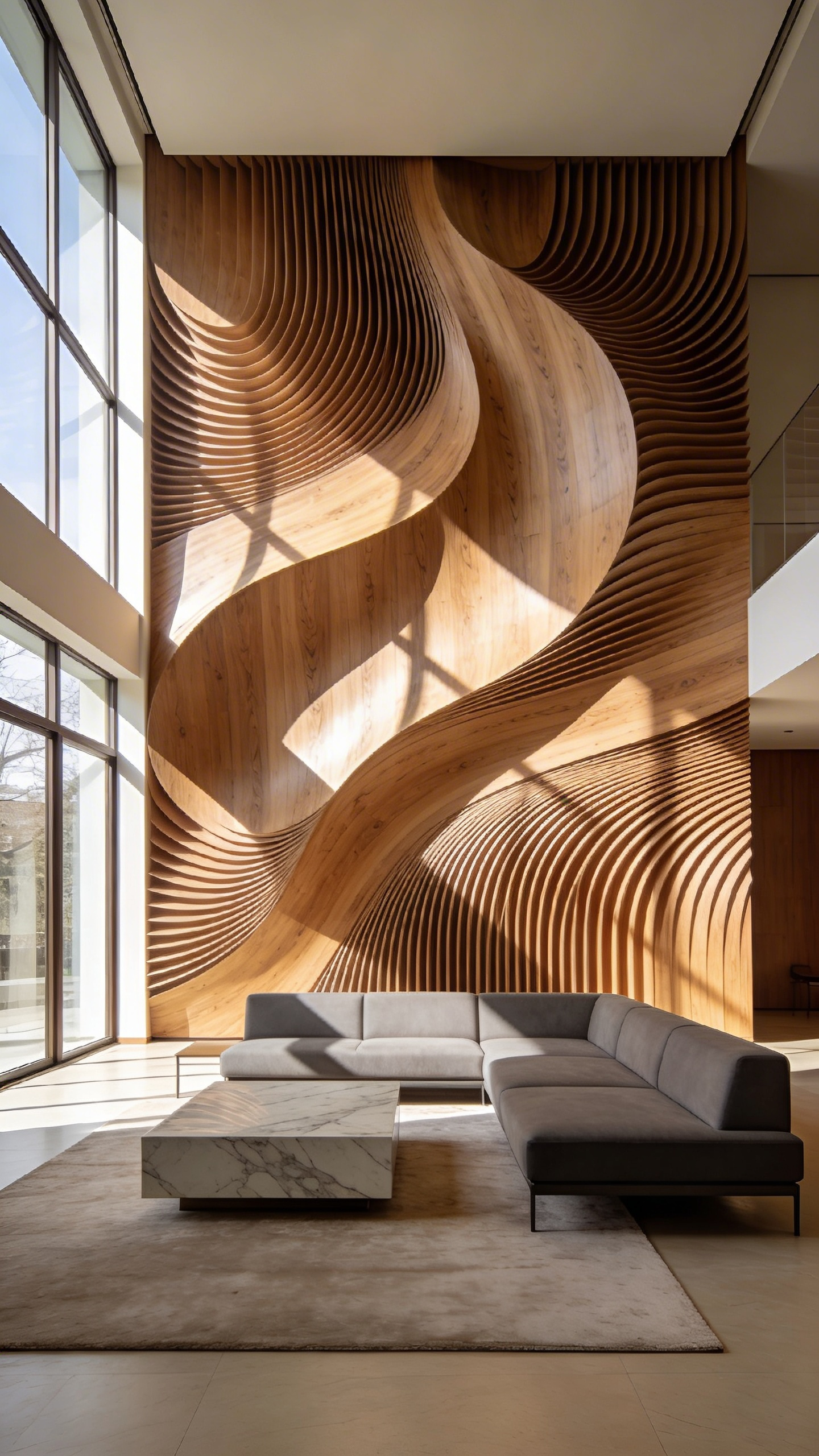
This innovative approach relies heavily on the visual parallax effect. Because of this, the sculptural installation shifts as you walk past it. Parametric wooden slats might initially look like rigid vertical lines. But moving across the space reveals beautiful organic rhythms. Ultimately, this transforms a static room into a kinetic experience.
These complex deep textures profoundly impact our sensory well-being. Specifically, visual perception safely triggers our brain’s tactile centers. Observing fluted plaster feels inherently grounding. Additionally, this varying depth serves a vital acoustic purpose. Three-dimensional panels efficiently diffuse sound waves rather than reflecting them.
As a result, the living area becomes exceptionally quiet. This makes the environment perfect for both resting and hosting. Sculptural integrations also uniquely utilize ambient light. Shifting sunlight essentially repaints the entire room in real-time.
These site-specific physical features permanently anchor the living space. Furthermore, true sculptural integration upgrades the home’s fundamental architecture. Homeowners increasingly prefer this over traditionally framed flat canvas pieces. In fact, custom bas-reliefs can increase overall property values significantly.
8. The Oversized Statement Canvas: Anchoring Multi-Use Spaces
Large canvases are essentially modern tapestries. Historically, aristocrats utilized massive textiles for insulation and mobile grandeur. Today, oversized art serves a totally different architectural purpose. Specifically, it replaces busy gallery walls to heavily reduce visual noise.
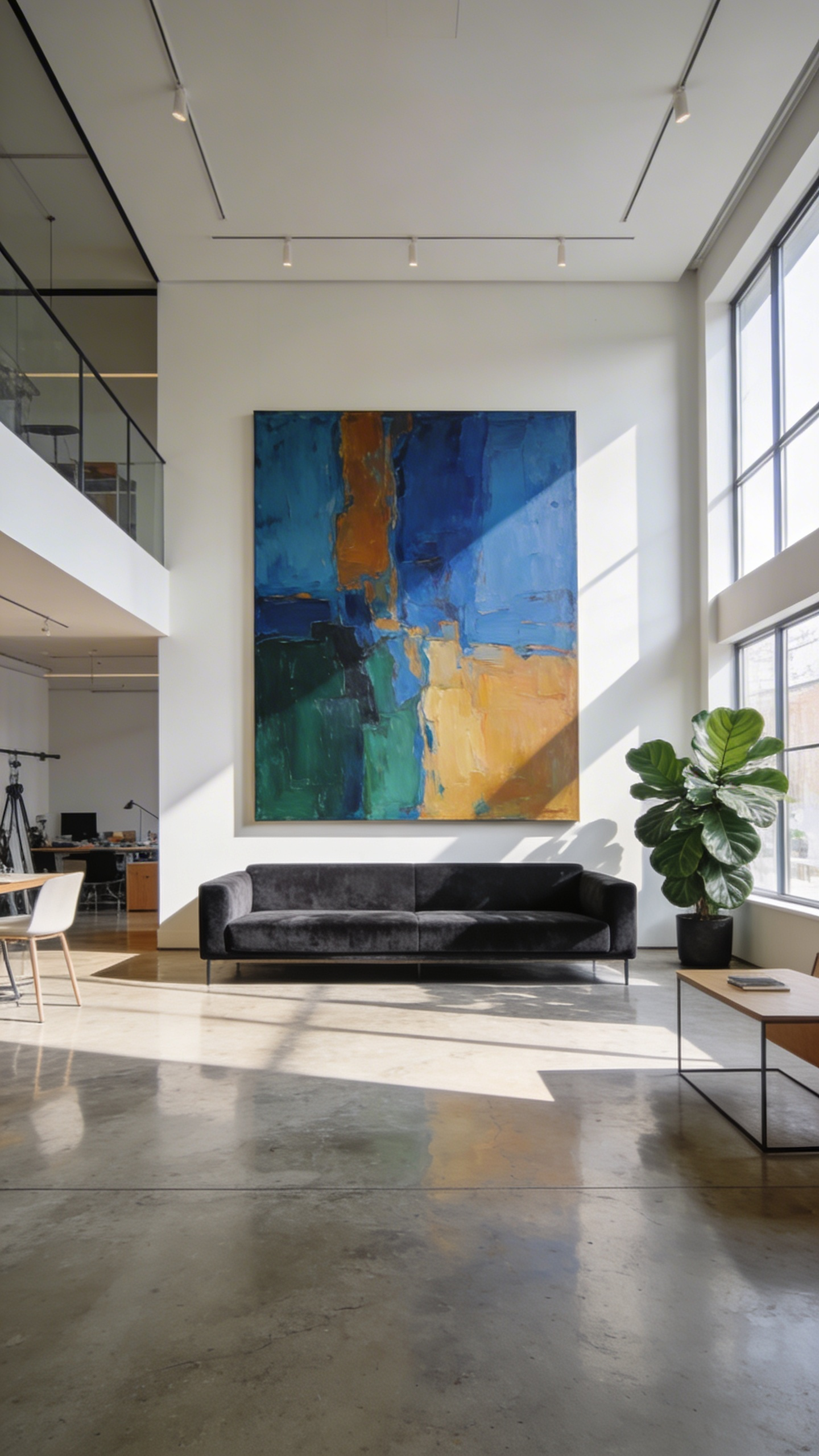
A single immersive piece creates a grounding visual landing strip. This sharp focus prevents stress in chaotic, open-concept spaces. Furthermore, statement paintings function as brilliant non-physical room dividers. Hanging a massive abstract behind your sofa completely zones the lounge. Effectively, it claims the area without blocking precious natural daylight.
Designers often suggest breaking traditional scaling rules completely. Therefore, choosing a canvas that nearly matches your furniture width is ideal. People often fear that massive art shrinks small spaces. However, the exact opposite is actually true. Deep color-field abstracts naturally draw the viewer’s eye upward.
Ultimately, this atmospheric depth mimics a vast, distant horizon. Proper installation requires precise technical execution. Namely, leave only a tiny four-inch gap above your sofa. This tight connection ensures both elements read as one anchored unit. Finally, a ceiling-mounted wall washer establishes a glowing, cozy sanctuary.
9. Suspended Heritage Textiles and Large-Scale Tapestries
To move beyond mere decoration, try using suspended textiles as architectural elements. Specifically, these large pieces introduce dimensional poetics into modern spaces. A bold tapestry anchors a high-ceilinged living area beautifully. Visually, it compresses the room height to create an intimate scale.
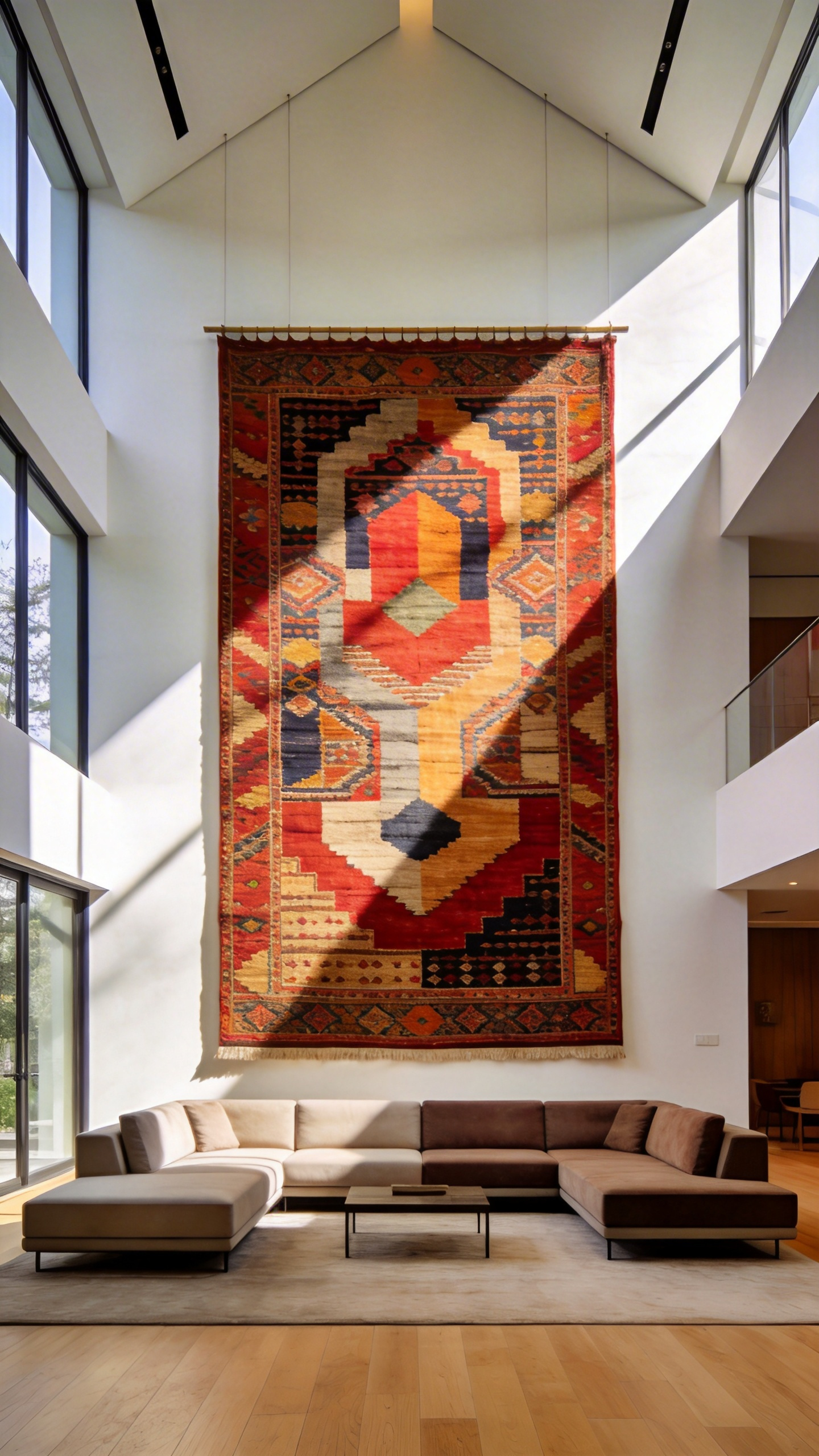
Furthermore, these woven works offer a brilliant acoustic solution. Modern open-concept living rooms often suffer from harsh echoes. Fortunately, heavy wools and thick cottons excel at absorbing sound. For optimal performance, hang textiles directly opposite large glass windows. Additionally, an air gap behind the fabric catches sound bounces effectively.
Beyond function, heritage textiles introduce powerful visual narratives. Antique Central Asian Suzanis often feature protective mandalas. Similarly, Bornean blankets originally served as sacred spatial dividers. Ultimately, pairing a century-old textile with sharp modern furniture works best. This mix of old and new creates a striking, edgy contrast.
However, the display method drastically changes the sensory impact. Suspending a piece from a hidden rod allows it to breathe. As a result, slight air currents give the textile a living, moving quality. Crucially, conservators advise wrapping wooden dowels in unbleached muslin. This simple step prevents acidic wood resins from yellowing the art.
10. Refined Modular Pegboards: Warmed Industrial Versatility
Traditionally, pegboards were strictly relegated to grease-stained garages. But this industrial staple has recently undergone a refined material migration. Today, these modular systems seamlessly bridge working studios and comfortable living rooms. Specifically, modern versions abandon cheap compressed fiberboard entirely.
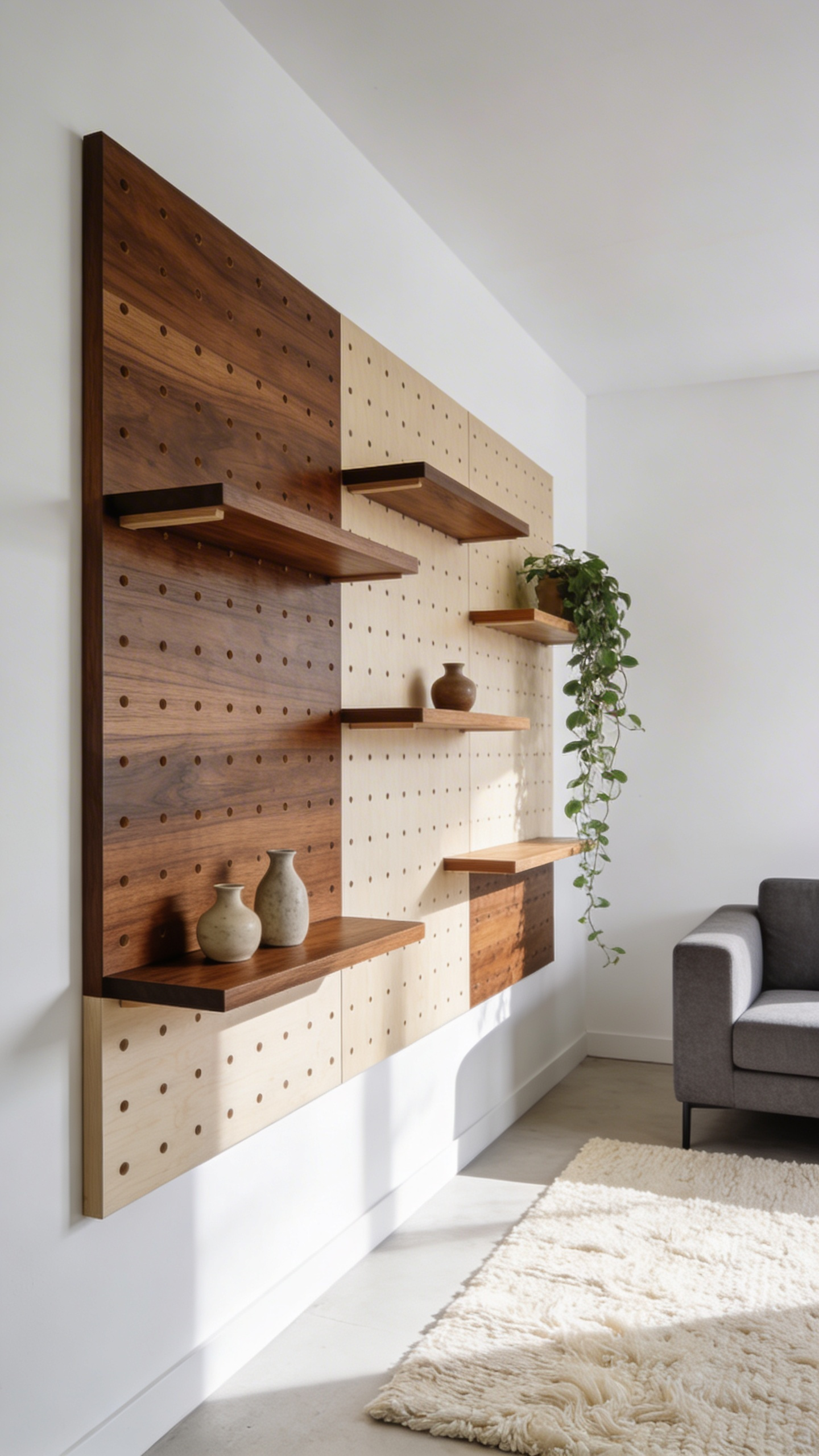
Instead, designers utilize CNC-machined birch plywood or solid American walnut. These heavy, furniture-grade solids actually prevent sagging under heavy display loads. Furthermore, low-VOC oils preserve the breathable, tactile texture of the wood. This organic warmth visually softens the rigid industrial grid. Additionally, solid brass pegs replace basic, ugly wire hooks. Therefore, the modular system ages gracefully with a natural patina.
Beyond aesthetics, these perforated boards offer surprising acoustic benefits. In fact, they act as hidden absorbers in echo-prone open floor plans. Sound waves enter the holes and safely dissipate into the backing. As a result, the living space feels noticeably quieter and more intimate.
Practically, an oversized pegboard panel also solves modern technical problems. For example, it provides a false wall to camouflage unsightly television cables. Users can easily snake wires directly through the perforations. Ultimately, this modular canvas allows for intentional, stress-free organization.
11. Architectural Built-In Shelving as a Functional Art Installation
Built-in shelving has rapidly evolved from basic storage into sophisticated functional art. Historically, architects used built-ins just to streamline rooms. Currently, computer algorithms generate incredibly fluid parametric designs. Today, shelving acts as the structural design DNA of modern spaces.
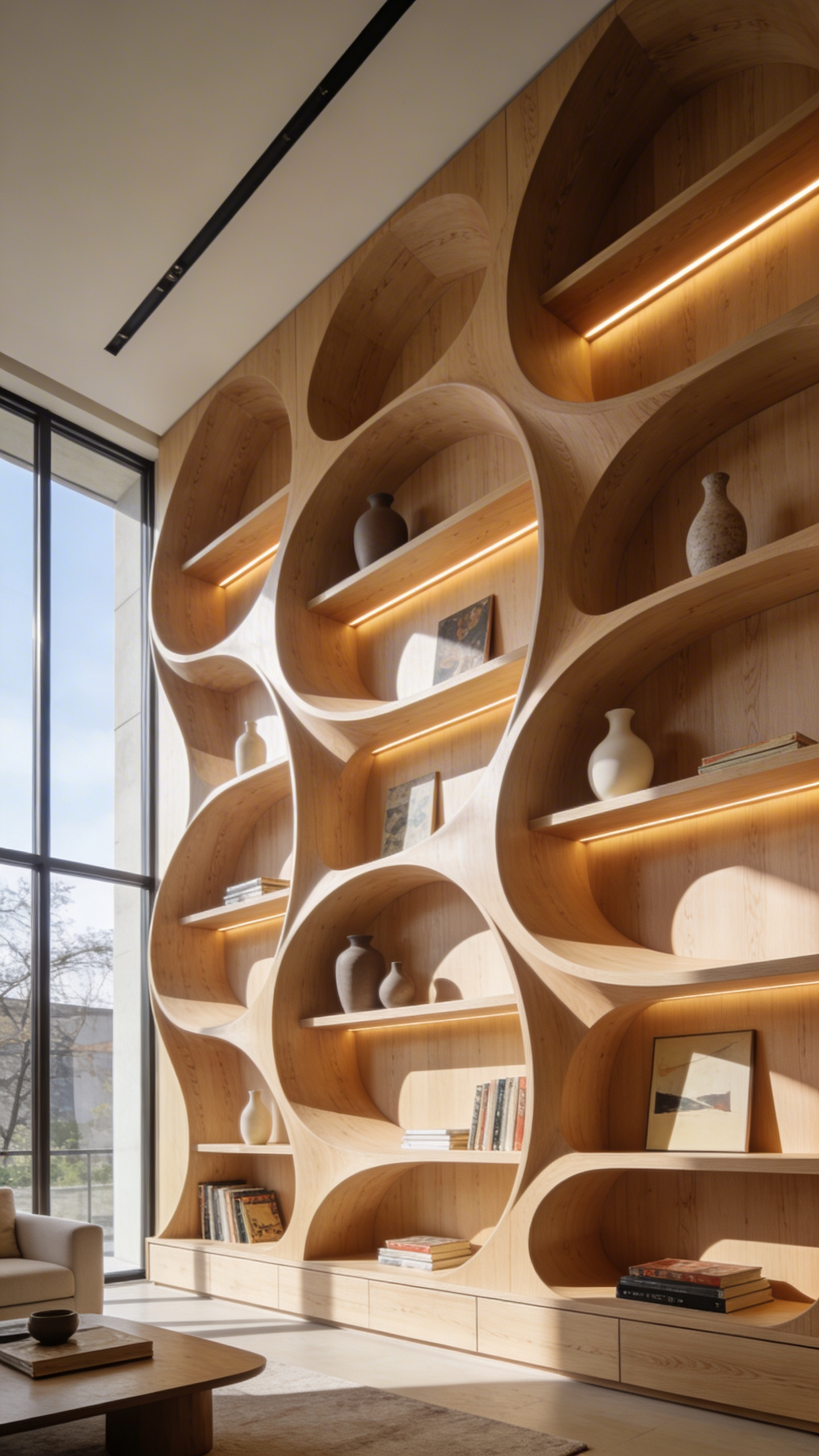
I view these installations as permanent sculptural features. Specifically, designers use sculptural materiality to create striking visual tension. Hidden steel supports create cantilevered shelves that appear to float. Alternatively, raw concrete forms anchor a room with serious visual weight. Furthermore, organic crescent curves introduce a rhythm that draws the eye inward.
True artistry often hides in the invisible technical details. Traditional Japanese wedged dovetail joints completely eliminate the need for screws. Master carpenters use hollowing techniques for seamless, tight edges. Additionally, recessed LED channels transform the structure into an illuminated lightbox.
Ultimately, these installations succeed because of profound environmental psychology. Built-ins flush with the architecture reduce visual noise significantly. Moreover, their deep nooks and rich textures generate intellectual fascination. Therefore, this functional art creates a deep, enduring commitment to your space.
12. Concealed Drop-Down Desks for Seamless Live-Work Harmony
Working from the living room couch gets old incredibly fast. Therefore, concealed drop-down desks offer a sophisticated solution for modern homes. Historically, these pieces evolved from the 18th-century fall-front desk. Today, they expertly manage the physical boundaries of your home.
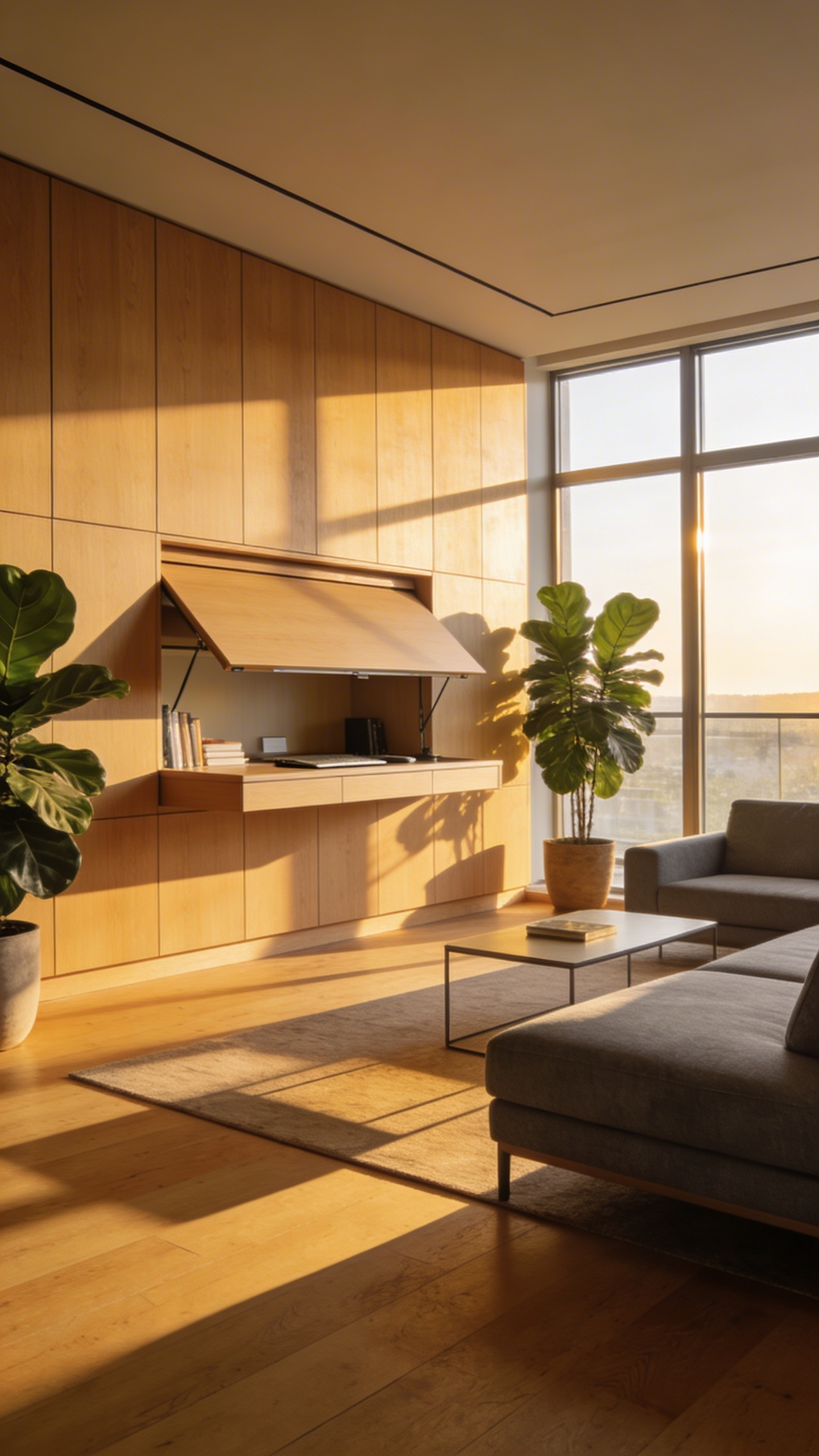
Specifically, closing the desk performs a crucial spatial reset. You effectively remove the visual cues of daily labor. This lets the living room reclaim its true purpose for leisure. Furthermore, this physical boundary reduces the risk of work-life bleed-over.
High-end models rely on highly calibrated engineering for daily use. Gas-piston struts allow heavy wood panels to descend completely silently. Moreover, bespoke units can support heavy professional gear with ease. Proper ergonomics remain absolutely essential for these compact creative spaces. Therefore, recessed wall cabinetry provides necessary depth for proper knee clearance.
Sensory architecture also plays a vital role in your daily focus. Notably, materials like saddle leather absorb distracting keyboard taps. Similarly, open-pore walnut softens the overall acoustics of the room. Invisible infrastructure keeps this setup entirely seamless. Ultimately, integrated docking stations eliminate messy cable nests completely.
13. Vertical Display Cubbies for Curating Artifacts
Vertical display cubbies are essential tools for a curated home. Specifically, they seamlessly bridge architectural form and daily function. Charlotte Perriand originally transformed basic storage into a living art form. Her shelving systems shifted rigid lines into rhythmic, open spaces. Thus, modular cubbies now act as beautiful sculptural room dividers.
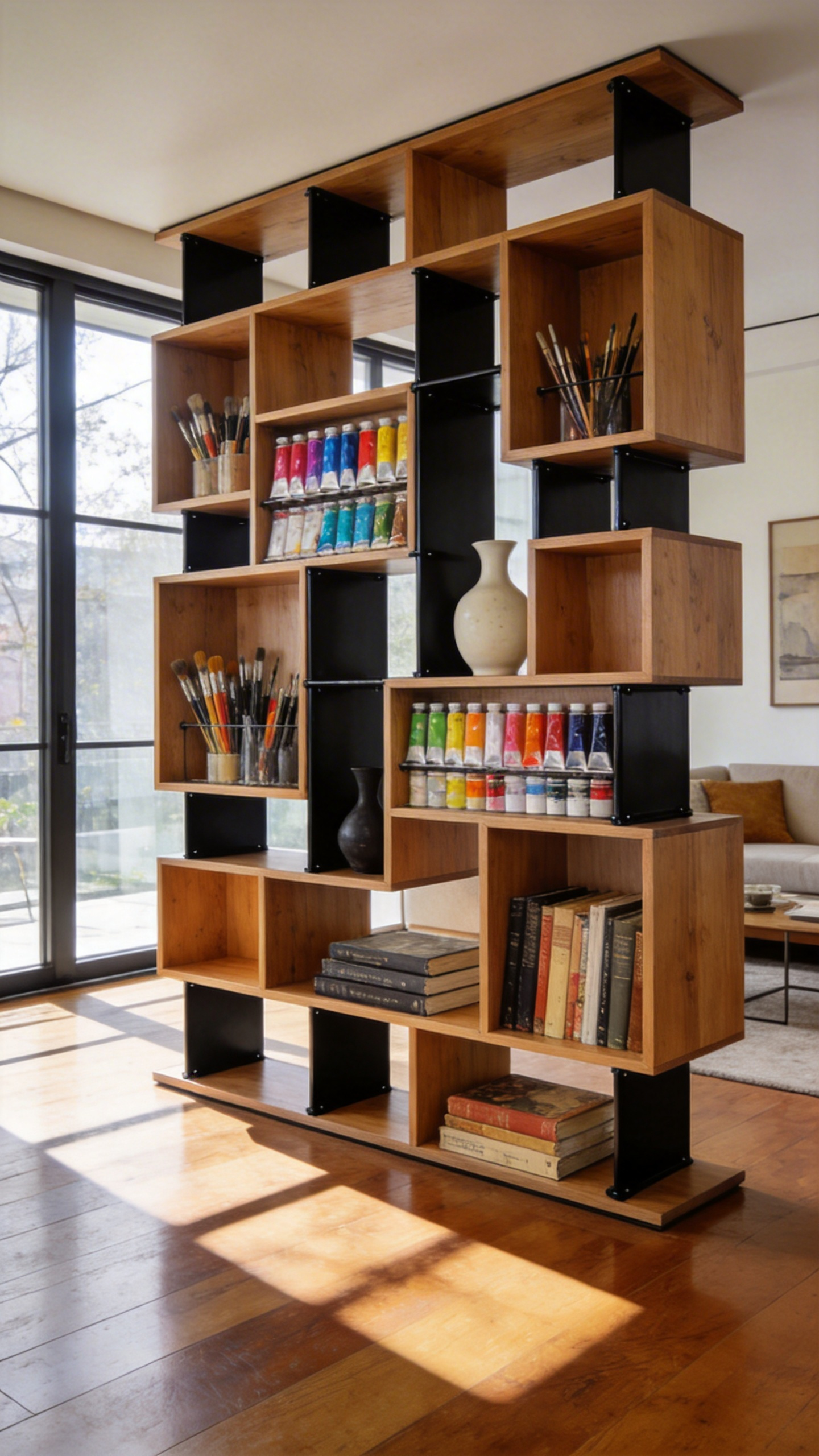
We can easily elevate everyday supplies into beautiful artifacts. Knolling involves arranging related objects at exact 90-degree angles. Suddenly, a simple box of books becomes a three-dimensional still life. Lower cubbies naturally ground the room with heavier, bulkier items. Meanwhile, the upper levels should always remain sparsely populated.
This intentional negative space naturally draws the viewer’s eye upward. Technically, integrated lighting is crucial for highlighting these curated objects. Continuous LED strips provide smooth illumination without harsh spotting. Specifically, a warm glow perfectly mimics natural golden hour light. It beautifully highlights the rich textures of raw ceramics.
These open shelves serve as a quiet archive of the self. Furthermore, they publicly display our core values and creative identities. However, heavily curated spaces can quickly become overwhelming visual clutter. Therefore, experts highly recommend strictly following a 70/30 ratio rule. You should leave thirty percent of the shelf volume completely empty.
14. Wall-Mounted Easels and Drawing Rolls
Integrating a wall-mounted drawing roll into a living room is a bold choice. Specifically, this approach bridges the artist’s studio and communal family living. Moreover, these installations transform static walls into highly interactive features. The roll serves as a permanent, visible invitation for daily creativity.
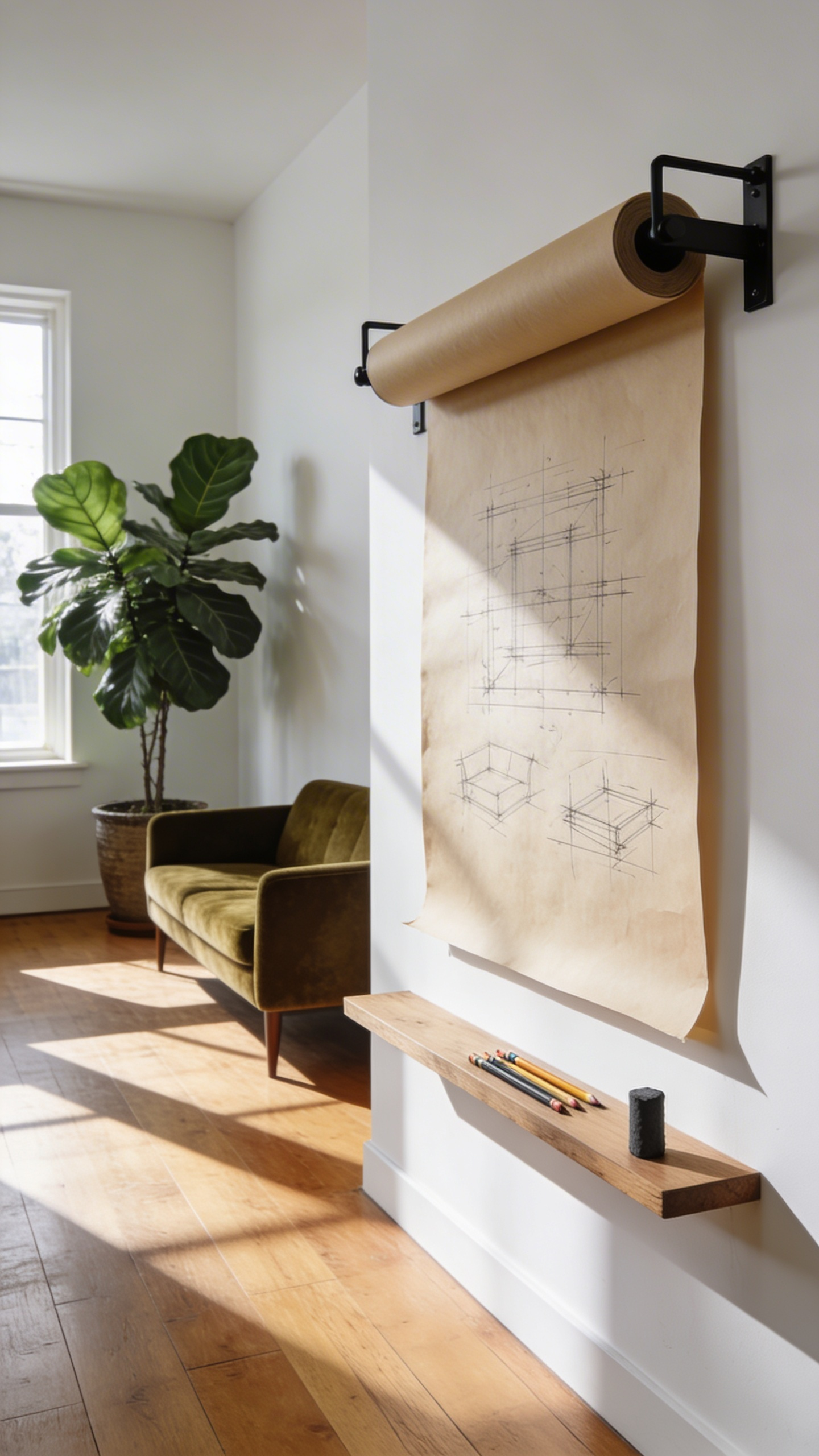
Furthermore, this setup offers a tactile rebellion against our modern screen era. Unbleached kraft paper introduces a warm texture to the room. Naturally, this organic material softens minimalist spaces perfectly. Additionally, the crisp sound of tearing paper provides a satisfying auditory reset.
Visually, the mounting hardware draws directly from classic drafting rooms. Designers often utilize oxidized brass or thick leather straps for a polished look. Ultimately, these elements honor the atelier style without creating visual clutter.
Psychologically, a continuous roll encourages a collaborative flow state. Unlike a solitary easel, this installation acts as a highly social anchor. Shared doodles and collaborative murals turn the paper into a rotating archive. Thus, your living room remains an evolving, highly creative space.
15. Strategic Sconce Placement to Wash the Wall
Strategic living room lighting ideas act as a powerful architectural intervention. Specifically, proper sconce placement completely redefines the scale and texture of a room. Understanding the difference between washing and grazing is absolutely essential.
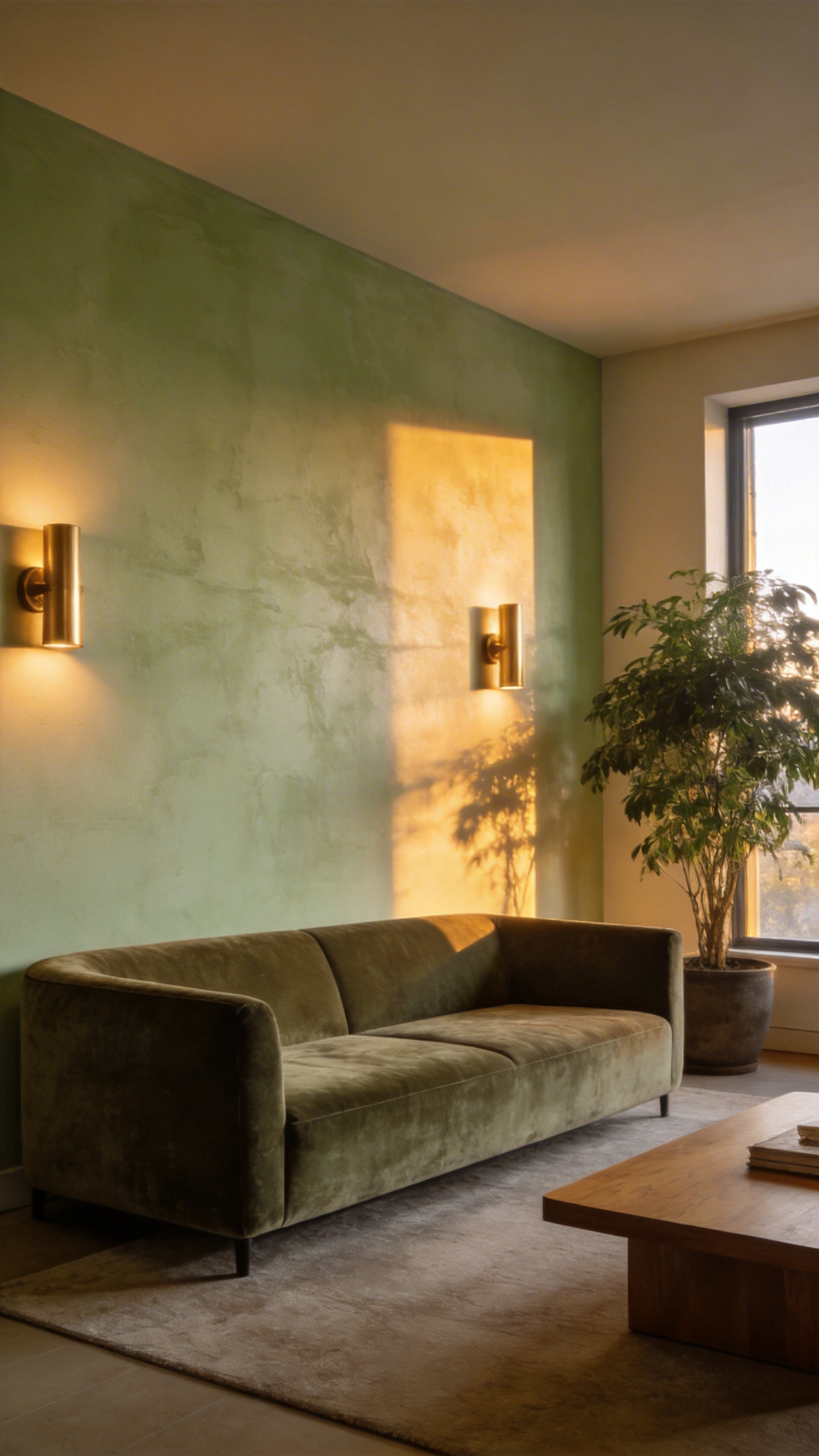
To achieve a true wall wash, mount sconces further away. This technique beautifully eliminates shadows to make spaces feel wonderfully airy. Conversely, place fixtures closer to highlight highly textured materials. Limewash or exposed brick deeply benefit from this close grazing. Personally, I absolutely love how grazing creates dynamic, moody shadows.
Furthermore, the temperature of your light dictates the room’s mood. You should always select a warm white bulb around 2700K. In fact, this specific hue mimics the relaxing golden hour. Additionally, directional warmth enhances natural pigments in wood grain and leather.
To avoid glare, center the fixture roughly 60 inches high. However, placing them slightly higher allows light to cascade beautifully. Ideally, space these fixtures about 8 to 10 feet apart. Thus, you prevent a cluttered runway effect along the wall. Ultimately, washing the room’s perimeter creates a soft, intimate environment.
16. Monumental Leaning Floor Mirrors to Double Visual Space
Monumental floor mirrors function as spatial architecture rather than mere decorative accessories. Specifically, these massive pieces manipulate the optical physics of a room. To truly double your visual space, choose a mirror exceeding the 72-inch height threshold. Ideally, the frame should reach three-quarters up your wall. This dramatic vertical line effectively lifts standard ceilings upward.
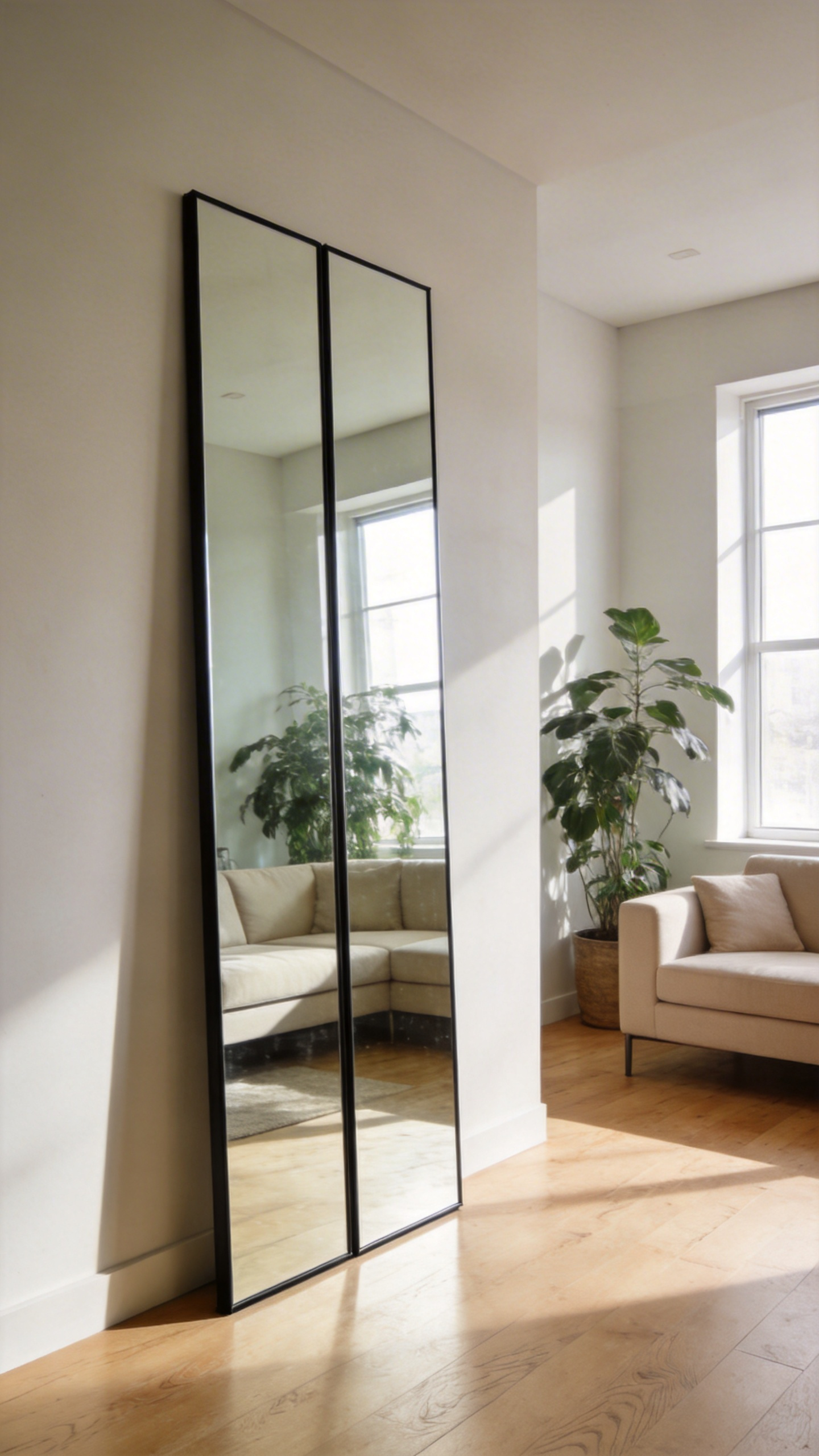
Moreover, a leaning mirror carries a distinct physical groundedness. It mimics an architectural doorway rather than feeling awkwardly pinned. Furthermore, leaning the glass echoes a classic artist’s atelier. Historically, painters leaned grand canvases against walls for continuous functional ease. Today, this casual angle cultivates an atmosphere of relaxed luxury.
Physically, a slight three-degree lean expertly shifts the reflection’s vanishing point. Therefore, the mirror bounces softer light from the uncluttered upper walls. Additionally, placing one opposite a natural window creates a bright secondary view. Essentially, this mimics grand corridors without requiring costly structural renovations.
However, these heavy elements must integrate safely into your room. Try layering a monumental mirror behind a low-slung sofa or armchair. Visually, this anchors the wall and adds incredible architectural depth. Meanwhile, heavy mirrors require discreet wire anchors for absolute safety. Finally, add silicone floor pads to prevent a dangerous gravity slide.
17. Fluted Acoustic Wood Paneling for Visual Rhythm
Open concept rooms often get incredibly loud and chaotic. Specifically, fluted acoustic wood paneling beautifully merges lively energy with necessary quiet. Unlike standard flat walls, this material leverages geometry for serious sound control. Therefore, the space feels acoustically soft and visually rhythmic.
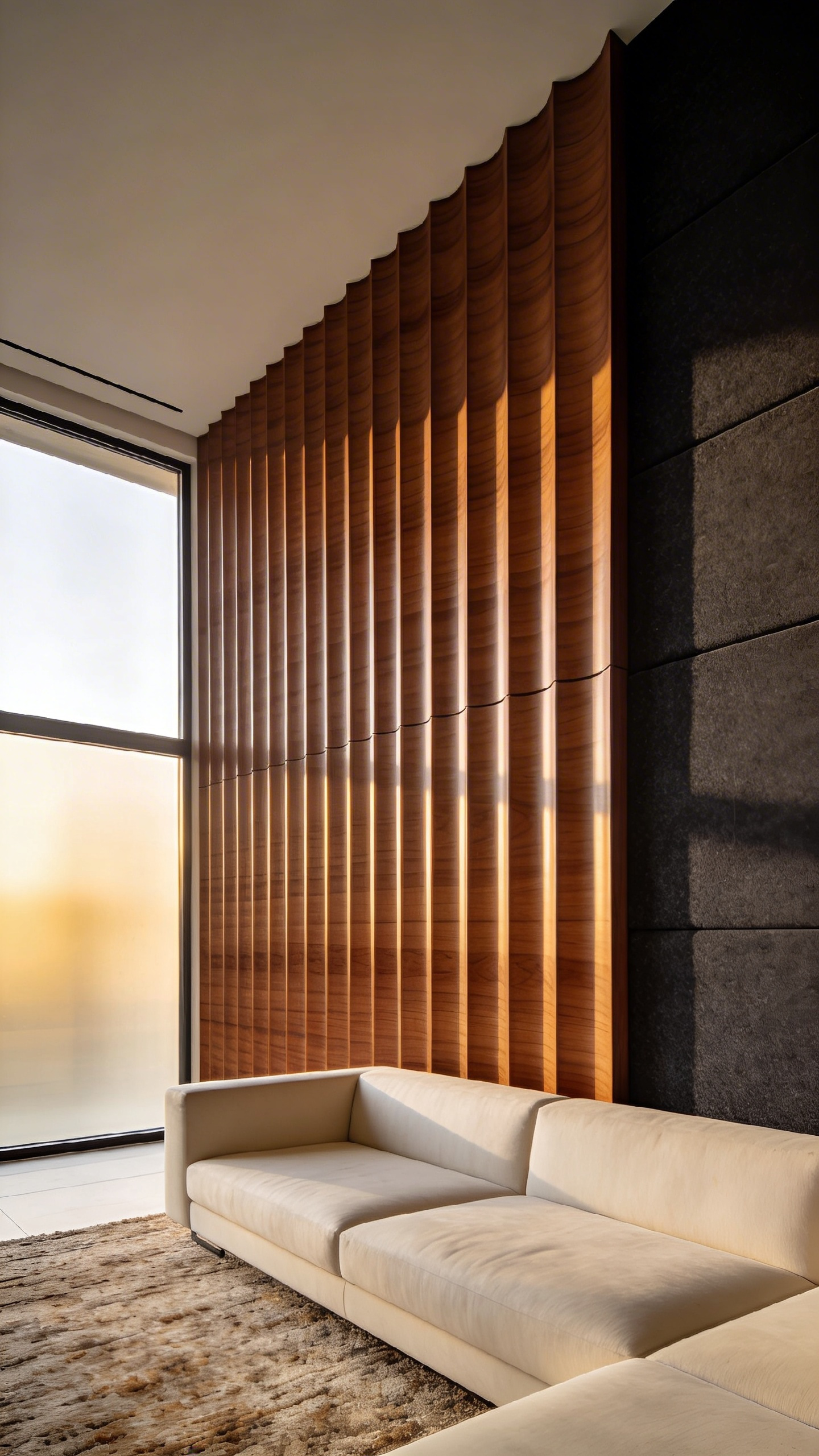
Physically, the concave grooves scatter sound waves in multiple directions. This effectively prevents harsh echoes while preserving natural conversation tones. Additionally, a high-density acoustic felt backing sits directly behind the wood. Functionally, this porous core captures stray sound energy effortlessly. In fact, premium fluted panels absorb up to 95 percent of sound.
Visually, the vertical lines draw the eye upward immediately. Thus, standard ceilings feel significantly taller and much more airy. Furthermore, the inward-curving flutes play dramatically with shifting daylight. As a result, deep linear shadows create a tactile, living wall.
Importantly, you must choose concave fluted panels over convex reeded ones. Deeper channels simply trap sound much better than rounded faces. For open spaces, I highly recommend using these panels for subtle zoning. Wrapping the paneling up onto the ceiling beautifully brackets a seating area. This creates an intimate room without rigid physical partitions.
18. Intentional Negative Space: The Power of the Unfilled Wall
An empty wall is rarely a void. Instead, it is a highly active design element. Specifically, this philosophy draws from the Japanese concept of Ma. Here, the empty space gives your art and architecture room to breathe. A room without negative space feels like a conversation where everyone is shouting.
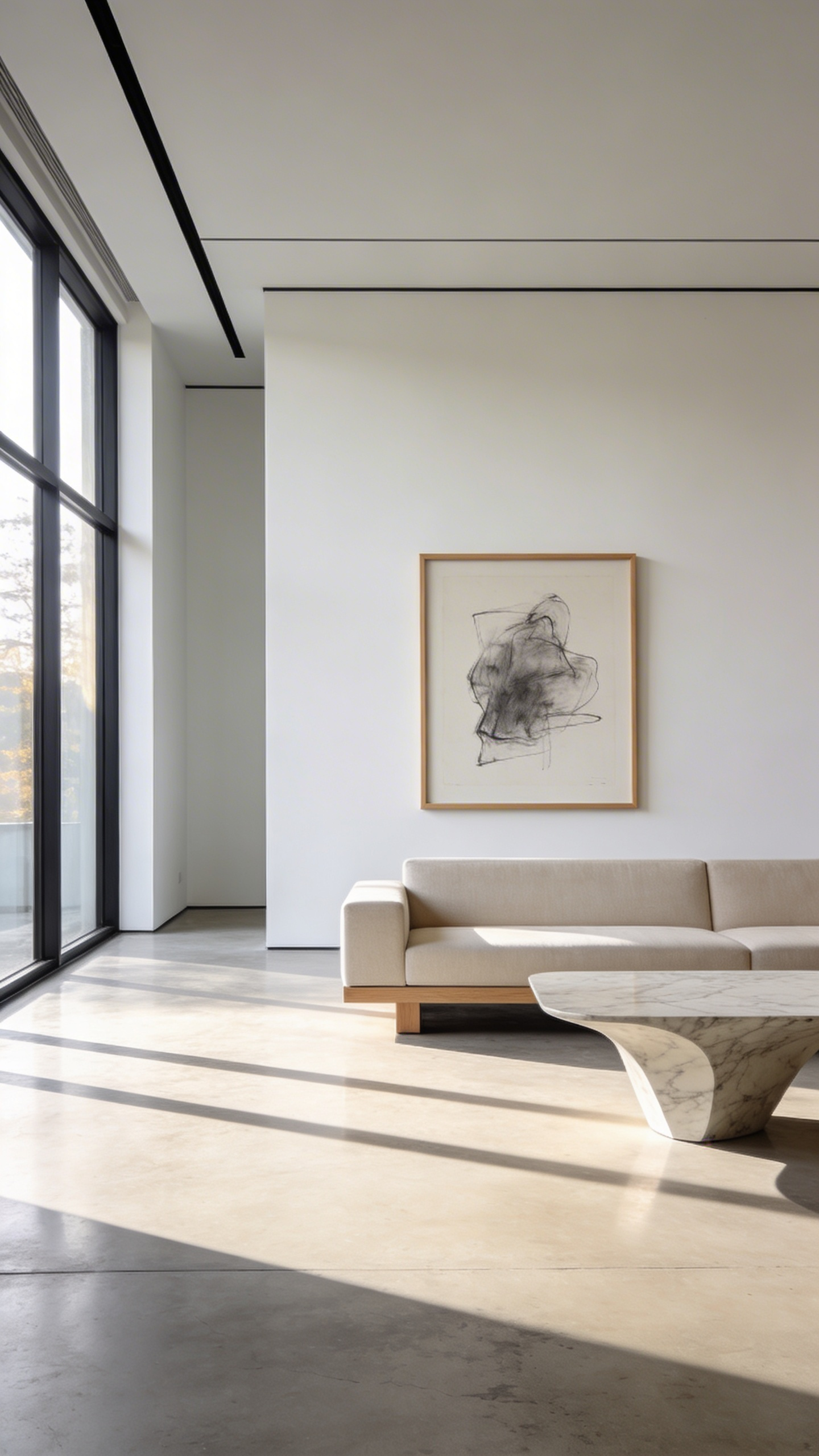
Therefore, applying a mathematical 60/40 rhythm brings essential balance to living spaces. Leaving forty percent of your room empty provides a necessary visual counterweight. However, an unfilled wall should never feel cold or accidentally unfinished. Designers often apply tactile finishes like Roman clay to prevent this.
These velvet-like textures absorb light and catch moving shadows from plants. Importantly, this intentional restraint drastically reduces our daily cognitive load. Naturally, the quiet wall provides a peaceful landing point for tired eyes.
Moreover, this negative space acts as a powerful curatorial framing device. A single luxury statement piece placed against a bare wall becomes a true sculptural statement. Finally, adding a recessed floor uplight ensures this emptiness always feels deeply deliberate.
Ultimately, the absolute best living room wall ideas genuinely reflect your personal history. By integrating thoughtful design, you can easily transform your home into a restorative sanctuary.
Frequently Asked Questions
How can I make my living room wall look expensive?
To achieve a truly high-end look, focus strictly on bespoke craftsmanship and scale. Utilizing architectural finishes like limewash adds depth that standard paint simply cannot replicate. Additionally, choosing a single oversized statement piece creates a powerful, curated feel. This approach signals luxury much better than a cluttered wall of tiny frames.
What is the best way to decorate a large living room wall?
The most effective strategy is to respect the massive scale of the room. A floor-to-ceiling salon wall can easily bridge the vertical “dead zone” found in high-ceilinged spaces. If you prefer a more modular approach, refined walnut pegboards offer fantastic storage. They double as an ever-evolving art installation.
How do you choose a focal point for a living room wall?
A focal point provides a grounding visual landing strip for the eye. Identify the wall that naturally draws attention when entering the room. Usually, this is the wall directly behind your main seating area. Use high-contrast elements, such as a dark sculptural relief, to heavily anchor the space.