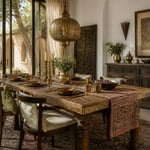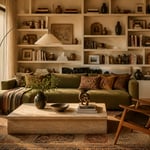
The dining room is one of the few spaces in a home that has to negotiate between daily life and deliberate design. It needs to handle pasta on a Tuesday and a dinner party for eight on a Saturday, and ideally, it should do both with some grace. Getting it right is less about a single large purchase and more about layering: materials, light, texture, and the quiet detail of objects that have been chosen with intent.
These modern dining room ideas work precisely because none of them requires you to gut the space and start again. Some will change the room entirely; others will shift the register just enough to make the difference. Start with what feels closest to who you already are, and build from there.
1. A Live-Edge or Reclaimed Wood Dining Table as the Room’s Anchor
There is something about a live-edge dining table that no other piece of furniture quite replicates. The natural contour of the slab, the bark edge left intact, the curve of the tree recorded in the wood, means every table is genuinely one of its kind. You are not buying an object; you are buying a particular tree, from a particular place.
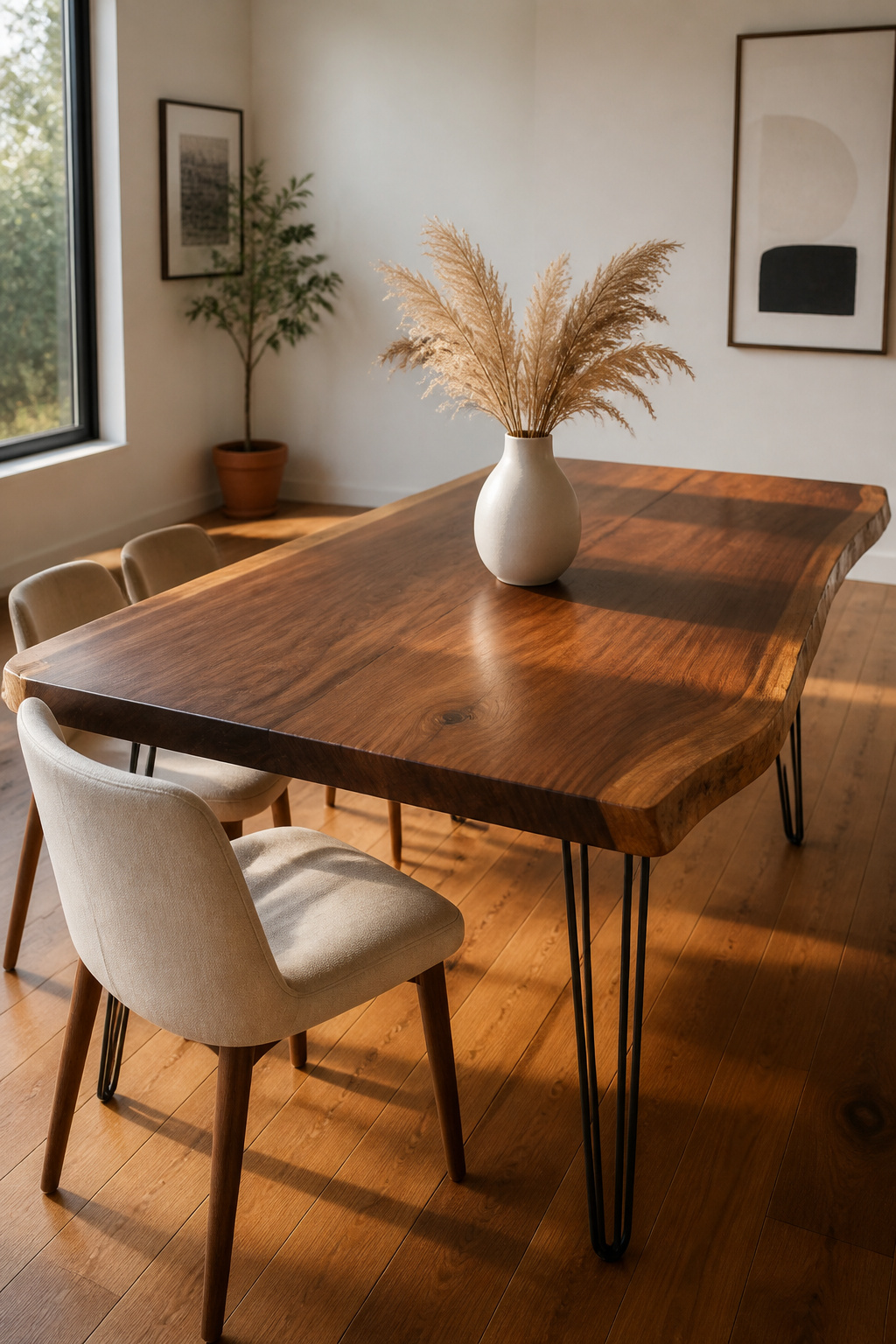
American Walnut and White Oak are the two dominant choices. Walnut’s deep brown heartwood reads warm and grounding, anchoring pale interiors and pairing well with cream upholstery, terracotta tones, or brass hardware. White Oak is cooler and lighter-toned, better for rooms leaning Scandinavian or grey-inflected. In any modern dining room, the floor tone matters: walnut on pale grey tiles can create an awkward clash; walnut on warm stone or dark-stained boards works well.
Leg style shifts the character considerably. Hairpin legs in brushed steel are light and industrial; they reveal the floor beneath and keep the table from dominating smaller rooms. A trestle base reads more substantial, farmhouse-adjacent but genuinely modern in black powder-coat. A pedestal base is the most formal option and works best with a heavier slab. Allow 24 inches of table length per seated person: a 72-inch table comfortably seats 6; a 96-inch table seats 8. For more on contemporary dining room table shapes and materials, the range of surfaces and proportions available is broader than most people assume.
The epoxy river table, resin filling the natural void running down the centre of the slab, has been everywhere. It can look extraordinary or deeply dated depending on the colour choices. Clear or subtle grey resin ages better than electric blue.
2. Statement Pendant Lighting: A Non-Negotiable Modern Dining Room Idea
The pendant light is the one decision that affects how the dining room looks and how it feels to be in it. Get it wrong and even a beautiful table looks flat. Get it right and the room gains a focal point that works without any help from the rest of the furniture.
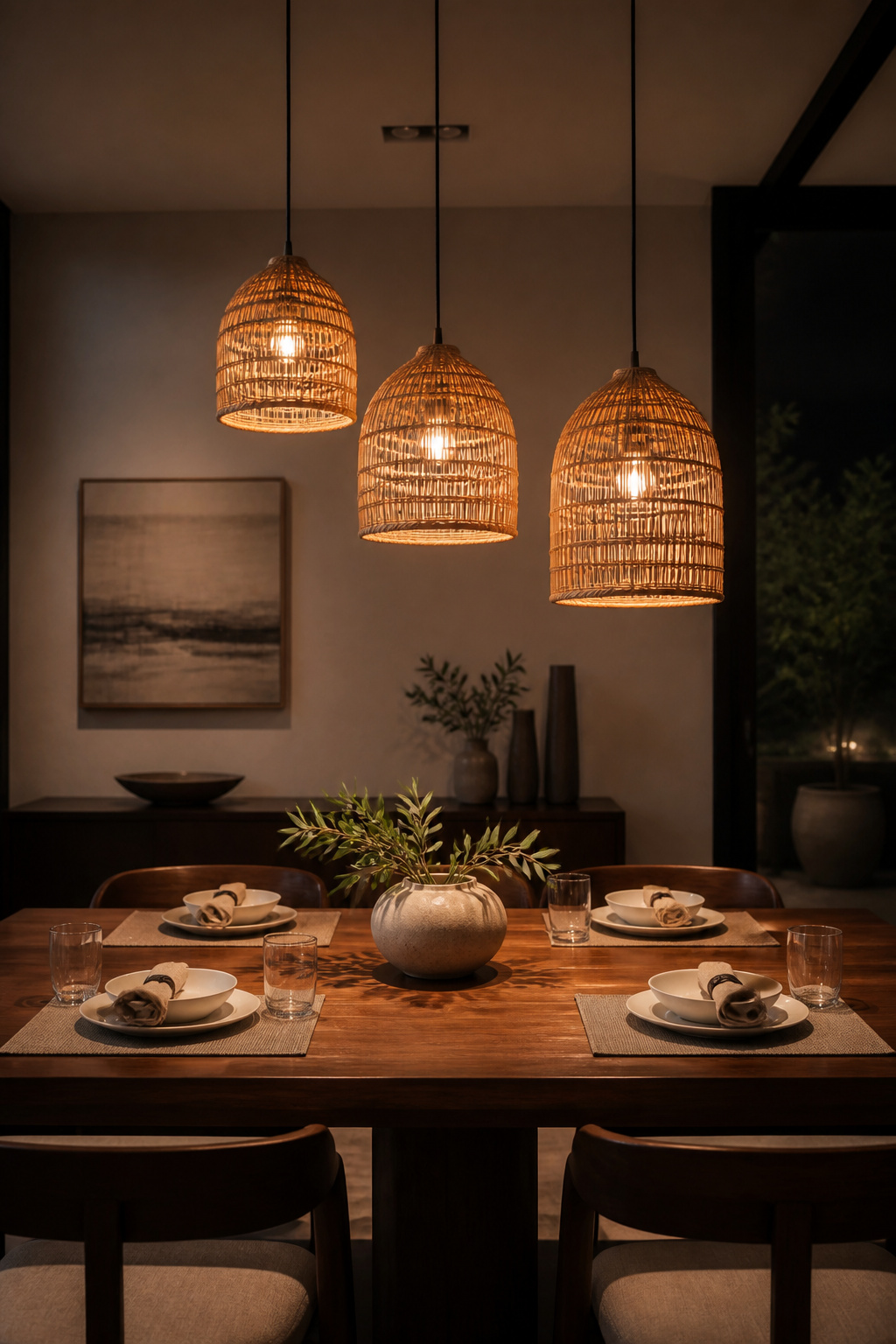
The height rule is less flexible than most people think: the bottom of the fixture should hang 30 to 36 inches above the table surface. Lower than 30 inches and it starts to interrupt sightlines; higher than 36 inches and it stops illuminating the table and becomes purely decorative. In rooms with 9-foot or higher ceilings, push toward the upper end of that range.
For a single pendant over a round or square table, the fixture diameter should be roughly half to two-thirds the table width. A 36-inch table takes a pendant in the 18 to 24-inch diameter range. For a cluster of 3 to 5 pendants over a rectangular table, use proportionally smaller individual fixtures; a trio of oversized lights crowds the space. Keep the lowest pendant at 28 to 34 inches above the surface and let the others float above. Contain the whole cluster within the middle two-thirds of the table’s length so it doesn’t spill awkwardly over the edges.
On materials: brushed brass diffuses warmly under the 2700K lighting that dining rooms need. Rattan pendants cast a softer, dappled light that suits texture-led spaces. Smoked glass lets the bulb show through and pairs well with mixed-metal interiors. Washi and paper pendants produce beautiful diffusion but are fragile in humid spaces. Before committing to any fixture, it is worth reviewing the pendant lighting mistakes worth avoiding — hanging height errors are the most common, and the most expensive to fix once the pendant is wired.
3. A Jewel-Toned Accent Wall That Shifts the Whole Room’s Register
One wall. That is all it takes. A jewel-toned accent wall in a dining room creates a sense of occasion, a visual marker that this room is for gathering rather than just passing through.
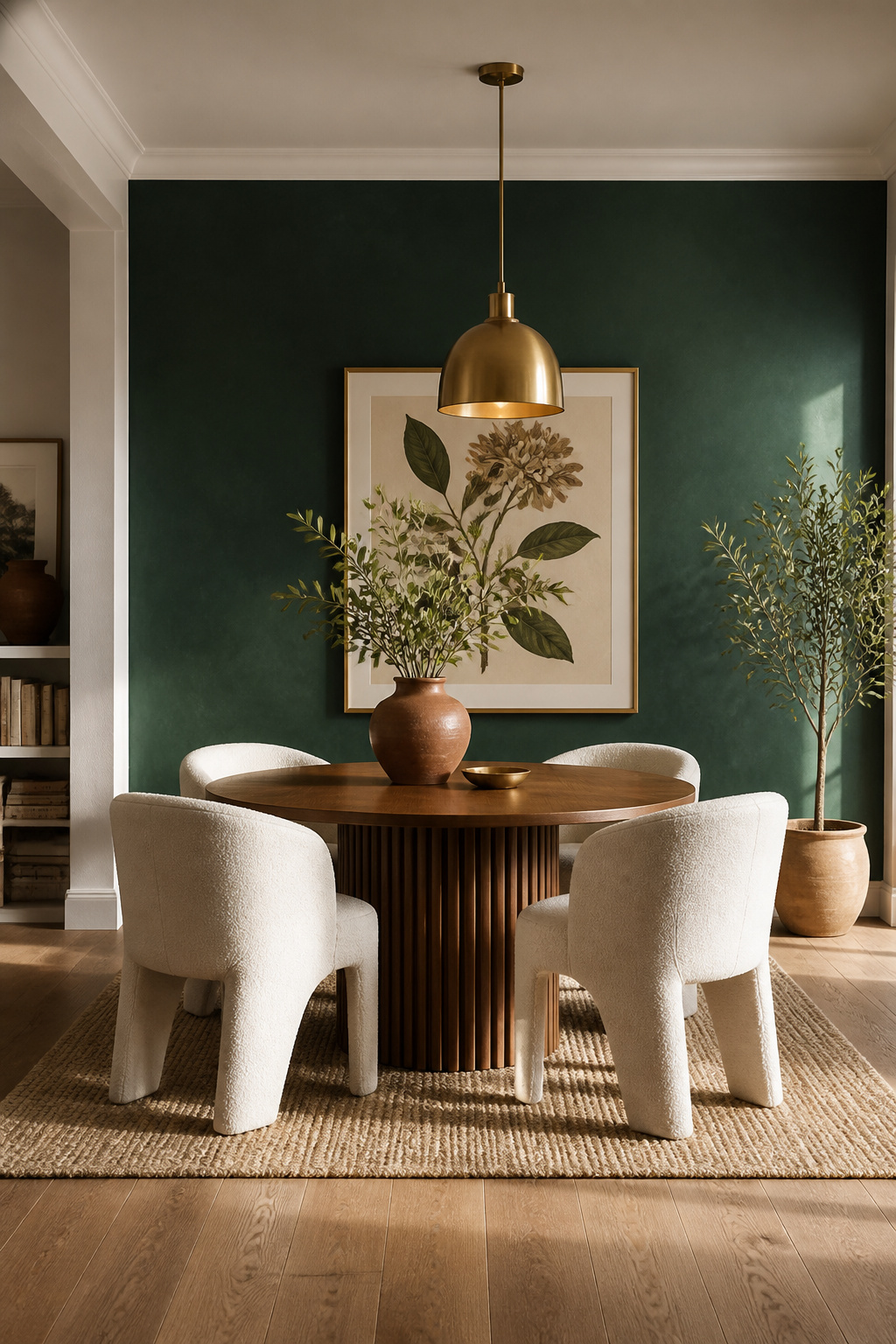
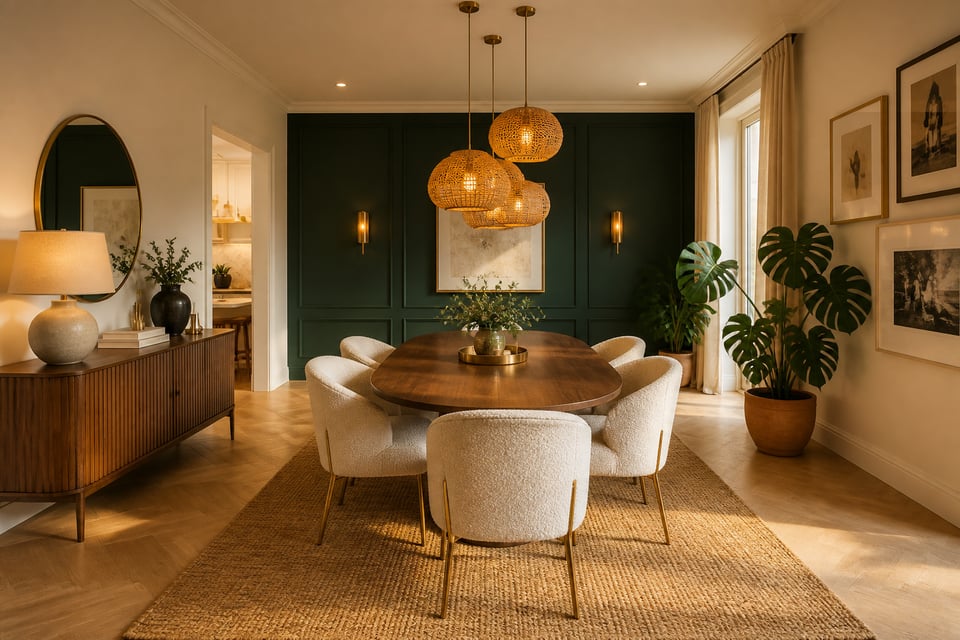
Emerald green, from the Hunter Green family with its slightly cool blue undertones, is the most versatile of the jewel tones for a modern dining room: sophisticated rather than earthy, and genuinely flattering against warm wood and brass. Deep terracotta is the most forgiving choice under candlelight; the orange-red tones warm skin and make food look good. Inky navy makes white table linens pop against it and pairs well with rattan seating and natural wood. Deep burgundy is the most theatrical; in a small dining room with walnut furniture and velvet chairs, it creates a genuine envelope of intimacy.
The application method changes the result considerably. A standard semi-gloss paint is the most reversible and practical; a dining room wall will get the odd splash and needs to wipe clean. Limewash plaster, applied in thin overlapping layers with a broad brush, creates a softly mottled, aged finish that photographs badly but reads well in person. Wallpaper in a linen-look or textured weave achieves pattern and texture together. All three approaches work well on a single accent wall; the mistake is applying any of them to all four.
Balance the saturated wall with what surrounds it. An emerald wall needs something light nearby: pale oak floors, white-painted trim, or a linen tablecloth. Terracotta reads better with darker flooring. A large mirror on the accent wall is not a cliché; it amplifies the colour without adding another object to the room.
4. Mixed Metal Finishes That Add Depth Without Visual Noise
The resistance to mixing metals in interior design was always overstated. Rooms with a single metal finish throughout can feel sterile. The trick is in the ratios — and in understanding that a modern dining room handled this way looks composed, not confused.
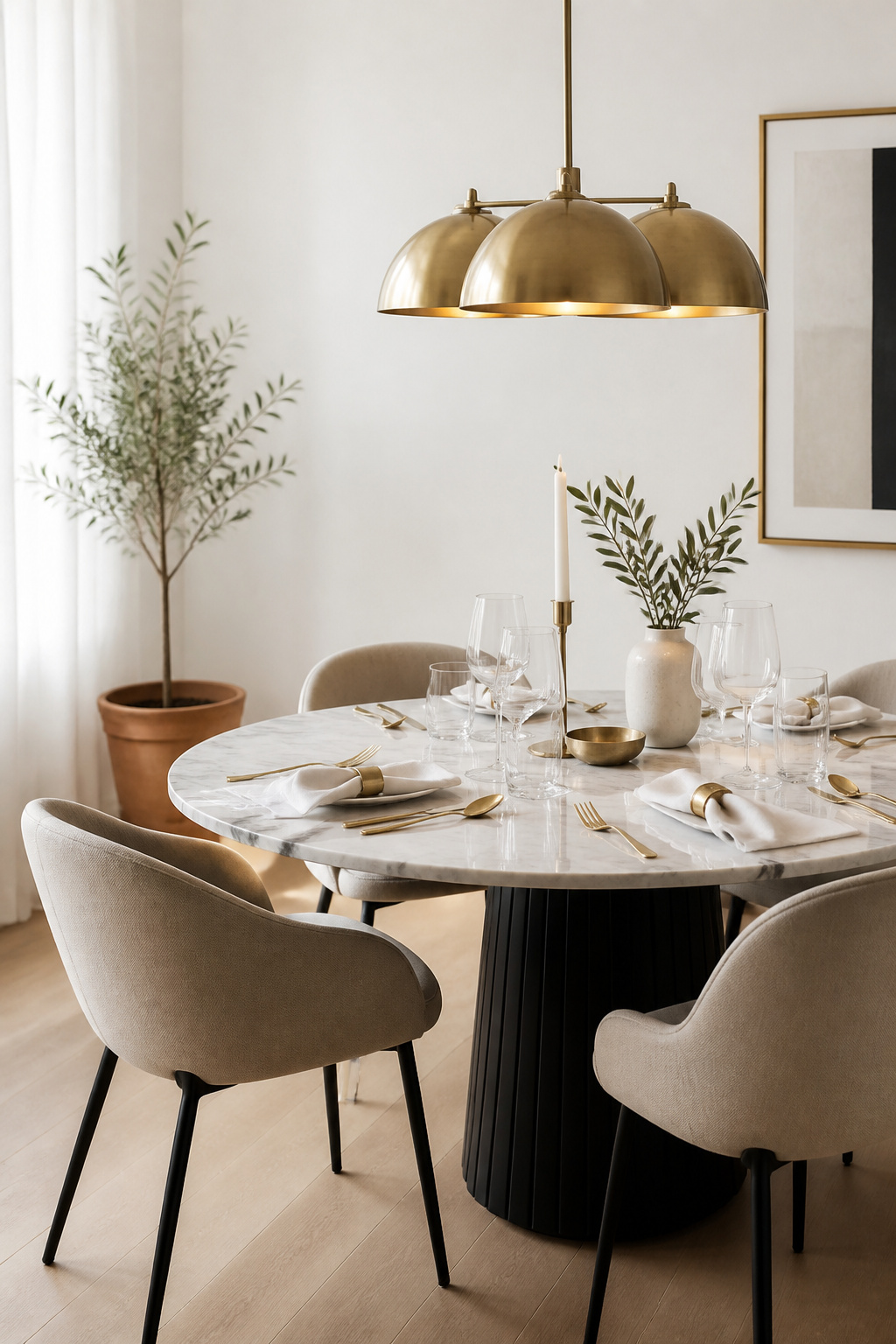
One dominant finish at roughly 70% presence, one or two secondary finishes at 30%: this is the principle that holds mixed-metal rooms together. Choose one warm and one cool tone. Brass plus matte black is the most current pairing, and for good reason: the amber warmth of brushed brass and the graphic flatness of matte black create exactly the right contrast.
Where to introduce each: the pendant fixture and the chair legs carry the most visual weight in a dining room, so the dominant metal belongs on the pendant and on any sideboard hardware. The secondary metal can sit on the chair legs, a console, and perhaps the cutlery. Distribute both finishes around the room rather than clustering them in one corner.
Two things to avoid: mixing similar metals (brushed gold and antique brass look like a mistake rather than a choice) and overusing matte black (too much of it creates a heavy, flat room; a note of brass lifts it immediately). Polished brass is the trickiest finish; it ages unevenly and looks inconsistent once it starts to oxidise in different zones. Brushed brass ages more gracefully and is generally the better long-term choice.
5. A Sideboard That Redefines Your Modern Dining Space
A sideboard is the most underused piece of furniture in modern dining rooms. Most people buy one for storage and forget that it is also the room’s second largest horizontal surface, a full-length opportunity to add height, warmth, and the kind of curated display that makes a room feel inhabited rather than assembled.
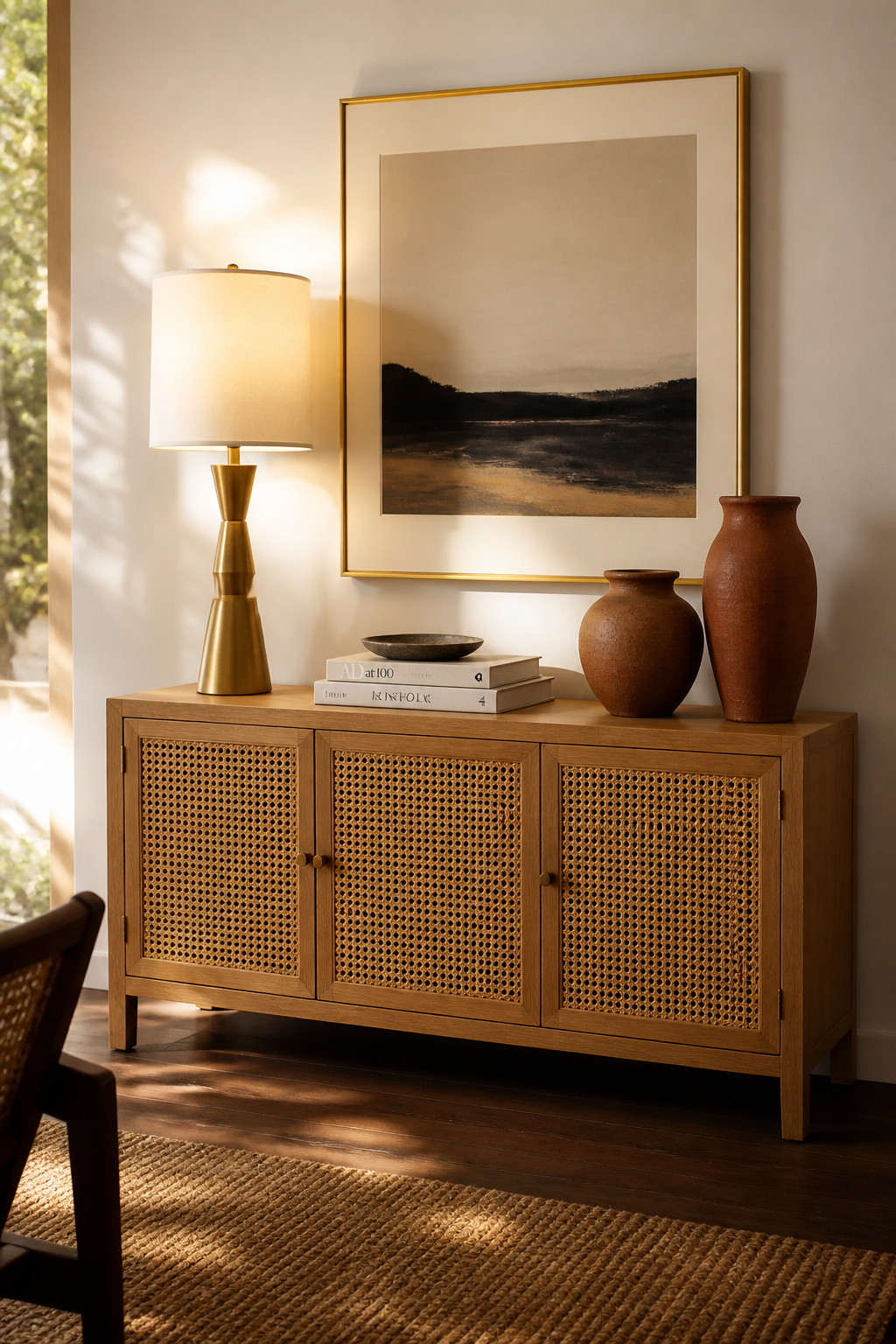
The dimensions matter. A sideboard should be between two-thirds and three-quarters the length of the dining table, not shorter than half or it looks marooned, not wider than the table or it competes. Standard height of 30 to 36 inches pairs naturally with dining table height and creates a comfortable visual line across the room. Depth should be at least 20 to 22 inches; anything shallower struggles to support a lamp base without it looking precarious.
Open shelving or glass-fronted doors work better in smaller dining rooms; the visual lightness prevents the piece from dominating. Closed cabinetry suits larger rooms where the mass is less of a concern, and cane-fronted doors are the best compromise: they conceal the everyday clutter while keeping the overall effect airy.
The surface styling is where it gets interesting. Anchor one end with a tall element: a substantial table lamp, a tall ceramic vase, a sculptural candlestick. Work toward the middle with mid-height objects (a stack of art books, a low bowl, a small piece of sculpture). Leave at least 30% of the surface empty; the negative space is what makes the styling look considered rather than crowded. A large framed mirror or piece of art hung above the sideboard completes the wall and doubles the visual height of the room.
6. Sculptural Dining Chairs That Pull the Room Together
The chair decision is where most dining rooms either become interesting or settle for the predictable. In a modern dining room, a genuinely considered chair selection lifts the entire space.
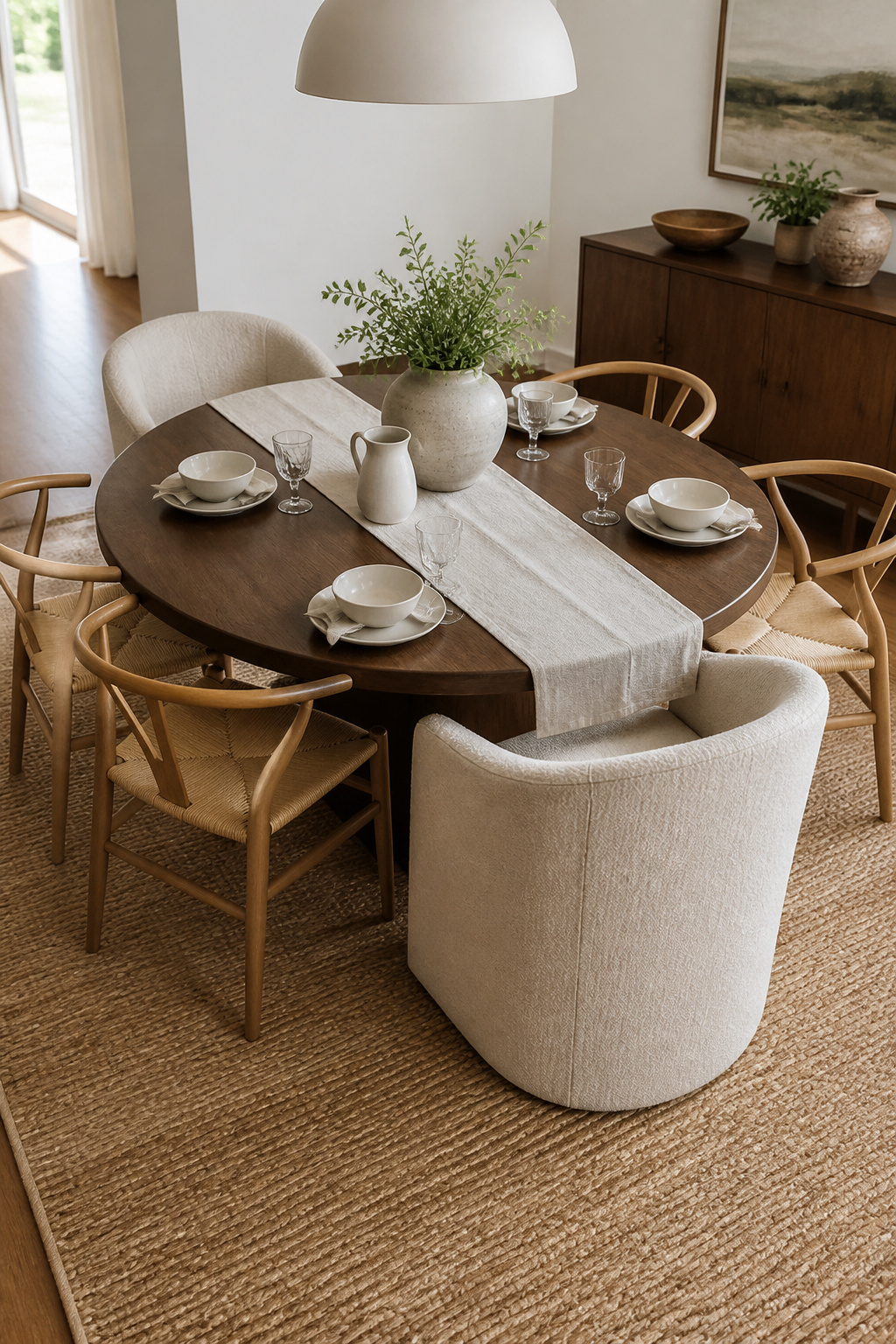
The classic approach to mixing chairs is more reliable than the full-matching option: two upholstered captain’s chairs at the ends of the table and four to six matching side chairs along the length. The variation is at the head, the consistency along the sides; it reads as deliberately curated rather than indecisive. A bench along one long side adds casual seating capacity and a softness that all-chair dining rooms sometimes lack.
For contemporary dining room chairs and seating options, the range is wide enough to suit almost any direction. The key is choosing a seat height of 17 to 19 inches from the floor, which gives 10 to 12 inches of clearance below a standard 29 to 30-inch table. Too little clearance and eating becomes uncomfortable within the first twenty minutes.
On upholstery: performance velvet is the most practical choice for daily dining; it is stain-resistant, wipes clean with a damp cloth, and holds colour well. Boucle is beautiful but traps crumbs and resists wiping; it is better for a formal dining room used two or three times a week than an everyday table. Natural leather ages well and cleans easily, but reads harder and colder in winter.
The Wishbone Chair (Hans Wegner), the HAY About A Chair, and the Eames DSW are well-made designs with a genuine design history; they hold their value on secondhand markets and look as considered in ten years as they do today. For the captain’s chairs at the ends, a semi-custom upholstered option gives more latitude on fabric, which is where the real character sits.
7. Curved Dining Furniture for a Softer, More Welcoming Modern Look
Contemporary dining rooms have a coldness problem. A room full of rectangular planes, table, chairs, sideboard, window frame, benefits enormously from one curved form. It is not a small change, and it is one of the most effective ways to soften a modern dining room without replacing the furniture you already have.
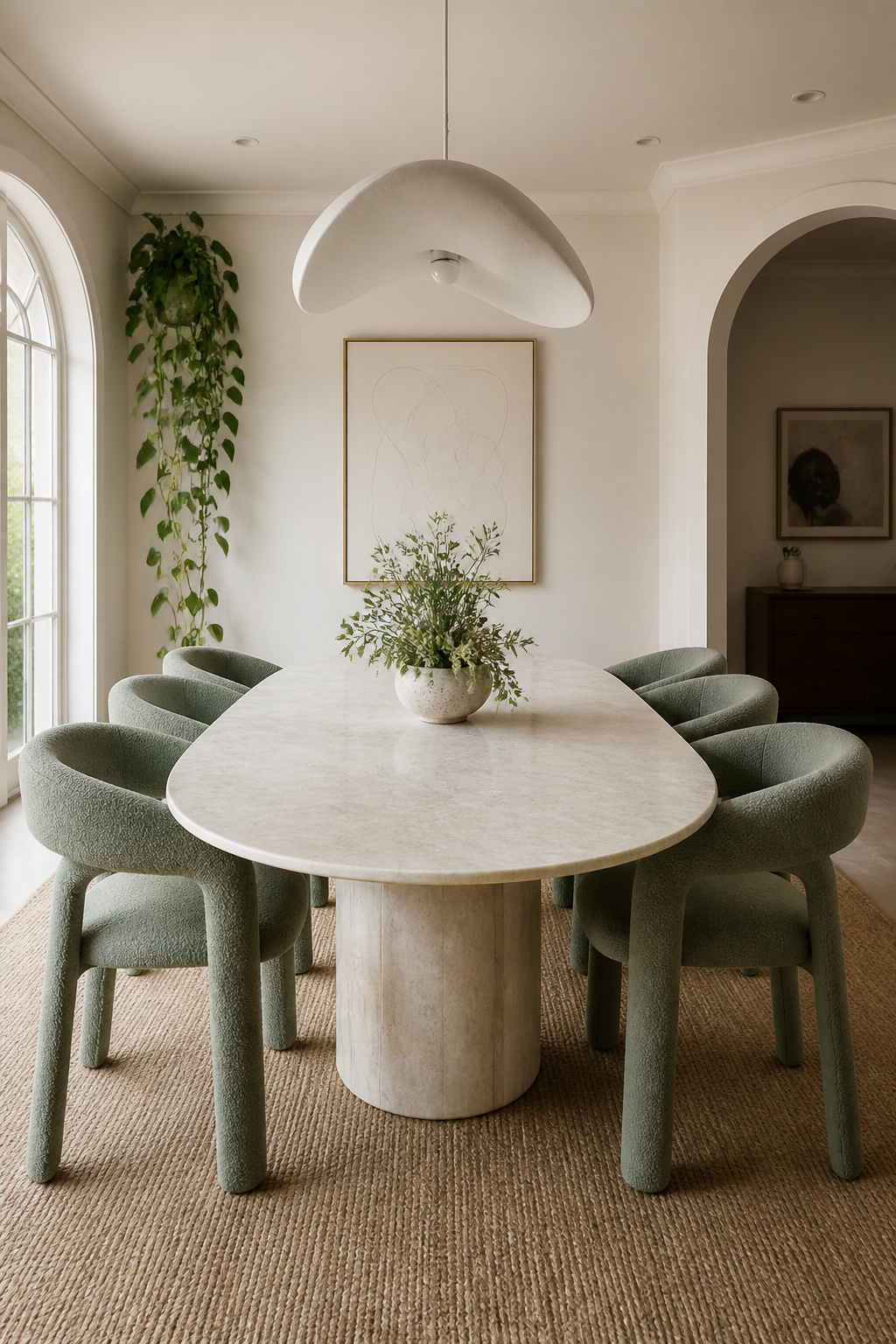
Curved furniture removes the visual hierarchy that rectangular tables impose. A round or oval table has no head; every seat is equally close to every other, which changes the dynamic of a meal in a way that is immediately felt rather than consciously noticed. Rounded edges also mean no sharp corners in the circulation path, which matters more than most non-parents admit.
Round tables suit 4 people naturally and work best in square rooms or alcoves. Above 6 people they start to feel cramped, and fitting centrepieces and serving dishes becomes a real spatial puzzle. The oval table solves most of these problems: a 72-inch oval comfortably seats 6; an 84 to 96-inch version seats 8 to 10. Oval proportions also flow more naturally down rectangular rooms, which describes most dining rooms. Extendable oval tables, which compact down to a round for everyday use and extend for entertaining, are among the more practical furniture solutions available.
Beyond the table itself: a curved or crescent-shaped bench along one long side adds a sculptural note that straight benches never quite achieve. Tub chairs (barrel-backed, low-armed) at the table ends are both sculptural and welcoming. An arched-front sideboard is less common than the rectangular version, but a room that includes one feels more considered for it.
8. Texture Mixing: One of the Most Rewarding Modern Dining Room Ideas
In theory, texture mixing sounds like a styling detail. In practice, it is the reason some rooms feel warm and alive and others feel like a furniture showroom.
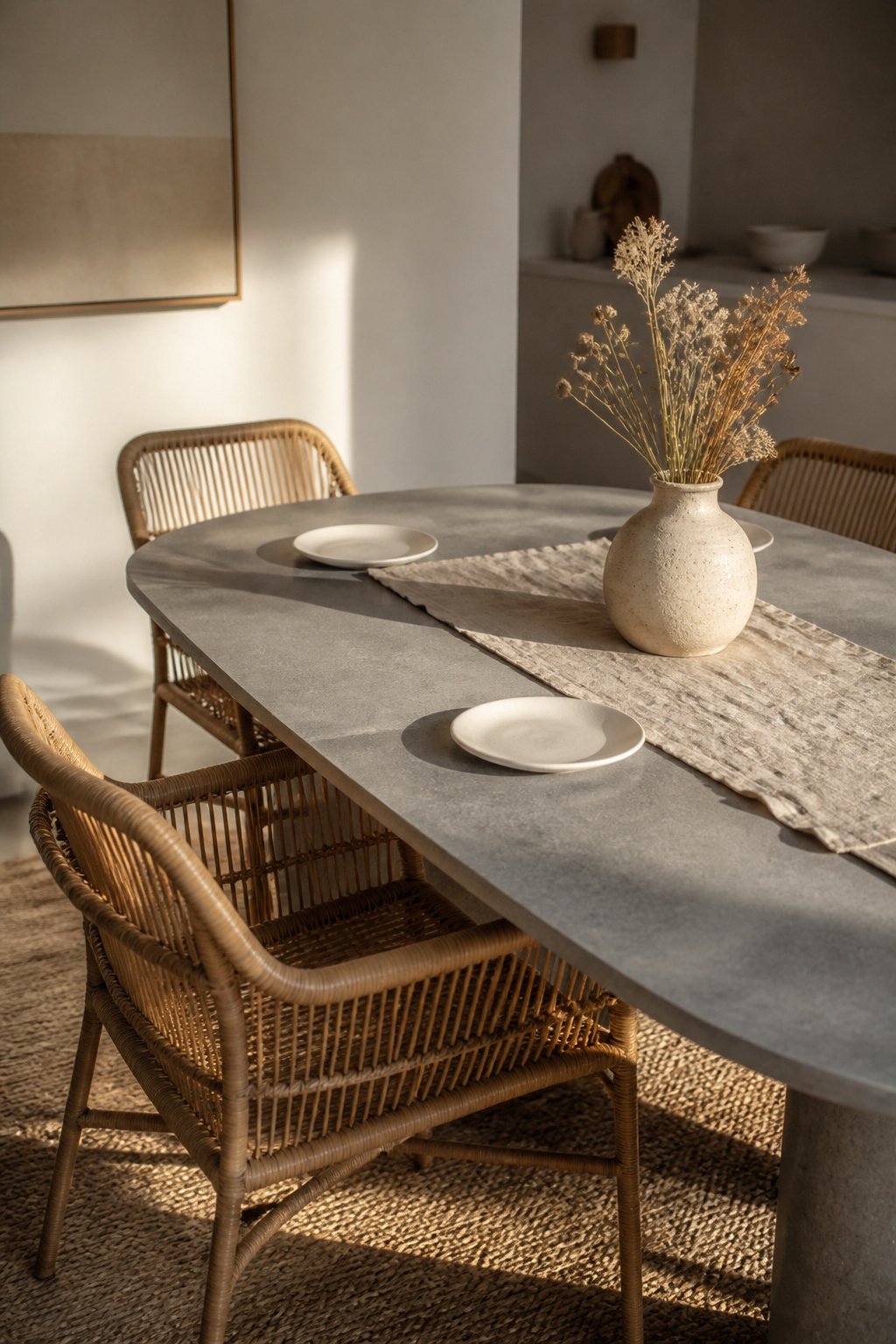
The working rule is a maximum of three texture families per space. Push beyond three and the eye loses its way. The triangle to aim for is rough, smooth, and tactile: rough in the rattan chairs or jute rug, smooth in the lacquered or stone table surface and glazed ceramics, tactile in the linen runner, the velvet chair pads, or the woven placemats.
Rattan chairs with a stone-topped table is a specific pairing cited consistently as one of the most effective in contemporary dining design. The organic weave against the mineral hardness is a visual contrast that matching materials never produce. Rattan with a lacquered table is also effective, particularly when the lacquer is either white or a deep saturated colour, giving maximum contrast to the natural weave. In both pairings, neither material should dominate; the contrast between them is the whole point.
Textiles are the most accessible way into this. A linen table runner is the simplest addition: it introduces texture while continuing to show off the table surface beneath, which is particularly good for beautiful wood or stone tops. Boucle seat cushions tied onto rattan chairs add comfort and a tactile quality that diners physically notice. Velvet or heavy linen napkins are underrated; they sit at hand and face level throughout a meal and their quality registers even without conscious thought. Rattan, linen, jute, and wool are natural partners; they all speak the same material language.
9. Indoor Plants and Natural Materials for a Biophilic Dining Room
Of all the material choices in a dining room, live plants do the most work for the least money. They bring the one quality that no manufactured object can convincingly mimic: actual life.
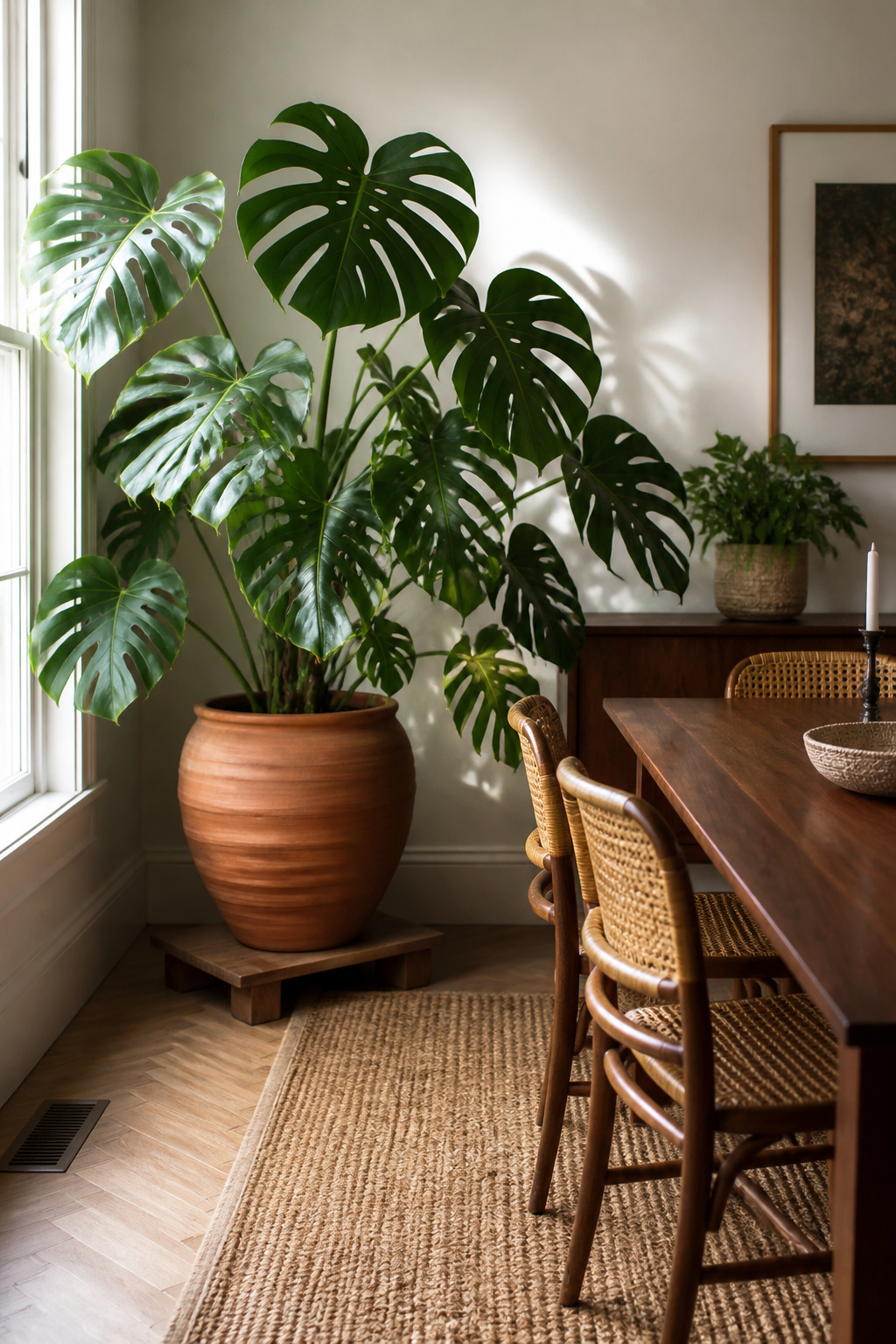
The plants that perform best in dining rooms are the architecturally impactful ones: Monstera Deliciosa for its iconic split leaf and tolerance of medium indirect light; Fiddle Leaf Fig for its upright, large-paddled statement in a bright corner; Bird of Paradise for its fan-like structure and drama in rooms with strong light. The Snake Plant earns its place in corners without windows; it thrives on neglect and has a clean, graphic vertical form that works with modern furniture. For a dining room with variable light and the inevitable humidity from cooking nearby, Monstera is reliably the lowest-maintenance large plant that still looks genuinely significant.
One principle matters more than any other: scale up. A 20cm Monstera in a small pot looks unconvincing in a room with 8-foot ceilings. The plant should feel like it belongs to the space rather than decorating the edge of it. Oversized terracotta or hand-thrown ceramic pots, 30 to 50cm in diameter, create a sculptural moment before the plant is even considered. Positioned in a dining room corner nearest to natural light, a large plant in a beautiful pot earns its place as a room element.
Beyond plants: a jute or seagrass flat-weave rug under the dining table grounds the furniture group and adds a natural underfoot layer that cushions the room acoustically. Stone serving pieces on the table, clay bowls for holding fruit or condiments, and a terracotta side dish all extend the natural material story into the objects people actually handle.
10. A Curated Gallery Wall That Anchors the Main Dining Elevation
A gallery wall done well is one of the most effective things you can do with a dining room wall. Done badly, it looks like a project that got out of hand. The difference is almost entirely in the planning.
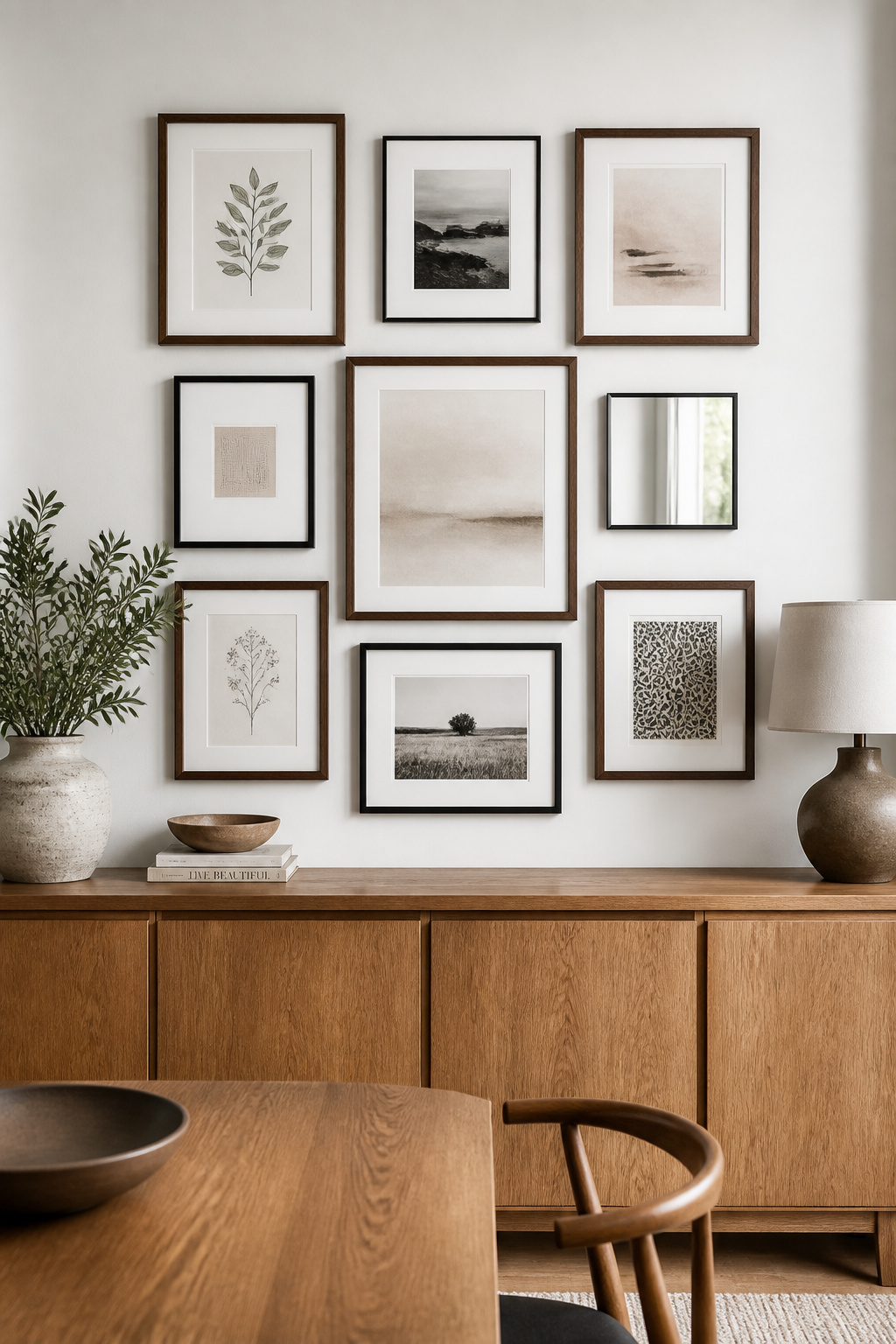
The paper template method removes most of the risk. Cut paper or newspaper to the exact outer dimensions of each frame, mark the hanging point on the back of each template (usually 8 to 10cm down from the top edge), and arrange the templates on the floor until the composition feels balanced. Only once the arrangement is settled do you tape the templates to the wall and nail through them. The centre of the overall arrangement should sit at 57 to 60 inches from the floor; museum standard for eye level. If the gallery sits above a sideboard, the bottom of the lowest frame should land 8 to 12 inches above the furniture surface.
Frame Selection and Spacing
For spacing: 2.5 inches between frames is the sweet spot. Tighter than 2 inches and the arrangement reads as cramped; wider than 4 inches and the pieces lose their cohesion as a group. Anchor the composition with one or two large pieces (16×20 or bigger) and fill around them with smaller works. Mixing frame materials (dark wood, natural oak, thin black metal, matted white) adds depth without chaos, as long as the art style stays loosely consistent.
For statement art choices for dining and living areas, the most considered galleries mix abstract prints, one or two photographic works, and perhaps a mirror or two, which add reflective depth and break up the flat picture plane. Print-on-demand sources (Society6, Desenio, Etsy) make assembling a cohesive print collection genuinely accessible; IKEA Ribba frames are the budget standard and blend well across different sizes. Unframed canvases alongside framed prints add another layer of material variation.
11. A Concrete or Stone Dining Table for an Industrial-Organic Statement
Concrete and stone dining tables bring a density and permanence that wooden tables don’t, a sense that the table has always been there and always will be. In a modern dining room with otherwise soft or natural materials, that quality can be exactly right.
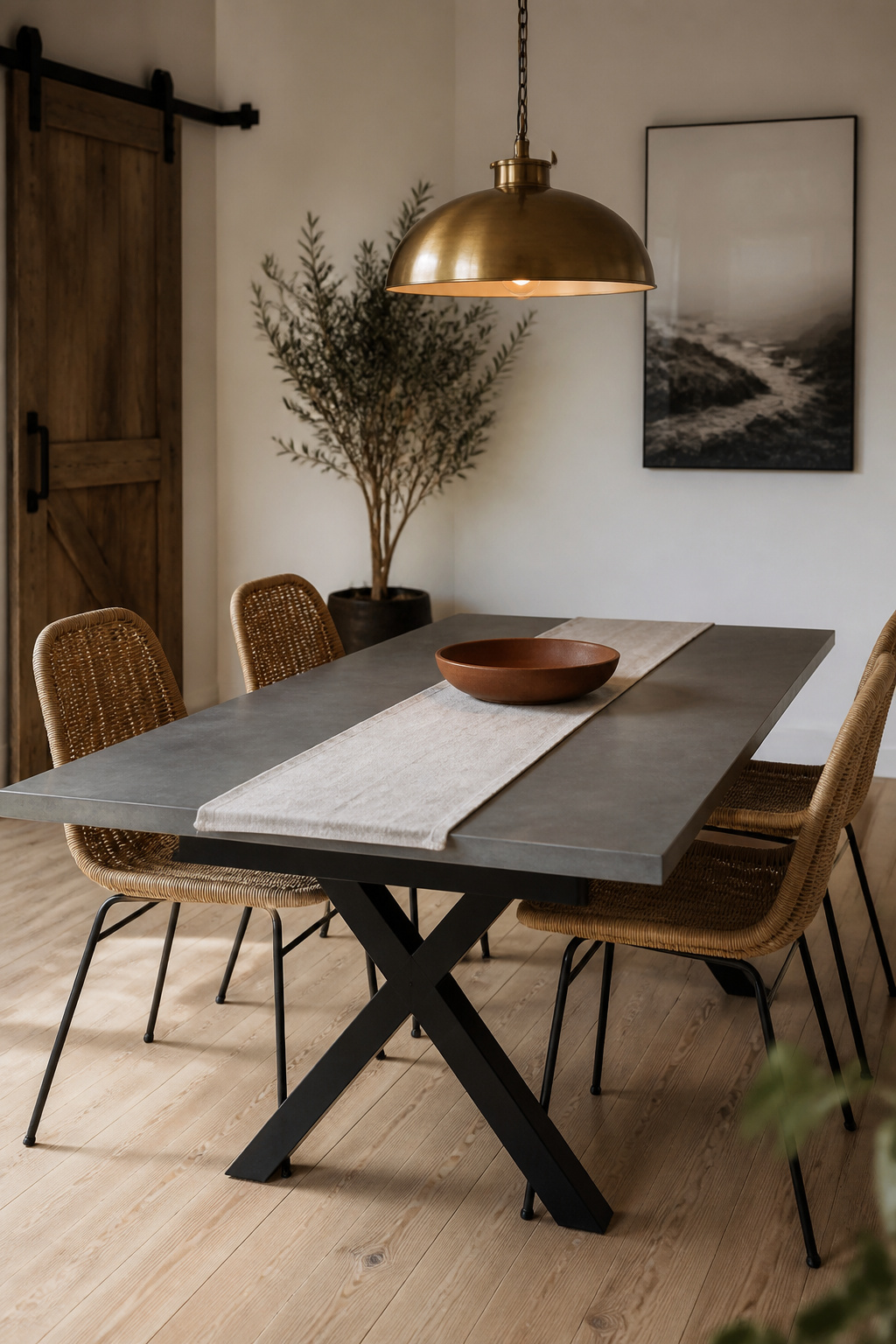
Among the hard surface options, sintered stone is the practical choice. Dekton, made by Cosentino, scores 8 on the Mohs hardness scale, harder than granite and far harder than marble, and is non-porous, requires no sealing, and comes with a 25-year warranty. Wipe it with soap and water. Natural marble is the opposite: porous (needs annual sealing), etches with acidic foods and wine, and requires genuine care. The marble aesthetic has been so thoroughly replicated by sintered stone that the maintenance burden of genuine marble is increasingly hard to justify in a dining room that sees daily use.
Polished concrete is the original industrial choice but has largely been displaced by sintered stone alternatives that achieve a similar aesthetic without the weight, porosity, and cracking risk. A genuine poured concrete dining table can weigh several hundred kilograms; structural floor loading is a real consideration.
For sintered stone specifically: the top requires a robust, well-distributed base. Slim hairpin legs are inadequate; a trestle or pedestal base distributes the weight correctly. Maximum unsupported overhang is 10 to 12cm for standard slabs; beyond this, support brackets become necessary. The table will also require professional delivery. And the one styling note that matters: place rattan or upholstered chairs around a stone table. The textural contrast is the warmth. Without it, the room stays cold.
12. Monochrome Tonal Layering for a Polished Modern Dining Room
A monochrome dining room is not a white room with white furniture. Done correctly, it is a study in the way light interacts with varying values and sheens of a single colour, and the result is more sophisticated than almost any multicolour scheme.
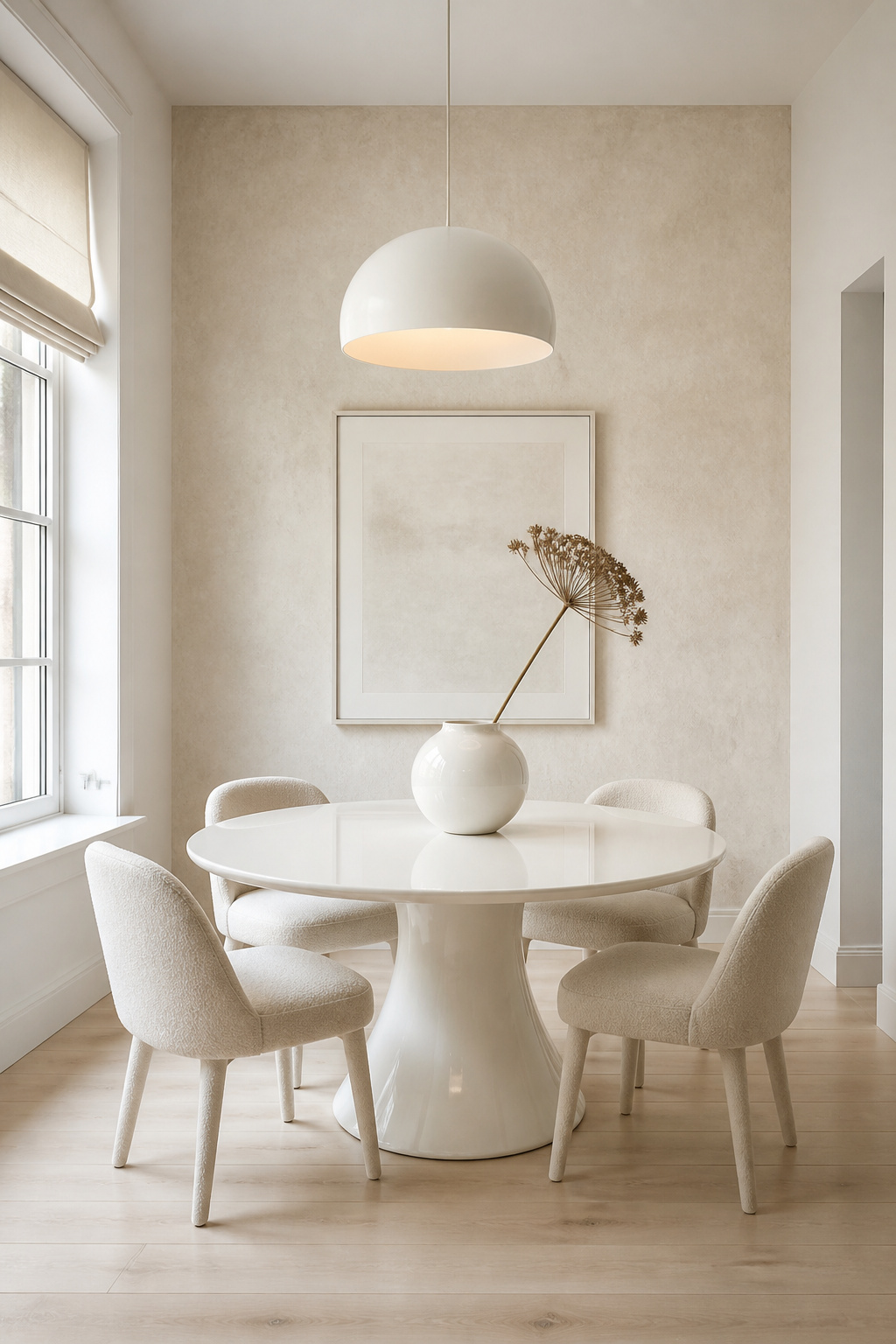
The practical execution involves choosing three to four values of the same hue: a mid-tone wall, a slightly lighter trim and ceiling, a slightly darker upholstery or flooring, a near-white linen on the table. The flatness that defeats most monochrome attempts comes not from the colour choice but from the sheen choices. Matte walls, satin upholstery, gloss ceramics, and eggshell-painted woodwork, when all four surfaces sit in the same tonal range, create a room of layered depth that reads as quiet luxury.
For choosing dining room paint colors that work with your scheme, the warm-cool distinction matters more in dining rooms than almost anywhere else. Warm white undertones (creamy, yellowish; Benjamin Moore White Down, with its LRV of 76.7, is a useful benchmark) look genuinely good under 2700K LED lighting and candlelight. Cool white undertones can be beautiful in daylight but turn slightly harsh under the warm artificial light of dinner. Always test paint chips under the room’s actual lighting conditions rather than in the shop or under daylight alone.
The one device that saves a monochrome scheme from total flatness: introduce a single surface with a subtle pattern in the same tone. A linen-weave wallpaper in the same family as the wall paint, a subtly textured upholstery in near-matching fabric; something the eye can land on without a colour shift to prompt it.
13. Artisan Ceramics and Wabi-Sabi Objects as the Dining Table’s Story
The dining table is, for some hours on some evenings, the most scrutinised surface in the house. What sits on it says more about a modern dining room’s character than almost any other single decision.
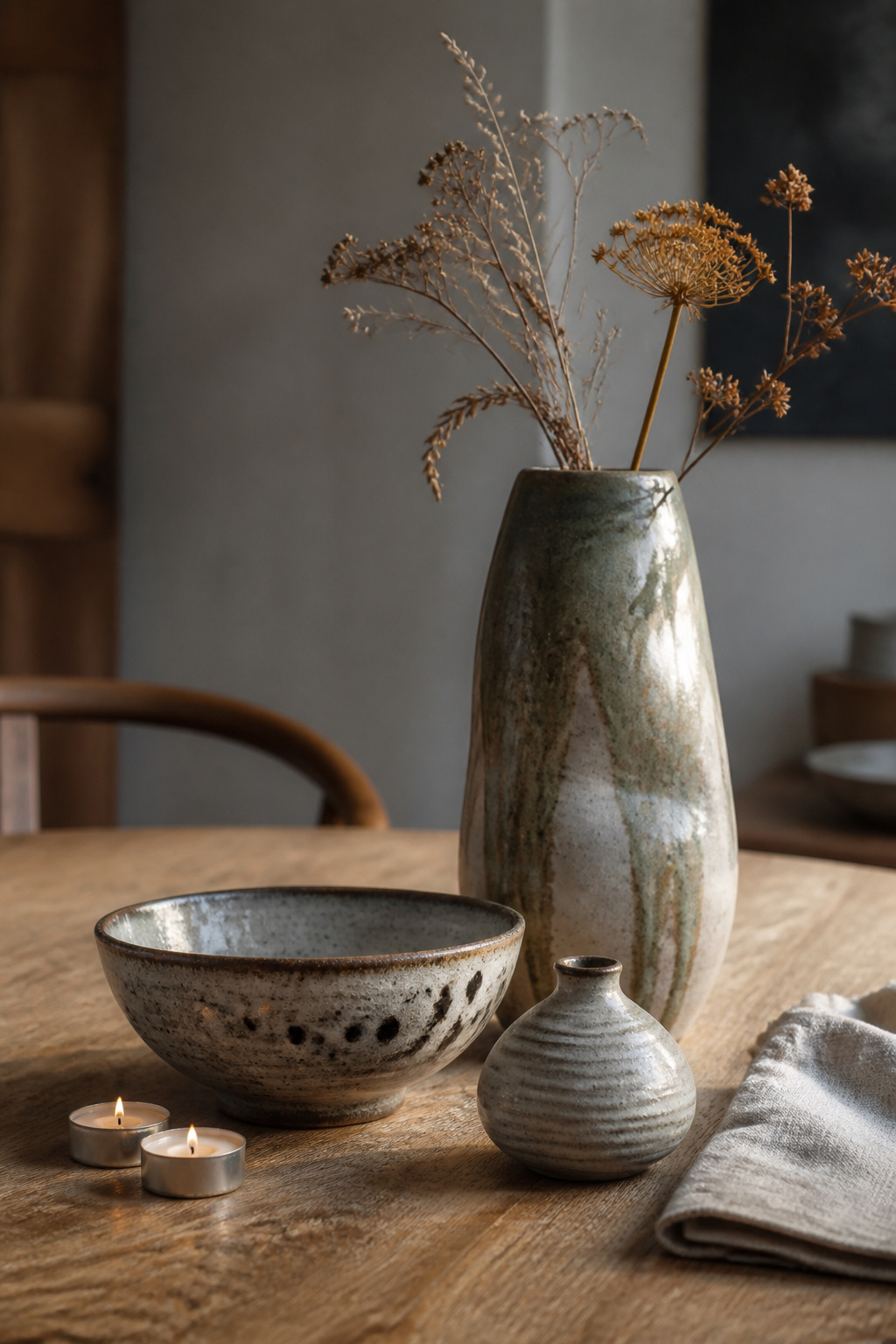
Wabi-sabi ceramics are handmade pieces defined by their imperfections: asymmetric rims, pooled glazes that break thin at the edge, visible throwing ridges, and surfaces that record the maker’s hand. The philosophy behind them, rooted in 12th-century Zen Buddhism, values the beauty in imperfection, transience, and the passage of time. In a room full of precision-machined furniture, a handmade ceramic with provenance and patina does something a factory bowl cannot.
Sourcing is easier than it might seem. Elea Ceramics, a French studio working in the Japanese tradition, ships internationally. OOAK Creation in London makes one-of-a-kind contemporary stoneware. Etsy’s ‘wabi-sabi pottery’ or ‘handmade stoneware’ search returns hundreds of independent studio potters at genuinely accessible prices. At pottery markets and craft fairs, look for pinch marks, throwing ridges, and glaze variations: signs of hand work rather than casting. A piece with a name attached to it becomes a talking point. That has value.
For everyday display: one to three pieces on the table, allowing the surface to breathe. A single beautiful tall vase with dried grasses and a low shallow bowl beneath it is almost always better than a cluster of equal-height objects. For dinner parties: build a low centrepiece (nothing above 30cm; above that, it obstructs sightlines across the table) using handmade chargers, woven mats, and a small grouping of vessels at different heights. The table should feel composed rather than decorated.
14. Open Shelving or Floating Shelves as a Functional Display Wall
A wall of open shelves in a modern dining room does what a sideboard cannot: it draws the eye upward, adds functional display storage at multiple heights, and frames the room architecturally in a way that a piece of furniture never quite manages.
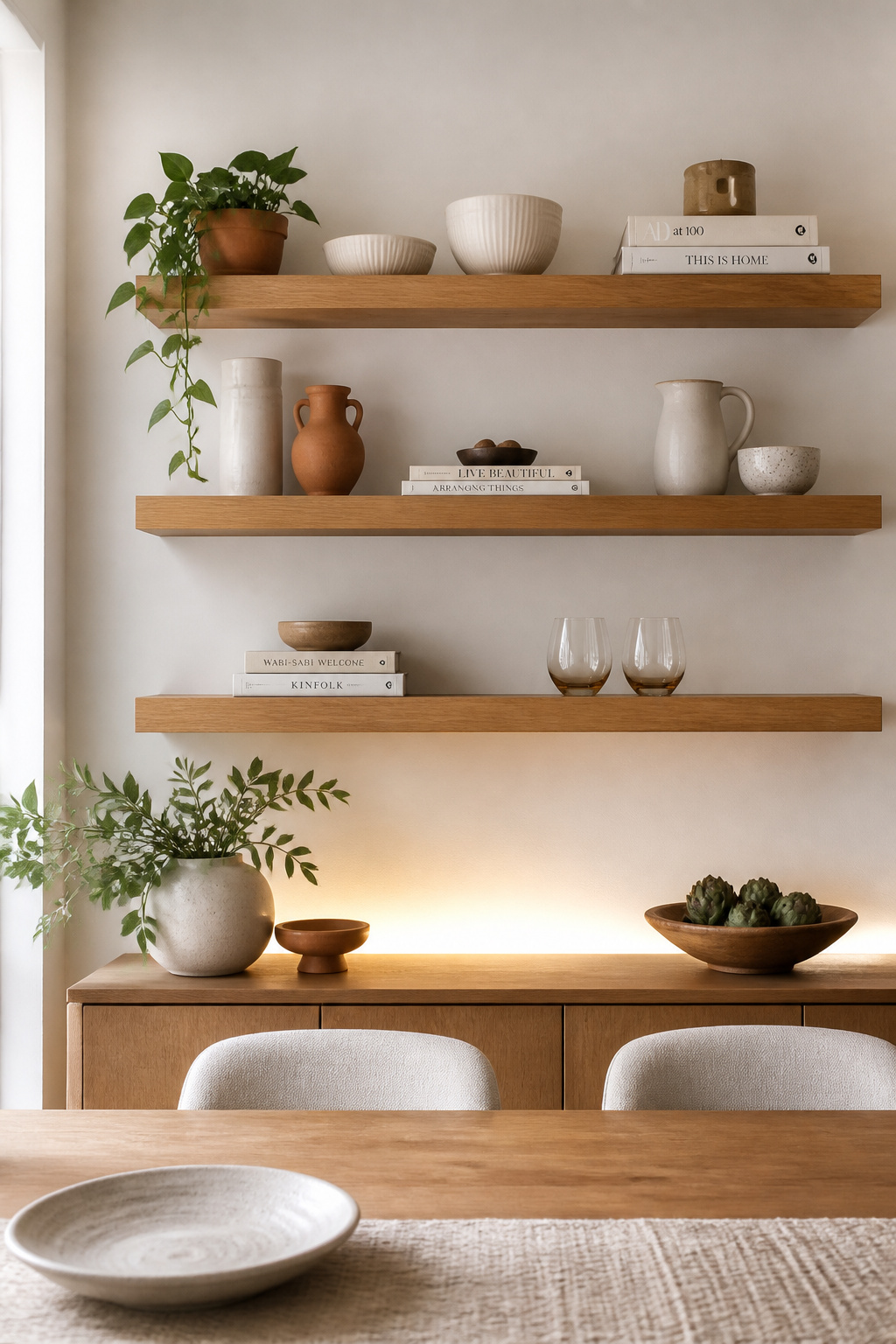
The most effective positioning is the wall that catches natural light; a shelf arrangement opposite or adjacent to the main window means light bounces off displayed objects throughout the day. Flanking a doorway with symmetrical shelving runs frames the architectural opening and creates a library quality. Base shelf height works best at 60 to 70 inches from the floor, just above seated eye level, accessible but not reaching.
On weight and installation: floating shelves mounted into wall studs can hold 15 to 50 pounds per linear foot, more than enough for ceramics, books, and small plants. Plasterboard alone, without studs, maxes out at 10 to 15 pounds per bracket and is not adequate for a loaded dining shelf. Always use a stud finder first, and always check the manufacturer’s weight rating for the brackets rather than just the shelf material. Solid oak shelves are heavy in their own right; powder-coated steel brackets are the strongest option relative to their visual slimness.
For styling: odd numbers of objects, varying heights, and a deliberate mix of practical and decorative items. A dining room shelf that holds actual glassware and a favourite ceramic alongside a few art books and a trailing plant looks considered; a shelf displaying only ornaments looks staged. Leave 20 to 30% of each shelf empty; the negative space is exactly what distinguishes curated from cluttered. Books lying flat with a small object placed on top create a natural plinth effect; ceramic vases of different heights provide the vertical rhythm.
15. Layered Lighting: The Move That Completes Every Modern Dining Room Idea
A single pendant over the dining table is the baseline, not the destination. A room lit from one source casts uniform light with no depth; shadows fall straight down, corners go dark, and there is no atmospheric gear shift between a regular Tuesday dinner and a table set for guests.
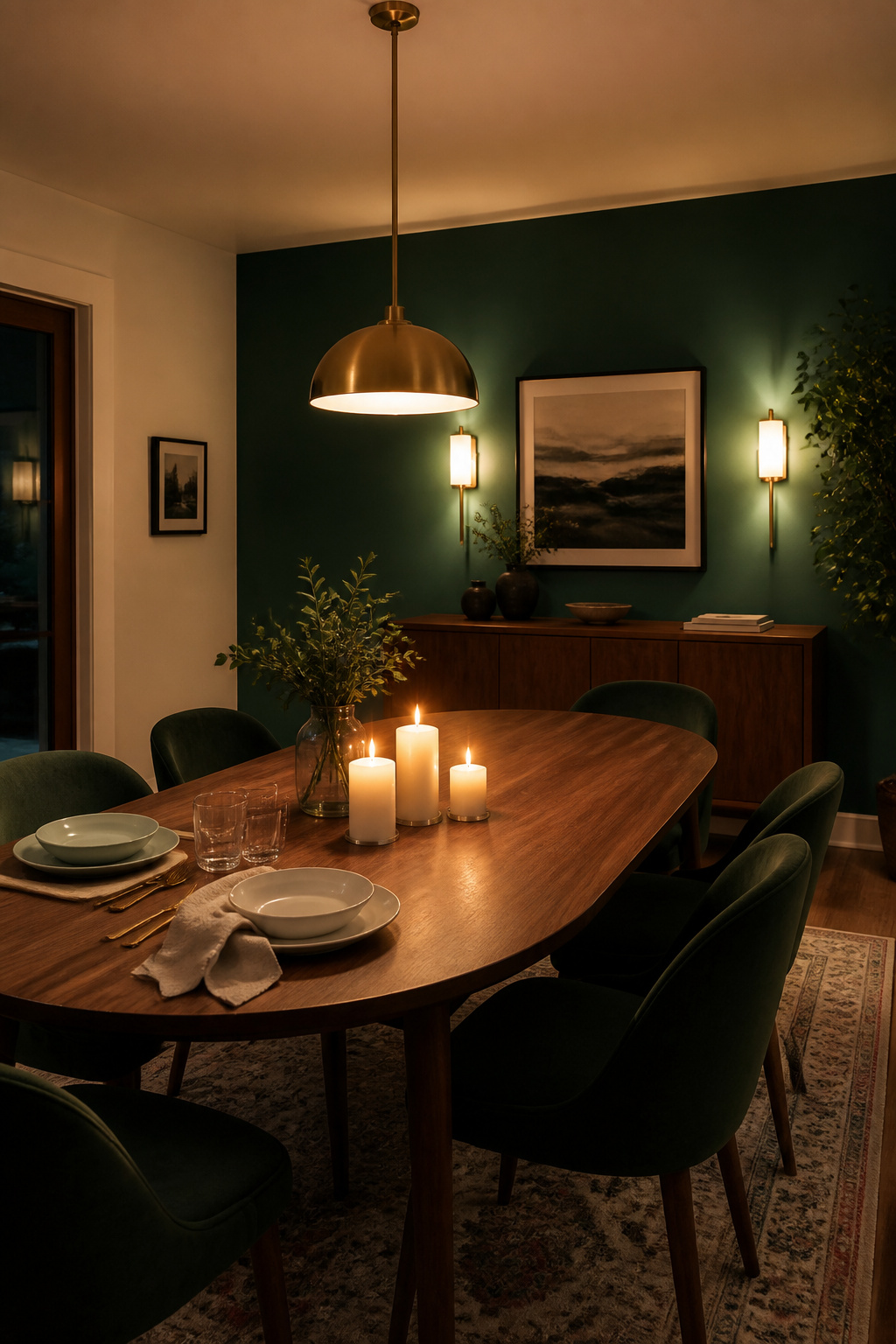
The three-layer approach changes this entirely. Ambient light (the pendant, the room’s primary source), task or focal light (sconces flanking the sideboard or accent wall), and accent light (candles, an LED floor lamp in a corner, or under-shelf strip lighting) together create a room that reads differently at different hours.
Colour Temperature and Dimmer Controls
For warm ambient lighting approaches for living and dining spaces, colour temperature is where the practical decisions live. The professional recommendation for dining rooms is 2700K, the warmest LED available. It produces a golden, amber-adjacent light that makes food look appetising and skin tones look good. At 3000K, the light is slightly crisper and cooler, functional but better suited to a kitchen. Above 3500K, the room starts to feel like a hotel corridor.
Wall sconces mounted at 60 to 66 inches from the floor cast warm, indirect light that fills the room at the level where faces sit during dinner. A floor lamp in a dining room corner is an unusual choice but very effective; it reaches the zones a pendant cannot, and the upward throw it creates makes the ceiling feel higher. Candles on the table and sideboard remain the one light source that artificial technology hasn’t convincingly replaced for intimacy.
On dimmers: install them on everything and buy dimmable-rated LED bulbs from the start. Non-dimmable LEDs on a dimmer circuit flicker and buzz; always check the bulb packaging before assuming compatibility. The dimmer extends the life of the bulb and gives the room a genuine mood range that fixed-brightness lighting cannot offer.
Finding Your Modern Dining Room Style: Where to Start
The table is always the right place to begin. Every decision in a modern dining room radiates from it; chairs must suit it, lighting must serve it, and the sideboard should complement its length. Getting the table’s material, scale, and proportion right is the single most valuable thing you can do before spending anything else.
If budget is limited, two interventions deliver the highest visual return: a statement pendant at the right height and one jewel-toned accent wall behind the primary seating. Both are reversible, both are relatively affordable, and both will transform how the room feels before any new furniture arrives.
If you are working with inherited or mismatched furniture, layered textiles and a gallery wall are the fastest routes to cohesion. They add character without requiring any replacement. A linen runner on an old table, boucle cushions on old chairs, and a considered arrangement of prints above a sideboard can bring together pieces that share almost nothing and make the mix feel deliberate.
The longer view, though, is this: one well-made dining chair held for twenty years is better for your budget and for the planet than three cheap replacements. The Wishbone, the HAY About A Chair, the Eames DSW all hold value on the secondhand market because the design is genuinely good. A dining room that accumulates a few meaningful objects over time, a ceramic bought from a potter at a market, a lamp found on a trip, a print from a gallery, has a quality that no styled-on-a-budget room ever quite manages to produce.