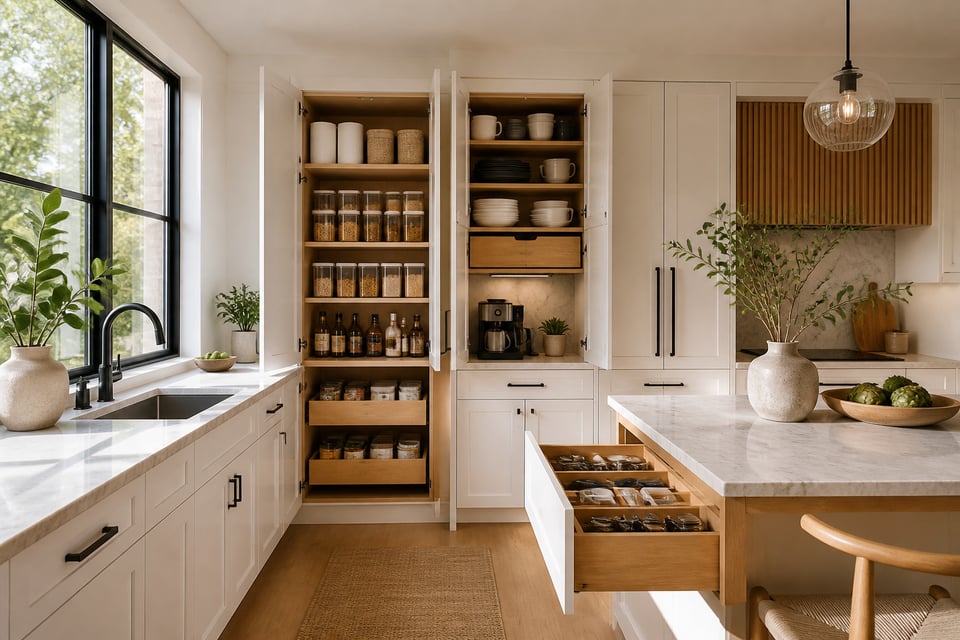
Opening a cluttered kitchen cabinet is a small but daily act of friction. The lid you need is buried under three others. Something rolls off a shelf when you reach past it. The back half is functionally a black hole. These moments add up — not dramatically, but persistently. They make cooking feel like more effort than it should.
Good kitchen cabinet organizers don’t just tidy space. They reduce the cognitive friction that comes from a kitchen that fights you. Japanese design uses the concept of *mieruka* — making things visible and accessible — as a foundational principle of calm environments. When every item in your cabinets has a defined place and can be retrieved in one motion, the kitchen itself becomes quieter.
These 17 kitchen cabinet organizers address specific problems. Some tackle the deep base cabinet that swallows things whole. Others solve the corner cabinet no one can fully use, or the drawer that turns every meal into an excavation. Each is chosen for practicality over aesthetics — though most manage both.
1. Pull-Out Drawer Organizers for Deep Base Cabinets
The standard base cabinet is 24 inches deep. Most people can only reach 12-14 inches inside without kneeling or leaning. That back half — the final 10-12 inches — effectively doesn’t exist as usable storage. Items pushed there stay there, undisturbed, until you’re forced to excavate.
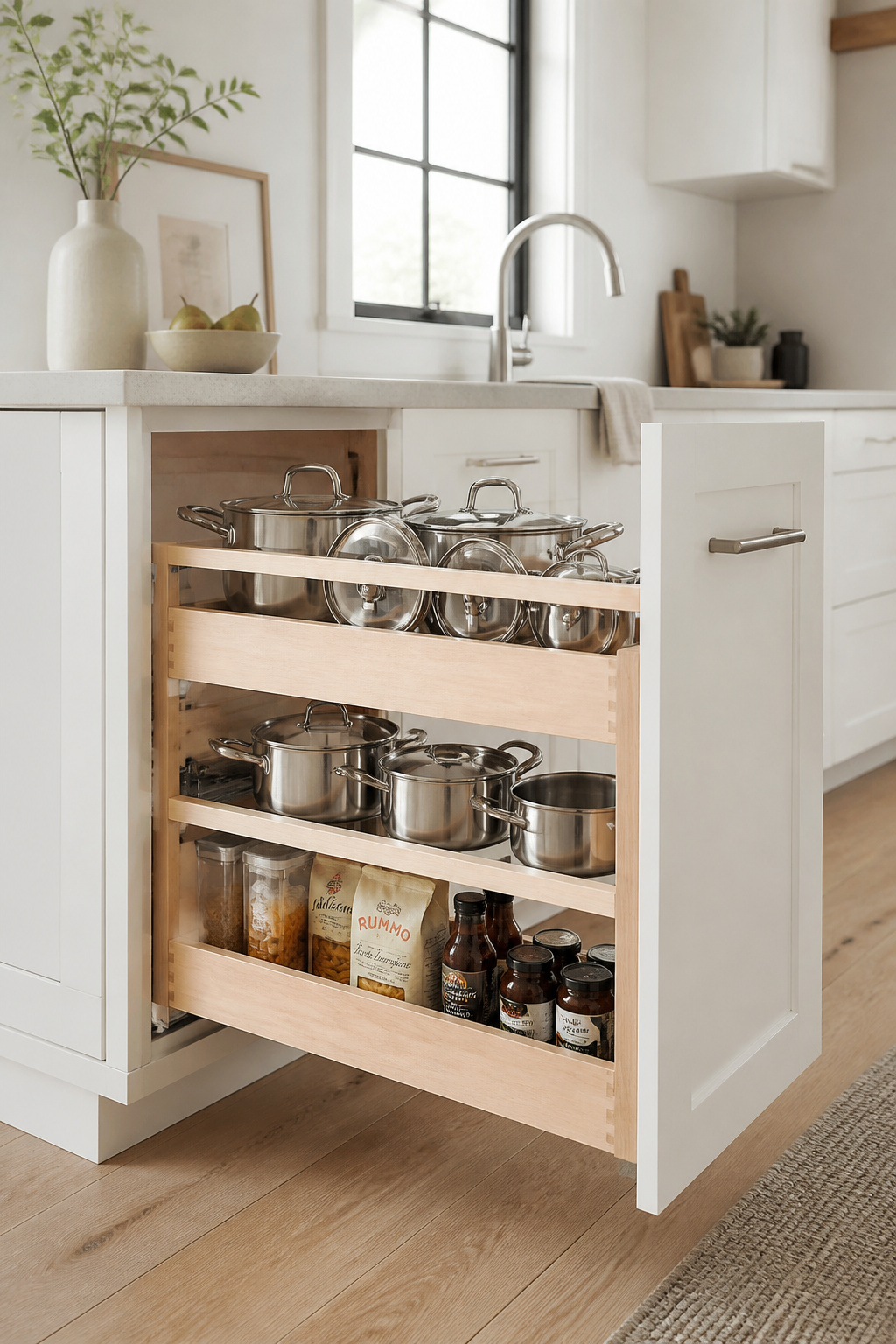
Pull-out drawer organizers solve this by converting the full cabinet depth into a drawer that comes to you. Rev-A-Shelf’s 4PIL series is the benchmark: 100 lb weight rating, 3-section ball-bearing full-extension slides, available in widths for 18-inch cabinets (13-3/8-inch unit) and 24-inch cabinets (20-inch unit). Full-extension slides are the key detail. Partial-extension slides only expose 75% of the cabinet — leaving a dead zone at the back that defeats the purpose. For broader kitchen storage organization ideas, these pull-outs are the single highest-ROI base cabinet upgrade.
The installation variable most people skip is the face-frame question. Run your hand inside the cabinet opening. If you feel a wood frame set back from the edge, you have a face-frame cabinet. These need 3/4-inch spacers on each side to mount the slides flush. Frameless (Euro-style) cabinets install directly. Most quality pull-outs include spacers for both types.
Blum BLUMOTION soft-close slides are available on the premium version and worth the extra cost in a busy kitchen. The mechanism absorbs the last inch of closing force. No slamming. No gradual loosening of the hardware over time.
2. Lazy Susan Turntable for Corner Kitchen Cabinet Organizers
Corner cabinets are where kitchen storage goes to be forgotten. Without a rotating solution, items at the back are accessible only by removing everything in front of them. Nobody does this voluntarily. Those items effectively don’t exist.
A properly sized Lazy Susan changes the geometry of the problem. The sizing rule is simple: measure the shortest inside dimension of your cabinet, then subtract 2-4 inches for rotation and door-swing clearance. A standard 33-inch corner cabinet takes a 29-31-inch turntable. Two-tier Lazy Susans for 36-inch cabinets require a cabinet height of 34.5 inches and 18 inches of depth — measurements that match most kitchens built after 1985.
There are two distinct corner cabinet situations. Pie-cut corners (door opens to the full interior) suit a traditional round Lazy Susan or Rev-A-Shelf’s kidney-shaped version. Blind corners need a magic-corner pull-out instead. A Lazy Susan won’t rotate freely in a blind corner, no matter how carefully sized. These are completely different products; confirm your cabinet type before ordering. For kitchens with traditional cabinetry, these traditional kitchen cabinet storage ideas show how organization principles adapt to different door configurations.
Material choice comes down to use case. Bamboo looks warm and aligns with a natural aesthetic. BPA-free plastic cleans easily and costs less. Stainless is the most durable option for shelves holding oils and anything prone to leaking. Two-tier versions are the practical default for most kitchens. Single-tier suits bulkier items — mixing bowls, a slow cooker — that won’t fit between two tiers.
3. Bamboo Drawer Inserts for Mindful Kitchen Cabinet Organization
The material of a drawer organizer matters more than it sounds. The right choice creates visual calm every time the drawer opens. The wrong one just contains the chaos at a different scale. For a kitchen that values stillness in its aesthetic, bamboo is the consistent answer.
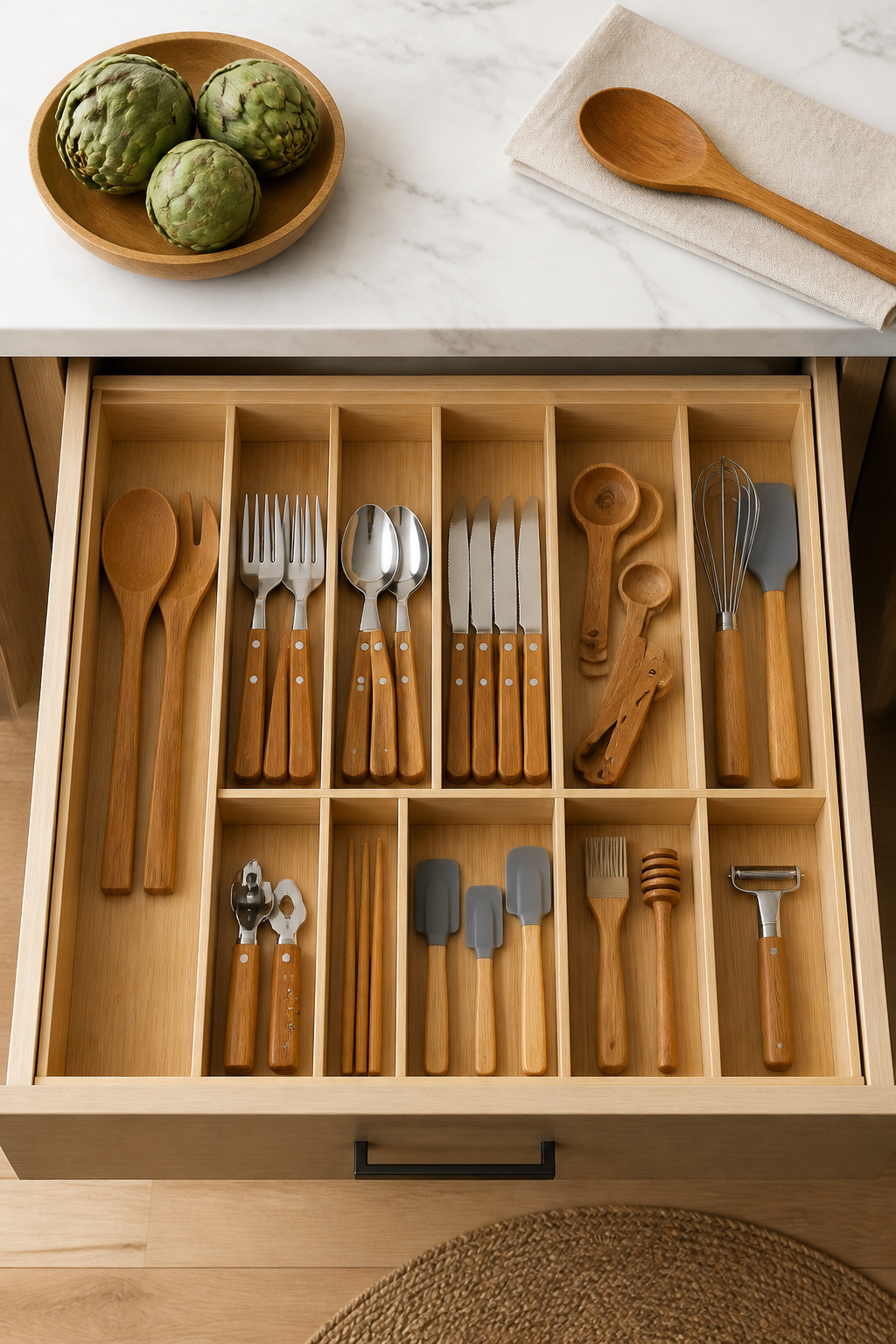
Bamboo is technically a grass, not a wood. It regenerates in 3-5 years, compared to 30-80 for hardwood trees. Its natural silica content gives it good moisture resistance. That said, it will warp if wet utensils sit on it consistently without drying first. A thin linen liner beneath the insert prevents this.
These mindful kitchen organizing ideas go deeper into the principles behind sustainable drawer organization. For the organizer itself, the choice is between fixed and expandable. Fixed inserts stay put better when they fit snugly. Expandable models are essential for non-standard drawer widths, common in older or custom kitchens. Pipishell (42,000+ reviews, 4.7 stars) uses a spring-loaded mechanism that maintains constant pressure against the drawer walls. ROYAL CRAFT WOOD uses a varnished sliding-panel design that locks at a set width — more stable if you remove the tray for cleaning. Both fit standard drawers in the 13-22 inch range. For drawers wider than 24 inches, the large bamboo magnetic-connected organizer extends to 37.4 inches.
The one mistake worth naming explicitly: check the expandable minimum, not just the maximum. A tray with a 13-inch minimum won’t fit in a 12-inch drawer at all. Measure internal drawer width before ordering. It takes thirty seconds and prevents a return.
4. Door-Mounted Spice Racks That Clear Counter Clutter
Door-mounted spice racks are kitchen cabinet organizers that work on vertical surfaces instead of horizontal shelves. Small individually. Numerous in aggregate. They take up shelf space proportional to the number of jars, and they tend to migrate — from the counter, from the windowsill, from wherever they were last used — into a disorganized collection that’s impossible to navigate quickly while cooking.
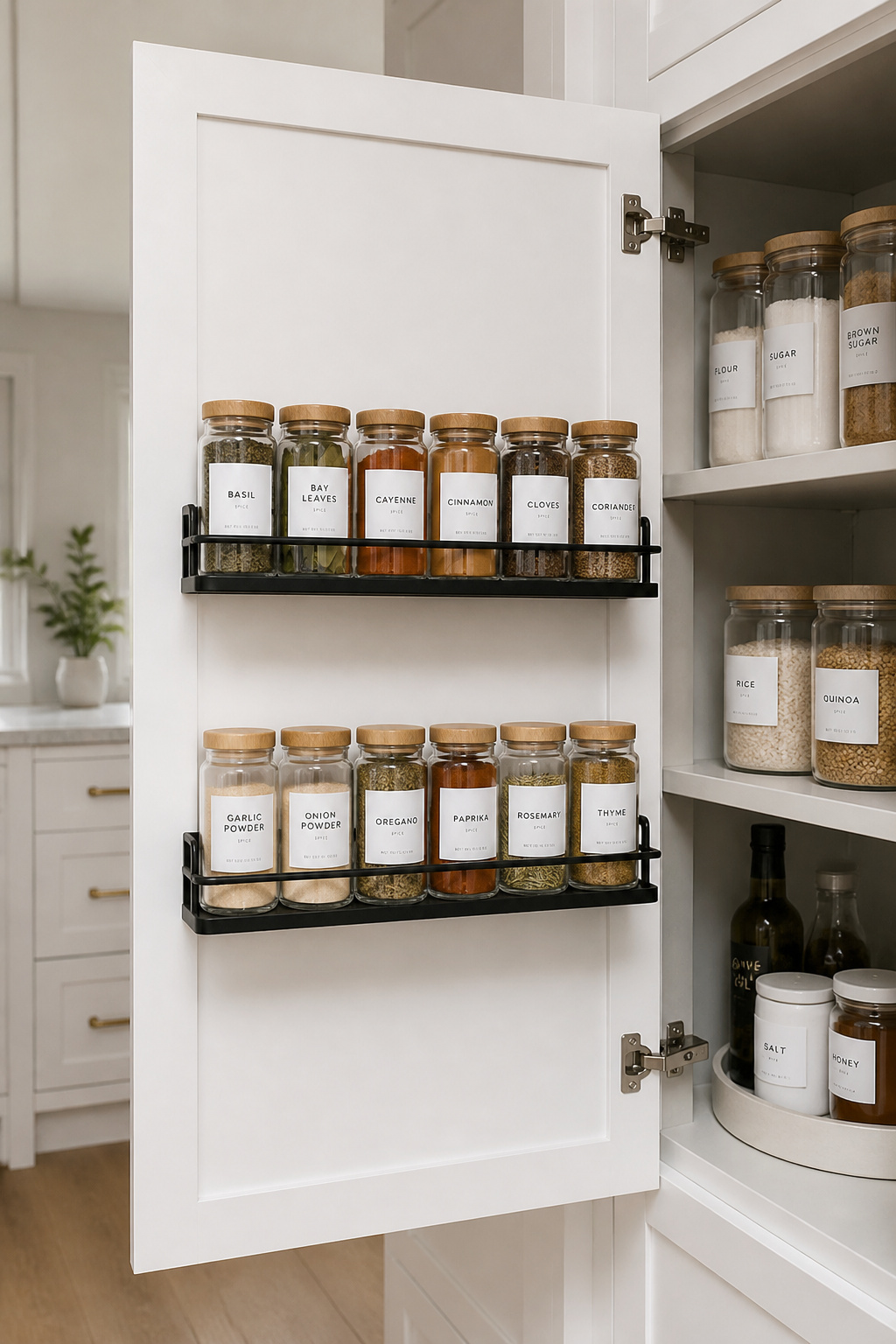
Moving them to the interior face of a cabinet door is the single highest-ROI cabinet upgrade for most kitchens. A standard upper cabinet door is 12-15 inches wide. A door-mounted rack running its full height holds 20-30 spice jars. It frees an entire shelf for heavier items.
The critical pre-purchase measurement is door clearance. The depth of the spice rack must not exceed the gap between the closed door interior and the nearest shelf edge. Measure it explicitly. That gap is typically 2-3 inches for standard upper cabinets. A rack that looks fine on paper will prevent the door from closing if clearance is tighter. Rev-A-Shelf’s 6232 series has a 4-3/8-inch maximum depth and clears most standard shelf configurations.
For installation method: screws into solid wood doors hold indefinitely. Use them for racks with any real jar weight. Adhesive strips work on solid wood only — not on hollow-core doors, painted surfaces, or particleboard. Over-door hook systems require no installation at all, but only work if the door has clearance above the cabinet box. Check before assuming.
5. Stackable Shelf Risers to Double Your Cabinet Shelf Space
The simplest improvement on this list requires no tools, no installation, and no measuring beyond confirming it fits. A shelf riser sits on an existing shelf, elevates one surface 3-5 inches, and creates a functional second level inside the cabinet. In a standard upper cabinet with 12-14 inches between shelves, this effectively doubles the storage capacity of that section.
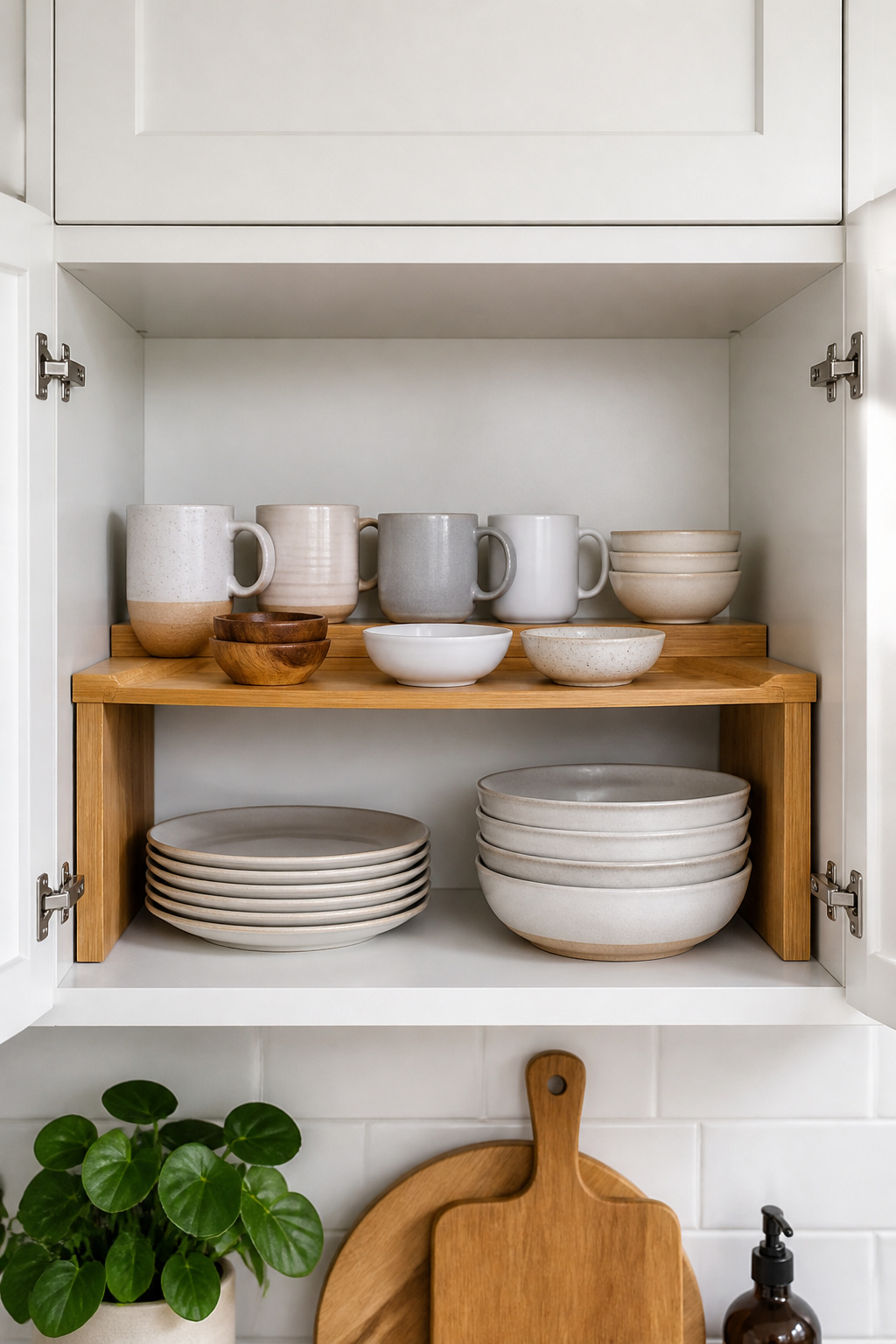
Material choice follows a predictable logic. Wire risers are lightweight and maximize visibility of what’s stored underneath. But the open grid lets small items — single-serve packets, loose tea bags — fall through the gaps. Bamboo risers have a solid surface that holds small items and a warmer aesthetic. Coated steel (white powder-coat is most common) is the most durable and easiest to wipe down. These kitchen storage hacks that actually work include more DIY-friendly approaches alongside purpose-built options.
The best use case is mugs. Stack 6-8 on the riser itself, leave space below for plates or bowls. A cabinet that held 8-10 mugs now holds 16-20, no modification needed. Keep loads under 15-20 lbs total and choose a riser whose length matches the shelf. An overhanging riser has a tipping point directly beneath the overhang. Under load, it becomes a problem.
6. Under-Shelf Baskets for Extra Kitchen Cabinet Organization
Every fixed shelf in a kitchen cabinet has 3-5 inches of dead space between its surface and the items sitting on it. An under-shelf basket clips or slides onto the shelf and reclaims that gap. It creates a secondary storage zone below the existing shelf. No drilling. No removal of anything.
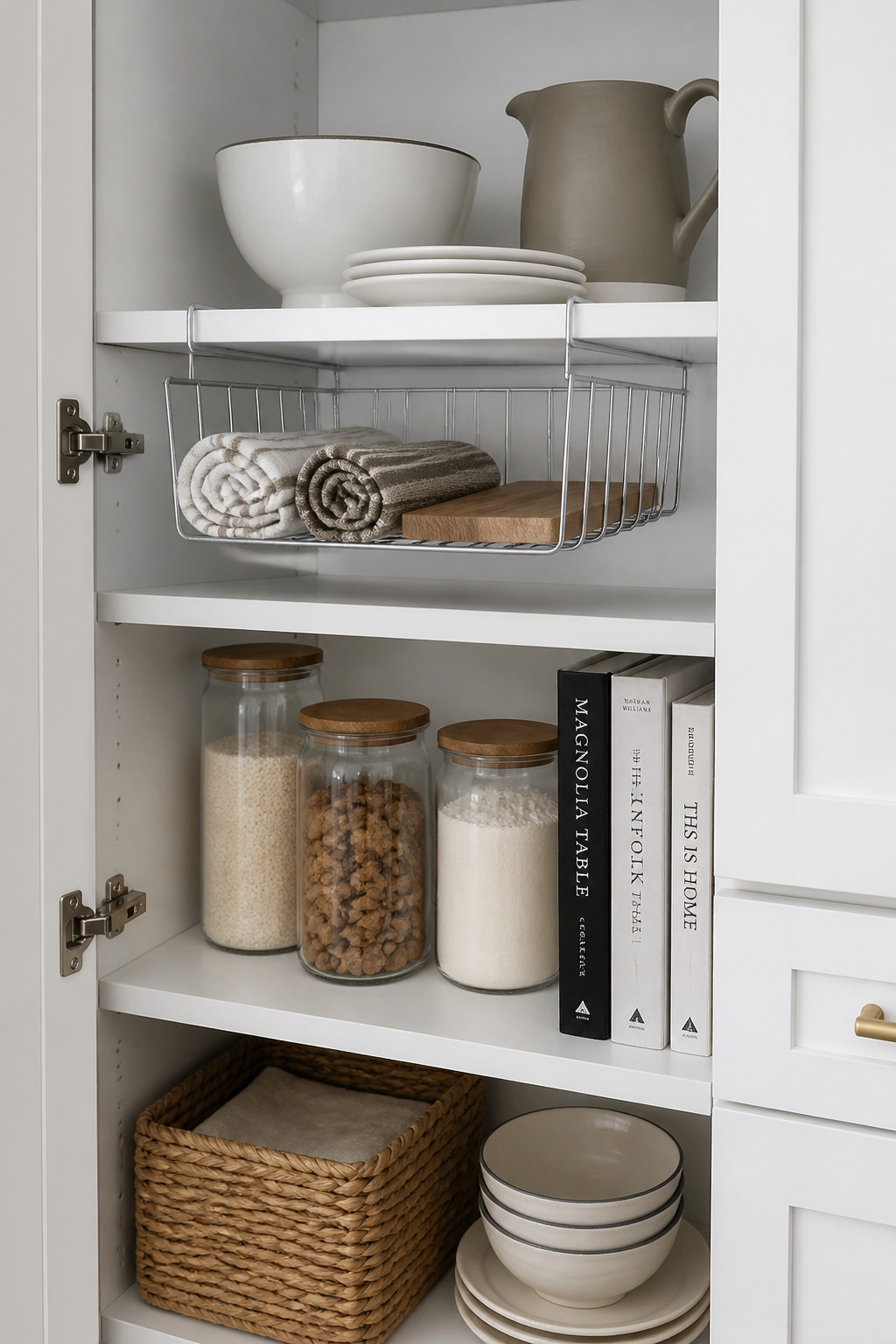
The critical variable is shelf thickness. Most modern kitchen cabinets have 3/4-inch shelves. Some older solid-wood cabinets run to 1 inch. Most under-shelf baskets accommodate shelves up to 1.1-1.2 inches thick. IKEA’s PÅLYCKE basket is more restrictive — it clips only to shelves 5/8-3/4 inch thick — but it’s also one of the cleanest-looking options available. Comfecto’s stainless model accommodates up to 1.2 inches, covering most non-standard shelves. This is the best kitchen cabinet organizer for recovering space that doesn’t require modifying anything.
Weight limits vary more than expected. The IKEA PÅLYCKE holds 4 lbs — suitable for dish towels, foil boxes, or snack pouches, nothing heavier. The SUFAUY 2-pack rates to 22 lbs per basket, extending the range to light canned goods or produce. Wire baskets suit items that benefit from ventilation: produce, dish towels, anything that shouldn’t sit in a closed container. Solid-sided baskets prevent small items from falling through and work better for packets and pouch foods.
7. Vertical Plate Holders for Stack-Free Dish Storage
Vertical plate holders are kitchen cabinet organizers worth reconsidering if you’ve only ever stacked plates. It’s also, over time, damaging to the rims. The rim is the thinnest part of any ceramic plate. Each stacked plate puts its rim against the face glaze of the plate below. The cumulative micro-abrasion from daily stacking and unstacking dulls the glaze. Eventually, it chips. Fine porcelain and artisan ceramics show this damage earliest.
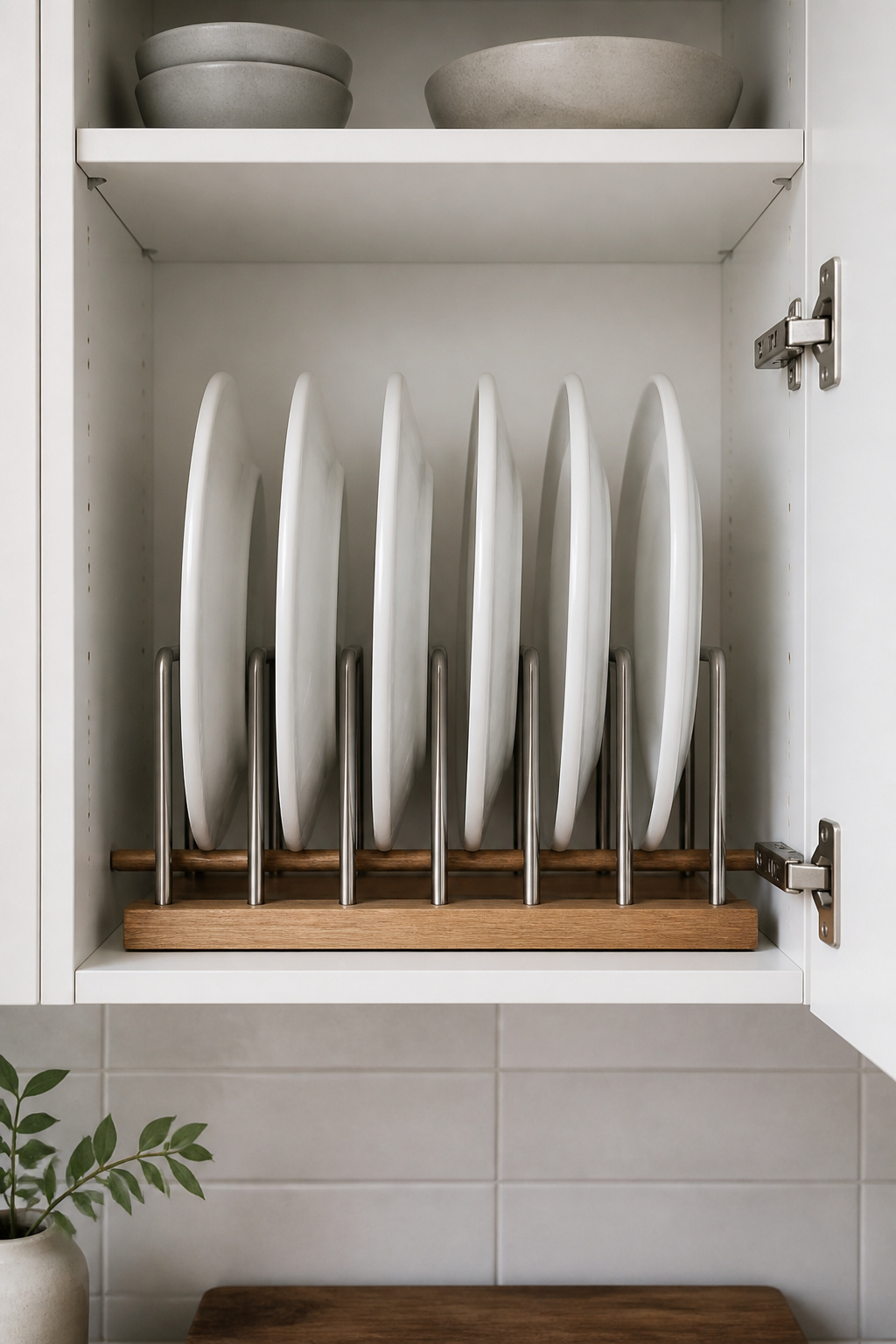
Vertical plate storage eliminates all rim-to-surface contact. Each plate stands on edge in its own slot, holds itself independently, and can be slid out without disturbing any other plate. The space requirements are modest. Allow 1.5 inches per slot — a 10-slot rack needs 15 inches of width. You need at least 12 inches of vertical clearance for standard 10-11 inch dinner plates.
Material determines how protective the rack actually is. Bare metal dividers scratch unglazed plate bottoms. Avoid them for anything ceramic or glazed. Vinyl-coated or rubber-tipped dividers are the minimum acceptable specification. The Yamazaki Tosca line (white steel with wood-accented crossbars and rubber-tipped dividers) combines genuine protection with a visual quality that works on open shelving as well as inside cabinets. Wood peg organizers look warm but need wide enough pegs to avoid creating pressure points on softer stoneware glazes. For households with a serious ceramics collection, vertical storage is non-negotiable.
8. Pegboard Pot Lid Organizers for a Sorted Kitchen Cabinet
Pot lids are, proportionally, the most disorganizing objects in a kitchen. Four lids of different diameters — 8″, 10″, 12″, 14″ are standard for most cookware sets — can’t nest neatly. They can’t stand independently. Stored inside the pots they belong to, they waste the pot interior and require lifting the whole pot to reach the lid. Stored separately without a system, they create chaos.
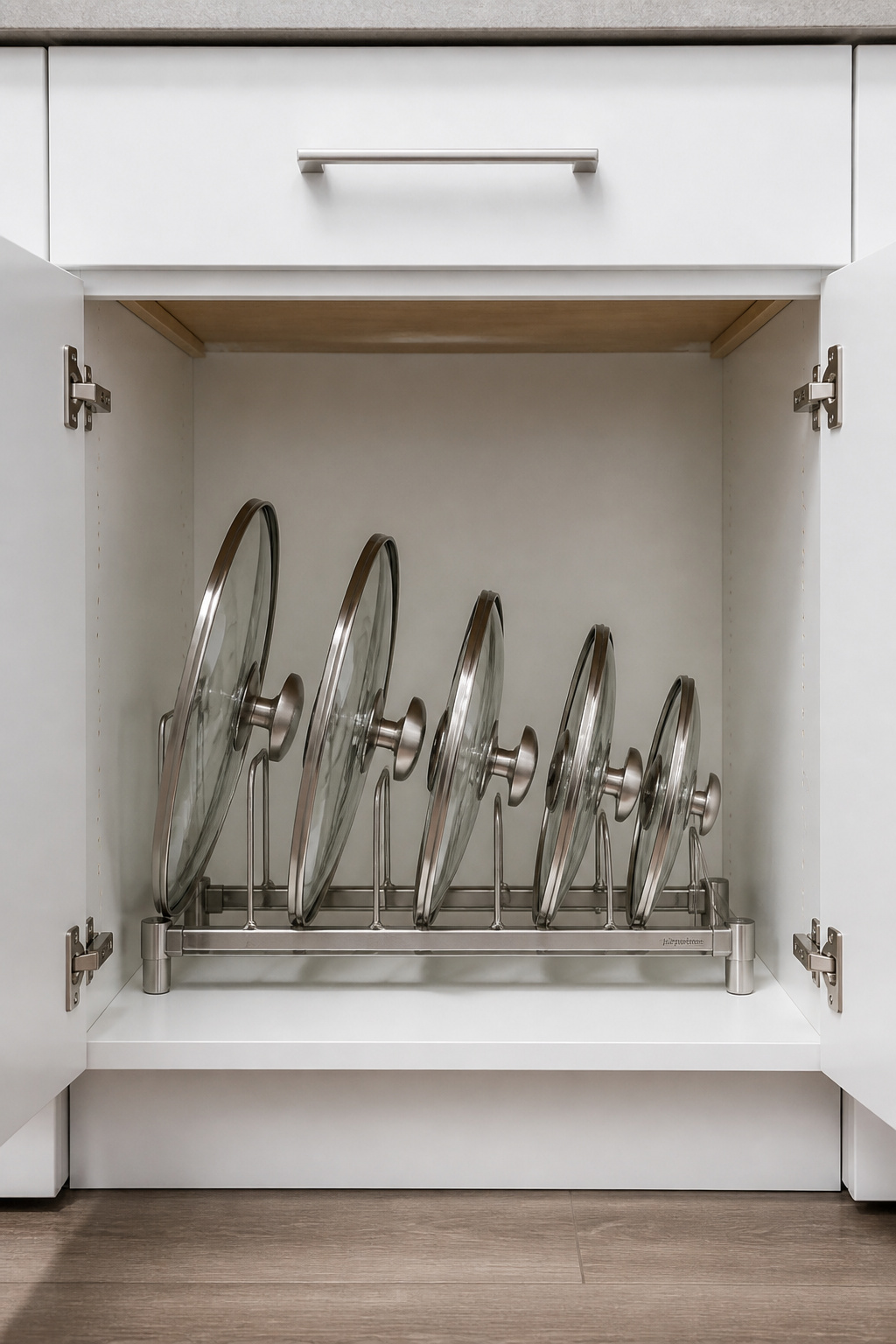
A designated lid organizer assigns each lid a fixed place. Universal organizers accommodate diameters from 6-13 inches in a single unit. That covers virtually all standard cookware.
Three format choices exist. Cabinet-door pegboard inserts mount to the door interior (typical dimensions: 5-1/4″ wide × 16-7/8″ deep × 5-3/8″ high) with lids hanging from stainless pegs. Freestanding 6-tier racks (13.7″ × 5.6″ × 2.7″) stand inside a cabinet or deep drawer. No installation required. Pull-out lid organizers mount to the cabinet floor with four screws in a 12-inch opening and slide out with the pull-out mechanism — the most accessible format, but the most permanent.
IKEA’s VARIERA takes a different approach: an adjustable stainless rail (3-3/8″ to 19-5/8″ length) that holds lids horizontally in a drawer or on a shelf. The cleaner aesthetic, and it doubles as a food container lid organizer. Whichever format you choose, arrange lids largest to smallest from bottom to top on door-mounted systems. The weight distribution keeps the door balanced on its hinges over years of daily use.
9. Pull-Out Pantry Inserts for Deep Shelf Accessibility
The deep pantry shelf creates the same problem as the deep base cabinet. A back zone that’s technically storage but practically invisible. Standard pantry shelves run 12-16 inches deep for upper sections and up to 24 inches for full-height pantries. Once depth exceeds 12 inches, items at the back stop being used consistently. People buy duplicates of things they already own because they genuinely can’t see what’s there.
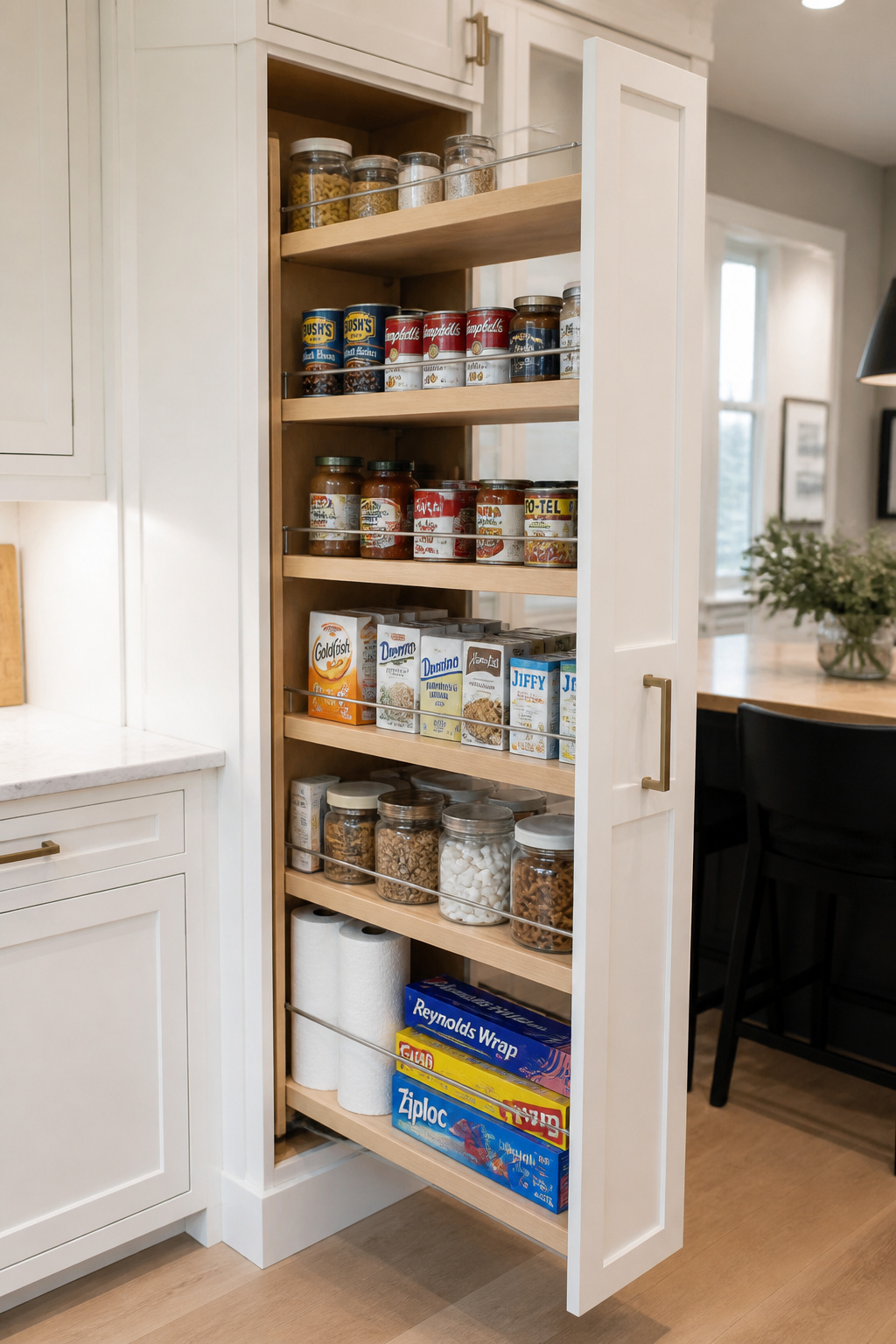
Full-extension pull-out inserts solve this with the same mechanism as base cabinet pull-outs: 3-section ball-bearing slides that expose the full shelf depth in one pull. Most pull-outs are built at 21 inches of depth. That fits the standard 24-inch pantry after accounting for 3 inches of cabinet structure. Weight capacity runs 75-100 lbs per shelf — a shelf loaded with 28 standard 15-oz cans weighs approximately 52 lbs, comfortably within range.
The Elysian 11-inch slide-out for 15-inch pantries includes wood spacers for both face-frame and frameless installation. For face-frame cabinets specifically: the frame reduces usable opening by 1.5 inches total. So a 15-inch face-frame pantry needs an 11-12-inch pull-out, not a 15-inch one. The most effective pantry setup layers two systems: a pull-out insert for the shelf depth plus a door-mounted organizer for the door face. Together they can triple the usable storage of a single pantry section. For a broader view of how kitchen cabinet organizers stack across different configurations, these smart kitchen cabinet storage ideas show a whole-kitchen perspective.
10. Tiered Can Organizers for a First-In, First-Out Pantry Cabinet
FIFO can dispensers are among the best kitchen cabinet organizers for pantry sections with canned goods. New inventory goes in the back. Older inventory comes out the front. The same principle works in a home pantry cabinet, and it solves a problem that’s surprisingly common: canned goods that expire because they got buried and forgotten.
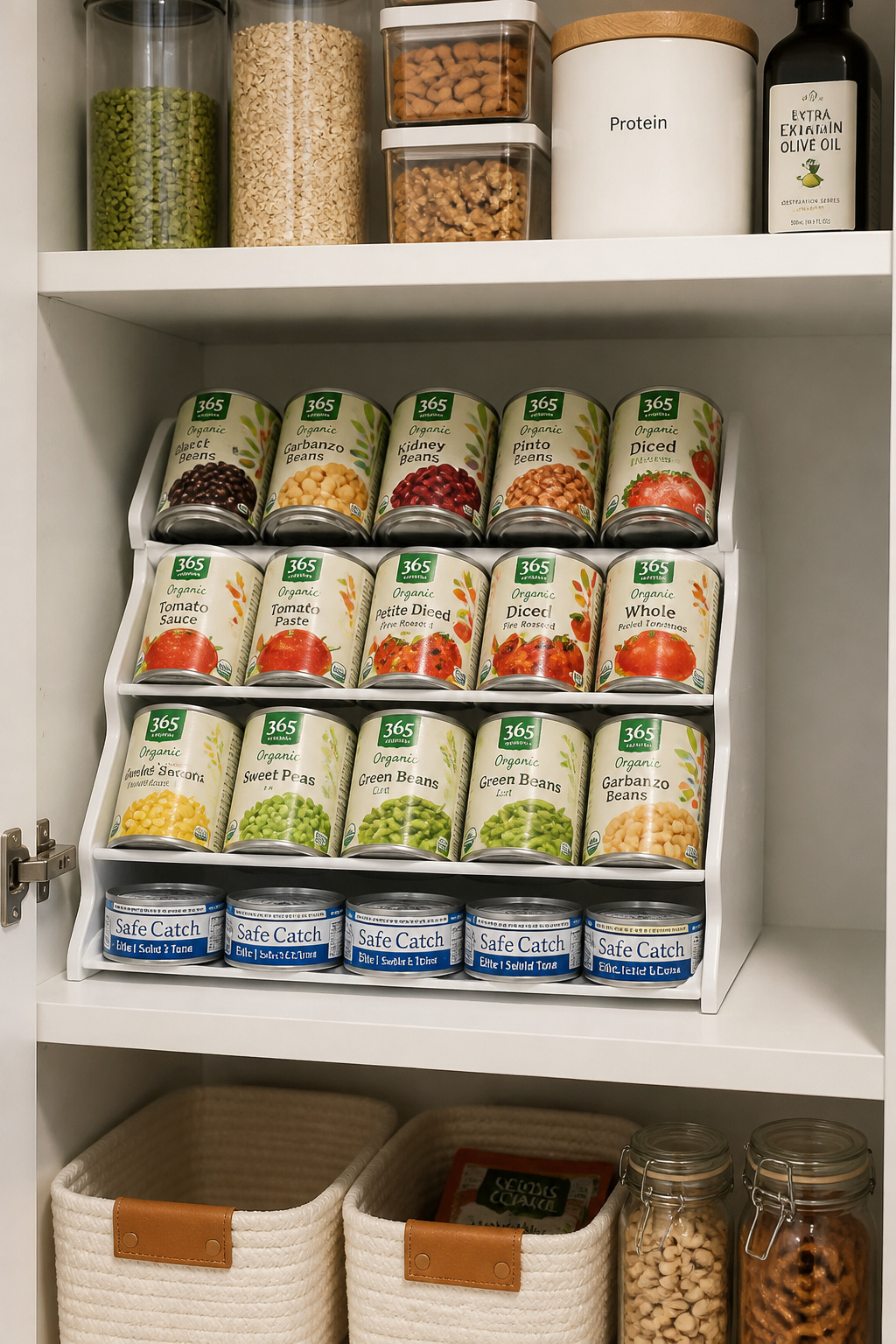
A FIFO gravity-feed can organizer loads from the back or top and dispenses from the front. When you take the front can, the one behind rolls forward automatically. You never need to rearrange cans when restocking. The oldest cans are always at the front.
Size selection depends on your cabinet dimensions. The FIFO Mini Can Tracker (12″ H × 16″ W × 16″ D) holds approximately 54 standard 10-15 oz cans. It requires at least 8 inches of cabinet height and 16 inches of shelf depth. The Mainstays 3-tier flat-shelf riser (10.75″ × 14.5″ × 10.25″) holds 27 standard cans and suits shallower cabinets. The Vrisa 7-tier (16.89″ × 12.44″ × 35.35″) works in tall pantry cabinets, holding up to 84 cans across angled tiers. The FIFO system also works for spice bottles, small juice bottles, and canned pet food — any cylindrical container of consistent diameter.
One requirement: the shelf must be level. Even a slight tilt causes cans to roll unevenly and jam in the tracks.
11. Adjustable Cutlery Trays That Fit Any Drawer Width
The fixed cutlery tray assumes all kitchens were built to the same specification. Standard trays run 13 or 15 inches wide. That fits standard drawers and leaves a gap in everything else. In older or custom kitchens, the fixed tray sits loose, shifts on every pull, and the gap between tray and drawer wall becomes a crumb collector.
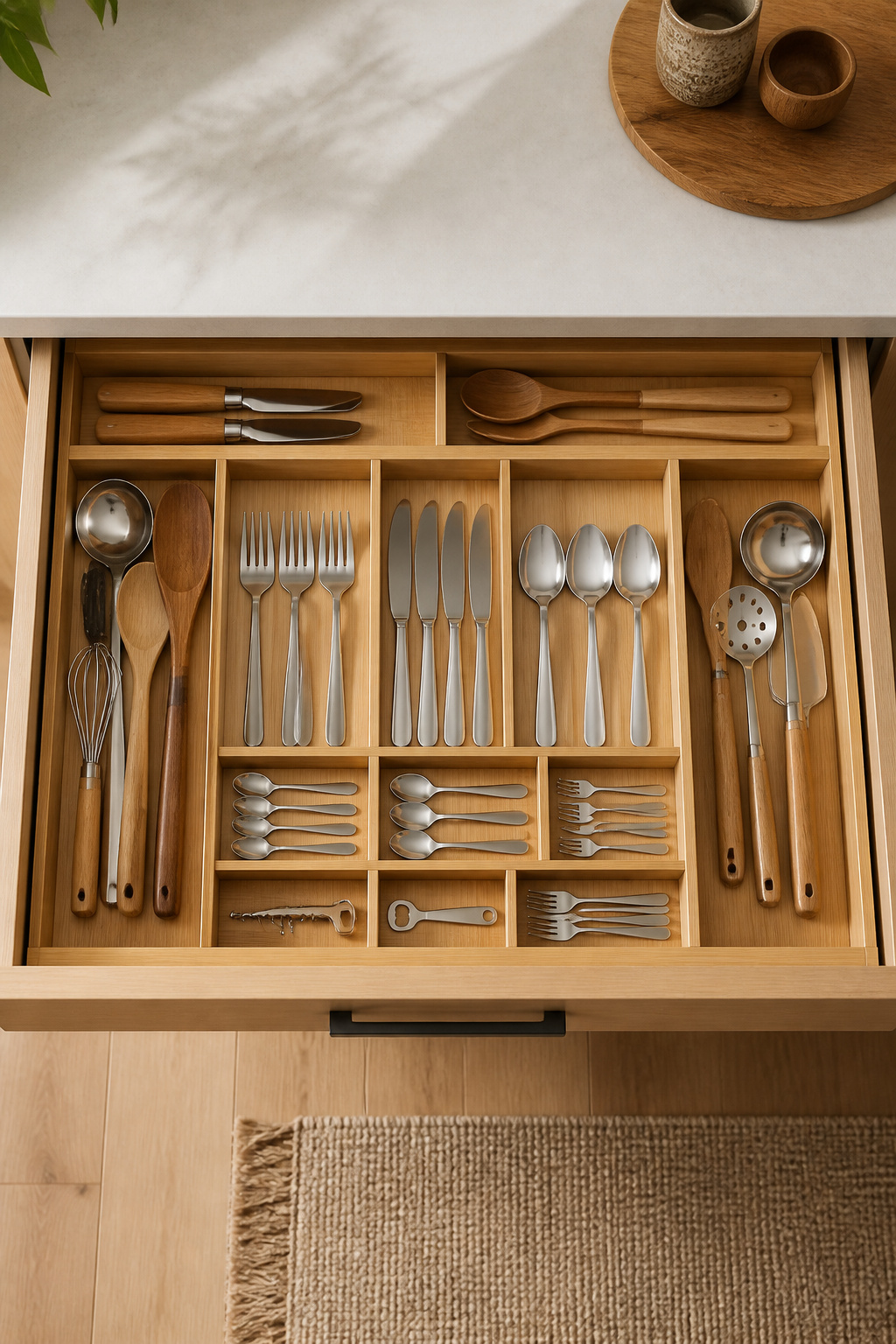
An expandable tray eliminates the gap problem. Two mechanical approaches exist. Spring-loaded (Pipishell, Lifewit): the tray expands and contracts with constant spring pressure, maintaining contact with both walls at any width. Set it once, it adapts automatically. Sliding panels (Totally Bamboo, ROYAL CRAFT WOOD): manual expansion that locks at a set width. More stable for trays you remove frequently for cleaning.
Lifewit covers 13-22.4 inches with 8 compartments — the right range for most standard kitchen drawers. KitchenEdge bamboo extends to 25 inches with 10 compartments, better for cutlery sets that include serving pieces. For wide prep drawers over 24 inches, the large bamboo magnetic-connected organizer spans 21.4-37.4 inches.
Material matters for one specific reason: moisture. Bamboo is the better aesthetic choice and handles kitchen conditions well when kept dry. But it warps if wet spoons or spatulas are placed in it regularly without drying. ABS plastic is less visually interesting but more forgiving. If utensils go directly from the dish rack to the drawer, plastic is the practical answer.
12. Over-the-Door Organizers for Every Kitchen Cabinet Door
The interior face of a cabinet door is reliably overlooked. It’s a flat surface of 80-200 square inches — depending on door height and width — that receives no use in most kitchens, even when the adjacent shelves are overcrowded. Over-door organizers require no drilling, no tools, and no permanent modification. They hook over the door top and immediately put that surface to work.
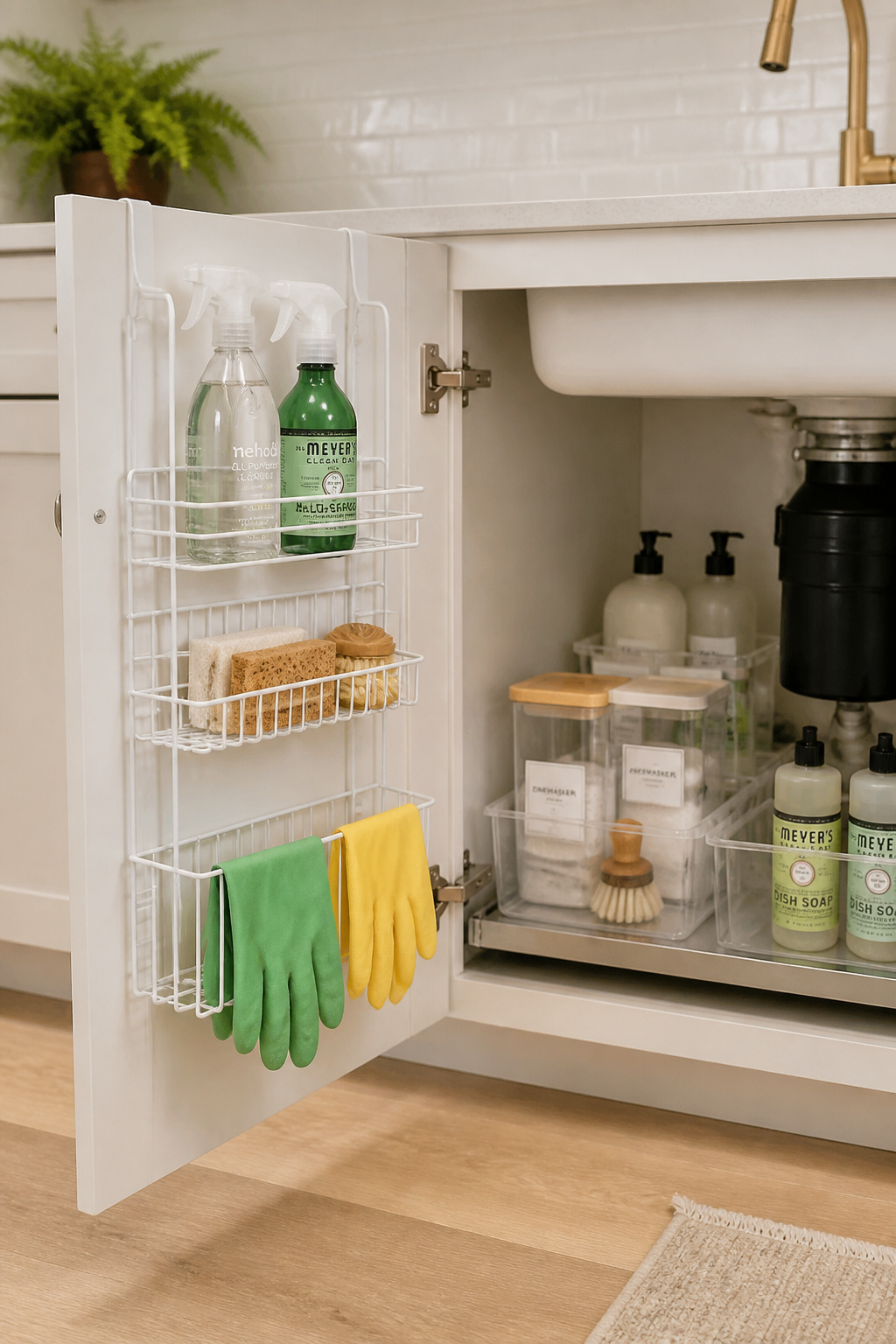
Metal wire organizers are the right choice for kitchen use. Fabric organizers absorb kitchen odors and cooking moisture. They stain and are difficult to clean. Metal wire holds cleaning spray bottles, foil boxes, and snack packets. It cleans with a wipe and doesn’t flex under the weight of heavier items.
The weight question requires honesty. Kitchen cabinet hinges handle the door weight plus approximately 10-15 lbs of additional load. Consistently exceeding this accelerates hinge wear. It produces misaligned doors within 2-3 years. Organizer listings advertise capacities of 44-80 lbs — they’re testing the organizer structure, not the door hinge. In practice, keep kitchen cabinet door loads under 8-10 lbs. Organizers with 4+ hook points distribute weight more evenly than 2-hook designs.
Best uses by location: under-sink door (cleaning sprays, sponge pouches, rubber gloves), pantry door (snack pouches, granola bars, ramen packets), and inside a spice cabinet door for lightweight oils and frequently used condiments.
13. Clear Acrylic Bins for Visible, Sorted Dry Goods
*Mieruka* — the Japanese principle of making things visible — is as practical in a kitchen pantry as in a manufacturing plant. When you can see every item in your cabinets, you know what you have. You use it before it expires. You buy what you actually need rather than duplicates of things already there.
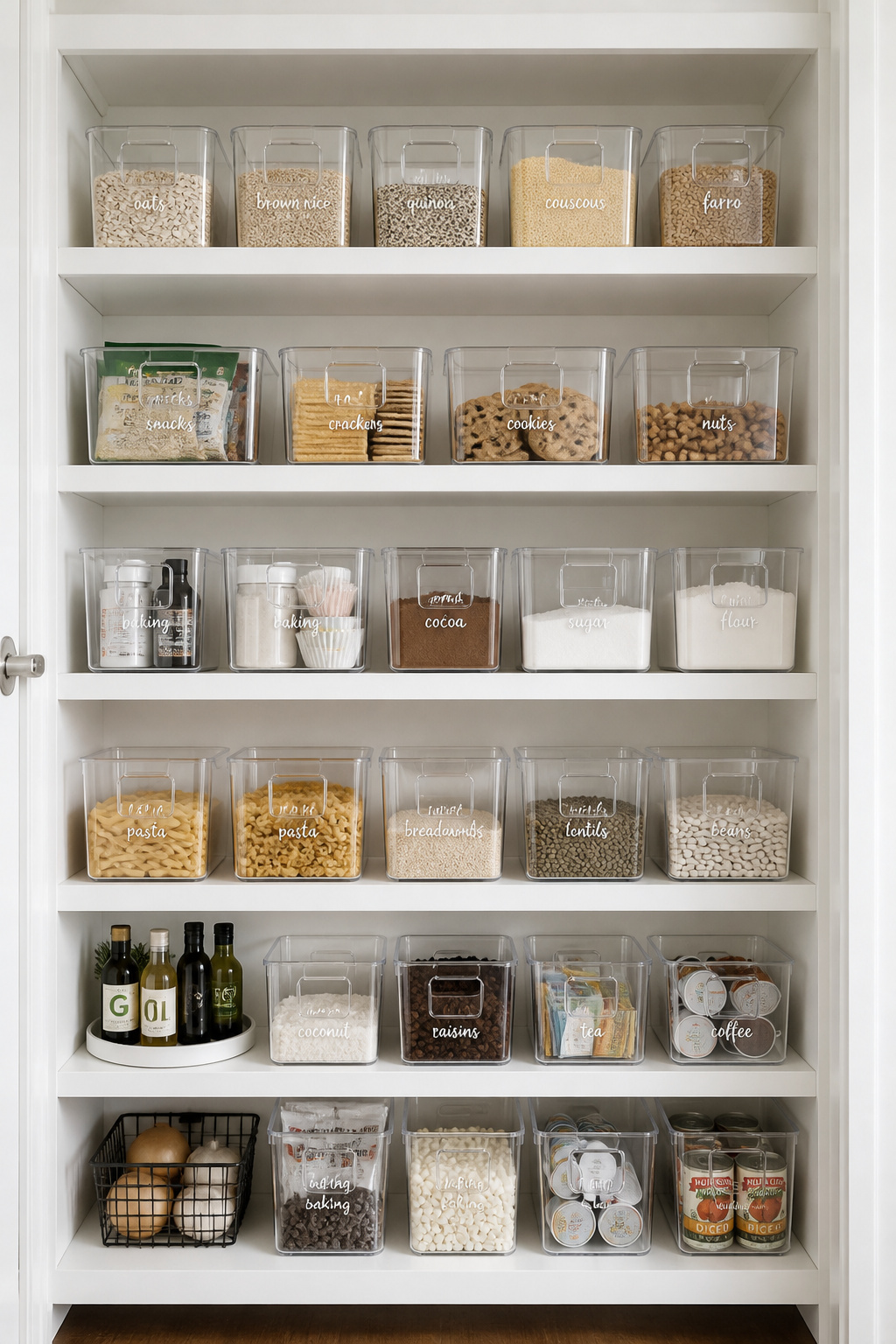
Clear storage bins apply this directly. iDesign’s BPA-free line is the most accessible benchmark: food-safe, clear plastic in multiple sizes (small: 10″×6″×3″; medium: 10″×6″×5″; Linus collection: 11″×7″×3.5″), stackable, with integrated handles that allow a one-handed pull to the shelf edge. The recycled plastic version (iDesign Eco line) uses post-consumer resin with the same food-safe certification — the better choice if material sourcing matters. These small kitchen decor ideas for calm spaces explore how visual organization principles translate into a kitchen that feels deliberately arranged.
The organizational principle is grouping by category: a large bin for grains and pasta, medium bins for baking supplies, small bins for snack pouches and packets at the front. Square and rectangular bins maximize coverage without the wasted corner gaps that round containers create. The bins don’t need labels if the contents are visible — the transparency is the point.
One measurement before ordering: the distance from the back cabinet wall to any front shelf lip. Some cabinets have a raised 1-inch lip at the shelf front. A bin that’s 10 inches deep won’t slide past it if the usable depth behind the lip is 9 inches.
14. Tension Rod Dividers for Baking Sheets and Cutting Boards
Among kitchen cabinet organizers for flat items, tension rod dividers are the most underused. The sheet you need is always at the bottom. Accessing it means removing the entire stack, extracting the one item, and replacing the rest. A 30-second ordeal that happens multiple times a week.
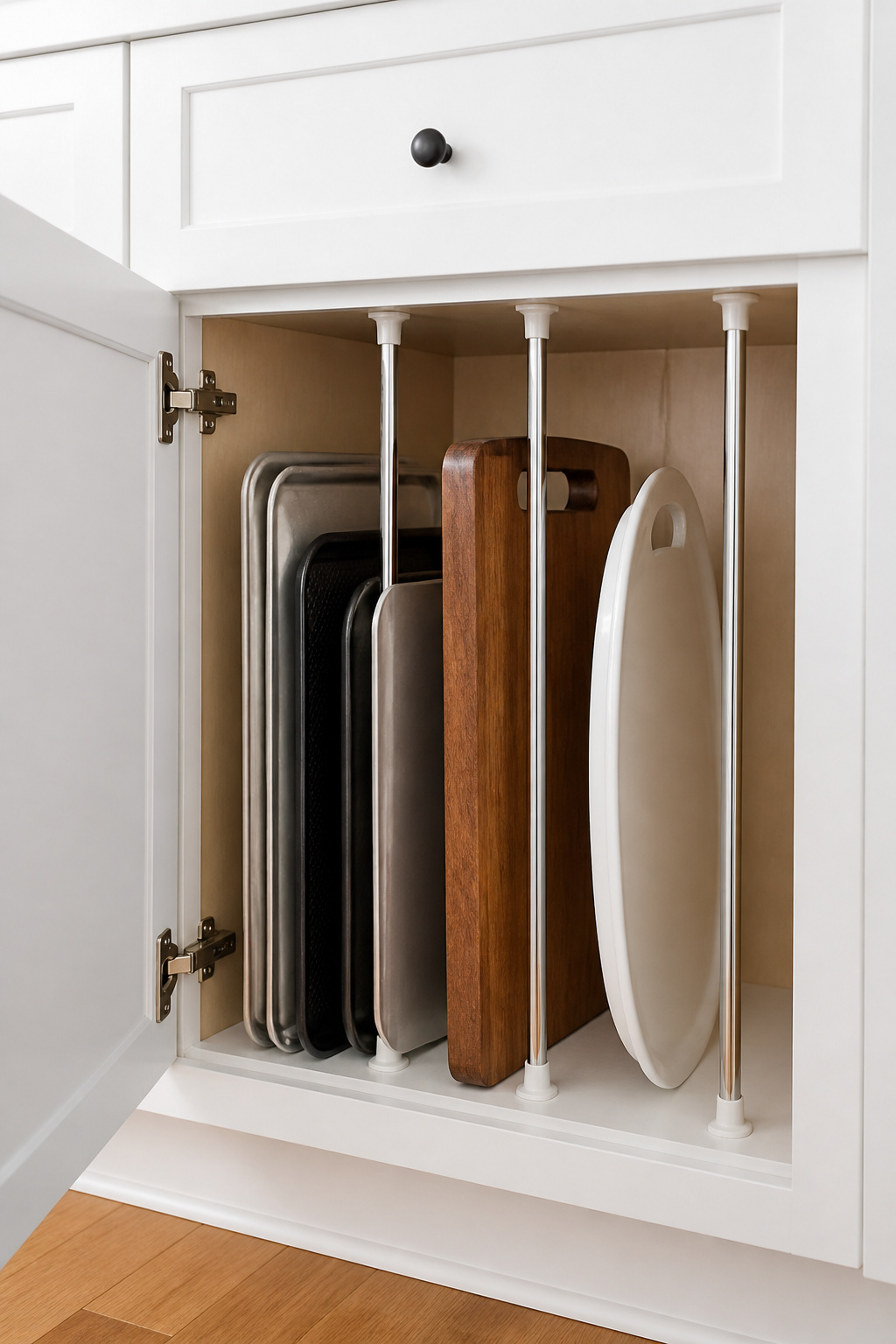
The solution costs $2-5 per rod and requires no drilling. Standard spring-loaded tension rods, installed vertically inside a base cabinet, create file-folder-style slots. Each baking sheet, cutting board, or serving platter stands upright. Any single item can be retrieved without disturbing the others.
Installation: extend the rod to approximately 0.5 inches taller than the cabinet interior height, compress the spring as you position it vertically, then twist to lock. The rod holds by pressure alone. Fully reversible, no damage. Spacing rods 2-4 inches apart customizes the slot widths: 2-inch spacing for thin cutting boards, 4-5 inches for baking sheets with handles or muffin tins.
A set of three rods creates two slots and costs $6-15 total. That’s less than most single-purpose organizers. As kitchen organizers cabinet solutions go, this is the highest-ROI option on the entire list — a minimal investment that solves a genuinely annoying daily problem.
15. Magnetic Knife Strips Mounted Inside Cabinet Doors
A knife block occupies 6-10 inches of counter width and collects crumbs inside its slots — slots that are difficult to clean properly. A magnetic strip mounted on the inside of an upper cabinet door takes up zero counter space. It’s easier to clean. It holds blades without any contact against a surface other than the smooth magnet face.
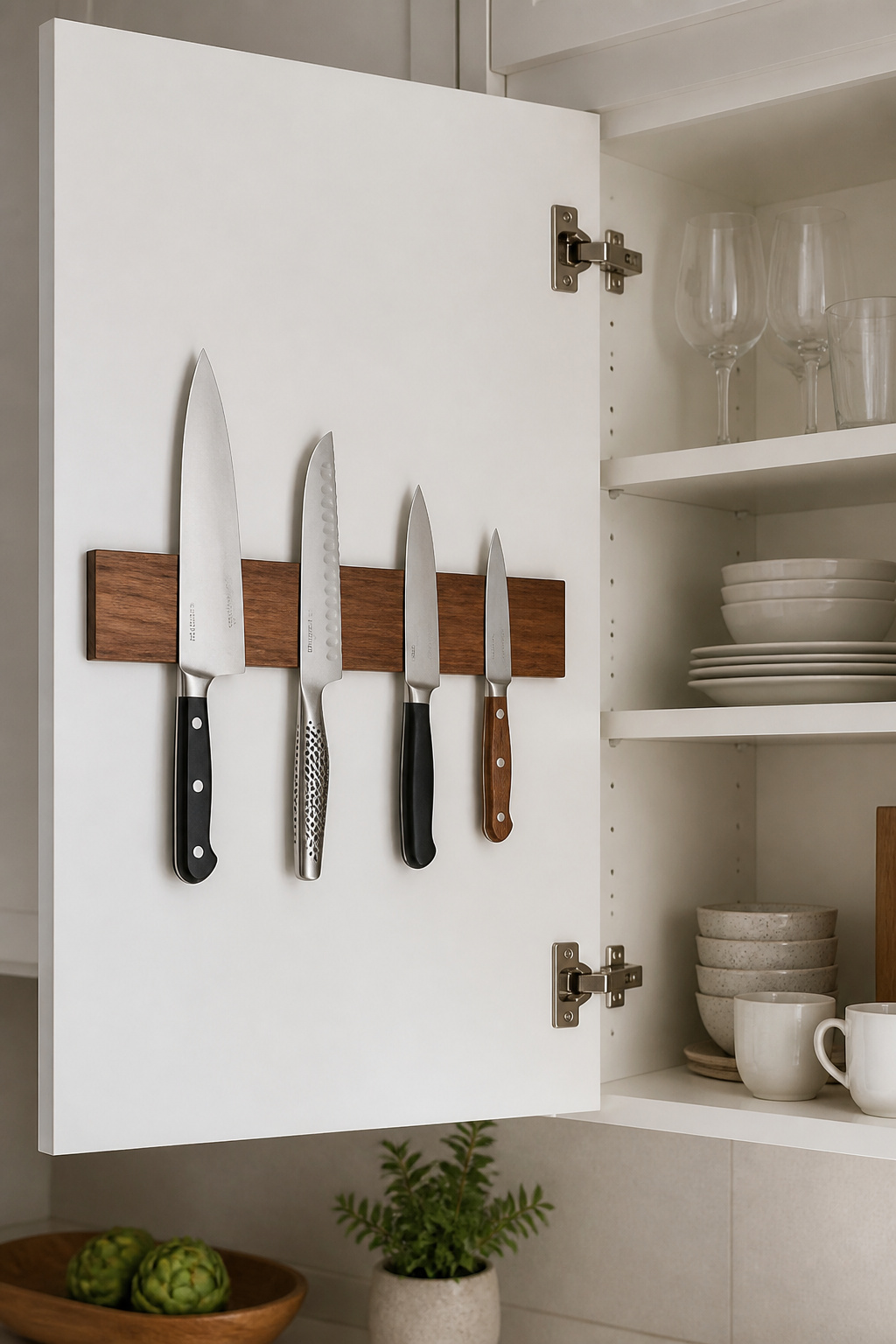
The inside-door position is also the safer option in households with children. The knives are behind a closed door rather than displayed on a backsplash. A cabinet door requires deliberate opening before access — a meaningful barrier compared to a strip at grabbing height on a wall.
Magnet quality is the only specification that genuinely matters. Neodymium magnets retain more than 95% of their field strength after 10 years. They demagnetize only above 176°F or on direct physical impact. Neither condition arises in normal cabinet use. The minimum acceptable specification: nickel-plated neodymium, at least 0.25 inches thick, pull force of 12 lbs or more per knife position. Consumer-grade ceramic magnets lose grip within 6 months of daily use. Aluminum-backed versions flex and eventually peel.
Mounting on a cabinet door interior: center the strip vertically, position it 3 inches from the hinge side, and use two #6 × 3/4-inch screws plus industrial-strength tape if the door is particleboard. Always place blades with the spine outward. The edge should never be the first surface a hand contacts when reaching inside.
16. Drawer Peg Systems for Modular Pot and Pan Organization
Drawer peg systems stand apart from other kitchen cabinet organizers because they adapt as your cookware collection changes. A kitchen accumulates pots and pans of different diameters, depths, and weights over years. Fixed-slot organizers become obsolete the moment the collection changes. A new pan with a different diameter doesn’t fit the existing slots. The whole system needs rethinking.
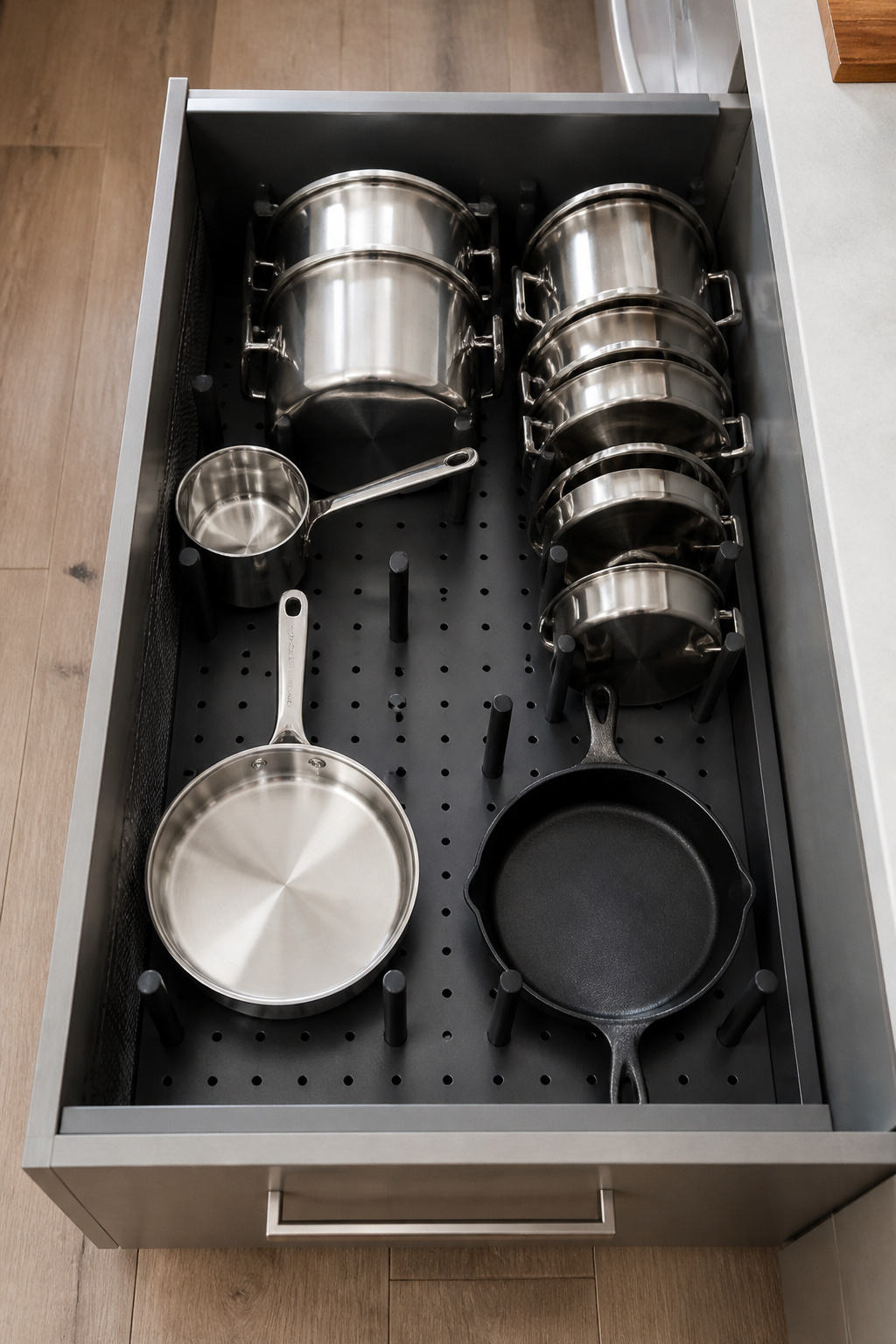
A peg-and-board system adapts to whatever the collection currently is. IKEA’s UPPDATERA (24″ and 30″ versions, 24-32 repositionable pegs) is the most accessible option. The flat grid base holds pegs that slot into any position on the grid. The pegs stand 5-3/8″ from the base — sufficient to support and separate almost any pan except the tallest stockpot. Rearranging for a new piece of cookware takes two minutes. These kitchen remodeling ideas for a more organized space include larger-scale approaches for kitchens being renovated rather than incrementally optimized.
Before purchasing: measure the drawer’s internal dimensions and — critically — the internal height. The drawer must close with the largest pan resting on its base between pegs. Most kitchen deep-drawer cabinets are 8-12 inches internally. The 5-3/8-inch peg height leaves 2-6 inches of clearance. That covers almost all configurations except unusually tall stockpots.
One detail worth attending to: the UPPDATERA grid is anthracite-coated steel. Place a thin felt drawer mat below the peg board to prevent the grid pattern from marking enamel-coated pan bases. For cast iron or stainless steel pans, this is unnecessary. For Dutch ovens and enamel-coated pieces, it matters.
17. Pull-Out Trash and Recycling Bins for Base Kitchen Cabinets
A standard 13-gallon freestanding bin occupies roughly 12 × 12 inches of kitchen floor space. In a small kitchen, that footprint competes with appliances, chairs, and movement. A cabinet-integrated pull-out bin uses cabinet interior space that was otherwise dead — behind a closed door, contributing nothing — and eliminates the floor footprint entirely.
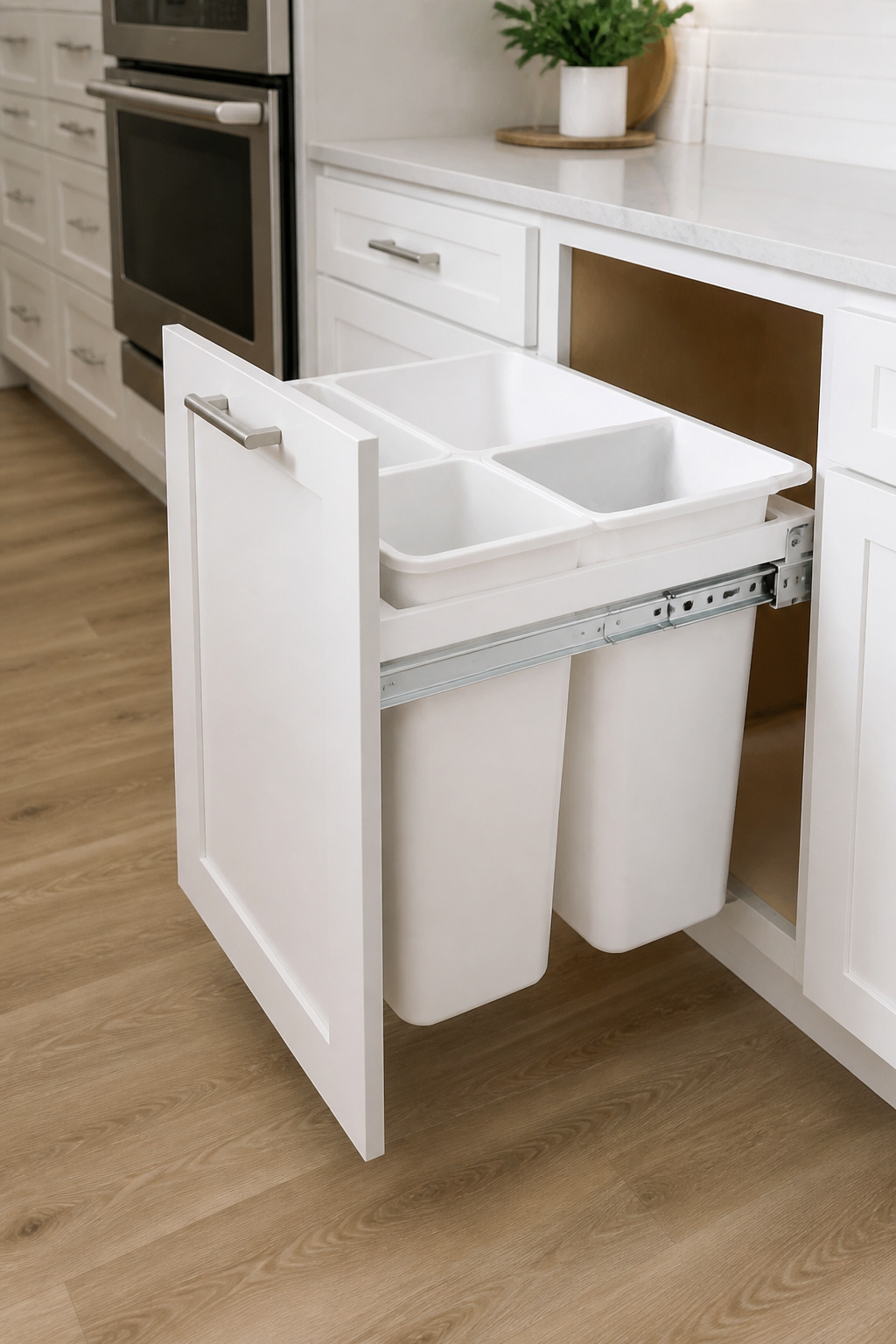
Rev-A-Shelf’s 4WCSC series (2 × 35 qt, Blum BLUMOTION soft-close slides) is the standard: minimum cabinet opening 15″ W × 20-5/8″ H, designed for standard 18-inch base cabinets. Hafele’s MX Matrix double-bin (2 × 36 qt, 80 lb load capacity) needs a 14-3/4″ face-frame or 15-1/2″ frameless opening — one of the strongest and most compact profiles available.
Volume sizing follows household waste patterns. A 20 qt single bin suits 1-2 person households who take recycling out frequently. A 35 qt side-by-side pair covers most 2-4 person kitchens. The 52-70 qt dual configuration suits households that sort waste at the point of disposal — separating recycling from general waste in the same cabinet.
Soft-close slides are worth the premium. In a kitchen where the bin is opened 5-10 times daily, the alternative — the door slamming against the bin, the bin jarring open on impact — adds up over years. Install with the same face-frame awareness as any other pull-out: measure the actual opening, not the nominal cabinet size.
How to Choose the Right Kitchen Cabinet Organizers for Your Space
The most common failure when choosing kitchen cabinet organizers is starting with the most visible cabinet rather than the one causing the most daily friction. The cabinet above the refrigerator, pristinely organized, produces exactly zero improvement in the cooking experience. The pots-and-lids cabinet that causes a small act of frustration three times a day — that’s where the ROI is.
Start there. Identify the two or three cabinet interactions per day that create friction: the reach past things to find one item, the avalanche when you open the wrong door, the ten seconds spent reorganizing a shelf before you can use it. Those friction points map directly to the kitchen cabinet organizer types in this list.
Then measure before you buy. The four numbers that prevent every return: internal cabinet width, internal depth (front of back wall to the inside of the door), shelf height (shelf-to-shelf, not cabinet to ceiling), and shelf thickness. For any door-mounted solution, add a fifth: the clearance gap between the closed door interior and the nearest shelf edge. For pull-outs, confirm whether cabinets are face-frame or frameless. The 3/4-inch difference on each side is enough to make a product that should fit not fit at all.
None of these systems require a kitchen renovation. They work with the space that exists. The goal isn’t a perfect kitchen — it’s a kitchen where every cabinet opens without friction and every item is exactly where you expect it to be.