Watch what happens when guests arrive at a dinner party. They drift past the living room, ignore the dining table until food appears, and end up exactly where the cook is. The kitchen becomes the party — and the bar is where everyone gravitates. The spot where conversations overlap the sound of chopping, where the boundary between host and guest dissolves completely.
Kitchen bar designs have matured well beyond the breakfast nook or the casual overhang bolted to an island. The best kitchen bar designs are considered architectural moments — a material statement, a lighting decision, a seating choice that collectively define how a kitchen feels to inhabit. Whether you’re working with a grand open-plan space or a compact galley, there’s a kitchen bar design here that transforms the space into something worth gathering around.
Here are fifteen distinct kitchen bar designs, from the sculptural drama of a waterfall-edge slab to the quiet authority of a Japandi oak counter, with honest notes on materials, dimensions, and the practical details that make or break each one.
1. Open-Plan Kitchen Bar Design with a Waterfall Countertop
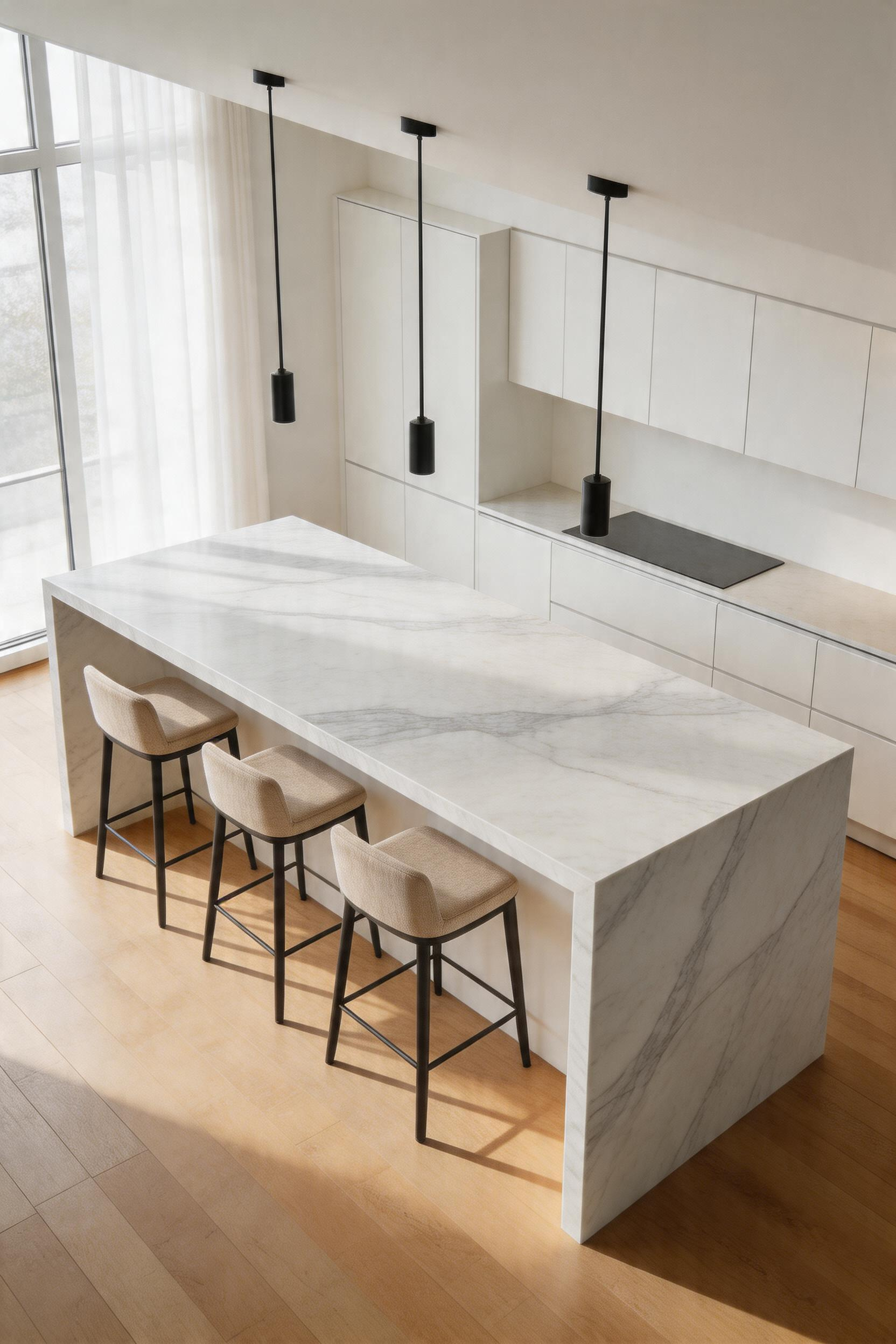
There’s a reason waterfall countertops have held their ground through multiple design cycles: when a slab cascades from the horizontal surface down the full vertical side of a peninsula, the counter stops being furniture and becomes architecture. It’s a kitchen bar design that earns its cost premium in sheer visual authority.
Material Choices
Quartz is the material most designers reach for first. Non-porous, scratch-resistant, and available in a colour range from bleached white to deep anthracite, engineered quartz requires no annual sealing and handles the daily demands of a busy kitchen without complaint. Waterfall quartz installations run approximately $85–$150 per square foot installed, including mitered edge work. Expect 20–50% above a standard countertop quote for the additional slab material and fabrication complexity.
Marble is the prestige choice — Calacatta or Carrara white with characteristic veining — but it chips at unsupported edges more readily than engineered stone, requires resealing every six to twelve months, and needs pH-neutral cleaning products only. For a bar surface where wine glasses and acidic spills are inevitable, factor in that maintenance commitment. Sintered stone (Dekton, Neolith) sits between the two: natural stone aesthetics with near-zero porosity and no sealing required.
Sizing Notes
Standard bar overhang for comfortable seating sits at 12–15 inches from the cabinet face to the counter edge. Anything over 12 inches in stone needs steel corbel brackets for structural support. For a waterfall design, keep the overhang consistent with the waterfall panel thickness to maintain the clean visual line — this sometimes means a slightly reduced overhang of 10–12 inches.
If you’re deciding between countertop materials for a white-cabinet kitchen, the kitchen countertops with white cabinets considerations apply directly to bar surfaces as well.
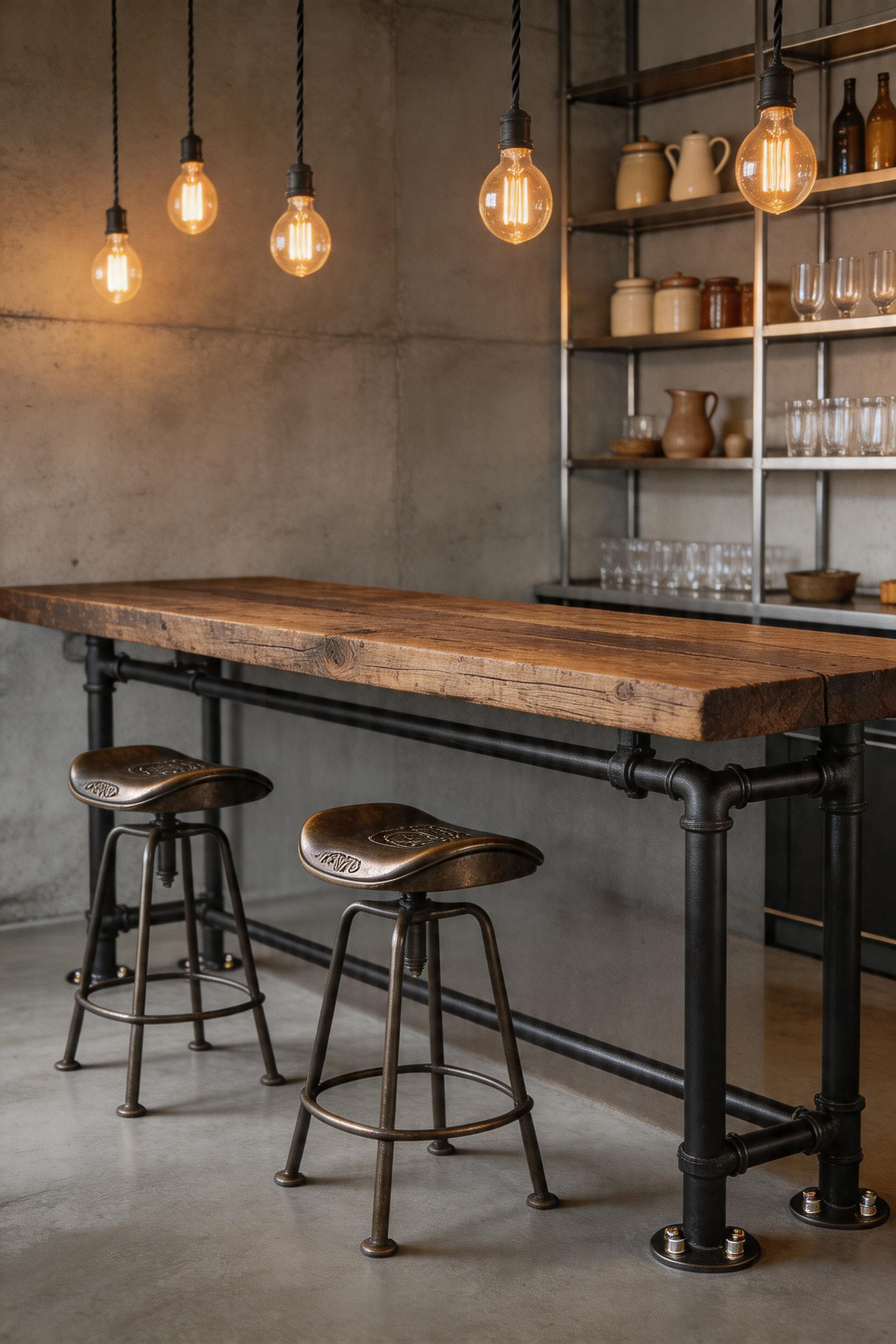
2. Industrial Pipe Shelving Bar Counter with Reclaimed Wood
There’s a particular quality in a bar top that carries its history in the wood grain — the marks left by a previous life in a barn or factory floor. Reclaimed wood does something no new material can: it arrives already worn-in, and looks better for it.
Sourcing and Treating Reclaimed Wood
The industrial pipe shelving bar pairs organic reclaimed timber with the structural vocabulary of black iron pipes and flanges. Source reclaimed wood bar tops from architectural salvage yards, specialist suppliers, or small-batch makers on Etsy who sell live-edge and barn-wood pieces. After sourcing, the critical step: clean the wood thoroughly, have it checked for insect activity, then seal with a food-safe penetrating finish. Waterlox Original is a popular kitchen surface choice because it penetrates rather than coating, preserving the wood’s tactile warmth while providing real protection against moisture and oils.
Black iron pipe hardware kits are available from Simplified Building and most hardware suppliers. A basic frame for a six-foot bar counter runs $150–$300. For stools, keep to the vocabulary: saddle stools in stamped metal or simple tube-frame designs with thin seat cushions. Fully upholstered stools soften the industrial edge too much. A 12–15 inch overhang on the reclaimed bar top provides knee clearance without requiring complex bracketing.
Pro Tip
Skipping the sealing step is the most common and most costly mistake with reclaimed wood kitchen bar designs — in a kitchen environment, unsealed wood absorbs cooking oils, moisture, and food stains within weeks.
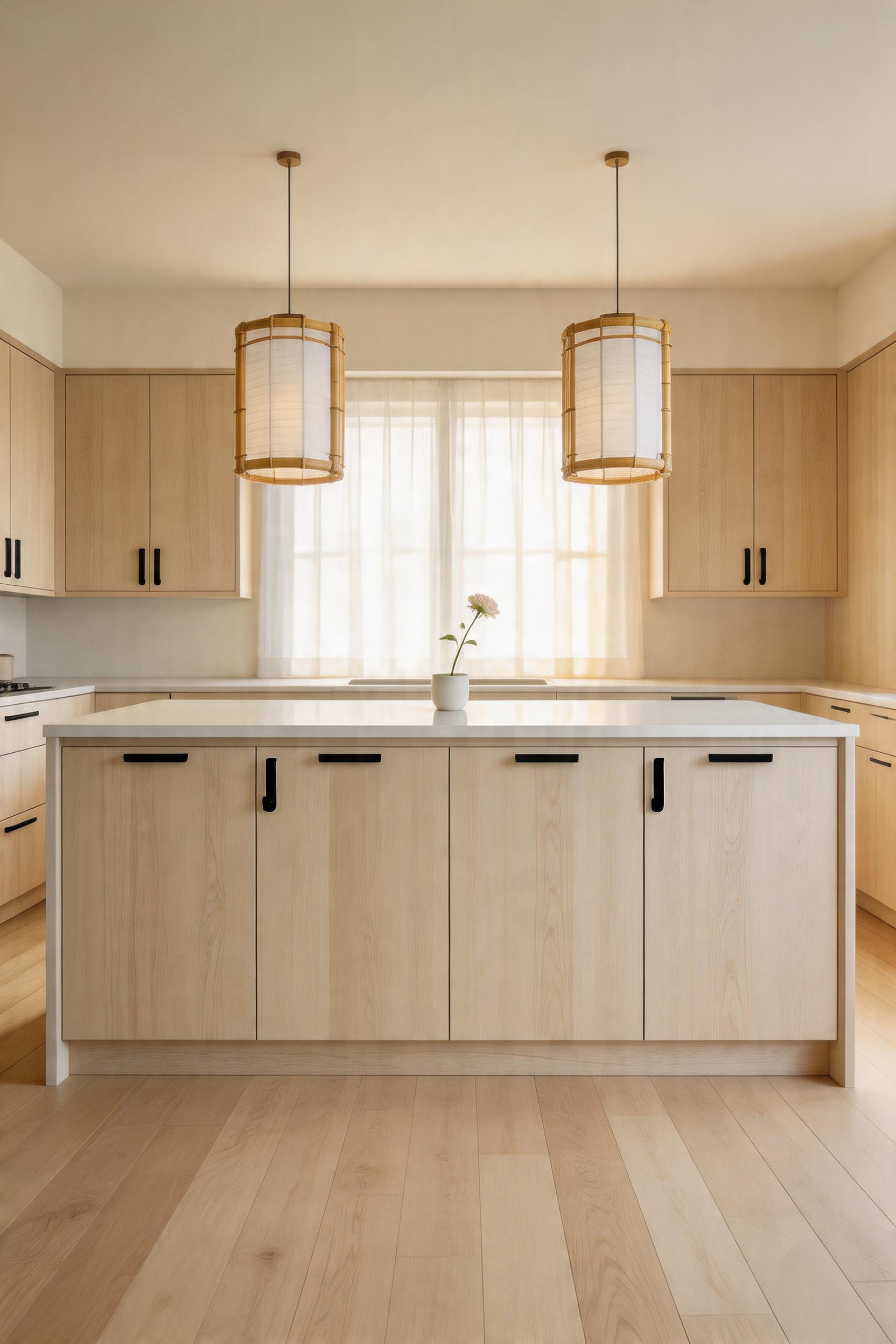
3. Japandi Kitchen Bar Design: Minimal Lines, Maximum Serenity
Japandi is often described as “minimalism with warmth,” which is accurate but incomplete. More precisely, it’s the convergence of Japanese wabi-sabi’s embrace of imperfection and transience with Scandinavian hygge’s prioritisation of comfort — and applied to kitchen bar designs, it produces a space that feels genuinely calming rather than merely tidy.
The Material Palette
The foundation of a Japandi kitchen bar design is rift-cut white oak cabinetry with a satin-oil finish. Rift-cutting produces straight, consistent grain without decorative figuring — the board reads as quiet, not showy. Pair it with matte black finger pulls or J-profile handles (no chrome, no brass) and a honed white or warm linen quartz counter. Matte throughout is the rule: matte paint, satin-oiled wood, matte black hardware. Glossy surfaces introduce a contemporary energy that disrupts Japandi’s underlying calm.
For pendant lighting above the bar, reach for natural materials — washi paper shades, bamboo, or simple matte black metal cones. Warm filament bulbs (2700K) are essential; cool-white LEDs strip the wood tones of their warmth.
Achieving Balance Without Sterility
The trap in Japandi kitchen bar designs is over-editing to the point of coldness. The antidote is deliberate layering in accessories: a small ceramic pot at one end, a linen runner along the surface, a single stem in a simple vase. These aren’t decoration — they’re the difference between a showroom and a lived-in home. Good kitchen storage organisation thinking underlies the best Japandi kitchens: everything present has a reason to be there.
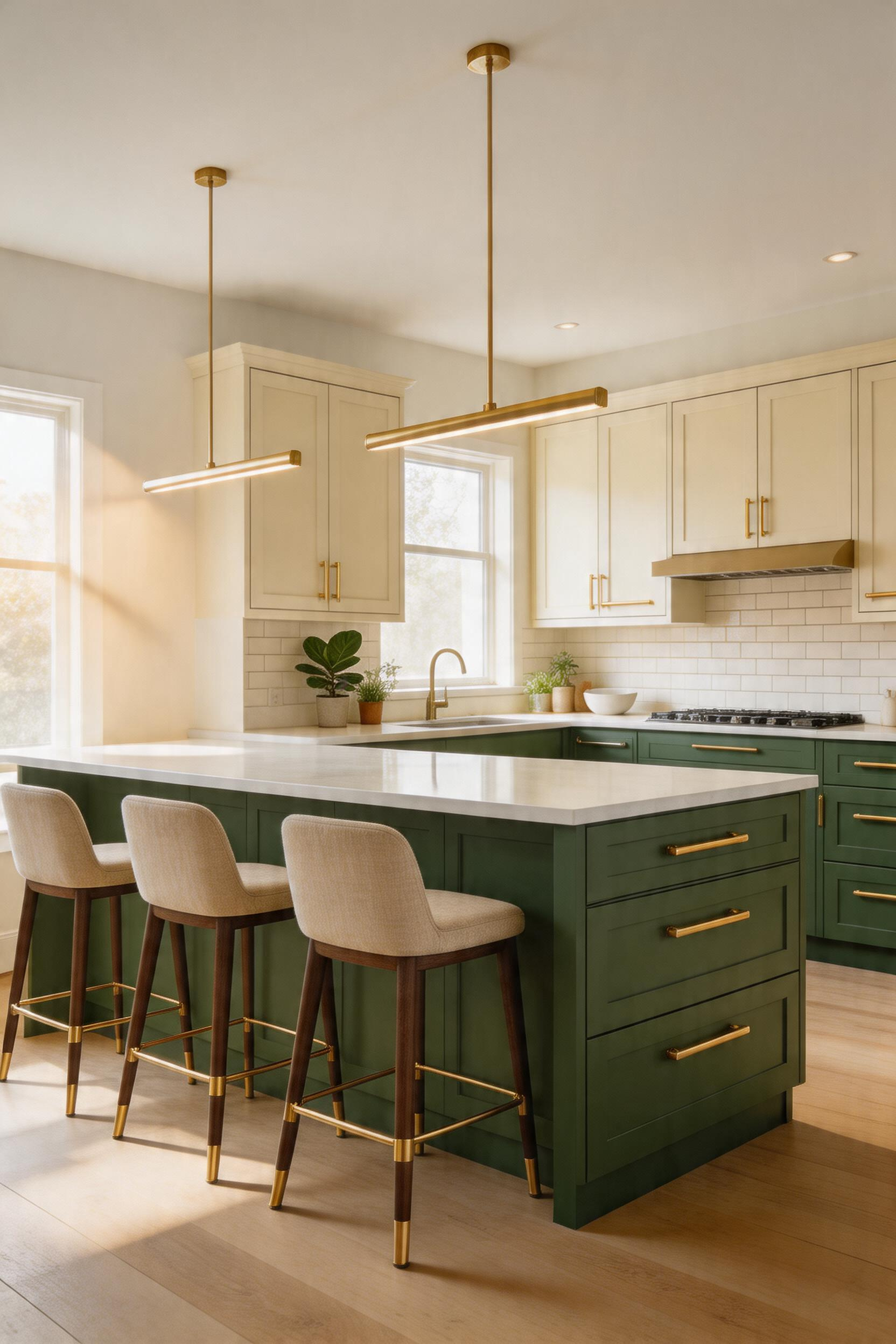
4. Two-Tone Cabinetry Bar with Contrasting Island Stools
Two-tone cabinetry has a logic to it: lighter tones above keep the kitchen open and bright; a bolder, more saturated colour at the base anchors the design without closing the space down. Applied specifically to a kitchen bar peninsula, this colour-blocking strategy does double duty — it differentiates the bar zone from surrounding cabinetry and creates a focal point that earns its colour choice.
Colour Combinations That Work
For 2025, forest green lower cabinets with cream or warm-white uppers is among the most popular two-tone kitchen bar designs, particularly with brass hardware. Forest green against cream has a botanical warmth — the three elements (green, cream, brass) share a natural quality that doesn’t date the way a trendier combination might. Navy and white remains the more graphic, less trend-dependent option. Avoid pairing two equally saturated mid-tones: one colour must clearly read as lighter or more neutral than the other.
Stool Coordination
Bar stool upholstery should contrast with the base cabinet colour, not match it. With a deep navy or forest green bar, stools in natural linen, warm cream boucle, or caramel leather prevent the bar area from reading as a heavy mass. If the hardware is brass, a stool with brass-accented metal legs carries the detail through without being literal.
Test paint samples on full door panels in the actual kitchen light before ordering. Two-tone colour combinations shift dramatically between a paint chip under shop lighting and a real door surface in home conditions.
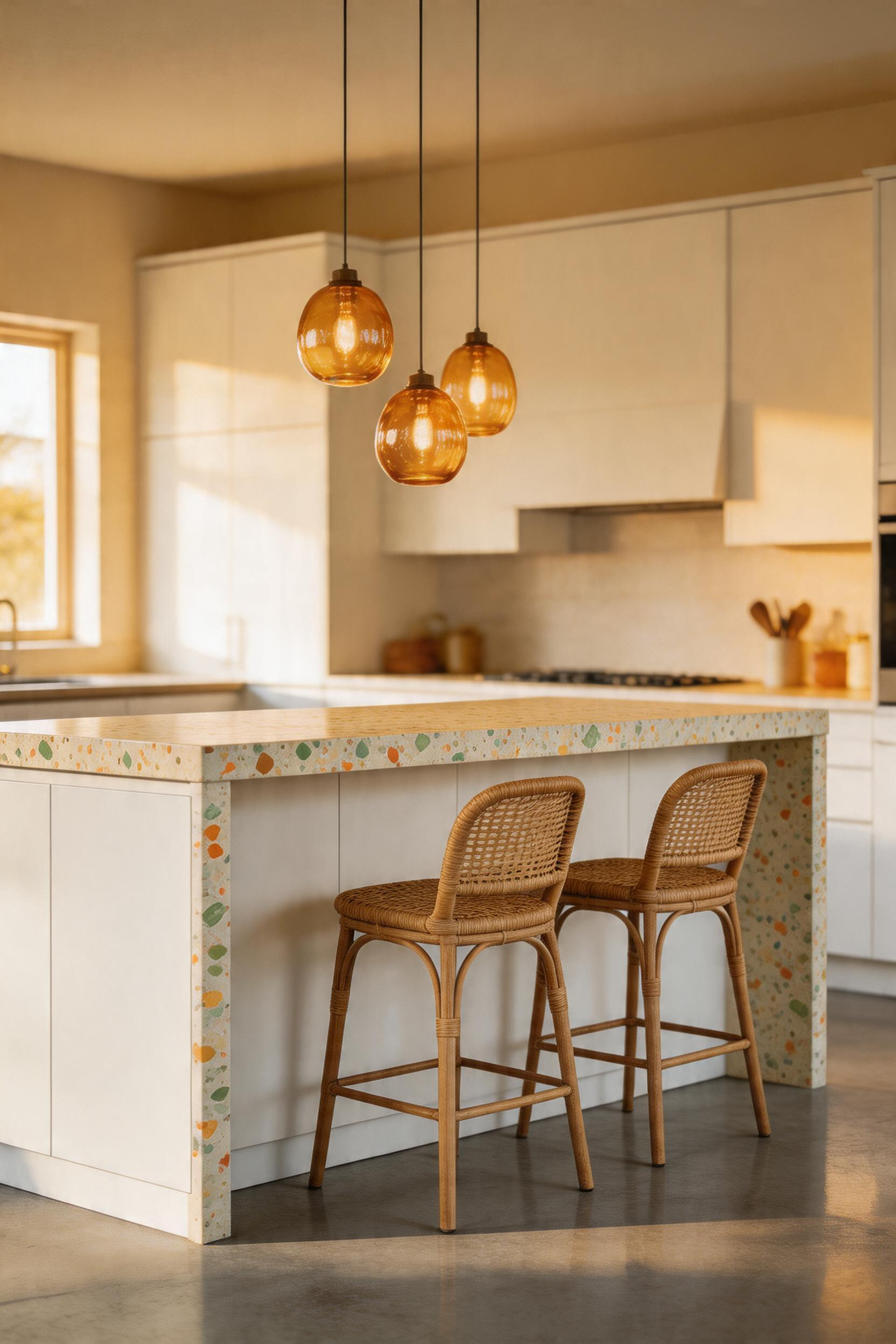
5. Terrazzo Countertop Bar with Sculptural Pendant Lights
Terrazzo has completed one of interior design’s more satisfying full cycles — from Venetian mosaic floors and mid-century heyday, through a long period out of favour, to its current position as one of the most sought-after kitchen bar designs. The appeal is clear: no two terrazzo surfaces are identical, bringing an artisanal quality that mass-produced materials simply lack.
Slab vs Tile: The Cost Reality
Terrazzo slab countertops cost $40–$75 per square foot with installation adding approximately $6/sqft. Terrazzo tile offers the same aesthetic at 30–80% less than slab, making it an excellent option for the bar’s front face or backsplash surround — as distinct from the counter surface itself, where slab continuity looks stronger. Neither option is DIY-appropriate: the material is heavy, installation tolerances are tight, and a poor install produces chips and cracks that are expensive to fix.
Pendant Lighting
The material’s natural richness pairs best with pendants that have strong, simple forms: handblown glass in amber or smoke tones, rough-cast concrete pendants, or sculptural ceramic pieces. Pendants should hang 30–36 inches above the bar surface; for a cluster arrangement, stagger two or three pendants at slightly different heights (30, 34, and 38 inches) for an organic result. Warm-toned bulbs (2700–3000K) bring out terrazzo’s warm aggregate tones; cool white flattens the surface.
6. Kitchen Bar Counter in Warm Walnut and Brushed Brass
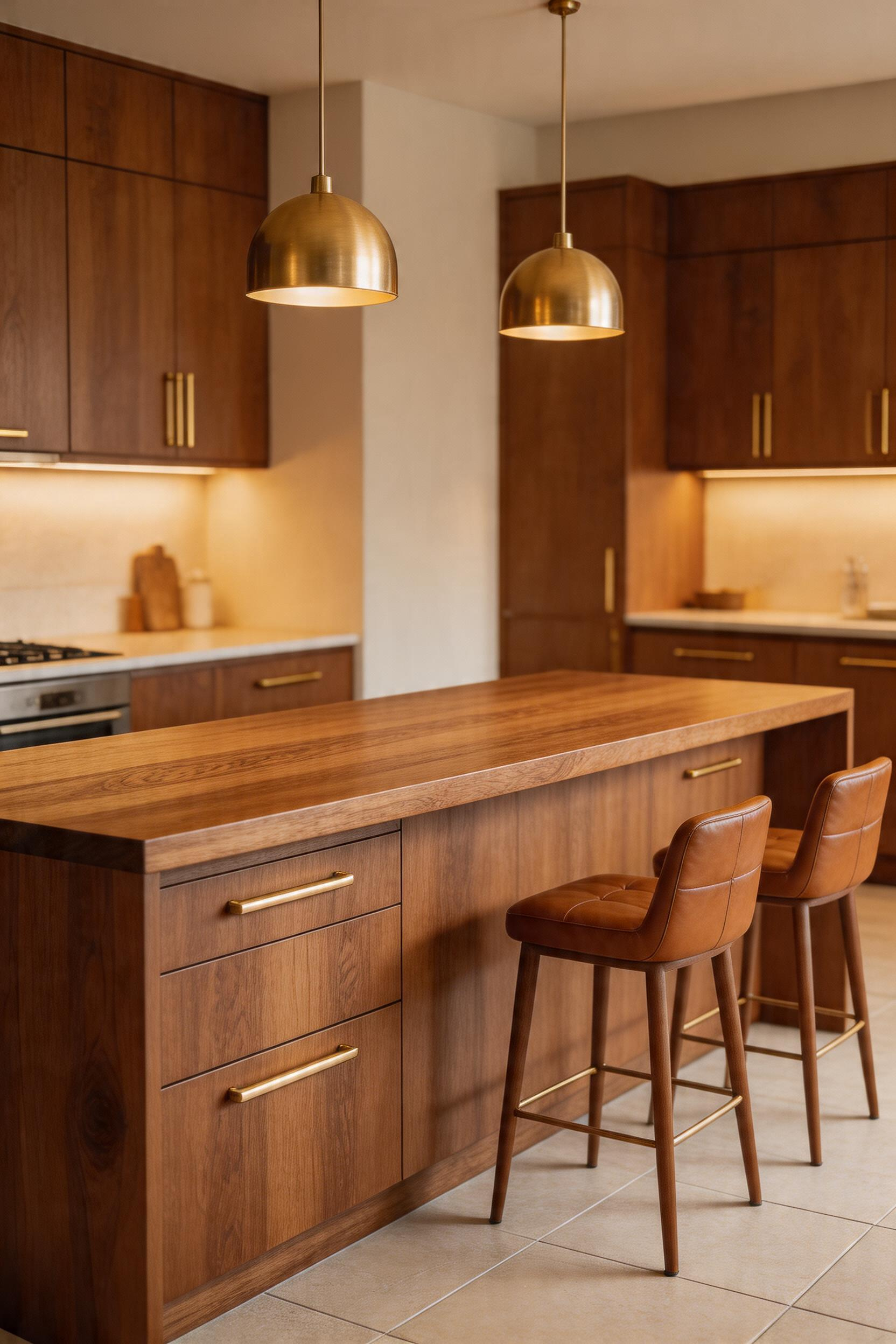
There are combinations in design that feel inevitable in retrospect — that seem to have been noticed rather than invented. Walnut and brushed brass is one of them. The wood’s brown-red warmth and the metal’s gold-ochre glow share an underlying quality that makes this kitchen bar design feel both comfortable and deeply considered.
Solid vs Veneer
Solid walnut bar tops run approximately $60–$120 per square foot depending on grade and thickness — they can be sanded and refinished over decades. Walnut veneer over quality plywood is 30–40% less expensive and more dimensionally stable in kitchen environments, with less movement from temperature and humidity changes. For a bar that will receive daily use, veneer over quality plywood is a defensible choice. For a centrepiece kitchen bar counter you intend to keep for 30 years, solid walnut is worth the premium.
Seal solid walnut with a penetrating oil — Danish oil or Rubio Monocoat — not a surface lacquer. Penetrating oils preserve the wood’s tactile warmth and natural texture; surface coatings create a sealed-in appearance that loses the quality that makes walnut worth using. The warmth-driven material thinking at the heart of the best farmhouse kitchen island designs translates directly to kitchen bar counter decisions — wood-plus-warm-metal is a language that works across scales.
Getting the Brass Right
Commit to brushed (not polished) and use it consistently across handles, kitchen tap, and pendant fittings. Mixing polished and brushed brass reads as oversight. At bar scale, four to five brass touch-points — handles, tap, pendant fittings, possibly a shelf bracket — is the right quantity. More than this and it starts to feel costume-like.
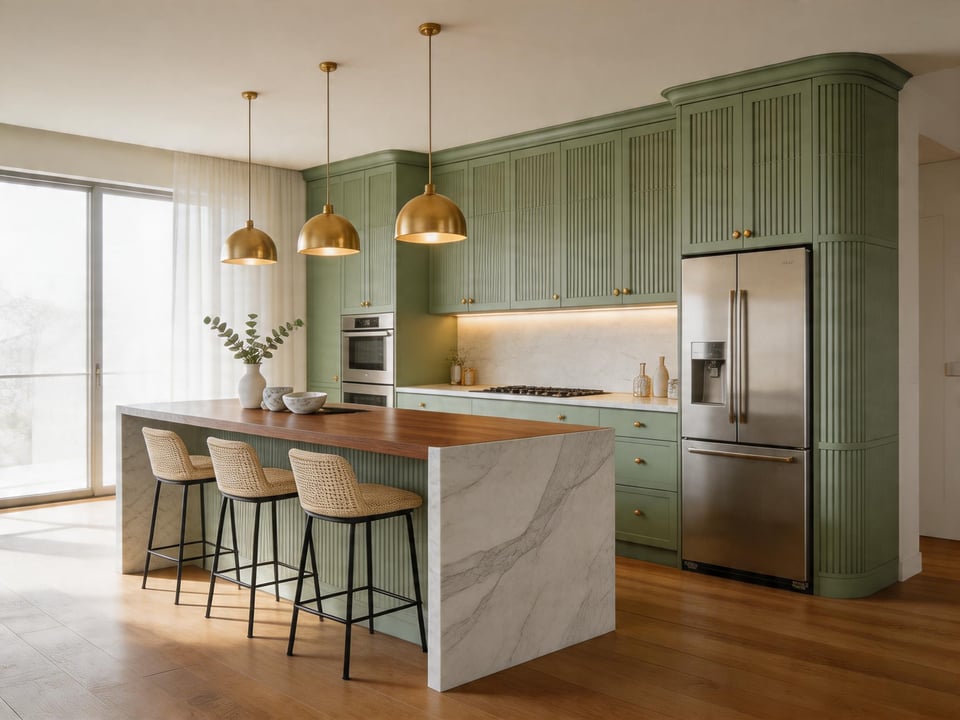
7. Curved Bar Peninsula in Sage Green with Fluted Detailing
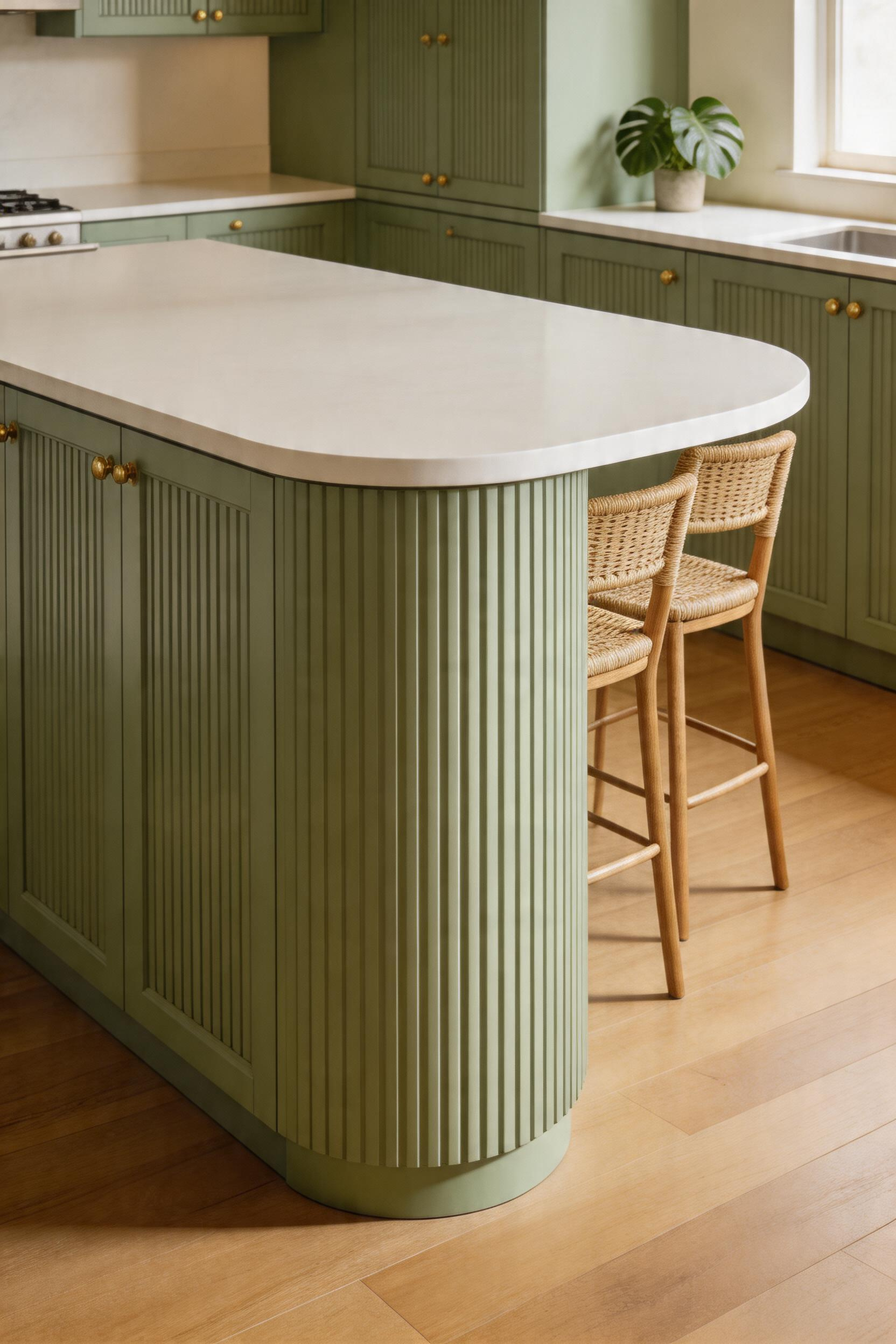
Straight lines dominate most kitchens by necessity. Which is precisely why a curved bar peninsula end reads as considered — it’s the choice that required more effort and cost, and the form announces that immediately.
The Case for Curves
A curved base to a kitchen bar peninsula improves traffic flow in small kitchens by eliminating the sharp corner that catches hips and bags. The cost premium is real — expect 20–40% above a standard straight peninsula quote — but the visual dividend justifies it for a kitchen where this bar will be the central design statement. Among kitchen bar designs, the curved peninsula is the one most likely to become the room’s signature.
Fluted Panels and Sage Green
Vertical fluted panels catch directional light and create shadow lines that give the cabinetry a sculptural quality absent in flat-front designs. Solid timber fluted panels (routed from oak or ash) are the premium option; MDF-routed fluting is the standard cabinet-industry approach, paintable and precise. Adhesive fluted profiles can update existing flat-front cabinetry as a retrofit.
Sage green is the colour that has defined recent kitchen design because it functions as a sophisticated neutral: the grey-green quality reads warmer alongside oak, cooler against white stone. Farrow & Ball Mizzle (No. 84) and Dulux Overtly Olive are the most referenced options. Test in the actual kitchen light — sage shifts dramatically between shop conditions and home.
8. Maximalist Patterned Tile Bar Surround with Rattan Seating
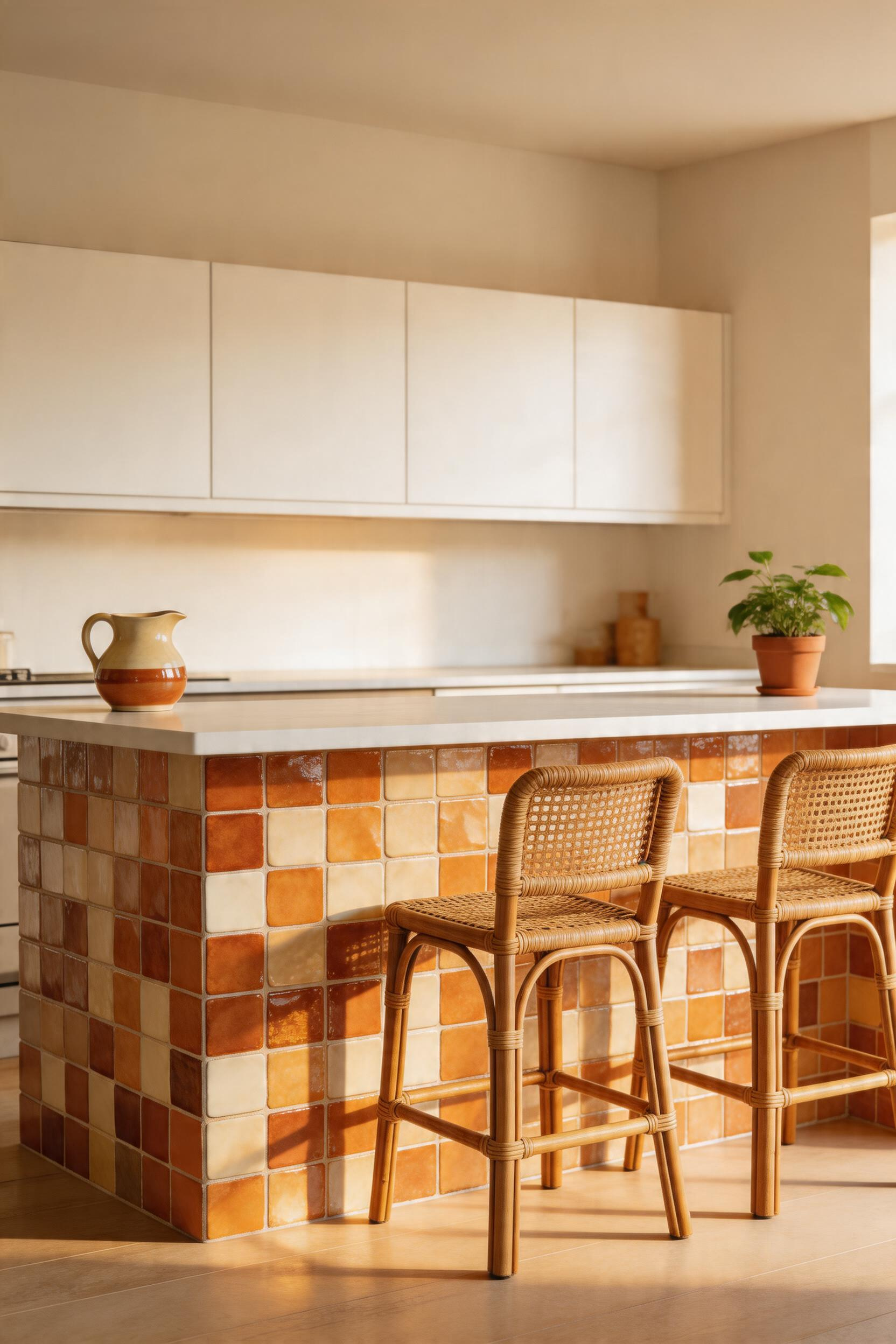
Not every kitchen bar design needs to be edited down to its essentials. There’s a version of kitchen bar designs that embraces richness of pattern, layering of texture, and deliberate abundance — and done well, it’s extraordinary.
Working with Zellige Tile
Zellige tiles — handmade Moroccan clay tiles with a slightly irregular glaze — have a surface that catches light differently at every angle. This variation is intentional, and it’s what mass-produced tiles are engineered to eliminate. Concentrate the tile on one plane: the bar’s front face, or a focused bar backsplash. Surrounding cabinetry should be quiet — plain white, warm linen, or natural wood. The countertop should stay simple — plain quartz or concrete — so the eye has a resting point. For more detail on using statement tiles in a kitchen context, the principles in kitchen backsplash design apply directly here.
Zellige is heat and water resistant, making it suitable for kitchen use. The installation note that matters most: use a warm buff or grey-beige grout rather than bright white. Bright white grout against Zellige’s varied surface creates a polka-dotted effect that works against the richness Zellige delivers.
Pro Tip
Rattan stools are the antidote to the tile’s intensity. The woven natural texture introduces softness that prevents the tiled kitchen bar from reading as hard or overwrought — and connects to the artisanal production of the tiles. Opt for rattan over a solid frame rather than all-rattan construction for better structural longevity in a kitchen environment.
9. Sleek Monochrome Kitchen Bar with Handleless Cabinetry
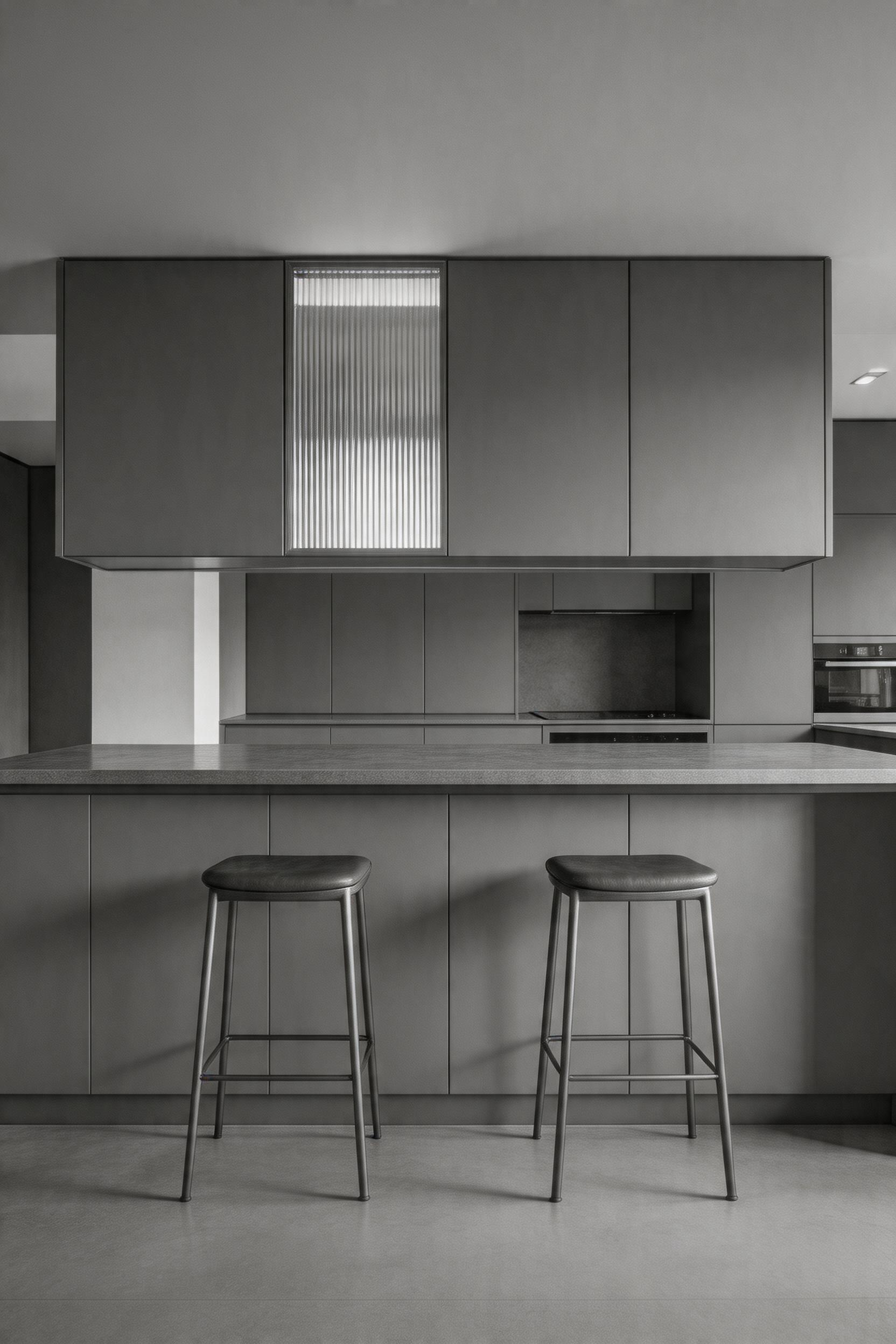
A monochrome kitchen bar — all one colour from cabinet to counter, with no contrasting hardware — has nowhere to hide. There’s no visual complexity to distract from poor-quality materials or imprecise installation. Done well, though, it creates a graphic presence that more fragmented kitchen bar designs can’t approach.
The Handleless Question
Push-to-open touch-latch systems create a completely uninterrupted surface — the purist’s choice, adding $200–$500 to a kitchen bar cabinetry quote, requiring more precise installation for consistent door gaps. J-pull handles (an integrated groove routed along the top of the door) provide the grip without visible hardware and are the practical compromise for heavier base cabinet doors. Both approaches are legitimate; the choice depends on your tolerance for mechanical complexity.
Texture Within One Colour
In an all-one-colour scheme, texture saves the design from flatness. Ribbed glass inserts in one or two upper cabinet doors catch light and create subtle diffraction. Satin laminate cabinetry reflects slightly more light than matte paint, adding tonal variation within a single colour at different viewing angles. Varying countertop texture from cabinet finish — honed concrete against gloss-lacquer cabinetry in matching grey — provides visual contrast the eye needs. The principles behind material layering in single-palette kitchens, explored in modern kitchen decor, apply directly to monochrome kitchen bar designs. The one thing to avoid: going fully matte on every surface — without any reflective element, the bar reads flat and unlived-in.
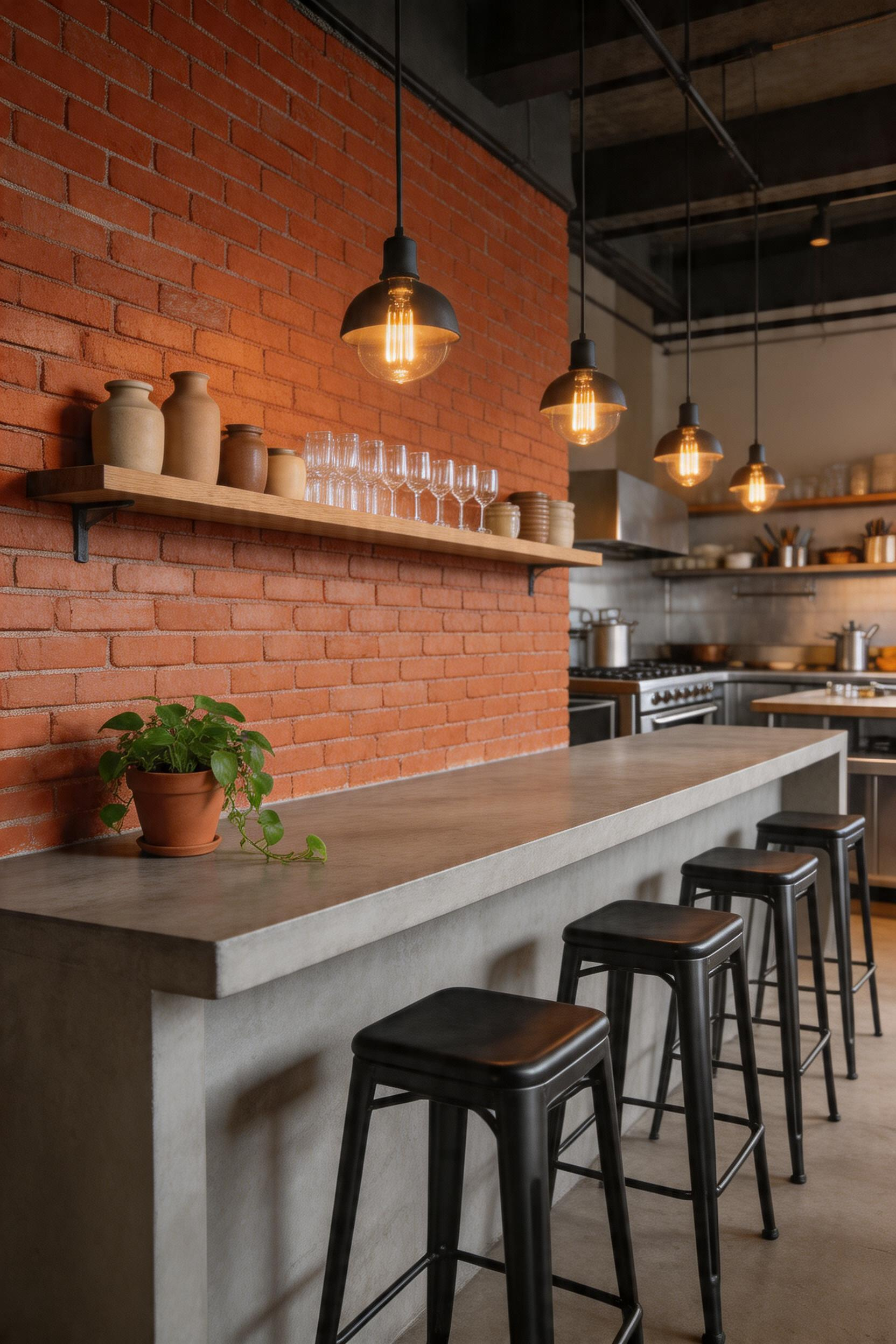
10. Industrial-Style Kitchen Bar Design with Exposed Brick
Exposed brick in an industrial kitchen bar design exists in its own aesthetic category — not quite industrial, not quite rustic, but carrying qualities of both: the warmth of a natural material, the character of something that predates the kitchen it now sits in.
Real Brick vs Brick Slips
The hygiene question comes first: brick in a kitchen must be sealed. Architects recommend a matte brick sealer that prevents dust contamination without destroying the natural texture. If the building has no structural brick behind the kitchen wall, brick slips are the practical solution — thin brick veneers (typically 3/4 inch thick) adhered to the wall surface, visually indistinguishable from real brick. Lighter, easier to install, and easier to seal. A concrete bar countertop (poured-in-place typically runs $75–$150/sqft installed) is the natural partner material; Edison carbon filament bulbs at 2200K emit a warm amber glow that flatters brick’s terracotta undertones.
Softening the Industrial Bar
One or two plants — a trailing pothos in a terracotta pot, or a small olive tree — provide the organic counterpoint that keeps this kitchen bar design from reading as purely utilitarian. An open shelf with edited objects (ceramic vessels, a coffee grinder, clean glassware) gives the bar a lived-in quality. A wooden element — a bar shelf in reclaimed timber, or a natural fibre pendant shade — bridges the hard materials and introduces necessary warmth.
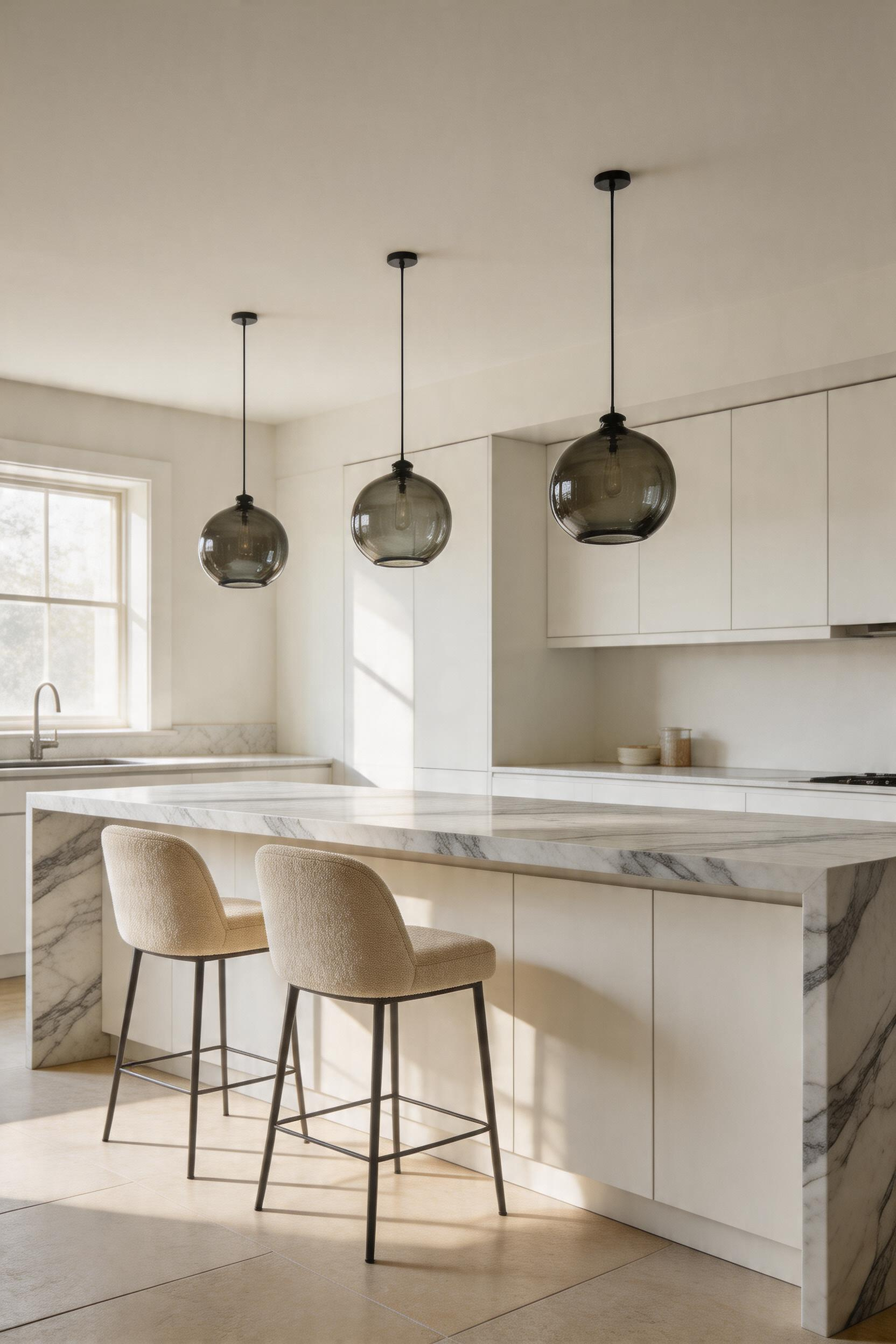
11. Marble Slab Bar with Statement Pendant Cluster
The argument for marble in kitchen bar designs is not really a practical one. It’s aesthetic: no other material offers the depth of veining, the cool luxury, and the visual statement of natural marble used in a bar context — where the surface is seen constantly and touched by guests.
Choosing Your Marble
Calacatta has bold veining against a bright white background — more prestigious and more expensive. Carrara has finer veining against a slightly grey-white ground — more versatile. Statuario sits between them: brighter white background with dramatic dark veining, arguably the most visually striking. For any kitchen bar design using marble, a honed (not polished) finish is the practical recommendation. Honed marble shows etching from acidic spills far less dramatically than polished marble, which reveals every mark under direct light.
Sealing and Pendant Placement
Sealing requirements: 2–3 coats of impregnating sealer on installation (24 hours between coats), then reseal every 6–12 months. Clean only with pH-neutral stone cleaner. Wipe spills immediately. These are the commitments marble asks for; if they feel too demanding, sintered stone offers the aesthetic at lower maintenance cost.
Above the marble bar, pendant clusters make the strongest statement. Hang pendants 30–36 inches above the bar surface; stagger a cluster of three at 30, 34, and 38 inches for an organic look rather than a mechanical row. Space pendants 24–30 inches apart. Odd numbers (three, five) feel more natural than even groups.
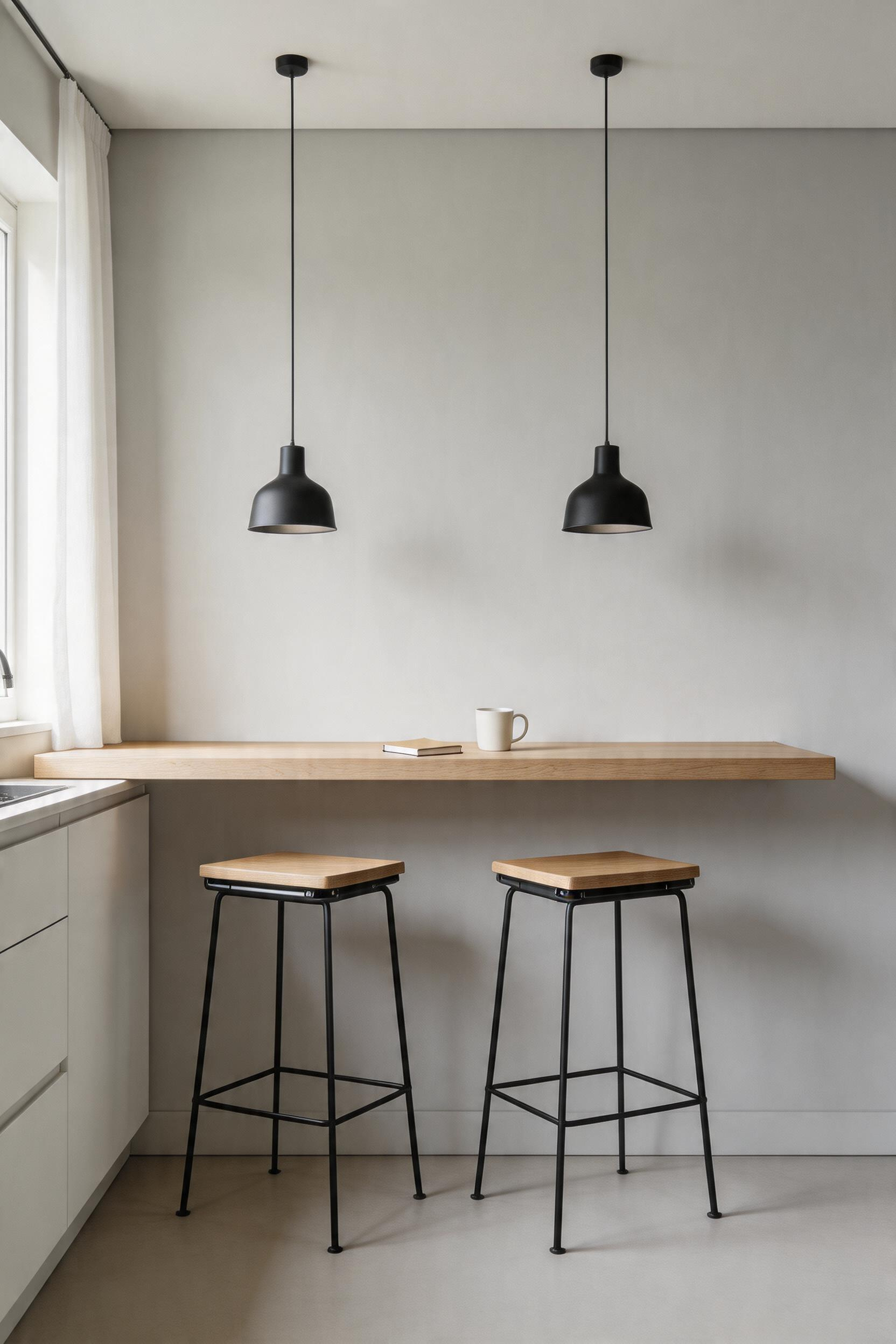
12. Floating Cantilever Bar Shelf for Compact Kitchen Layouts
The compact kitchen has a spatial problem: every square foot allocated to seating is a square foot taken from circulation or preparation. Among kitchen bar designs for small spaces, a floating cantilever bar shelf solves this most elegantly — it leaves the floor beneath completely clear, with stools pushing fully under when not in use.
Dimensions and Installation
Standard bar height is 40–42 inches from floor to counter surface, paired with 28–30 inch bar stools. The shelf can be as narrow as 10–12 inches while still providing adequate elbow placement and knee clearance. A properly installed floating bar shelf, fixed into wall studs or masonry anchors, handles kitchen bar loads comfortably — 45–50 lbs per stud fixing. The non-negotiable: bracket fixings must go into solid structure (stud, masonry, concrete). Plasterboard alone is not adequate for a surface that guests lean on. For more ideas on maximising function in a compact kitchen, kitchen island ideas for small kitchens covers the same space-planning principles.
Making It Look Designed
Shelf thickness at the counter surface matters: minimum two inches for a wooden surface prevents bounce and flex. Finish the underside — paint or veneer it in the same material as the top, because it sits at direct eye level for seated guests. Add a toe-kick space below the bracket mounting point for foot rest. A pair of pendant lights directly above the shelf, spaced evenly along its length, designates the floating bar as a designed kitchen bar area rather than a useful accident.
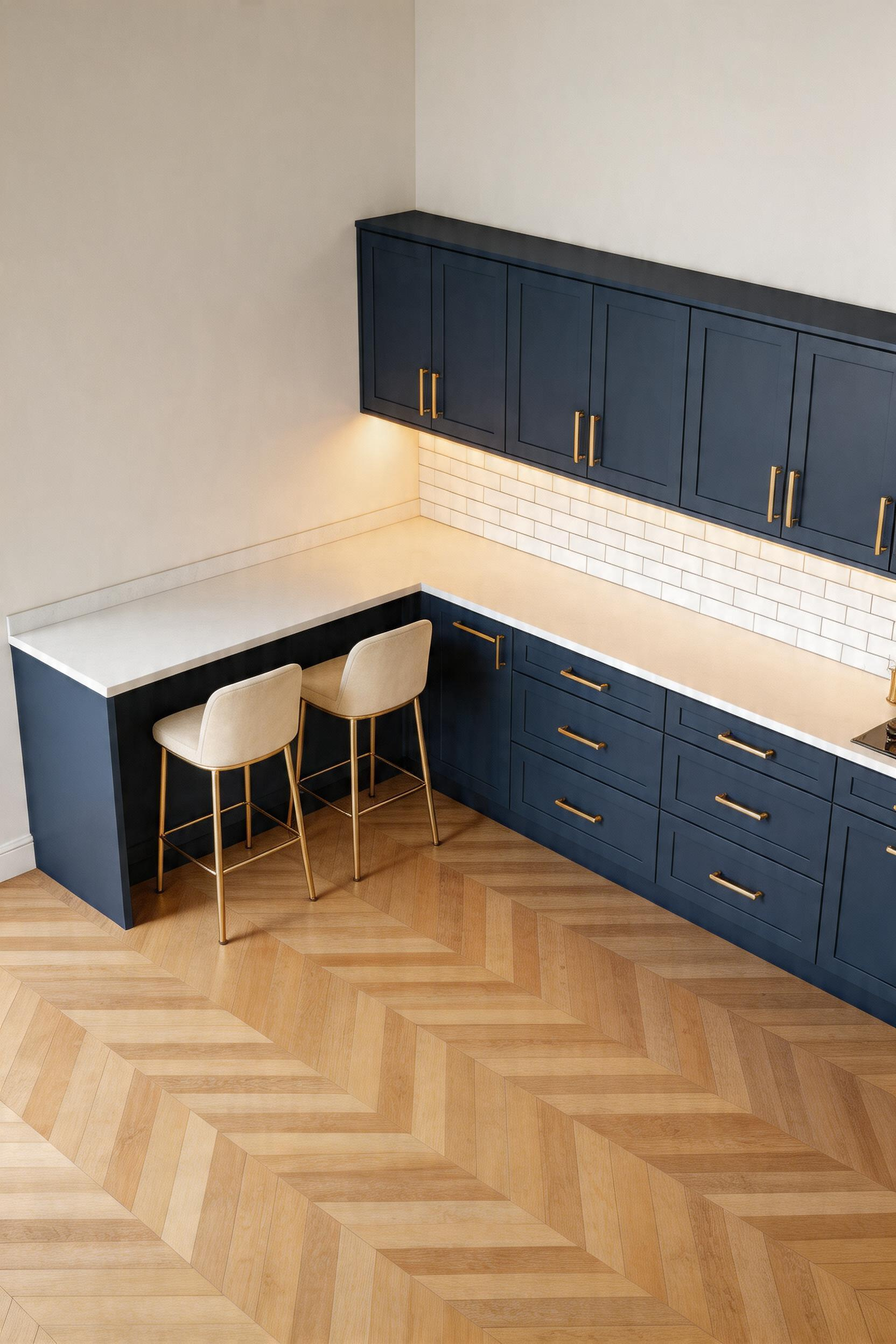
13. Corner Kitchen Bar Design for Awkward Spaces
Corners are the most undervalued square footage in a kitchen. They collect dead storage, create workflow bottlenecks, and generate the awkward-cabinet problems that kitchen designers spend significant effort engineering around. A corner kitchen bar design reframes the same space as a genuine social asset.
L-Shaped vs Diagonal Configurations
The most common corner kitchen bar design follows the two walls at a right angle. Bar stools seat two to three people on the longer return, facing into the kitchen — a naturally sociable position from which guests can watch the cooking without being in the way. Below the bar, the cabinetry becomes straightforward drawers rather than a revolving lazy Susan.
The diagonal corner bar cuts across the corner at 45 degrees, creating a single bar surface that positions guests facing inward. Conversation is easier; the seating arrangement reads as more considered. It requires marginally more floor space but produces a stronger design statement.
Dimensions and Seating
Dimension guidance: 24 inches depth, height at 36 inches for counter-height seating (24–26 inch stools). Maintain 42–48 inches of clearance on the kitchen side. Allow 18–24 inches of bar frontage per stool. The choice between bar stools and a built-in banquette deserves genuine consideration: stools are flexible; a banquette creates a booth-like intimacy that’s difficult to achieve any other way. If the corner bar is meant to become the household’s primary dining spot, the banquette investment is usually worth it.
14. Coastal Whitewashed Bar Counter with Woven Bar Stools
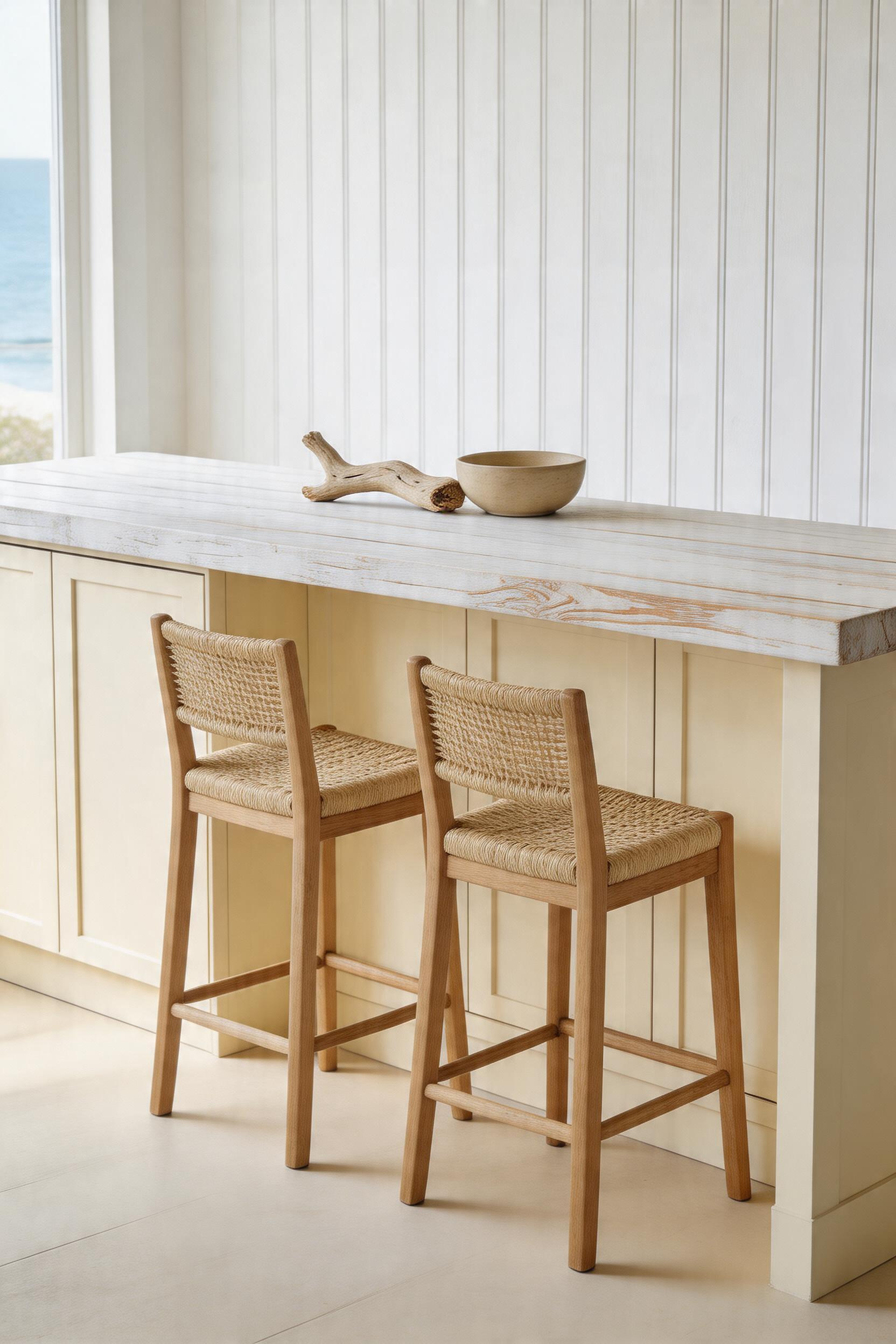
Coastal design has a cliché problem. The anchor motifs, the rope coils, the collected shells — they turn a potentially beautiful aesthetic into a themed interpretation of living near the sea. Done with restraint and a genuine material eye, coastal kitchen bar designs achieve something better: a lightness and warmth that comes from texture and tone rather than symbolic objects.
Getting the Whitewash Right
The reference points for this kitchen bar design should be driftwood, sea glass, bleached linen, and the quality of light in a room where the sun has done years of gentle work — not maritime decoration. Traditional lime-wash (Bauwerk, Coat) creates an authentic mineral quality that patinas naturally over time. Over bare or lightly sanded wood, diluted white paint at a 50/50 ratio with water creates a DIY whitewash whose opacity you control by adjusting the ratio. Commercial chalk-paint products (Annie Sloan, Rust-Oleum Chalked) apply to existing surfaces with light preparation.
Choosing Woven Stools
For woven stools, the practical hierarchy: seagrass first for a busy kitchen bar (naturally water-resistant, tightly woven, holds its colour), abaca for a slightly more refined aesthetic in a calmer setting, water hyacinth only for lower-traffic environments. One or two natural objects on the bar — a piece of driftwood, a ceramic bowl in a muted sand tone — is the maximum. The look should feel sun-bleached and collected over time, not assembled from a coastal décor catalogue.
15. Kitchen Bar Designs That Double as a Home Office Station
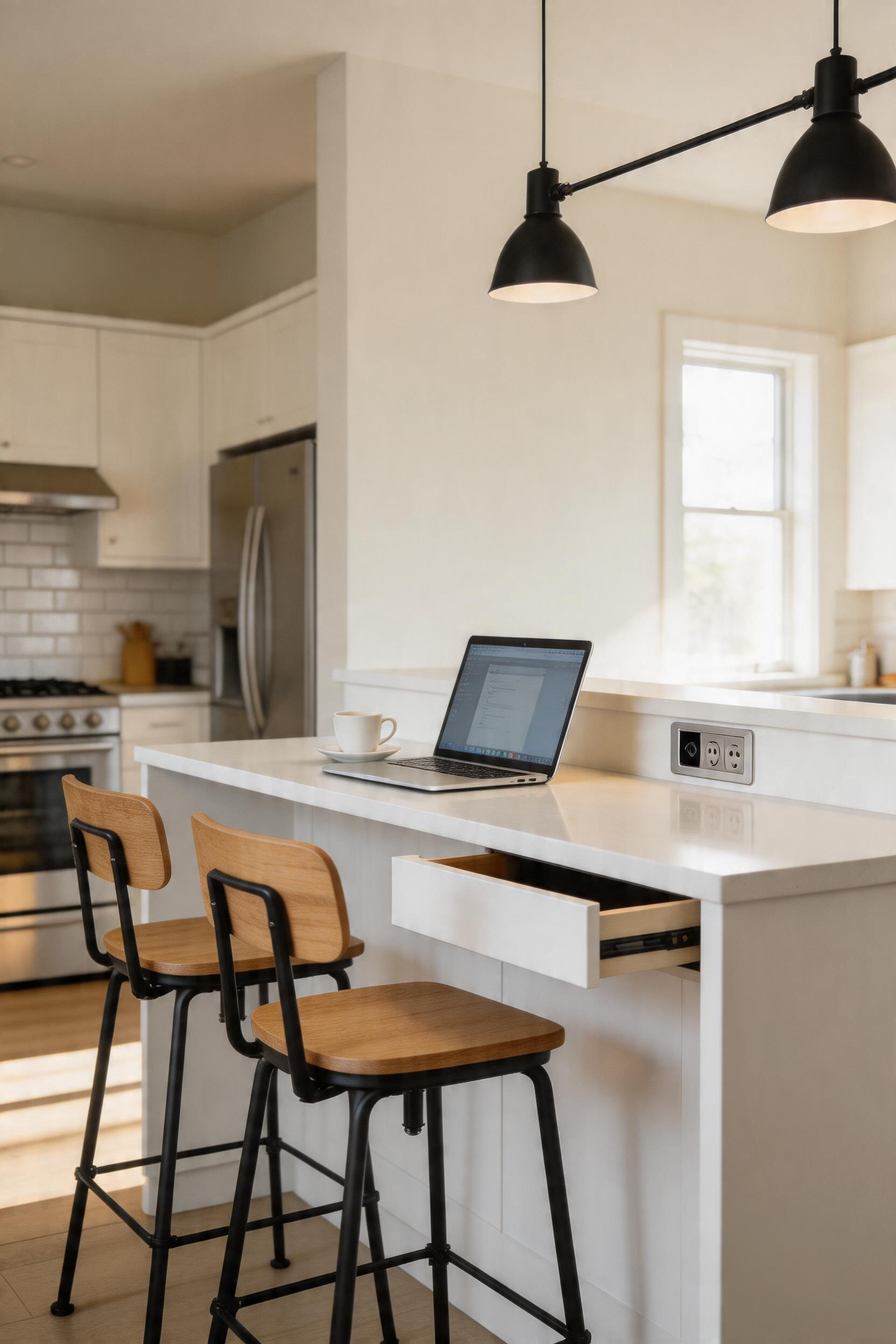
The kitchen bar as occasional home office is an honest acknowledgment that open-plan living has produced spaces where the most practical work surface in the home is often the one that runs through the kitchen. The challenge with these kitchen bar designs is making them serve both functions without visually compromising either.
Technical Foundations
Pop-up outlet units (Hafele’s CAPLE series, Evoline) emerge from the bar counter surface on demand — two standard sockets plus USB-A and USB-C — then disappear below the surface when not in use. Cable management through the bar cabinet structure to a hidden power source handles the rest. A narrow shallow drawer beneath the bar overhang, 3–4 inches deep, provides storage for notebooks, chargers, and stationery.
The Height Question
Counter height (36 inches, paired with a 24–26 inch stool) is the non-negotiable for kitchen bar designs that need to function as desk surfaces. At 42 inches (full bar height), working with a laptop becomes uncomfortable within thirty minutes. If the dual-purpose function is important, counter height is the right choice.
This kitchen bar design works best facing a wall or window, with the user looking away from the kitchen activity zone. It fails when the bar seating faces directly into a cooking hob — heat, steam, and cooking movement make sustained focused work impossible. Treat it as an occasional workspace for calls, emails, and short tasks rather than a primary all-day desk, and it performs reliably.
Finding the Kitchen Bar Design That Actually Works for Your Home
Before committing to any kitchen bar design, look at what the kitchen already has. Its bones — the flooring material, the existing cabinetry tone, the quality of natural light — should guide the direction. A walnut-and-brass kitchen bar counter will look right in a warm-toned kitchen with oak floors; in a cool-stone, white-everything kitchen, it’ll look like a room that hasn’t decided what it is. The bar design’s job is to amplify what’s already there, not to introduce a competing aesthetic.
Layout is just as decisive as aesthetics. A corner kitchen bar design is only right for a kitchen where the corner genuinely invites it. A floating cantilever shelf needs a wall with accessible structure. A full peninsula requires 42–48 inches of clear floor on every open side — less than that and the kitchen becomes difficult to navigate. Measure before committing to any particular design direction.
On budget: the principle is consistent across all kitchen bar designs. Spend on the bar surface, because it’s what takes the daily contact and carries the visual weight of the whole design. A quality countertop — solid quartz, properly sealed marble, solid walnut — will hold its appeal for decades. Save on stools initially; stool trends move faster than kitchen design, and you may want to update them in five years without redesigning the bar. Invest meaningfully in lighting: two well-chosen pendants above the bar will do more for the overall design than almost any other single decision at a comparable cost.
The best kitchen bar designs are the ones that look like they were always there — not the product of a catalogue choice or a trend, but a considered response to a specific kitchen, household, and way of gathering.