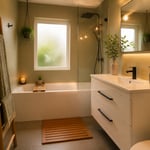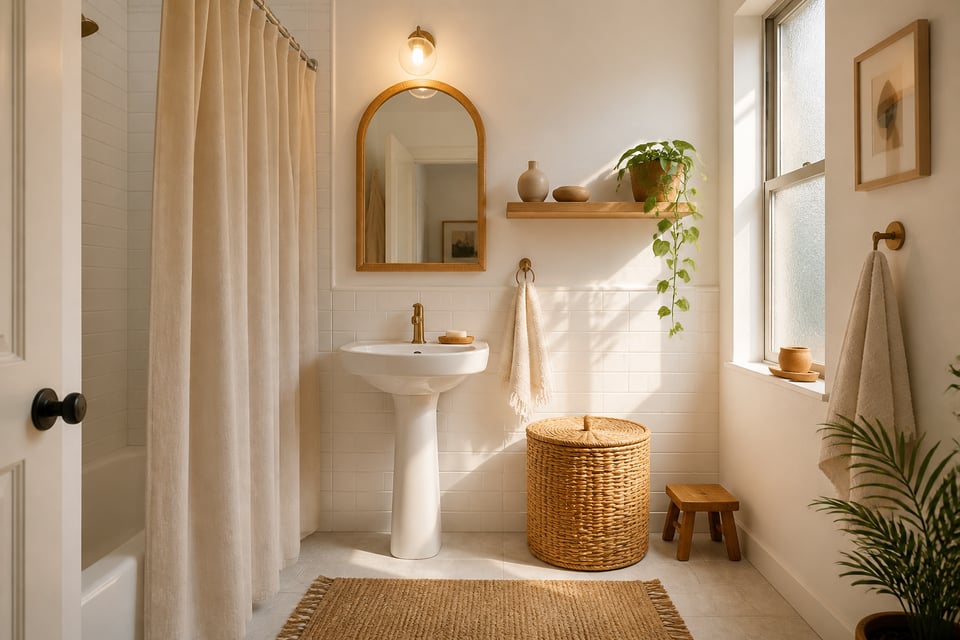
Most apartment bathroom decor looks like a lot of effort applied to no clear result — a shelf crowded with products, a curtain pulled from a bulk bin, tiles that’ve surrendered. Then there’s another version: a single bamboo shelf holding three objects, a linen curtain softening the light, a trailing pothos working slowly overhead. The second bathroom isn’t bigger. It just knows what it’s trying to be.
These 15 apartment bathroom decor ideas approach a small rental space the way any mindful design problem should be approached. Remove what doesn’t serve the space. Introduce only what does. Some are entirely free. Most cost under $50. None require a landlord’s permission. All of them apply the principle that constraint in design isn’t an obstacle; it’s the invitation to refine.
1. Floating Bamboo Shelves as Apartment Bathroom Decor That Earns Its Place
The phrase “open shelving” tends to make renters nervous. Every product on display, every cluttered bottle visible from the doorway. But that anxiety is about the wrong kind of open shelving — the accumulated kind. The right kind starts with a deliberate decision: the shelf holds three things, and those three things earn their place.
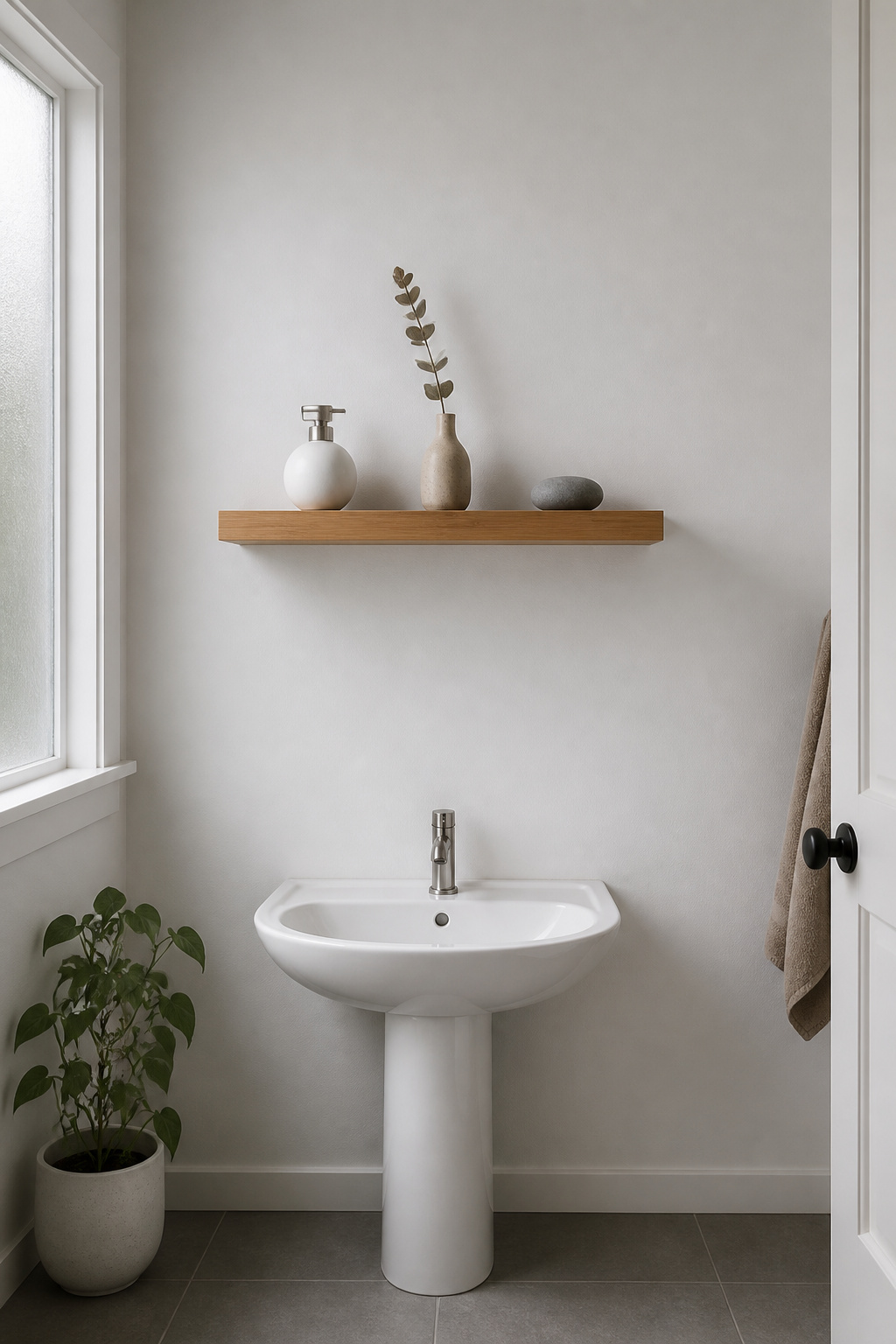
Bamboo is the right material here for reasons beyond aesthetics. Solid bamboo scores higher on moisture resistance than painted MDF and won’t warp under daily steam the way cheaper composite materials do. Adhesive-mount bamboo shelf systems — FAYYGYH and similar damage-free wall organiser shelves are widely available — hold up to 4 lbs of everyday essentials without drilling a single hole. One honest test from a bathroom user: the adhesive held for nearly a year before needing remounting, and the wall came away undamaged. That’s a reasonable track record for a rental.
The display itself follows what the Japanese concept of *ma* (間) — the value of negative space — suggests about arrangement. Leave 40% of the surface empty. The three-object rule works reliably in a bathroom. One functional item: a hand soap that doesn’t come in terrible packaging. One sensory element: a small diffuser or bud vase. One visual anchor: a smooth stone or a ceramic vessel. Rotate seasonally. A shelf that accumulates without editing becomes a storage shelf. A shelf that’s curated becomes zen-inspired bathroom shelf decor. Those read very differently from the doorway.
2. Washi Tape Accent Lines for a Renter-Friendly Wall Treatment
Budget constraints and a security deposit tend to shut down any conversation about wall treatments before it starts. Washi tape reopens it. It qualifies as apartment bathroom decor that requires zero tools. This is genuine tape — not the cheap opaque kind from school supply aisles — made from natural fibres, available in widths from 6mm to 50mm, and designed to peel off without leaving residue or lifting paint. A single roll costs $3–$8.
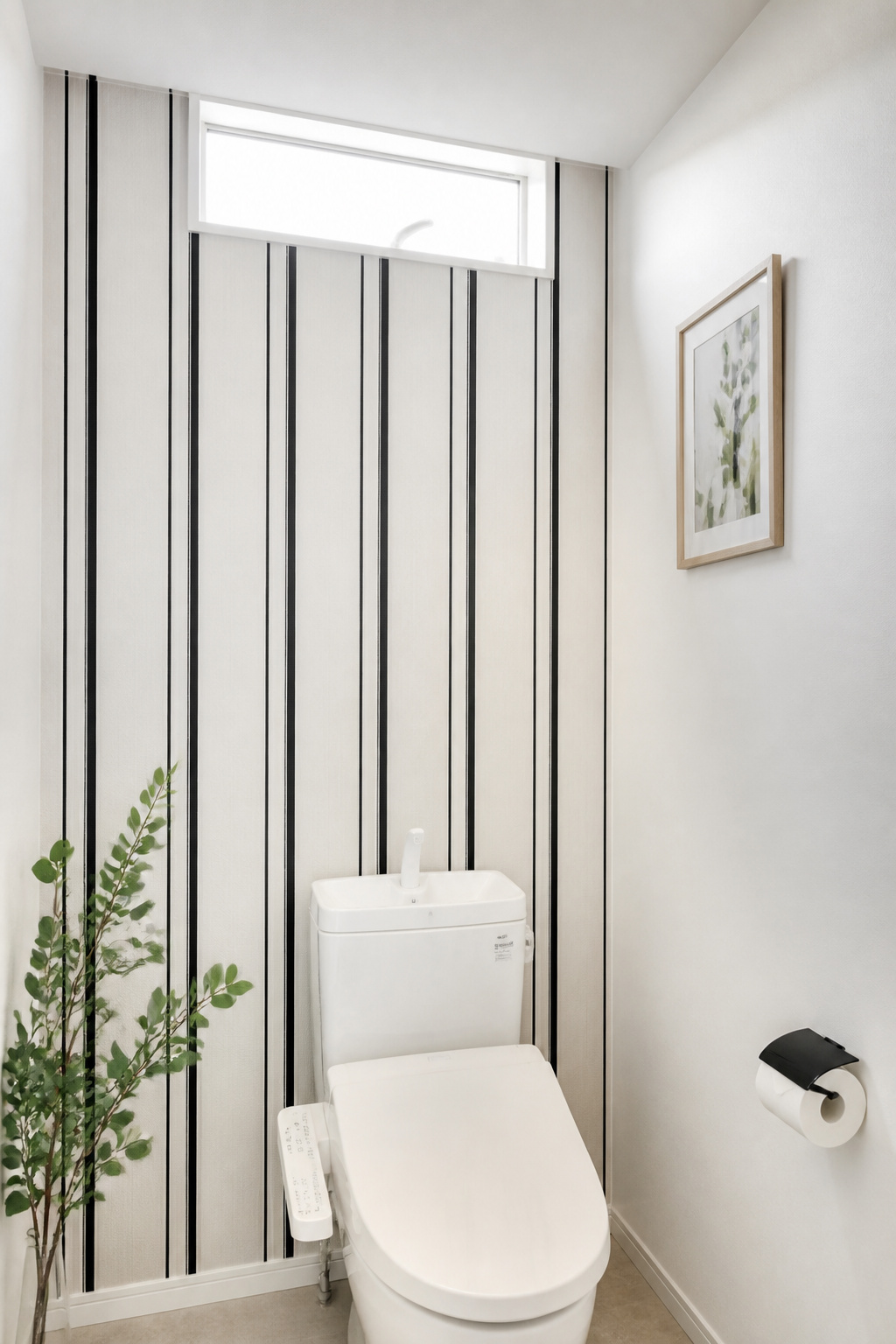
The patterns that work best in a small bathroom are the ones that lean into the room’s proportions. Vertical stripes using a 15mm tape elongate a low-ceiling bathroom in the same way a striped wallpaper would, without the wallpaper. A grid pattern on a single wall (the one behind the toilet is ideal — contained, visible, not competing with the mirror or the shower) adds structure and visual interest without weight. Measure with a level before you start. The line between geometric art and a crooked DIY project is a pencil mark and a ruler applied first.
Removal is the practical reassurance: peel at 45 degrees, slowly, and the tape comes away cleanly. If any adhesive residue lingers, a cotton ball with a small amount of rubbing alcohol removes it without affecting the paint. In a bathroom that sees genuine steam, re-sealing the edges every 6 months maintains adhesion. Bathroom-specific washi tape products are rated for humidity and hold considerably better than craft-store alternatives in steamy environments.
3. A Japanese Stone Tray and Pebble Display for the Countertop
Wabi-sabi (侘寂) is a Japanese philosophy that describes finding beauty in imperfection, in natural materials, and in the honest signs of age and wear. In interior terms, it translates to something simpler: a few natural objects arranged without fuss that make a bathroom countertop look like it was considered rather than filled.
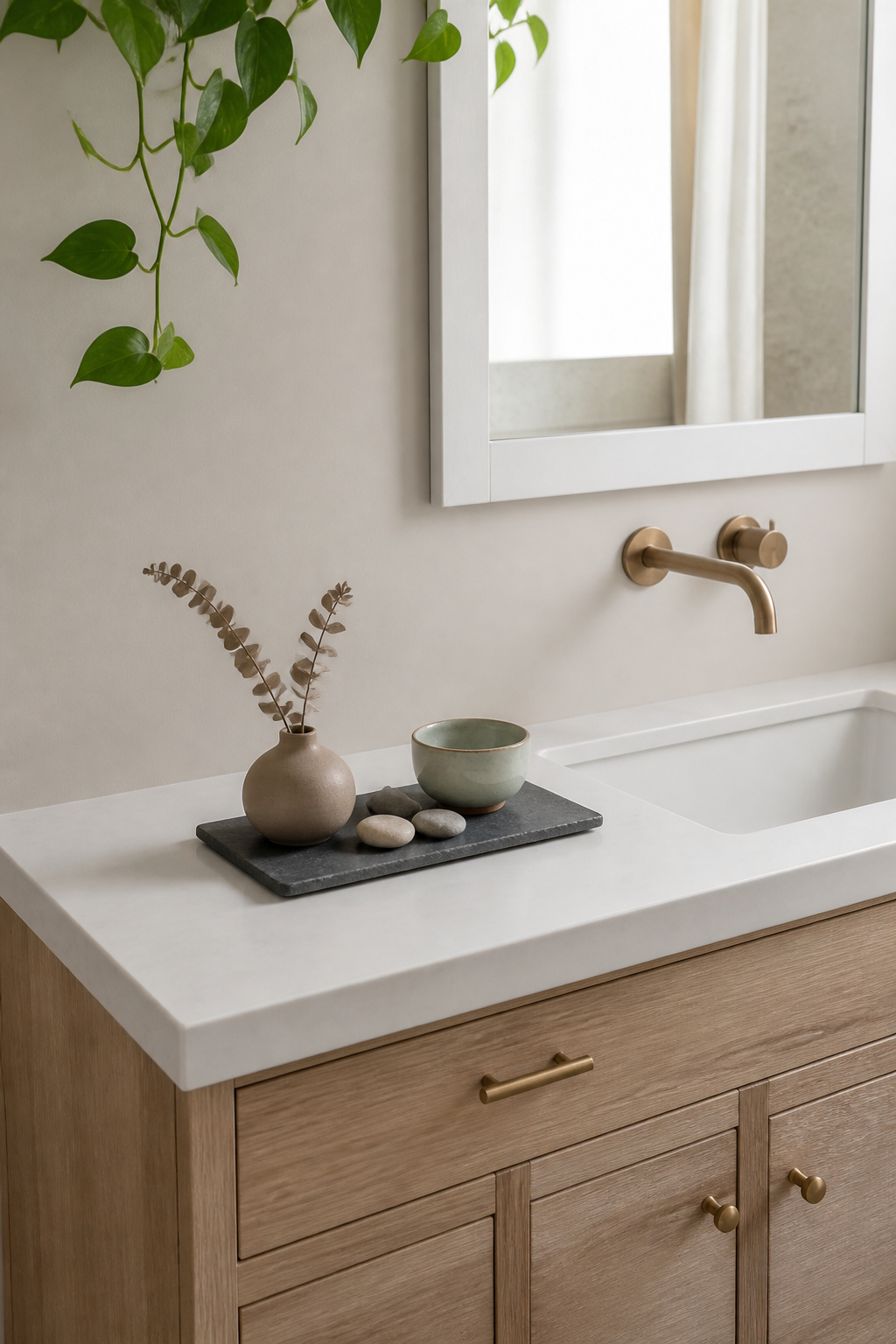
The right scale for a standard vanity is a rectangular slate or marble tray, 20 to 30cm, for a standard vanity top — acts as a visual boundary. Everything inside the tray reads as intentional display. Everything outside reads as functional. Within the tray: three or four grey river pebbles, a single bud vase with a dried eucalyptus stem, and a small ceramic vessel for cotton rounds. That’s the whole arrangement. The wabi-sabi aesthetic expressly discourages adding more: a level of modesty is essential. The beauty sits in the restraint.
For a genuinely intentional zen bathroom, the colour palette is what holds everything together. The wabi-sabi tonal range (beige, warm grey, soft olive, brown) works alongside any rental tile colour because it doesn’t compete. This isn’t neutrality from a lack of opinion; it’s neutrality as a considered choice. The pebbles can be collected from a park or a beach, dried, and washed. Free, and arguably the more meaningful approach.
4. Linen Shower Curtains: The Simplest Upgrade for Apartment Bathroom Decor
A shower curtain occupies roughly 6 to 8 square feet of visual space in a small bathroom. It’s the single largest decorative surface in the room, and in most apartments, it comes in translucent plastic. The upgrade from a builder-grade PEVA curtain to a linen one is the highest-impact, lowest-commitment change available to a renter.
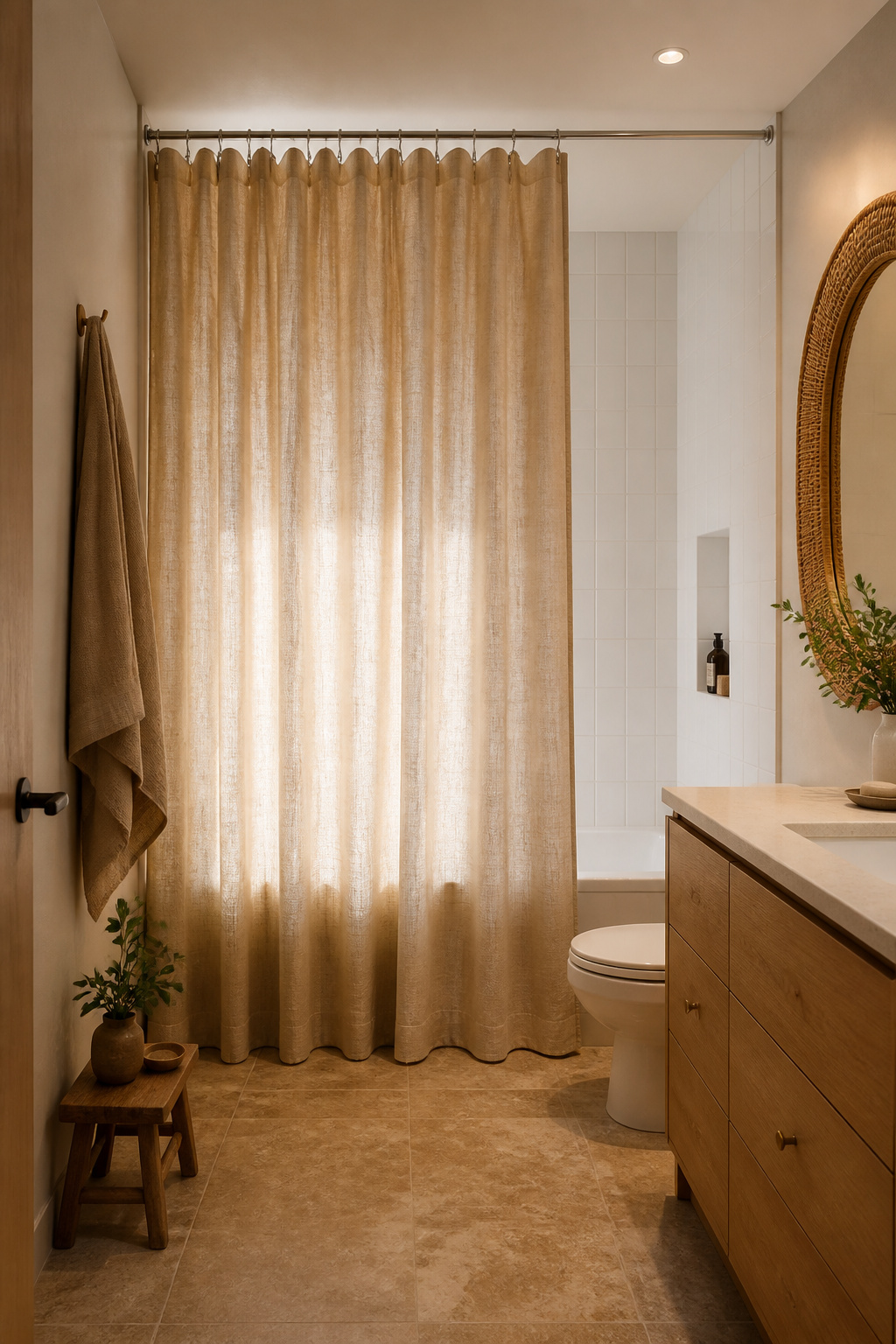
Linen performs well in a bathroom because of its fibre structure. It wicks moisture and dries faster than cotton. The longer fibres mean the fabric doesn’t hold humidity the way a dense terry weave does. It’s naturally antimicrobial and mildew-resistant. A 100% European linen curtain requires a separate waterproof liner hanging inside the tub; cotton-linen blends with an integrated waterproof backing skip the liner step entirely. For a bathroom with consistent morning steam, the blend is the more practical choice.
The small bathroom designs that maximise the space consistently reach for the same colour insight: off-white and warm natural linen reflect light and read as deliberately minimal rather than plain. White-on-white (curtain matching tile exactly) looks unintentional. A subtle tonal step — natural linen against white subway tile, or warm stone linen against cream ceramic — creates a gentle contrast that suggests the bathroom was designed rather than assembled. For rooms with low ceilings, a floor-length curtain panel (96 inches, rod mounted 12 inches below the ceiling) creates a vertical emphasis that a standard 72-inch curtain simply cannot achieve.
5. A Freestanding Ladder Rack for Towels and Low-Maintenance Plant Styling
Apartment bathrooms are frequently under-equipped for towel storage. The single fixed rail on the back of the door holds two towels under ideal conditions and feels crowded with three. A freestanding ladder rack solves this apartment bathroom decor challenge without a drill, takes up less than one square foot of floor space, and, done well, reads as furniture rather than storage hardware.
Bamboo ladder racks are finished in cashew nut oil, lightweight (3–4kg), and handle normal bathroom humidity well when not placed directly in the shower’s splash zone. Teak is the more serious option: the AquaTeak range uses hidden stainless steel hardware and the wood’s own natural oils to resist moisture, mould, and bacteria even in shower-adjacent positions. Teak racks run $80–$150 versus bamboo at $30–$60. The gap is meaningful for a bathroom upgrade, but teak will outlast bamboo in a persistently humid room. Steel powder-coated racks are the budget choice; check the coating quality before committing because cheaper versions show rust within six months.
The top rung becomes a display surface. A small pothos in a 4-inch terra cotta pot balanced there trails naturally downward, its cascading vines softening the rack’s vertical lines. Pothos tolerates low bathroom light and the ambient humidity means watering is needed only every 10–14 days. Alternatively, a small woven seagrass basket on the top rung holds rolled face cloths — the rack becomes coherent from every angle.
6. Paper and Washi Lantern Lighting for Soft, Diffused Ambiance
The default bathroom light fixture in a rental apartment provides clinical brightness. It’s designed for functionality: adequate illumination at the mirror for grooming tasks. What it doesn’t provide is atmosphere, and atmosphere is precisely what the bathroom lacks when it feels like a utilitarian interruption rather than a moment of recovery in the day.
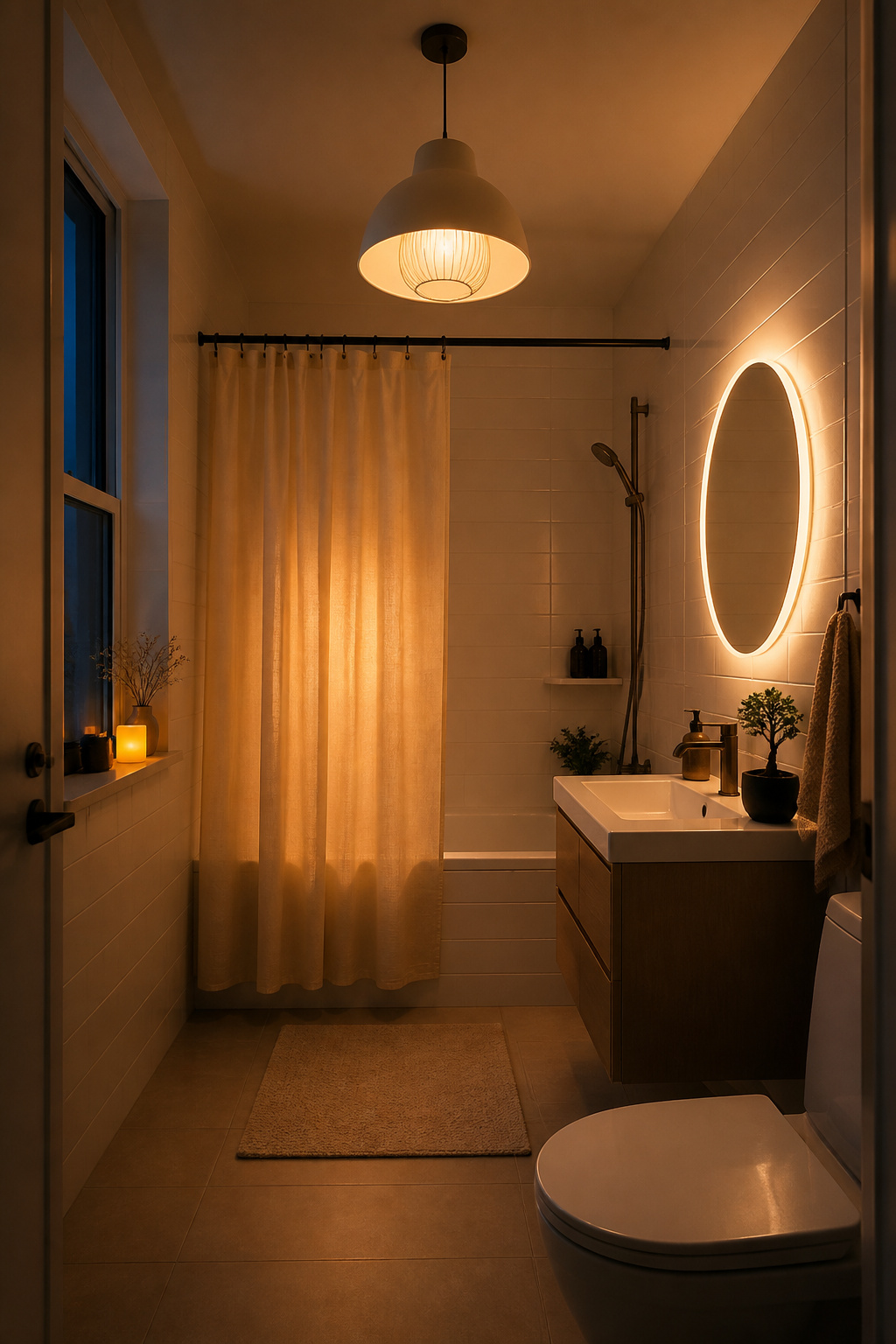
Japanese design philosophy approaches light as mood rather than function. Shoji screens and paper panels exist because diffused, filtered light creates a fundamentally different psychological experience than direct overhead brightness — the eye softens, the body follows. For a bathroom, the translation is straightforward: a secondary light source with warm-colour output (2700K is the target) that sits at a different position from the overhead. A dimmer on the main circuit (a $15–$30 compatible module) achieves this for free, allowing the room to operate in two modes: full brightness for morning grooming, warm amber for an evening bath.
For new apartment bathroom decor in the form of a light fixture, the critical specification is the IP rating. Bathroom Zone 2, the area within 0.6 metres of the bath or shower, requires IP44 minimum. IP44-rated paper-style pendants exist (Mullan Lighting’s ceramic pendant range, Pooky’s IP-rated collection) and provide the visual warmth of soft shade lighting with correct moisture protection. For apartments where rewiring isn’t possible, a plug-in pendant on an existing ceiling rose with an IP44-rated shade is a renter-legal alternative. The elevated bathroom decorative ideas that feel most transformed often start precisely here — with the decision to treat light as design rather than specification.
7. Peel-and-Stick Stone Panels: Low-Commitment Apartment Bathroom Ideas for Walls
Modern peel-and-stick wall tiles are a different product from what the category looked like five years ago. The best 2025 options use embossed composite surfaces that replicate travertine, slate, and Calacatta marble convincingly. The grout-free installation is an advantage, not a compromise. In a small space, it creates a cleaner surface than real tile.
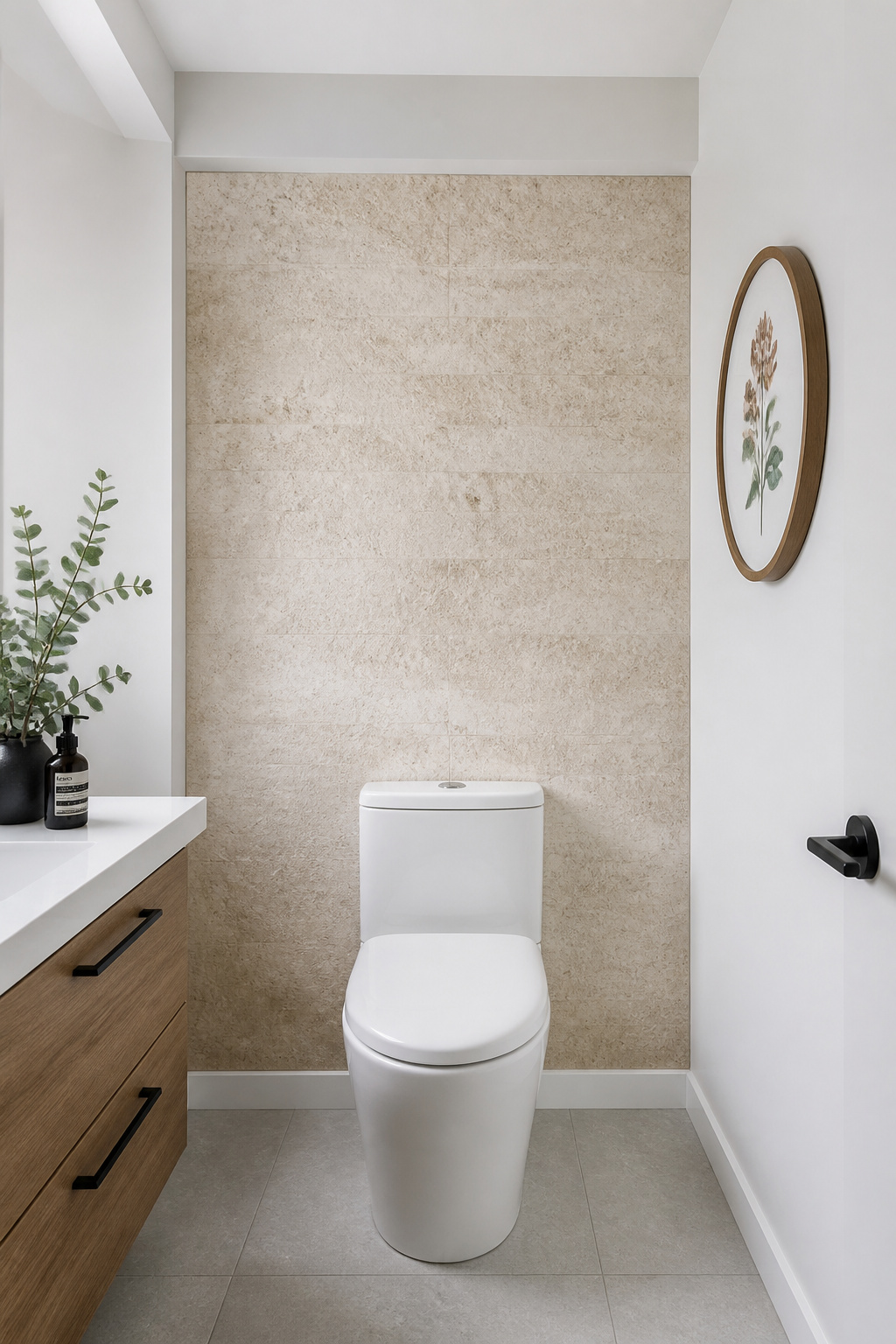
Cost comparison grounds the conversation: $1–$5 per square foot for peel-and-stick versus $10–$30 per square foot professionally installed. A feature wall behind a toilet — typically 15 to 20 square feet — costs $20–$100 in peel-and-stick panels and under $50 in most cases. Surface preparation determines whether this succeeds or fails: degrease the wall thoroughly before application (soap residue is the primary cause of early adhesive failure) and use a smoothing liner film on textured walls. Peel-and-stick panels need a flat substrate to adhere evenly.
Removal is genuinely renter-safe when done correctly. A hairdryer on medium heat for 10–15 seconds per section softens the adhesive; peeling back at 45 degrees cleanly removes the panel. Any residue left behind responds to Goo Gone or a citrus-based cleaner on a soft cloth. The wall comes back. The contained sections that benefit most: behind the toilet, behind a pedestal sink, as a vanity backsplash treatment. Avoid shower walls unless the product is specifically rated for wet zones — budget panels not designed for direct water exposure lift within weeks.
8. Framed Botanical Prints in a Minimal Gallery Arrangement
Framed prints are some of the most underestimated apartment bathroom decor. Botanical illustration has a long and serious history — the Victorian-era specimens produced by artists like Pierre-Joseph Redouté and Georg Dionysius Ehret are genuinely beautiful objects, meticulously observed, and entirely in the public domain. The Biodiversity Heritage Library, Rawpixel’s public domain collection, and the British Museum’s digital archive all offer high-resolution downloads at no cost. Print at a local copy shop and you have a $5–$8 piece of wall art that would sell for $60 in a boutique home decor shop.
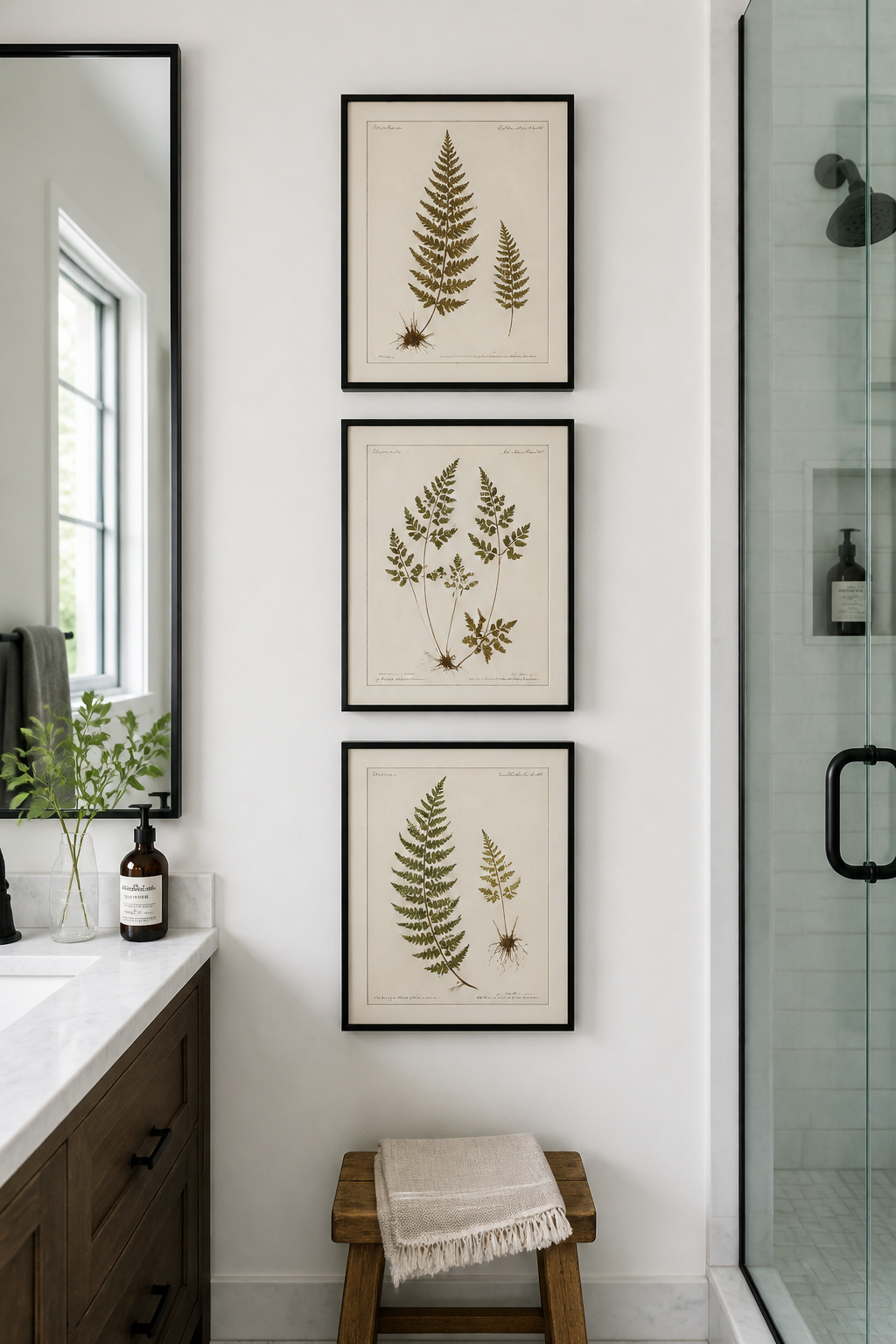
For bathroom placement, the frame material matters more than it would in a drier room. Aluminium, plastic, and treated wood frames are the humidity-resistant choices. Avoid ornate gilded or thick wooden frames — they’re out of register with a minimal bathroom aesthetic anyway, and solid wood expands noticeably in persistent steam. Acrylic-glazed prints are better than glass-fronted ones for bathroom use: lighter, unbreakable, and resistant to the fogging that glass develops in fluctuating humidity.
A three-piece vertical arrangement — three 8×10 prints stacked with consistent gaps between — fits neatly on the wall beside or behind a toilet and reads as deliberate rather than decorative from the doorway. Adhesive picture strips (Command’s bathroom-specific line is rated for steam environments) hold up to 4 lbs per pair, adequate for acrylic-glazed frames to 11×14 inches. The planning trick: cut paper templates, tape them to the wall with masking tape, and live with the layout for a day before committing. Repositioning mid-installation is possible but harder than planning in advance.
9. A Hinoki Wood Bath Caddy for the Ritual of Bathing
Hinoki is Japanese cypress — *Chamaecyparis obtusa* — it has been the preferred material for Japanese bath culture since the Nara period in the 8th century AD. This is not a trend. The ofuro (Japanese soaking tub), the bath bucket, and the bath bench have been made from this wood for over 1,200 years because the material earns it.
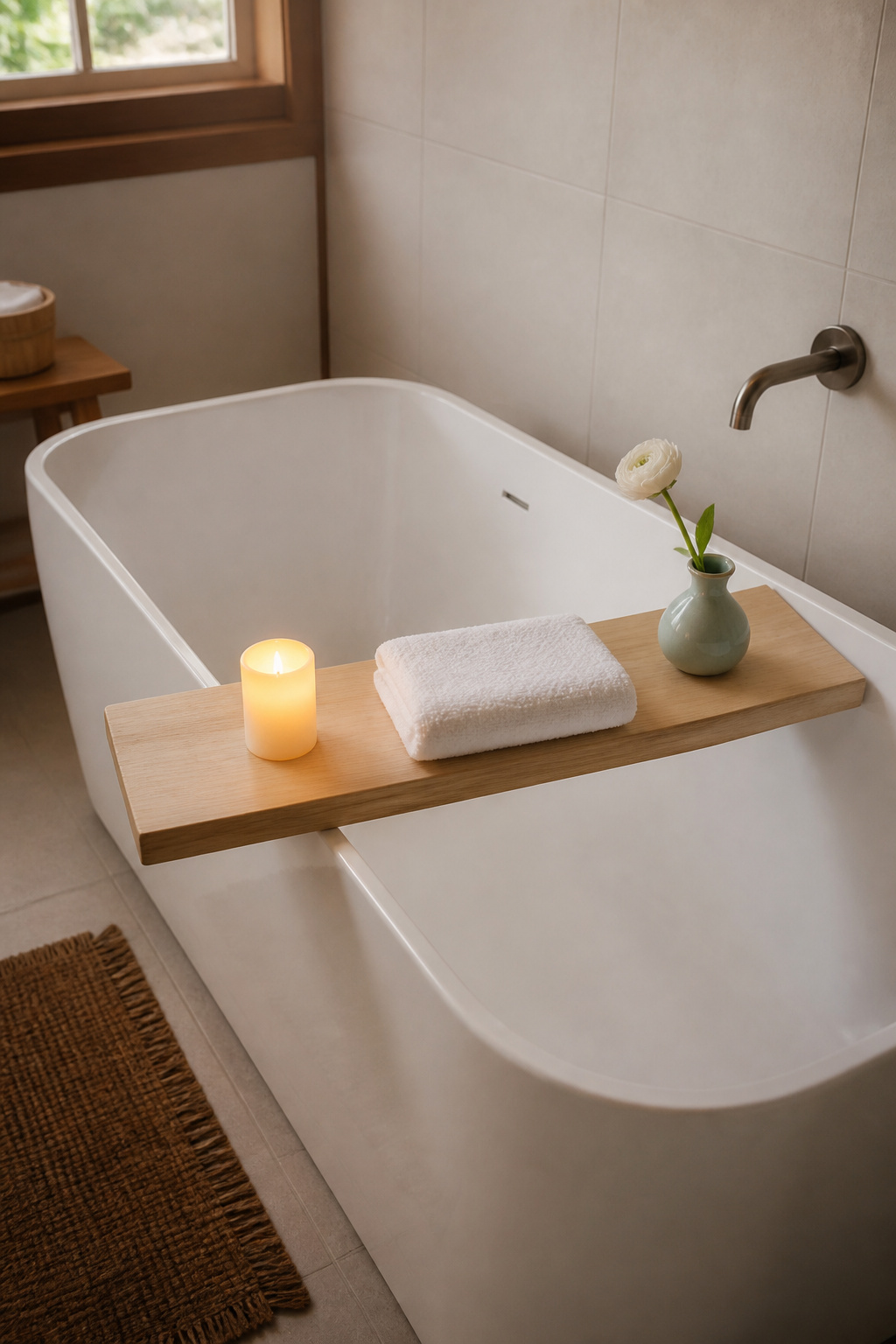
The properties that make hinoki remarkable in a bath context are its natural aromatic oils. These oils serve two purposes. They make the wood moisture-resistant without any treatment, and when the wood gets wet, they release a clean, slightly lemony, subtly woody fragrance. The onsen industry uses that scent specifically for its stress-reducing effect on the nervous system. It’s not a strong scent. It’s the kind that registers at the edge of awareness — present, grounding, calm. The parallel with aromatherapy is not coincidental; it’s the point.
As apartment bathroom decor that is also functional ritual equipment, a hinoki bath caddy resting across the tub transforms the experience of the bath itself. The arrangement on the caddy follows a three-object logic: a candle or small LED candle on one end, a book or tablet in a waterproof sleeve in the centre, a single stem in a bud vase on the opposite end. Care is straightforward. Wipe down with a damp cloth after use, allow to dry thoroughly, and stand it upright rather than flat so air circulates on the underside. No oiling required, and specifically: do not apply teak oil or linseed oil, which interfere with the wood’s own aromatic compounds.
10. Woven Rattan Baskets as Apartment Bathroom Decor Storage That Stays Visible
There’s a case to be made for open storage in a small apartment bathroom that most people resist making. The resistance is understandable — the average bathroom cabinet, when closed, looks intentional; when open, it reveals an unsorted collection of half-empty bottles and mismatched products. But the argument for open basket storage isn’t about showing everything. It’s about only showing what deserves to be shown.
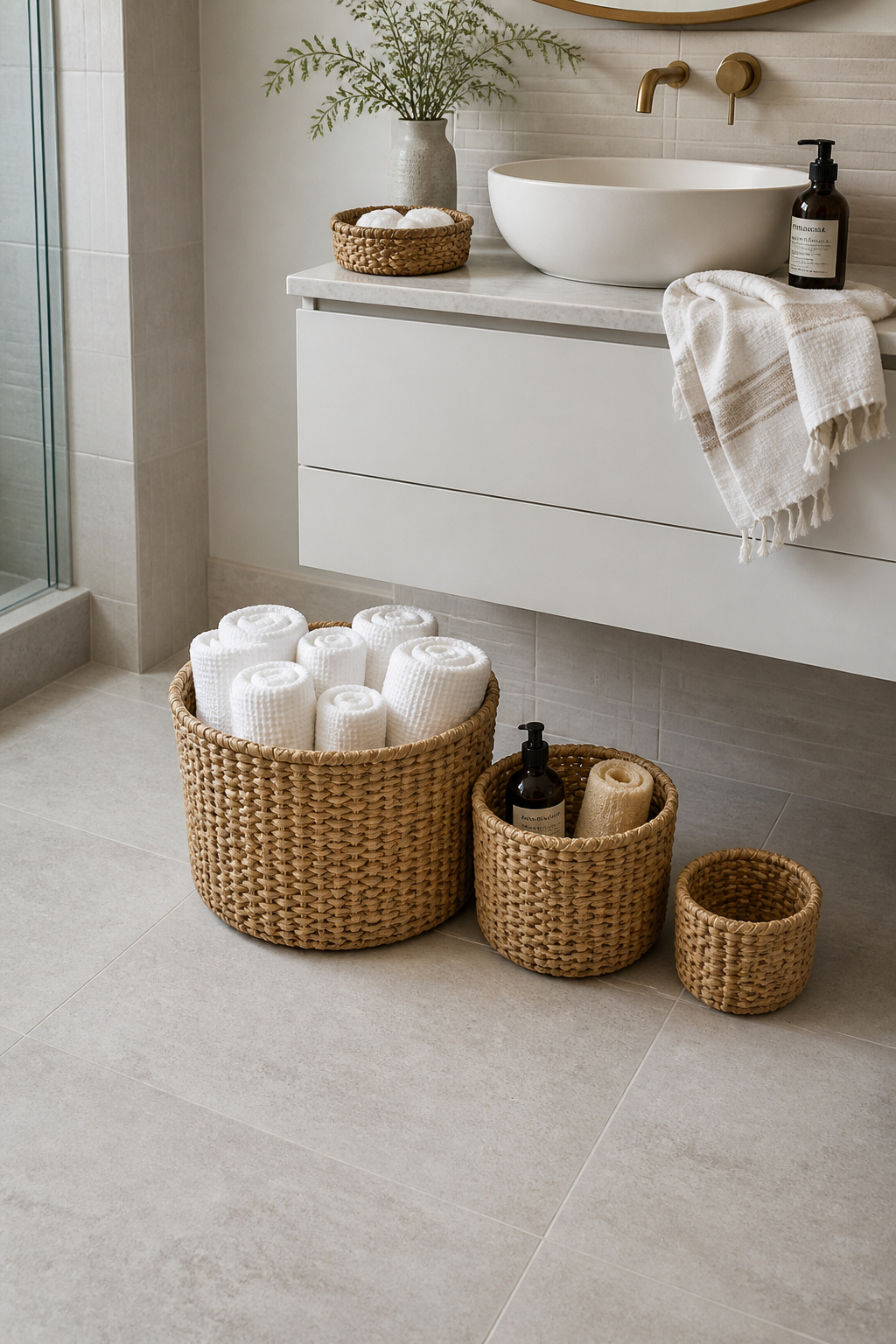
The practicality of bathroom storage ideas that maximise small spaces consistently points to the same principle: visible storage creates an organising discipline that closed storage tends to undermine. When the towels live in a rattan basket on the floor and the basket holds four — not fourteen — towels, the bathroom stays tidier because the constraint is visible. The basket doesn’t expand. Closed cabinet doors hide entropy; open baskets surface it, which is uncomfortable until you realise that discomfort is a signal to edit.
Rattan, seagrass, and water hyacinth each have specific properties for bathroom use. Rattan is denser and handles heavier loads — better for floor-level baskets holding spare towels or toilet paper. Seagrass is lighter and open-weave — appropriate for shelf display where the visual effect matters more than weight capacity. Rectangular seagrass baskets (16 × 6.5 × 4.3 inches) sit precisely on a toilet tank lid and hold 4–6 rolled hand towels without looking overstuffed. The contents visible in open baskets — rolled natural-coloured towels, a bar of soap, a natural loofah — set the aesthetic. Branded plastic packaging should move to closed storage. Decanting shampoo into matching amber glass pump dispensers, a $15 investment, makes the whole arrangement coherent.
11. Rattan-Framed or Arched Mirrors That Require No Drilling
The bathroom mirror is usually the fixed element that defines apartment bathroom decor more than any other single piece. It’s the largest object on the wall, present in every functional use of the space. In most rentals, it’s a plain rectangular piece that contributes nothing beyond its function. A rattan-framed or arched mirror, leaned or adhesive-mounted, is the single-piece upgrade with the highest visual impact relative to cost.
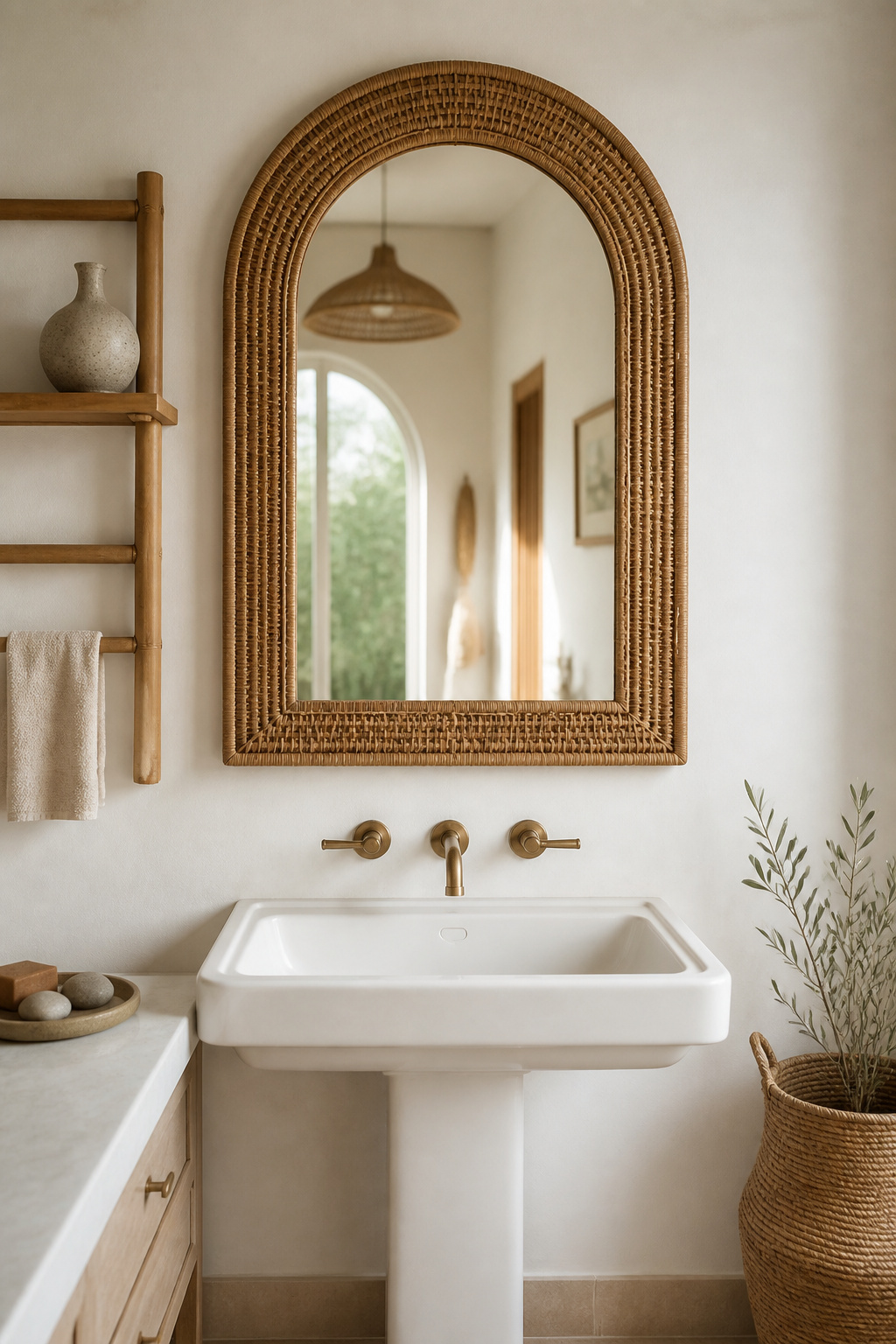
Arched mirrors create vertical emphasis. The eye reads the curve upward, and in a bathroom with a standard 8-foot ceiling, this matters. Arched forms make the room feel taller in a way that a rectangular mirror of identical size cannot. A 24 × 34-inch rattan arched mirror (the Threshold × Studio McGee collaboration at Target is widely available at $60–$90) replaces a standard rental mirror and changes the room’s entire register from utilitarian to considered.
Renting rules out drilling in many apartments, but there are real mounting solutions. Mirror adhesive formulated for bathroom surfaces bonds to tile, ceramic, marble, and painted drywall. It’s rated for temperature and humidity variation. 3M VHB foam tape (double-sided, clear, designed for heavy mounting) holds a 24 × 34-inch mirror to a smooth painted wall reliably once cured. For larger mirrors that are genuinely heavy, leaning against the bathtub surround surround or a wall beside the vanity avoids mounting entirely. Faux rattan and resin-moulded rattan frames are the more durable bathroom choice over real woven rattan if the mirror position is adjacent to a shower — moisture tolerance in uncoated natural rattan is limited.
12. Trailing Pothos and Peace Lilies for Living Bathroom Accents
The difference between apartment bathroom decor that feels designed and a space that feels purely functional often comes down to whether anything in it is alive. A single plant, not a tableau of twelve, not a curated jungle, adds a dimension that no material object replicates.
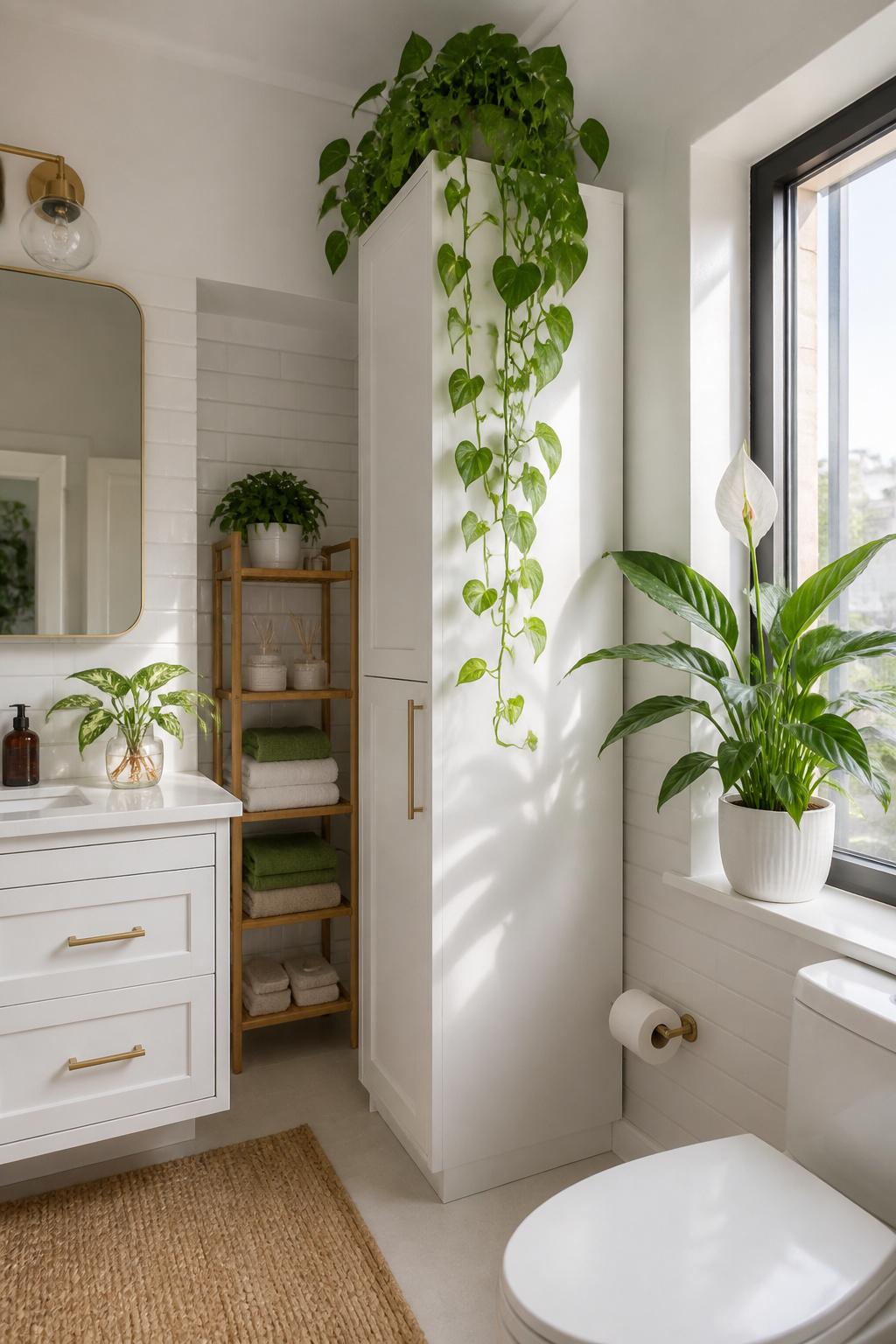
Pothos (*Epipremnum aureum*) is the reliable choice because it tolerates what apartment bathrooms typically provide: low and indirect light, high humidity, irregular care. Water when the top inch of soil dries out, which in a humid bathroom happens every 10–14 days rather than the weekly cadence most care guides specify. A pothos on the top rung of a ladder rack or the top of a tall cabinet trails naturally downward, the cascading vines following gravity and softening the transition between hard horizontal surfaces and blank wall.
Peace lily (*Spathiphyllum*) is the choice for anyone wanting occasional flowers. It prefers indirect light — direct morning sun through frosted glass can scorch the leaves — and benefits from the ambient humidity of a bathroom that means you rarely need to mist it. Keep the soil lightly moist but never waterlogged. The white flower spathe is formal and clean, a counterpoint to the organic irregularity of natural materials elsewhere in the room.
Both species propagate easily. A pothos cutting placed in a glass of water in indirect light roots within two weeks. Glass propagation vessels — small pharmacy bottles, vintage glass jars, any transparent container — with their visible root systems are a form of bathroom decor in their own right. The growth process becomes part of the display.
13. Ceramic Vessels and a Reed Diffuser for Layered Apartment Bathroom Ideas
The sense of smell is the most underinvested dimension of bathroom design. Most apartment bathrooms are olfactorily dominated by whatever cleaning products were used last. A reed diffuser in a ceramic vessel doesn’t just add fragrance — it introduces a continuous, low-maintenance sensory element that shifts the room’s atmosphere in a way that no visual change can fully replicate.
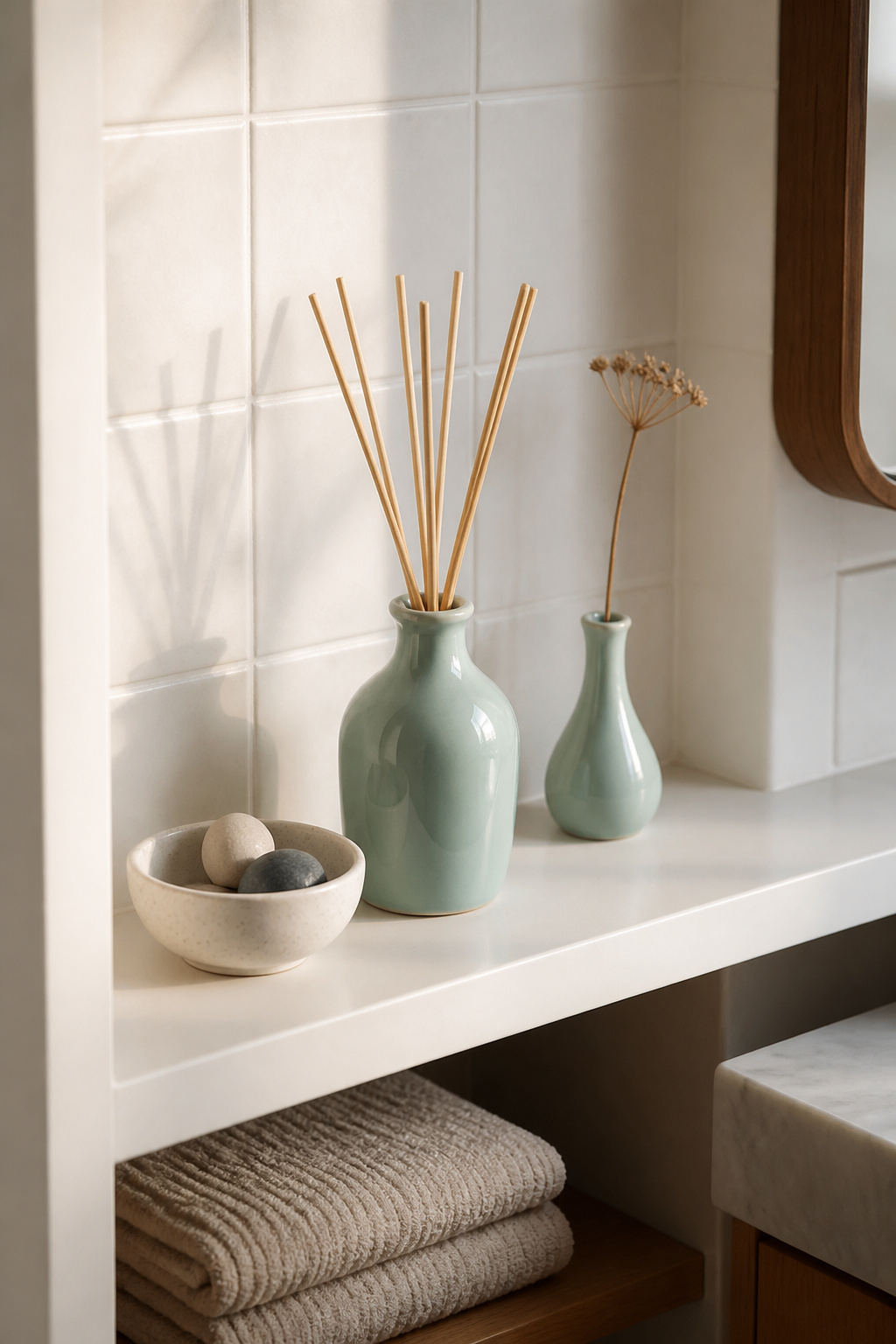
Japanese bath culture understands scent as integral to the bathing ritual. The canonical fragrance profile for these spaces returns to three notes: hinoki (Japanese cypress, clean and woody), yuzu (bright citrus, energising), and green tea (light, astringent, clarifying). These are not arbitrary — they’ve been selected across centuries. These aren’t arbitrary preferences. They’re scents selected over centuries for their specific psychological effects in an enclosed, warm, humid space.
Hinoki diffuser — brands like Apotheke (Hinoki Lavender) and The Cross Living’s Hinoki Reed Diffuser Kit — reinforces the natural wood material language of a bathroom that has bamboo, rattan, or teak. Yuzu is the morning choice, energising rather than settling. Green tea works in bathrooms with cool tile tones and creates a clean, minimal olfactory presence. The ceramic vessel itself is part of the design: short, wide-mouthed matte white or celadon (pale blue-green) vessels at 8–12cm height work on a countertop; taller narrow vessels are better on a shelf or floor display. If the rest of the apartment is following the same aesthetic logic, the apartment bedroom decorating ideas to carry the aesthetic further extend this material and sensory language beyond the bathroom door.
14. A Wooden Step Stool as Functional Sculpture in a Small Bathroom
Most of what gets placed on the floor in a bathroom is purely functional — the bath mat, the bin, the towel rail base. A wooden step stool is the exception in apartment bathroom decor. It has genuine functional use — reaching high shelves, serving as a foot rest — but in the right material and proportion, it reads as furniture rather than a utility item.
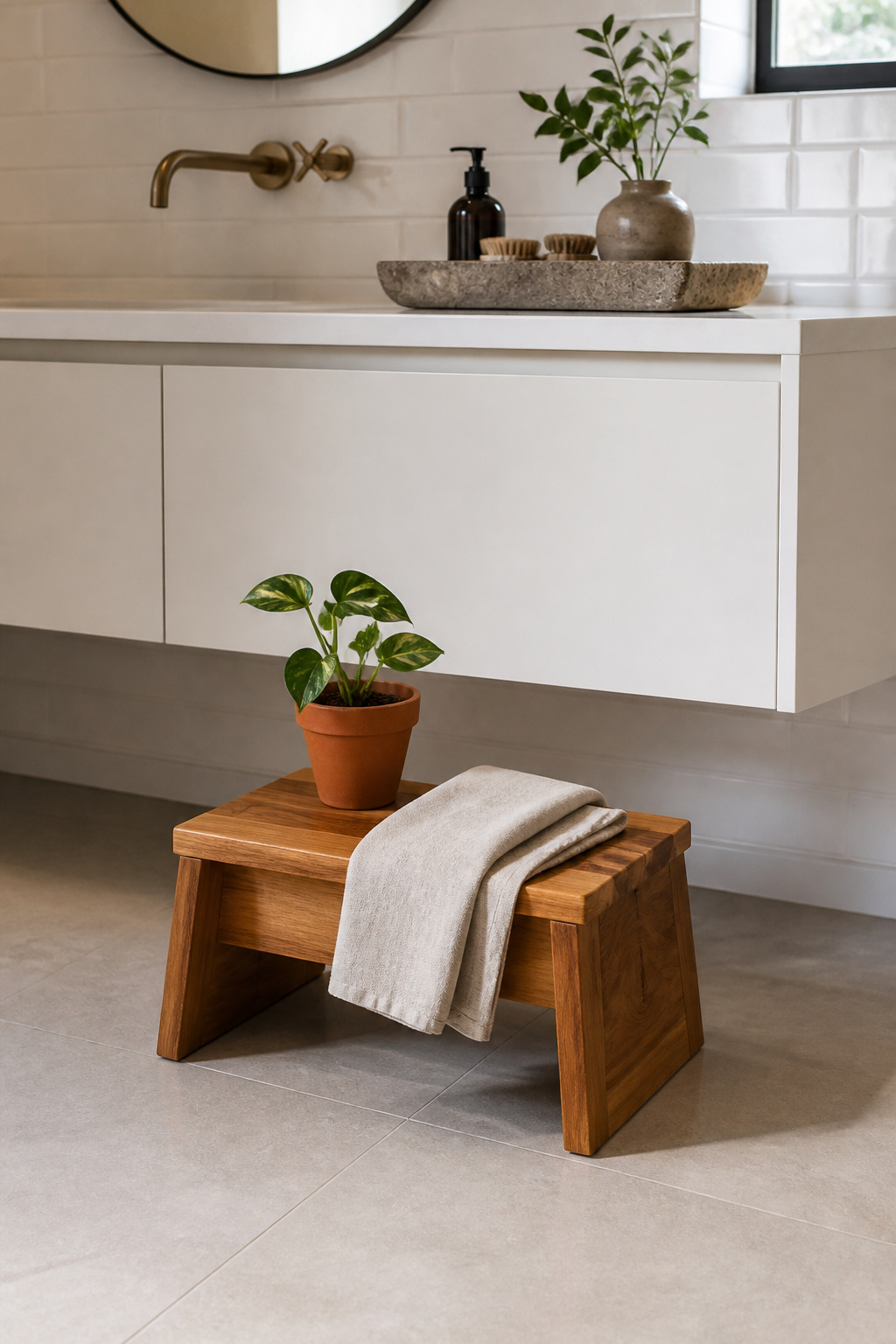
A compact teak step stool beside a floating vanity or a freestanding bath introduces warm wood tone at floor level: the point in the room where natural materials are most absent. The top surface functions as a secondary display: a small plant in a terra cotta pot, a folded hand towel, a single bar of soap. These small arrangements on lower surfaces create a visual rhythm moving from floor to shelf to ceiling that makes a small bathroom feel layered rather than flat.
Dimensions matter in tight apartment bathrooms. Stools with a platform height of 7–8 inches (17–20cm) slide under floating vanities without obstruction. AquaTeak’s 18-inch Asia Teak Shower Bench (platform dimensions 17.75 × 12.6 inches) fits the gap beside most standard toilets, typically 18–24 inches wide, and carries 300 lbs. Teak is the appropriate material for a bathroom that sees daily humidity: the heartwood’s natural oils resist water, rot, mould, and bacteria without chemical treatment. Rubberwood is the budget alternative, significantly less expensive than teak, handles humidity well when properly lacquered, and is widely available in step stools under $40. Avoid untreated pine or MDF, which swell and discolour within a season of bathroom exposure.
15. Monochrome Towel Sets in Textured Weaves for a Cohesive, Restful Palette
Towels communicate the design intent of a bathroom more clearly than most people realise. A mismatched set — one hotel-brand white, one faded grey, one patterned from several years ago — reads as accumulated rather than chosen. A matched set in a considered neutral and a textured weave reads as a decision that was made.
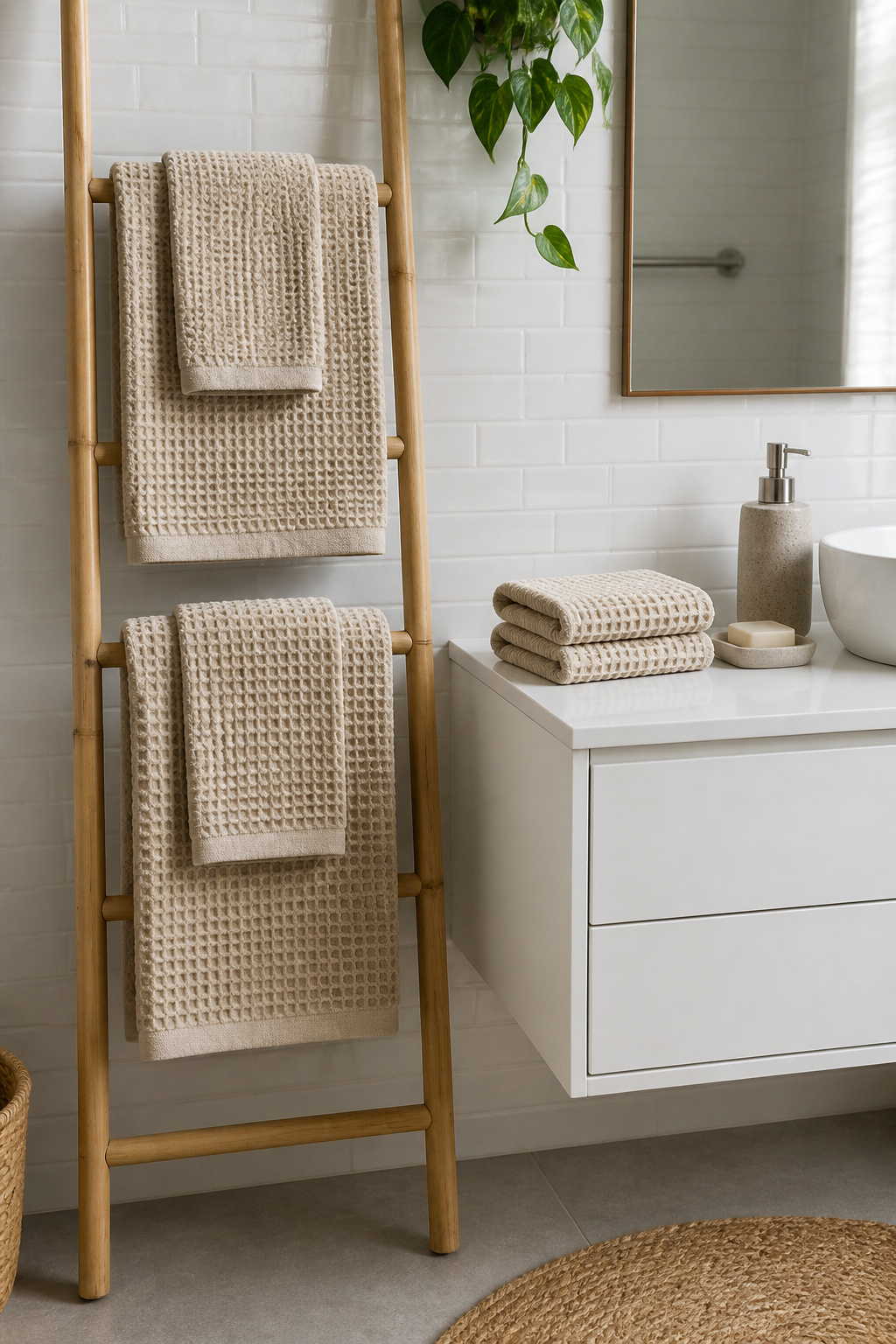
Waffle-weave towels have a honeycomb texture visible across a bathroom. The three-dimensional surface catches light and adds tactile interest to a towel rail or ladder rack in a way that flat terry cannot. They dry faster than terry, are lighter to launder, and hold their appearance better over time. Turkish flat-weave (peshtemal) towels are the spa choice: thin, quick-drying, with a long fringe edge that creates visual interest when folded. The fabric softens with each wash, improving rather than degrading with use. Ribbed towels (clean parallel rib pattern) are the most contemporary-feeling of the three — H&M Home, Zara Home, and Coyuchi all offer them at accessible price points.
Colour: warm white, oatmeal, natural linen, pumice stone, or warm slate grey. These neutrals work against any rental tile colour because they don’t compete — they settle. Bright white shows every watermark and requires frequent laundering to maintain. Warm neutrals are more forgiving and more interesting. Buy a complete matched set in one transaction from one brand. The slight tonal variation between whites from different manufacturers looks subtle in product photography and very obvious on a towel rail. The folding technique completes the effect: a spa-style tri-fold stacked on an open shelf looks like a deliberate choice. When the bathroom achieves this kind of quiet coherence, the apartment living room ideas that carry the same restful palette through adjacent spaces tend to follow naturally. The apartment reads as a considered whole rather than a series of rooms assembled separately.
Designing Your Apartment Bathroom Decor: Start With One Small Decision
The most common mistake in a small bathroom is treating it as a project to complete all at once — a renovation-style moment where everything changes simultaneously. This produces either paralysis (too many decisions at once) or an over-decorated space that looks busy rather than calm.
The more useful frame is incremental addition. Start with the shower curtain: it’s the largest visual element in the room, it sets the palette for everything that follows, and it requires no commitment beyond the price of the curtain. Once the curtain tone is established, subsequent choices become easier because they’re responding to an anchor rather than working from scratch.
From there: the highest impact per dollar comes from a matched towel set and a single plant. Three things — a curtain, towels, a plant — and the bathroom has a point of view. Everything after that is refinement.
For renters who might move within 12 months, weight the freestanding and no-damage choices: the ladder rack, the baskets, the step stool, the plants all move with you. Adhesive-based changes (peel-and-stick tiles, washi tape patterns) require careful removal but leave the walls intact when that removal is done correctly. The zero-impact changes — curtain, towels, stones in a tray — never touch the walls at all.
The principle underlying all 15 of these ideas is the same one that informs a well-designed bath ritual: a small, considered act repeated consistently produces a better outcome than a large, unfocused intervention. One bamboo shelf, edited carefully, holds more atmosphere than a bathroom stuffed with every trending accessory. Less, chosen deliberately, is always more.