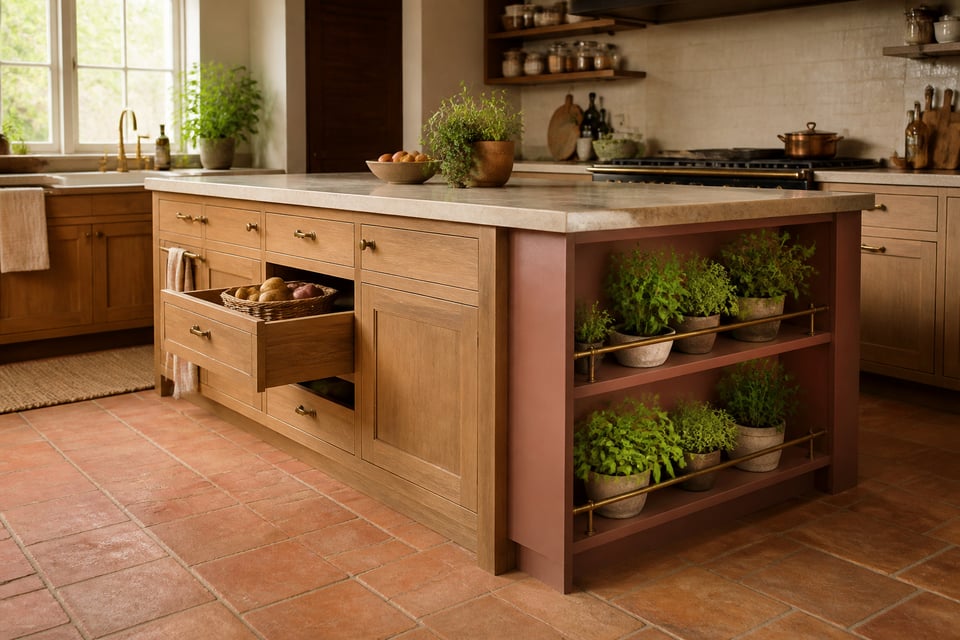
Most kitchen islands start with good intentions. You picture prep space, conversation, somewhere to set the groceries down. Then six months in, the surface is buried under mail, the cabinet beneath holds three things you haven’t used this year, and the whole thing has become an obstacle rather than the productive heart of your kitchen.
Kitchen island cabinets are where this goes right or wrong. Get the storage configuration right and the island becomes the most hardworking piece of furniture in your home. Get it wrong and you have an expensive counter. These 16 kitchen island cabinet ideas cover the full range — shaker classics with herb drawer integrations, steel-frame industrial setups, compact rolling solutions for renters. Most of them are practical before they’re beautiful, which is the right order to think about them.
1. Shaker-Style Kitchen Island Cabinets With Integrated Herb Drawer Systems
The shaker kitchen island cabinet earns its popularity. The 5-piece door construction — solid frame, recessed panel — is structurally honest and endlessly adaptable. That matters when you’re designing storage to do specific things rather than just look good.
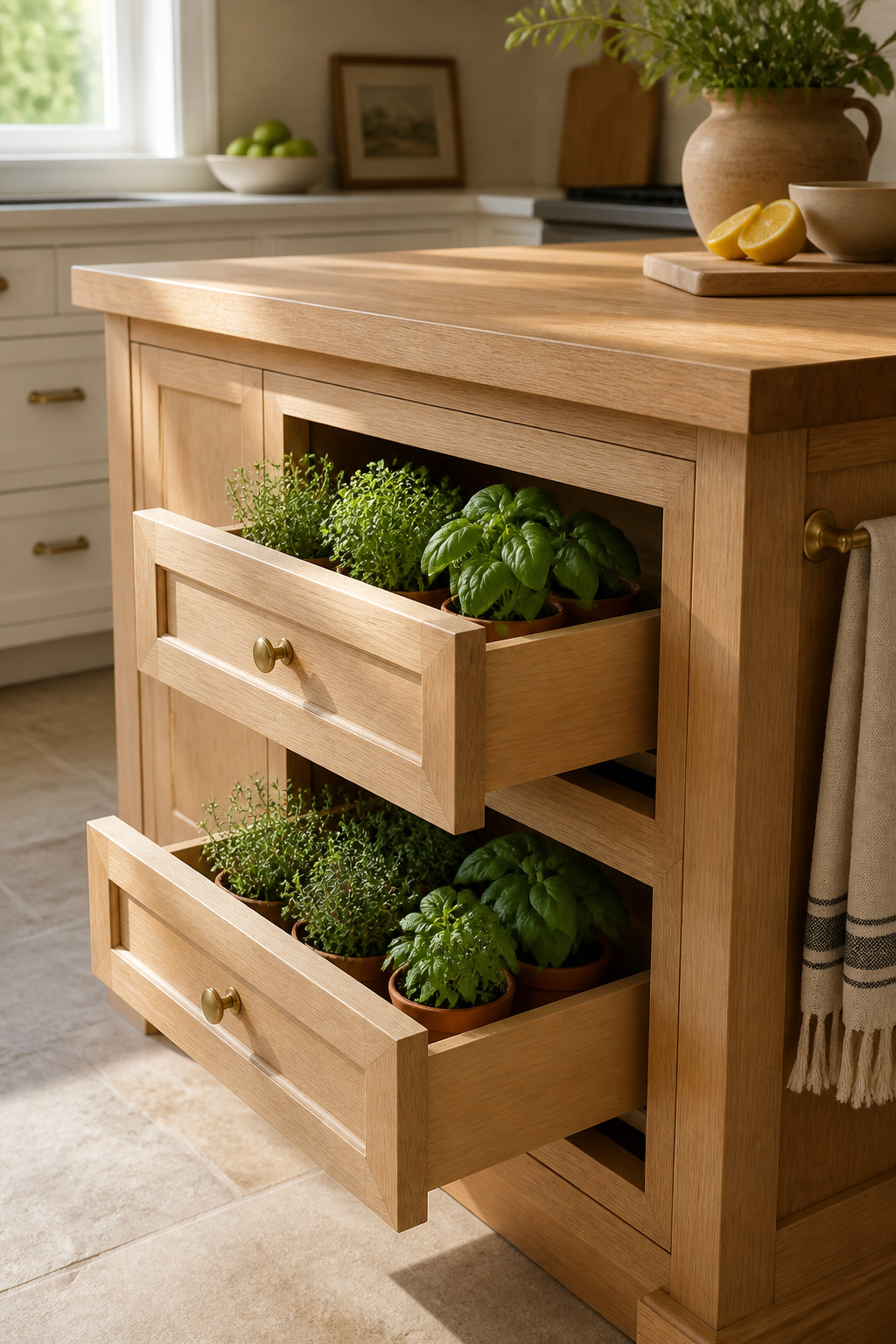
White oak and birch are the best species for kitchen island cabinet boxes. Both have tight grain structures that resist moisture better than softer woods. For the drawer boxes, dovetail joints with 1/2-inch plywood bottoms are the standard you want — stronger than dowel-built options, and built to hold bulk storage over years.
The herb drawer integration is where this configuration gets interesting. A standard shaker base typically has a 7-inch high drawer stack. Split that into two 3-inch shallow drawers and you have dedicated herb tray storage directly beneath your prep surface. Line each with a food-safe silicone mat to catch moisture, or use removable terracotta inserts that regulate humidity naturally.
For finish, hardwax oils (Rubio Monocoat, Osmo Polyx) penetrate rather than film-build. They’re repairable in sections without stripping and refinishing the whole island. Avoid lacquer near herb and food storage — solvents can off-gas into adjacent drawers in the weeks after application.
Why shaker suits the sustainable kitchen
The material choices pair naturally with natural kitchen philosophies. Solid timber construction, no laminate skins, easily repairable without replacement. An island built this way lasts decades rather than years.
2. Open Shelving Islands With Bamboo Dividers for Zero-Waste Organization
Open island shelving is a commitment. It looks calm and intentional when it works. It looks like storage overflow when it doesn’t. The difference is usually the discipline of the categories and containers, not the shelving itself.
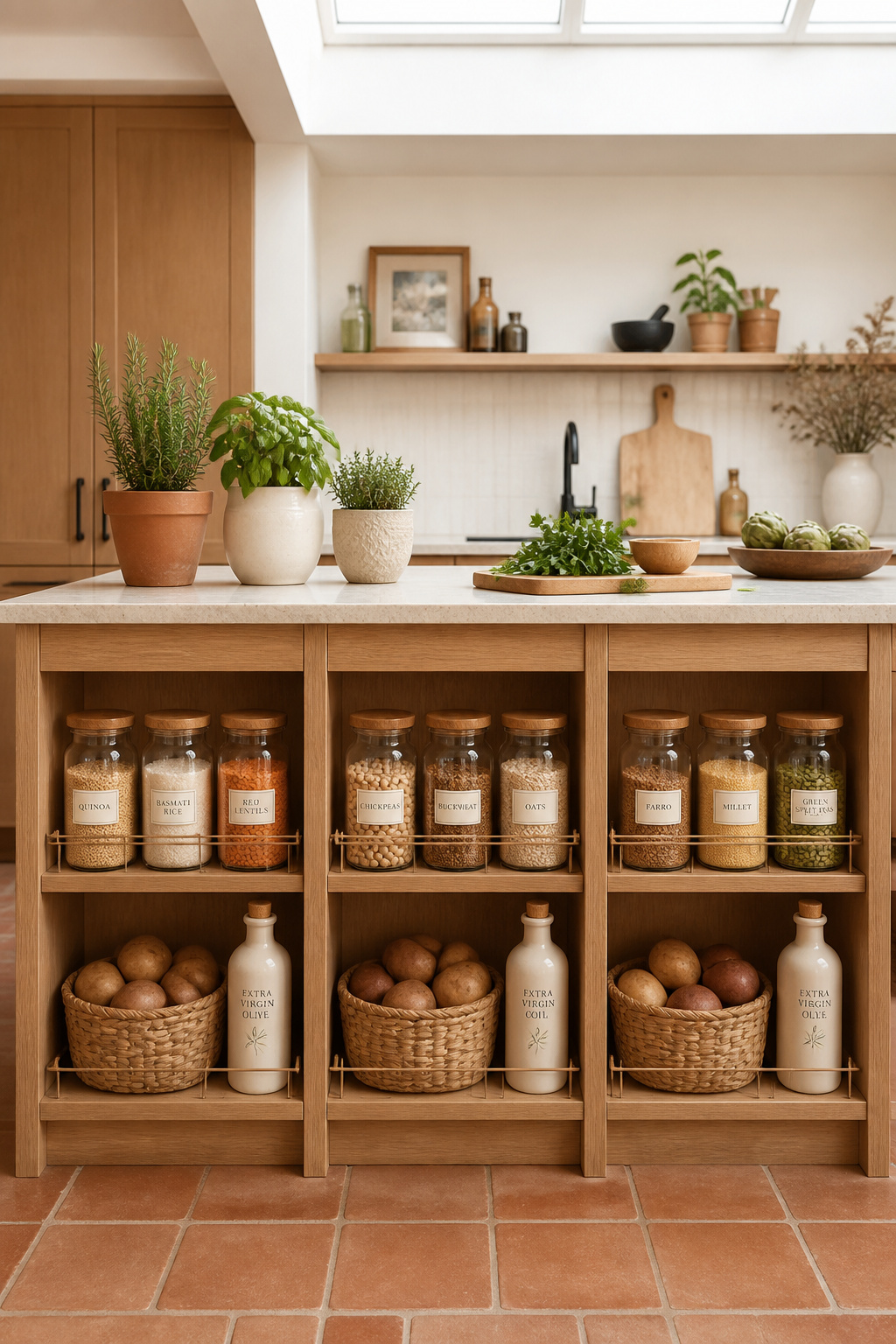
Bamboo dividers make open shelving manageable. Expandable options from SpaceAid and Bambusi adjust from 17.5 to 22 inches. They fit most standard 24-inch island base widths without custom cutting. Bamboo’s tight grain structure resists odour absorption — unlike particleboard organizers that start smelling of old onions within months.
Bamboo regrows in 3-5 years without replanting. It requires fewer chemical inputs than conventional timber. It’s also significantly lighter to ship than comparable wood or metal organizers. Stackable bamboo shelf risers can double the usable area of a single island shelf bay without structural modification.
For open island shelves to work visually, the three-category rule helps. No more than three distinct item types per shelf — grain jars, a wicker produce basket, a ceramic oil bottle. Uniform containers transform a collection of ingredients into a display. The lowest shelf holds the heaviest, most-used items; lighter display pieces go higher. For more kitchen storage hacks that actually save space, the approach extends well beyond the island.
The honest caveat: open island shelves gather dust. A rotating stock of actively-used dry goods solves this better than decorative displays that never move.
3. Deep Drawer Kitchen Island Cabinet Design for Bulk Dry Goods and Root Vegetables
Of all kitchen island cabinet configurations, deep drawers consistently deliver the most usable storage per square inch of floor space. A standard hinged base cabinet wastes 30-40% of its interior depth to inaccessibility. A deep drawer brings everything to the front in a single motion.
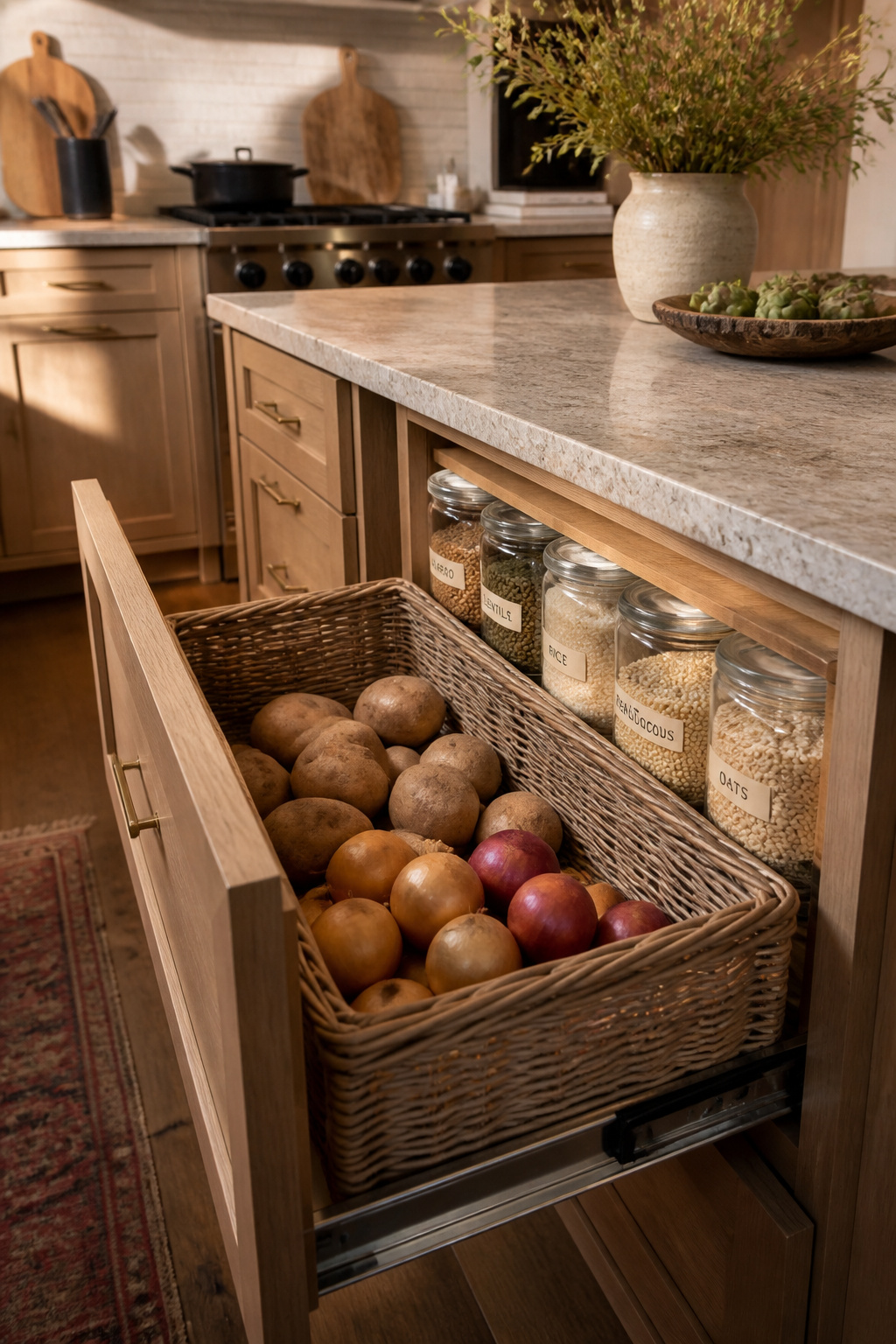
Root vegetables need darkness and air circulation. A mesh-front wicker basket insert provides both when the drawer is closed — dark, covered, with enough breathability to prevent moisture buildup. Line the basket with breathable linen for a cleaner look that still allows airflow.
Standard base cabinet interior depth runs 21-23 inches. Deep island drawers are typically 24 inches. A three-drawer stack works well: top for weekly-use items (current potatoes, onions, garlic), middle for bulk reserves, bottom for large infrequent-use items.
The Rev-A-Shelf 4WDB series and Blum Legrabox both adapt well to deep island drawer configurations. Decant bulk dry goods into standardised glass or food-grade PET containers. Uniform sizing lets you fit more per drawer depth and makes quantities visible at a glance. Good kitchen storage organization starts with this kind of visibility — deep drawers are its most effective expression.
The ergonomic advantage
The pull-out motion means heavy items (cast iron, bulk grain containers) can be moved in and out without lifting. That matters more than it sounds after two years of daily cooking.
4. Two-Tone Kitchen Island Cabinet Ideas With Natural Wood and Painted Fronts
Two-tone kitchen island cabinet ideas have moved past trend status. The logic behind them is genuinely sound. The island is the focal point of the kitchen by definition. A distinct colour separates it visually from the perimeter cabinetry and defines it as a purposeful zone.
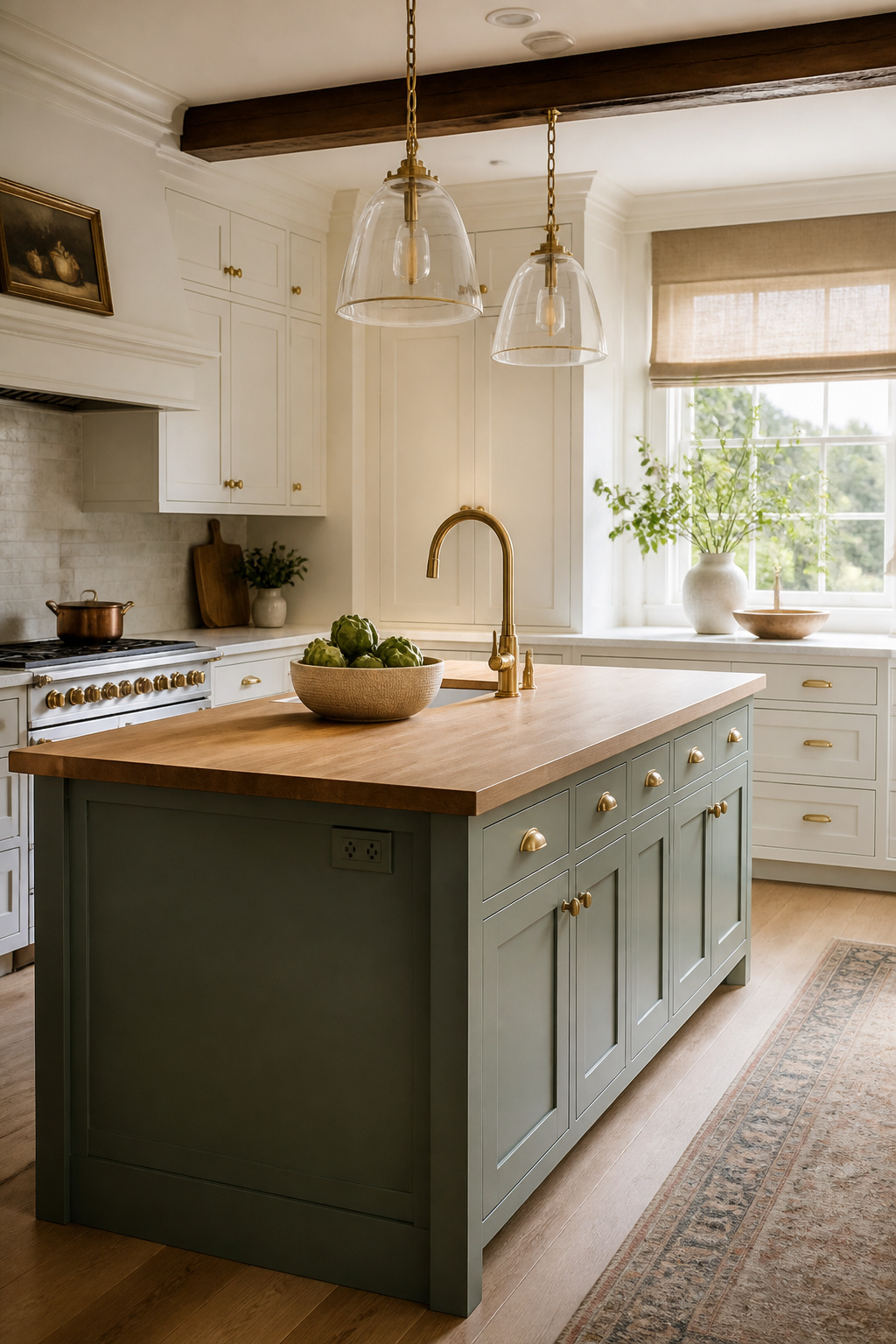
The 60-40 rule is the most useful guideline. Dominant colour covers 60% of cabinet surfaces; accent covers 40% (the island). The strongest 2025 island tones are forest greens, deep navies, and warm terracottas against lighter perimeter cabinets.
Warm-toned woods — white oak, hickory — pair naturally with forest green or terracotta. The warmth in the wood prevents the paint reading cold. Cooler-toned woods like maple suit navy or charcoal, where the neutrality of the timber doesn’t fight the cooler hue.
For durability, Benjamin Moore Advance is the most consistently recommended cabinet paint. It self-levels to a near spray finish and the hard enamel surface takes daily contact without chipping. Matte finishes are popular but satin is the practical sweet spot — easier to wipe clean. For a wider view of how kitchen island designs use colour and character, there are configurations across every aesthetic.
5. Farmhouse Island Cabinets With Tongue-and-Groove Panelling and Apron Details
A farmhouse kitchen island looks inherited rather than installed. It arrived from somewhere, was built for a purpose, and has been used. Tongue-and-groove panelling on the island sides creates that impression cost-effectively, even when the island itself is new.
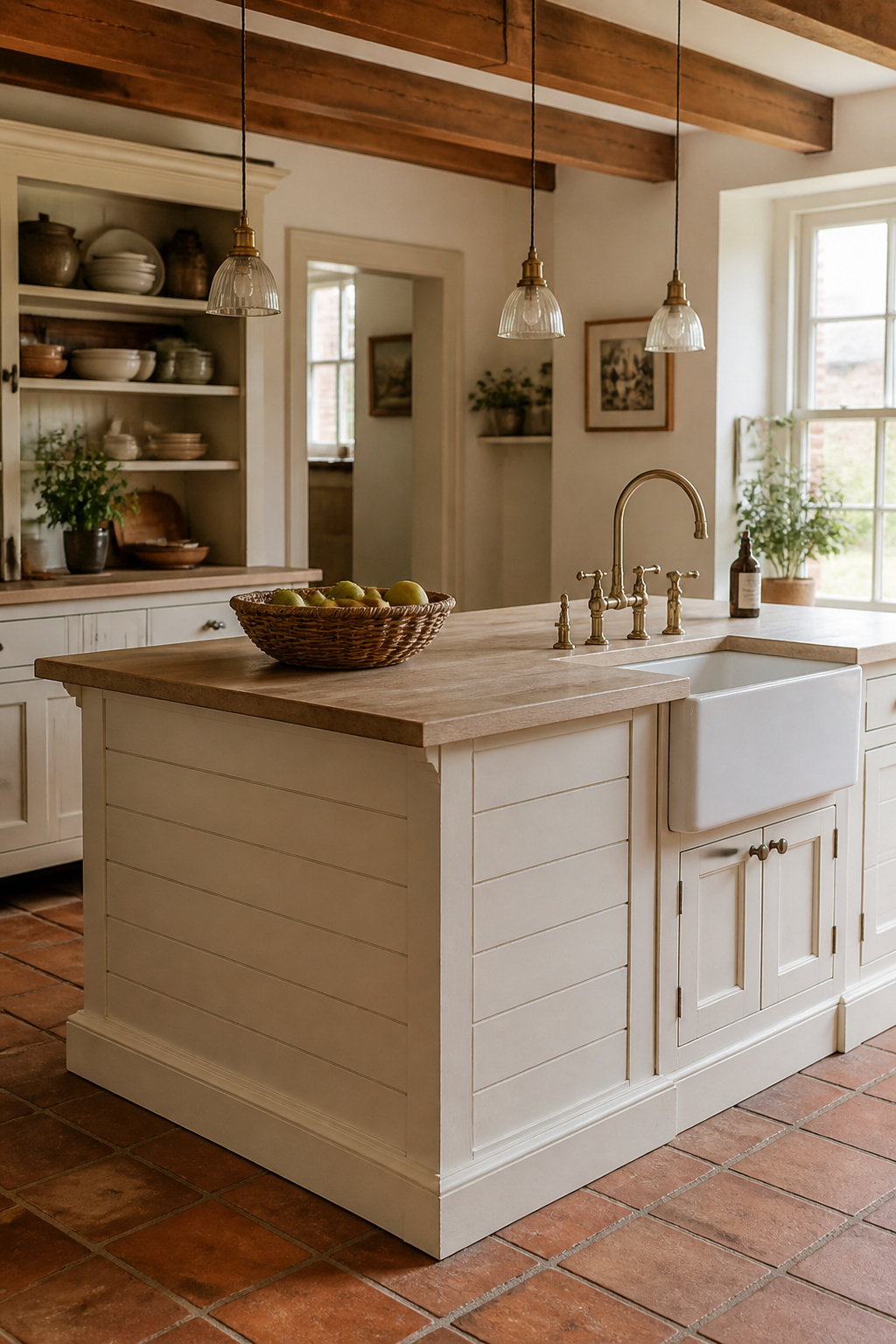
Standard T&G boards for island side panelling run 3/4-inch thick. Run them horizontally to visually widen the island, or vertically for a classic wainscoting look. Pre-primed MDF T&G boards take paint more evenly than raw wood. They’re also dimensionally stable — a worthwhile upgrade where colour consistency matters.
Chalk paint with clear wax gives a matte hand-painted finish. Eggshell in a cabinet-grade paint is more practical for a kitchen that gets real use — still farmhouse in aesthetic, but wiping clean doesn’t require annual wax reapplication.
Apron sink integration transforms a farmhouse island into something that reads as architectural. The apron front sits flush with the island panelling, creating a continuous visual line. Apron sinks need a minimum 33-inch wide reinforced cabinet opening — plan this in at the design stage. The piece on farmhouse kitchen island design principles covers the full range of material and configuration choices available.
Avoiding the common panelling mistake
Use 3/4-inch boards, not 1/2-inch. Thinner T&G on island sides bows over time in kitchen humidity. The extra cost of the thicker board is negligible compared to the remediation.
6. Minimalist Island Storage With Integrated Push-to-Open Cabinet Panels
A handleless kitchen island is the sculptural version of island storage. No hardware interrupting the plane of the cabinet fronts, no visual noise — just the form of the island itself. It’s harder to execute well than it looks, and hardware choice matters more than most people realise.
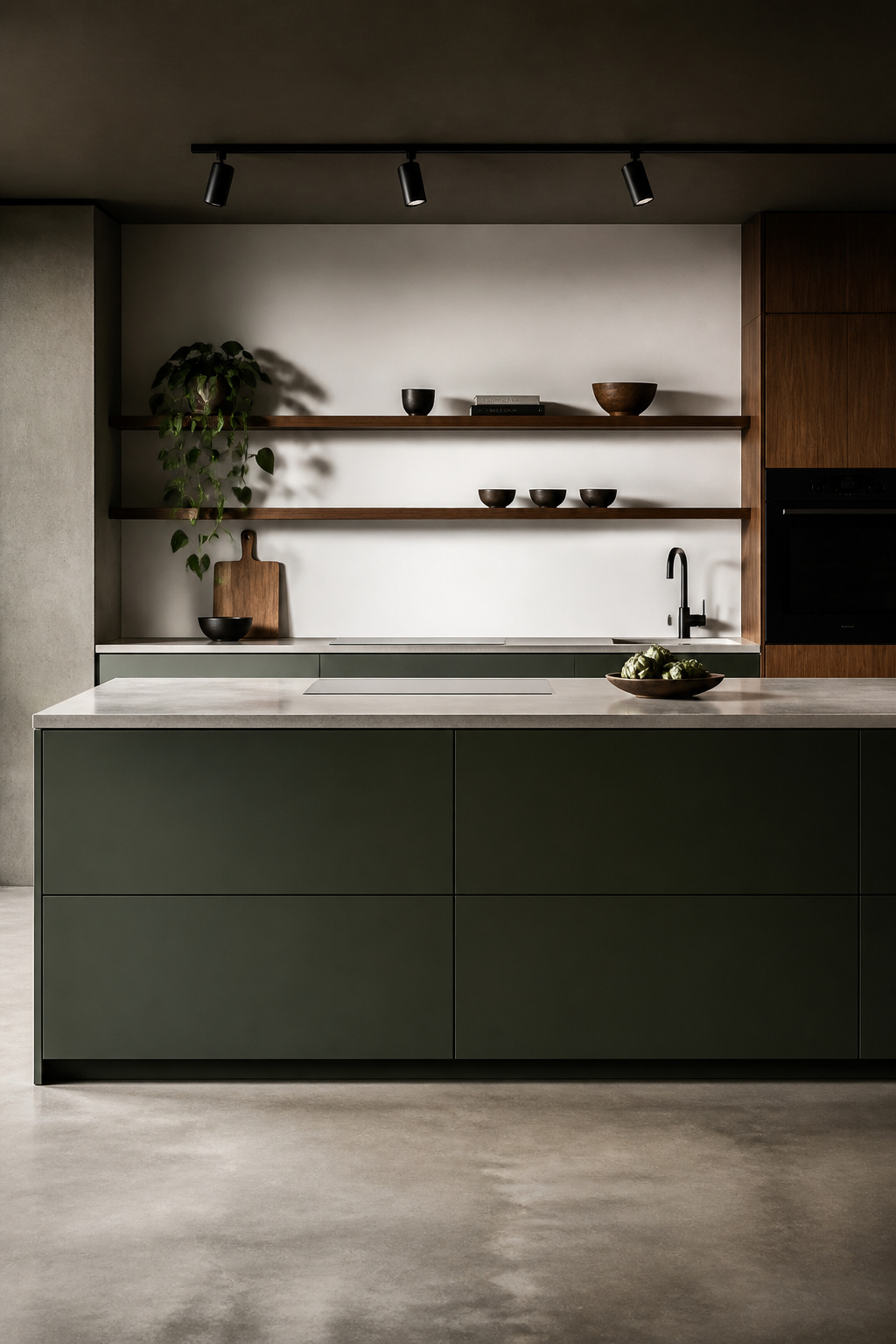
There are two distinct systems. Mechanical tip-on latches (Blum TIP-ON) are spring-loaded pistons rated for over 100,000 cycles. Magnetic touch latches cost $2-4 each versus $15-40 for Blum TIP-ON, but degrade over 3-5 years as magnetic holding force diminishes. High-cycle hardware pays back over a kitchen’s lifetime.
Island doors get used more than any other cabinet — the island is the most active surface in the kitchen. Fingerprint-resistant matte lacquer is essential on handleless fronts. Every touch point shows on a flat, uninterrupted surface.
Always specify soft-close hinges alongside push-to-open mechanisms. Without them, the spring-loaded opening creates a return snap that loosens cabinet frames over time.
7. Kitchen Island Cabinets With Built-In Composting and Waste Sorting Systems
The most environmentally honest upgrade to kitchen island cabinets is still treated as an afterthought in most kitchen guides. Build the waste sorting system in from the start — and build it in the right place.
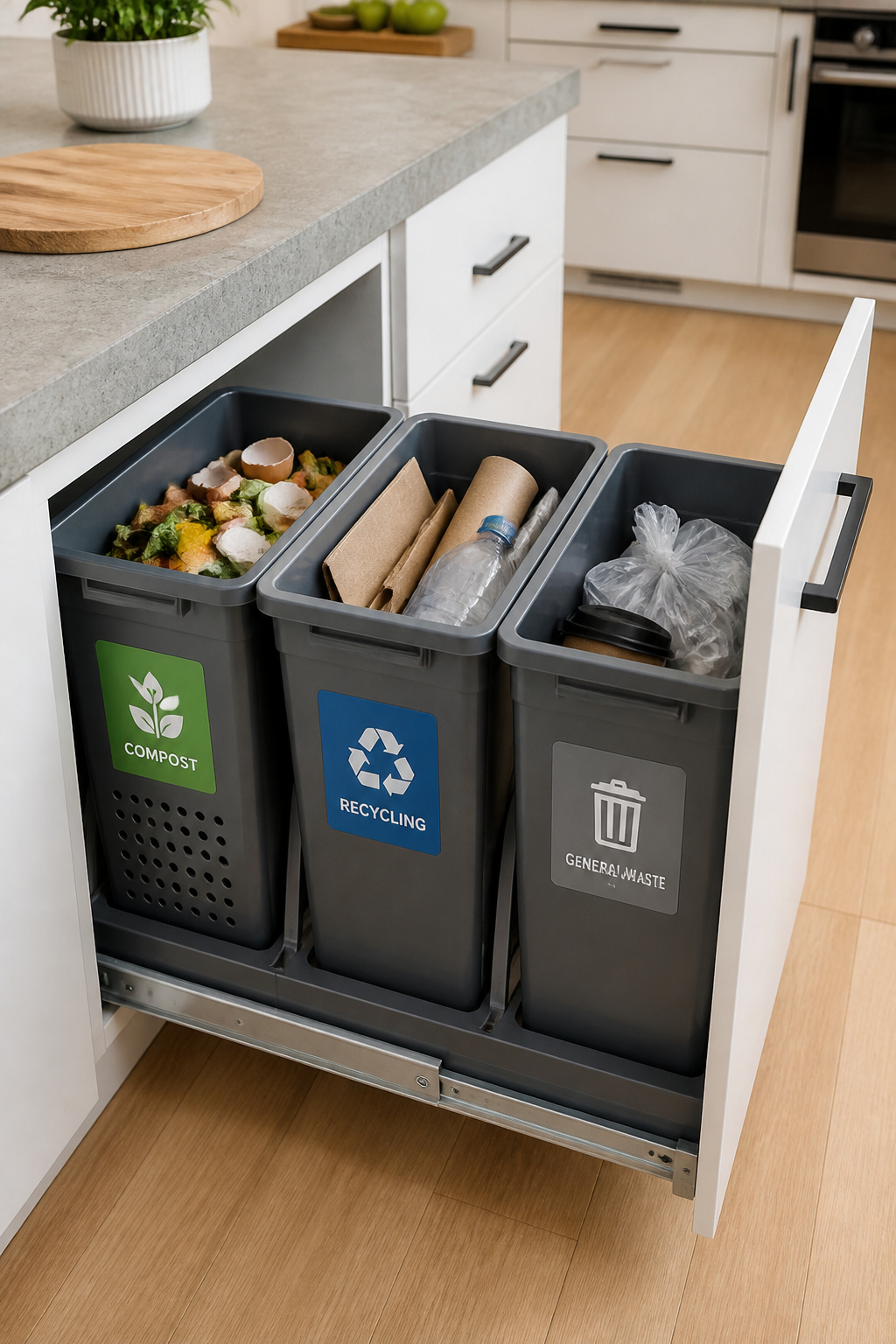
Placing the compost pull-out below the island prep surface means food scraps can be swept directly from the chopping board into the bin. That friction reduction is everything. People sort waste when it’s easy. For a deeper exploration of kitchen design built around ecological intention, the piece on an organic kitchen cabinet ecosystem covers the full picture.
Häfele and Rev-A-Shelf both make pull-out bin systems for two or three streams. A three-stream unit needs a minimum 18-inch cabinet width — a standard dimension in most island configurations. IKEA’s FARMARKVAST compost bin includes a charcoal-filtered lid that seals tightly enough for weekly emptying without odour between changes.
Ventilation matters more than people anticipate. A sealed cabinet holding compost creates anaerobic conditions that produce methane and foul odour within days. A 5-10mm passive gap at the cabinet back provides air circulation. Active ventilation — a compact 12V USB fan in the back panel — works better in warm kitchens. Ventilated bins with perforated sides keep the contents aerobic and the smell manageable.
8. Reclaimed Wood Kitchen Island Cabinet Doors for an Eco-Chic Look
Reclaimed wood cabinet doors are worth the sourcing effort. The grain patterns in old-growth timber — tighter rings, denser fibres, the character marks of a century of life — aren’t available in new lumber at any price. A reclaimed barn oak door has something a new oak veneer cannot replicate.
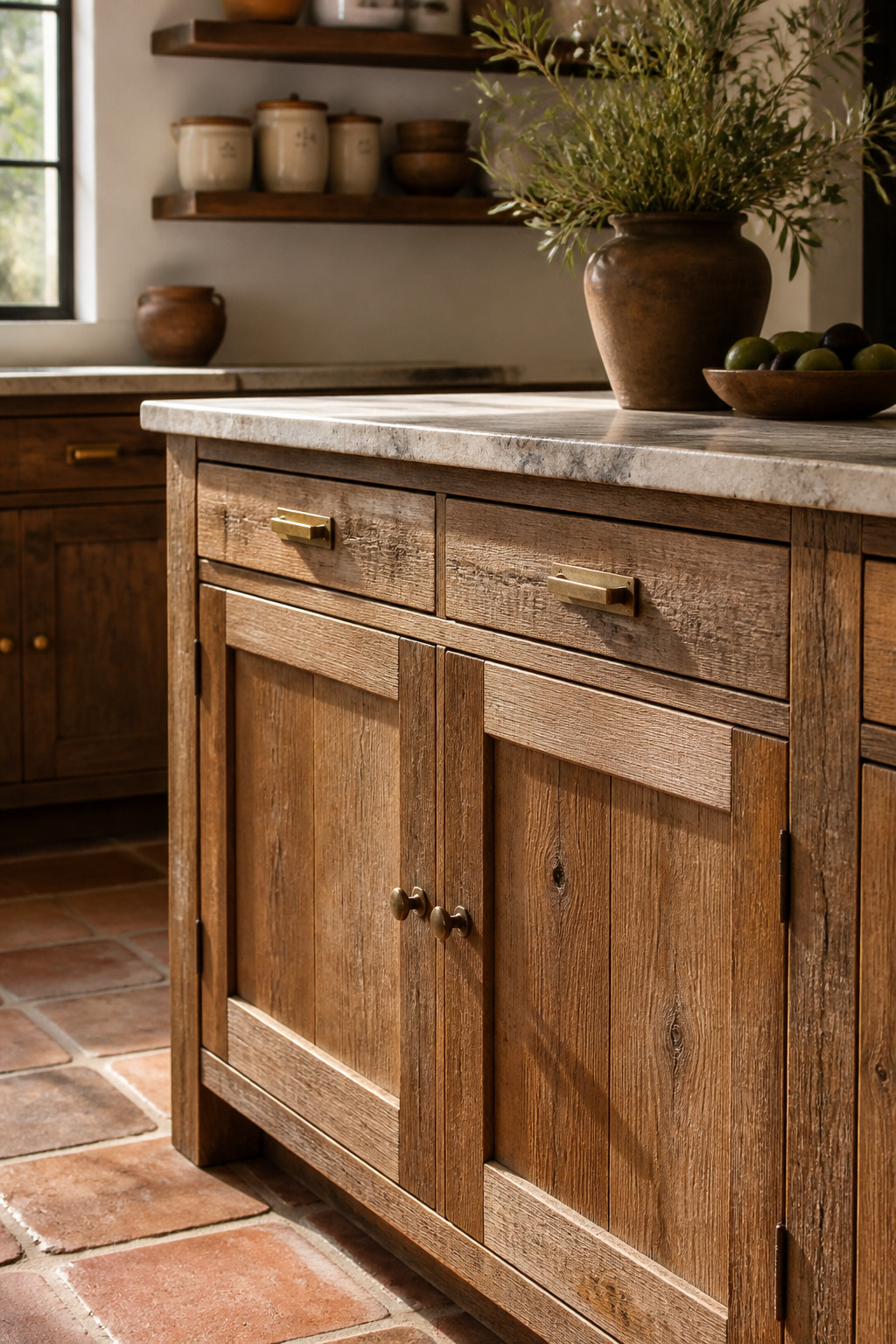
The environmental argument is solid. Reclaimed wood avoids virgin timber harvest and diverts structural material from demolition waste. For a kitchen designed around ecological values, the material is as honest as it gets.
Sourcing matters. Specialist reclaim suppliers — The Hudson Company, Olde Wood Ltd, Reclaimed World — supply kiln-dried, graded boards for cabinet making. Check moisture content with a pin moisture meter before purchase. Indoor cabinet use requires under 12%; freshly pulled barn boards often run 18-25% and need time to dry. Magnet-sweep all boards before cutting to find embedded metal.
Hardwax oils (Rubio Monocoat, Osmo Polyx) are the right finish for reclaimed kitchen cabinet doors. They penetrate dense grain rather than film-building over it. That means the oil doesn’t crack at knots and character marks — exactly the features that make reclaimed wood worth choosing in the first place.
9. Corner-Wrap Kitchen Islands That Maximise Every Edge and Angle
A kitchen island configured to wrap around a corner is a more ambitious project than a straight island. The storage return justifies the complexity. A corner island typically adds 15-20% more cabinet capacity than a straight island of the same overall footprint.
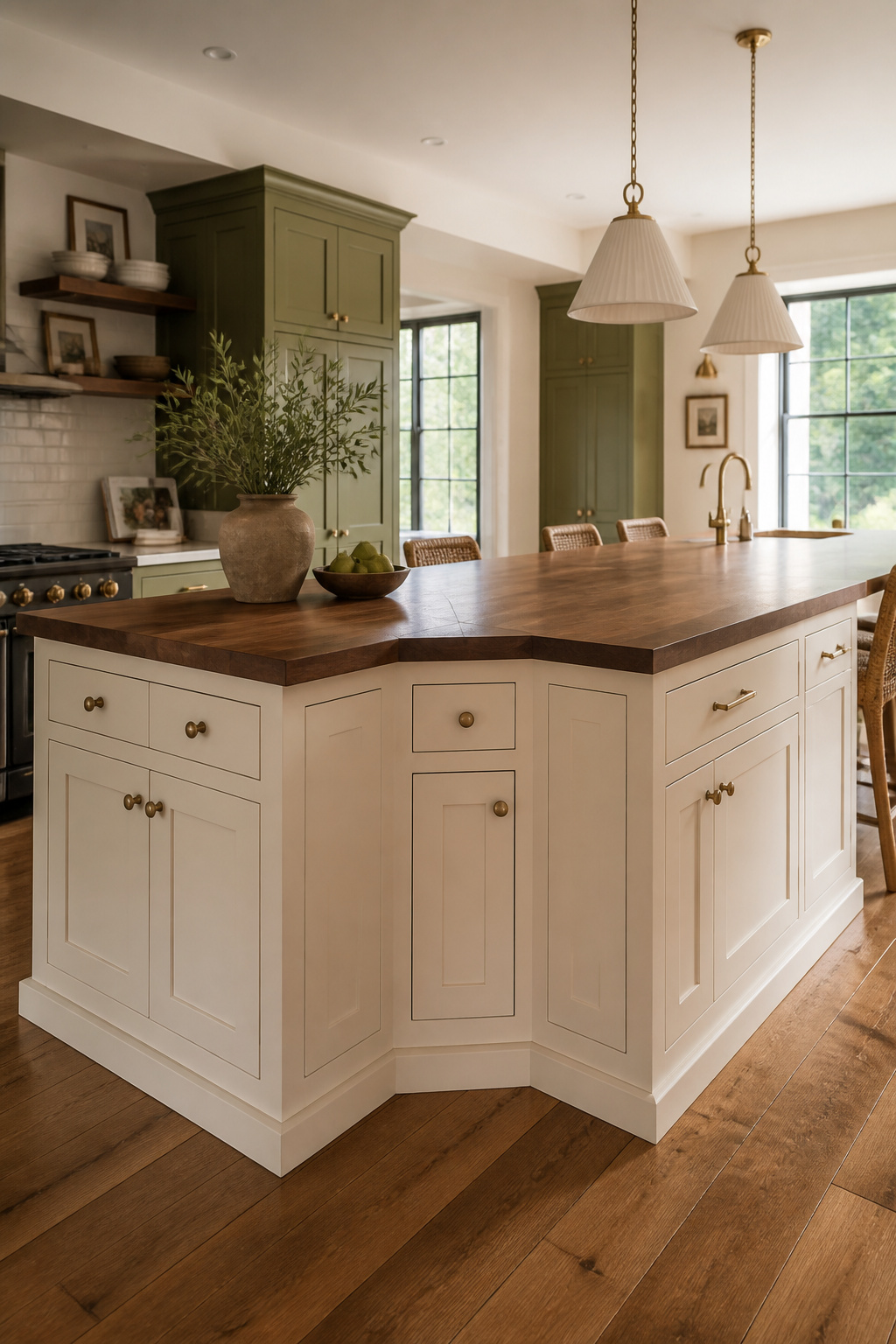
Traffic flow is critical for corner islands. A minimum 36-inch clearance is needed on all active sides, and 42 inches where the corner sits on the main circulation route between sink, cooker, and refrigerator.
Three standard corner solutions exist. Full-circle Lazy Susans (24-28 inch diameter, $50-200 installed) are most affordable but rotate items in circles. Blind corner pull-outs (Häfele Magic Corner, $150-450) slide out and swing contents forward — ergonomically best. Pie-cut drawers curve around the corner and pull straight out. The cleanest solution aesthetically, but requiring professional cabinetry to execute.
Whatever corner solution you choose, treat the junction as a design moment. A vertical post, a contrasting wood inlay, or a turned leg detail at the corner makes it feel intentional. Alternatively, abandon the corner cabinet entirely and let the island end become an open display shelf.
10. Pull-Out Kitchen Island Cabinet Shelves for a Zero-Waste Pantry Setup
A pull-out shelf system inside an island cabinet is the single most impactful storage change you can make without architectural work. Standard base cabinet interiors lose 40-60% of their depth to inaccessibility. Full-extension pull-outs bring every item to the front in one smooth motion.
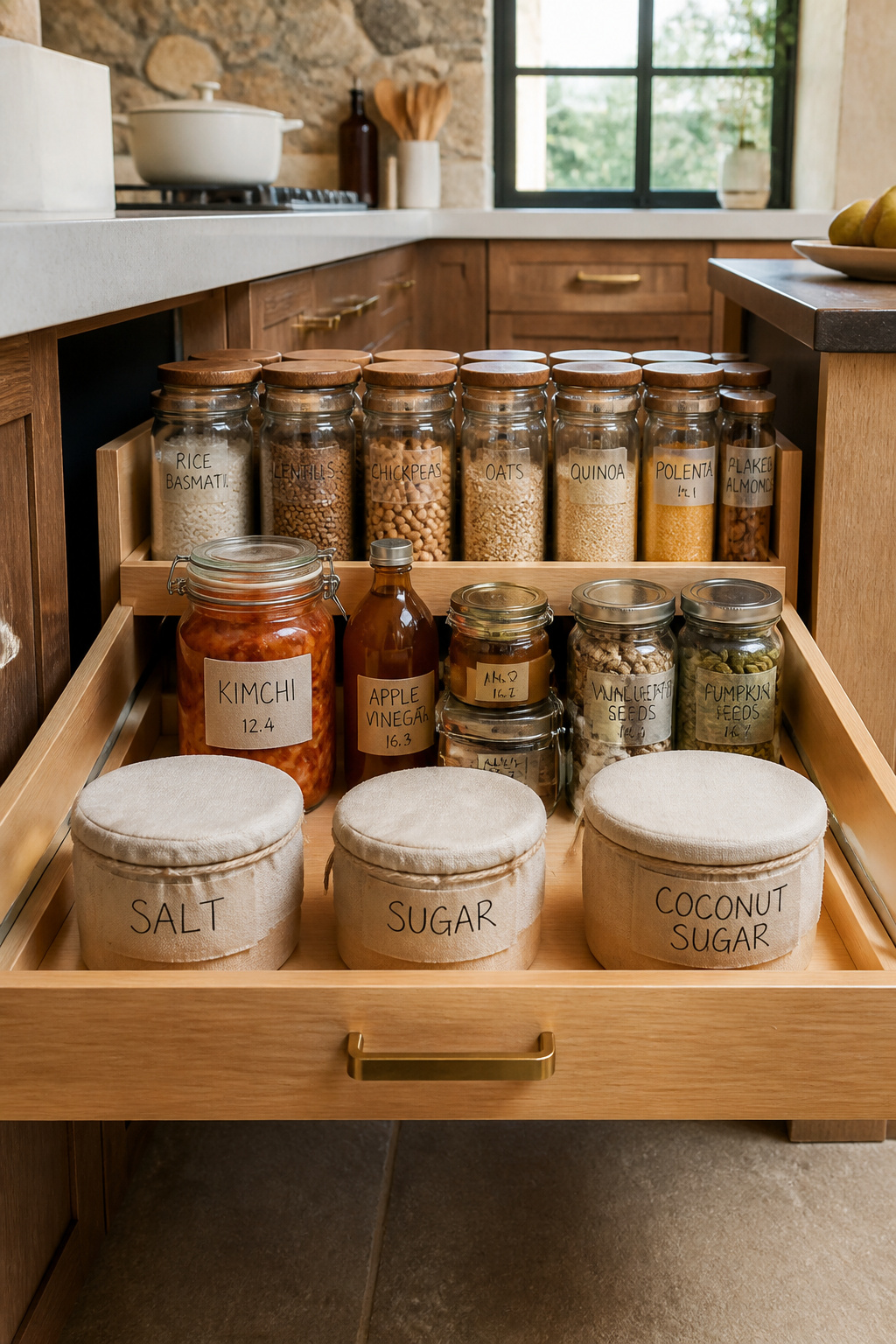
The zero-waste argument for pull-outs
Household food waste is substantially driven by forgotten ingredients. Pull-out pantry island cabinets make invisible things visible. You know what you have, use what you have, and buy only what you actually need.
Blum TANDEM full-extension undermount slides carry 100 lbs static load per pair. Full extension gives access to the very back of the cabinet. Standard widths run 12-24 inches; subtract an inch each side for slide clearance when measuring.
Organise pull-out island shelves by use frequency. Top pull-out for daily items — oils, vinegars, current week’s grains. Middle for weekly bulk. Bottom for monthly-frequency items. Decant everything into standardised glass or food-grade PET containers. Uniform sizing fits more per shelf depth and makes quantities visible at a glance.
A dedicated fermentation shelf is worth planning at this stage. Sourdough starter, kimchi, and kombucha do well at stable room temperature away from heat sources. An island cabinet pull-out away from the cooker is exactly the right environment.
11. Vertical Panel Sides on Kitchen Islands for Hanging Herb and Pot Storage
The two end panels of a kitchen island are almost always blank. They collect grease and occasionally hold a dishcloth hung over the corner. Turning them into active storage is one of the most productive low-cost island upgrades available.
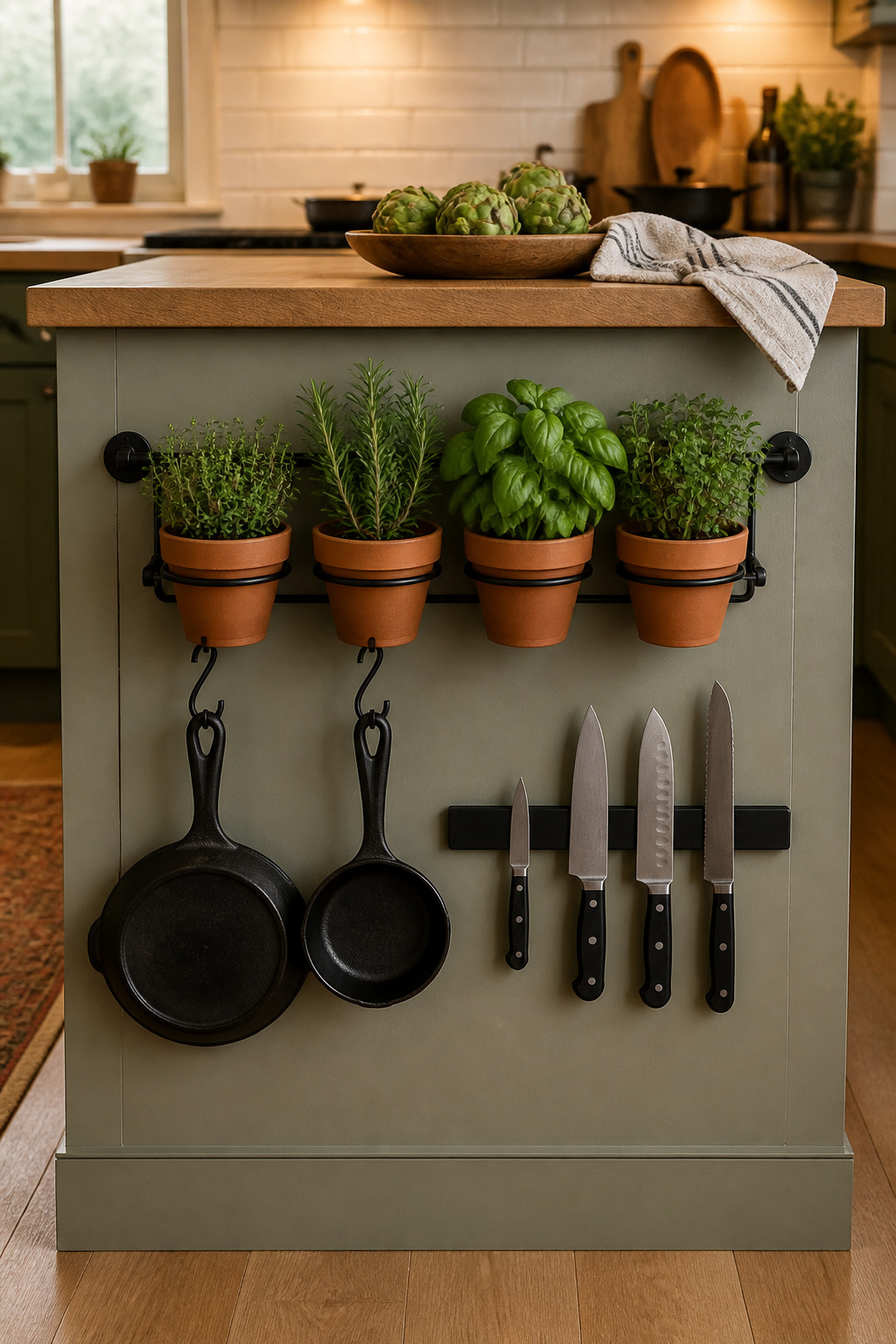
IKEA’s KUNGSFORS (stainless, 22 inches, $20) and HULTARP (matte black, 23.5 inches) both mount to island side panels with two screws. Both take the same S-hook accessories for pots, utensils, herb pots, and spice jars. The HULTARP reads cleaner in modern kitchens; KUNGSFORS works better in industrial and farmhouse contexts.
Visual discipline matters more than the hardware choice. Limit each end panel to one category — a pot rail, or a herb rail, not both. Four matching terracotta herb pots on a panel reads as intentional design. The same rail with a dish brush, three utensils, a towel, and two herb pots reads as overflow.
Match rail material to island hardware. Brass pulls and a chrome rail create visual noise. Matte black pulls and matte black rail read as deliberate. The rail should feel like it was always there.
12. Kitchen Island Cabinets With Seed Sprouting and Microgreen Station Drawers
This is the island cabinet configuration that most directly embodies the idea of a kitchen as a productive living space. A dedicated microgreen drawer puts the freshest possible salad greens — harvested 7-14 days from seed, at peak nutritional density — within arm’s reach of the surface where you prepare them.
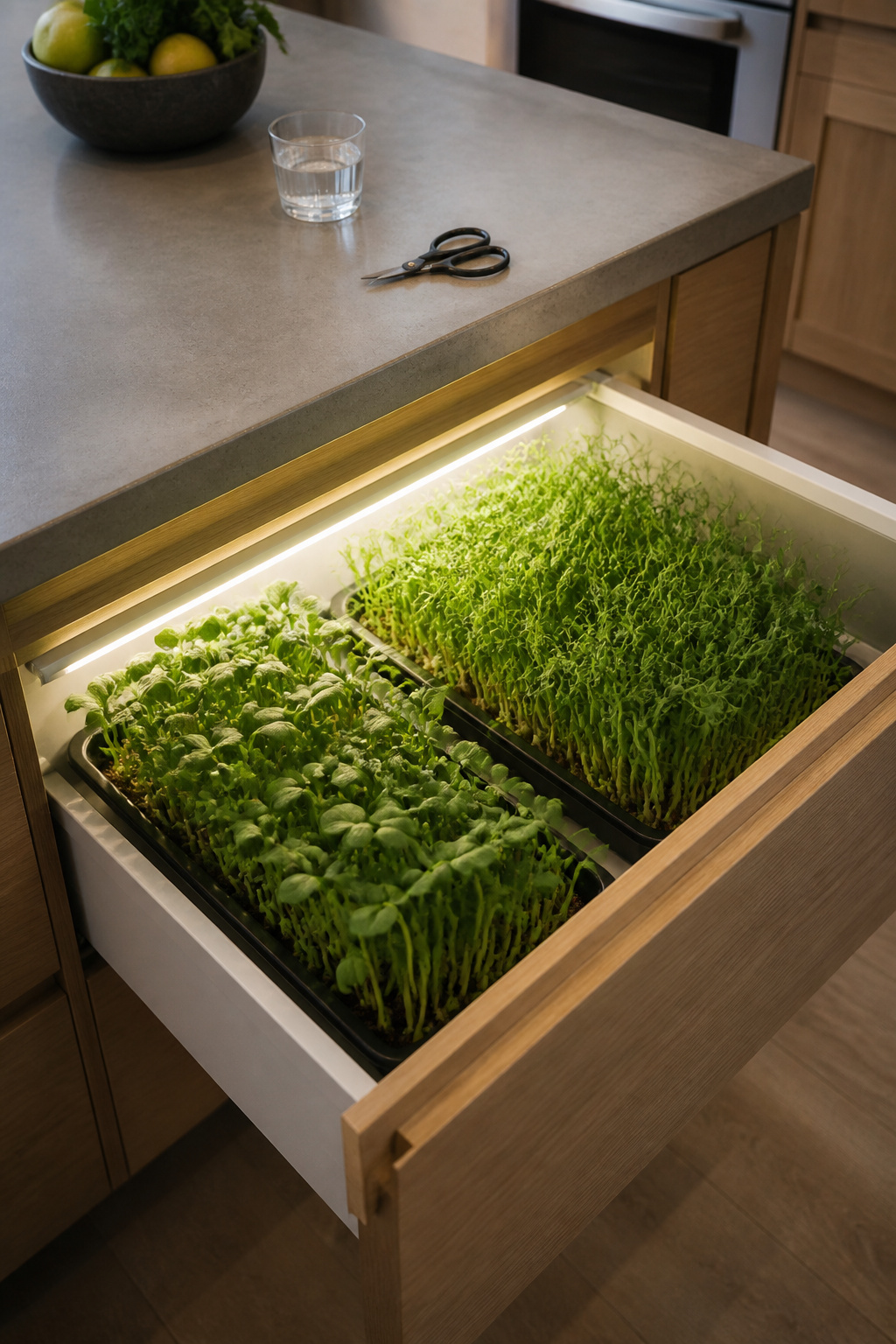
Standard 10×20-inch propagation trays (the commercial microgreen standard) fit in a 24-inch wide island drawer with 2 inches of clearance on each side. A two-drawer rotating system gives continuous supply — one germinating, one at harvest readiness, with staggered seeding.
Waterproof the drawer interior with marine-grade silicone coat or a pre-formed stainless steel insert. Watering microgreen trays creates genuine moisture load that an unprotected wooden box won’t handle. Allow a 1/2-inch drainage gap at the drawer back for overflow.
Active Grow IP65 waterproof LED strip lights (24W, full spectrum) mount flush to the underside of the cabinet above the drawer. Microgreens need 200-400 µmol/m²/s of light at 6-12 inches above the tray — a 24W strip at 8 inches achieves this in a standard 4-inch drawer clearance. Run them on a smart plug timer at 14 hours on, 10 hours off.
13. Glass-Front Island Cabinet Doors for a Visible, Curated Pantry Display
Glass-front cabinet doors on a kitchen island create something a solid door never can: the impression of space. Light passes through, the island feels less visually heavy, and the kitchen reads as more open. This matters particularly when the island is large and the perimeter cabinets are already substantial.
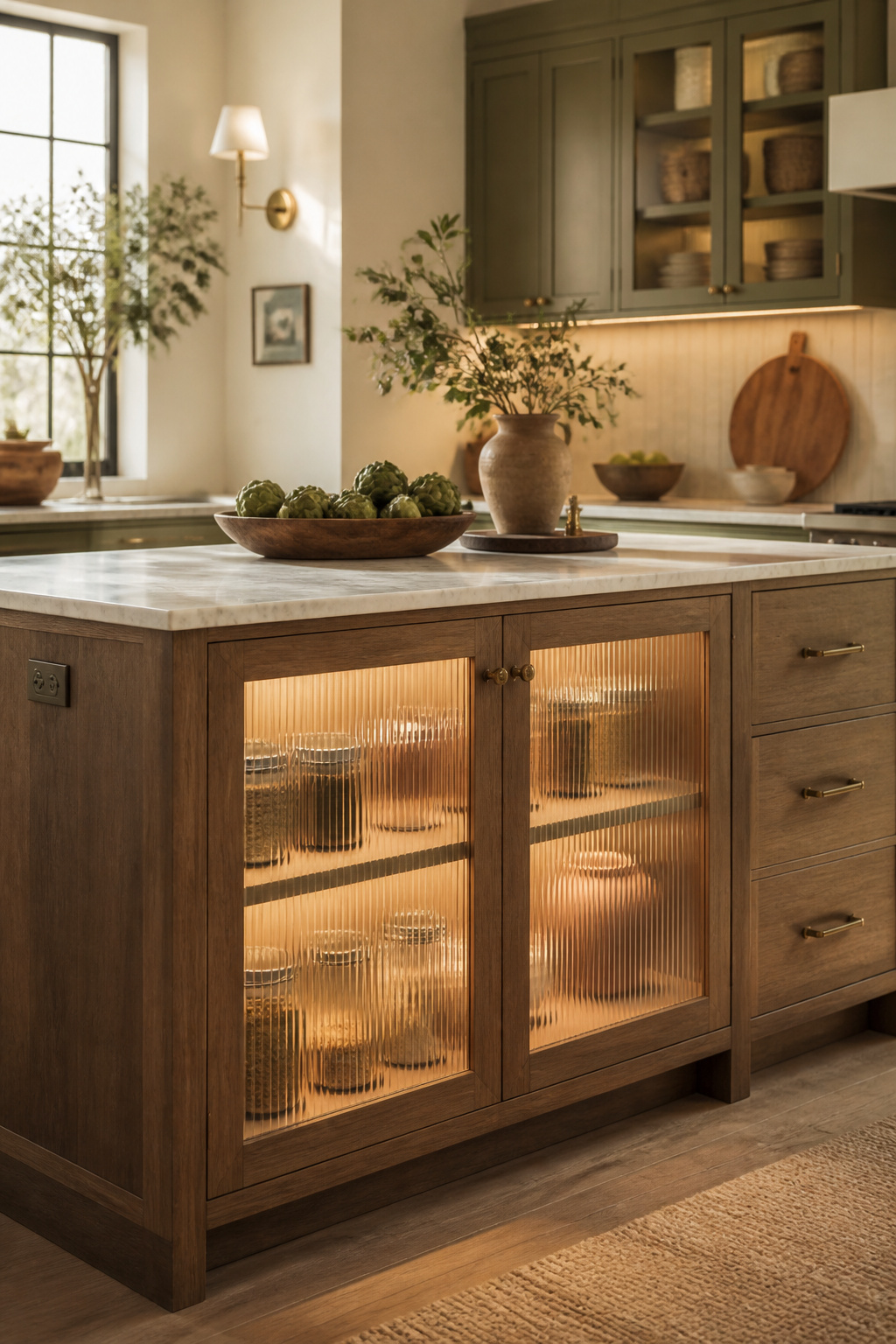
The glass type determines how it reads. Clear tempered glass (6mm standard) gives maximum visibility and suits displays where every item is deliberately chosen. Reeded or fluted glass is the current preference — vertical texture blurs contents just enough to hide imperfection while allowing light through. It also looks beautiful at different angles as light changes through the day. Seeded glass — the hand-blown, bubbly variety — suits farmhouse kitchens where artisan texture reinforces the overall material story.
Behind glass: uniform glass grain jars, dried herbs in labeled tins, artisan ceramics, cast-iron cookware. Not behind glass: plastic bags, takeaway containers, appliance cords, anything with a commercial logo that breaks the visual calm.
Under-shelf LED at 2700K warm white transforms a glass-front island cabinet at night. Modest investment, substantial effect.
14. Industrial-Style Island Cabinets With Steel Frames and Reclaimed Timber Shelves
Steel-framed kitchen island cabinets carry a specific kind of material honesty that resonates in kitchens designed around real values. The structural system is visible, undecorated, and clearly load-bearing. No laminate skin hiding what the cabinet is made of.
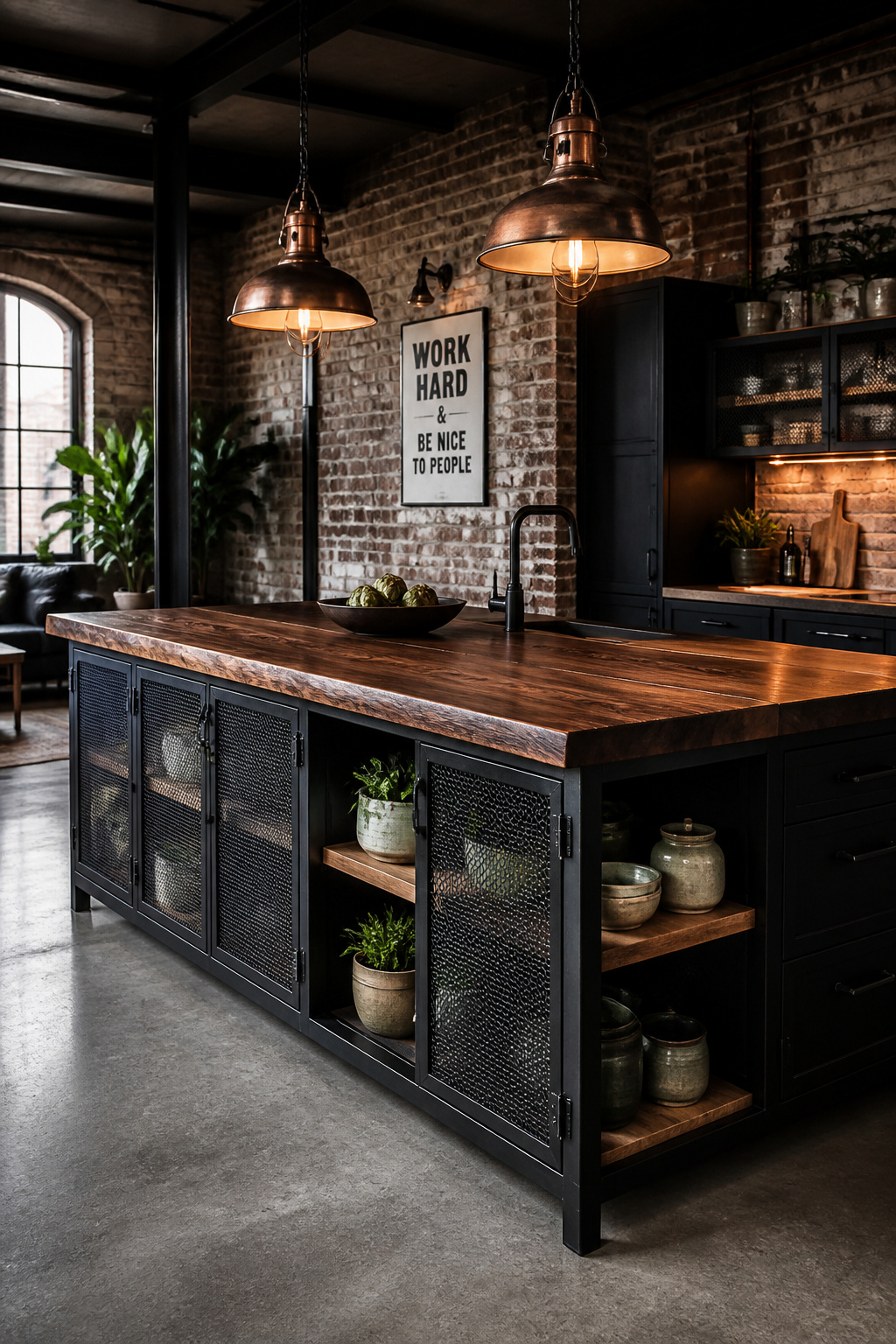
Steel is 100% recyclable at end of life. Paired with reclaimed timber shelving, both primary materials are either infinitely recyclable or rescued from demolition waste. It suits urban apartments and converted spaces where the industrial aesthetic is already present in the architecture.
Local metalwork fabricators produce steel island frames at 40-60% less cost than design brands, with the advantage of custom sizing. For reclaimed timber shelves, specify minimum 1.5-inch thickness for any span over 24 inches. Oak, elm, and reclaimed pine are the most commonly sourced species.
The warmth problem is real. Steel and reclaimed timber can feel more industrial than liveable without counterbalancing elements. Pendant lighting in warm metal tones (brass, aged copper), hung 700mm above the island countertop, does significant work here. Leather or natural linen drawer pulls bridge the material gap between cold steel and irregular warm wood.
15. Kitchen Island Cabinet Colour Ideas: Earthy Greens, Terracotta, and Warm Clay Tones
The strongest long-term colour choices for kitchen island cabinets are the ones that don’t need to be justified as trends. Earthy greens, terracottas, and warm clay tones reference the natural world — soil, vegetation, clay — rather than a design moment. They don’t date because they were never specifically of a moment.
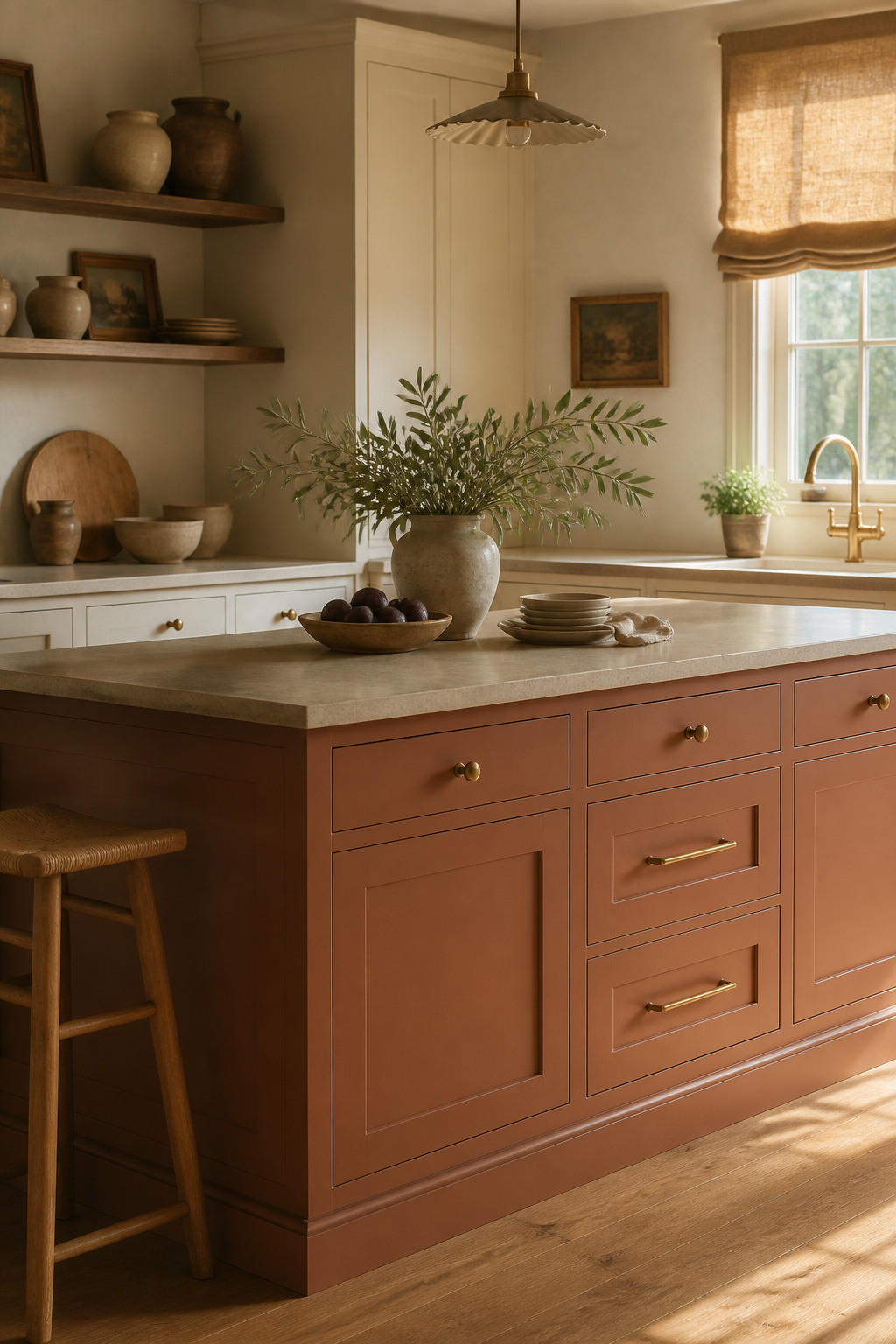
Farrow & Ball Mizzle (No.266) remains the most consistently specified earthy green for kitchen island cabinets. It shifts from warm sage in afternoon sun to a cooler, more sophisticated green in northern overcast light. It works with natural wood countertops, stone flooring, and white perimeter cabinets without requiring other anchoring choices.
Naperon — Farrow & Ball’s 2025 addition — is a faded terracotta, one shade lighter than Red Earth. Named with intent: the word “apron” is its etymological origin. For a kitchen island, the resonance is fitting. Marmelo, also from the 2025 collection, is a burnt orange inspired by marmalade — warmer and more of a statement, but still grounded in natural pigment.
Test paint samples in the actual kitchen over 48 hours before committing. North-facing kitchens shift green paint towards grey. South-facing kitchens add warmth to every tone significantly. Always use a cabinet-specific paint — the film hardness difference versus standard wall paint is significant in a kitchen where cabinet fronts take daily contact.
16. Compact Kitchen Island Cabinets for Small Kitchens and Apartment Spaces
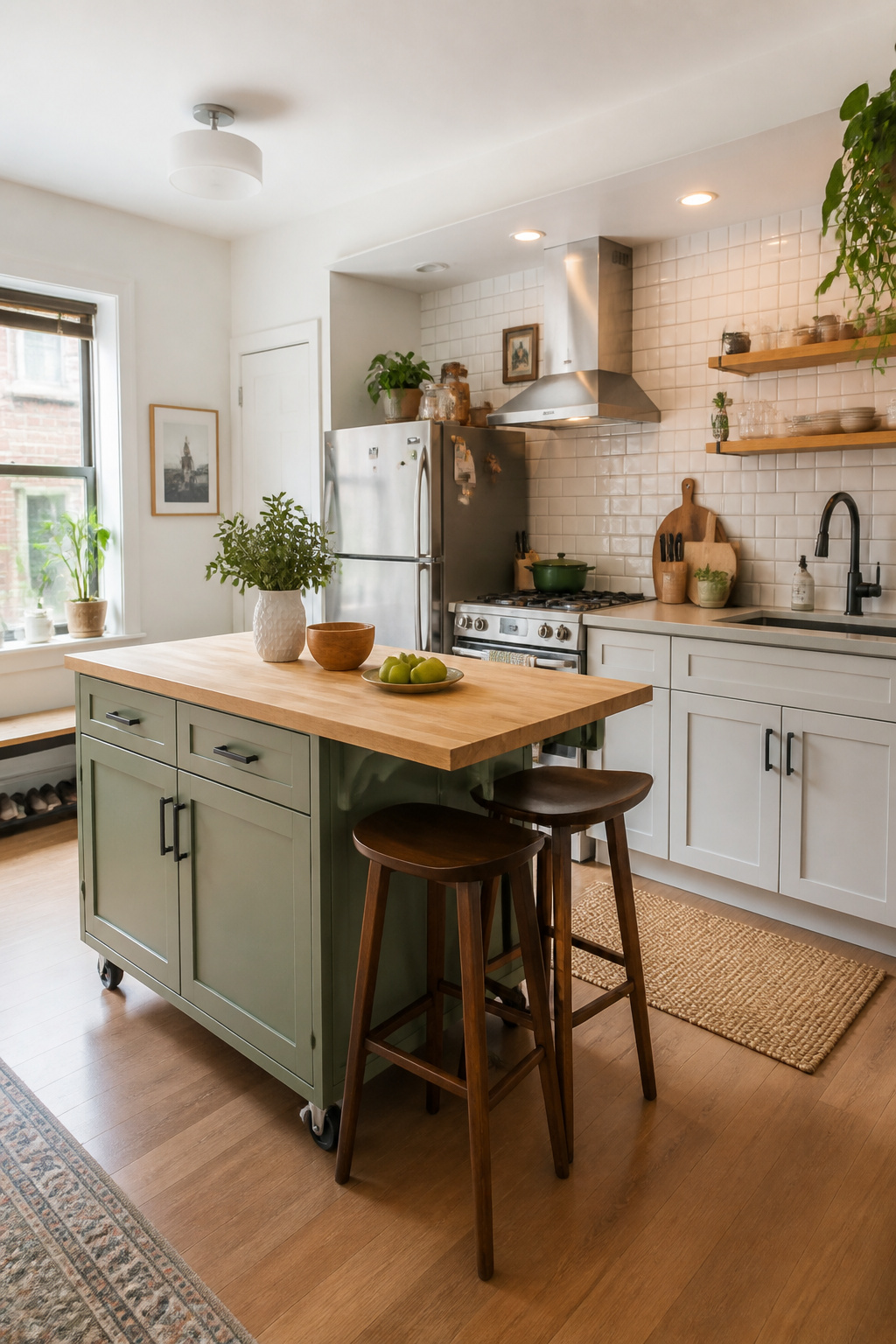
A compact kitchen island correctly sized is more valuable than a large island marginally too big. The difference is livability. A 24×48-inch island with 42-inch clearance on all sides makes a small kitchen work. A 30×60-inch island with 30-inch clearances makes the same kitchen nearly unusable.
Sizing it correctly from the start
The NKBA minimum clearance is 36 inches on all sides. 42 inches is preferred where the island is the main route between sink, cooker, and refrigerator. If the island footprint exceeds roughly 40% of the open floor area between perimeter cabinets, it will feel cramped regardless of technical compliance.
A compact island earns its footprint by serving three functions. Storage below, prep surface on top, seating on one side. A 12-inch overhang accommodates two stools at standard bar height without adding to the island’s floor footprint. For a complete view of how to configure the right size for your kitchen, the collection of kitchen island ideas for small kitchens covers configurations from minimal to ambitious.
For renters, rolling islands are the honest solution. An IKEA RÅSKOG trolley adapted with a butcher block top comes in under $150 and adds genuine prep and storage capacity without permanent installation. Commercial butcher block islands on locking casters (John Boos, Catskill Craftsmen) handle daily use and move freely when unlocked — a good investment for anyone who moves every few years.
Choosing Your Kitchen Island Cabinets: How to Get It Right the First Time
Before choosing style, colour, or hardware, one question is worth answering honestly: what is this island actually for?
A prep island prioritises counter surface and keeps cabinet doors away from the main work zone. A storage island prioritises cabinet capacity above everything else. A dining island is defined by seating height and overhang dimensions. Most islands try to do all three without making the necessary trade-offs — which is how you end up with something too small to prep on, too crowded to eat at, and too shallow for useful storage.
Match cabinet configuration to kitchen size. Kitchens under 150 square feet need rolling or minimal fixed islands. Between 150 and 200 square feet supports a 48-inch fixed island. Above 200 square feet allows a full 60-72-inch island with seating and multiple storage configurations.
Lifestyle drives material choice. A zero-waste household benefits most from composting pull-out systems and visible pantry storage. A household with young children benefits from push-to-open hardware with no pinch points and durable painted surfaces over reclaimed wood. A household that grows its own food has very different cabinet priorities to one that orders most meals in.
Budget honestly. A functional flat-pack island with pull-out storage runs $500-1,500. A semi-custom island with quality hardware runs $2,000-5,000. Bespoke cabinetry — steel frames, reclaimed doors, integrated composting — starts around $8,000. The right island is the one that solves your actual kitchen problems at a scale your kitchen can hold. Start there. The aesthetics will follow.