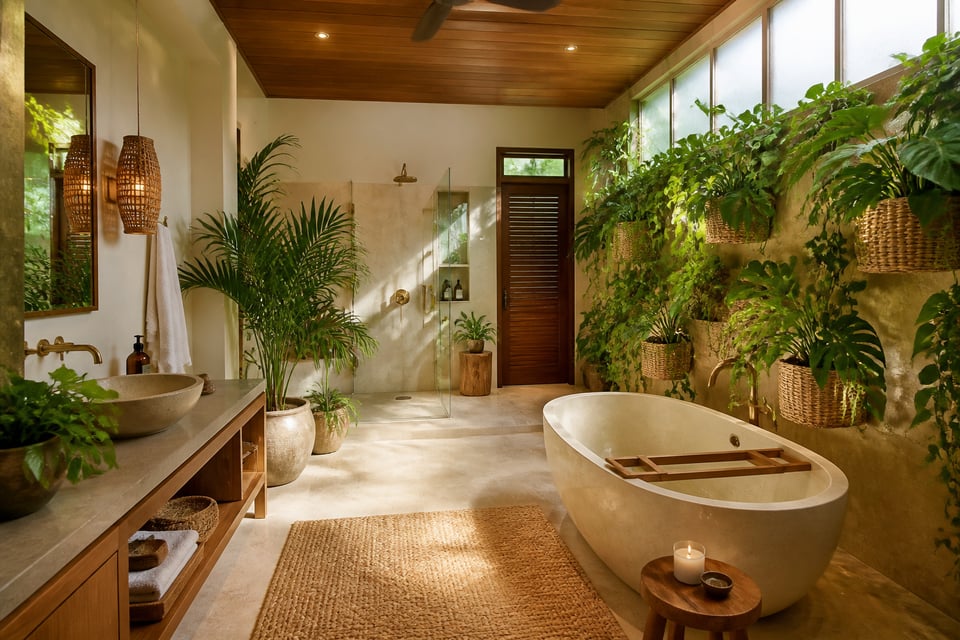
There’s a version of your bathroom that functions, and there’s a version that restores you. Most of us are living with the first — a room of hard surfaces, flat overhead light, and zero sensory intention — when we could, with relatively small changes, be stepping into something closer to a personal retreat. Good bathroom decor inspiration closes that gap faster than any renovation budget alone.
I’ve spent over a decade designing spaces where beauty and environmental responsibility aren’t in competition, and bathrooms consistently offer the richest territory for meaningful transformation. They’re intimate, they’re daily-use, and they respond dramatically to even one well-chosen element. A different light source, a living plant, a hand-thrown soap dish — any of these shifts the entire atmosphere of the space.
What follows is a curated collection of fifteen directions, each grounded in real materials, real dimensions, and real design thinking. Whether you’re planning a full renovation or looking for one high-impact change to make this weekend, these ideas span the full spectrum of scale, budget, and aesthetic commitment.
1. Living Plant Walls as Bathroom Decor Inspiration for Small Spaces
Steam from your morning shower is essentially free irrigation, and the plants that love it most — Boston ferns, golden pothos, peace lilies — happen to be some of the most visually dramatic species you can grow indoors. A living wall doesn’t require a large bathroom. A modular pocket-frame panel (felt or woven nylon pockets mounted flush against the wall) holds 10 to 20 small pots in a footprint smaller than a single framed print.
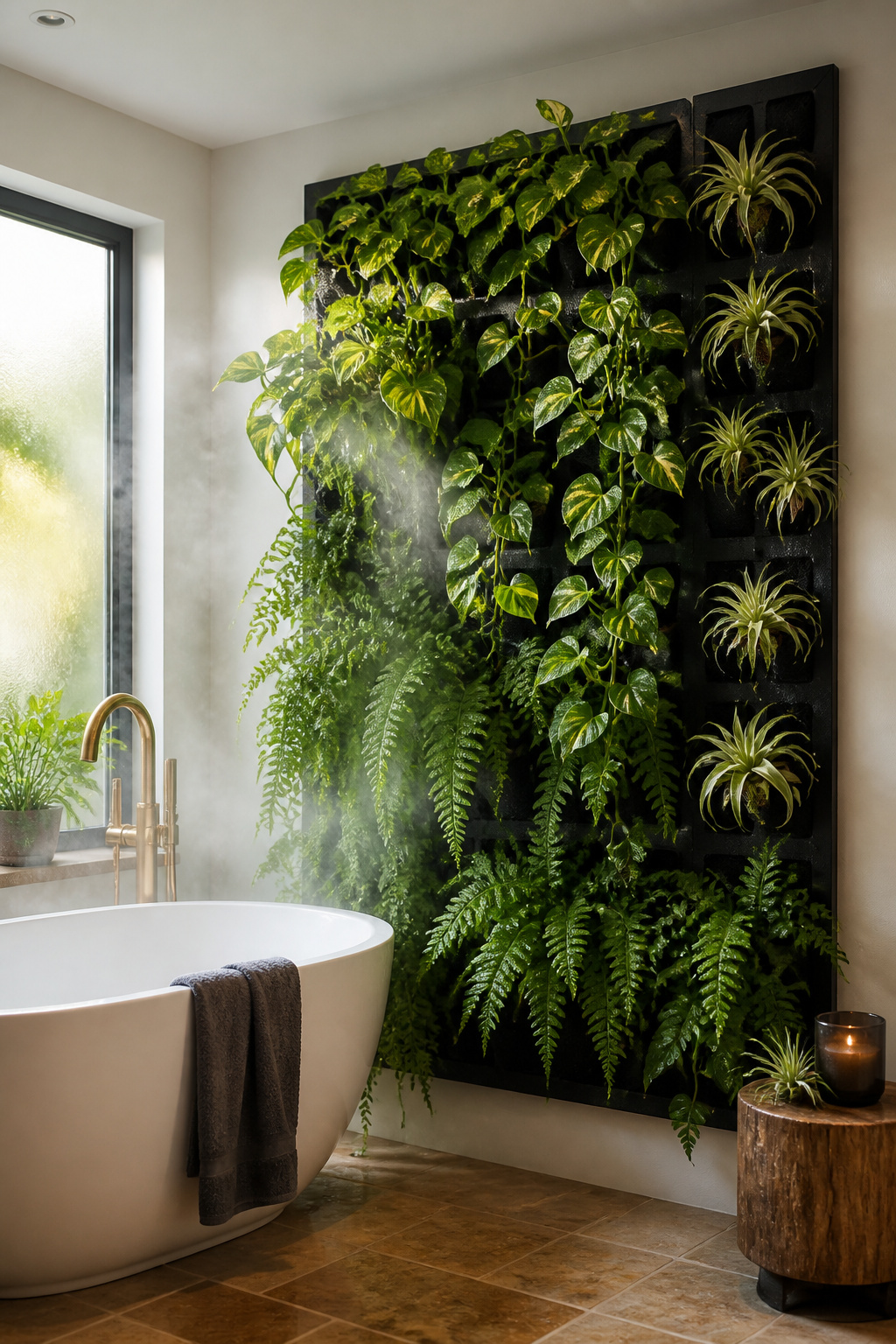
The species selection matters more than the system. Pothos and spider plants tolerate genuinely low light — interior bathrooms with frosted glass or no window at all — while Boston ferns prefer indirect light and reward you with lush, arching fronds in exchange for the humidity your bathroom already provides naturally. The one mistake to avoid: succulents and cacti are evolved for dry conditions and will rot within weeks of consistent steam exposure.
For a truly low-maintenance approach, Tillandsia air plants are the cleanest possible option. They absorb moisture directly from steam, require no soil, and attach to shower tiles via suction cup mounts. In a humid bathroom they need almost no supplemental watering — the environment does the work. Arrange three or five on a mounted driftwood branch beside the mirror and you have a living sculpture that evolves daily.
Keep the planter outside the direct spray zone. A panel beside the shower or above a freestanding bath captures steam without waterlogging. Running the extractor fan for 15 to 20 minutes after each shower maintains the airflow the plants need between sessions.
2. Natural Stone Tile That Transforms a Bathroom Into a Wellness Retreat
Walk into a bathroom tiled entirely in honed Calacatta marble and you feel the difference before you’ve consciously registered what’s different. The surface absorbs light rather than bouncing it back, the room reads quieter, and the slight variation in veining reminds you that you’re in the presence of a material that took millions of years to form. This is the bathroom decor inspiration that no large-format ceramic porcelain — however convincing — quite replicates.
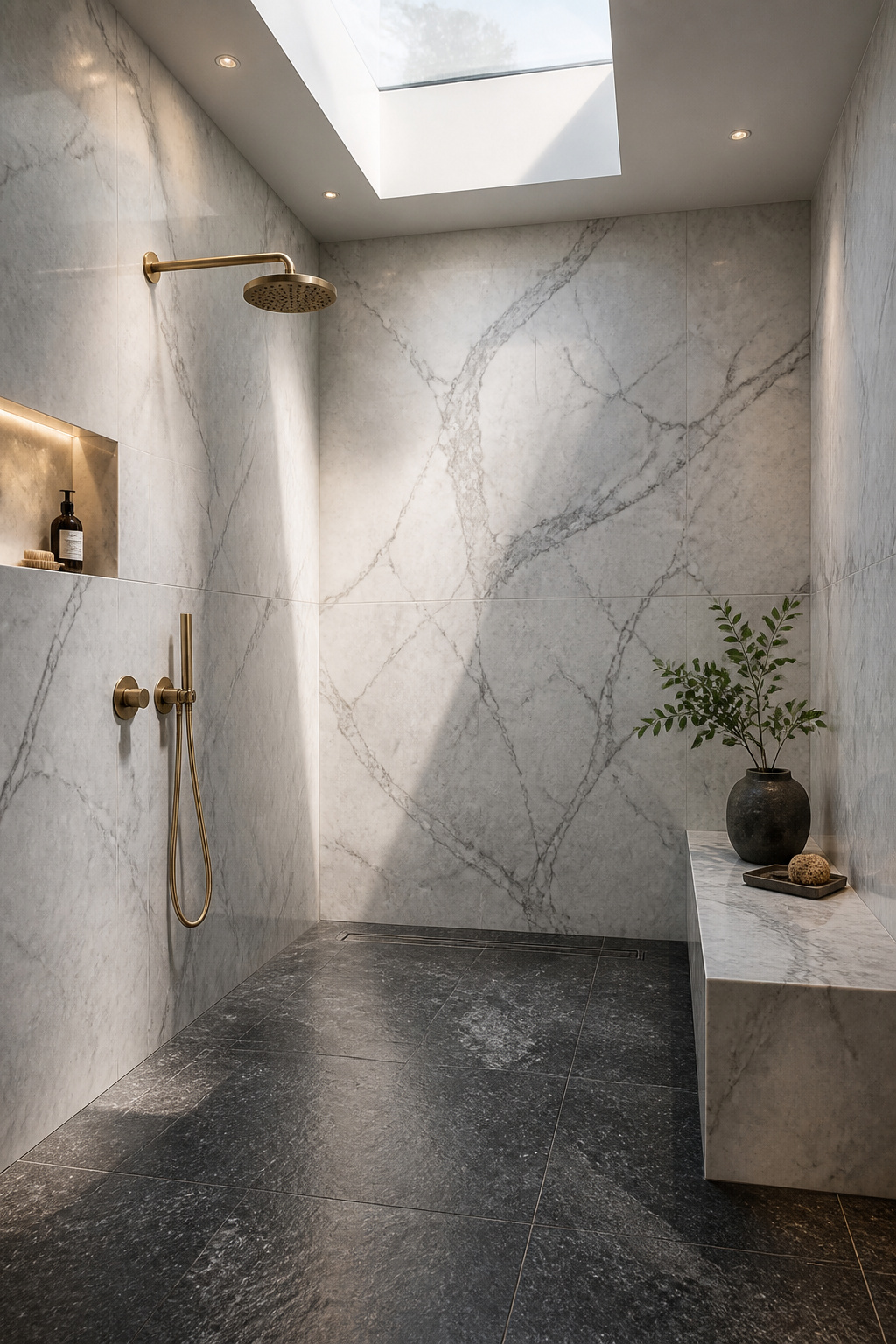
The practical decisions start with choosing the right stone for the right location. Honed marble (matte surface, not polished) is ideal for walls but should never go on a shower floor — it becomes dangerously slippery when wet. Slate, with its naturally layered and textured surface, is the correct choice for shower floors: excellent grip, visually dramatic, and practically indestructible. Travertine — warm, earthy, porous — suits walls and dry bathroom floors, where its Mediterranean warmth reads genuinely beautiful but where its higher porosity (3 to 12% versus marble’s 0.5 to 3%) can be managed through sealing.
Sealing and Long-Term Care
Travertine and limestone need resealing every three to five years in bathroom applications; marble every two to three years in shower environments. Use a penetrating (impregnating) sealer that bonds with the stone’s pores rather than a surface sealer that sits on top and peels — particularly in wet zones. Water-based penetrating sealers are preferable to solvent-based in enclosed bathrooms for lower VOC emissions. Keep grout joints tight (2 to 3mm) to reduce penetration points and achieve the cleaner look that large-format stone demands.
3. Warm Unlacquered Brass Hardware for Sophisticated Bathroom Character
Standard lacquered brass always looks exactly like what it is: a manufacturing decision. Unlacquered brass, by contrast, is dynamic. It’s an alloy of copper and zinc with no protective coating — which means it oxidises, develops warmth, and accumulates character in direct proportion to how frequently it’s used. Interior designers call it a “living finish” and the description is accurate.
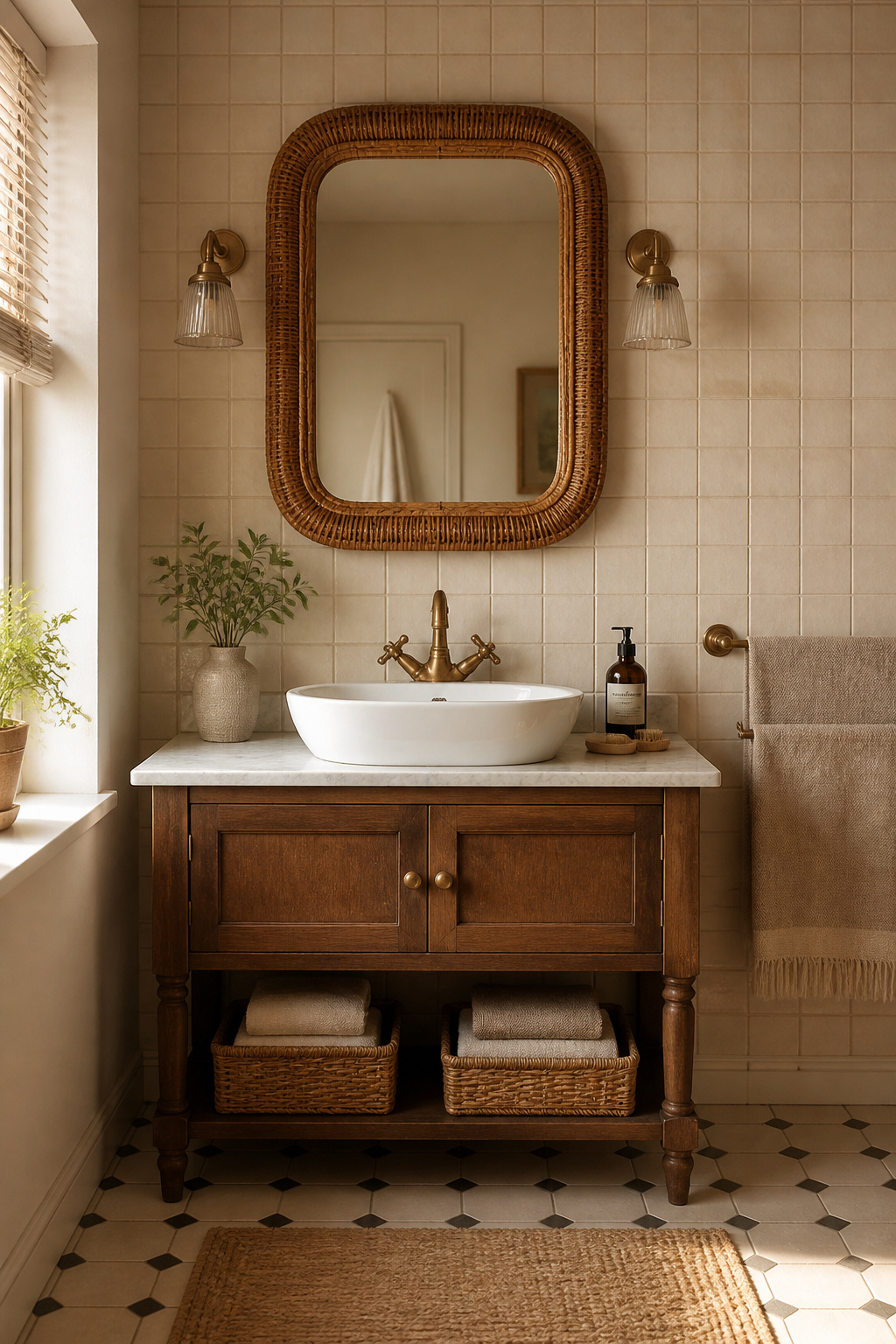
The timeline is genuinely interesting. In months one through three, the hardware is polished and bright — the classic gold that reads luxurious but could belong to any era. By months four to twelve, you’ll notice a shift in the most-touched areas: the tap handles and door pulls warm toward honey, while less-contacted surfaces remain brighter. The contrast is the hardware’s first character note. By years three to seven, a full antique bronze settles across every surface — warm, matte, and irreducibly personal. Hard water and bathroom steam accelerate this development; soft water slows it.
Pairing and Maintenance
Unlacquered brass wants warm companions: cream, ivory, warm white, terracotta, sage green. Put it against cool grey tiles and the warmth of the metal clashes with the palette’s chill. Put it against dark Nero Marquina marble or black slate and you get something dramatic and sophisticated — the warm metal reading against cool dark stone creates a compelling composition. To preserve the polished gold appearance, a monthly polish with a gentle metal cream keeps it bright. To embrace the patina, simply clean with warm water and mild soap. Either way, this is bathroom decorating ideas at their most satisfying — a material that genuinely improves with time.
4. Japanese Soaking Tub Bathroom Decor Inspiration for the Everyday Retreat
In Japan, the bath isn’t the place you wash. You wash first, at a shower or handheld nozzle beside the tub, and then you enter a deep, hot, clean tub for the ritual of restoration the Japanese call furo. That distinction — bathing as mental reset, not hygiene task — is what makes the ofuro such effective bathroom decor inspiration for anyone rethinking how they use their space.
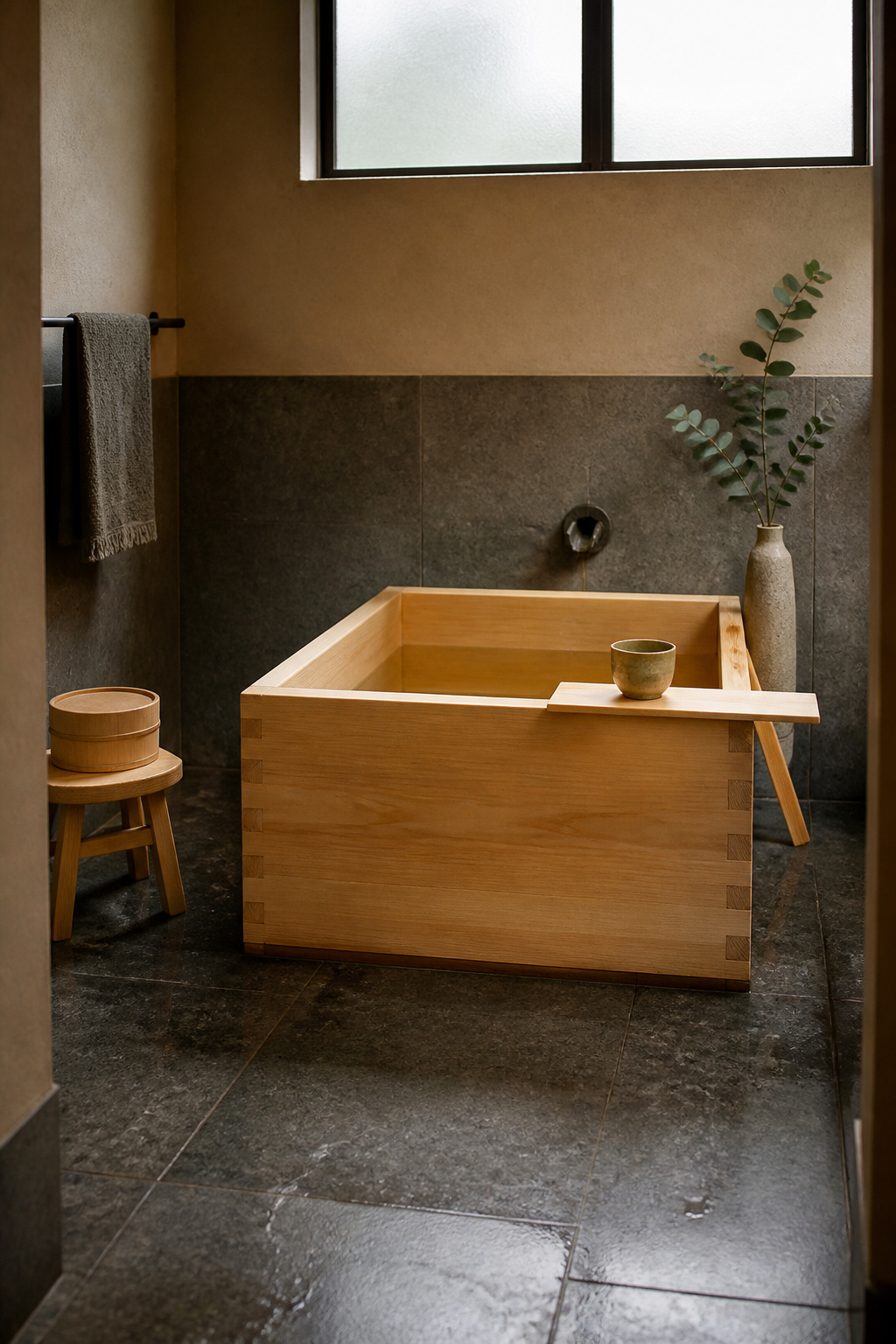
The dimensions work surprisingly well in smaller bathrooms. A standard single-person ofuro runs approximately 100 by 70 centimetres — significantly more compact than the 170-centimetre stretch of a Western freestanding bath — but goes 55 to 65 centimetres deep, allowing full-body immersion up to the shoulders while seated. That depth is the experience: physiologically different from soaking in a shallow Western tub, it slows your heart rate and disengages the stress response in a way that ordinary bathing doesn’t.
Material Choices and Practical Considerations
Hinoki cypress is the prestige option — naturally antibacterial, aromatic, and resistant to rot in daily wet conditions. A quality hinoki ofuro costs between £3,000 and £8,000 and requires one specific habit: keep a small bucket of water inside the tub (or a tight-fitting lid over it) when not in use, to prevent the wood drying, shrinking, and cracking. Composite stone versions — stone resin or DuPont Corian — are considerably more forgiving at £2,000 to £4,000, need no special maintenance, and still deliver the visual warmth of the original. For a modern apartment with no appetite for bespoke wood care, composite is the practical path to the same restorative ritual.
Floor reinforcement is rarely necessary for composite or stainless versions, but a structural engineer consultation is worthwhile for older properties if you’re planning a full hinoki tub — filled, it can reach 300 kilograms.
5. Woven Rattan and Bamboo Accessories That Add Eco-Luxury Texture
The surface materials in a typical bathroom — tile, glass, chrome, enamel — are all hard, smooth, and reflective. They create a space that reads precise and clean, which is appropriate, but they leave a visual and tactile hunger for something warmer. Woven rattan and bamboo accessories answer that hunger without adding visual weight or complexity.
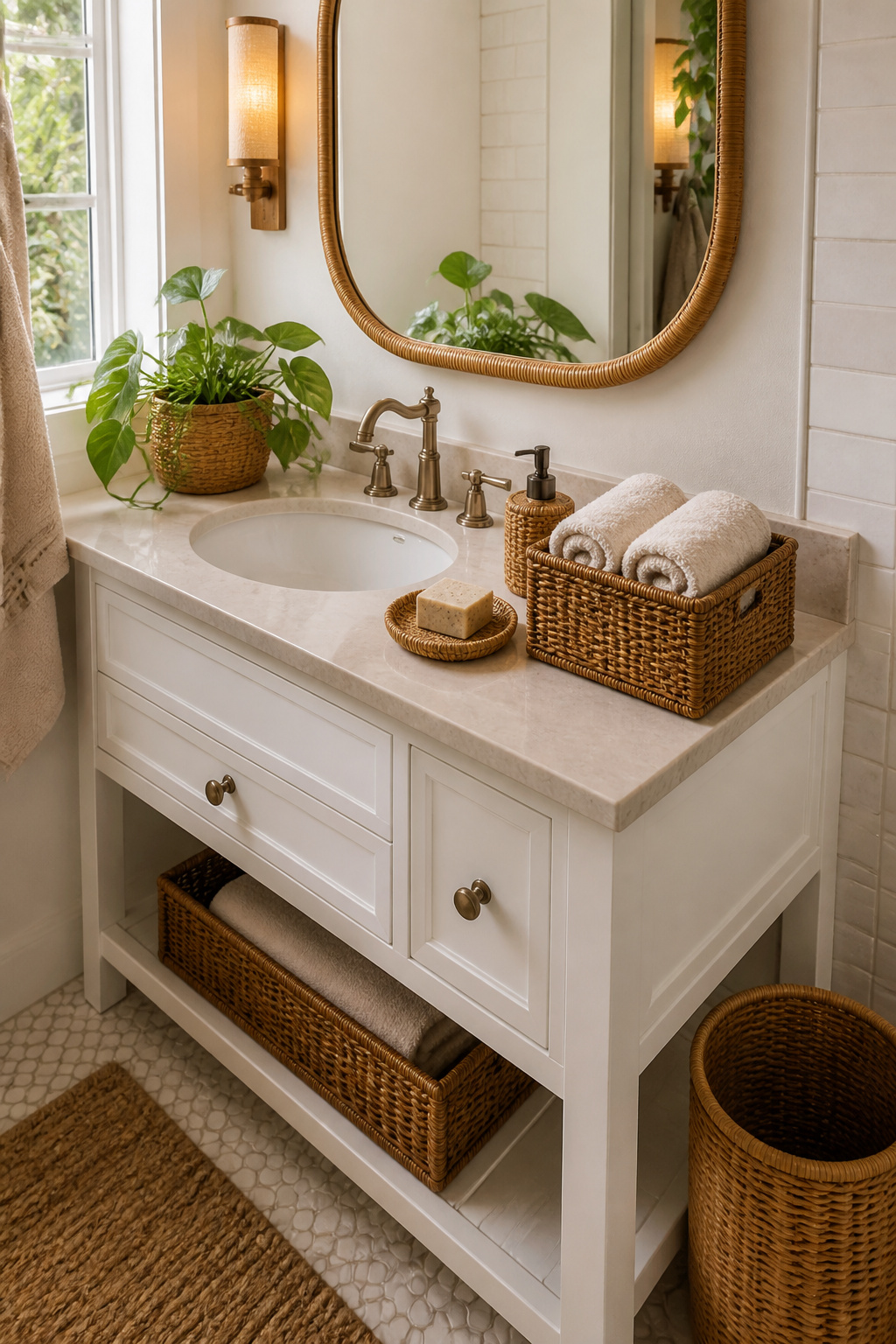
A coordinated set of rattan accessories — towel holder, waste bin, small storage basket, soap tray — across four categories creates a cohesive eco-luxury layer that reads intentional rather than eclectic. The organic texture contrasts effectively with the uniformity of tile, and the natural warm-brown colour harmonises with brass hardware and linen textiles in a way that synthetic alternatives don’t.
The material choice matters in a bathroom environment. Bamboo is naturally more water-resistant than rattan — its cellular structure is denser and absorbs less ambient moisture at baseline. For rattan, look for products described as lacquered, varnish-coated, or resin-finished — a clear protective coat is essential to prevent discolouration and softening from consistent steam. Untreated rattan in a bathroom will deteriorate within months. If you’re drawn to rustic bathroom decor with natural materials more broadly, rattan fits comfortably within that aesthetic alongside reclaimed wood and natural stone.
Apply the 60-30-10 principle to the palette: hard surfaces (tile, stone, enamel) carry 60% of the visual weight, secondary textures (wood, towels) take 30%, and natural fibre accessories account for the 10% accent. Rough-weave rattan against smooth honed stone is a satisfying tactile and visual pairing that rewards attention.
6. Statement Mirrors With Organic Shapes That Anchor the Vanity Wall
The mirror is the most singular decorative decision in any bathroom after the vanity itself. It’s large, it’s central, and it’s unavoidable — which means getting it right transforms the room and getting it wrong undermines everything else. Current design thinking strongly favours organic shapes: arched, pill-shaped, oval, and irregular forms that interrupt the grid of tiles and the horizontal line of the vanity top.
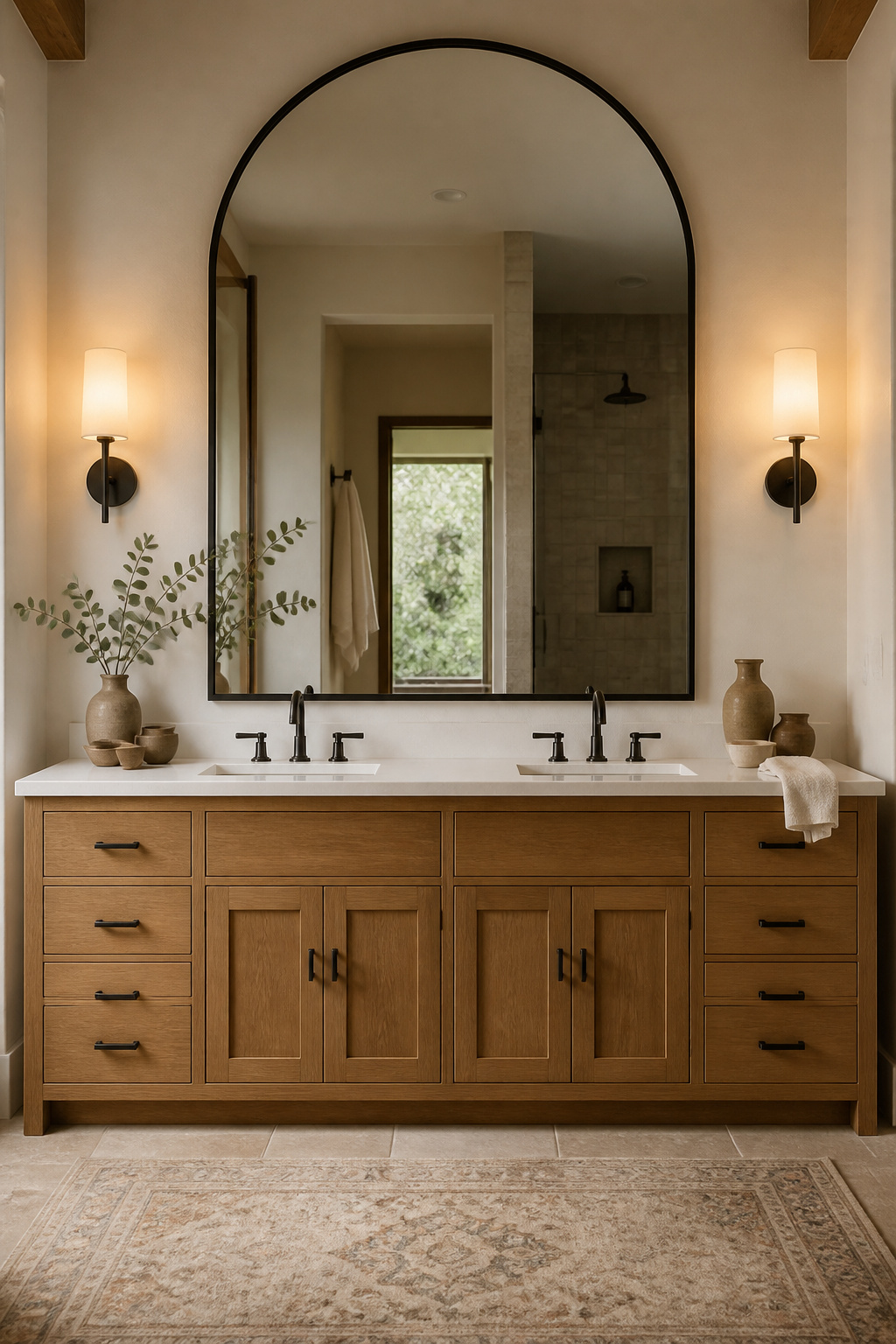
Arched mirrors do something specific in low-ceiling bathrooms: they create a sense of height that rectangular mirrors cannot deliver. The curve draws the eye upward, and in a tight bathroom, that vertical emphasis is genuinely valuable. Pill-shaped and oval mirrors soften the hard edges of a tile-heavy space — the organic outline creates visual rest in an environment of right angles. These organic shapes are consistently the top bathroom decorating ideas for 2025 to 2026, alongside backlit LED mirrors that combine form and function.
Frame material coordinates the mirror with the rest of the hardware narrative. Unlacquered brass or iron frames tie the mirror to the tap and towel rail finish — selecting the same metal family across all three elements creates a cohesive metallic story. Solid oak or walnut frames add warmth to a bathroom where the vanity is also wood. Rattan-wrapped frames (available from Rebecca Udall and similar contemporary homeware brands for £150 to £500) connect the mirror to a tropical or biophilic theme.
Scale and Sizing for Your Bathroom Decor
Sizing is where most buyers go wrong. The mirror should be 2 to 4 inches narrower than the vanity width, leaving 1 to 2 inches of wall space on each side — that margin creates a natural visual frame. Alternatively, 70 to 80% of vanity width gives the mirror a slightly smaller, proportionate appearance. Arched mirrors can be pushed to fill 70% of the available wall height, making the curve the dominant architectural statement in the room.
7. Earthy Bathroom Decor Inspiration Through Terracotta and Clay Tones
Terracotta is having a genuine design renaissance, and the bathroom is where it’s landing with the most conviction. The colour connects to biophilic design psychology at a deep level — warm clay earth tones are linked in environmental psychology research with groundedness, calm, and reduced cortisol — making the bathroom, already the home’s most restorative room, an ideal context for a terracotta-led palette.
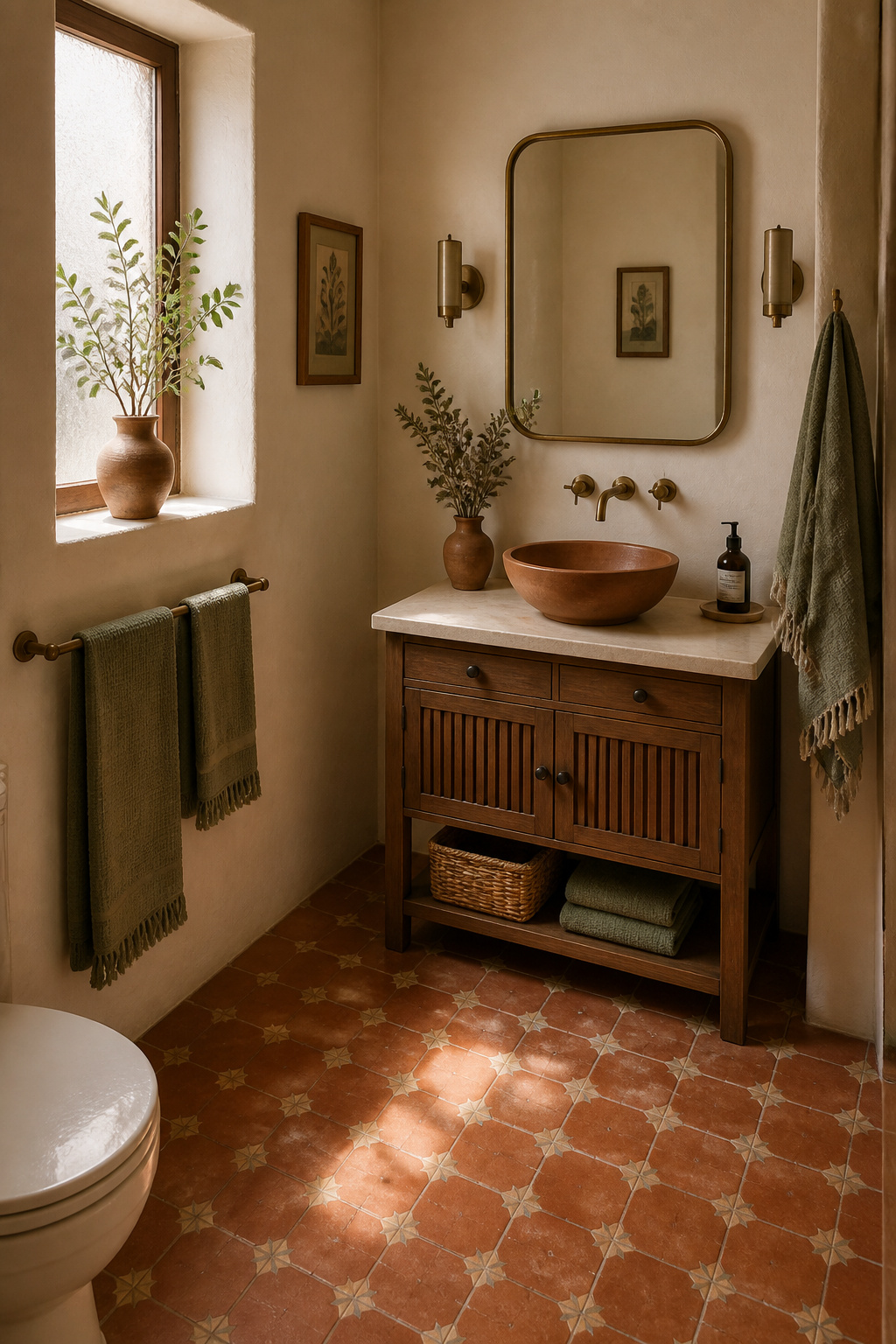
The practical approach depends on your commitment level. The paint route is the lowest stakes: Farrow & Ball’s ‘Red Earth’, Sherwin-Williams’ ‘Cavern Clay’ (a more contemporary dusty take), or Benjamin Moore’s ‘Moroccan Spice’ all deliver the palette without permanence. The tile route is a longer commitment with a longer reward — terracotta encaustic or cement tiles on the floor anchor the palette with genuine material warmth, and paired with white or warm-cream walls, they don’t overwhelm a smaller space. For renters or those testing the colour story first, terracotta ceramics, soap dispensers, and towels introduce the palette as moveable bathroom decor inspiration with zero permanence.
The complementary pairings are worth getting right. Sage green and terracotta is the defining colour combination of 2025 to 2026 bathroom design — the cool of the green against the warmth of the clay creates a biophilic palette that reads like garden and earth simultaneously. Aged brass hardware connects both tones, its warmth echoing the terracotta while grounding the palette. The one pairing to avoid: bright white. The contrast makes terracotta read harsh and slightly garish. Warm white — Farrow & Ball’s ‘Wimborne White’, Benjamin Moore’s ‘White Dove’ — is what the palette actually needs. If you want to explore the earthy bathroom direction through pattern, bohemian wallpaper in earthy olive, terracotta, and botanical tones offers another route into the same palette world.
8. Layered Organic Linen and Cotton Textiles for Quiet Luxury
The most affordable transformation in any bathroom costs less than £100 and takes twenty minutes: replace the towels. This sounds too simple to be useful bathroom decor inspiration, but the quality gap between a 300 GSM budget towel and a 650 GSM stonewashed linen towel is large enough to change how you feel about the room every single morning.
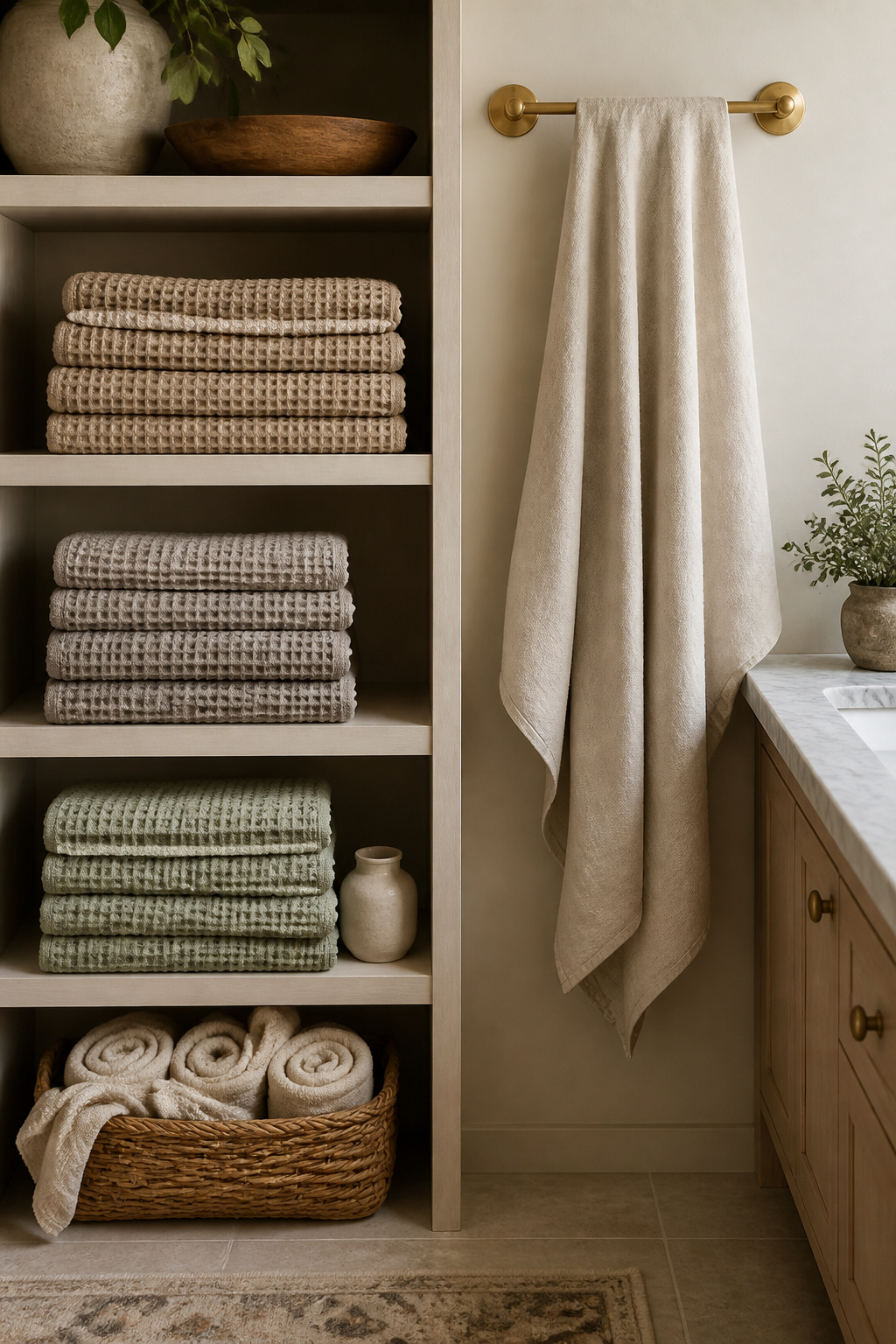
GSM — grams per square metre — is the universal measure for towel quality. Standard budget towels sit at 300 to 400 GSM; hotel-quality terry cotton runs 600 to 700 GSM; spa-grade reaches 700 to 900 GSM. Linen towels work differently from terry cotton — the flat or waffle weave surface (no looped pile) is naturally antimicrobial, fast-drying, and gets progressively softer with every wash rather than thinning over time. Stonewashed linen towels are pre-softened during manufacture, so they start where cotton towels take years to arrive.
Layering textures creates the effect. A waffle-weave hand towel (the honeycomb pattern increases surface area and moisture-wicking performance) alongside a ribbed cotton bath sheet and a stonewashed linen face cloth gives a coordinated but visually varied collection. Build the palette in neutrals — oatmeal linen, warm stone, soft cream — with one deeper accent (sage, dusty clay, deep indigo) that echoes the bathroom’s colour story.
Display and Storage
Display matters as much as quality. Towels folded in thirds and stacked in tonal order on open rattan shelving create a boutique-hotel aesthetic most people associate only with professional interior design. A brass towel rail positioned where it’s visible from the bathroom doorway turns everyday towels into a considered display. Rolled towels in a wicker basket beside the bath reference the spa tradition of rolled guest towels with zero effort. And bathroom storage ideas for a spa-like space covers the full range of open-shelf approaches that keep this kind of display organised long-term. One care note: wash waffle-weave towels at 40°C maximum — higher temperatures break down the honeycomb structure.
9. Sustainable Vanity Materials: Teak, Bamboo, and Reclaimed Wood
The bathroom vanity is the largest piece of joinery in the room and is under more environmental stress than any furniture piece in the house — daily humidity, occasional direct water contact, temperature swings between steam-hot and window-open cold. Getting the material selection wrong means warping, cracking, or delamination within years.
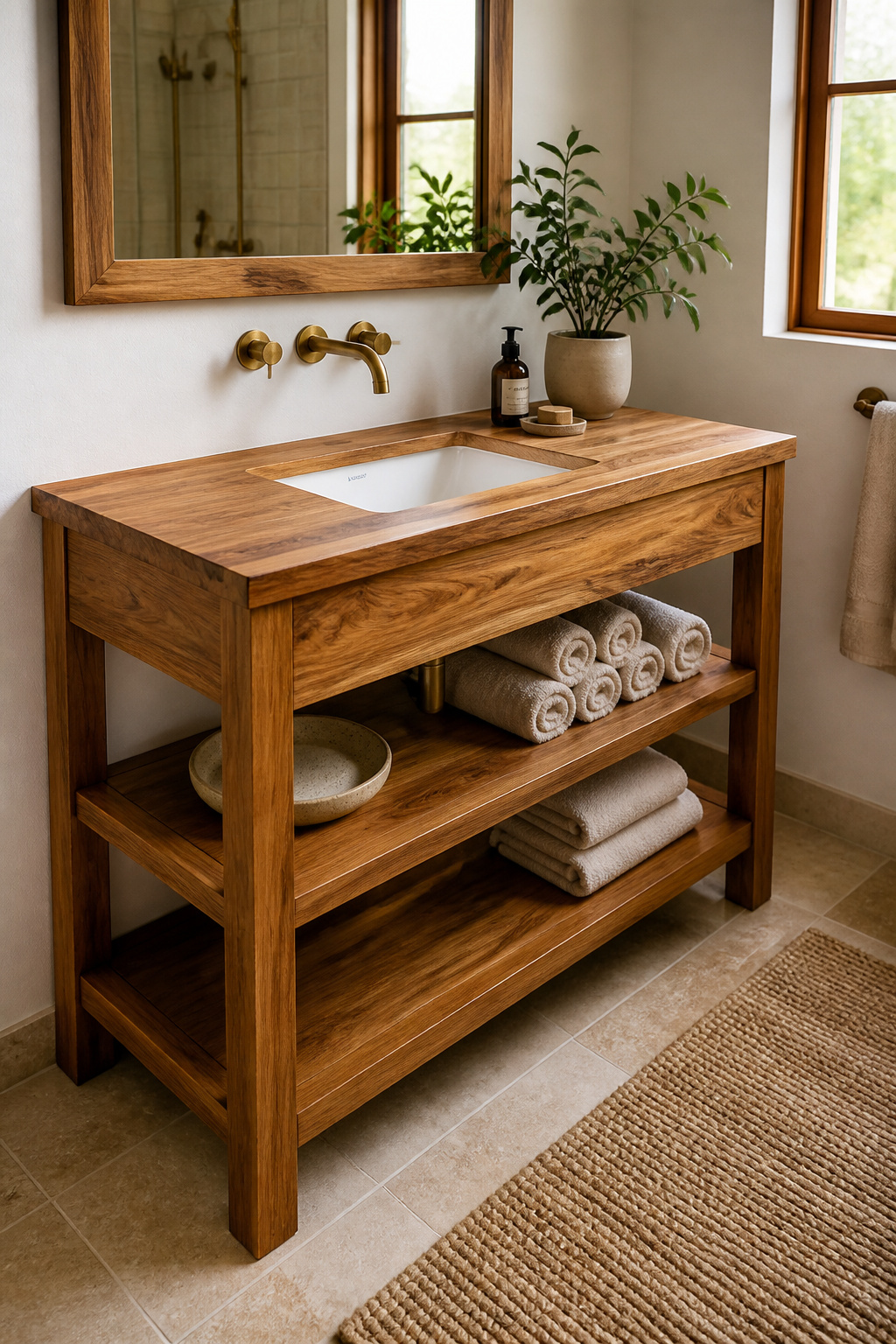
Teak is the benchmark. Three compounding properties make it the standard against which other bathroom timbers are measured: natural silica content and internal oils that repel moisture at a molecular level, a closed grain structure that minimises water penetration, and a moderate hardness (approximately 1,050 lbf on the Janka scale) that resists denting without brittleness. The finish requirement for teak is one of its most practical attributes — penetrating teak oil every few months is all it needs. Polyurethane and lacquer actively peel off teak’s oily surface and should never be used.
Bamboo is the more sustainable alternative, and the performance case is stronger than most people realise. Bamboo regenerates in 3 to 5 years versus teak’s 25 to 50 year cycle. Strand-woven bamboo — the manufacturing process that compresses bamboo fibres under high heat into a board material — is harder and denser than most hardwoods and performs comparably to teak in bathroom humidity. Look for FSC-certified products and the ‘strand-woven’ specification specifically. For more on how natural wood vanity choices translate across different bathroom styles, farmhouse bathroom vanity ideas covers the aesthetic spectrum in useful detail.
Reclaimed Wood Bathroom Decor Options
Reclaimed timber deserves more consideration than it typically gets. Reclaimed teak from decommissioned boats and buildings brings decades of seasoning that eliminates the shrinkage risk of new wood, and the silver-grey weathering has a patina no new material can imitate. Treatment requires 5 to 7 coats of penetrating oil over the first weeks to close the grain, but the result is a material story that mass-produced cabinetry simply cannot tell. Source from specialist reclaimed timber suppliers — Retrouvius UK and Lassco are good starting points — who provide provenance documentation.
10. Coastal Bathroom Decor Inspiration With Driftwood and Sea Glass Accents
The elevated coastal bathroom is not the one with nautical rope borders and anchors on the shower curtain. It references the shore through texture, colour, and material without illustrating it — driftwood’s silver-grey grain, sea glass’s frosted translucency, the palette of soft aqua and sandy beige that suggest the water’s edge without spelling it out.
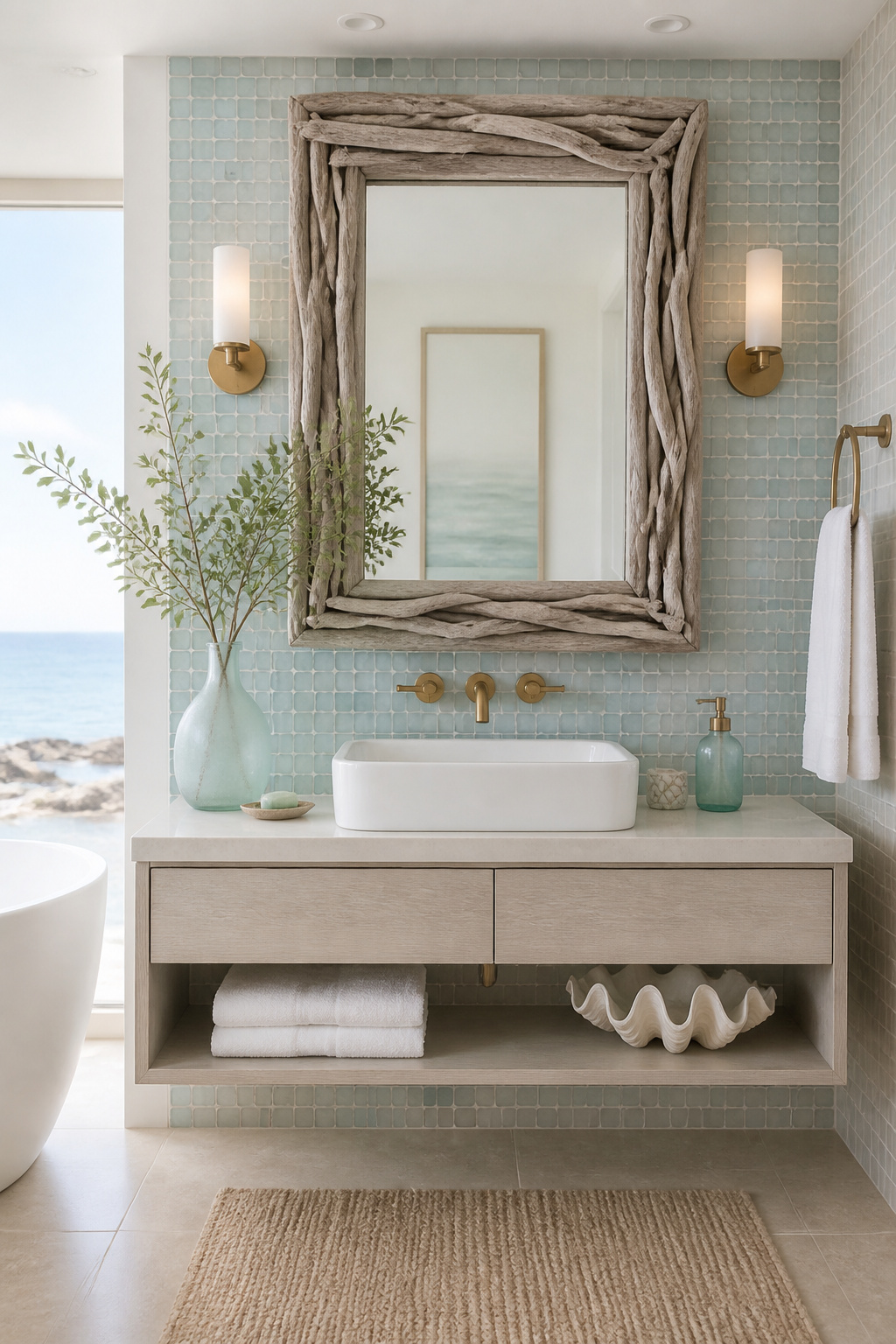
Driftwood as a design element only works if it’s been properly treated for indoor use. Raw beach driftwood carries salt residue and bacteria that make it unsuitable for display without preparation. The process is straightforward: a 30-minute soak in a 1:10 bleach-to-water solution, a white vinegar rinse to neutralise the bleach, and a full week of drying before a coat of clear matte polyurethane seals it for display. High-quality resin-cast artificial driftwood (Cox & Cox and Wayfair both carry convincing ranges at £20 to £100 per piece) is a practical alternative for those who’d rather skip the preparation.
For a comprehensive approach to the complete coastal bathroom look, coastal bathroom ideas covers 21 fully developed examples including vanity, tile, and finishing details. The 2026 prediction worth noting: wall-hung vanity units (floating, no floor contact) are being widely tipped as the dominant bathroom furniture direction of the year.
Sea Glass Tile and Accessory Details
Sea glass mosaic tiles — frosted glass in aqua, seafoam, and white — create a shimmering effect on shower niches or basin splashbacks that genuinely references the ocean. Suppliers including Tile Giant and Fired Earth carry sea glass mosaics in 30x30cm sheets. River pebble bath mats (polished river stones set into a silicone backing) create a reflexology-massage effect underfoot and reference coastal stone beaches with more sophistication than standard rubber matting. Frosted sea-glass soap dispensers and diffuser bottles carry the palette across the vanity top without repeating the same material twice.
11. Artisan Ceramic Vessels and Hand-Thrown Soap Dishes as Sculptural Decor
A hand-thrown soap dish costs more than a mass-produced one. And it signals more than its cost justifies — because the human record written into handmade ceramics, the slight asymmetry of the rim, the way the glaze pools differently each piece, communicates craft and intention in a way that manufactured objects cannot fake. One artisan ceramic piece on a vanity says more about aesthetic intelligence than an entire matching bathroom accessory set from a high-street retailer.
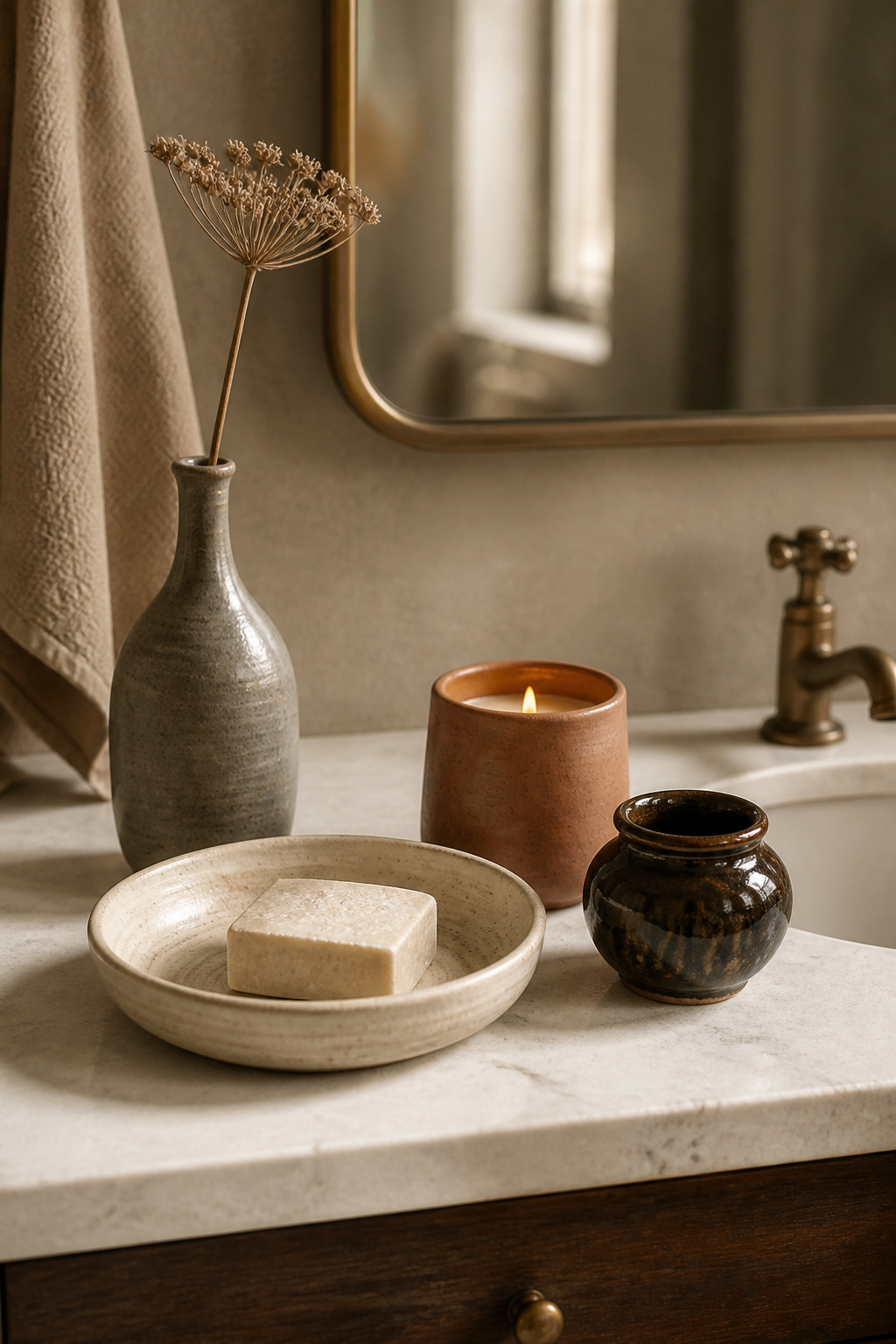
Wabi-sabi aesthetics — the Japanese philosophy of beauty found in imperfection and impermanence — are the dominant sensibility in bathroom styling for 2025 to 2026, and handmade ceramics are their most natural expression. Look for stoneware clay (denser and more durable than earthenware), drainage holes in soap dishes (a functional necessity the best makers build in thoughtfully), and glazes described in terms of natural origins: ash glaze, shino, celadon, tenmoku. These glazes produce surfaces that look nothing like manufactured bathroom accessories — they look like art.
Etsy’s handmade ceramics market is genuinely rich territory here. Search for ‘wabi-sabi soap dish’, ‘hand-thrown stoneware bathroom accessories’, or ‘studio ceramic soap holder’ and you’ll find hundreds of small-batch makers at prices from £18 to £120 for individual pieces. LKSABII is a consistently well-reviewed shop with black matte stoneware that suits darker bathroom palettes. For earth-toned bathrooms, creamy ash glazes and warm terracotta-toned stoneware pair naturally.
Arrangement and Composition for Your Bathroom Decor Ideas
The arrangement matters. For a broader framework for pulling together a cohesive bathroom display, bathroom decorative ideas for a curated look offers useful guidance. On the vanity itself: group ceramics in odd numbers (three or five), vary heights (a tall slender bud vase beside a wide shallow soap dish beside a medium-height vessel), and unify through glaze family — all warm earth tones or all cool celadons, never both in the same arrangement.
12. Biophilic Shower Enclosures That Bring the Garden Indoors
The biophilic shower is more than a design trend — it’s a recognition that the shower is already a sensory environment that references nature (water, steam, warmth) and that amplifying those references through plant life and natural material creates a genuinely different experience. The visual of lush greenery through frameless glass while steam rises around you is the domestic equivalent of bathing in a jungle stream.
Frameless glass enclosures maximise the connection between the shower interior and the surrounding plant display. Standard glass carries a slight greenish tint; specifying low-iron glass (Starphire or equivalent) eliminates this and makes tile and plant colours read true. Stone-effect porcelain — available in convincing basalt, travertine, and granite patterns from most major tile suppliers — achieves the visual warmth of natural stone without any sealing requirements.
For plant integration within the shower itself, the species selection is crucial. Tillandsia air plants are the cleanest option: they absorb moisture directly from the air, require no soil or pots, and attach to tiles via suction cup mounts or wall wire. Pothos is nearly as resilient — trail it from a ceiling hook and it’ll grow actively toward the light, cascading attractively over time. Bird of paradise tolerates high humidity with good drainage and provides the most dramatic foliage statement if ceiling height allows.
Care and Ventilation
Ensure 30 to 60 minutes of extractor fan ventilation after each shower. Plants need air circulation between sessions to prevent fungal rot. Soil-based plants should sit at the shower perimeter rather than inside the spray zone — waterlogged roots are the most common cause of failure. Steam generator systems add £1,500 to £4,000 to a shower installation but transform the experience, and the high-humidity environment they create is paradise for tropical plant species.
13. Low-Voltage Mood Lighting as Bathroom Decor Inspiration for Ambience
The single most impactful change most bathrooms need is not new tile, not a statement mirror, not a new vanity. It’s better lighting. Most bathrooms are lit by a single overhead downlight that flattens every surface, creates unflattering shadows across the face at the mirror, and makes the room feel clinical regardless of how beautiful the other elements are. A layered lighting scheme transforms the same bathroom into somewhere you actually want to spend time.
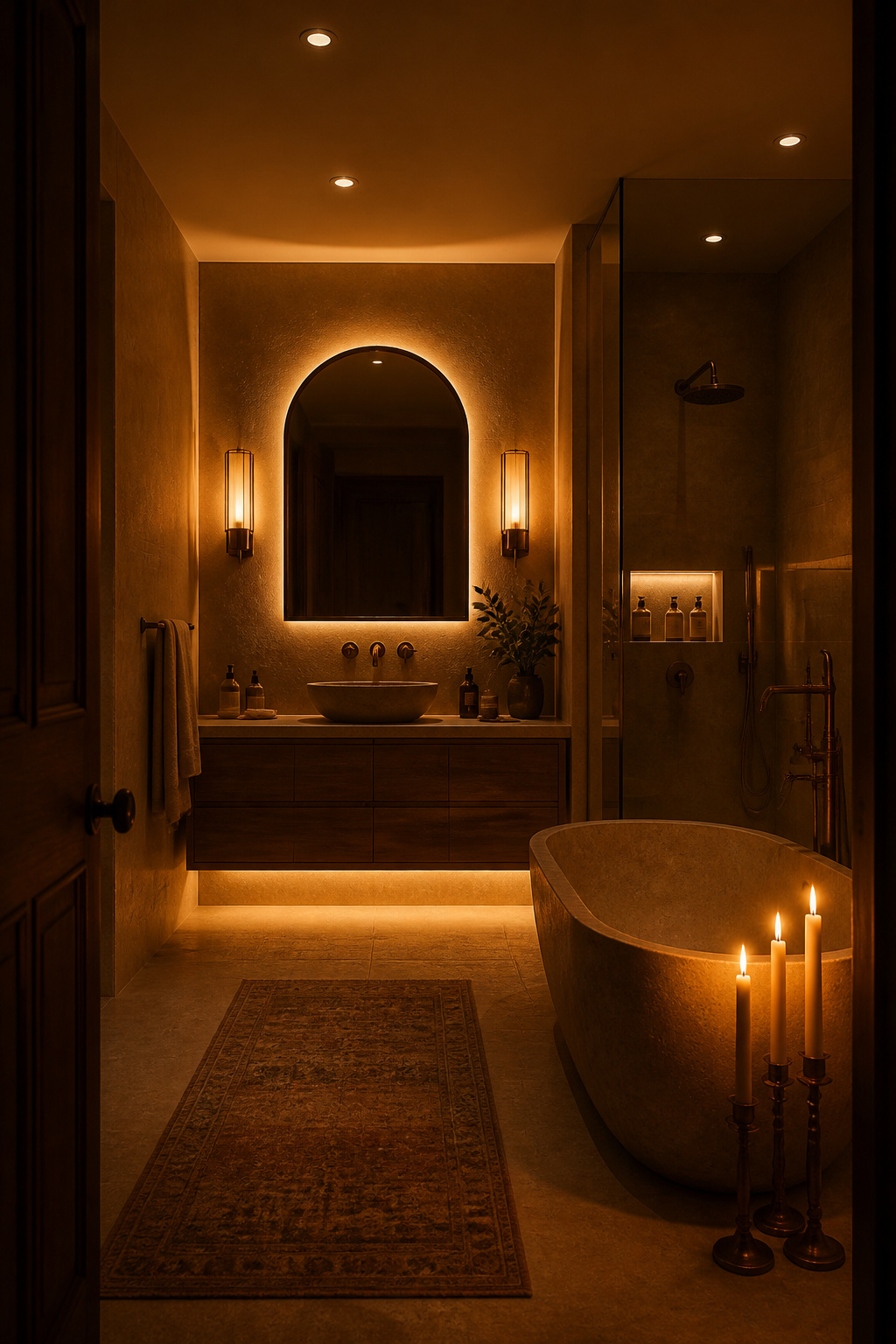
The zone system is non-negotiable for safety: IP44-rated fittings (protection against water splashes) are required for ceiling lights within 3 metres of the shower; IP65-rated fittings are required directly above the shower enclosure. These are building regulations in the UK and safety requirements everywhere — not optional. A 2700K colour temperature (the warmest standard LED, closest to candlelight) creates the most spa-like atmosphere for bathing and ambient areas. The mirror area needs a separate circuit at 4000K to 5000K for accurate colour rendering — this is task lighting, and it needs to be cool enough to show you what you actually look like.
Layered Lighting Schemes
The three-layer scheme that makes the biggest difference: recessed ambient downlights (warm, dimmable, IP44) for general light; wall sconces or swing-arm lights flanking the mirror at face height for shadow-free task light; LED strip under the vanity kickboard for a soft ground-level accent. A backlit LED mirror is the most efficient single upgrade if budget allows — the circumferential light source eliminates the facial shadows that overhead-only lighting creates. For a full picture of what this looks like in practice, modern bathroom lighting ideas covers the full range of fitting types and placement schemes. And for evening baths: real candles at 1800K create an atmosphere no electrical fitting replicates — a set of unscented taper candles in a brass holder beside the bath is the most effective low-cost upgrade on this entire list.
14. Botanical Print Gallery Walls That Turn Bare Bathroom Surfaces Into Art
Bathrooms are the home’s most sensory room, and botanical and ocean-themed imagery resonates within them in a way it rarely does elsewhere. The visual of a detailed fern print or a watercolour ocean scene connects the water theme of the space to the natural world — it’s decoratively coherent in a way that abstract art in a bathroom often isn’t. As bathroom decor inspiration goes, a well-composed gallery wall is one of the highest-impact changes you can make for the lowest material cost.
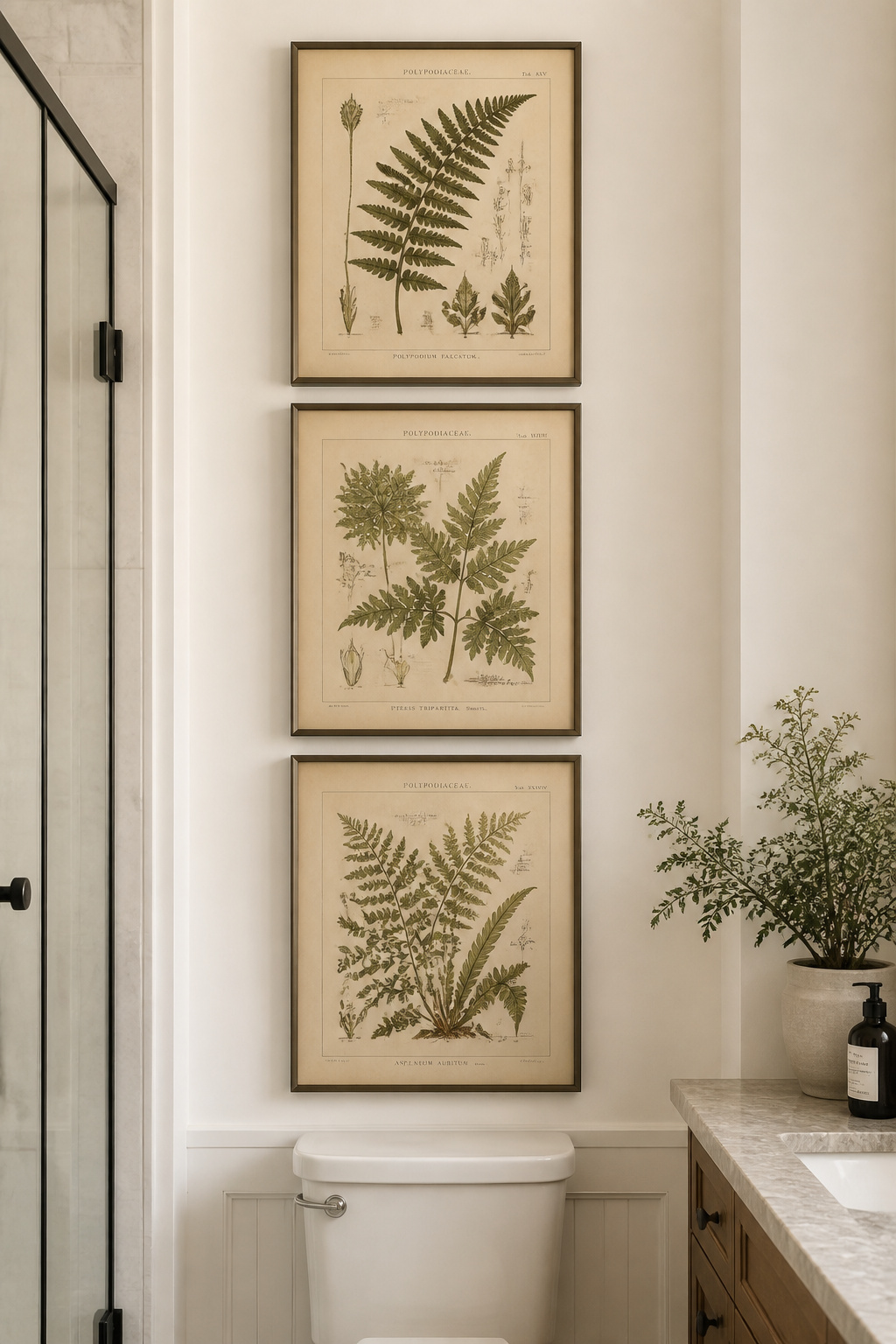
The humidity challenge is real but manageable with the right framing approach. Acrylic (Perspex) glazing is preferable to standard glass for three reasons: it’s lighter (easier to hang on tiled walls), less prone to internal condensation forming between the glass and the print, and shatter-resistant if knocked. Metal frames or Polcore frames (manufactured from recycled polystyrene) are completely unaffected by moisture — unlike raw wood frames, which can warp and develop mould at the rebate where the print meets the frame.
For the prints themselves, premium giclée printing on archival-quality cotton rag paper (300gsm+) offers UV-resistant inks with a lifespan of 75 years or more when properly framed. Avoid standard thin paper posters — they ripple in bathroom humidity within weeks even behind glass. Society6, Desenio, and specialist botanical print publishers offer archival-quality options at reasonable prices.
Placement for Bathroom Decor Safety and Longevity
In small bathrooms, one large statement print (A1 or larger) reads more sophisticated than a grid of small prints. In larger bathrooms, a vertical stack of three identically-sized prints creates height without width on the wall beside the mirror. Keep everything at least a metre from the direct splash zone (shower head and bath taps) and run the extractor fan for 20 minutes after each shower. Those two habits extend artwork life more reliably than any specialist coating.
15. Indoor Tabletop Water Features That Add Spa Energy to Any Bathroom
Environmental psychology research is fairly unambiguous about what the sound of moving water does to the nervous system: it activates the parasympathetic response — the body’s rest-and-digest mode — and reduces perceived stress in a way that background music or silence doesn’t quite replicate. A small tabletop fountain is the most direct way to introduce this effect into the bathroom, and contemporary ceramic and stone-cast options integrate beautifully with eco-luxury aesthetics.
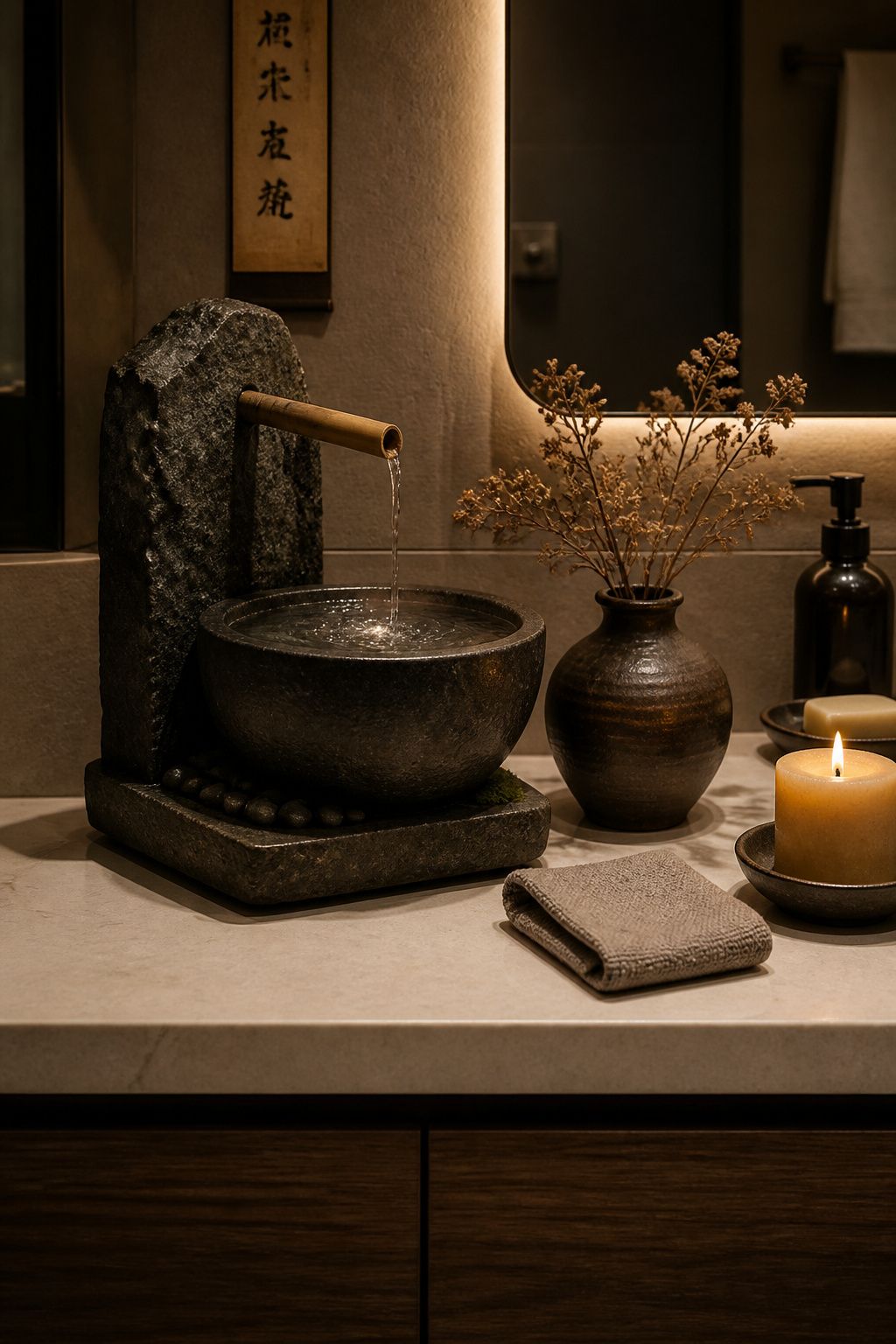
The sound quality matters more than most buyers consider. Low flow rate produces a gentle trickle — a calm background note that recedes after a few minutes and lets you think. High flow rate creates a louder, more energetic sound that can feel intrusive in a small bathroom. The best tabletop fountains have adjustable submersible pumps that let you tune the flow to your preference. Position the fountain on the vanity beside the mirror or on a shelf beside the freestanding bath — the visual of moving water combines with the sound for a compound sensory effect that a diffuser or candle alone cannot achieve.
Material options range from ceramic and stone-cast polyresin (£40 to £200, the accessible entry point) to genuinely carved basalt and granite (£200 to £600+, the weight and texture of real stone). Bamboo spout fountains reference the tsukubai tradition of Japanese garden design — a bamboo tube dripping water into a stone bowl — and produce the characteristic soft, irregular tapping sound that many people find the most calming. Avoid LED-lit stone fountains: the backlighting tends to undermine the natural material quality; choose stone colour (warm grey, basalt black, terracotta) instead.
Maintenance and Water Quality
One rule is absolute: use distilled water, not tap water. Tap water leaves mineral deposits that clog the submersible pump and leave white scale marks on the fountain surface within months. Distilled water eliminates this entirely. Monthly cleaning — drain, wipe with diluted white vinegar, rinse thoroughly, refill — takes ten minutes. Keep the fountain out of direct sunlight to slow algae growth, and change the water every one to two weeks. That’s the full maintenance commitment for a daily dose of bathroom decor inspiration that engages the nervous system, not just the eyes.
How to Use This Bathroom Decor Inspiration to Start Your Own Transformation
The most common obstacle between reading bathroom decor inspiration and actually acting on it is the paralysis of choice. Fifteen directions are useful for building a vision — but they’re not a sequential to-do list. The question is which one change would have the most impact in your specific bathroom, right now.
For small bathrooms (under 5 square metres), prioritise vertical solutions and soft elements before any structural change. A living plant wall, a tall arched mirror, a gallery wall of botanical prints — these work vertically in tight spaces where horizontal additions create congestion. Textiles and ceramics transform the sensory feel without touching a single tile.
For bathrooms with poor natural light, the lighting layer is non-negotiable and should come first. Warm-toned dimmable LEDs plus a backlit mirror will do more for how your bathroom feels than any new surface material. After that, choose lighter palette options — warm stone-effect porcelain rather than dark natural slate — to maximise whatever light is available.
For budget-conscious transformations, a sequenced investment model makes sense. Replace the lighting first (highest impact per pound). Then replace the textiles. Then hardware. Tile and vanity come last: the most expensive categories, but also the most permanent, so they benefit from having a fully considered aesthetic already in place. The compounding effect is real — each element here reinforces the others, and the bathroom decor inspiration you begin with becomes something increasingly your own as the layers accumulate.