Most bedrooms are designed for everything except sleep. There’s a TV on the wall, a phone charging by the pillow, a desk wedged into the corner, and a wardrobe overflowing onto the floor — and somehow we expect to drift off in the middle of all that stimulation. The room has no idea what it’s for.
A bedroom remodel doesn’t have to mean knocking down walls. It means deciding what the room is actually for, and then making deliberate choices — about light, about materials, about what comes in and what goes out — to support that intention. These 15 bedroom remodel ideas range from structural changes to things you can do this weekend, all of them chosen for the same reason: they shift the room from a multi-use storage space into a place you genuinely want to sleep in.
1. The First Bedroom Remodel Idea Worth Getting Right: Remove the TV
There’s a reason this comes first. Nothing undoes a bedroom faster than a screen on the wall, and no amount of warm lighting or linen bedding compensates for it.
Blue light suppresses melatonin for approximately twice as long as warm light. But the deeper problem isn’t just the light. It’s the associative cue. When you have a TV in your bedroom, the brain begins to associate the room with stimulation and wakefulness rather than rest. You’re not just watching something before sleep; you’re training your nervous system to expect it.
A 2024 PMC study on adult screen use found that daily screen exposure before bed correlated with around 7.6 fewer minutes of sleep on workdays. Multiplied across a year, that’s the equivalent of losing nearly two full nights. If you look at bedroom design styles that prioritise rest, the most restorative spaces share one consistent characteristic — no screens.
The wall the TV leaves behind is prime real estate. A horizontal wood plank panel, a single framed work, or a warm wall sconce pair all make better use of it. And if you use a TV to fall asleep, swap to audio: a white noise machine, a sleep podcast, or a nature sound app delivers the same lull without any blue wavelength stimulation. The transition takes a few nights, then it stops being noticeable.
One mistake to avoid: moving the TV to a different wall rather than removing it. Same circadian problem, slightly further away.
2. Switch to Warm, Layered Lighting That Dims
The bedroom light switch does two things: it turns the light on, and it turns it off. That binary approach is part of the problem. A room that goes from fully lit to completely dark gives the brain very little time to transition.
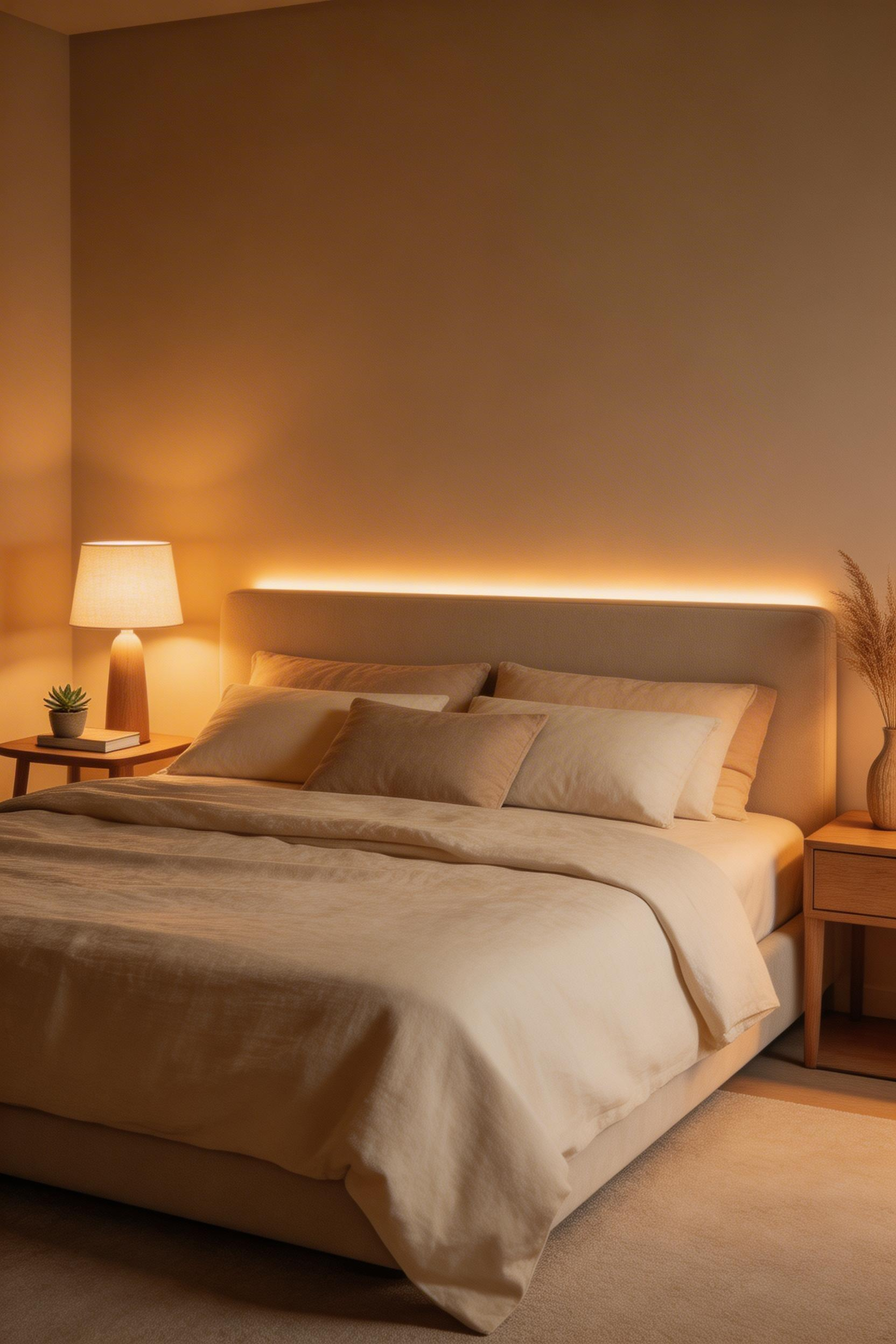
Warm white light in the 2700K–3000K range mimics sunset tones and allows natural melatonin production. Anything above 4000K — which includes most standard LED downlights — measurably delays sleep onset. Harvard-tracked research showed participants exposed to warm evening light fell asleep 19 minutes faster than those under cool-toned bulbs.
Layering fixes the binary problem. Ambient lighting handles the room overall, but it needs supplementing with bedside task lighting at eye level — roughly 52–58cm from the floor — and a low-wattage accent source, such as an LED strip behind the headboard at 10% brightness. The goal is a gradient: bright enough to get ready, reduced by evening, and further dimmed as you approach sleep. For a broader look at how to make this work, bedroom lighting ideas that work with a minimal aesthetic cover everything from fixture placement to bulb selection.
For smart home users, Philips Hue and LIFX both offer adaptive lighting modes that shift automatically from 4000K during the day to 2200K by 9pm. Matter-compatible smart bulbs (the 2024–2025 interoperability standard) now work across Google Home, HomeKit, and Alexa, so you can buy the best product rather than the most ecosystem-compatible one. A timer-dimmer switch costs from $25 and requires no ecosystem at all. That’s often the right solution.
3. A Bedroom Renovation Idea Designers Swear By: Panel or Shoji-Style Room Dividers
Not every bedroom problem is about furniture or paint. Sometimes the problem is that the room has no internal zones — it’s one undifferentiated space where sleeping, dressing, and working happen in the same eyeline.
Sliding panels solve this without construction. A shoji-style divider, placed between a sleeping area and a desk corner or dressing zone, reduces the visual reminder of unfinished tasks at the moment you’re trying to rest. The screen doesn’t block the space; it redirects attention within it.
Modern versions have moved well past the flimsy paper-and-balsa constructions you might picture. Contemporary options include frosted glass in powder-coated aluminium frames, translucent acrylic in timber surrounds, and timber slat designs with horizontal planks spaced 1–2 inches apart. The slat version is currently the most sought-after in contemporary interiors — it offers visual separation while still moving light through the room.
Installation uses a hardware-track system and is completely reversible. A top-track-only system eliminates tripping hazards and works on most floor types including carpet. Pre-made kits from suppliers like RoomDividers.com start under $800 including hardware and shipping. Custom commissions from makers like Miya Shoji run $1,200–$3,000+, made to exact room dimensions. For a budget entry point, IKEA PAX wardrobe doors fitted with frosted glass inserts do the job from around $200.
4. Lower the Bed Frame to Reclaim Visual Calm
One of the most underappreciated bedroom remodel moves costs nothing beyond the bed itself. Lower the frame.
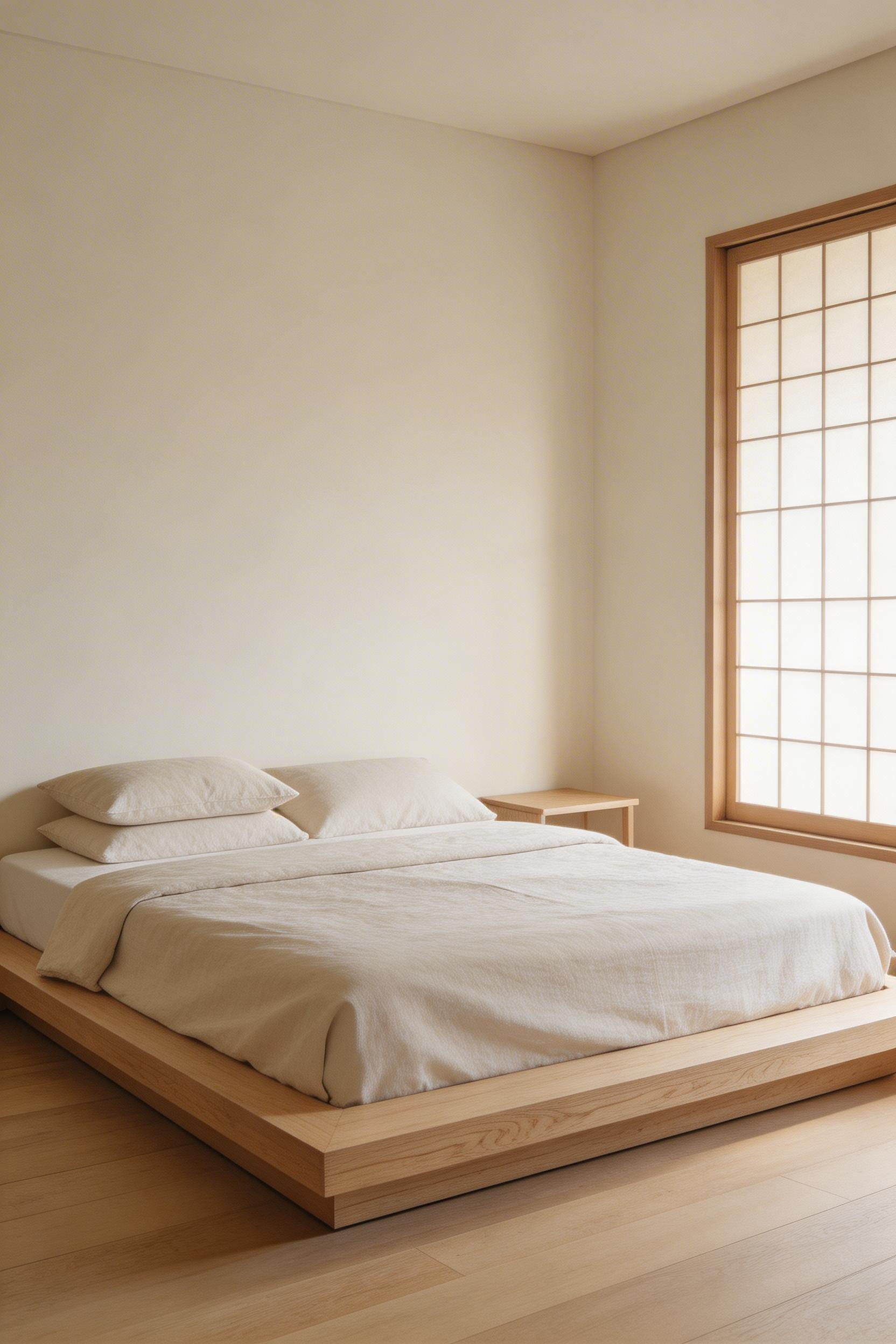
A low-profile platform bed — typically 6–12 inches from floor to mattress surface — does something specific to a room. The long horizontal line draws the eye across rather than up and down, making the space feel wider and calmer. Ceilings appear higher. The relationship between the sleeping surface and the floor shifts to something more grounded.
This is rooted in Japanese interior design, where near-floor sleeping connects to a sense of groundedness and deliberate rest. The practical logic is spatial: there’s more open wall above the bed, more visual breathing room. Standard platform beds also eliminate the box spring entirely, reducing total bed height by 6–9 inches versus traditional setups — which is often the most dramatic single furniture change you can make to how a room reads.
Under-bed clearance on most platforms is 6–8 inches — enough for flat storage containers, but not for rolling drawer units unless specifically designed for them. Budget options include IKEA MALM and MANDAL at $300–$500. Mid-range: Castlery, Article, and West Elm offer solid wood platforms at $800–$1,500. At the investment end, Muji and Room & Board provide natural timber platforms from $1,500+.
One error worth avoiding: buying a low frame and then placing a 14-inch pillow-top mattress on it. The total height ends up the same as a tall frame, and the visual effect disappears entirely.
5. Clear the Floor With Under-Bed and Built-In Storage
A bedroom floor clear of objects does something measurable to the quality of rest you get in it. This isn’t interior design philosophy — it’s environmental psychology. Unresolved visual information at floor level creates low-level cognitive load that persists even during sleep. The room stops reading as a rest space.
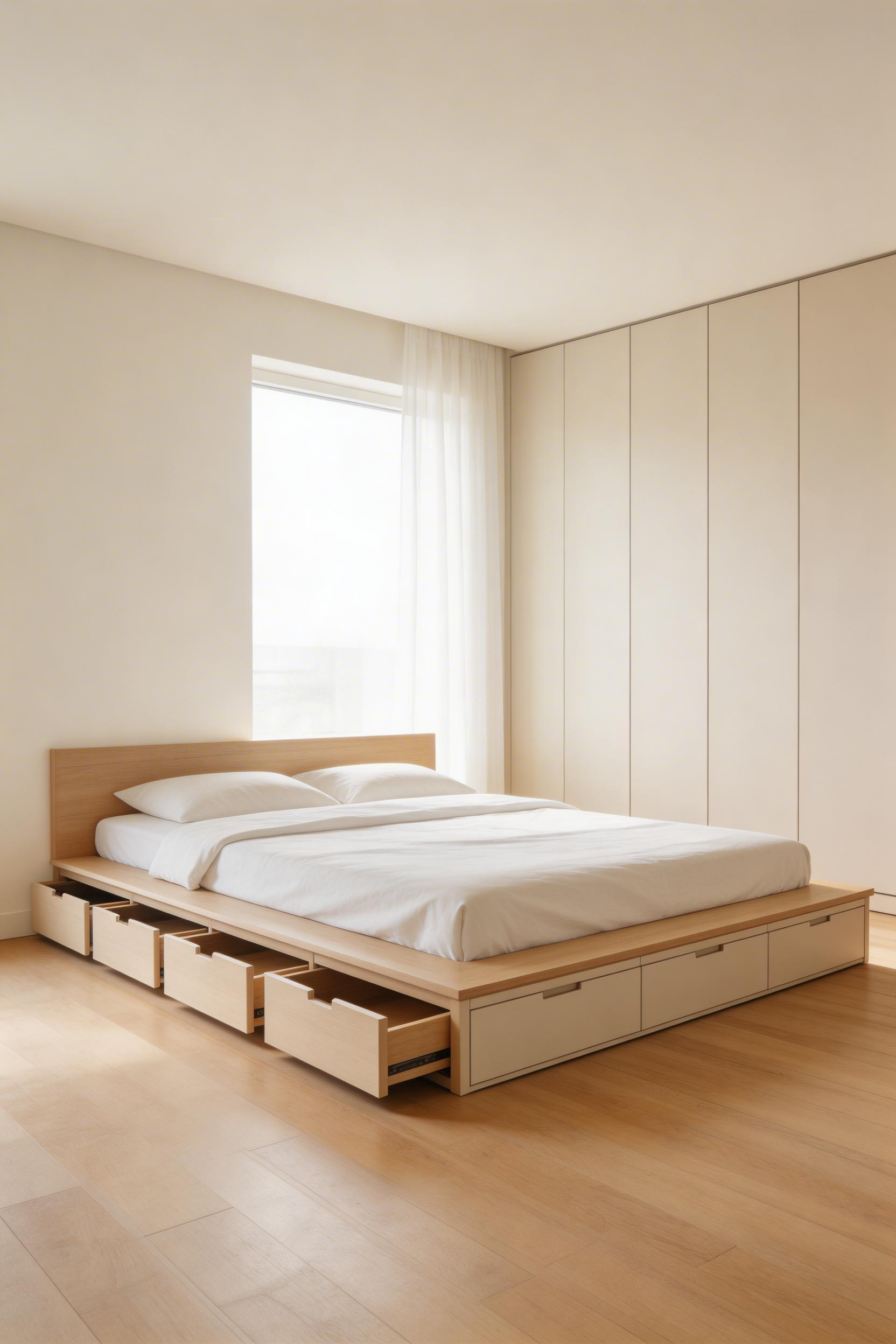
The minimalist bedroom decor principles that reduce visual noise aren’t about owning less; they’re about storing things out of sight. Under-bed storage is the most practical tool for this.
Platform beds with integrated drawers offer 4–8 full-width drawers in queen and king sizes. IKEA’s BRIMNES includes two drawers per side at approximately 90cm × 60cm × 23cm deep — enough for folded bedding, seasonal clothing, and anything that currently occupies the floor. Ottoman storage beds use a lift-up mechanism to reveal a full under-mattress compartment, better suited to bulkier seasonal items. Separate low-profile rolling bins ($30–$80) slide under most platform beds with 18cm or more of floor clearance.
For the wardrobe, IKEA PAX screw-fixed to walls and trimmed to ceiling height reads like built-in joinery at a fraction of custom cabinetry cost ($400–$1,200). Custom built-ins make sense when there’s an awkward alcove or chimney recess that standard options can’t use.
6. Replace Closet Doors With Frosted Glass or Open Niches
Standard hinged closet doors create more disruption in a bedroom than most people realise. They interrupt wall planes, require a 24–32 inch swing arc that limits furniture placement, and produce a slab-like visual break in the room surface.
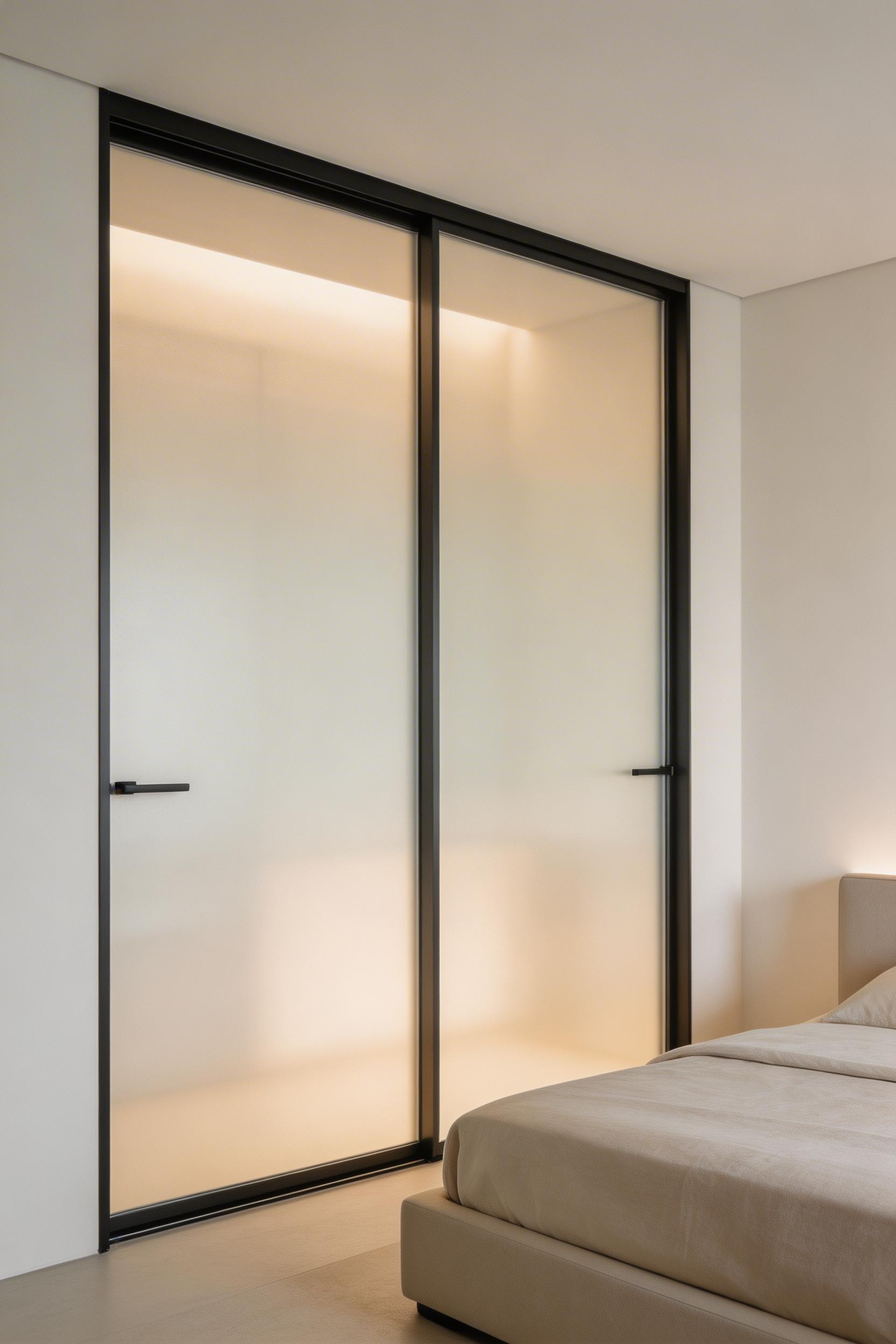
Sliding bypass systems fix the arc problem entirely. Tempered frosted glass panels in a top-track system (4mm SGCC-certified glass, available up to 96×80 inches) recover the swing space, filter light naturally, and sit flush when open. Hardware comes in matte black, brushed gold, or brushed silver. Pre-assembled panels allow 30-minute DIY installation; professional fitting adds $150–$300. Bypass door pairs from Amazon and Home Depot run $250–$600 depending on size.
The alternative is removing the doors entirely. A capsule wardrobe — fewer than 40 garments, organised visibly — can look deliberately curated rather than cluttered. Add a linen curtain on a ceiling-fixed rod ($30–$80) if occasional concealment is needed. A simple LED strip inside the wardrobe ($20–$30) transforms it from storage to feature.
The common mistake with frosted glass: choosing panels with visible frames at every seam. Minimal-frame or frameless options make the difference.
7. One Bedroom Remodel Idea That Changes the Morning: A Ritual Corner
Sleep and waking are two distinct processes, and most bedrooms are designed for only one of them.
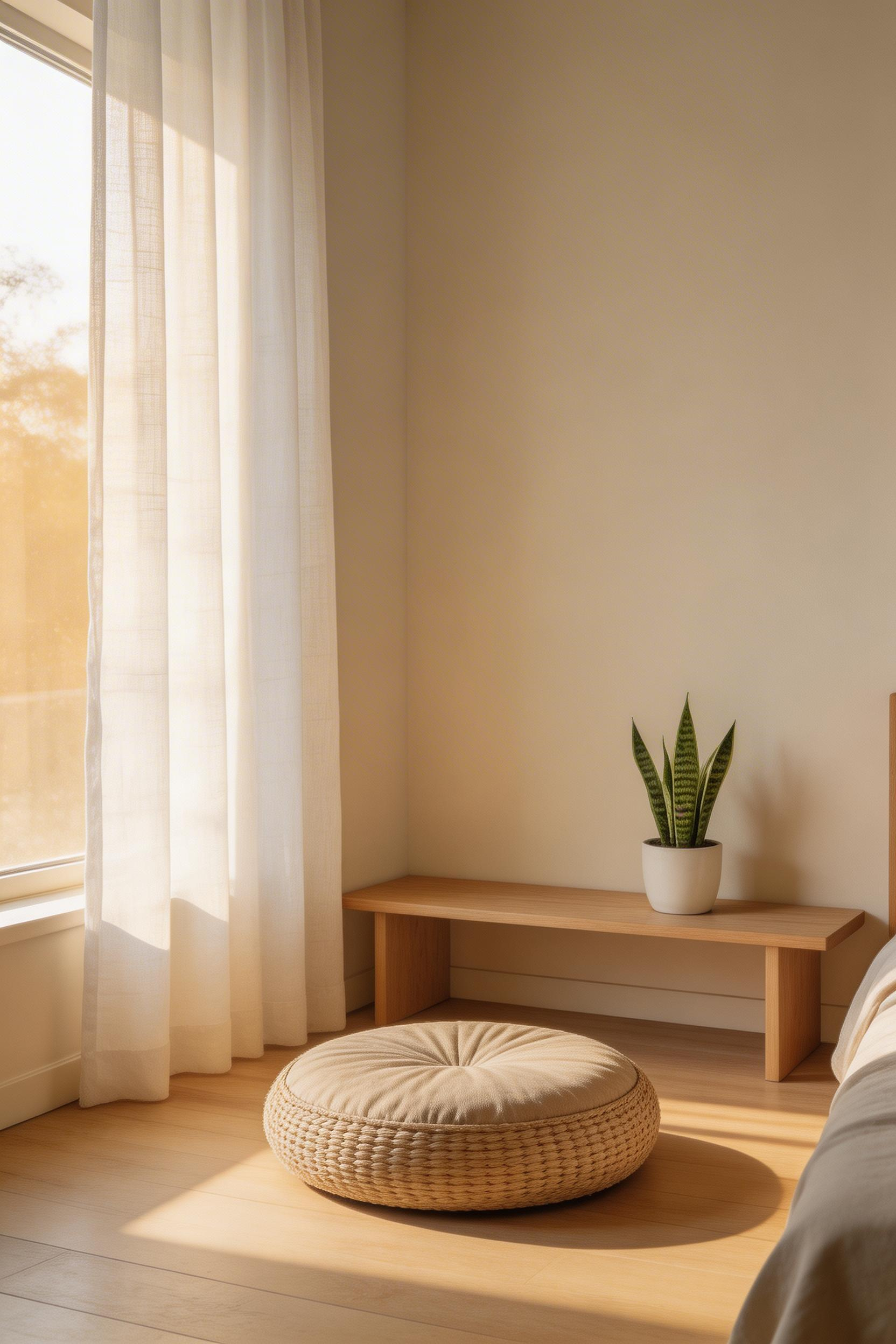
A ritual corner — a dedicated 4×4 foot area near a window, with seating, a small surface, and one considered object — creates a spatial cue for the start of the day. Moving from the sleeping zone to a separate zone signals to the brain that a new mode has begun. The spatial cue is as important as the practice itself.
East- or north-facing placement works best for consistent morning light without harsh direct sun. For small bedrooms, the furniture footprint can be minimal: a 24-inch low meditation bench or a Muji-style floor chair. A zafu cushion (40cm diameter) on a small tatami tile takes up almost nothing. If floor space isn’t available, a deep closet nook converted into a standing ritual corner — shelf, mirror, plant — does the same work.
Lighting: a low-wattage warm floor lamp at 2200K directed toward a wall creates uplighting rather than direct glare. The effect should feel like early sunlight, not overhead task lighting.
For most bedroom makeover ideas in this category, the mistake is the same: overstocking the corner. If setup requires multiple arrangements before you can sit, you won’t use it. Three objects maximum — a cushion, a surface, and one plant — is the ceiling.
8. Repaint With Muted, Warm Neutrals That Absorb Rather Than Reflect
Colour temperature in paint works the same way it does in lighting. High-LRV whites and cool greys — the default choice in most modern bedrooms — actively bounce light around the room, counteracting the warm-toned bulbs you’ve carefully installed.
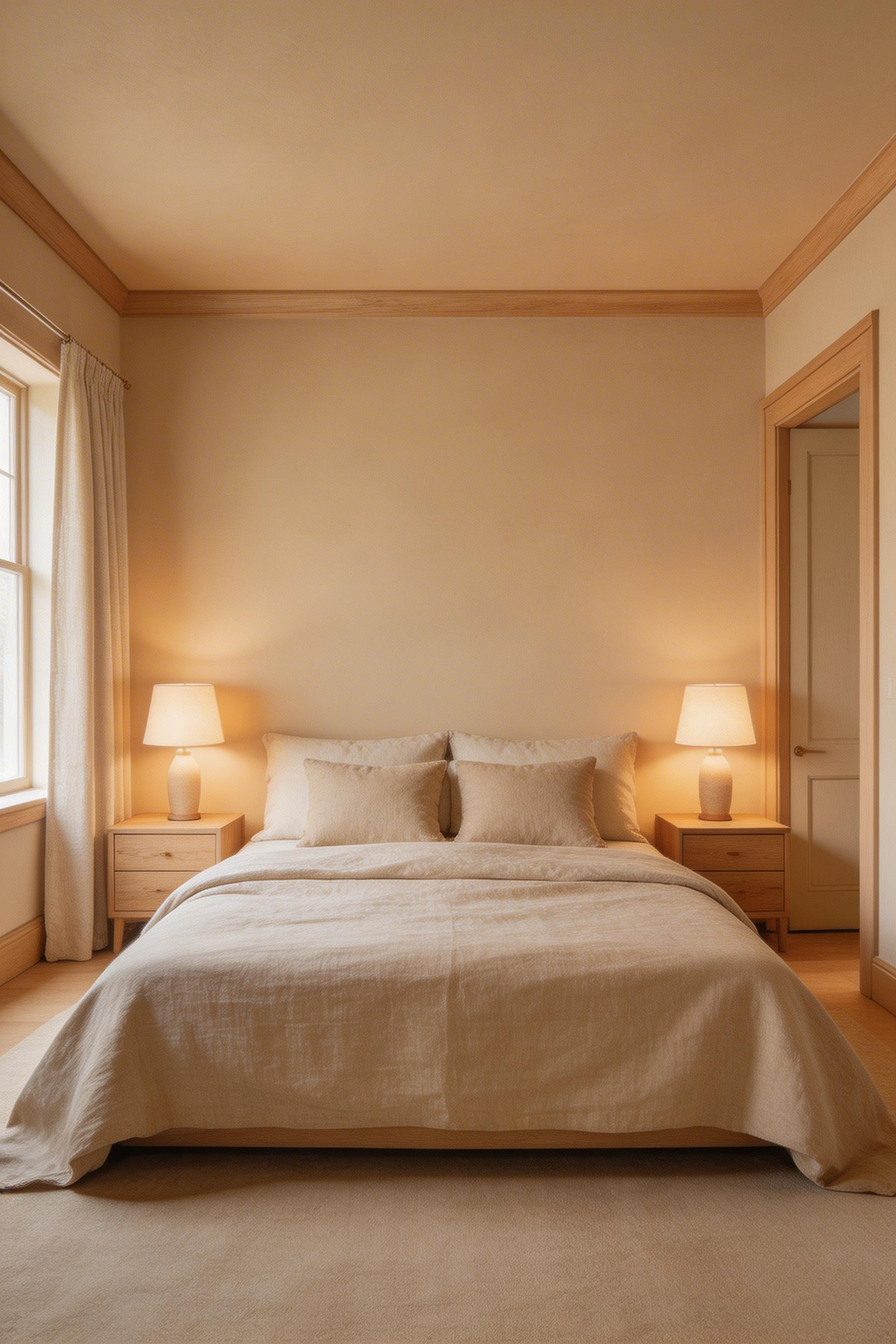
LRV (Light Reflectance Value) measures how much light a colour reflects. Pure white sits around 95; pure black around 5. For a restful bedroom, the useful range is LRV 45–65 — warm enough to absorb some of the room’s light, balanced enough not to feel heavy.
Colour Options Worth Considering
Benjamin Moore Pale Oak (OC-20) is the most consistently recommended warm neutral: LRV 70, with pink and yellow undertones that hold well under both artificial and natural light. Sherwin-Williams Accessible Beige (SW 7036) at LRV 58 reads as neutral without veering yellow. For something with more depth, Farrow & Ball Setting Plaster (No. 231) — a warm clay-blush — creates a genuinely cocooning effect in evening light. For more options at work in real rooms, bedroom paint ideas that create a genuinely serene atmosphere covers the full range, including how the same neutral reads differently in north versus south-facing rooms.
Also worth pairing with: check out 23 Essential Modern Bedroom Decor Ideas for a broader look at how paint, furniture, and material choices work together in contemporary bedroom design.
Ceiling treatment matters too. Paint it the same warm neutral as the walls, or one shade lighter — this closes the room softly without the stark contrast of white ceiling against beige walls. Colour drenching (walls, ceiling, and trim in the same tone) is the approach used in high-end bedroom design. Ensure the trim white has warm undertones: Benjamin Moore White Dove rather than Bright White.
Before committing, test A4+ sized samples on multiple walls. A paint that reads warm on a small chip reads completely differently in a large north-facing room.
9. Layer Natural Textures: Linen, Rattan, and Unfinished Wood
In a bedroom with a neutral palette and warm lighting, texture becomes the primary design element. When most surfaces are in the same tonal range, texture variation is what gives the room its sense of depth and material quality.
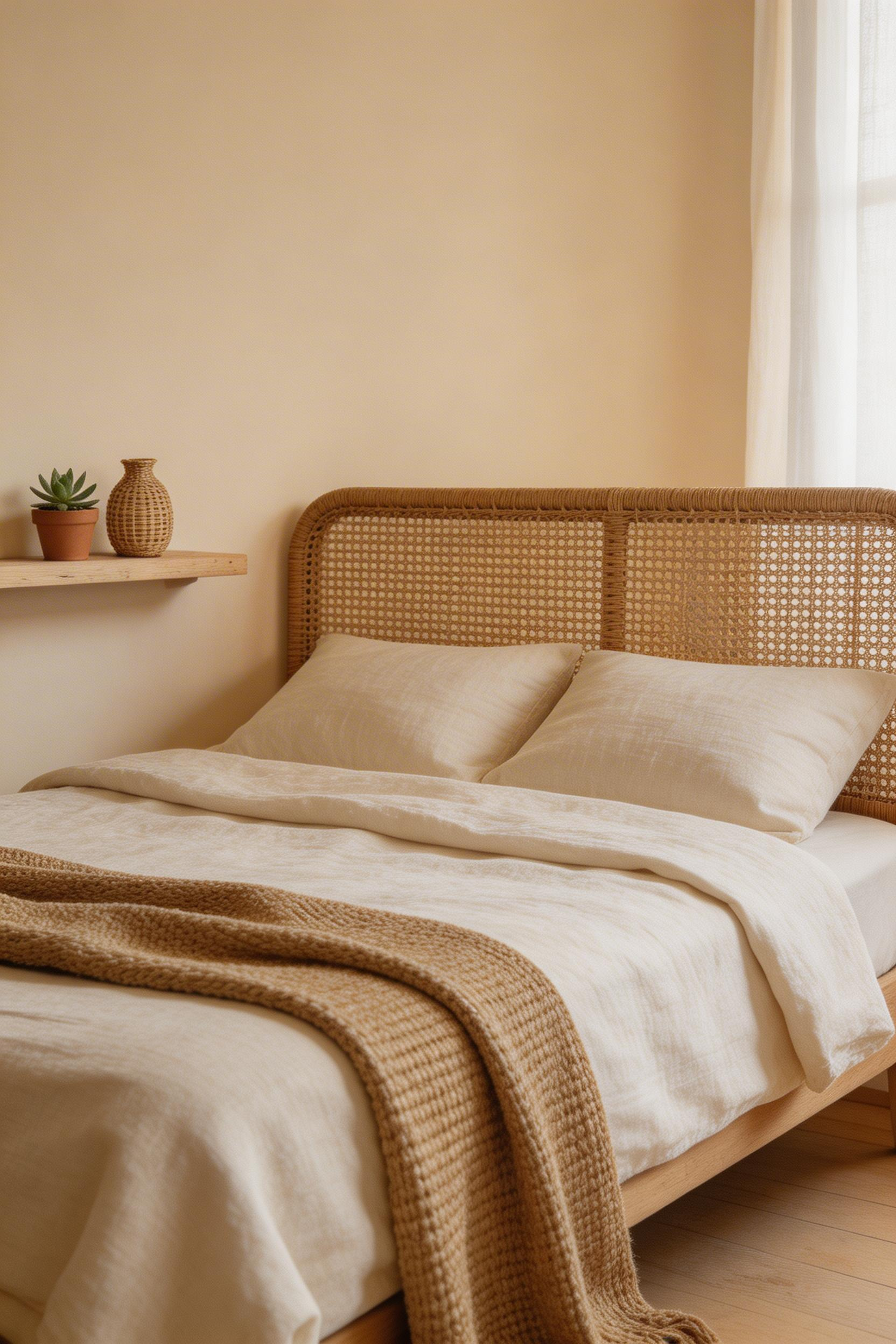
Linen, rattan, and unfinished or lightly oiled wood work together because they share a quality: they look different at different times of day. Linen’s weave catches morning light differently than evening lamplight. Rattan’s woven pattern creates visual interest without adding colour. Wood grain is never uniform. The result is a room that reads as nuanced even in a narrow palette — a quality synthetic materials don’t replicate.
The practical combination: linen duvet cover and pillowcases in cream or warm grey, one large rattan piece (headboard or accent chair — not multiple smaller items), and raw or oiled wood on the floor, shelf, or accent wall. Add a jute or wool throw at the foot of the bed as a third tactile layer.
What to avoid: high-gloss furniture, polyester bedding, chrome fixtures. They reflect light differently from the organic materials, and the contrast is immediately visible even if you can’t identify exactly why the room doesn’t cohere. Faux rattan (plastic wicker) fails for the same reason — its uniform weave and visible seams read as imitation at close range. In this kind of room, the details are the room.
10. Bedroom Makeover Idea for Tech-Savvy Households: Hide Smart Controls
Smart home technology and a restful bedroom are in real tension. The technology supports better sleep — automated dimming, temperature scheduling, motorised blackout blinds. Yet the physical presence of the devices contradicts the calm you’re trying to create. Blinking LEDs, visible screens, tangled cables — all of these undermine everything else on this list.
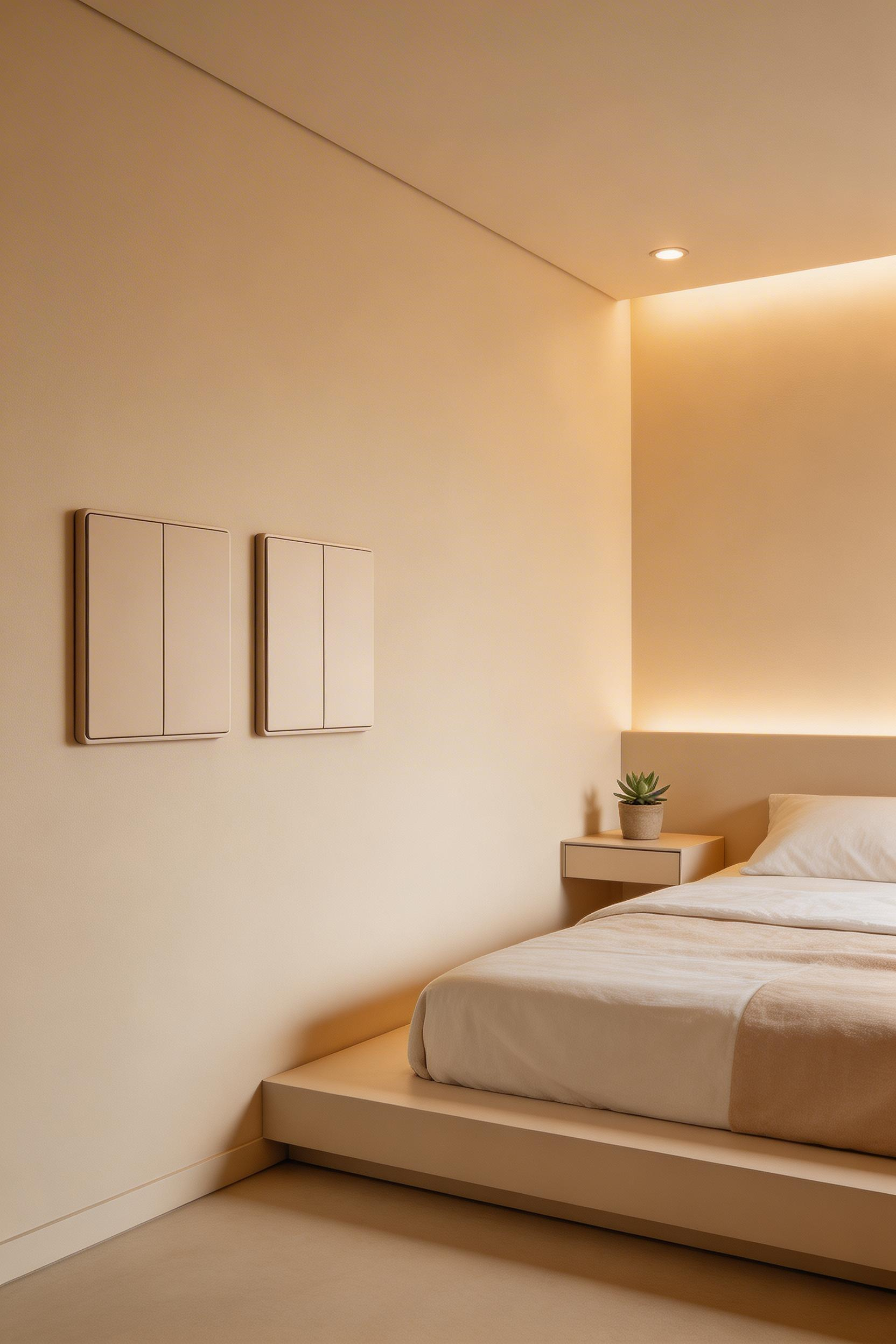
The resolution is separation: controls should be functional but invisible from the bed.
Making the Technology Disappear
In-wall smart switches — Lutron Caseta, Leviton Decora Smart — sit flush with a standard wall plate. No protruding device, no visible LED on standby. They look like a standard switch until you touch them, and they’re the single most effective way to add smart control without the hardware showing. Smart speakers (HomePod mini, Google Nest Mini) work better on a shelf behind or beside the bed than on a nightstand where they’re always in the sightline. Cover status LEDs with black electrical tape, or buy models with a sleep mode that disables them after 10pm.
For platform-level automation: Apple’s HomeKit Sleep Focus mode automatically dims lights, silences notifications, and activates Do Not Disturb at a scheduled bedtime. Google Home Routines run a ‘goodnight’ sequence — lights to 10%, thermostat set, blackout blinds down — from a single spoken command. Matter compatibility (the 2024–2025 standard) means mixing brands freely without ecosystem lock-in. A minimal functional setup costs $110–$215: smart dimmer switch, smart plug for fan or air purifier, one smart speaker.
One hard rule: screen-based devices (Amazon Echo Show, Google Nest Hub) don’t belong in the bedroom. The form factor defeats the purpose.
11. Add a Horizontal Wood Accent Wall Behind the Bed
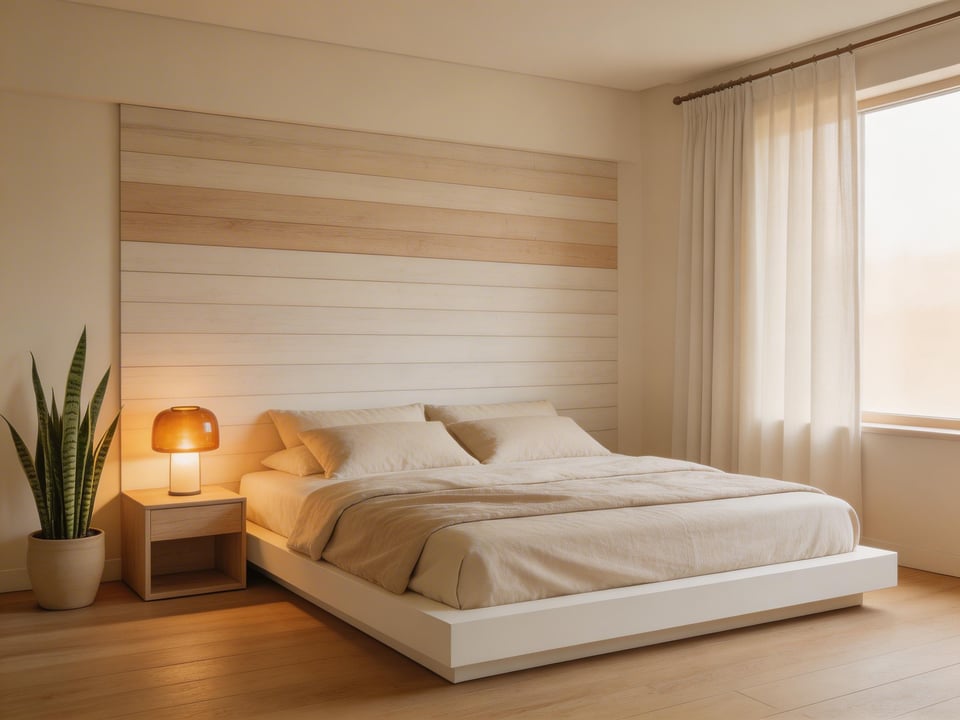
The bed wall is the natural focal point of any bedroom — you face it when you enter and it frames your first and last view of the day. Most people put a large piece of art above the headboard and leave it at that. A horizontal wood plank wall is a more considered answer to the same question.
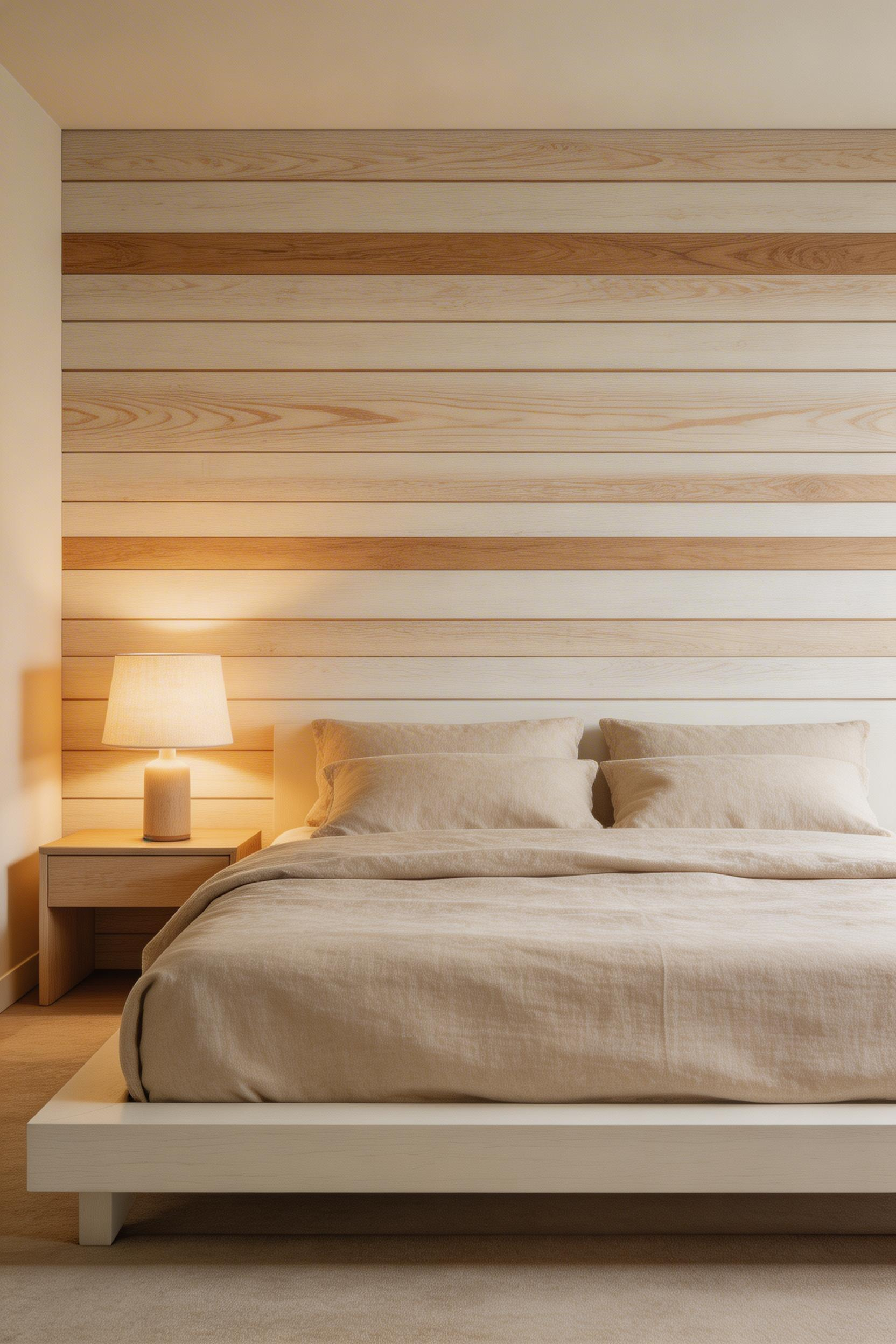
Horizontal planks do two things at once: they anchor the bed within the space and extend the visual width of the wall, making narrow bedrooms feel wider. The organic variation in wood grain — no two boards are identical — means the wall reads as natural and intentional rather than factory-produced.
White oak is the premium choice: consistent grain, Janka hardness of 1,360, and a natural warmth that shifts from golden in morning light to honey in lamplight. Aromatic cedar has an antimicrobial quality that’s a practical bonus in a sleeping space. Budget option: knotty alder at roughly $2.99 per 8-foot plank reads as intentionally rustic without trying too hard.
For finish, natural oil (Rubio Monocoat or Osmo) preserves the raw quality and allows the wood to breathe. Lacquer creates a plastic finish that ages poorly and conflicts with the organic materials elsewhere in the room.
Cost range: a DIY peel-and-stick system (Wallplanks unfinished white oak at $8–$12/sq ft) keeps a standard queen bed wall under $200. Nail-up solid plank systems cost $3–$7/sq ft for affordable species, $10–$15/sq ft for white oak, plus labour if needed.
Install planks horizontally. Vertical lines read as taller and narrower — the opposite of the calm, wide extension this technique is designed to achieve.
12. Bring In One Considered Plant, Not a Collection
The standard approach to bedroom plants is a shelf of small pots in various states of health. Some thriving, some struggling, a few quietly dead. The effect is the opposite of restful.

One plant, correctly chosen and correctly sized, does more for a room than twelve small ones. At the right scale — floor-level, reaching 80–120cm — a plant reads as furniture. It changes the room’s proportions in the way a side table or lamp does. A collection of small pots reads as clutter, and clutter in a bedroom works against everything else you’re trying to achieve.
Snake plant (Sansevieria) is the most practical choice: it uses CAM photosynthesis to release oxygen at night rather than CO2, tolerates genuinely low light, and needs watering only every 1–3 weeks. Its upright form also holds its own architecturally against furniture without looking fragile. ZZ plant (Zamioculcas zamiifolia) needs water every 2–3 weeks and has a structured, contemporary quality without reading as cold. Peace lily adds a flowering dimension — one of the few plants that blooms in genuine low light — and slightly raises room humidity, which benefits breathing during sleep.
Container, Scale, and Placement
All three are toxic to pets, worth noting if cats or dogs share the room. For container: matte ceramic or unglazed terracotta complements natural material schemes far better than plastic nursery pots. Size the pot to roughly 10–15% of the plant’s height. Place it at floor level against a wall rather than on a shelf where it competes with other objects — a floor-to-ceiling specimen changes the scale of the room in a way a shelf plant simply can’t.
13. This Bedroom Remodel Idea Costs Less Than a Duvet: Install Blackout Curtains Properly
Most blackout curtains fail. Not because the fabric is wrong — modern blackout lining is genuinely effective — but because of the installation. The light gap at the top, the sliver at each side, the slight separation between panels: these are installation problems, and they’re all solvable.
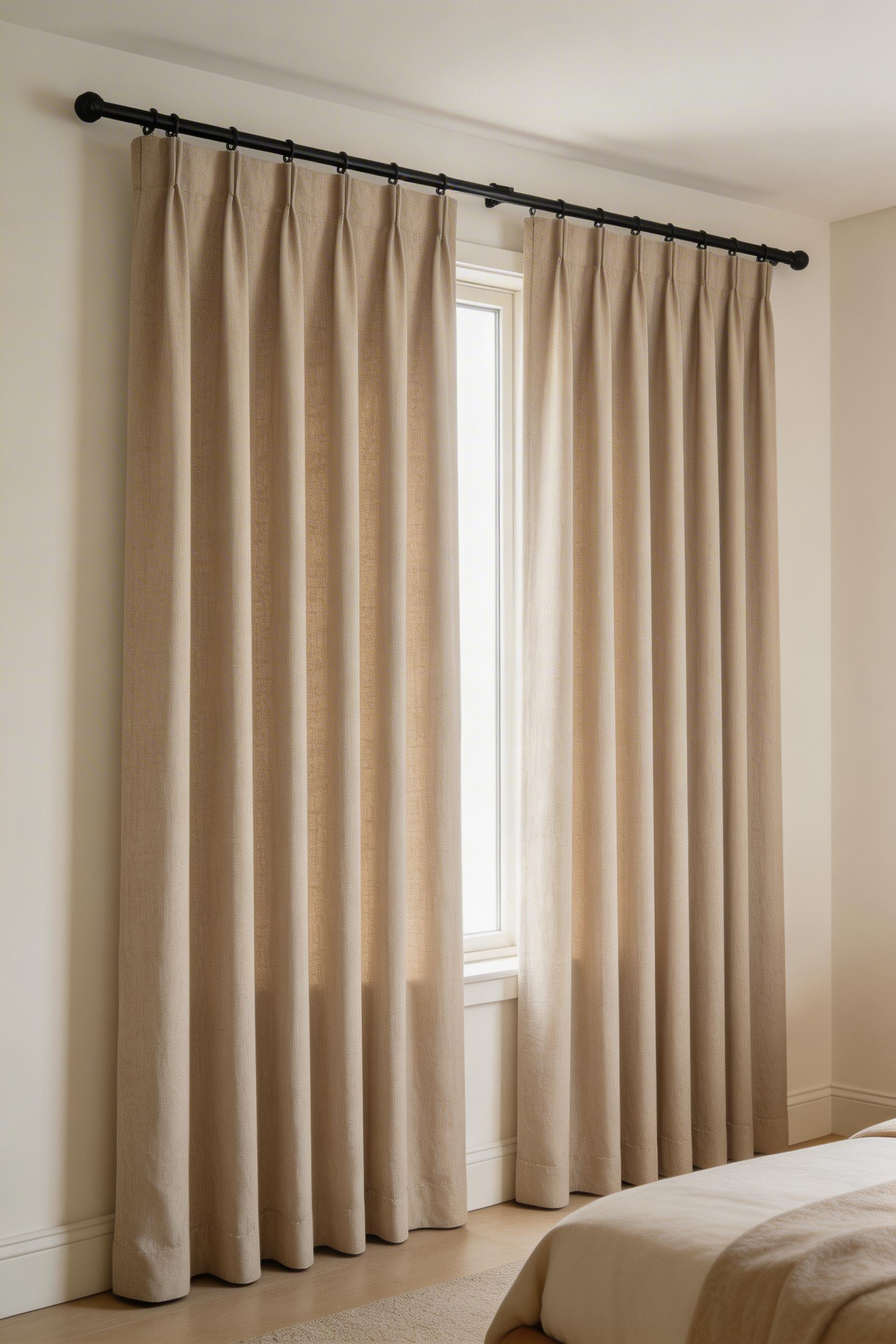
The standard mistake is mounting the rod at the top of the window frame, which leaves a gap between the rod and the ceiling through which light enters freely. For true blackout, mount as close to the ceiling as possible — ideally on a ceiling-fixed track rather than a wall bracket. Ceiling mounting also makes the room feel taller, since the curtain appears to originate from the ceiling line.
For side gaps: extend the rod 6–12 inches past the window frame on each side, and choose curtain panels that are 20–30% wider than the rod length when closed. The fullness ensures no light penetrates at the edges.
Ceiling-mount tracks from IKEA Kvartal ($30–$60) are the most accessible option. Custom ceiling track systems run $80–$200 but offer more precise operation. Total cost for a well-installed blackout system in a standard bedroom: $80–$250, making this one of the best cost-to-impact ratios on the whole list.
For fabric: linen-look blackout curtains (blackout lining bonded to a linen-weave face fabric) look nothing like institutional hotel blackout. Velvet panels add acoustic dampening as a bonus — relevant for street-facing rooms where ambient noise is also a factor.
14. A Low-Effort Bedroom Redesign Move: Swap Nightstands for Wall Shelves
A standard bedside table is 22–30 inches wide and 16–22 inches deep. In a small double bedroom, two of them together occupy significant floor area and create dark, difficult-to-clean corners between the table, the wall, and the headboard.
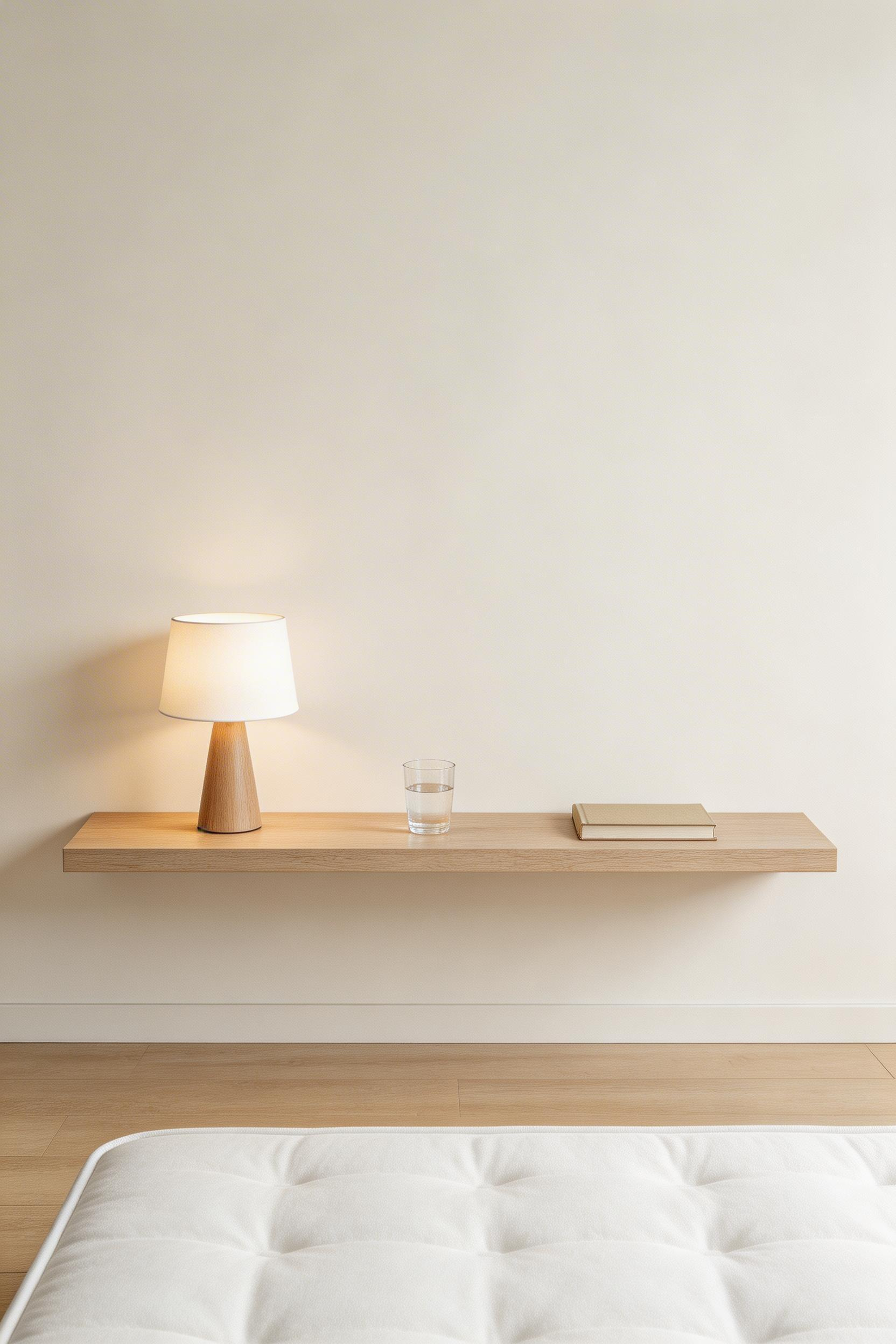
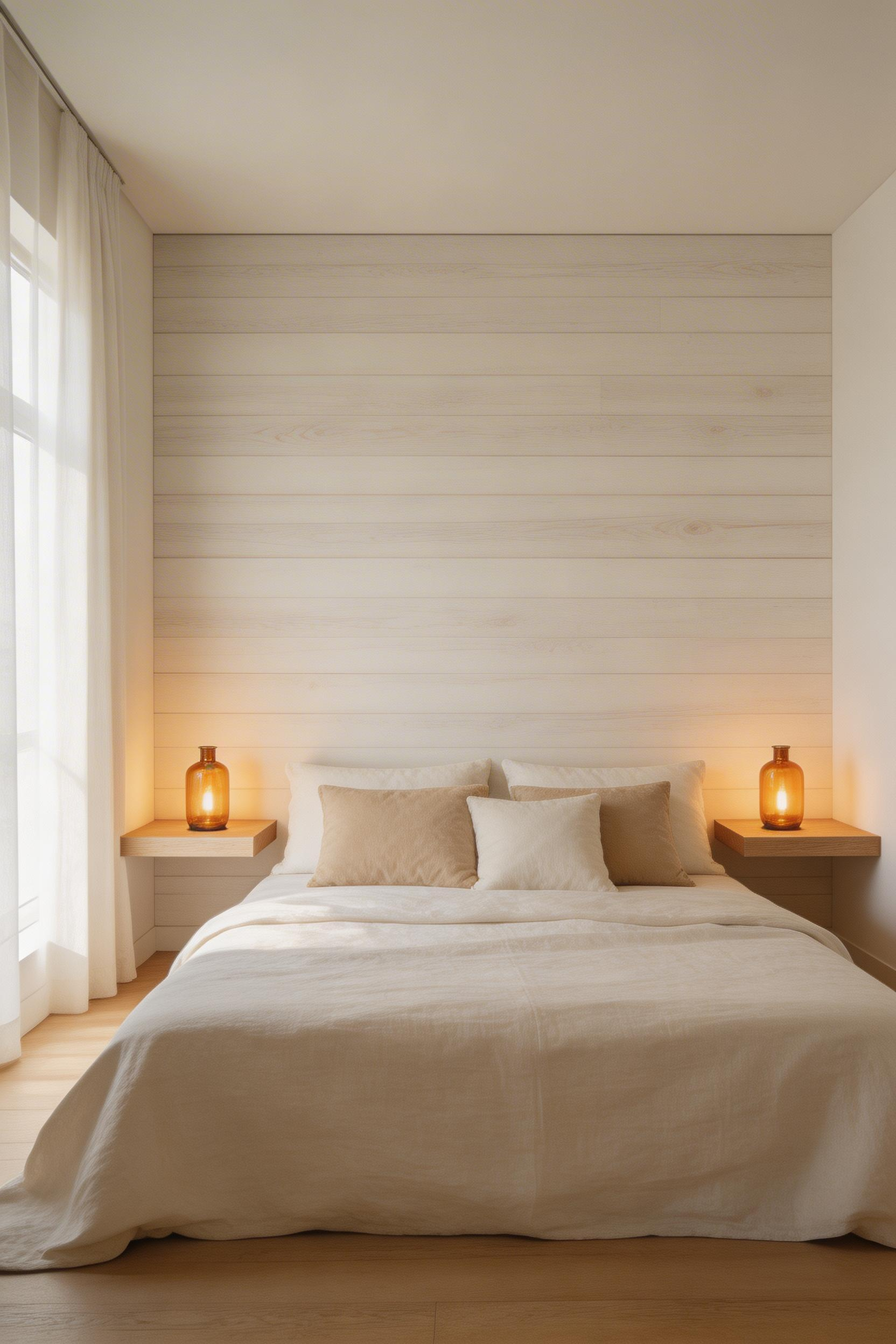
Floating wall shelves at mattress height do exactly the same job — lamp, water glass, book, phone — while recovering the floor entirely. The visual result is cleaner: the floor reads as continuous, and the wall above the mattress feels lighter without furniture bulk pressing against it.
Ideal depth: 10–12 inches, enough for practical bedside items without protruding too far. Ideal height: 4–5 inches above the mattress surface, reachable without sitting up. Load capacity: mounted into wall studs, a floating shelf holds 45–50 lbs per stud — more than sufficient for any reasonable bedside setup. A shelf into drywall anchors only, limit to 20 lbs.
What to put on it: one lamp (or a wall sconce directly above, which frees the shelf surface entirely), a water glass, a book, and a phone face-down with notifications off. What to leave off: multiple charging cables, stacks of books, anything that accumulates. The discipline of a small shelf is part of its function — it enforces the edit the room needs.
Natural oak shelves from makers like Krovel Furniture Co. run $180–$280 for the material quality. Basic timber shelves from IKEA sit at $20–$40. Both work. The installation is what matters.
15. Finish the Floor With Cork, Bamboo, or Sealed Concrete
The bedroom floor is the first thing you touch when you wake up and the last surface you leave at night. Standard wall-to-wall carpet accumulates dust mites and allergens at concentrations 4–8 times higher than hard floors. Cold hardwood causes an involuntary tension when you step onto it — a small but real disruption to the half-awake state.
Cork: The Practical Case
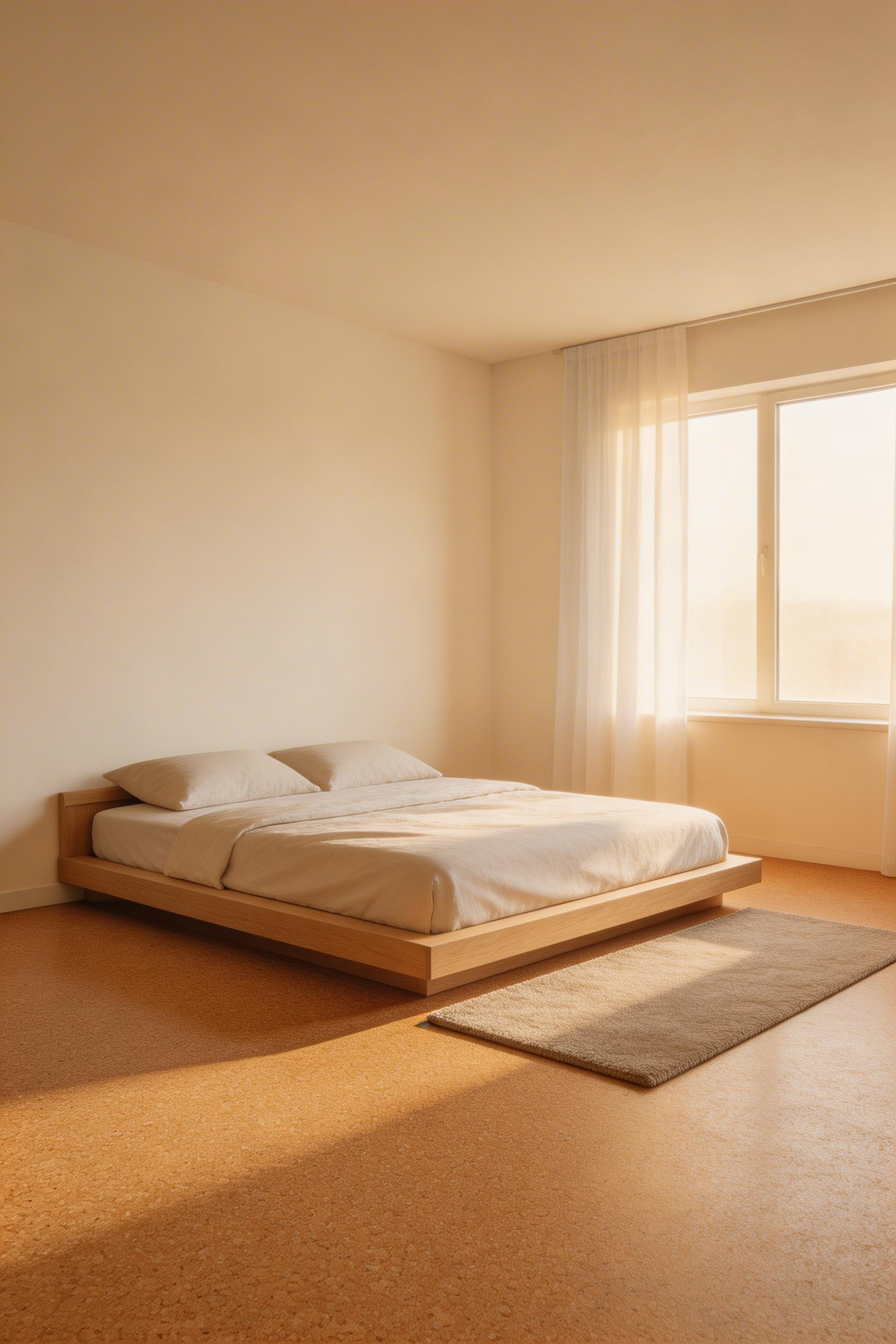
Cork addresses both problems. It’s hygienic, warm underfoot without underfloor heating, and an exceptional acoustic insulator — a Noise Reduction Coefficient (NRC) of up to 0.7, significantly reducing both impact noise and ambient sound transmission. In a bedroom above another room, this is meaningful. Cost: $3–$7/sq ft for materials, $5–$14.50/sq ft installed.
The durability caveat: cork dents under heavy furniture without felt pads, and benefits from refinishing every 5–7 years in high-traffic areas. In a bedroom, where foot traffic is minimal, cork holds up considerably longer before needing attention.
Bamboo is harder than most hardwoods (strand bamboo exceeds Janka 3,000) and more sustainable, but it provides minimal thermal or acoustic insulation compared to cork. Sealed or polished concrete is the most minimal option — a near-gallery-quality floor — but it requires a thick wool rug at the bedside to provide the underfoot warmth the material itself doesn’t offer. That rug then becomes a deliberate textile layer in the natural material scheme.
Install furniture pads under every heavy piece before the flooring goes down. Indentations from bed legs and wardrobes are permanent on cork without them.
Which of These Bedroom Remodel Ideas Should You Tackle First?
The instinct is to start with the most visible change — the paint, the new bed, the feature wall. But sequencing matters more than starting with the most dramatic gesture.
Start with removals. Take out the TV and anything that doesn’t belong in a rest space. This costs nothing and immediately changes how the room functions. Then fix the lighting: a warm-toned bulb swap costs under $30 and gives the room a different quality before anything else changes. These two steps alone — removing a screen and correcting the light temperature — shift the room’s psychological function without touching a wall or spending significant money.
Paint before furniture. Always paint before replacing or repositioning pieces — easier to cut cleanly without moving things, and you avoid re-touching work after new furniture arrives. Structural and floor changes come last: flooring is the most disruptive work in any remodel, and everything else should be complete before it goes down.
The free and near-free bedroom remodel ideas on this list — removing the TV, rearranging existing warm bulbs, styling an open wardrobe, swapping to a wall shelf — make a more immediate difference than most paid interventions. A $25 smart dimmer and an $80 blackout curtain installation done correctly will change your sleep quality more reliably than a $1,200 bed frame in a room that’s still lit with cool LEDs and open to the morning light at 6am. Work through the list in order of impact per effort, not visual drama, and the room will find its function.