You know the feeling. You’ve scrolled through hundreds of kitchen inspo ideas, saved dozens to a folder you never open again, and still can’t figure out what you actually want your kitchen to look like. Kitchen inspo is everywhere — and somehow that makes it harder, not easier. Every design account posts a different “direction,” and the noise of it all can drown out the simpler question: what do you actually love?
I’ve been thinking about this a lot lately, particularly from the perspective of someone who approaches kitchens as living spaces rather than showpieces. The kitchens that stay interesting over years tend to have two things in common: they’re functional in a real, daily way, and they have at least one thing in them that cost almost nothing but carries a lot of personality. These 18 kitchen inspo ideas range from zero-cost styling moves to considered material investments — all of them practical enough to actually execute.
1. Open Shelving Styled Like a Pantry Market Display
There’s a version of open shelving that looks effortlessly abundant — warm ceramics, glass jars full of grains, a trailing herb or two — and a version that looks like someone ran out of cabinet space. The difference is almost entirely in how ruthlessly you’ve edited what goes up there.
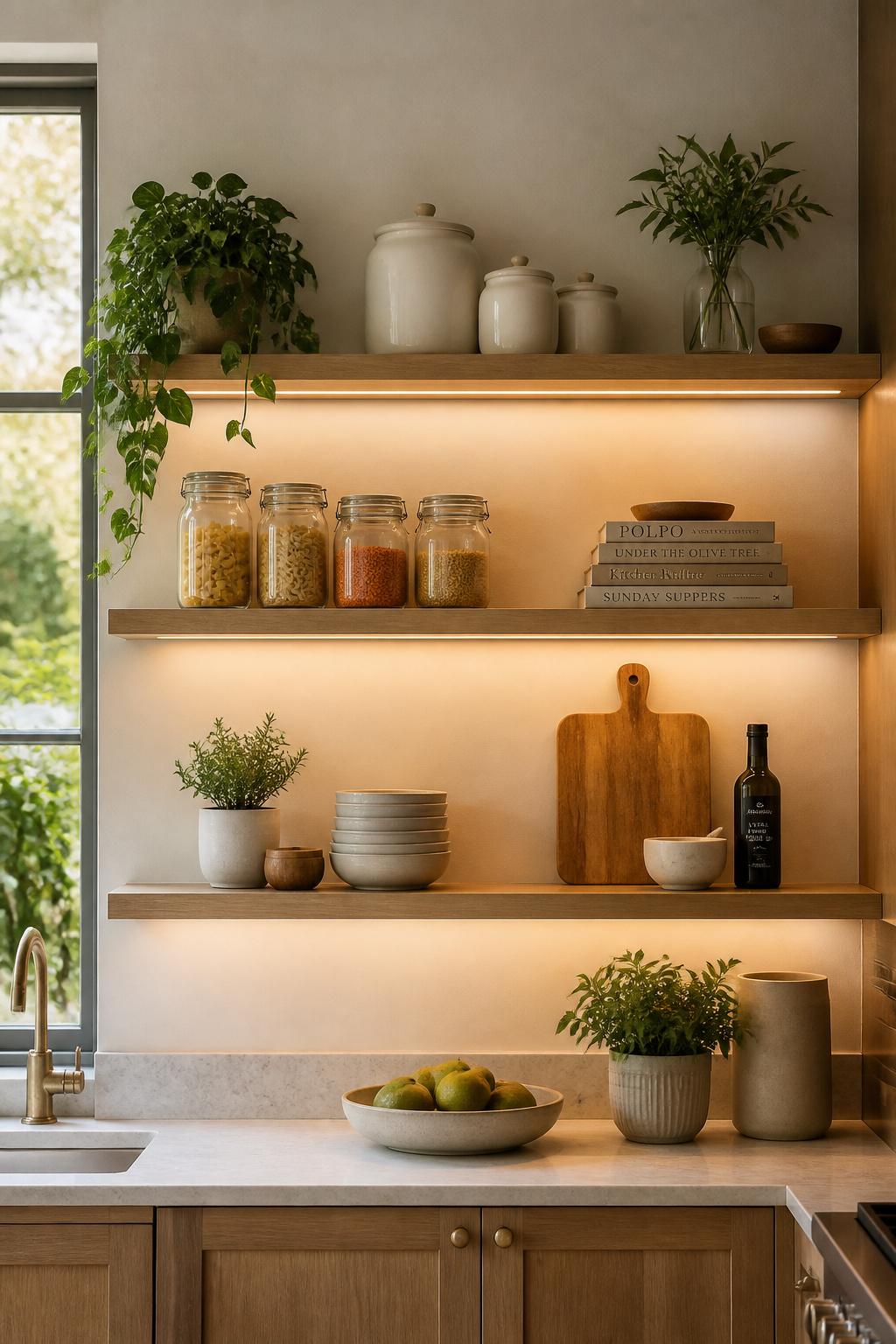
The foundation is color harmony. A small, unified palette (warm whites, aged wood tones, terracotta) makes a fully loaded shelf read as intentional even when it’s full. The market stall principle helps: group items by category, vary the heights within each group, and leave visible breathing room between clusters. A stack of four white bowls is a composition; four white bowls surrounded by seven other differently coloured things is clutter.
Start by removing 40% of what’s currently on your shelves before adding anything new. Mix textures deliberately — a ceramic canister beside a glass jar beside a small cutting board stood upright covers three different materials in three inches. Under-shelf LED tape at 2700K is the upgrade that makes everything else look better; lit shelves feel gallery-like even when the contents are just pasta and rice.
The rule for what to hide is simple: anything with garish branded packaging, cleaning supplies, and rarely-used appliances go behind closed doors. What stays out should be things you find genuinely beautiful or reach for daily, ideally both.
2. A Statement Kitchen Island in a Bold Contrast Color
A kitchen where every surface is the same color has no visual anchor. The eye doesn’t know where to land, and the whole room reads as either a showroom or a blank slate. A single contrasting island — deep emerald against cream, navy against pale grey — gives the room a centre of gravity.
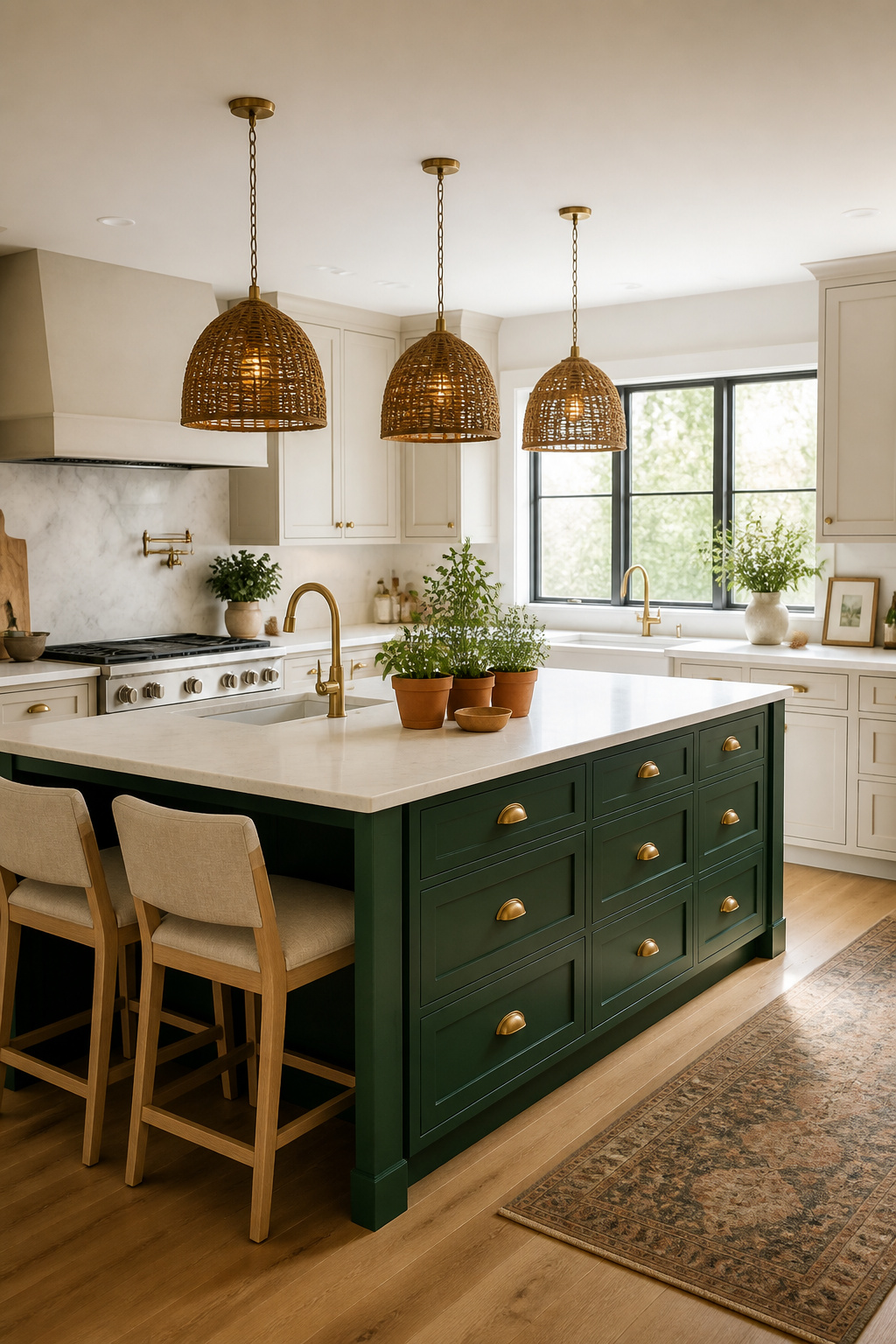
The most consistently successful combination right now is a deep emerald island with warm cream perimeter cabinets and aged brass hardware. It reads luxurious without trying too hard. If your kitchen is smaller, the same principle applies with a softer contrast: sage against warm white, or dusty blue against off-white. The key rule is that your island and cabinet colors should be at least three value shades apart; close tones look muddy rather than designed. A contrasting island is among the kitchen inspo ideas with the most consistent return across kitchen sizes and budgets.
Once you’ve chosen the color, repeat it somewhere else in the room: a pendant shade, bar stools, the spine color of a row of cookbooks on a shelf. Repetition is what makes a design choice look intentional rather than accidental. If you’re working through the color decision, kitchen island color options worth exploring covers the most useful combinations across the full spectrum.
If a full remodel isn’t on the table, painting an existing island costs $200-600 professionally prepared and finished in oil-based eggshell — or considerably less if you’re competent with a brush and patient with prep. A freestanding butcher-block cart painted in a bold color delivers the same effect for under $400.
3. Kitchen Inspo From the Japandi Design Movement
Japandi (the design shorthand for the hybrid of Japanese wabi-sabi and Scandinavian minimalism) has moved well past trend status into genuine design language. In a kitchen, it doesn’t look like a Pinterest board. It looks like a space where every material was chosen for a reason and nothing is apologising for its existence.
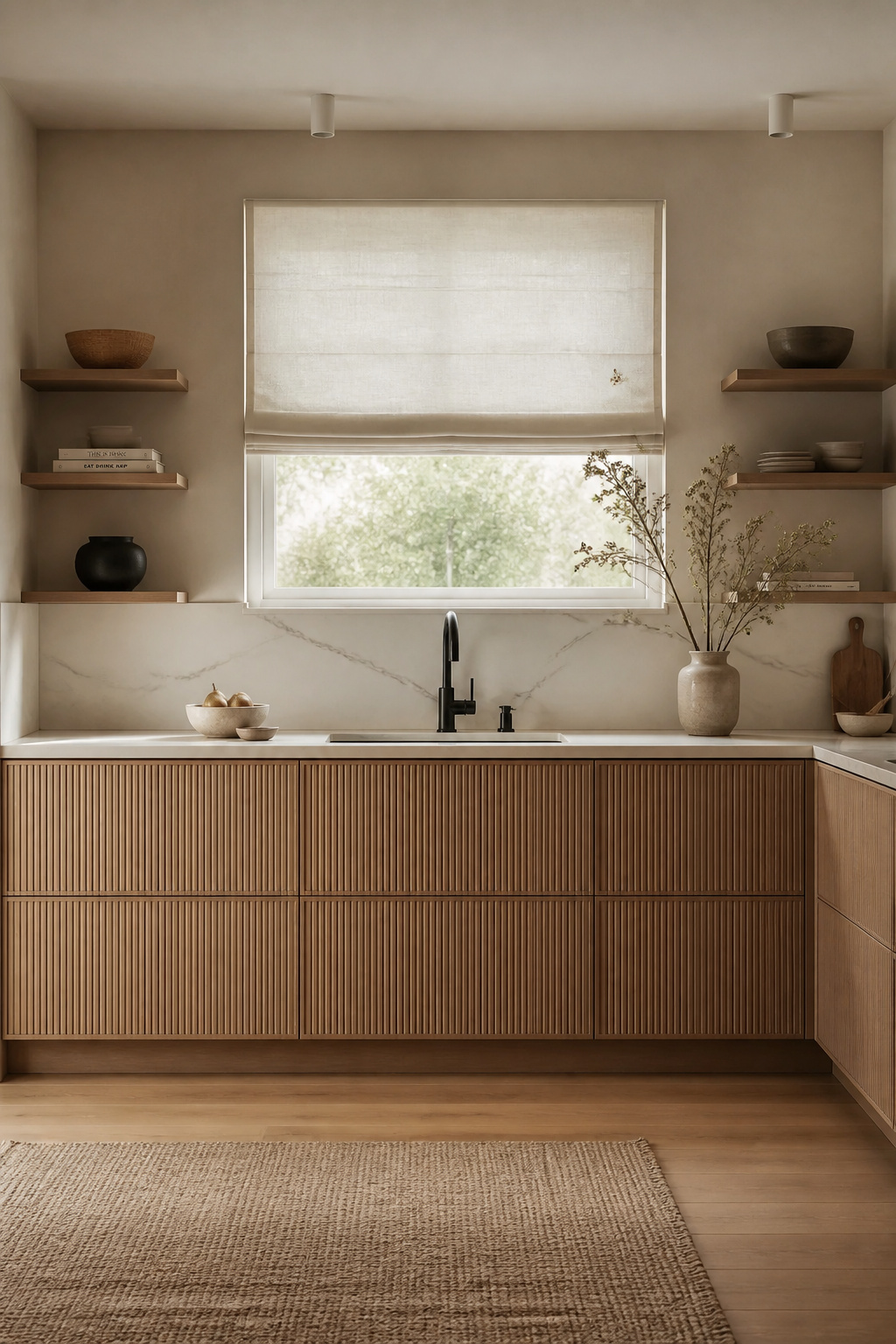
The material palette is fairly specific: light oak or walnut cabinetry with visible grain, handle-less flat-front doors, matte black or brushed brass hardware (never polished chrome), and a honed — not polished — stone countertop. The 2025 shift within Japandi is toward fluted wood cabinet fronts, which add texture and warmth while maintaining the clean lines the aesthetic is known for. Microcement is appearing as a backsplash material, providing a seamless surface that continues from countertop to wall without a grout line in sight.
What makes the Japandi kitchen work for a real, lived-in household is the wabi-sabi acceptance of imperfection. A grain mark in the wood, a slightly irregular handmade ceramic bowl, the honest wear of a much-used chopping board — these aren’t problems to fix, they’re evidence of use. The practical edit is straightforward: replace plastic containers and garish branded packets with glass jars and simple ceramics. The kitchen starts to feel considered not because you spent more, but because you edited more thoughtfully.
4. Sustainable Countertops Made From Reclaimed Materials
The default kitchen countertop categories (granite, quartz, laminate) have a third option that most renovation conversations never reach: countertops made from genuinely recycled or reclaimed materials. Paper composite (Richlite and Paperstone are the main brands), recycled glass (Curava and Vetrazzo), and sealed reclaimed wood all perform well in daily kitchen use and substantially outperform stone and engineered quartz on environmental terms. For kitchen inspo ideas that carry real environmental weight, this is the most underexplored category.
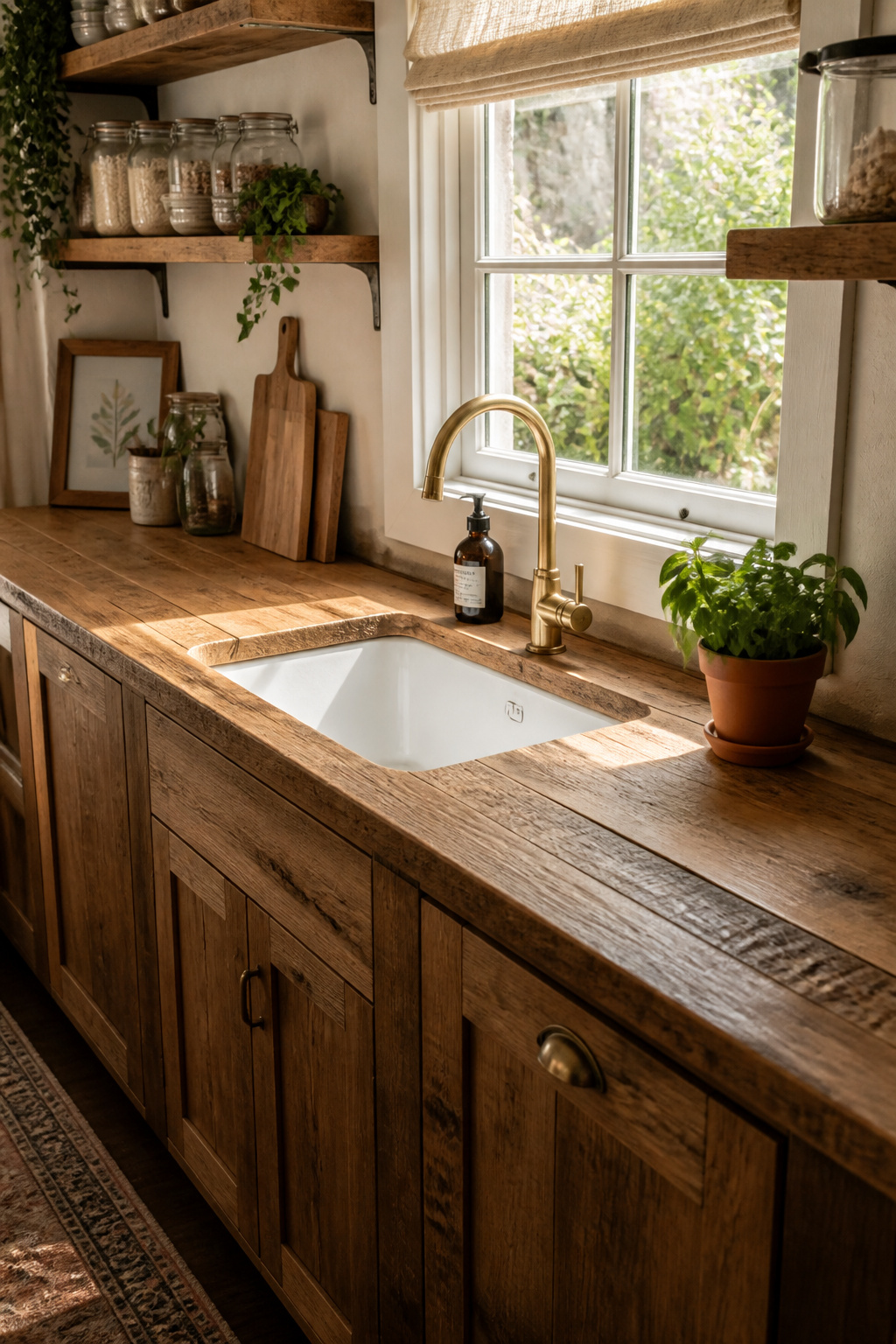
Paper composite is made from 100% recycled paper or cardboard with non-toxic, plant-based resins. It’s non-porous, heat and water-resistant, and has a dense matte finish that looks convincingly like dark slate. Richlite in particular has been used in commercial kitchen settings for years — it’s not a delicate material. Cost runs $30-50 per square foot installed, which sits below quartz in most markets.
Recycled glass countertops embed post-consumer and post-industrial glass in a cement or resin binder. The result is a mosaic-like surface where no two sections look identical. Curava’s range goes from subtle aggregate through to quite bold chip sizes — ordering samples is worth the time. Budget for $30-60 per square foot installed. Reclaimed wood deserves an honest caveat: it requires sealing every 1-2 years (Rubio Monocoat and Osmo Polyx are the food-safe professional recommendations), and it will stain around the sink area over time. Beautiful, but not low-maintenance.
5. Painted Cabinet Doors in Deep Forest Greens and Blues
The all-white kitchen peaked sometime around 2019. What replaced it isn’t one alternative but several — and deep, complex greens and blues are the most consistently successful. Farrow & Ball Studio Green is a dark forest green that shifts toward near-black in lower light and opens back up under natural light; Hague Blue (No. 30) does a similar thing in a deep green-blue direction. Both of these are expensive. Benjamin Moore’s Black Forest Green and Sherwin-Williams Cascades deliver comparable depth at roughly half the cost per litre.
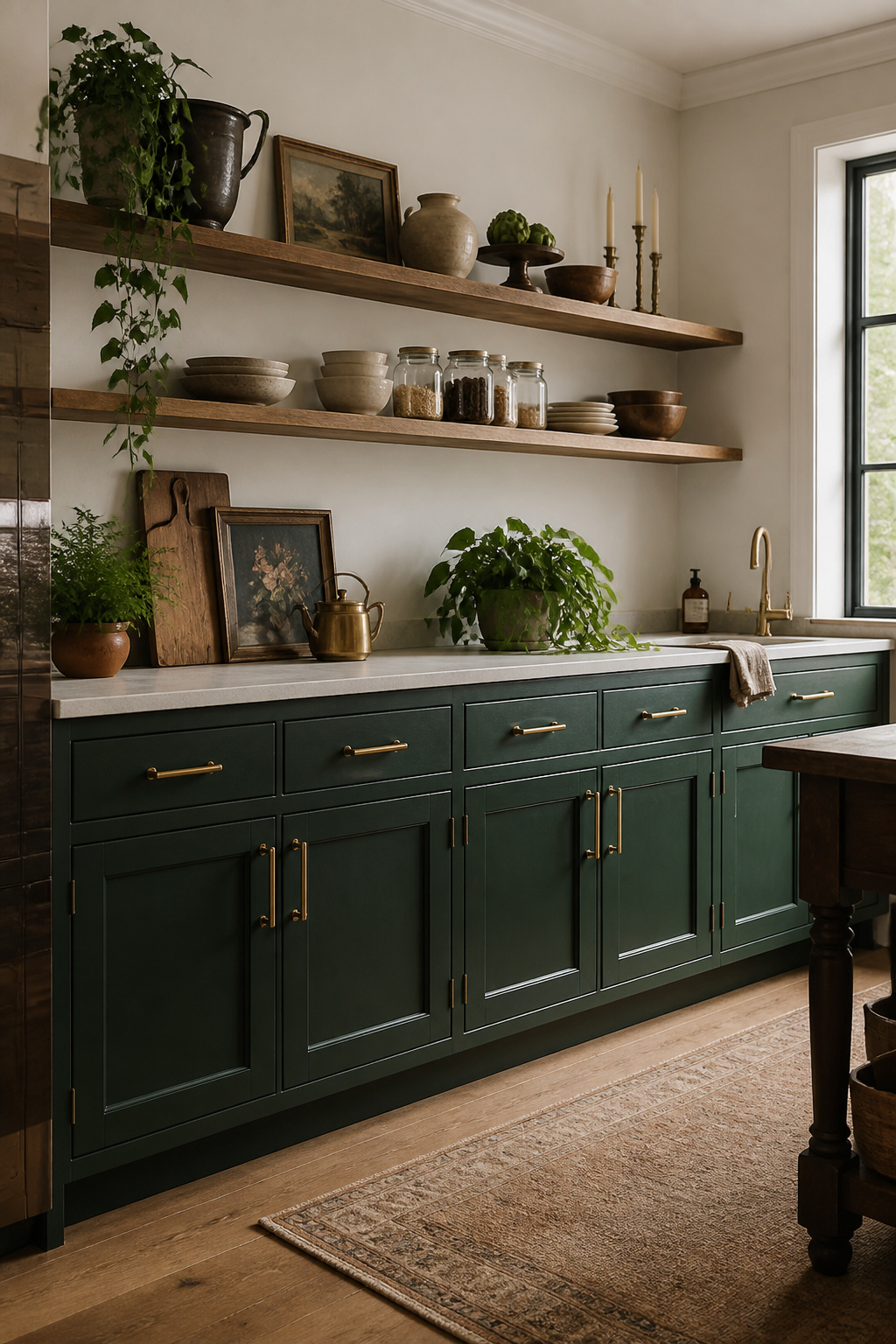
On cabinet doors, the finish matters as much as the color. Oil-based eggshell is the minimum — it provides enough sheen to wipe down cleanly while remaining matte enough that the grain and texture of the door face still reads. Flat or chalk finishes look beautiful on sample cards and terrible on cabinet doors within six months; every fingerprint shows and every wipe leaves a mark. If you’re committed to dark green but undecided on the exact shade, green kitchen cabinet ideas that go the distance is a useful reference.
For smaller kitchens: dark lowers with light uppers is the standard designer move. It delivers the moody lower-half aesthetic without making the room feel like a cave. Pair a dark green or blue with a pale stone or white quartz countertop — dark cabinet against dark countertop in a small kitchen is the combination most likely to create the cave effect you’re trying to avoid.
6. A Pot Rack That Doubles as a Kitchen Focal Point
The case for a ceiling pot rack is functional before it’s aesthetic: it frees 30-40% of your cabinet space and puts every pan within immediate reach without digging. But the aesthetic case is equally real. A wrought iron oval above an island, hung with a collected set of cast iron or copper cookware, fills dead overhead space and gives the kitchen a professionally occupied quality that no other single element provides.
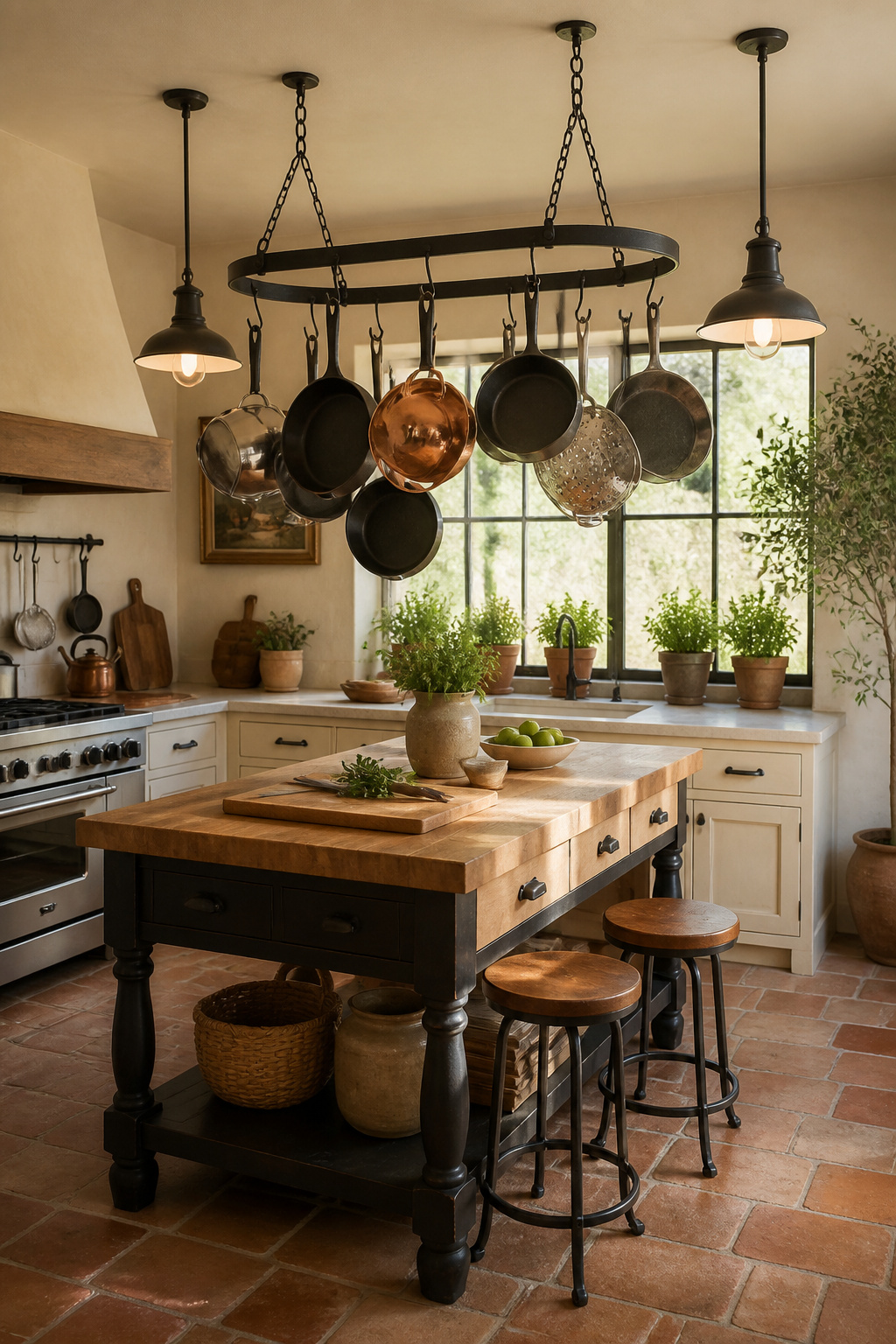
Position matters: directly above an island or peninsula is ideal, where the rack frames the workspace without obstructing movement paths. Standard hanging height is 42 inches above the counter surface — low enough to reach without stretching, high enough that you won’t clip it during prep. Mount to ceiling joists in at least four points; this is not optional, particularly with cast iron cookware. Drywall anchors and a rack full of 12-pound pans is a genuinely bad combination.
For a DIY solution, a raw steel pipe rack costs under $150 in materials and takes a weekend to build. Industrial, urban, fits loft kitchens well. Commercial wrought iron ovals run $250-500 and tend to suit traditional or farmhouse kitchens better. Copper racks are the most visually striking and age beautifully — they suit warm-toned or vintage kitchens and pair well with copper or brass cookware. The pot rack is among the kitchen inspo ideas with the best visual return per dollar; if the overhead route isn’t an option for your ceiling type, a pull-out pots drawer in lower cabinetry is the practical alternative.
7. Kitchen Inspiration Through Vintage Market Sourcing
The most interesting kitchens aren’t assembled from a single source. They’re accumulated over time — a 1960s enamelware pot found at a flea market, a ceramic canister set from an estate sale, a hand-thrown bowl bought directly from a ceramicist. That accumulated quality is what kitchen inspiration through vintage market sourcing actually means in practice, and it’s achievable without spending much.
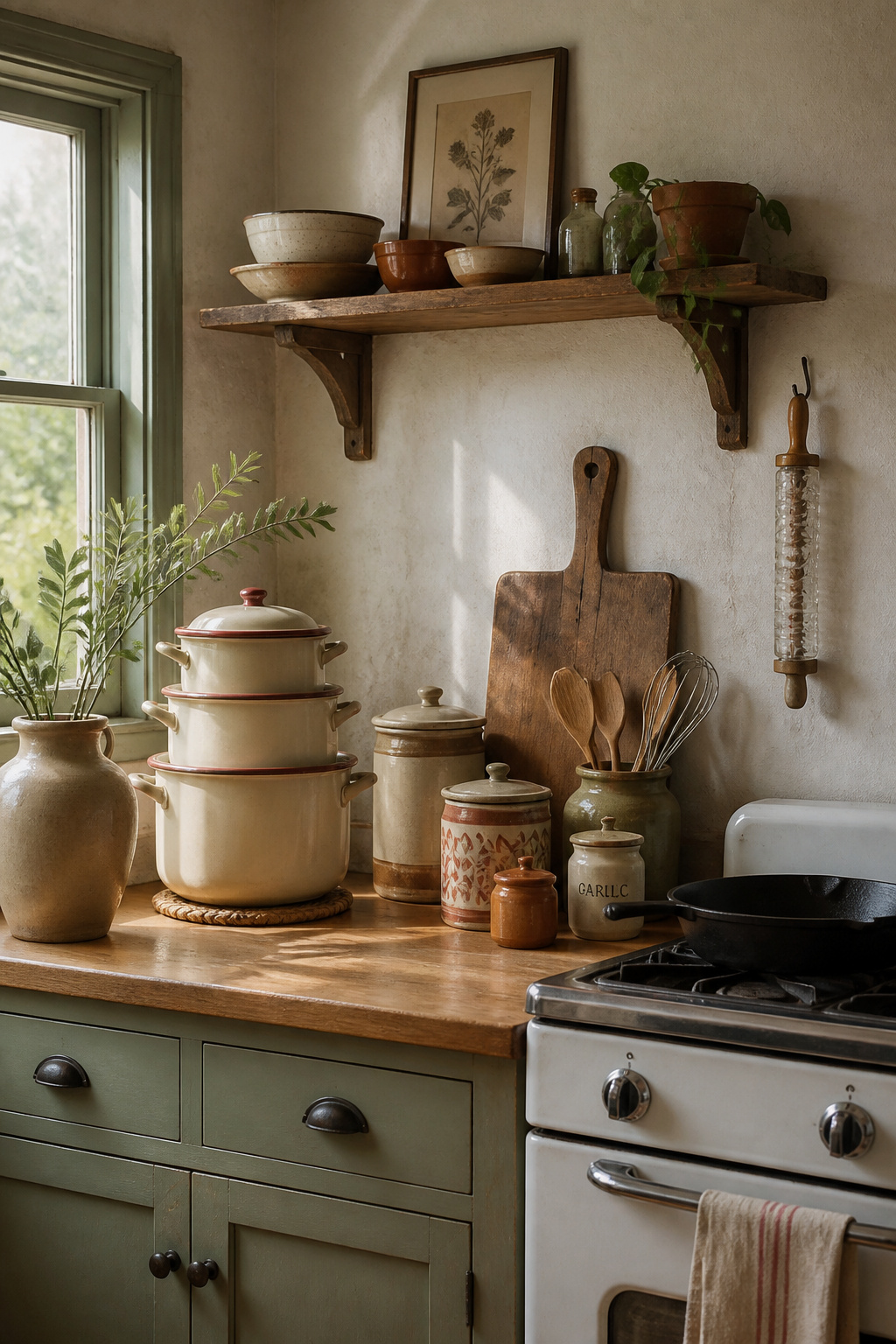
Pre-1980s European enamelware (Czech, Polish, and Scandinavian pieces particularly) is thicker and better-made than most modern equivalents. The enamel finish chips less readily, the pots heat evenly, and the shapes have a graphic simplicity that looks entirely at home on an open shelf. Cast iron from the same era (pre-1960s Lodge and Wagner Ware) has a naturally smoother cooking surface than modern cast iron; it also displays beautifully on a pot rack. Vintage Pyrex in the turquoise diamond or snowflake patterns earns a place on any open shelf — functional and genuinely collectable.
Chairish is the easiest entry point: curated, well-photographed, prices are premium but authentication is reliable. Etsy’s vintage section requires more due diligence: filter by age and read seller reviews carefully, and the price ceiling is lower and the variety broader. Estate sales and flea markets are the best hunting ground for heavy ceramics and enamelware that would cost a fortune to ship. The rule for mixing vintage with modern is proportion: keep vintage to 30-40% of any display, and unify the collection through a single color family even if the individual pieces are from different eras.
8. Under-Cabinet Lighting That Transforms Your Workspace
Overhead kitchen lighting illuminates the top of your head, not the counter in front of you. You’re always working in your own shadow. Under-cabinet LED lighting fixes this, and it also does something more: it adds a layer of warm, focused light at eye level that makes the kitchen feel intentionally designed rather than just illuminated.
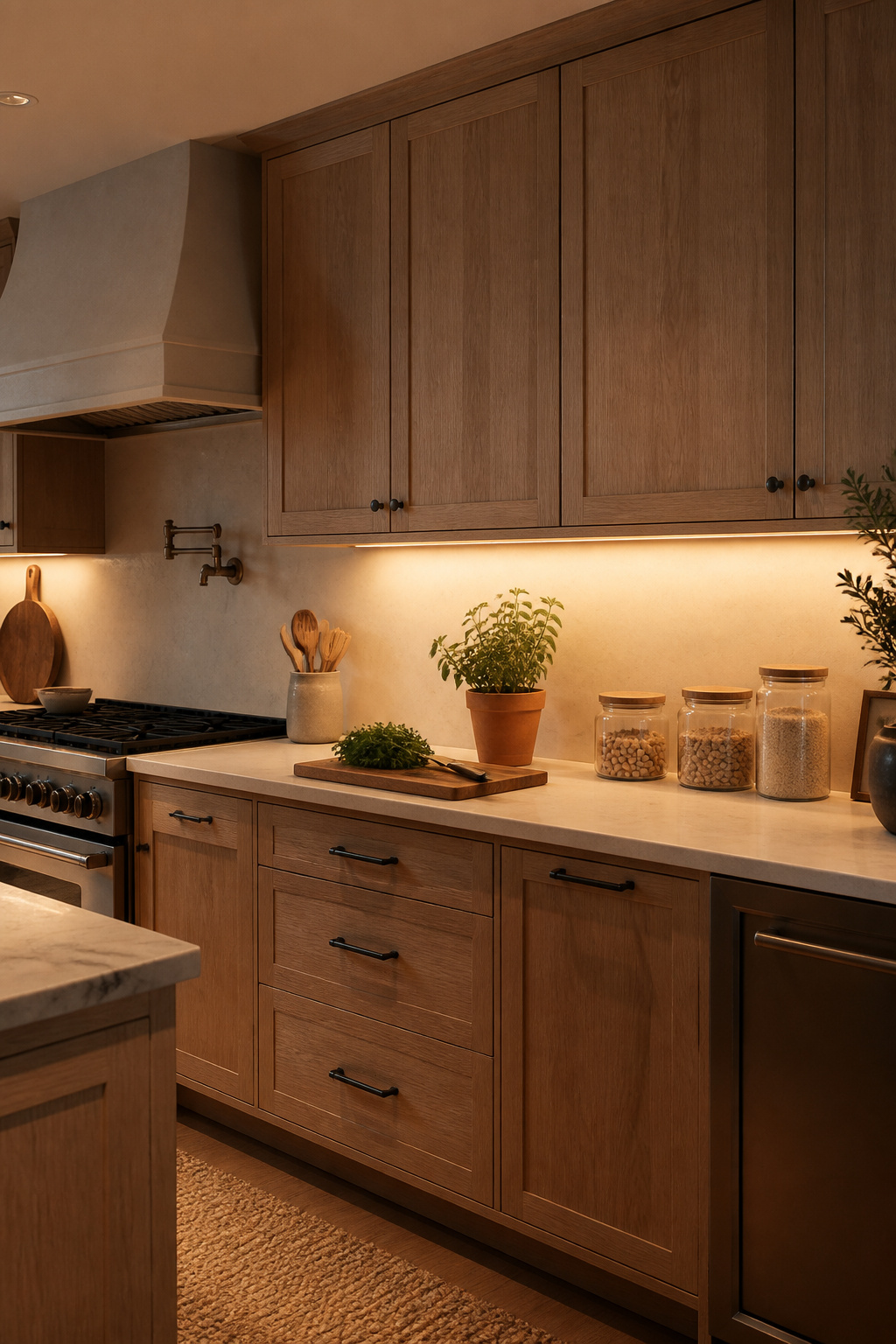
LED strip lights are the accessible entry point — Philips Hue and Govee both produce plug-in strips with dimming capability, and the adhesive backing installation takes an afternoon. No electrician required for plug-in versions. For a more permanent solution, hardwired recessed under-cabinet strips are cleaner (no cord) but need a licensed electrician and add cost. The difference in finish quality is significant if you care about it. The lighting decisions are more technical than they first appear — modern kitchen lighting ideas worth exploring covers the full range, from task lighting to ambient.
Color temperature is the decision that most people get wrong: anything below 3000K produces a yellowish-amber light that slightly distorts food colors during prep. Beautiful for ambiance, but less useful for a workspace. For most kitchens, 3000K is the sweet spot: warm enough to be flattering, accurate enough for cooking. If your kitchen has a predominantly white or grey palette, 3500K provides better task clarity without feeling clinical. CRI of 90 or above is the quality indicator that ensures food actually looks like food under the light, and worth specifying when you buy. Under-cabinet lighting is among the kitchen inspo ideas with the highest impact-to-cost ratio on this list.
9. Kitchen Inspo for Compact Apartment Cooking Zones
A small kitchen is not a compromised kitchen. It’s a focused one. Professional kitchens (Michelin-starred ones included) run on galley layouts because the constraint is the point: everything within two steps, every surface doing exactly one job. The compact apartment kitchen is working from the same principles, with the added freedom to make it beautiful as well as functional.
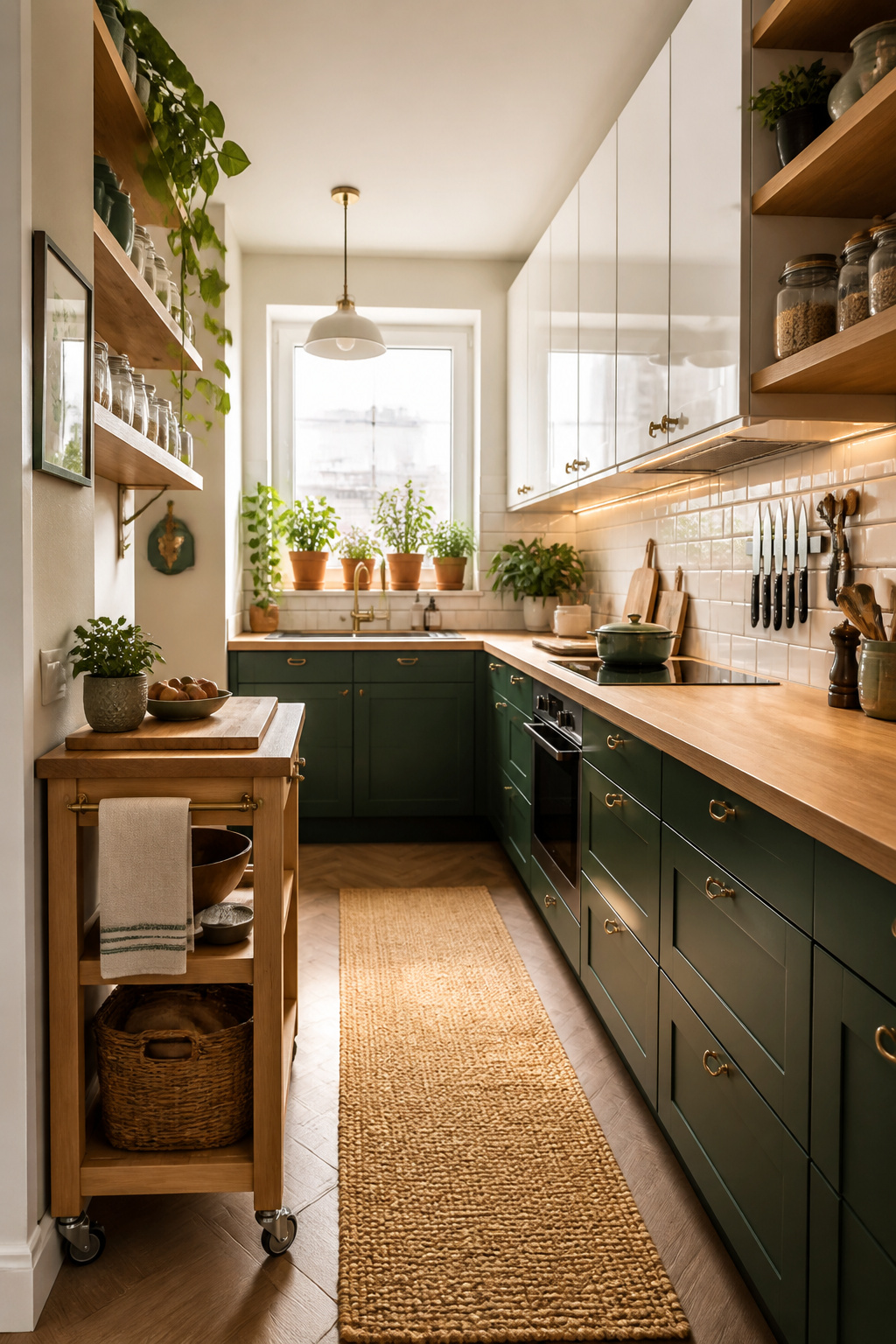
The most impactful structural move in any small kitchen is replacing lower cabinet doors with drawers. Drawers increase accessible storage by roughly 30% — you can see and reach everything in a drawer, whereas things in a cabinet behind other things effectively don’t exist. Go vertical for the rest: tall, shallow cabinets to the ceiling, open wall shelves above the counter, a magnetic knife strip rather than a knife block on the counter. If you’re working with under 80 square feet, apartment kitchen ideas that maximize every inch is worth reading in full.
Visual space is as important as actual space. Glossy or satin cabinet fronts reflect light and expand the room visually; matte white cabinets absorb light and can make a small kitchen feel smaller. A rolling cart works as a supplementary island during prep and parks against the wall otherwise — for under $200 it adds both a work surface and meaningful storage without permanent commitment.
10. A Live Herb Counter Garden That Works Hard Every Day
This is the kitchen change that costs least, requires the most daily attention, and delivers the most daily reward. A row of terracotta pots on the windowsill, each holding a herb you actually cook with, is both the most functional and the most honest form of kitchen decoration — it’s growing, it’s being used, it’s alive. As kitchen inspo ideas go, the herb garden is the one that gets more rewarding over time rather than less.
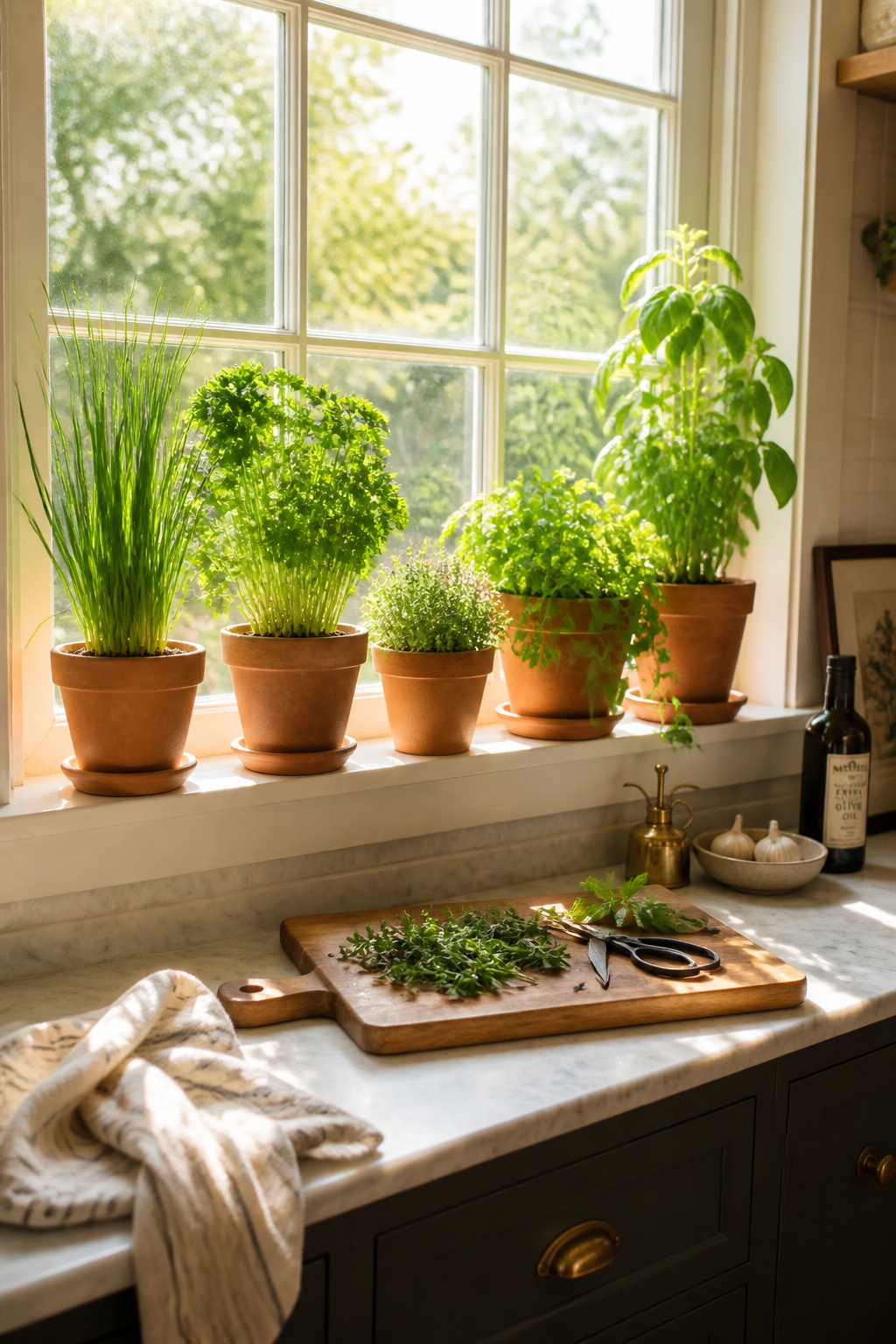
The herb selection determines whether this works. Chives are nearly indestructible: they tolerate lower light levels, recover quickly from heavy harvesting, and keep growing with minimal intervention. Mint handles east or west-facing windows with four to five hours of indirect sun and actively likes moisture. Parsley manages lower light better than almost any other culinary herb. Basil is the trap that catches most indoor herb gardens — it needs a south-facing window with at least six hours of direct sunlight daily, or a dedicated LED grow light running 14-16 hours at 15-30cm above the plants. Supermarket basil is grown in artificial conditions and needs hardening off before it moves indoors permanently; don’t expect it to thrive immediately.
Style the herb garden like any other kitchen display: matching containers (terracotta or a single ceramic color), varying heights as the plants grow at different rates, the tallest pot at the back. Self-watering pots from Lechuza or Cole & Mason genuinely solve the most common herb death (inconsistent moisture) for basil and parsley. Drainage holes are non-negotiable for everything else; without them, root rot arrives within a month.
11. Mixed-Metal Hardware for a Collected, Not Matched Look
A kitchen where every handle, tap, and fixture is the same brushed nickel was designed by a spreadsheet. It’s coordinated in a way that reads as assembled rather than considered. The more interesting approach, now the more prevalent one in kitchen design, is to mix two or three metal finishes in a way that reads like accumulation over time.
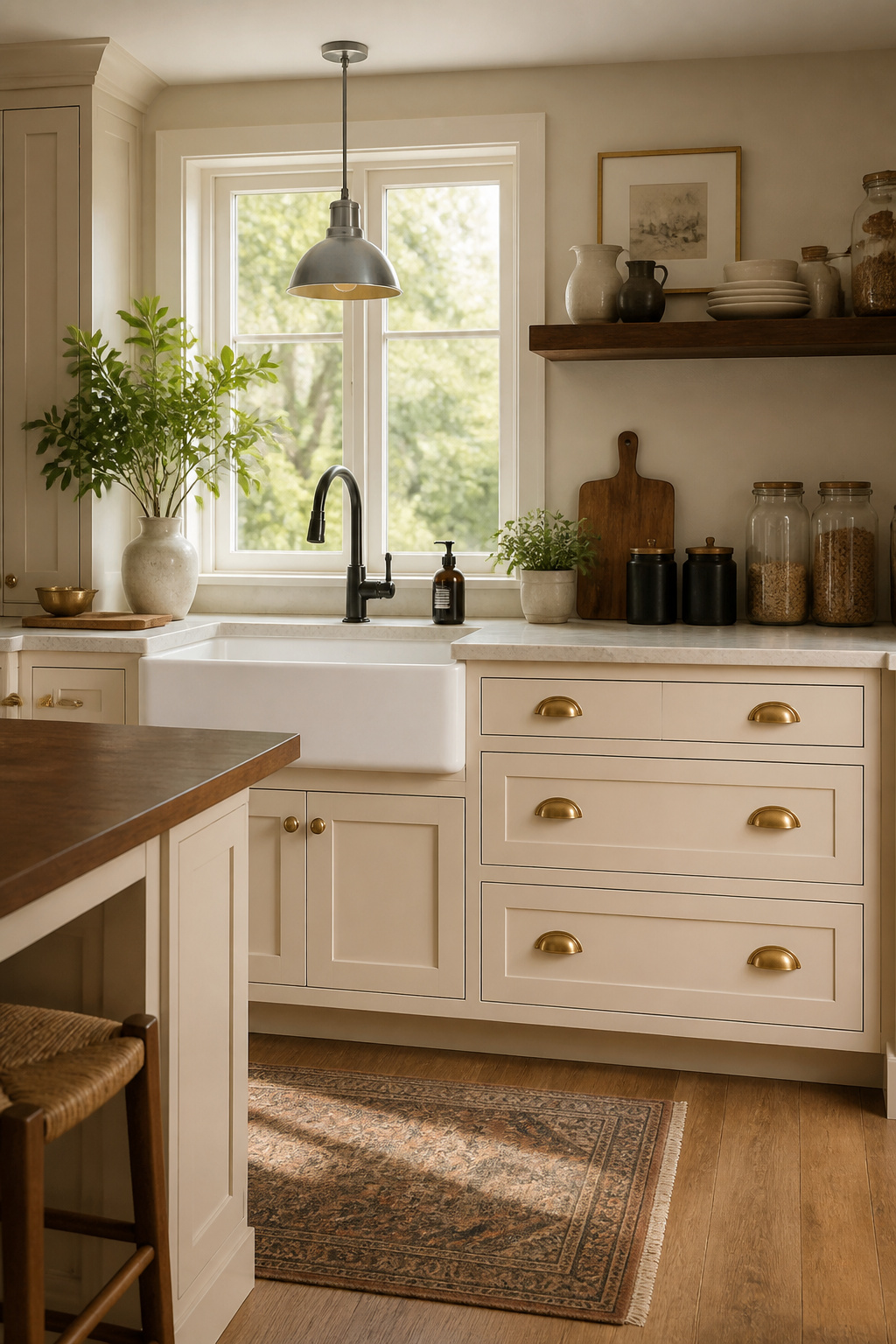
Hardware is among the kitchen inspo ideas that most people underestimate. The rule that actually holds up: limit the total to three finishes maximum, with one dominant metal at 60-70% of all hardware. The most reliable current combination is aged brass as the dominant finish (cabinet pulls and drawer knobs) with matte black as the accent (faucet, pendant frame, maybe the range hood). Both are matte-to-brushed in sheen — and matching sheen across mixed metals is what prevents the combination from looking like a mistake. Polished brass with matte black reads like a collision; brushed brass with matte black reads like a choice.
The highest return-on-investment kitchen upgrade is hardware — $150-300 of quality aged brass or matte black pulls on plain white or green cabinet doors completely transforms how the kitchen reads. Rejuvenation and Schoolhouse Electric produce excellent quality pieces; CB2 and Anthropologie offer solid mid-tier options. The faucet is the bigger commitment (needs a plumber in most cases), but changing from polished chrome to unlacquered brass or matte black ties the whole updated metal scheme together in a way that the cabinet hardware alone can’t quite achieve.
12. Terrazzo Backsplash for a Retro-Modern Kitchen Inspo
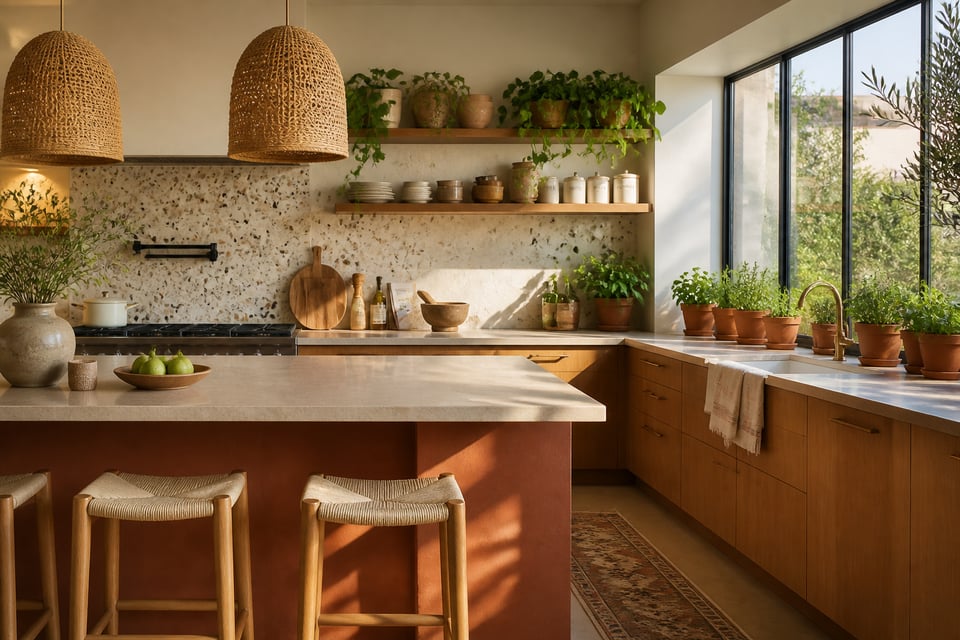
Terrazzo went from 1970s institutional material (school cafeterias, hospital corridors) through two decades of complete absence to a genuine contemporary revival, and it hasn’t over-stayed its welcome yet. In a kitchen backsplash, it delivers something that plain subway tile can’t: inherent variation. Every square foot of terrazzo looks slightly different, which means it hides marks, reflects light differently throughout the day, and never looks boring.
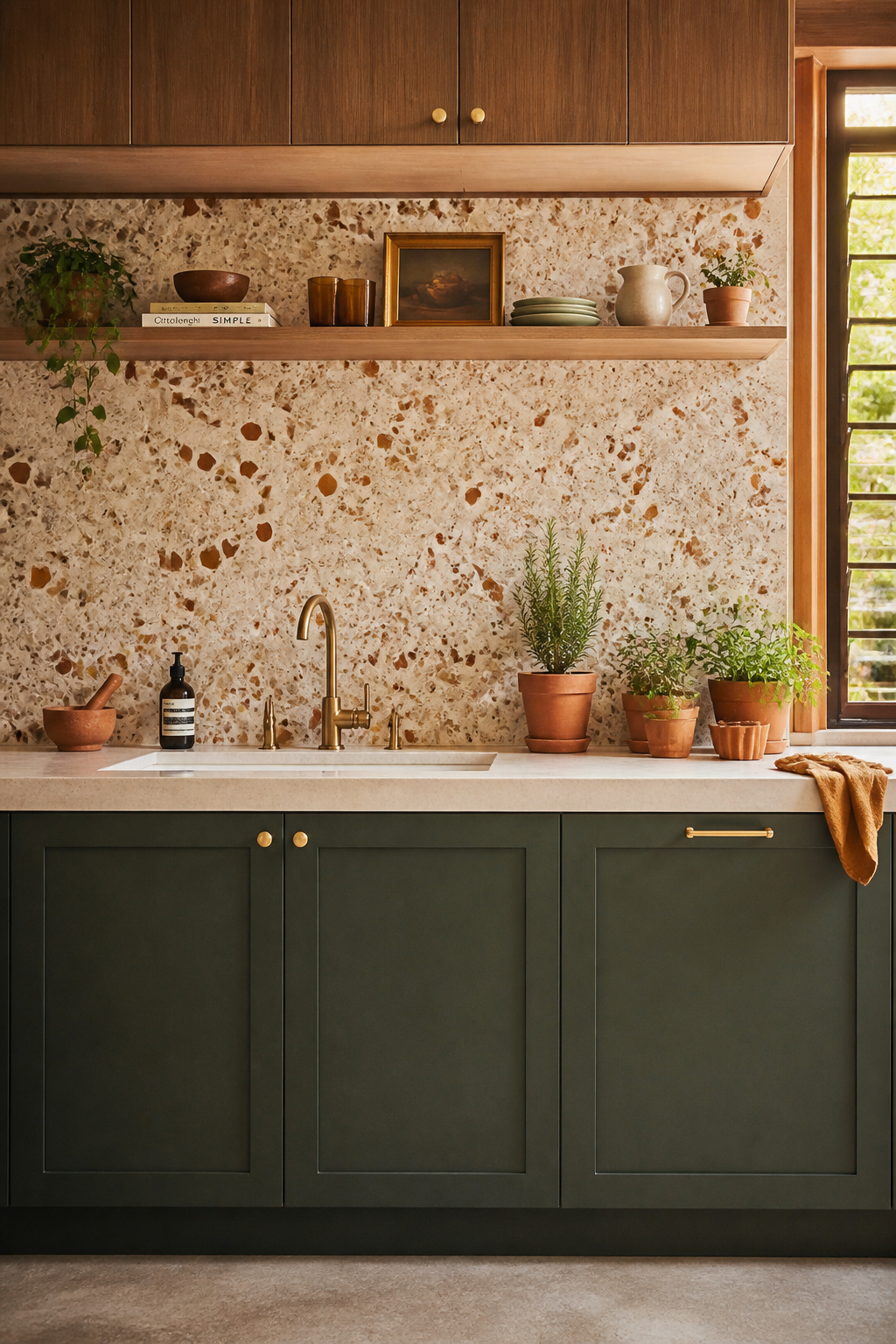
The practical options have also multiplied. Poured terrazzo slab is the premium route ($45-120/sq ft for material, plus $25-60/sq ft installation labor) — seamless, genuinely beautiful, typically a professional installation. Terrazzo tile achieves the same visual effect for $15-30/sq ft in tile cost plus standard labor, making a full kitchen backsplash project around $800-1,500 total. For renters, peel-and-stick terrazzo-look vinyl at $3-8/sq ft is a serious option — removable without damage on departure.
For pairing guidance beyond terrazzo, kitchen backsplash design ideas worth considering covers the full range of surface combinations. The terrazzo-specific rules: use a light-base terrazzo with dark cabinets (the contrast between the light surface and dark uppers is the point); choose warm-chipped terrazzo (rust, ochre, terracotta chips) with white or cream cabinets to prevent the kitchen reading cold; pair with natural wood somewhere in the room to balance terrazzo’s manufactured quality. Never put terrazzo adjacent to a patterned countertop — two visually busy surfaces fight each other.
13. A Chalkboard Wall for Recipes, Notes, and Daily Planning
The kitchen chalkboard earns its wall space by being operationally useful: meal planning written out on Sunday evening, a grocery list added to throughout the week, a recipe in progress, a child’s drawing from yesterday. It replaces the covered-in-magnets section of fridge door with something that erases cleanly and looks deliberate.
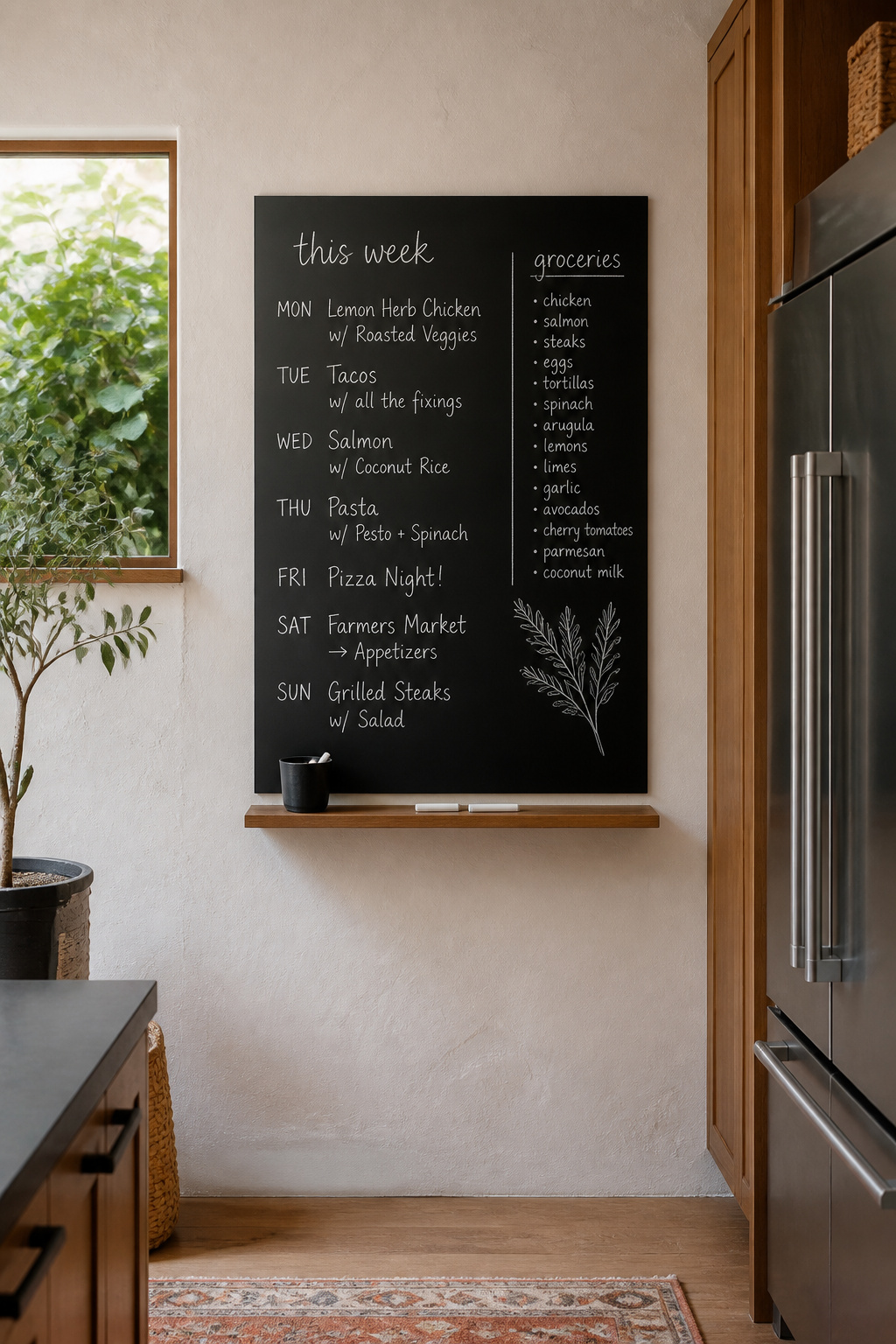
Placement is more important than style. A chalkboard adjacent to the refrigerator or the pantry door is physically wired into the meal-planning workflow — you reach for it naturally when checking what’s in stock or planning dinner. An end wall of a galley kitchen is ideal: it’s visible from everywhere, doesn’t interrupt a work surface, and the vertical expanse makes it genuinely usable. As kitchen inspo ideas go, a chalkboard wall is one of the few that gets more useful over time rather than less.
The choice between chalkboard paint and a framed chalkboard panel comes down to permanence preference. Chalkboard paint requires at minimum two coats (often three), each sanded with fine-grit paper between applications, followed by a 72-hour cure before conditioning the surface. Done well, the result is seamless and integrated. A pre-made panel (Quartet, MasterVision) in a frame is faster and fully removable — the better choice for renters or anyone uncertain of the commitment. Chalk markers rather than traditional chalk reduce the dust issue considerably, though they require a dedicated chalk-marker-rated surface to erase fully.
14. Kitchen Decor Ideas Using Natural Texture and Woven Baskets
Kitchens are dominated by hard, reflective surfaces: tile, stone, stainless steel, glass. These materials are practical but cold, both visually and acoustically. Woven natural fiber baskets (seagrass, rattan, water hyacinth) introduce an organic warmth that none of those materials can replicate. Even an inexpensive seagrass basket reads as intentional; the handmade quality of the weave is visible in a way that no manufactured material quite matches.
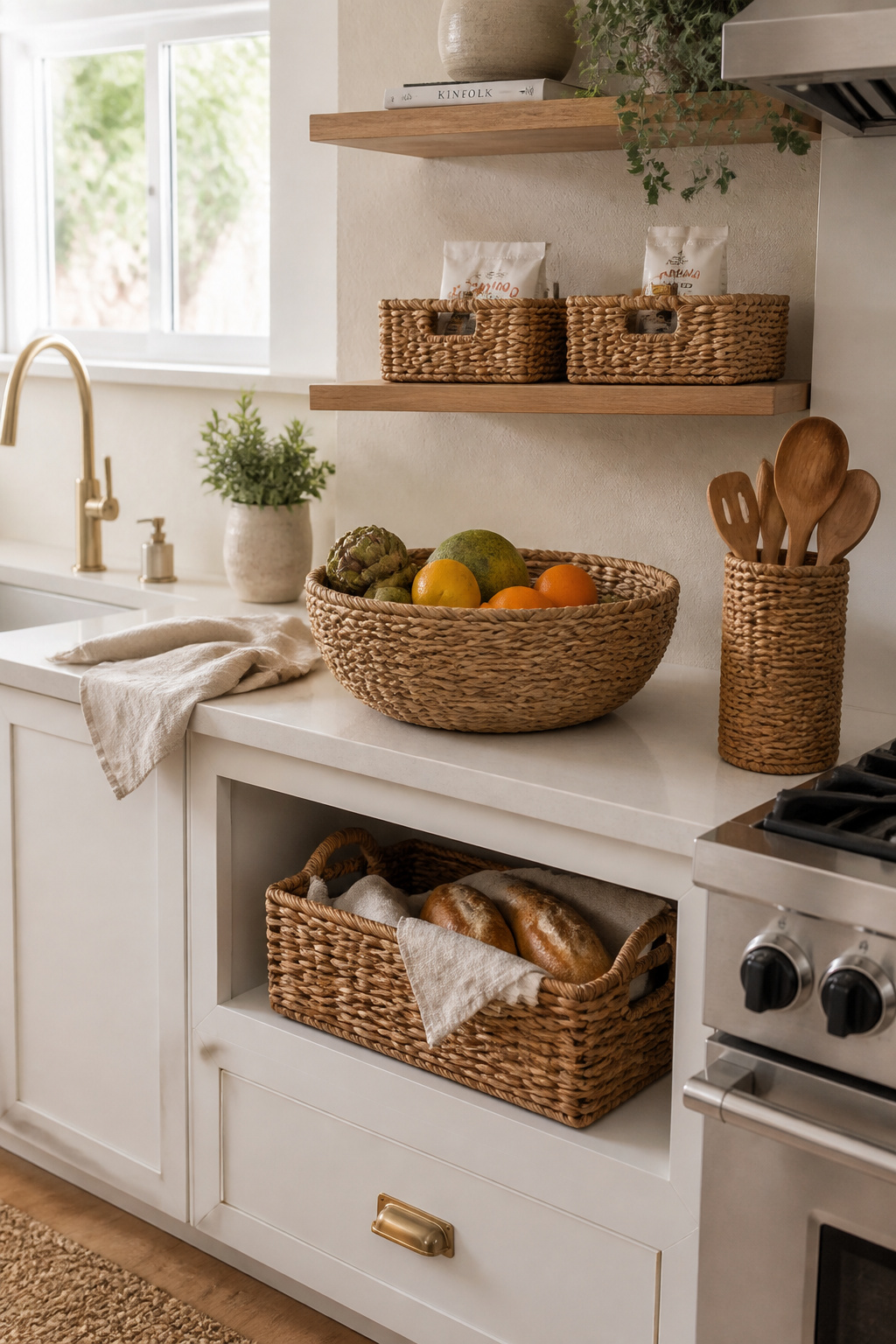
The most functional kitchen baskets are also the most natural-looking: a round, open-weave seagrass bowl for fruit (airflow through the weave extends ripening time), an oval bread basket lined with cotton or linen, rectangular pantry baskets sliding into shelves to corral packets and tins. IKEA’s BULLIG seagrass range is the practical starting point — functional, very affordable, consistent sizing for shelves. Serena & Lily and similar retailers stock more refined versions when you’re ready to invest.
Placement logic: cluster baskets at different heights rather than on a single shelf. One on the counter, one on a lower shelf, one on an open pantry shelf creates vertical distribution that prevents the flat look of everything at the same level. Keep them away from cooking surfaces — heat and steam degrade natural fibers over time. Side counters, pantry shelves, and open storage are better locations than the zone adjacent to the stove.
15. Statement Pendant Lights Over the Island or Counter
The pendant light is the jewelry of the kitchen — the most personality-forward design element you can add without touching a wall or replacing a cabinet. It’s also governed by precise rules that most people don’t follow, which explains why so many kitchens have pendants that are either too high to do anything useful or too small to register visually.
Hanging height: 30-36 inches above the countertop, measured from the bottom of the shade to the counter surface. For ceilings above 8 feet, add 3 inches per additional foot. At this height the pendant provides genuine task lighting while keeping sightlines open across the island. The sizing rule: each pendant should be one-third to one-half the width of the island — for a 48-inch island, pendants of 12-16 inches diameter. Space pendants 24-30 inches apart, center to center, with the first pendant at least 6 inches from the island end.
The style decision is where personality comes in. Rattan pendants read relaxed and coastal; they work particularly well above natural wood countertops or in Japandi-influenced kitchens. Clear or ribbed glass globes with visible filament bulbs at 2200-2700K provide warm ambient light and a timeless look that doesn’t date. Ceramic shades sourced from independent ceramicists have a quality that no mass-produced option matches — it’s worth spending more on one pair of handmade shades than on three sets of catalogue pendants. I’d prioritise the pendant over almost any other kitchen inspo ideas if the island currently has none at all; the room literally changes character when you get the hanging height right.
16. Kitchen Inspiration Behind a Capsule Sustainable Pantry
The capsule pantry borrows its logic from the capsule wardrobe: fewer things, deliberately chosen, maintained with enough care that the system stays functional. Applied to food storage, it means a pantry where every item is visible without moving something else, everything has a designated container, and the whole thing takes about five minutes a week to keep in order.
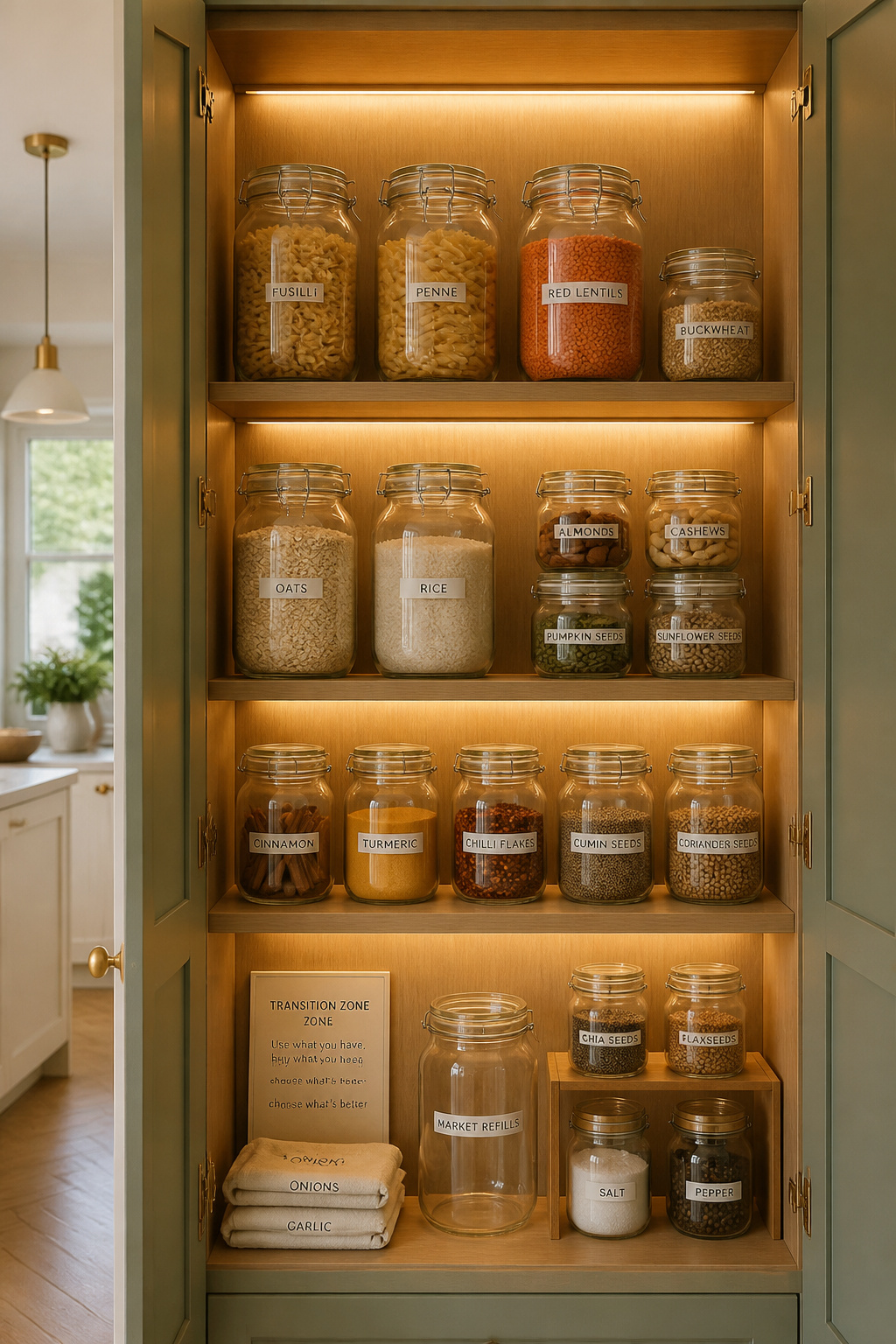
The glass jar is the foundation. Bormioli Rocco Fido jars (with Italian heritage since 1825) use a wire-bail hinged-lid design with high-quality lead-free glass built to last for decades rather than seasons. Kilner and Ball offer a compatible ecosystem of accessories (wide-mouth funnels, pour spouts, storage lids). The practical effect of decanting dry goods into uniform glass jars is dramatic: a pantry full of branded packets is visually chaotic and difficult to inventory quickly; a pantry full of glass jars is calm and immediately legible.
The operational discipline is as important as the containers. First-in, first-out means newer stock goes behind older stock, so nothing gets buried and expires quietly at the back. A consistent labeling system — wax pencil directly on glass (wipes off cleanly), dissolvable labels, or a label maker, applied uniformly throughout, creates a system that maintains itself. The ‘transition zone’ concept is useful: a dedicated shelf or basket for reusable bags, empty jars waiting to go to the market for refilling, and farmers’ market crates. Everything in the sustainable shopping ecosystem lives together rather than scattered across the kitchen.
17. A Single Bold-Colored Appliance as a Design Statement
One bold-colored appliance (a Smeg kettle-and-toaster set in cobalt blue, a KitchenAid stand mixer in sage green, a Bertazzoni range in cherry red) has disproportionate impact in a neutral kitchen precisely because of the contrast. It’s the single point of strong color in an otherwise quiet palette, and it works because everything else lets it.
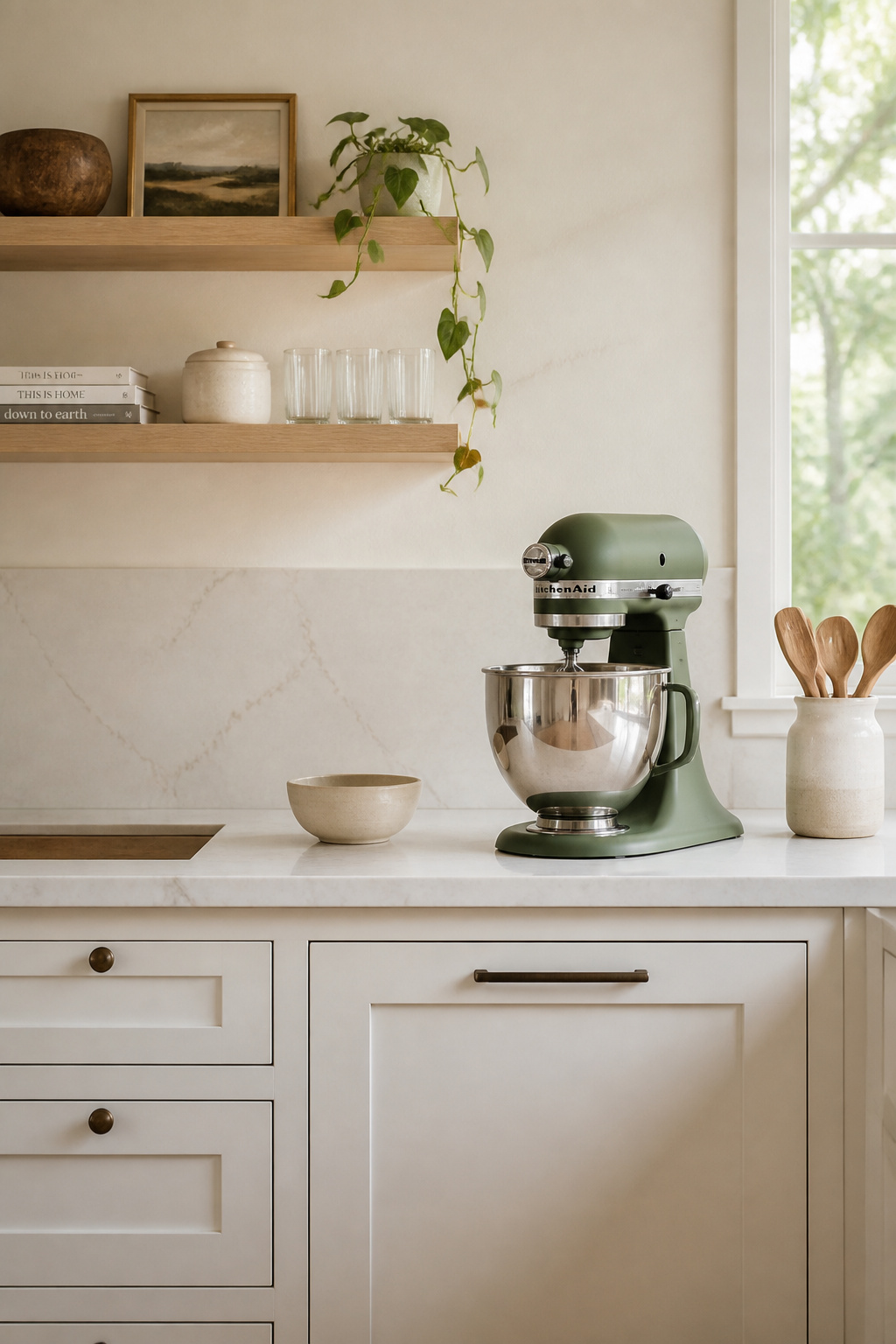
Smeg and KitchenAid approach this differently. Smeg is explicit about the 1950s retro aesthetic — the rounded forms, pastel blue, cherry red, mint green, and jade green are the whole point; the appliance is as much furniture as it is kitchen equipment. KitchenAid’s stand mixer occupies a different register: the form is genuinely functional, and the color is an addition to a machine that would exist without it. Juniper (a dark green with metallic flake) and Hibiscus are recent KitchenAid colors that have shown staying power beyond the trend cycle they launched in.
The color choice timeline matters. If you’re choosing a specific shade because it’s everywhere in kitchen inspo ideas right now, it’s probably 18 months from peaking and 36 months from feeling dated. The most durable choices sit between bold and neutral: cream, stone, sage, and olive green have been in the Smeg range long enough to feel like classics rather than trends. Cobalt blue and cherry red have the same tenure in the brand’s identity — they’re not trend colors anymore, they’re house colors. One appliance, maximum. Two bold-colored appliances in different colors in the same kitchen competes and cancels.
18. Floating Shelves With Ceramics, Books, and Found Objects
Floating shelf styling is a skill, not a talent, and the skill is mostly about what you leave off. The shelves that look genuinely curated are the ones where the objects on them have room to exist individually — not packed together so densely that nothing registers.
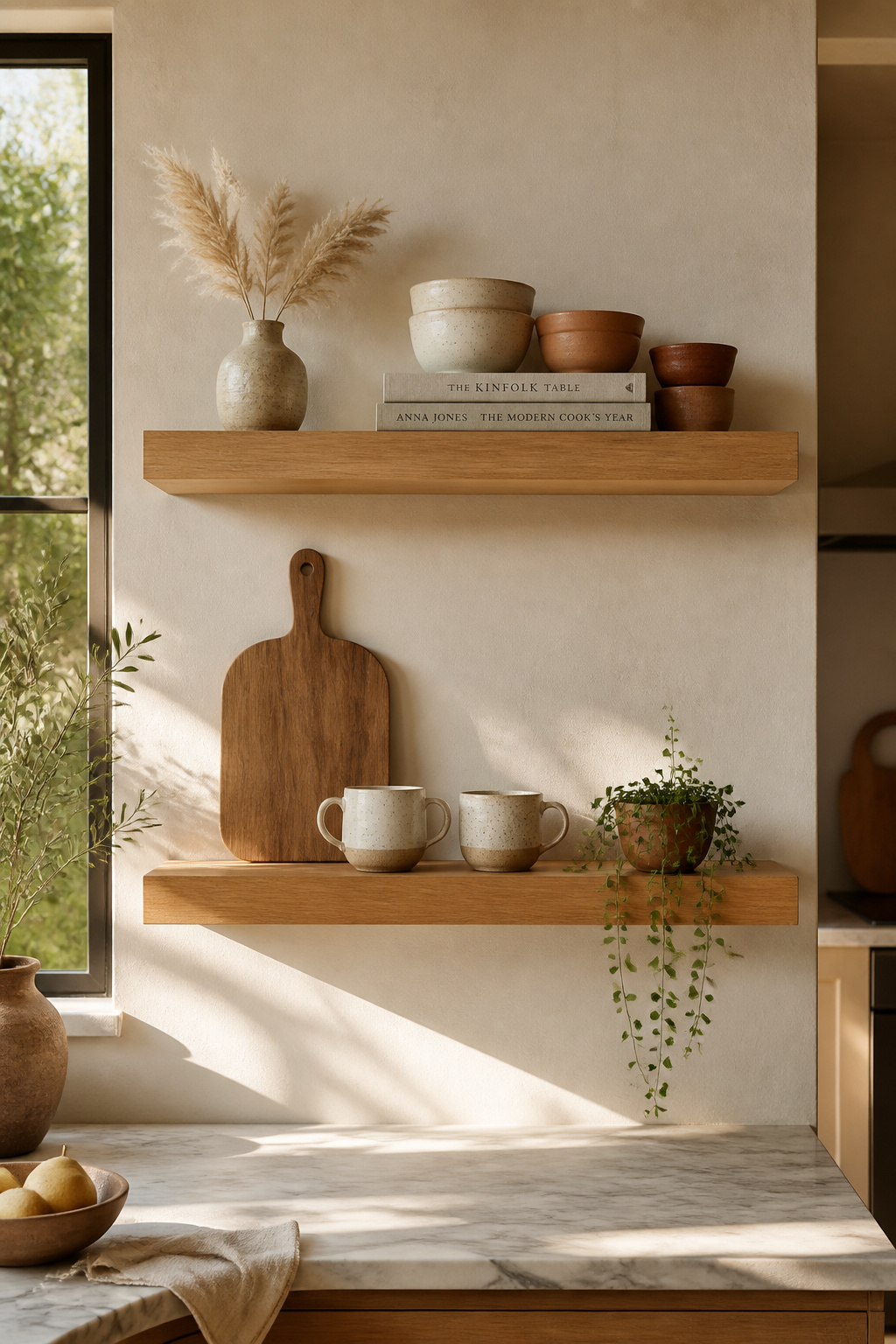
The composition principles are consistent: group items in odd numbers (3 and 5 create natural asymmetry that even numbers don’t), layer depth from back to front (tall at back, medium mid-shelf, small items or trailing plants at the front edge), and leave 20-30% of the shelf surface deliberately empty. The rule of thirds gives each shelf a visual structure: divide it mentally into three sections, give each section a different height emphasis — a tall vase or standing cookbook left, a medium group of ceramics centre, low scattered items right.
The source question is often where people get stuck. The best shelf objects aren’t usually the ones that cost the most — they’re the ones that have some particularity to them. Thrift stores and charity shops produce individual ceramic pieces in a consistent color family for almost nothing; several mismatched pieces in the same palette read as a collection. Independent ceramicists on Etsy and Instagram make bowls, cups, and small vessels that no other shelf has; following local potters and buying directly keeps the price reasonable. Dried botanicals (seed heads, cotton stems, wheat, pampas) last indefinitely, need no care, and add an organic quality that plastic and silk alternatives can’t replicate.
How to Find the Kitchen Inspo Ideas That Fit Your Life
Here’s the thing about kitchen transformations: the most successful ones started with a single change that clarified everything else. Paint the island forest green, and suddenly brass hardware is obviously the next step. Add brass hardware, and suddenly the open shelf with the right ceramics makes sense. The sequence reveals itself once you’ve committed to the first decision.
Before committing to any of these kitchen inspo ideas, score each one on impact relative to your specific situation. Under-cabinet lighting in a kitchen that currently has none delivers a dramatic transformation for $80-150 — it probably beats a new backsplash in impact-to-cost terms. A set of quality cabinet hardware changes the entire read of plain cabinet fronts for $200-300. These are the moves to make first.
Before buying anything new, live with each change for a week. The next need usually becomes obvious once one layer is in place, and impulse-buying in a direction that doesn’t fit tends to create clutter rather than cohesion. The kitchen that takes 18 months to get right — one deliberate decision at a time — almost always outlasts the one that was fully renovated in a weekend.