Most home decor advice treats simple as a starting point — the plain base you build on before the real work begins. Interior design blogs repeat this. Makeover shows preach it. But restraint is not a starting point. It is a skill. The rooms that feel most intentional are almost always the ones where every element was chosen deliberately and nothing was added out of habit. These 15 simple living room ideas are not about spending less. They are about choosing more carefully. The result is a space that feels complete, not sparse — considered, not plain. Simple living room ideas succeed because they ask you to make decisions rather than defer them — and the rooms where every decision has been made are the ones that feel most resolved.
1. A Single Statement Sofa in a Neutral Tone
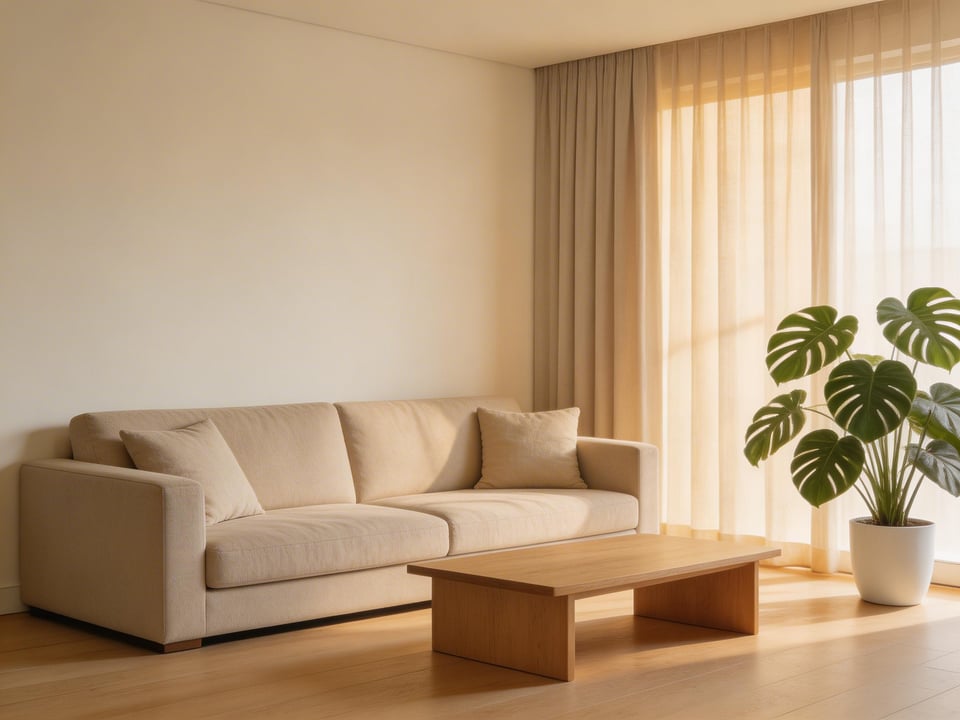
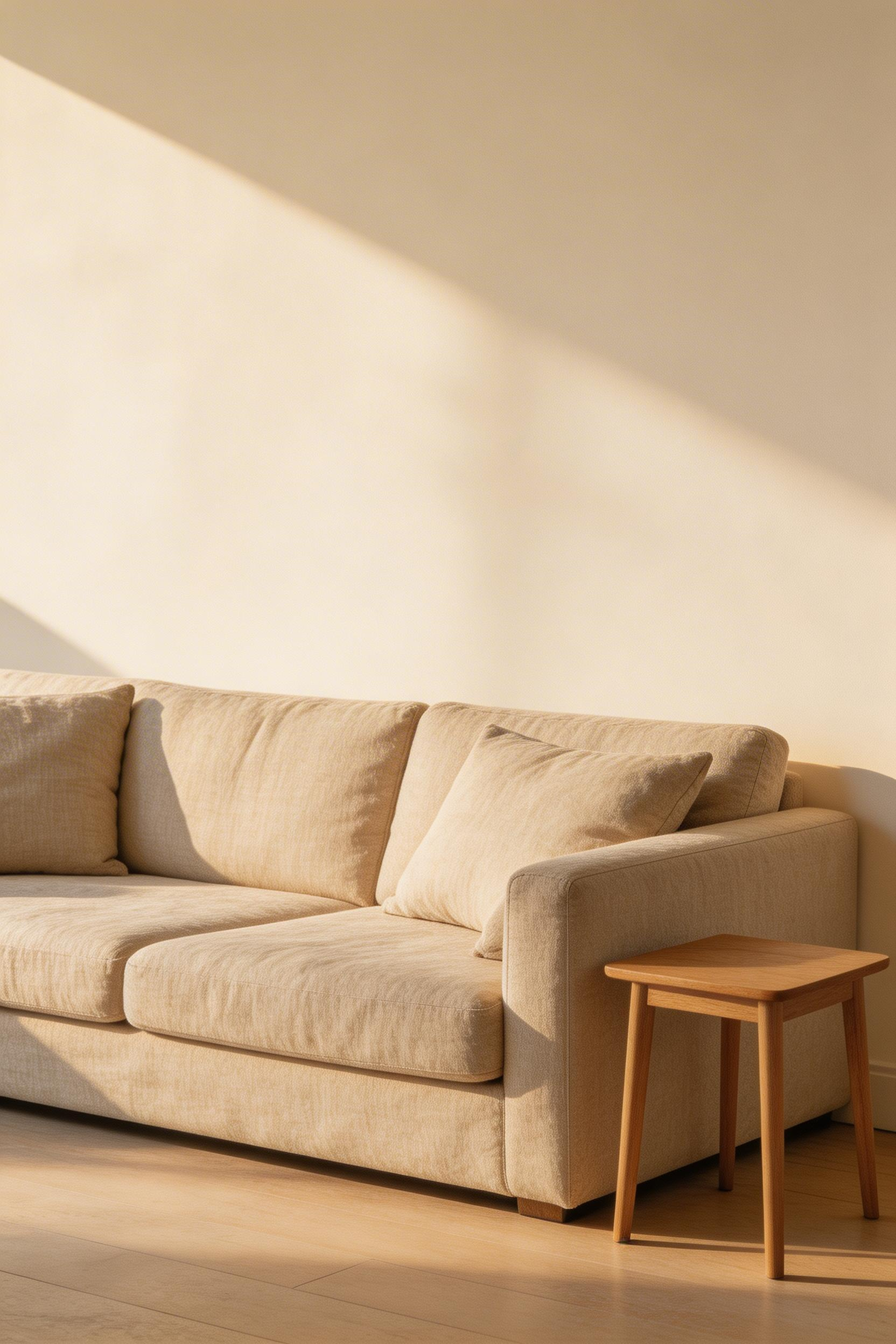
The sofa is the largest object in almost every living room, so it sets the tone for everything else. A single well-made piece in oatmeal, warm grey, or sand does more for a simple living room than a matched three-piece suite. Matched sets read as finished furniture rather than considered design. They also dominate every visual angle instead of anchoring just one.
When sizing, the sofa should take up roughly two-thirds of the wall behind it. A 90-inch sofa against a 12-foot wall sits in good proportion. Standard seat depth is 21–24 inches for upright seating. Deeper seats (24–28 inches) suit lounging but can overwhelm smaller rooms. Among all simple living room ideas, getting the sofa scale right has the highest single impact on whether the room looks resolved or not.
Fabric and Frame
Performance fabrics — Crypton, Sunbrella, and TopNotch — now come in convincing linen-look textures. They are far easier to live with than raw linen or cotton velvet. For a simple scheme, choose a tight-back sofa with exposed legs. The legs lift the piece visually and prevent it reading as a heavy block on the floor.
The IKEA Kivik 3-seater in Tussöy natural (around £595) has clean lines and replaceable covers. The Article Sven in Oxford Tan ($1,799) adds mid-century proportions at a step up. The West Elm Haven Large Sofa in Twill Ivory ($2,299) is the choice for deep seating with a Fair Trade credential. A 2022 Houzz survey found that 71% of homeowners who described their style as minimal chose a neutral sofa — more than double any other colour group.
Before ordering, cut newspaper to the sofa’s exact footprint and leave it on the floor for 48 hours. You will know immediately whether the scale is right.
2. Low-Profile Furniture to Open Up Floor Space
Keeping furniture close to the floor makes ceilings feel higher. When the eye meets less furniture height, it reads the full distance to the ceiling as more generous. This principle from Japanese residential design matters in simple living room ideas because perceived space is real space — a room that feels larger is more restful, even when the dimensions are fixed.
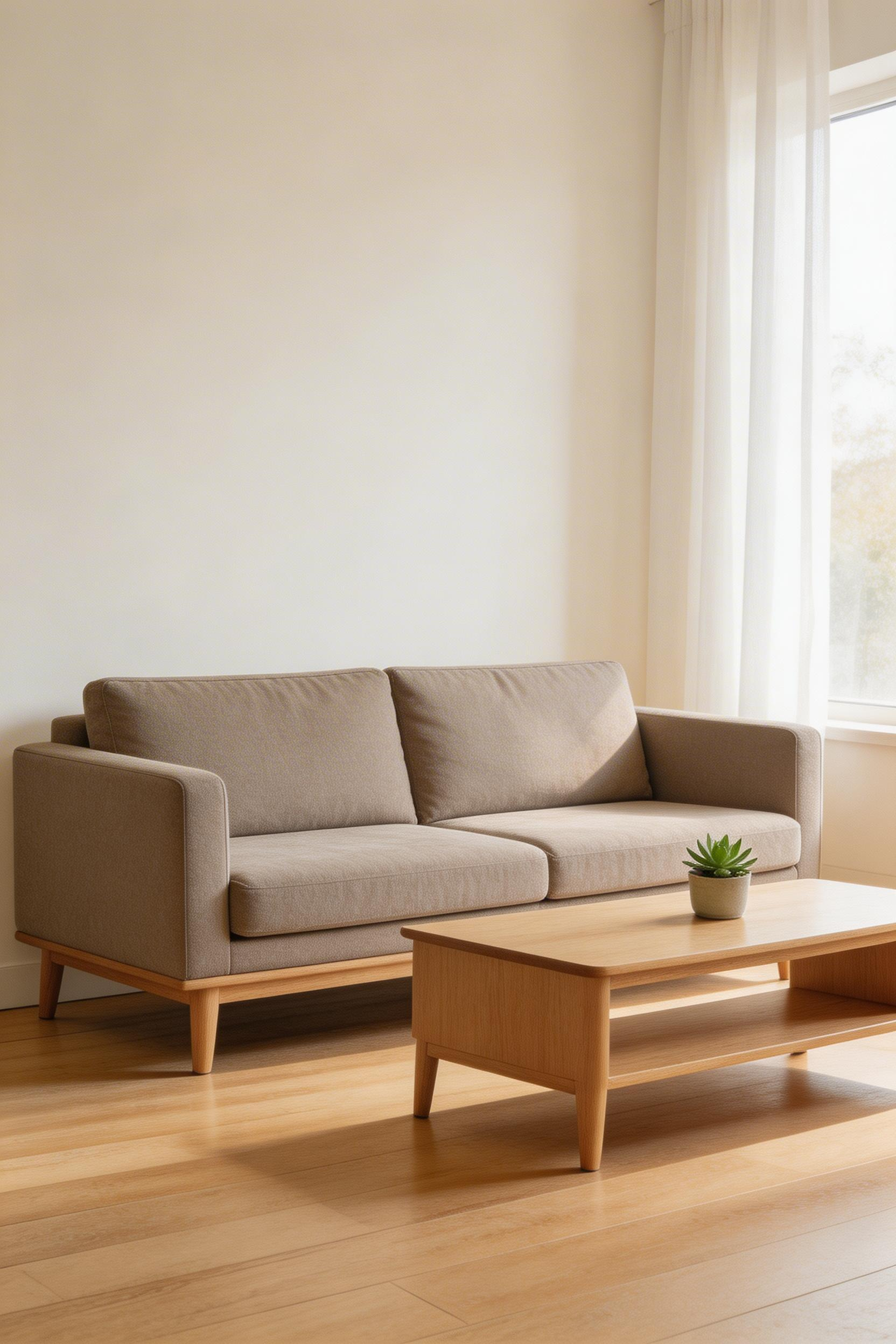
Standard sofas sit at 18–20 inches seat height. Low-profile pieces range from 14 to 17 inches. The key is consistency: a low sofa paired with a full-height accent chair looks confused rather than intentional. So keep everything in the seating area — sofa, accent chair, coffee table — at the same horizontal register.
Getting the Coffee Table Right
The coffee table is the trickiest piece. It should sit within 2 inches of sofa seat height. A standard 18-inch coffee table against a 15-inch sofa looks like a mistake rather than a decision. Mid-century furniture from the 1950s and 60s was built at this lower register by default, which is one reason it works so well in contemporary simple spaces.
The CB2 Avec Low Sofa ($1,699) holds good mid-century proportions. The MUJI Low Table in oak at 15 inches (£199) pairs well with it. Research by the Environmental Design Research Association confirms that rooms with lower furniture are rated as more spacious even when dimensions are identical to standard-furnished rooms.
3. A Single Large Rug Instead of Layered Rugs
Rug layering had a moment around 2018. By 2023, most designers had moved on. Layering introduces visual complexity that simple living room ideas are built to avoid — two rugs of different scales and textures become a focal point in themselves. A single well-chosen rug, correctly sized, does the job with more authority.
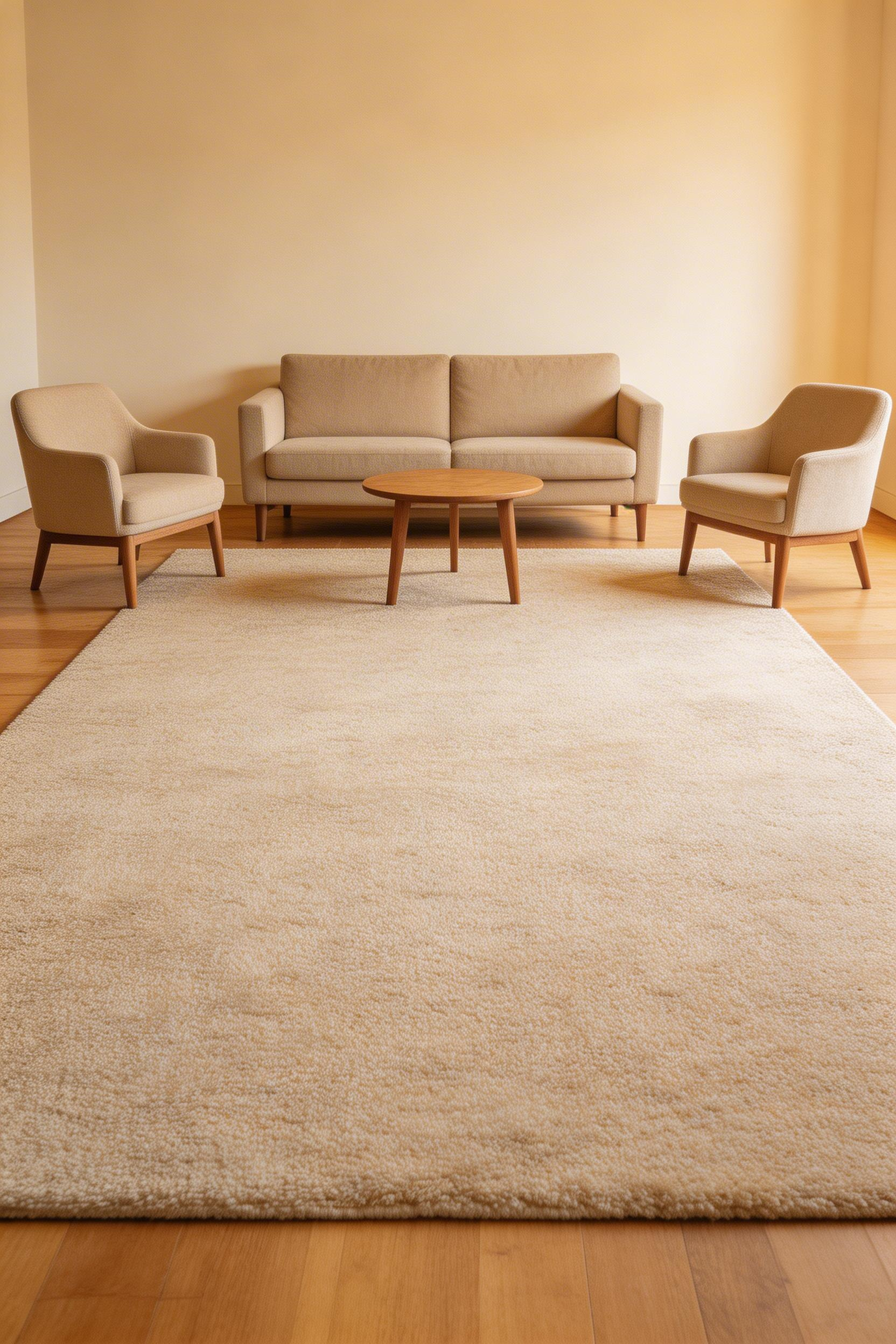
The most common mistake is going too small. In a 12×15-foot room, an 8×10 rug is the minimum. A 9×12 is usually better. The front legs of every piece of seating should rest on the rug. If legs are half-on and half-off, the rug reads as too small and the arrangement looks accidental. Correct rug sizing is one of the simple living room ideas that costs nothing extra — it is just a matter of knowing the rule.
Material and Scale
Natural fibre rugs — wool, jute, sisal — hold texture better over time than synthetics but need more care. Jute sheds initially and does not respond well to moisture. Wool cleans more easily and tolerates heavier use. A tone-on-tone or subtle geometric adds texture without pattern noise. The Ruggable Siena Cream 9×12 ($499) is washable and practical for family rooms. A Beni Ourain-style wool rug (typically £350–£700) adds handwoven texture that suits almost any simple scheme. Always add a rug pad — it prevents slipping, protects floors, and makes the rug feel more substantial underfoot.
4. Warm White or Off-White Walls to Anchor Everything
Cool white walls — the default of most developers and landlords — create a clinical backdrop that fights against the warmth simple living room design is trying to build. Warm whites have yellow, red, or orange undertones. Cool whites lean blue or green. The difference is subtle on a small paint chip and significant on a full wall.
Reliable warm whites: Farrow & Ball All White (No.2005, £67 for 2.5L) works in north- and south-facing rooms without reading cold or yellow. Benjamin Moore White Dove (OC-17, $75 per gallon) has an LRV of 85.4 with a slight cream warmth. Dulux Timeless (£20 for 2.5L) is the accessible option — one of the UK’s best-selling living room shades. Little Greene Slaked Lime adds a subtle stone tint that gives large walls depth without feeling like a deliberate colour choice.
Test Before You Commit
A colour that looks warm at noon can read greenish under LED strip lighting in the evening. Paint a sample at least A3 size and observe it across a full day. A small paint chip tells you almost nothing about how a colour behaves at full scale. Eggshell finish is preferred over flat/matt for living rooms — it wipes clean without scuffing. Flat absorbs more light beautifully but marks easily. Dulux’s 2024 colour report found that off-white and warm neutrals accounted for 43% of all interior paint purchases — far ahead of every other group. Among simple living room ideas, wall colour is the one with the widest reach: it affects every other element in the room simultaneously.
5. One Focal Point Wall With Intentional Art
Gallery walls work in eclectic spaces. But they actively undermine simple living room ideas, because when every wall has something on it, the eye has nowhere to rest. A single focal point wall — with one large piece or a deliberate arrangement — does more with less.
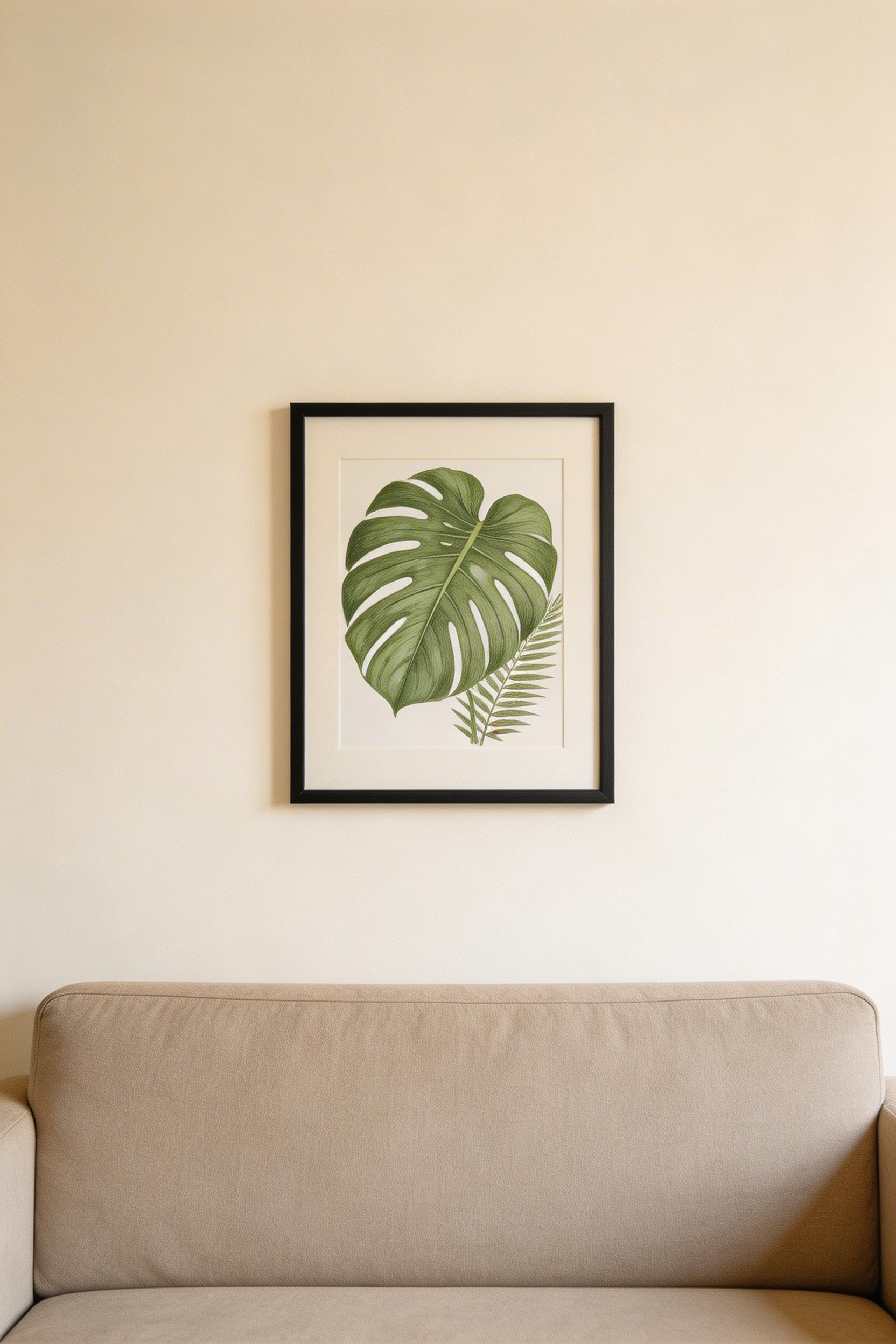
The standard hanging height: centre of the artwork at 57–60 inches from the floor. Over a sofa, art should sit 6–8 inches above the sofa back. It should also span roughly two-thirds to three-quarters of the sofa’s width. A piece that is too small hovers like a Post-it note; one wider than the sofa looks mismatched.
Sources and Framing
Large-format prints do not need to be expensive. Desenio, Society6, and Minted all offer clean minimal prints up to 90x120cm. Etsy digital downloads, printed locally on matte art board, cost very little. Photography, botanical prints, and abstract line art suit simple schemes well. For framing, black or natural wood reads best — white frames can look clinical, ornate frames compete with the art itself. The IKEA LOMVIKEN in black (£20 for 50x70cm) is a clean, inexpensive solution. A 2023 Art.com survey found that 68% of homeowners with minimal living rooms chose a single large-format piece as their primary wall decoration. For simple living room ideas on a tight budget, a well-printed poster in a clean frame is the highest-impact low-cost choice available.
6. Concealed Storage to Keep Surfaces Clear
A simple living room accumulates gradually — remote controls, magazines, chargers, books. The solution is not discipline; it is infrastructure. When storage is built into the room, objects have easy homes. When it is improvised, everything ends up on surfaces.
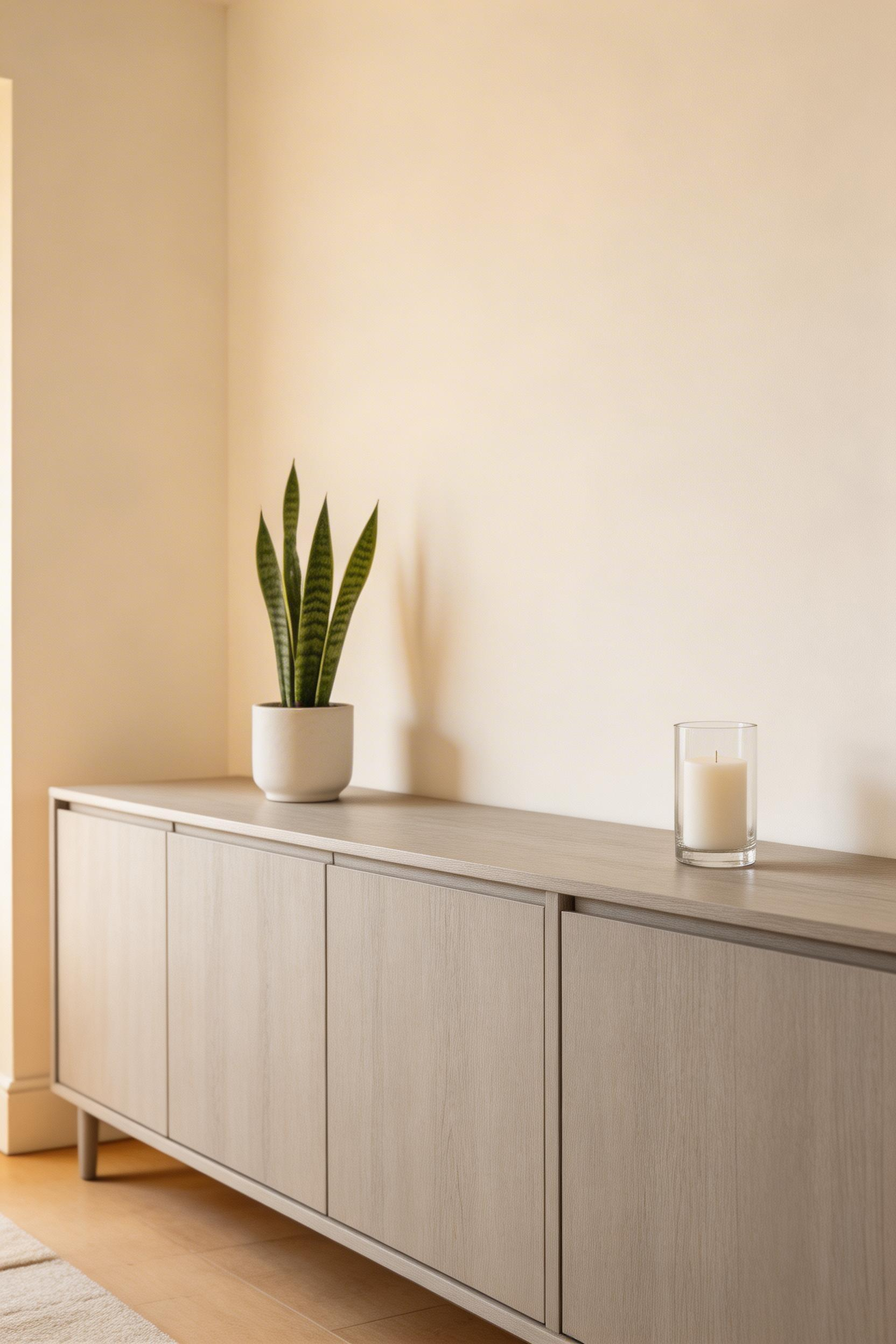
Research published in Personality and Social Psychology Bulletin found that people who described their home as cluttered were significantly more likely to report fatigue and depression than those who described it as restful. So clear surfaces have a measurable physiological effect — not just an aesthetic one.
The Right Pieces
The storage ottoman is the most versatile choice: footrest, occasional seating, and concealed storage in one. The West Elm Mid-Century Storage Ottoman ($499) has a hinged lid and 37-litre capacity in 8 neutral tones. A closed sideboard at 80–90cm height serves as console, display surface, and storage. The Habitat Oken in light ash (£549) has a clean handle-free design that maintains the simple visual line. The IKEA BESTA TV unit with Lappviken doors (£315 for 180cm wide) is the budget workhorse. Also, visible cables undo the work of every other simple living room idea — so this is worth addressing early. D-Line paintable conduit (£25) fixes to the skirting and disappears when painted to match the wall.
7. Natural Wood Accents for Warmth Without Noise
A room built entirely from white, grey, and neutral textiles risks reading as cold. One or two pieces in natural wood resolve this without adding visual complexity. The wood does not need to dominate; it needs to be present.
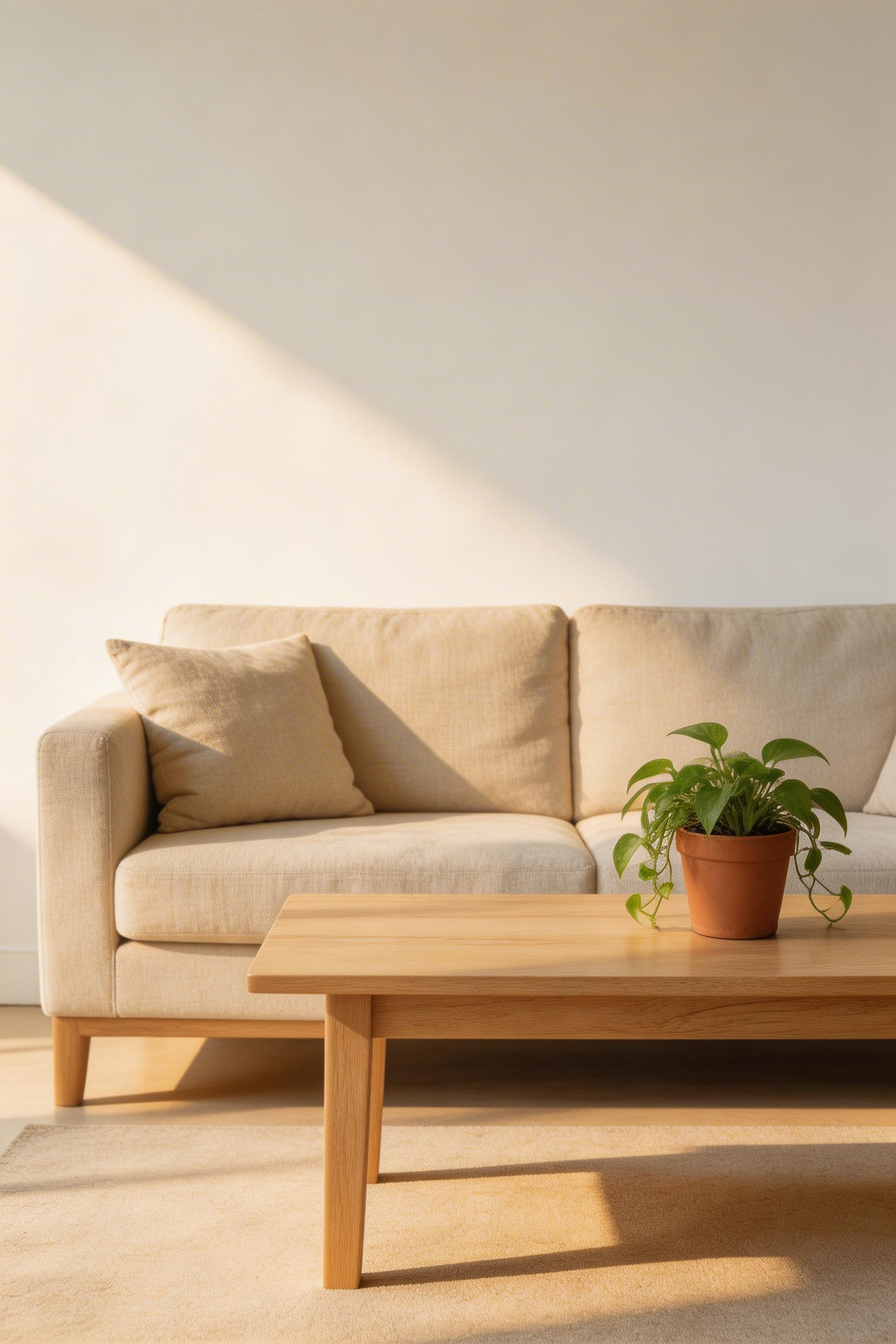
Warm wood tones — oak, walnut, ash — are the most reliable. Lighter species (natural oak, ash) work well in bright rooms and Scandinavian palettes. Darker species (walnut, smoked oak) add warmth to north-facing rooms with cooler light. Let the wood tone appear in two or three places for cohesion: a coffee table, a floating shelf, a picture frame. Enough to feel intentional; not so much it becomes a wood-panelled effect.
Solid or Veneer
For a coffee table that gets daily use, solid wood is worth the premium. It can be sanded and re-oiled when it shows wear. Veneer on MDF cannot be restored in the same way. Oiled and waxed finishes age better than lacquered wood — they can be refreshed without full refinishing. The IKEA LISTERBY coffee table in oak veneer (140cm, £149) is a clean design with good proportions. The Habitat Corder solid oak side table (£129) pairs well with most sofas. WGSN’s 2024 Home Futures report found oak and ash appeared in 73% of professionally designed simple living room schemes surveyed. The material does what no synthetic can — it adds warmth and character without adding visual noise.
8. Streamlined Curtains in Floor-to-Ceiling Linen
Window treatments are the most under-thought element in many simple living room schemes. Most people size curtains to the window and hang them at window height. The result looks correctly dressed rather than considered. Hanging curtains at ceiling height changes the proportion of the entire wall — and it costs nothing extra to do so.
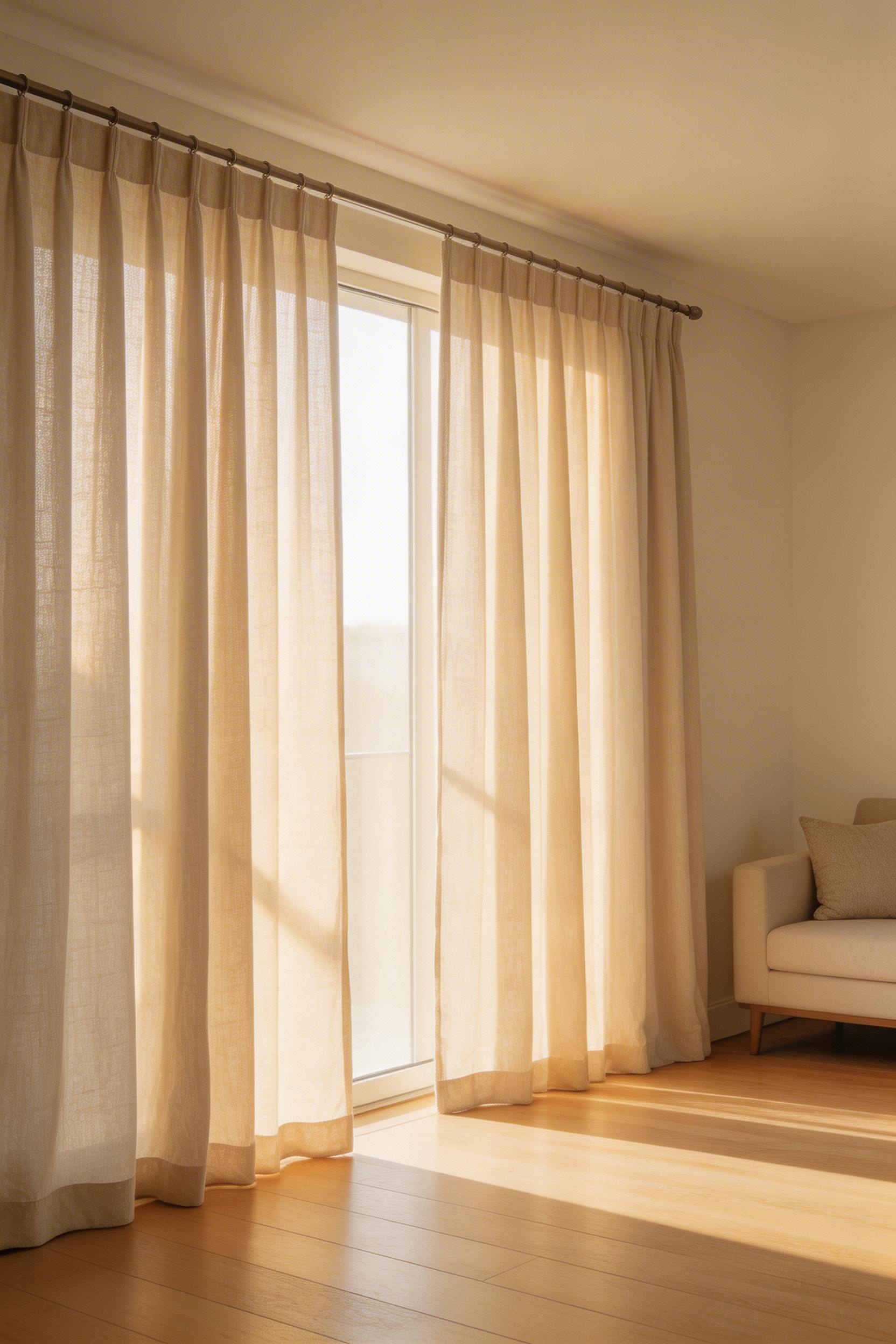
Fix the rod 4–6 inches below the ceiling, or flush against the cornice in period rooms. The curtains then run the full wall height, even if the window only occupies the lower half of it. The effect is an immediate increase in perceived ceiling height and a sense of architectural deliberateness.
Material and Width
Linen diffuses light beautifully — it glows in daylight without going transparent. Linen blends (55% linen, 45% cotton or polyester) are more stable than 100% linen, which can shrink significantly. Always wash before hemming. Width matters: each panel should be 1.5 to 2 times the window width. A 150cm window needs at least 300cm of total curtain fabric. The IKEA DYTAG pure linen curtains in natural (2 panels, 145x300cm, £75) are the go-to accessible option. Pottery Barn’s Belgian Flax Linen Rod-Pocket Curtain ($99 per panel) offers stonewashed softness in 12 neutral tones. John Lewis data (2023) shows linen curtains have been their fastest-growing window category for three consecutive years. For simple living room ideas that make an immediate visual difference without structural changes, ceiling-height linen curtains are the best single intervention.
9. A Curated Plant or Two, Not a Jungle
Biophilic design research confirms that even a single living plant measurably reduces stress compared to an identical plant-free room. But the research is about presence, not quantity. A shelf of 15 mismatched plants in different pots adds visual noise that cancels much of the calm the plants create. For simple living room design, one well-chosen large plant outperforms a collection every time.
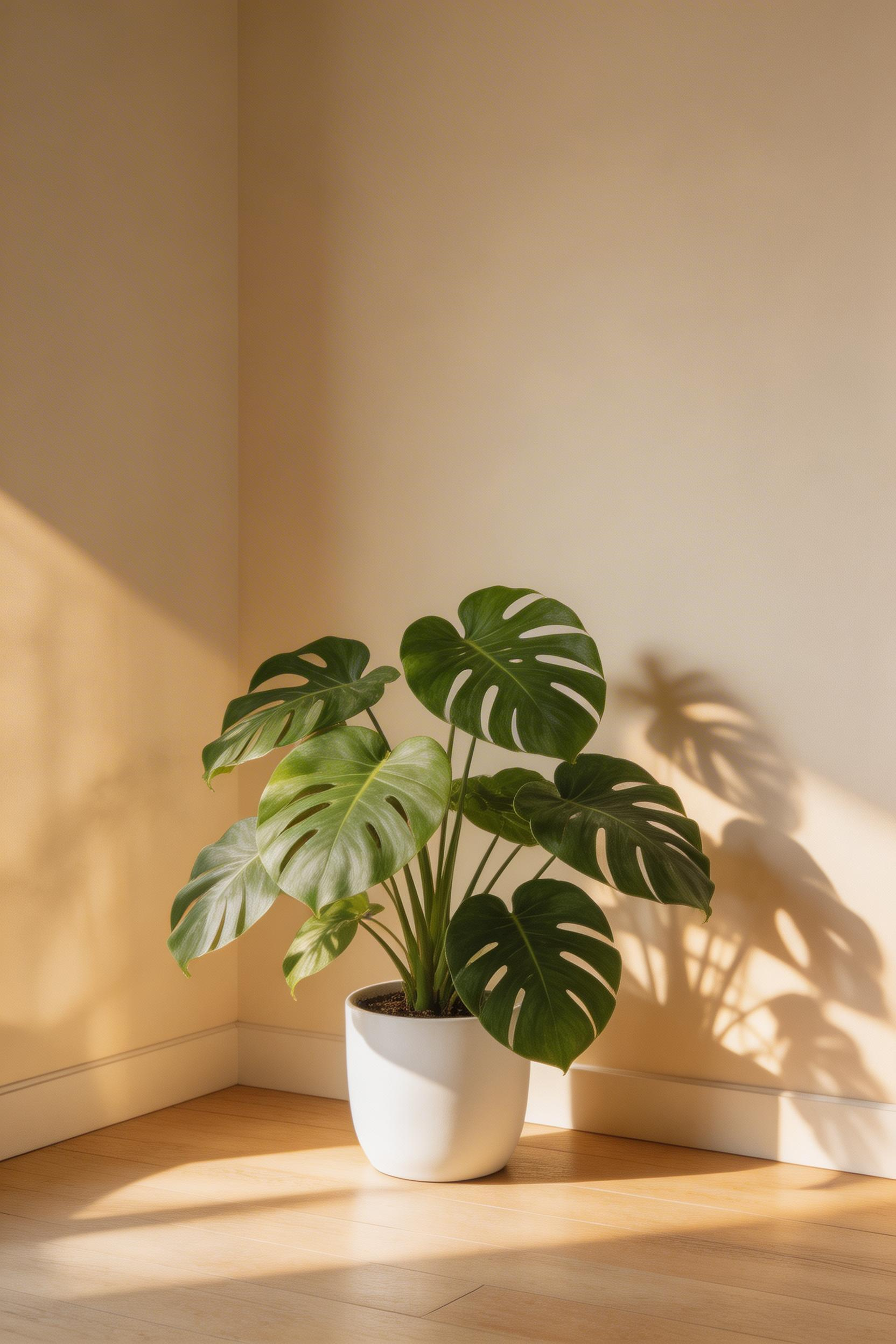
Sculptural plants with clear form work best. A monstera deliciosa at 80–120cm (£40–80) is the most forgiving — it tolerates irregular watering and grows in medium indirect light. A fiddle-leaf fig (Ficus lyrata, £50–120) looks striking but needs stable conditions. It dislikes drafts, irregular watering, and low light. An olive tree standard stem (£60–150) adds Mediterranean character in bright rooms with good direct light.
Pot and Placement
Terracotta, white ceramic, or natural rattan suits a simple scheme. Glazed multicoloured pots create the visual noise simple living rooms avoid. One large floor plant (1.2–1.8m tall) in a corner creates far more presence than six small plants scattered across shelves — and it is much easier to water correctly. The Royal Horticultural Society (2022) found that rooms with one or two healthy plants were rated significantly higher for calm than rooms with many small ones. Quality of presentation matters more than quantity — and one impressive plant is always cheaper than fifteen mediocre ones. Among simple living room ideas that involve adding something rather than removing it, a single well-placed large plant is the most effective biophilic choice.
10. Ambient Lighting Layered With One Task Lamp
Lighting is the most underestimated element in simple living room ideas — and also the one with the highest return on small interventions. The wrong colour temperature can make a room feel institutional regardless of everything else. But the right layered approach transforms the same space without moving a single piece of furniture.
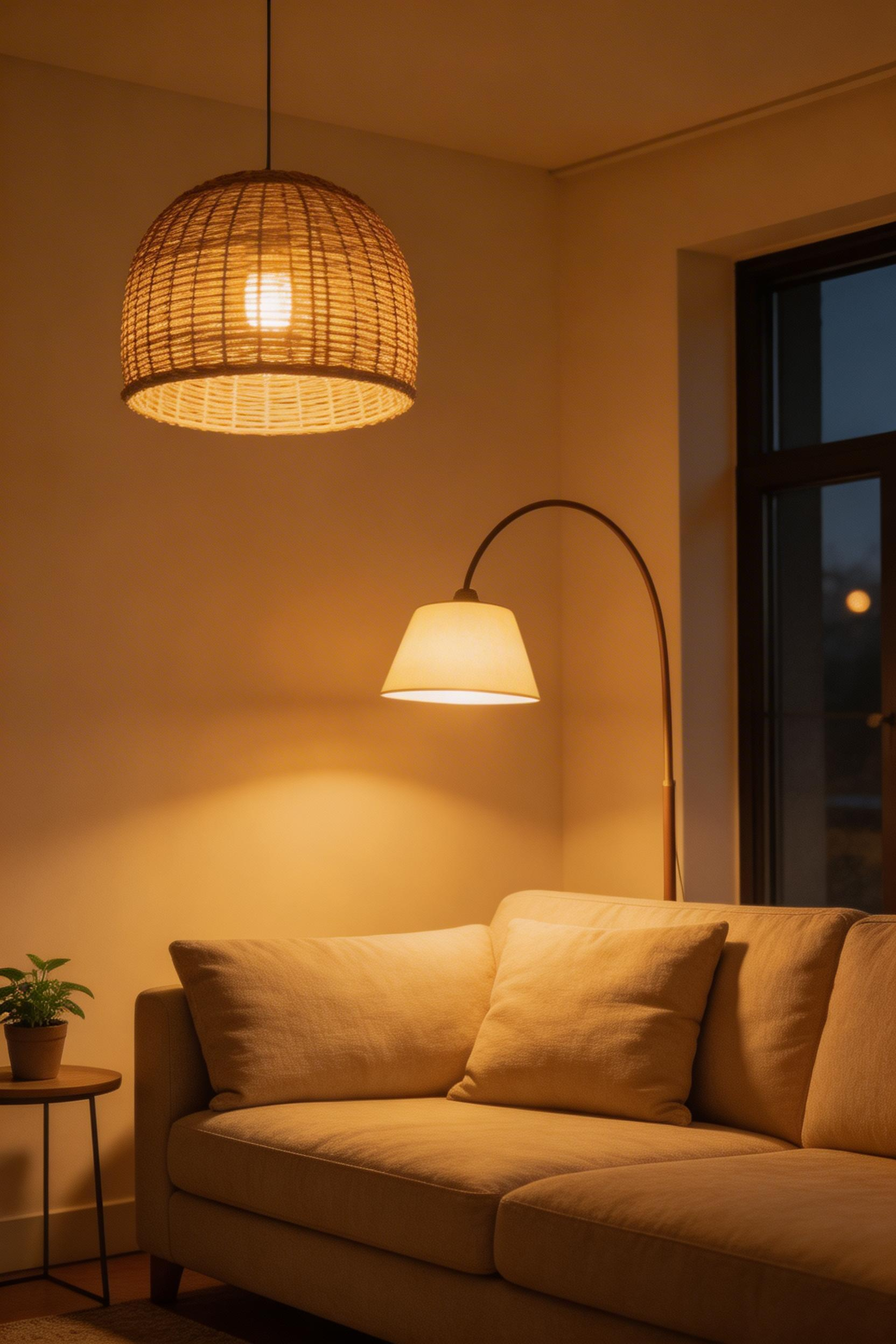
A pendant plus one arc floor lamp covers 90% of living room lighting needs. The most impactful single upgrade is a dimmer switch. A smart dimmer (Lutron Caseta or Philips Hue, £30–80) retrofits to most wiring and allows the ambient level to drop in the evening. The atmosphere shifts completely. For colour temperature, 2700K is correct for warm living room schemes. At 4000K or above, a warm white room starts to look cold and the neutrals you have chosen will read differently than expected. Try swapping all bulbs to 2700K LED before buying any new fixture — you may find the room transforms without additional hardware. Of all simple living room ideas, this is the one most people skip and the one that makes the fastest difference. You can explore layering approaches further in our living room lighting ambiance guide.
Fixtures to Consider
The Nordlux Dftp Shapes rattan pendant (£120) produces warm, diffused light and suits a broad range of simple styles. The HAY Nelson Bubble Pendant (£230) is a design standard — its glow is exceptional. For the floor lamp, the IKEA HEKTAR arc (£75) is clean and functional. The Anglepoise Type 75 (£265) is the investment choice: fully adjustable, British-made, and built to last decades. The Lighting Research Center at Rensselaer Polytechnic Institute found that warm tunable lighting at lower evening intensities produced significantly lower stress than fixed cool overhead lighting.
11. A Limited Colour Palette of Two or Three Tones
The 60/30/10 rule is the most practical tool for building a simple living room palette. Sixty per cent dominant colour (walls, main upholstery), 30% secondary (curtains, rug, accent seating), 10% accent (cushions, small objects, plants). The framework sets a ceiling on how many tones can enter the scheme — and that ceiling is what keeps simple living room design from becoming something else entirely.
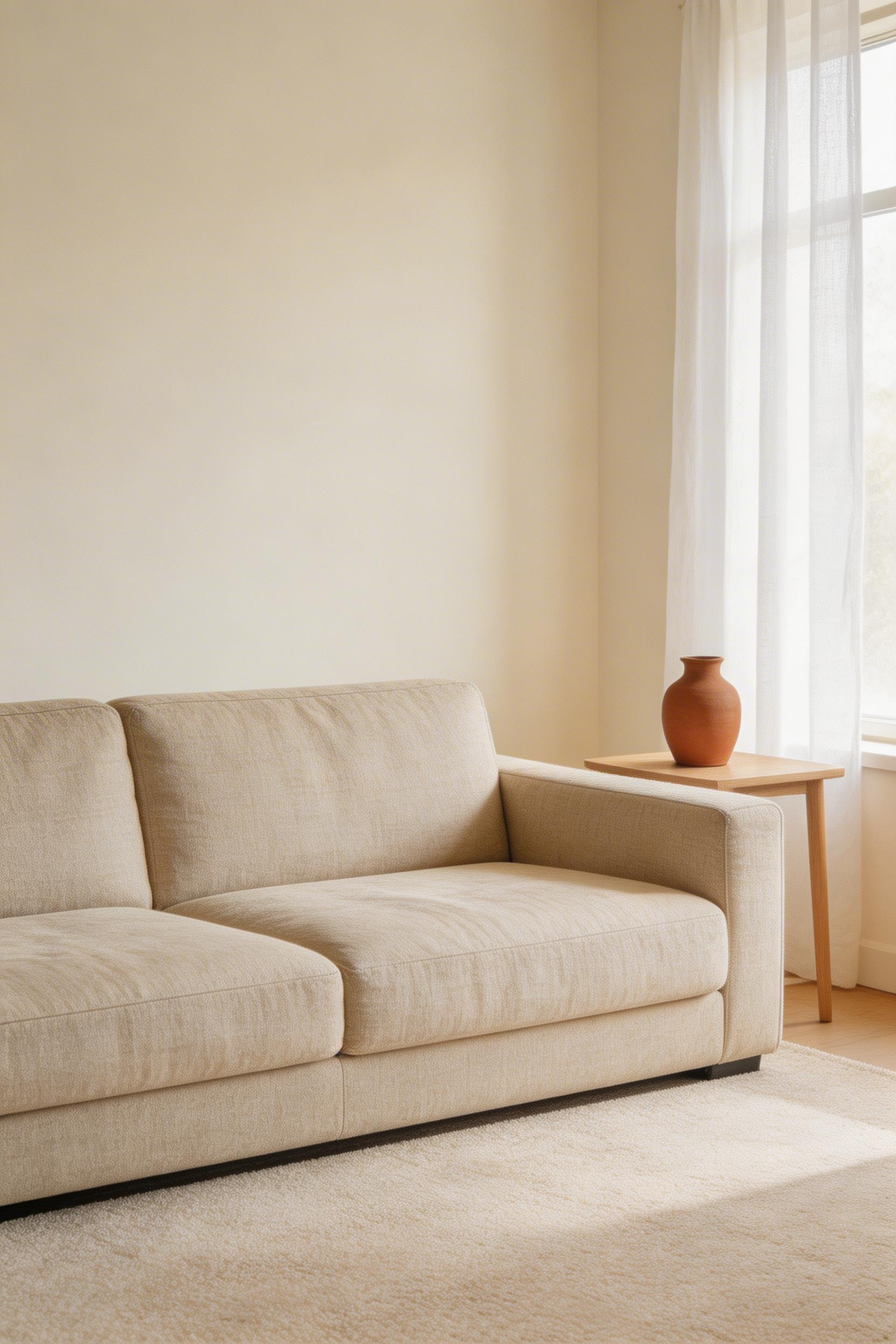
The most effective simple palettes follow a pattern: warm white plus natural oak or linen plus one earth tone accent. Terracotta is still the most liveable accent choice. Sage green is a close second. Warm charcoal suits rooms where the emphasis is on calm rather than warmth. Adding a fourth colour almost always makes a scheme feel less simple, not more interesting — the eye now arbitrates between more competing claims and the hierarchy breaks down.
The mistake most people make: they keep walls and sofa neutral but buy accessories in different colours as they go — a blue vase here, a green cushion there. The base stays neutral; the top layer becomes chaotic. So choose the 10% accent tone before shopping, then hold to it. For apartment living room ideas, a monochromatic palette — all tones of one colour family, varied only by texture — is particularly effective in smaller spaces. Havenly’s 2024 data found projects using three colours or fewer received 22% higher satisfaction scores on calmness and cohesion than those using four or more. Palette discipline is one of the simple living room ideas that pays dividends across every other element.
12. Textural Interest Through Fabric, Not Pattern
When pattern is minimal — as it typically is in genuine simple living room design — texture becomes the primary design language. Without it, a neutral room reads as flat. With the right textures, a room in cream, oatmeal, and warm white feels layered and genuinely warm. The surfaces do the work that pattern usually does, but without any visual noise.
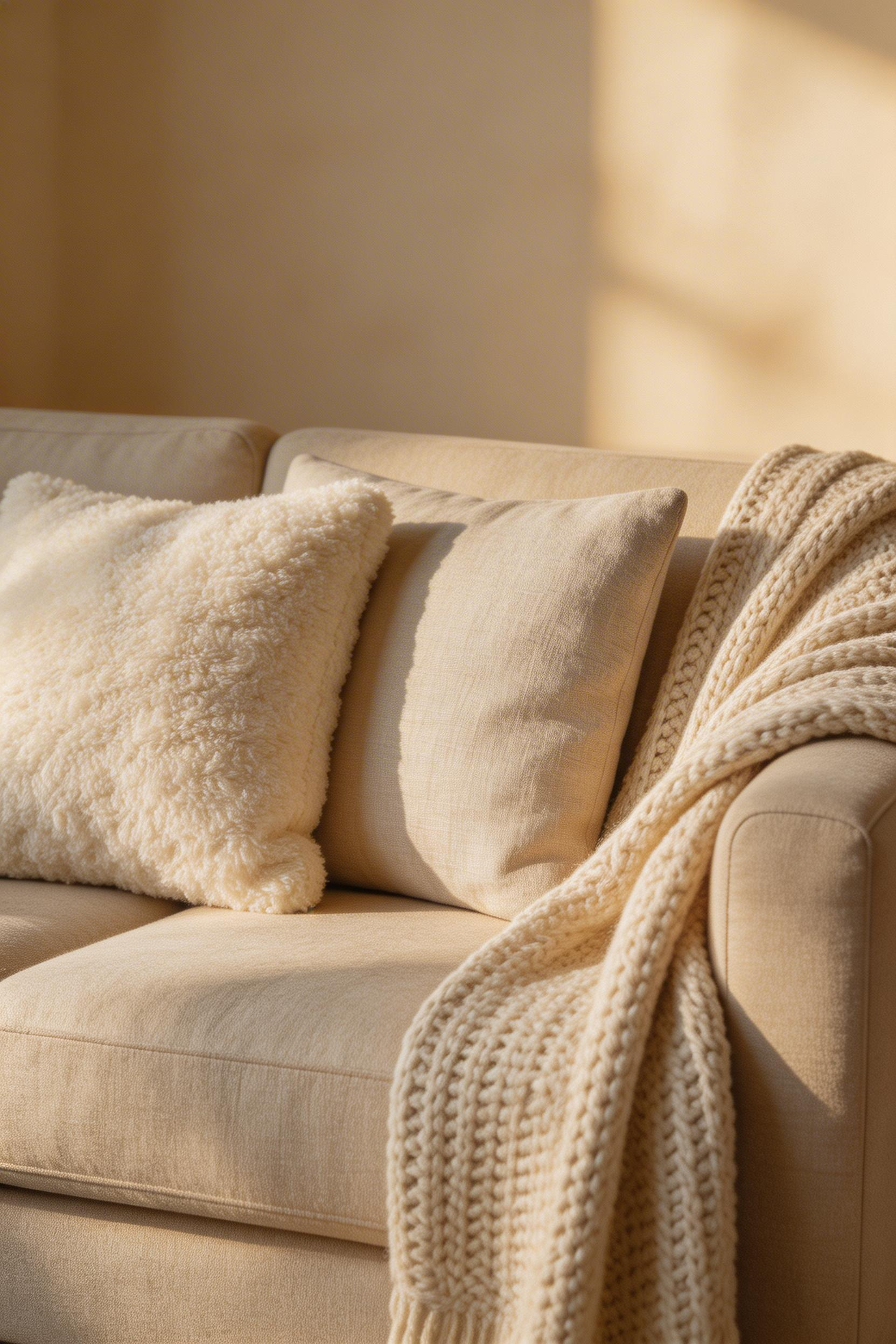
Key textures: bouclé (looped wool weave, deeply tactile), waffle-weave cotton (understated, good for throws), linen (naturally irregular weave), rattan and cane (organic geometric grid), and chunky knit wool. Mix three or four across cushions and throws in the same neutral tone family. An oatmeal linen cushion next to an oatmeal bouclé cushion next to an oatmeal ribbed-knit throw reads as rich, not repetitive.
The Rattan Note
Rattan furniture adds organic texture and warmth without adding any colour burden — which is why it has remained consistent in simple design since 2020. A rattan accent chair or side table does textural work quietly. For cushions on a standard three-seat sofa, a mix of two 50cm and two 60cm pieces in different textures is the right balance. Over six starts to look busy. The White Company’s chunky-knit throw in oat (130x170cm, £99) works as both a styling element and a practical object. WGSN’s 2024 research identified quiet luxury — texture-rich neutral schemes without bold pattern — as the most searched interior aesthetic globally, surpassing maximalism for the first time. It is essentially the spirit of simple living room ideas applied at a global scale.
13. A Coffee Table With Intentional Surface Styling
The coffee table is the one surface in a simple living room that most people find hardest to keep. Left entirely clear, it reads as unfinished. Covered in everyday objects — remote controls, cables, cups — it becomes functional storage rather than a design element. The three-object rule finds the balance: one stack of books, one organic or natural element (a stone, dried flowers), one functional item (a tray, a candle).
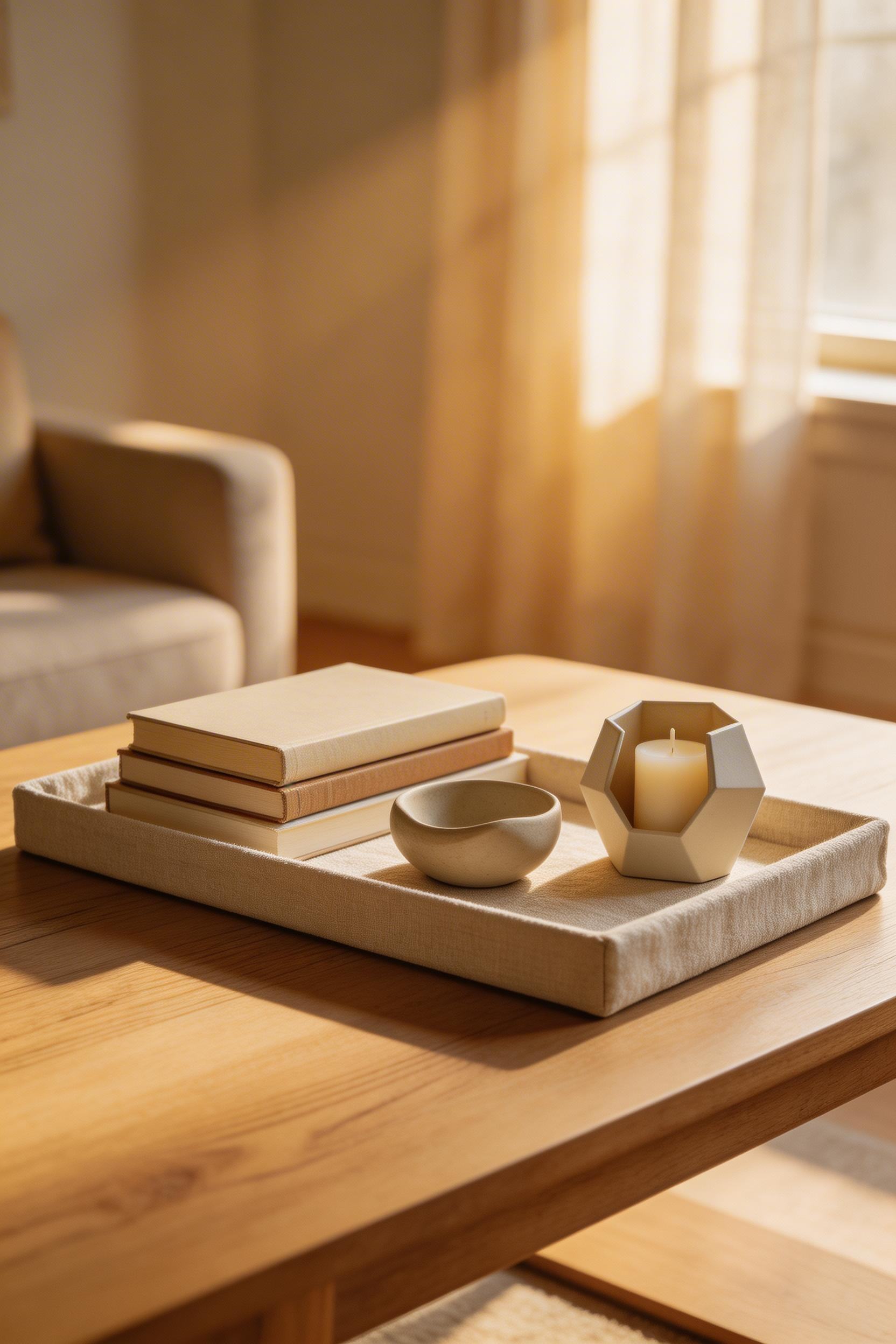
Scale matters most. Small objects on a large table look lost. One well-chosen 25–30cm vase or a stack of four books makes more impact than twelve tiny scattered objects. A tray covering roughly one-third of the table surface creates a visual boundary that makes the arrangement look deliberate. Coffee table books serve double duty: they are interesting objects and a subtle form of self-expression. Stack two or three with a consistent colour family in the covers for a considered result. Our guide on cozy living room design covers similar principles for maintaining warmth and order across the whole room.
Edit the coffee table every few weeks. What looks intentional when first styled gradually accumulates — remote controls, magazines, cups. A two-minute weekly reset keeps the room feeling considered. Pinterest’s 2024 trend report found intentional coffee table styling had a 45% year-on-year increase in saves. Simple living room ideas are increasingly understood as habits of maintenance, not just one-off decorating choices.
14. Strategic Empty Space as a Design Tool
The Japanese concept of ma (間) describes negative space as a design element in its own right — not the absence of things, but a quality of presence created by what is not there. Western interiors tend to fill space out of discomfort. Trained designers protect it, because empty space is what allows every other element to be seen clearly.
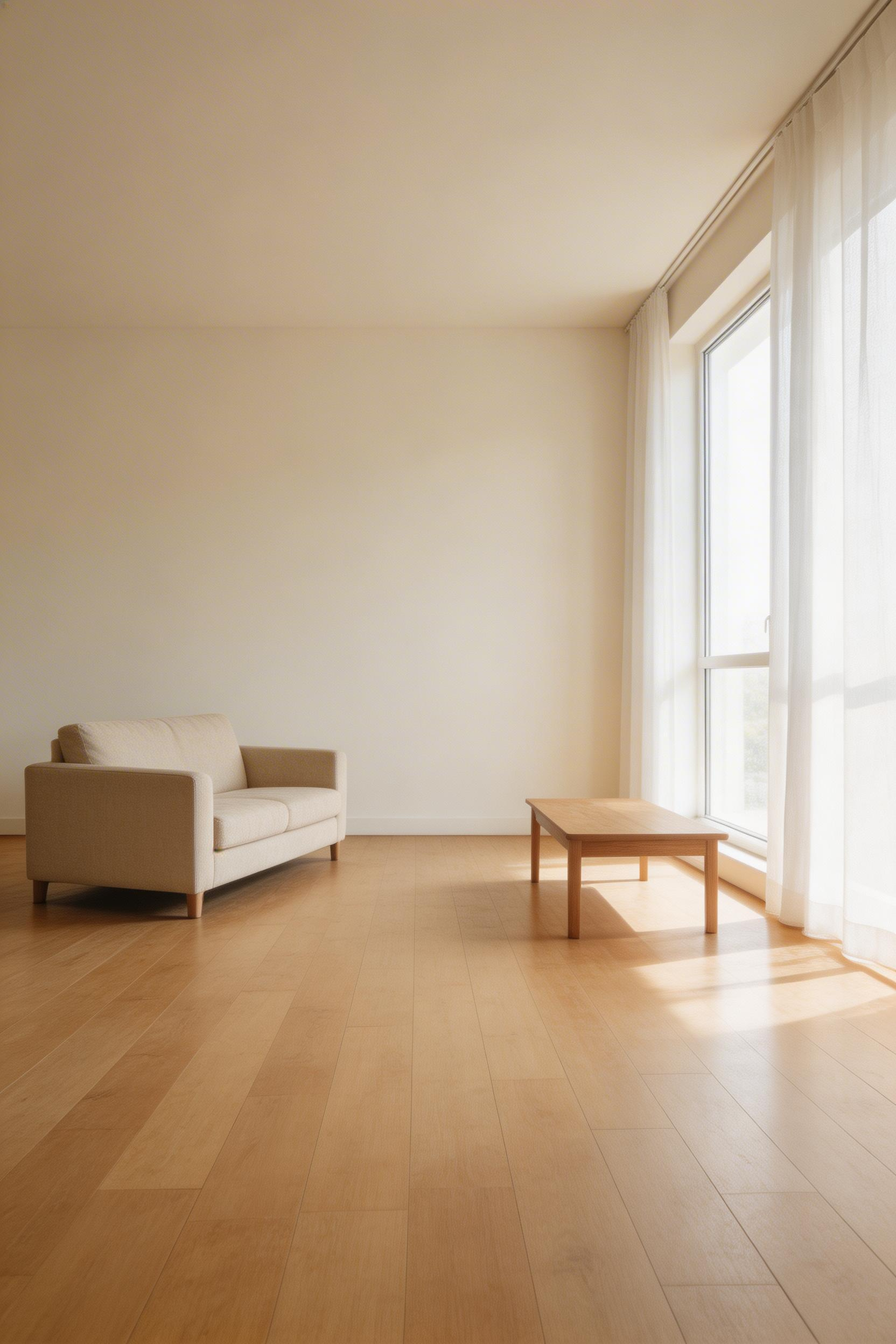
In practice: a clear floor path (minimum 36 inches for comfortable circulation), deliberate spacing between pieces (18–24 inches between sofa and coffee table), and at least one wall left entirely bare. The wall beside or behind a television is one of the most commonly over-decorated surfaces in a living room. A TV on a plain wall is not an oversight — it is a choice. Furniture pushed against every wall can paradoxically make a room feel smaller by framing the perimeter. Floating the sofa 18–24 inches from the wall makes the room feel deeper, because the eye reads that gap as part of the room’s volume.
A Low-Cost Improvement
Painting skirting boards the same colour as the walls — rather than the traditional contrasting white — reduces visual breaks and increases perceived spaciousness. A 2.5L tin costs £20–40. The effect is modest but consistent with the principle of removing unnecessary visual interruptions. Cornell University environmental psychology research found that rooms perceived as uncluttered were rated 15–25% more spacious than physically larger rooms that were more heavily furnished. The best simple living room ideas often cost nothing at all — they involve removing rather than adding. Our living room decor for apartments guide shows how this principle applies in smaller floor plans where every decision carries more weight.
15. A Consistent Hardware and Metal Finish Throughout
In simple living room design, metal appears in more places than most people notice: lamp bases, curtain rods, picture frame edges, cabinet handles, candle holders, decorative objects. When those metals match, the room reads as unified. When they do not, the eye registers low-level noise it cannot quite identify — a sense the room is not quite right despite every individual piece being fine.
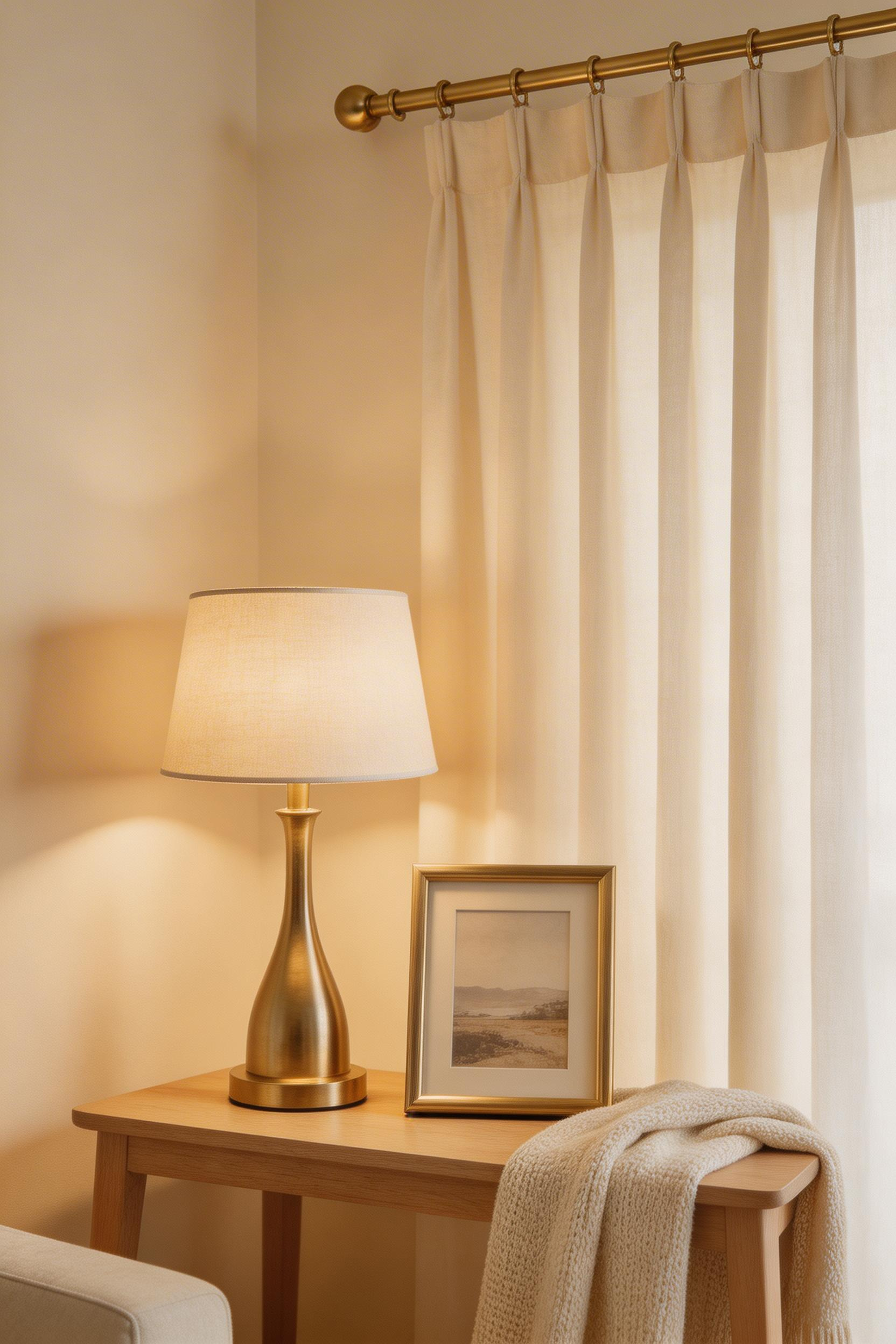
The four dominant finishes in contemporary simple rooms: matte black, brushed brass, brushed nickel, and warm bronze. Matte black is the most versatile — it reads as a neutral and does not date as quickly as brass. Brushed brass has been dominant since around 2018 and remains popular in warm-toned schemes. Two finishes can work if combined intentionally — brushed brass with matte black is a reliable pairing. Three or more almost always reads as oversight rather than design choice.
The Photo Test
Walk around the room and photograph every metal surface on your phone. Reviewing them together reveals mixing that your eye normalises in context. If it looks chaotic in photos, it reads as noise in person — you have simply stopped noticing it. Warm-toned metals (brass, bronze) suit warm white and earth-tone palettes. Cool-toned metals (chrome, brushed nickel) suit cool grey palettes better. The Dunelm brushed brass curtain pole (150cm, £25) is budget-friendly and the correct warm tone for linen curtains. Cox & Cox makes a good thin-profile brushed brass picture frame (£35). Houzz’s 2024 Trends Report found 78% of designers recommend one dominant metal finish per room. This principle applies to simple living room ideas more than almost any other context. In a neutral scheme, metallic inconsistency has nowhere to hide.
The Simplest Living Room Is the Most Considered One
Every idea in this list involves making fewer but better choices: one sofa instead of a suite, one statement plant instead of many, one metal finish instead of several, one focal wall instead of every wall decorated. That consistency is the point. Simple living room ideas work because they ask you to commit — to a palette, a scale, a material logic — rather than keeping all options open.
The rooms that feel most restful are never accidental. They are the ones where the occupant decided what the space was for and what it did not need. If there is one starting point worth returning to from this list, it is item 14: before buying anything new, remove something first. Most simple living rooms are one subtraction away from feeling exactly right. And simple does not mean sparse — it means every object has earned its place.
For a smaller floor plan, these principles apply in constrained spaces just as well as in larger rooms — often more so, because every decision carries more weight. For a warmer, more textured approach that still holds to a simple framework, the principles in our small rustic living room guide adapt the same logic beautifully to natural materials.