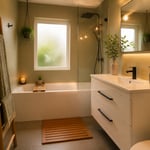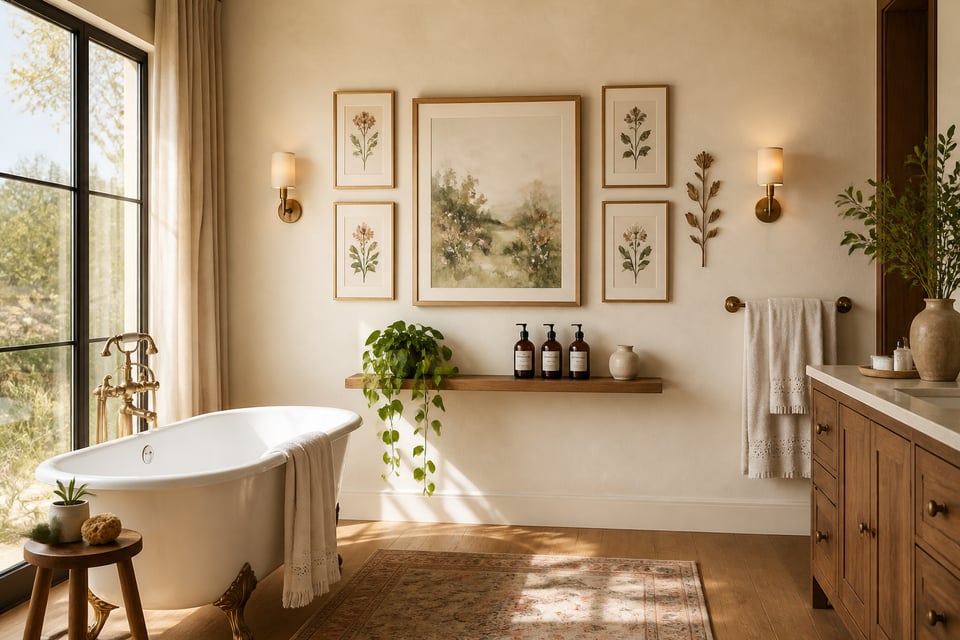
The bathroom is the last room most people think to hang art in, and the first room they stare at every single morning. I’ve lived with bare bathroom walls before — that flat expanse of nothing above the toilet, the sad white wall beside the mirror — and I’ve learned what every interior designer knows but rarely says out loud: the bathroom is actually one of the best rooms in the house for art. You’re a captive audience. You stand still, you look up, and you have three to eight uninterrupted minutes of contemplation. That’s more time than most people spend looking at the work on their living room walls.
The challenge isn’t motivation. It’s the practical bit — steam, humidity, the fear of damaging something you love. I’ve spent years figuring out how bathroom wall art actually survives (and sometimes thrives) in humid spaces, and the answer turns out to be less complicated than most people expect. The right framing material, one small change to the backing, and suddenly the bathroom is the room with the most considered art in the house.
These 16 bathroom wall art ideas cover every budget and every style, from a $3 thrift-store reframe to a sculptural powder-coated steel installation. If you want more context before diving in, there’s a lot of strong territory already covered in bathroom art ideas that push toward gallery-worthy. What follows is my own take on where to start.
1. Gallery Wall With Framed Botanical Prints
Nothing transforms a utilitarian bathroom into a considered space faster than a group of framed prints working together — and yet framed prints are only one form that bathroom wall art takes. The botanical genre is particularly well suited to bathrooms — it echoes the natural materials (stone, wood, plant life) that make these spaces feel less clinical, and it ages well. A botanical print you chose a decade ago looks intentional rather than dated because the subject matter doesn’t have a style era.
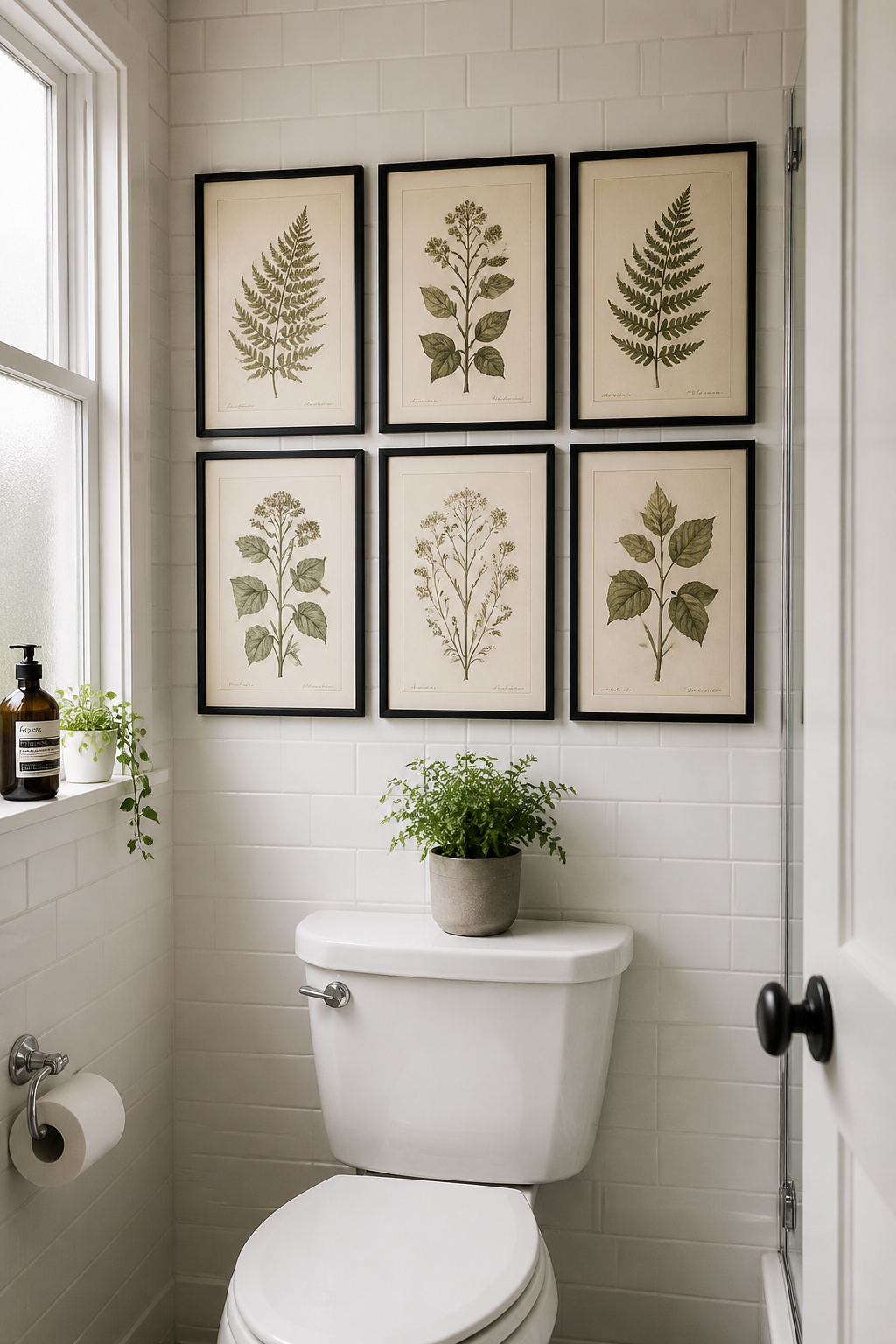
For small bathrooms under about 50 square feet, a tight grid works better than a free-form gallery. Three 5×7 frames in matching finishes, hung in a row or an L-shape above the toilet, reads as intentional. Free-form gallery walls — the kind built around a larger anchor piece with varied sizes orbiting it — need at least 24 inches of continuous wall to avoid looking cluttered.
The single most important practical decision is the frame material. Metal frames (powder-coated aluminum, pressed steel) and high-quality plastic frames handle bathroom humidity far better than wood. Sealed or painted wood is acceptable; raw or stained wood will warp within 12-18 months. Swap standard glass glazing for acrylic — it’s lighter, won’t shatter if knocked from a humid wall, and resists the fogging that happens when temperatures shift during showers.
Why Frame Material Determines How Long Your Bathroom Wall Art Lasts
One detail most people skip: rubber bumper pads at each corner of the frame’s back. Mount them before hanging. They create a 3-5mm airflow gap between the frame and the wall, and that gap is what prevents mold from growing behind the artwork. It’s the difference between a print that lasts and one that needs replacing in two years.
Free botanical print sources include the Metropolitan Museum’s Open Access portal (492,000+ images, all public domain) and the Biodiversity Heritage Library — both excellent, both free.
2. Oversized Statement Prints as Bathroom Wall Decor
Counter-intuitive design principle: in small bathrooms, a single large print makes the room feel bigger. Multiple small prints fragment the eye and create visual noise. One oversized piece — minimum 16×20 for a standard bathroom, 20×24 or larger for a master bath — anchors the space and pulls the gaze upward.
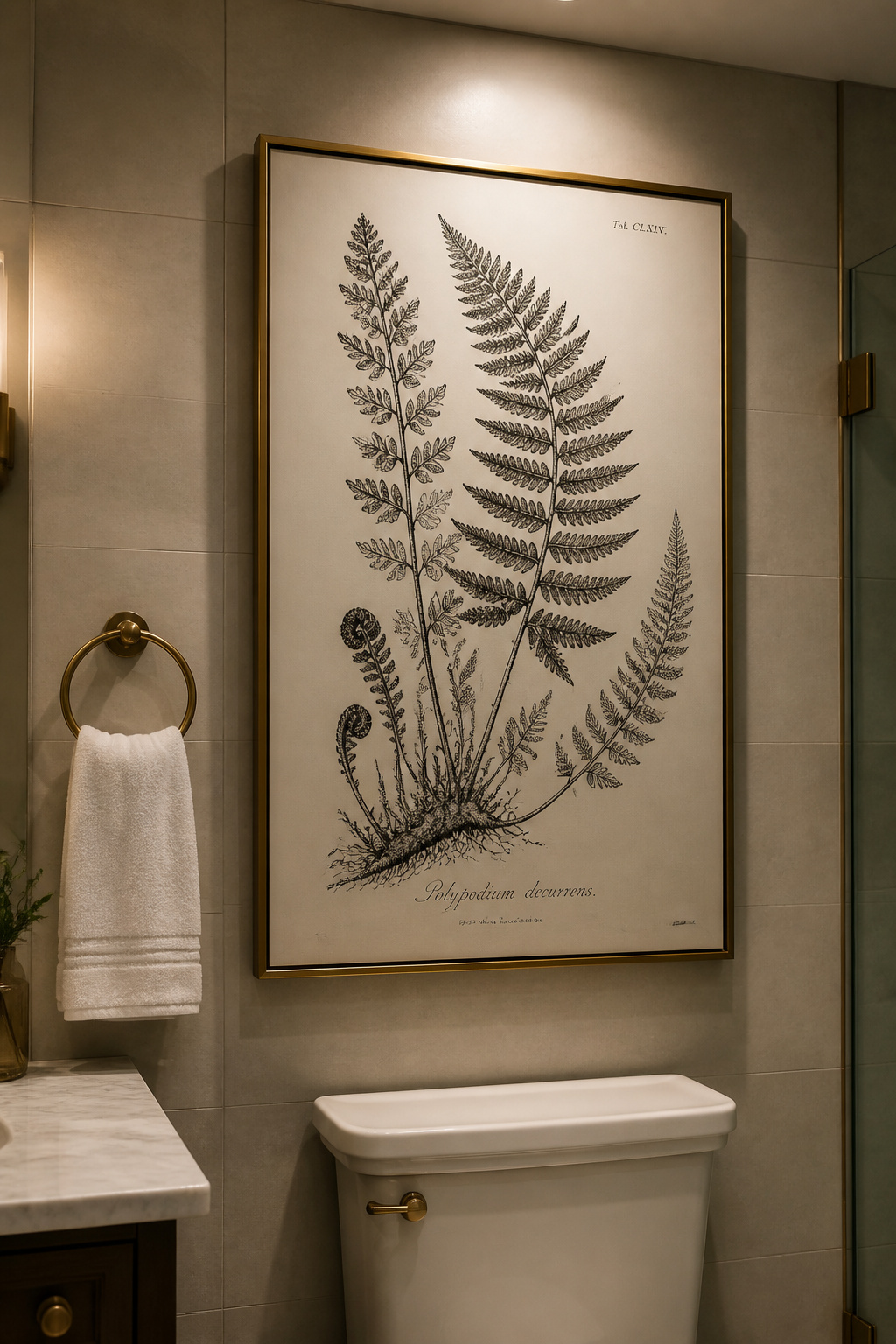
Above the toilet is the most common blank wall in any bathroom, and the sweet spot for that space is a print that’s 18-24 inches wide and 24-36 inches tall. Tall enough to feel significant, not so large it crowds the cistern. The center of the print should sit at about 57-60 inches from the floor, which is standard eye level for a standing adult.
Subject matter matters more in bathrooms than in other rooms. Abstraction, nature, and architectural photography all work well because they invite quiet contemplation. Figurative portraiture is a different experience — being watched by a figure while you brush your teeth is the kind of thing that sounds quirky until you’ve lived with it for a week.
For the framing, matte finish is always the right call on large prints in bathrooms. Steam creates glare on glossy surfaces that can make the print nearly invisible from most viewing angles. Canvas prints (gallery-wrapped) bypass the framing question entirely for large pieces — just confirm before ordering that the service applies a moisture-resistant coating; most do.
If you’re navigating a small room, it’s worth looking at small bathroom interior design ideas alongside this — scale choices interact with the layout in ways that make a big difference.
3. Black and White Photography in Minimalist Frames
Black and white photography is bathroom wall art that solves a problem unique to the room: color competition. A typical bathroom contains white subway tile, gray grout, brass or chrome fixtures, colored towels, and whatever products have accumulated on the vanity. A black and white photograph sits above all of that. It doesn’t compete with anything. It just occupies its space cleanly.
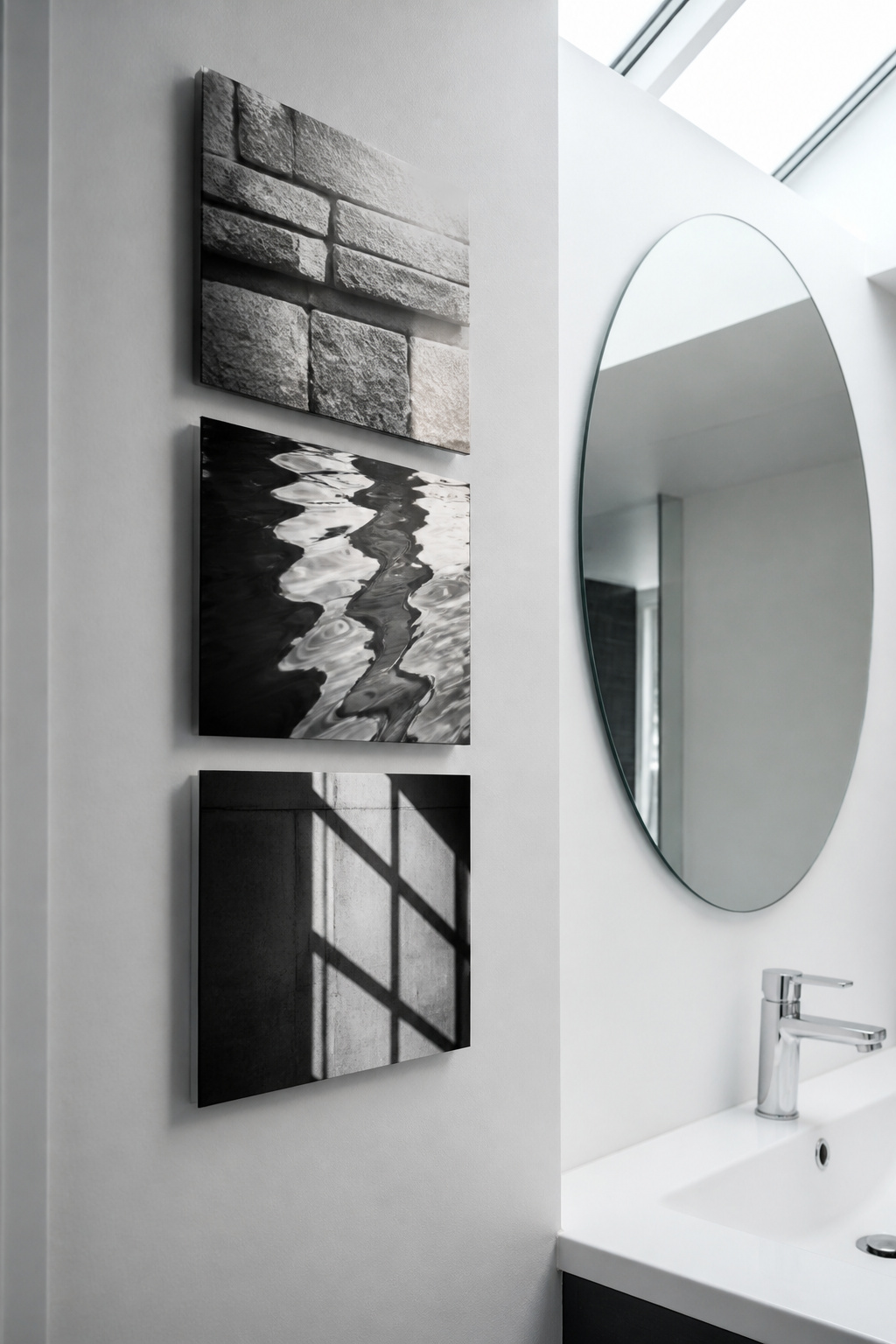
High-contrast black and white work best here — bold architectural detail, close-up botanical texture, graphic landscape — because it reads from six feet away without requiring close inspection. Softer, low-contrast black and white photography is beautiful in a gallery setting but gets lost in a bathroom, where you’re never standing right in front of it.
The printing substrate is worth getting right. Metal prints, made by infusing chromogenic dye into aluminum, are the most humidity-resistant option available. The image is bonded to the metal surface rather than applied on top, which means steam cannot separate or warp it; ChromaLuxe-process metal prints carry a 65-year archival rating. Acrylic face-mount prints are technically rated even longer (100+ years with TruLife acrylic) and add a slight luminous depth to black and white work that’s beautiful. Both are more expensive than paper prints, but they’re the right choice if the piece matters.
For sourcing: Unsplash and Pexels have thousands of high-resolution black and white photographs at no cost. Look for images with a minimum 4000 pixels on the short side before printing at 16×20 or larger. Print-on-demand metal prints from Vivid Metal Prints or Nations Photo Lab run $40-90 for a 16×20 — a one-time cost for something that will outlast most of the fixtures in the room.
4. Woven Macramé and Fiber Art for Textured Walls
Every other item on this list is flat. Macramé is not. It projects from the wall by several inches, catches light differently at different angles, and casts shadows that shift through the day — morning light from a side window produces something completely different from the overhead light you use at night. That dynamism is something framed art simply cannot do.
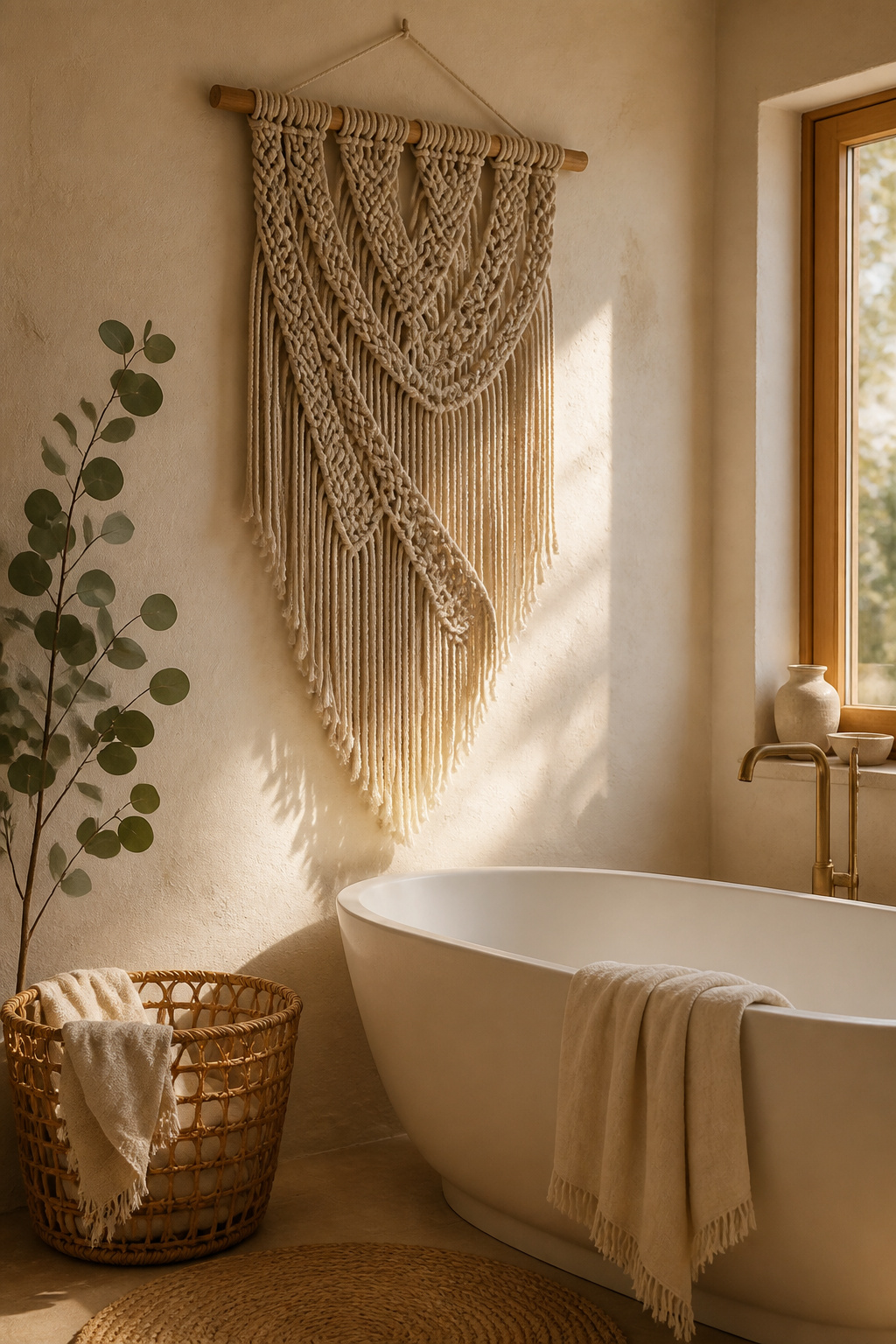
Fiber art also brings warmth into spaces dominated by hard, cold surfaces. Tile, porcelain, chrome, and glass are the materials most bathrooms are built from. A woven piece provides textural contrast that makes the whole space feel more habitable — more like a room someone lives in, less like a room someone installed.
The fiber choice is not optional in a bathroom. Cotton and jute — the two most common macramé materials — absorb moisture readily and will develop mildew within months in a humid environment. Polyester cord is mold and mildew-resistant and explicitly recommended for high-humidity spaces. Linen is the best natural fiber alternative: naturally antimicrobial, dimensionally stable across humidity shifts, and low-luster enough to look refined rather than crafty.
Whatever material you choose, placement matters as much as fiber. Mount the piece at least 36 inches from the primary moisture source. Never directly above the shower or bath, where steam accumulates in the ceiling zone. A wall beside the mirror, or the wall above the towel bar, is the right location.
Contemporary macramé artists on Etsy sell pieces that bear no resemblance to 1970s plant hangers — look for work by Bochiknot or similar fiber artists for asymmetric, architecturally considered pieces in the $40-150 range. For DIY, 3mm polyester single-strand cord and a wooden dowel is a $15 materials investment for a 12-inch piece.
5. Ceramic Wall Tiles as Sculptural Bathroom Wall Art
Ceramic is the one art medium that was made for bathrooms. It’s literally designed for wet environments. A decorative ceramic tile mounted as an art object — rather than installed as a functional surface — brings three-dimensional texture and handcrafted quality that no print can replicate.
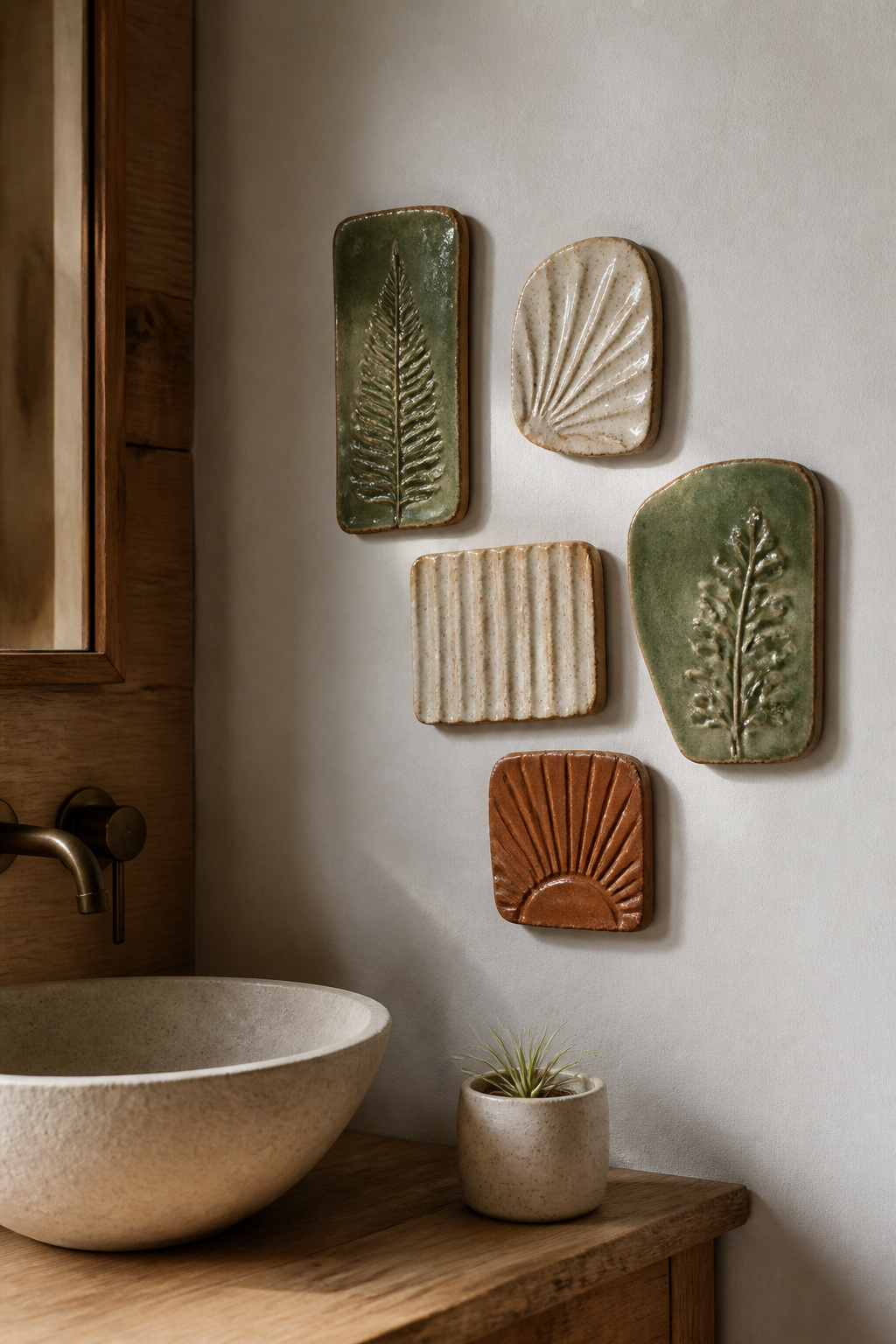
Artisan-made decorative tiles differ from standard bathroom tiles in that they’re designed to be displayed. They often have sculptural relief, hand-painted surfaces, or distinctive reactive glazes that make each piece unique. A single 6-inch handmade ceramic tile mounted in a shadowbox frame makes an effective piece for a very small bathroom; three to five tiles grouped asymmetrically on a wall create something that reads as an installation.
For installation without permanent damage, 3M Command strips rated for the tile’s weight are the cleanest solution. A standard handmade 6-inch tile weighs 300-400 grams — about 12-14 ounces — so two heavy-duty Command strips (rated to 7.5 lbs each) comfortably hold a grouping of three to four tiles. For pieces over two pounds, check the wall structure behind the mounting point; tile-on-tile installation requires a diamond drill bit rather than adhesive.
The Etsy market for handmade ceramic wall art is strong: independent potters sell decorative tiles and ceramic wall sculptures from $20 for smaller pieces to $80-150 for larger handmade tiles. Anthropologie and West Elm both stock ceramic wall art in the $50-120 range. If you’re already thinking about tile in the context of a bathroom refresh, the work over at modern bathroom tiles is worth reading alongside this — the two subjects overlap more than you’d expect.
6. Vintage Maps and Antique Prints in Classic Frames
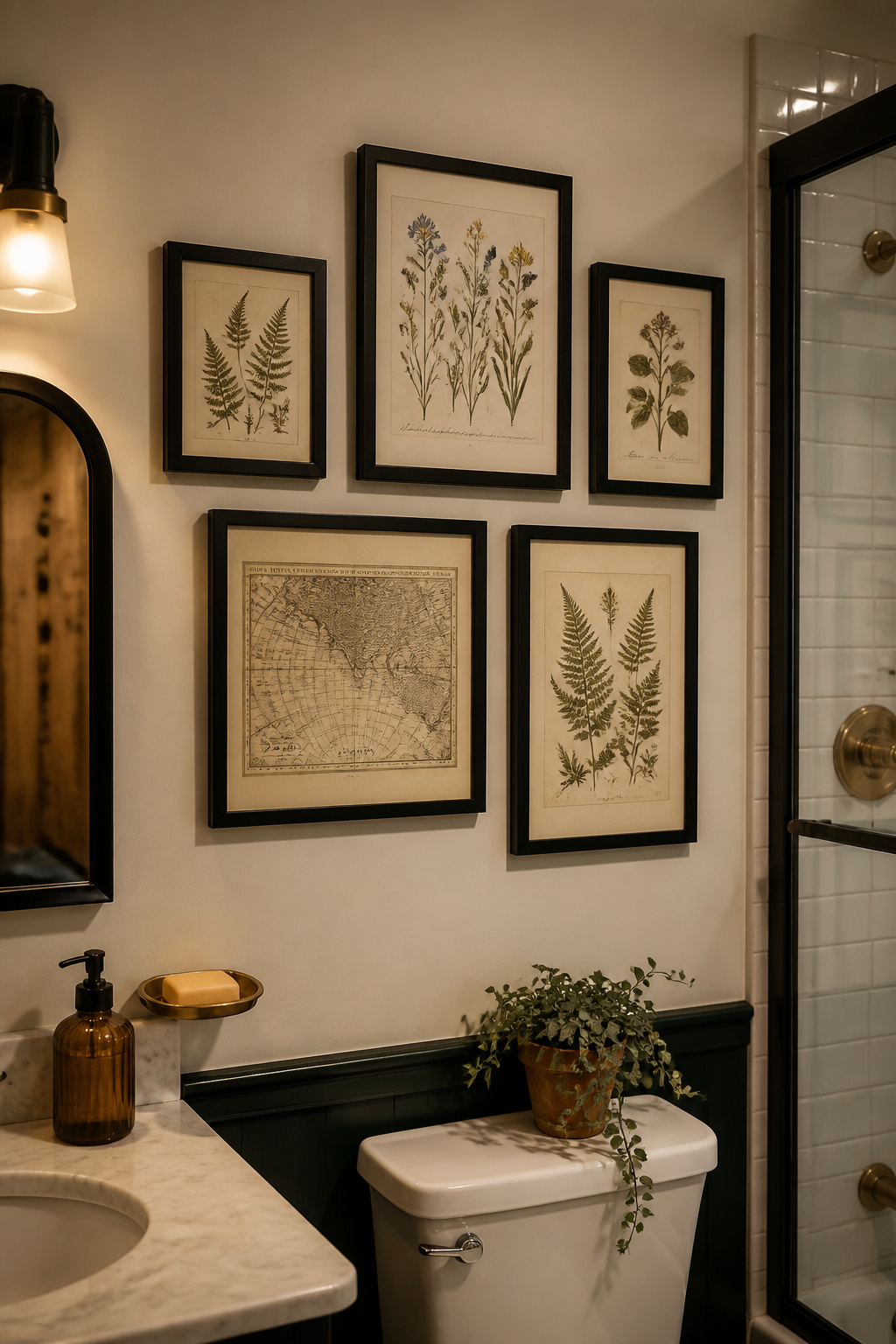
There’s a quality to antique paper art that contemporary prints don’t have: it carries implicit narrative. A 19th-century botanical plate suggests a history of scientific inquiry; an antique map of a place meaningful to you creates personalization that no mass-market print can. In the bathroom — a room where you stand still and look — that narrative quality gives you something to think about.
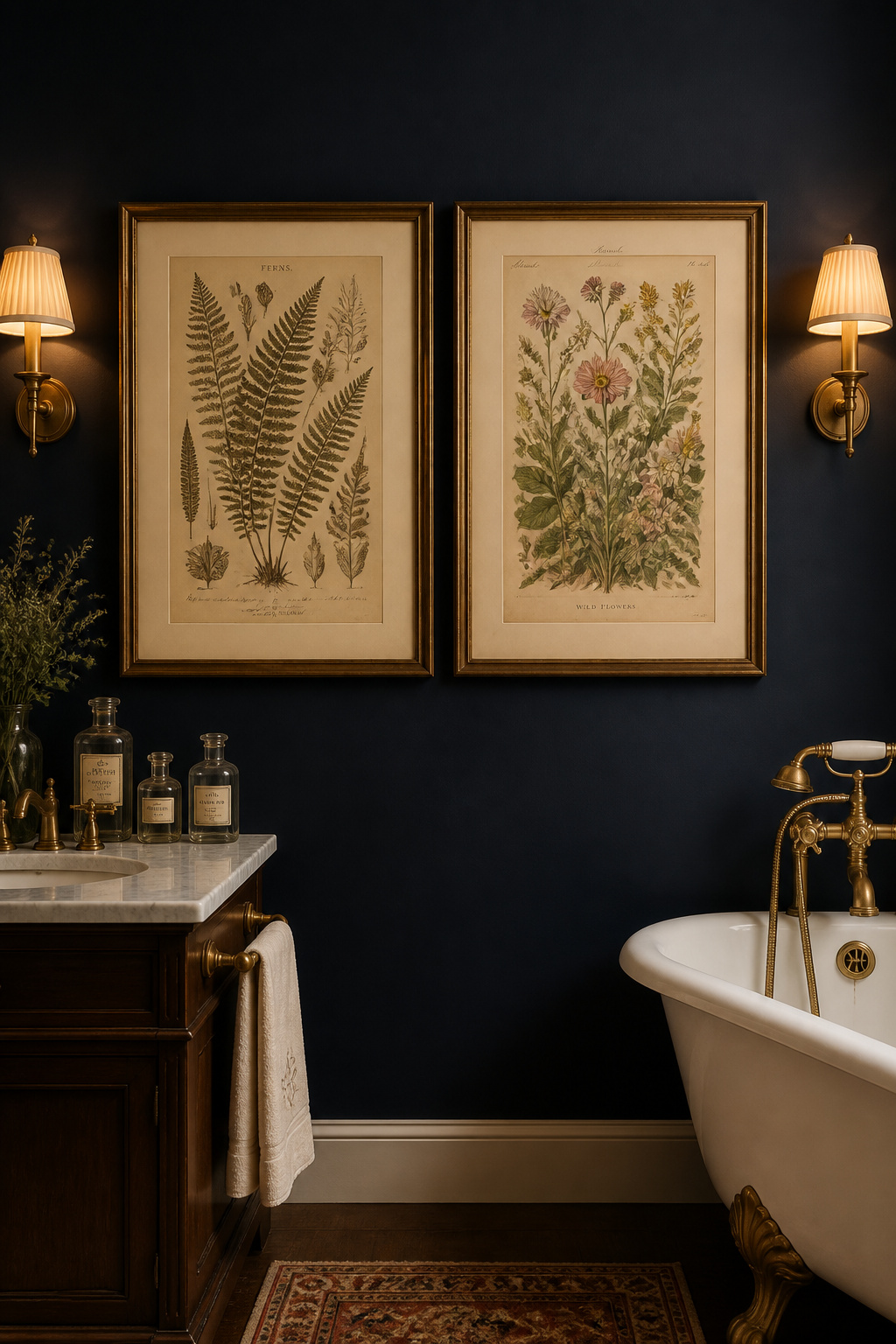
Genuine antique maps and botanical illustrations are more accessible than most people assume. Estate sales, local antique shops, and eBay regularly surface 8×10 and smaller antique prints for $10-30; genuine 16×20 botanical plates from auction houses run $100-400 depending on rarity. If authenticity isn’t the priority, reproduction antique maps from National Geographic or Old World Maps deliver the visual experience at a fraction of the cost.
The Biodiversity Heritage Library offers millions of scanned antique botanical and natural history illustrations as free high-resolution downloads — all public domain, all printable at home or through a print service. For a bathroom with no budget for art, this is the single best free resource available.
The framing is where this approach lives or dies. Paper art in a bathroom requires: UV-filtering glazing (acrylic preferred for weight), acid-free mat board, archival foam-board backing (not standard fiberboard, which absorbs moisture and transfers it to the print), professional spacers between the mat and glazing, and a sealed frame back. Skip any one of these and humidity will eventually reach the paper. Get them all right and the piece can last 50 years in a humid room.
For anyone drawn to the aesthetic category broadly, vintage bathroom inspiration covers the design vocabulary that vintage prints work best within.
7. Watercolor Paintings With Moisture-Proof Framing
Watercolor is the bathroom wall art medium where framing technique matters most — the paper substrate needs proper archival protection, but the payoff is worth it. The translucent washes have an inherent softness that suits a bathroom in a way that most other media don’t. The gentle value shifts and luminous layering echo the way light moves in a steamy, humid room — they feel compatible with the space rather than incongruous. It’s also a medium where the gap between original work and a high-quality print is small; a giclée print of a watercolor painting on fine art paper is nearly indistinguishable from the original at normal bathroom viewing distance.
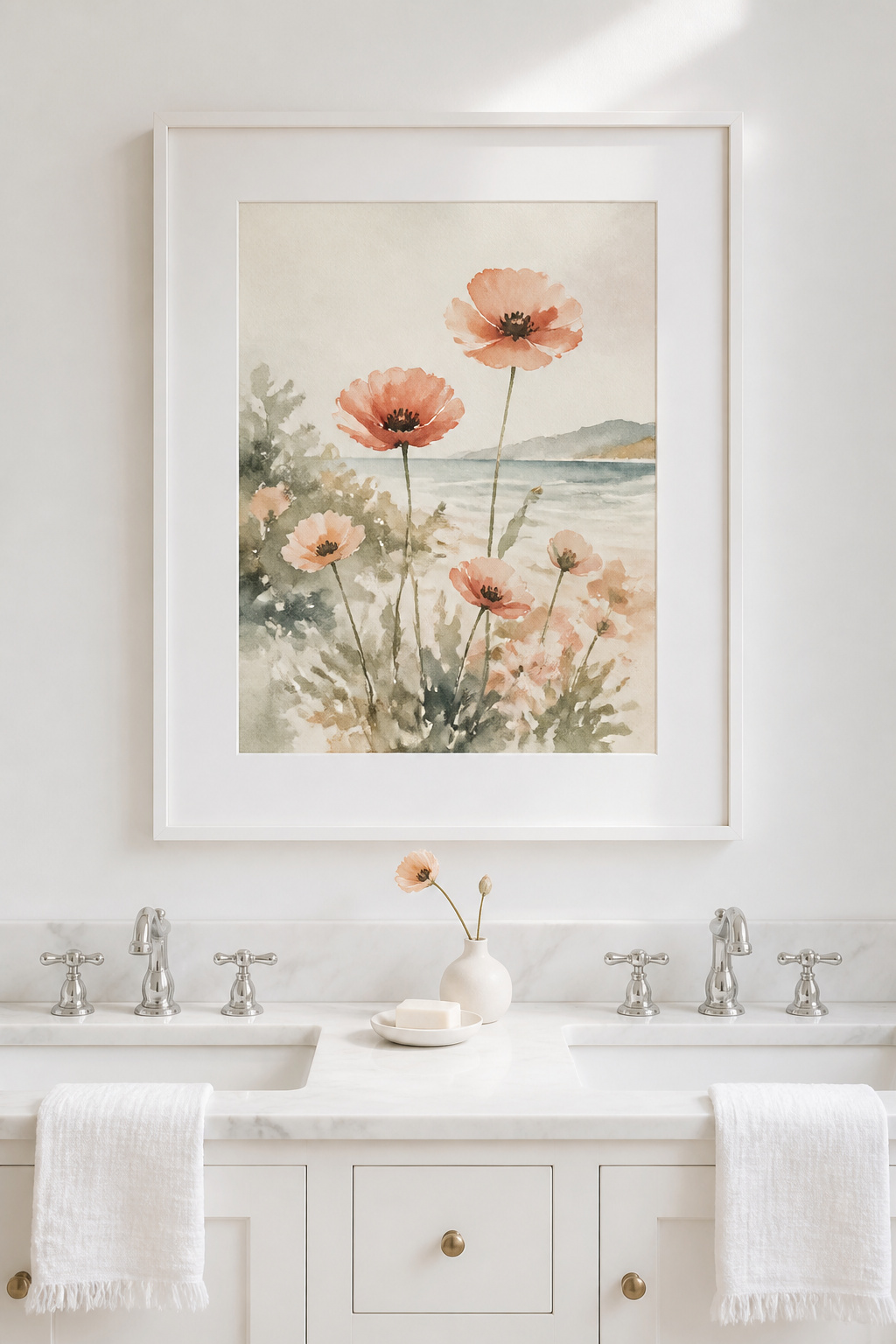
Floral and botanical watercolors are the most popular category, and for good reason, but coastal watercolors (muted water and horizon abstractions), abstract wash paintings, and loose landscape work all suit bathroom contexts well. Society6, Saatchi Art, and Etsy all have strong watercolor selections; giclée prints from artists run $15-40 for small sizes, and many artists offer digital downloads for even less.
Framing Watercolors for the Long Term
The framing requirements for watercolor are more demanding than for any other medium. The paper substrate is the most humidity-vulnerable material you’ll hang in a bathroom, which means every archival framing step matters: UV-filtering acrylic glazing (block 99% of UV radiation), acid-free mat board, archival foam-board backing, professional spacers between the mat and the glazing. That last element — the spacers — prevents the paper from touching the glazing. When paper touches glazing in a humid room, condensation transfers directly to the print. This is how expensive watercolors get ruined.
After framing, run gummed conservation tape around the entire perimeter of the frame back, sealing the gap between the rabbet and the backing board. It takes five minutes and prevents humidity from entering from the rear. Professional framers do this automatically; DIY framers almost never think to.
8. Floating Shelves That Double as Wall Art for Bathrooms
A well-curated shelf is a genuine art installation. The objects, their arrangement, the space between them — these constitute a visual composition in the same way a painting does, and they have the advantage of being changeable without touching the wall. An artist’s approach to shelf styling is fundamentally the same as an artist’s approach to composition: relationship between objects, contrast of scale and texture, intentional use of negative space.
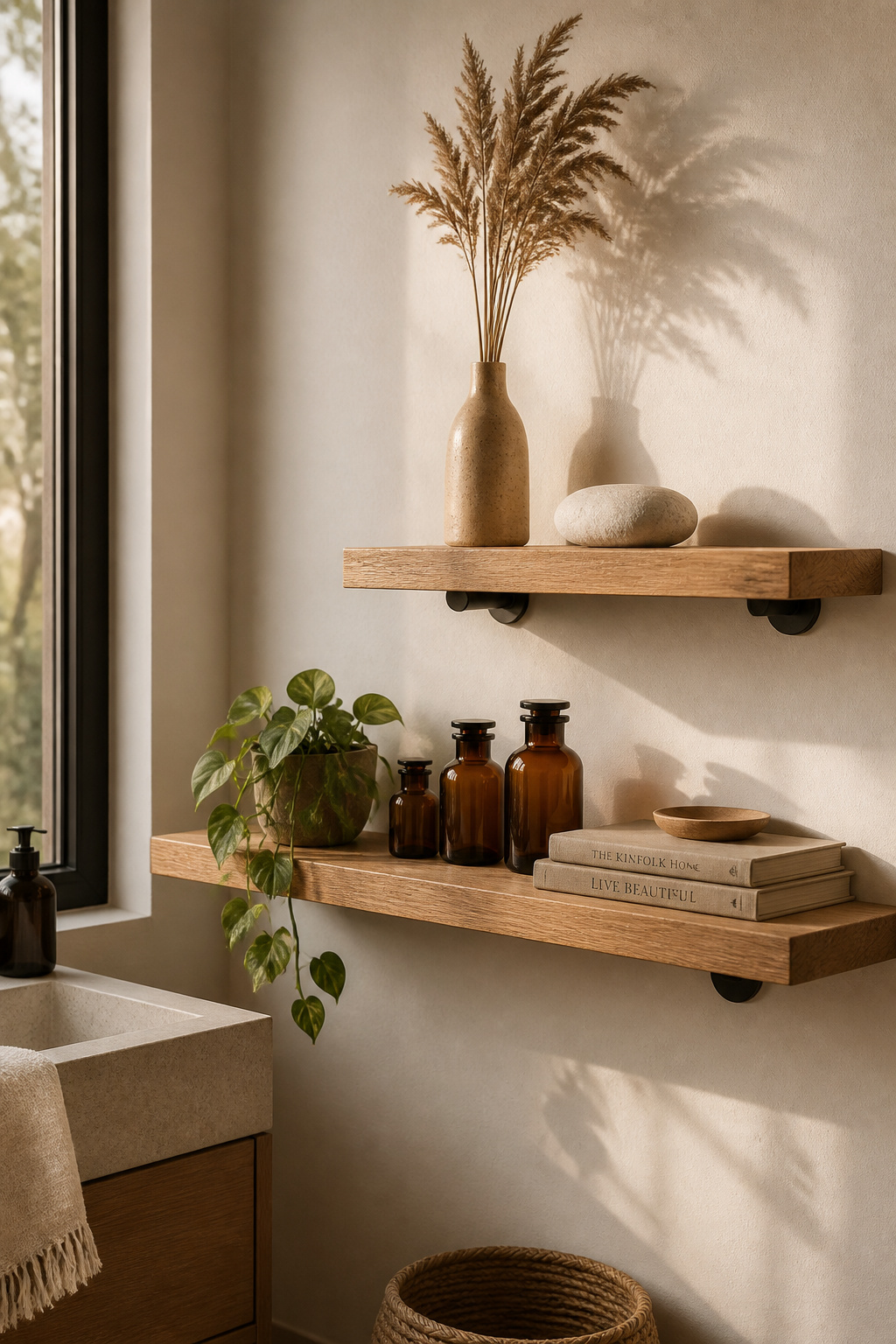
The rule most professional stylists return to: three object types per shelf, varied heights (tall, medium, low), one repeated material creating visual coherence. A practical bathroom shelf composition — taller dried stem arrangement, medium ceramic vessel, low smooth stone — reads as deliberately designed from across the room because the height variation creates rhythm. An overfilled shelf looks like storage; a shelf with breathing room between three intentional objects looks boutique.
For shelf material, solid hardwood with a polyurethane or oil finish handles bathroom humidity well. MDF shelves warp within 12-18 months in humid environments. Acrylic and powder-coated steel shelves are the most humidity-resistant options but carry a more contemporary look. The shelf’s weight capacity is determined by the wall fixing, not the shelf material — a properly anchored shelf into a stud holds 15-20 pounds easily.
The most practical plants for bathroom shelves: pothos (low light, high humidity, nearly unkillable), air plants (tillandsia, no soil required, absorb moisture from air), spider plants, small ferns. Succulents are the wrong call on a bathroom shelf — they need low-humidity air to thrive and will rot on a steamy shelf.
The broader category of bathroom shelf decor ideas covers the compositional principles in more depth if the styling side of this resonates.
9. Abstract Canvas Panels in Bold Color Blocks
Most bathrooms default to neutral palettes — white, gray, or beige tile — because it’s the safe remodel choice. Bold abstract bathroom wall art is the most cost-effective way to introduce real color into that kind of space without touching a single tile. One piece can reframe the entire room’s feeling.
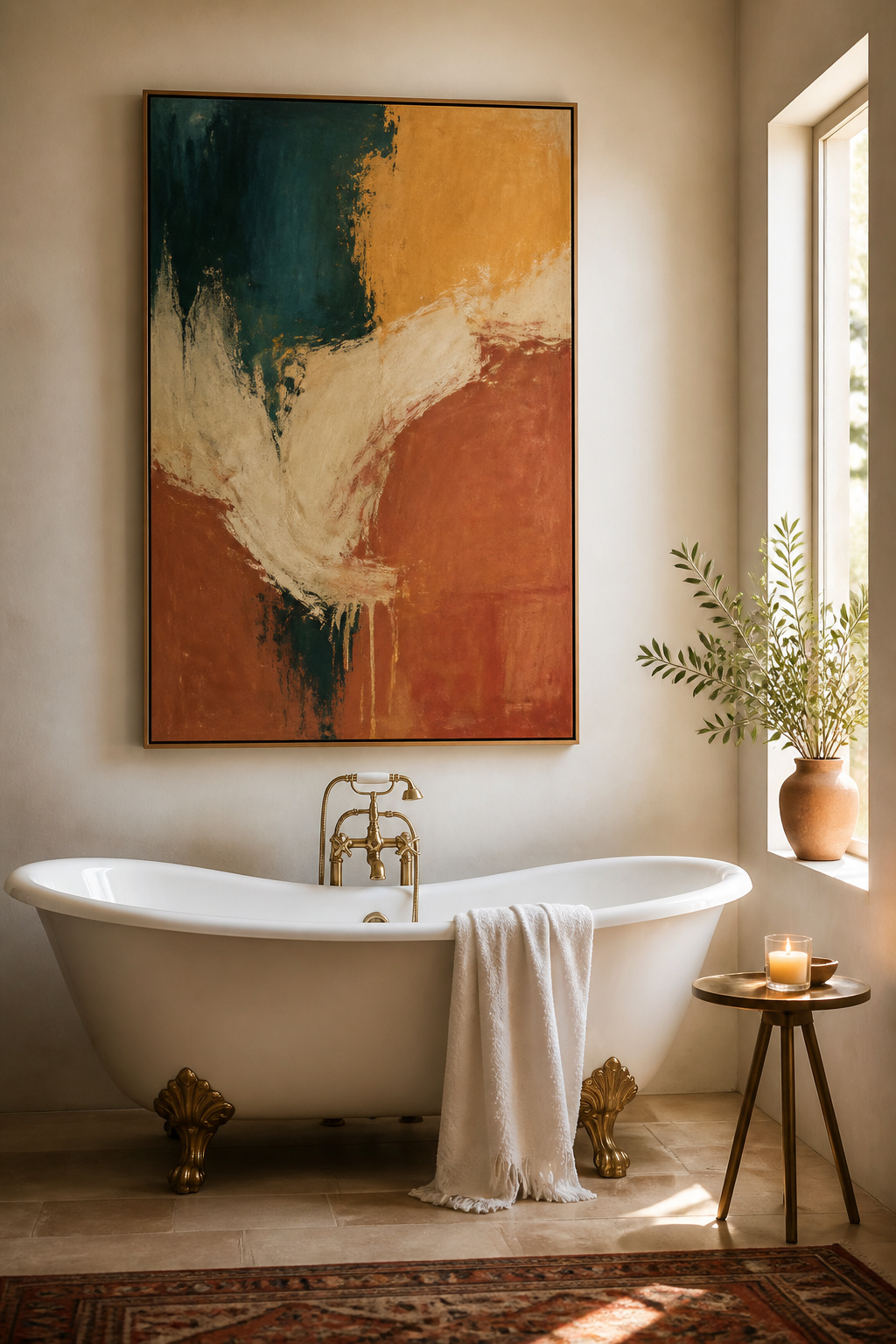
Color-field and geometric abstract work are particularly well suited here. They don’t require interpretation, which matters in a room where you’re often only half-awake. You can engage with them at whatever level you want — a passing appreciation of the color, or a longer look at the composition — and neither requires the mental effort of figurative art.
For color selection, a simple starting point: match the dominant color in the art to the undertone of your tile, shifted 10-15% in value. Warm-toned white tile (cream undertone) pairs with ochre, amber, or warm terracotta abstracts; cool-toned white tile (blue-gray undertone) pairs with blue-green or slate abstracts. If you want contrast rather than harmony, go complementary: a deep teal print in a warm terracotta bathroom creates energizing tension.
Gallery-wrapped canvas is the most common format for abstract art, but for a bathroom specifically, it needs moisture-resistant treatment — ask the print service if the canvas is coated; most are, but verify. An untreated canvas will warp at the stretcher bar joints within two years in a steam-heavy bathroom. Acrylic panels are the most humidity-resistant option and add a luminous depth to color-field work; they’re more expensive but worth it for a piece that matters.
10. Photography Diptychs and Triptychs for Cohesive Walls
Paired or grouped photographs are bathroom wall art that looks planned rather than accumulated. Single photographs can feel random in a bathroom. Two or three related photographs, mounted as a set, feel like a decision. The relationship between the images creates meaning that a single image can’t — a diptych implies a before-and-after, a left-and-right, a call-and-response; a triptych sequences something, makes it feel complete.
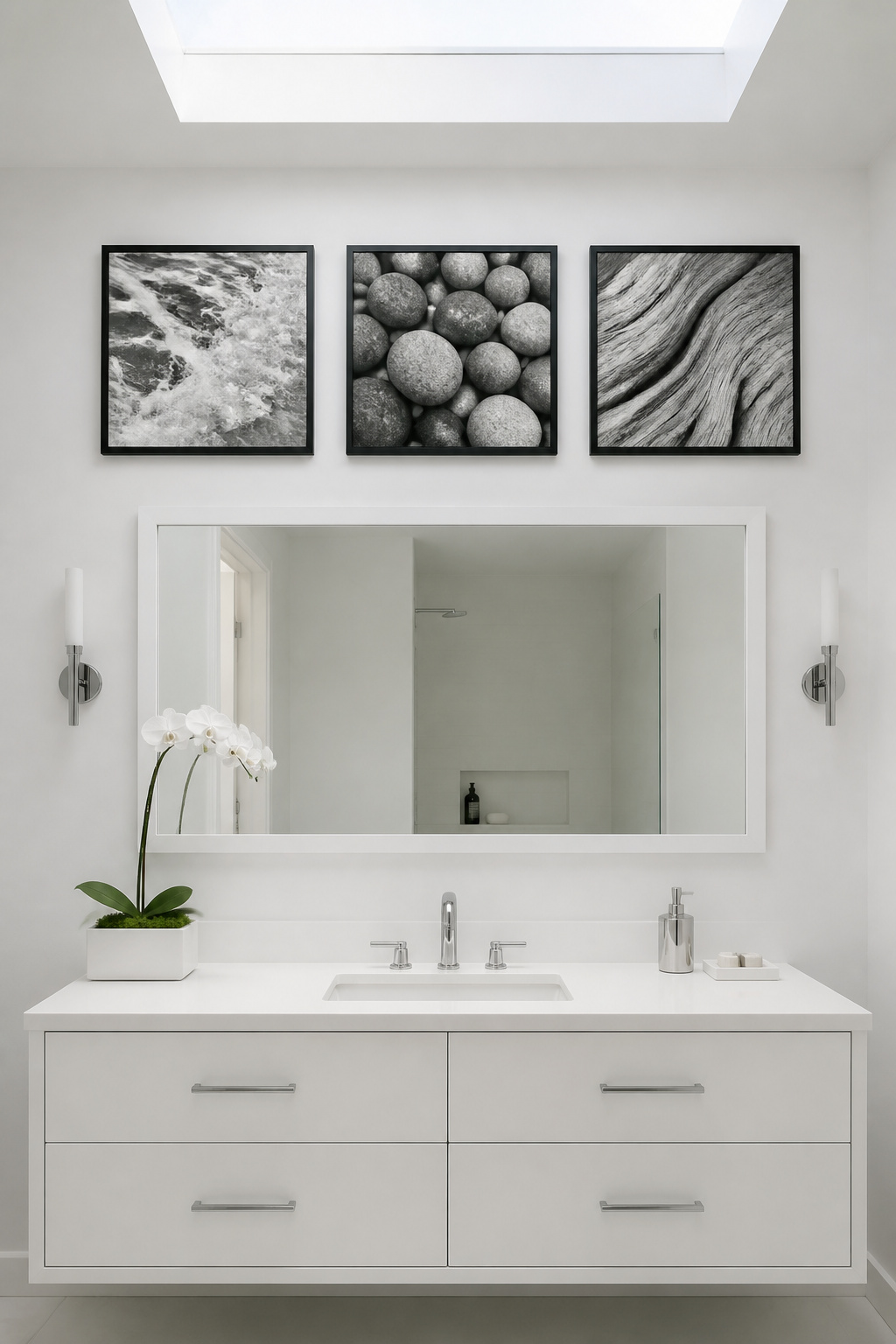
For bathroom walls, the most practical configuration: two square frames (8×8 or 10×10) at the same height with 2-3 inches between them, mounted above the toilet or alongside the mirror. This proportion suits the narrow vertical spaces that most bathrooms offer. For a longer horizontal wall above a double vanity, three equal-sized prints in matching frames creates a considered installation without requiring a single large piece.
The cohesion comes from a consistent thread — same photographer, same subject (a botanical series, a coastal series), same processing style (same tonal treatment), or same color palette. Any one of these is enough; you don’t need all of them. What destroys the cohesion is inconsistency in frame finish or print size. Order from the same supplier in the same order if possible, because nominally ‘same-size’ prints from different sources can vary by a quarter-inch, and that misalignment is visible when the frames are hanging side by side.
Mpix and Nations Photo Lab both produce print series at reliably consistent dimensions — standard for professional photography clients, useful here for exactly this reason. Digital prints on heavyweight matte paper (270gsm and above) hold their dimensions better than standard photo paper in humid environments, another reason to step up from the drugstore print tier.
11. Mixed Media Collage Frames for Layered Bathroom Artwork
Of all the art types on this list, mixed media rewards the sustained looking that a bathroom actually offers better than any other. A piece that combines photography with painted passages and paper collage elements gives you something new to notice on the fifteenth viewing that wasn’t visible on the first. The layers have depth — physical, visual, and in the case of the best mixed media work, conceptual.
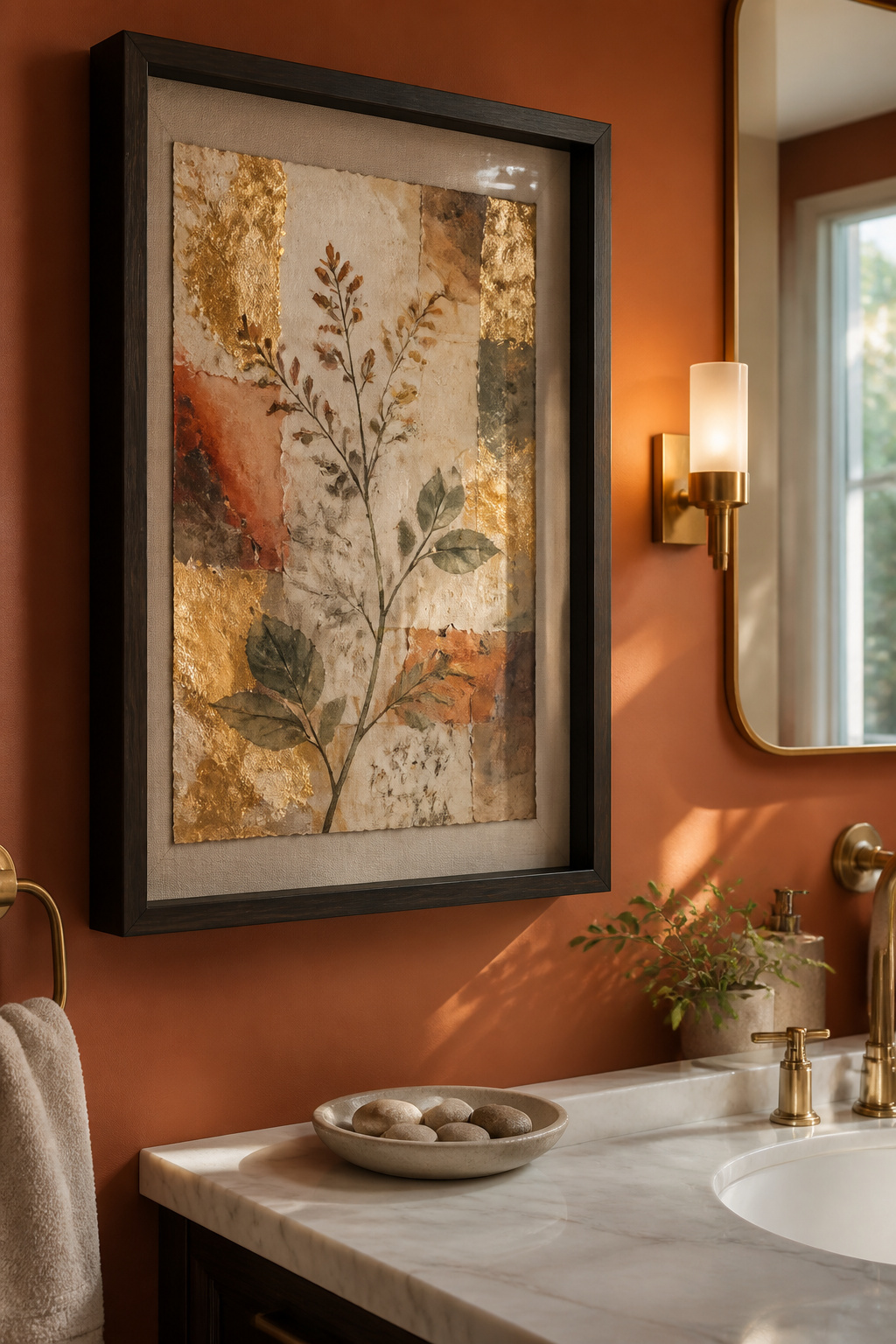
The light behavior of mixed media is also different from flat prints. A textured surface with paint buildup and collage relief catches morning light from a window differently than it catches the flat overhead bathroom light in the evening. The piece is different at different times of day. That dynamic quality is rare in any art context and welcome in a room you use twice daily.
For a bathroom context, look for mixed media work that’s been varnished or resin-sealed — the sealed surface handles ambient humidity without the individual paper, paint, or photographic elements absorbing moisture. Unsealed mixed media with exposed paper collage will deteriorate quickly in steam. Saatchi Art and Etsy both have strong markets in the sealed work; search for ‘encaustic painting,’ ‘resin art,’ or ‘mixed media original’ to find three-dimensional pieces.
The category of elevated bathroom design has a lot of strong reference material worth consulting before committing to a direction.
Deep shadowbox frames (1-2 inch depth) accommodate the relief of mixed media work without compressing it against the glazing — this is critical for pieces with physical texture. For varnished or resin-sealed work, no glazing is necessary at all; the sealed surface is its own protection.
12. 3D Metal Wall Sculptures and Geometric Pieces
Three-dimensional bathroom wall art is in a category by itself. Everything else on this list is two-dimensional. Three-dimensional metal wall art projects physically from the wall and creates shadow patterns that shift as the light source changes through the day. In a bathroom with a side window, the morning and evening shadow geometries are completely different from the midday version. In a bathroom with only overhead lighting, the shadows fall downward and create a strong graphic effect that reads from across even a small room.
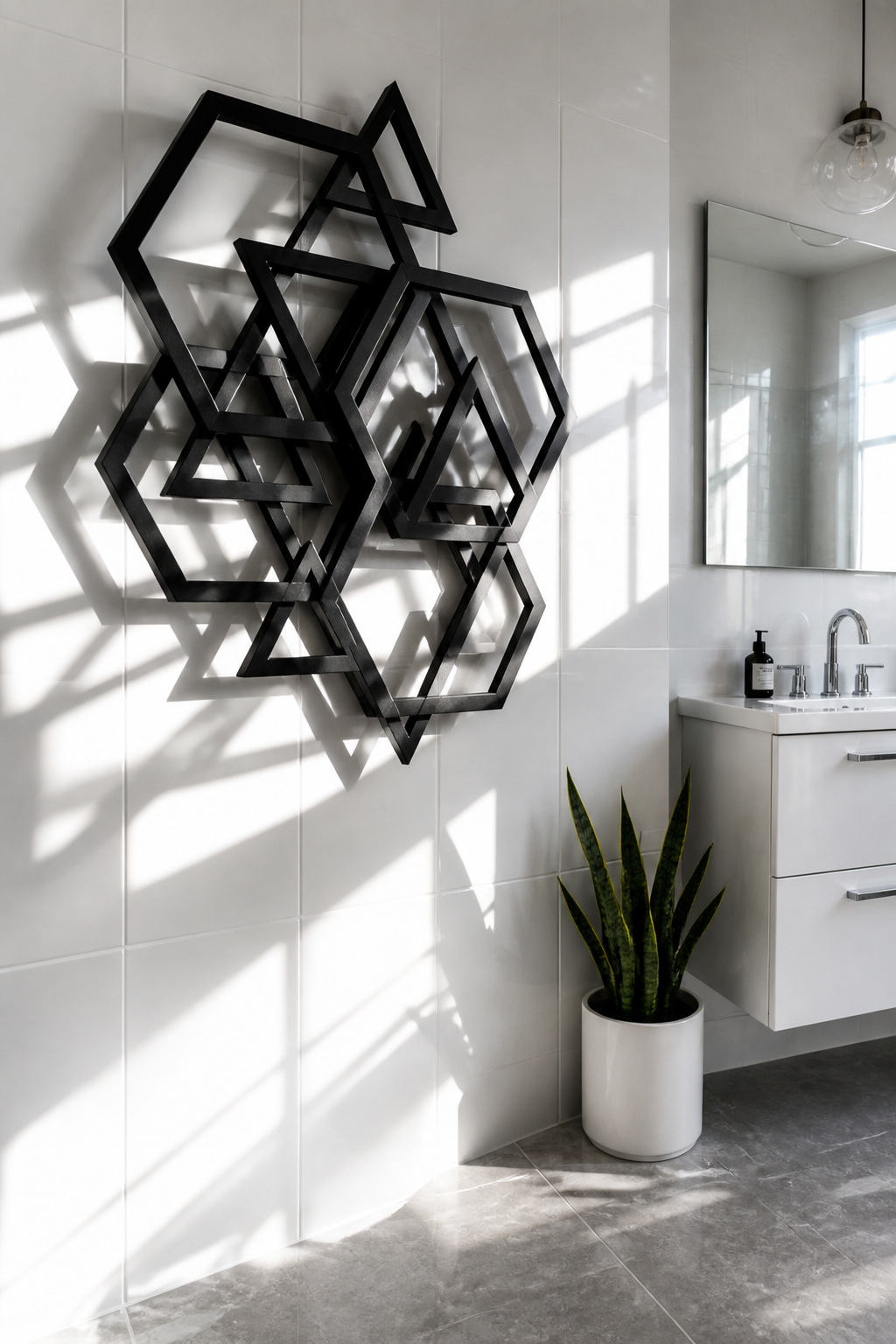
Laser-cut powder-coated steel is the standard material for geometric wall sculpture, and it’s well suited to bathrooms. The electrostatic powder-coat finish creates a hard, moisture-resistant surface; manufacturers consistently rate it as corrosion and rust-resistant for humid indoor environments. The 2mm premium steel standard for wall art is significantly more rigid than the 0.8-1mm material in cheaper pieces — it holds its geometric form rather than flexing when mounted.
Brass and brass-finished pieces work in bathrooms but require more attention; steam exposure can cause tarnish buildup over months. Lacquered brass maintains its finish with minimal upkeep. Raw or untreated steel or iron should never go in a bathroom — it will show rust spots within weeks.
Scale and Placement in the Bathroom
Scale matters more for 3D art than for flat prints. In a small bathroom, one medium-sized piece (16-24 inches wide) makes more impact than several small pieces because the dimensional quality needs visual space around it to read effectively. Mount at eye level — center at 57 inches from the floor — for the best shadow angle from standing height.
Geometric forms (triangles, hexagons, starburst patterns) suit modern and contemporary bathrooms. Organic forms (leaf, wave, abstract floral) suit transitional and natural aesthetics. The Etsy market for handmade powder-coated metal wall art is strong; Wayfair stocks a useful range of mass-market geometric pieces at $30-80.
13. DIY Pressed Botanical and Nature-Inspired Frames
Botanical pressing is the most accessible form of bathroom wall art to make yourself — and the pressed botanical art circulating in design spaces right now bears almost no resemblance to the craft-fair pressed flower squares of twenty years ago. Contemporary botanical pressing is an intentional art practice — asymmetric compositions, layered transparencies, monochrome palettes that work as visual design before you register what the specimens are. The aesthetic has caught up with the technique, and the result is a DIY option that can compete with purchased art.
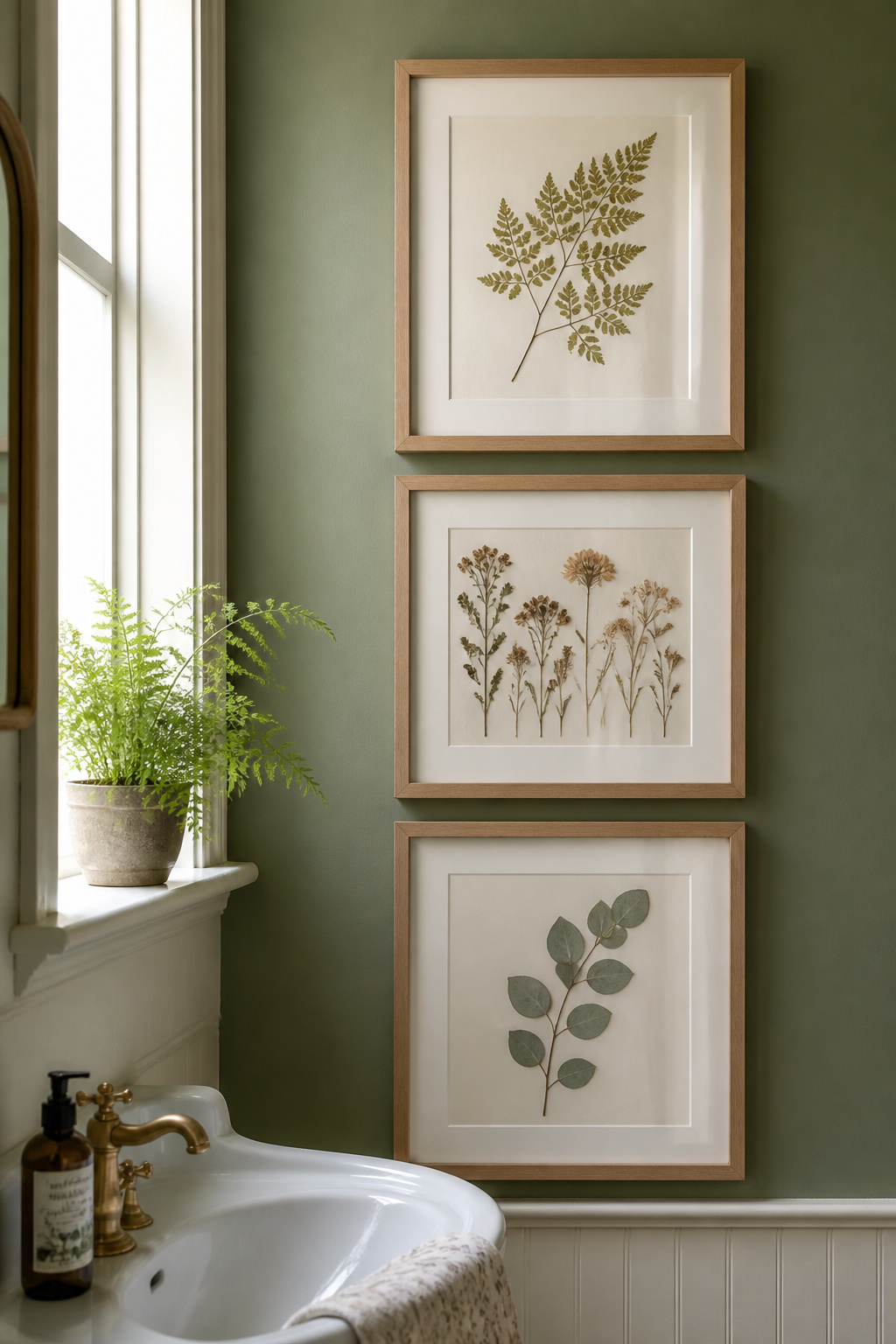
The pressing process is simpler than most people expect. Most foliage — ferns, eucalyptus, small-leaved branches — is ready after 2-4 weeks under heavy books. Flowers with significant moisture content (thick-petaled roses, succulents) need a dedicated flower press and silica gel desiccant, with 3-6 weeks of drying time. For a bathroom application, ferns, pressed herbs, and dark-toned foliage hold up better visually than delicate florals, and they suit the botanical aesthetic that works well in bathroom spaces.
Getting the Framing Right
The framing is where most DIY botanical projects fail. Adhesive is the critical step: hot glue and standard craft tape contain chemicals that seep into delicate petals within months, causing permanent staining. Use only archival pH-neutral PVA applied in tiny dots to the stem, never the petal surface. Professional spacers between the mat and glazing prevent the botanicals from touching the glass — that contact creates condensation transfer that degrades specimens faster than humidity alone.
For a bathroom, UV-filtering acrylic glazing is the single most important investment. Conservation-grade UV acrylic blocks 99% of UV radiation and is lighter than glass — important when you’re mounting above a toilet. Seal the frame back with conservation tape. Done properly, pressed botanical art lasts 50 years or more. Done without the archival steps, it fades and browns within 12 months.
14. Typography and Quote Prints as Bathroom Wall Art
Typography wall art succeeds in bathrooms in a way it often doesn’t in living rooms, because you actually have time to read it. A line of text above the toilet gets seen and processed every single day. The words you choose will become part of your daily mental environment — which is either a great argument for choosing carefully or a great argument for choosing something with genuine personal meaning rather than a mass-market motivational phrase.
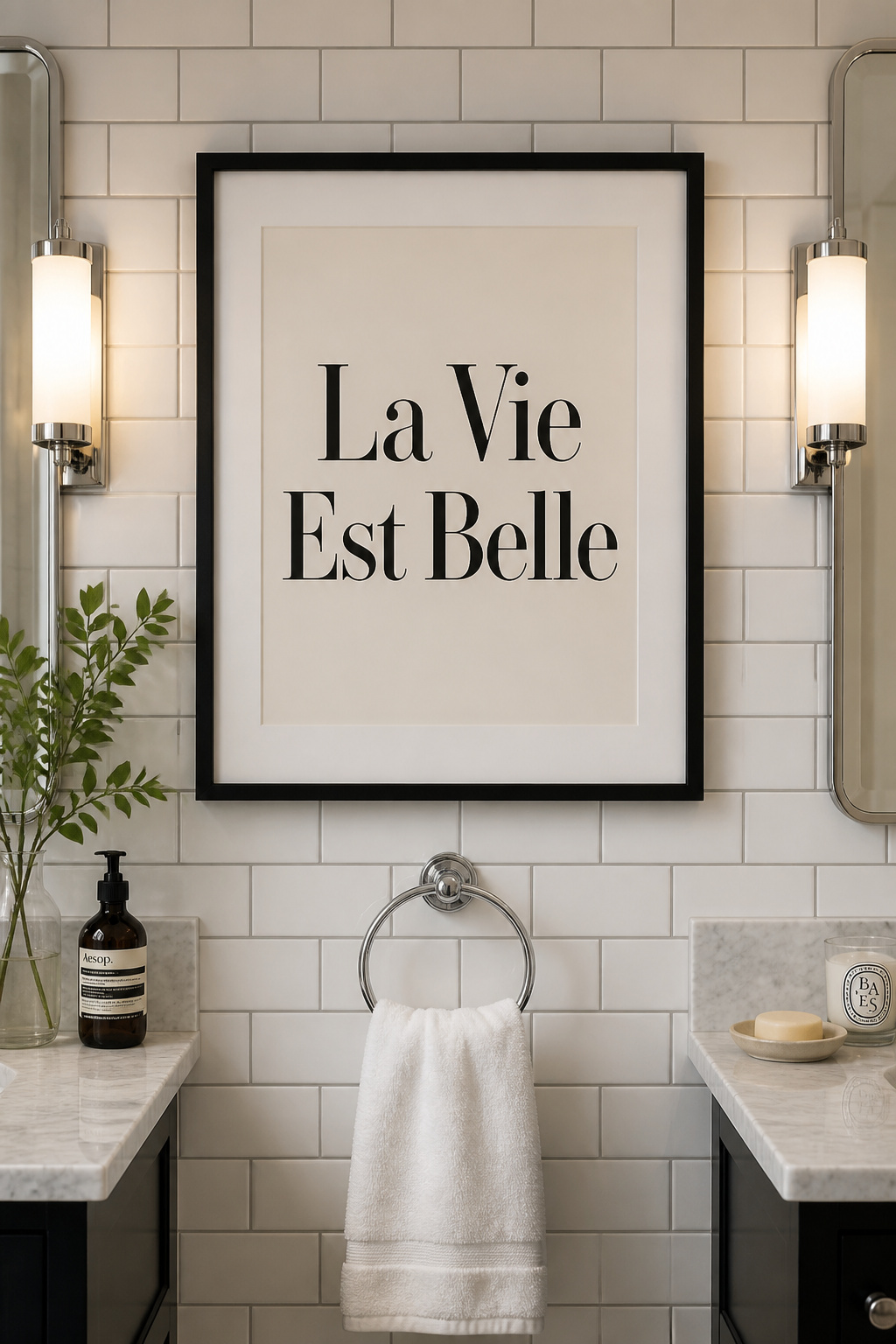
The design principle that separates good typographic art from bad: the letterforms must function as visual design before the words are parsed. The composition, the negative space, the weight contrast between letters — these should read as visually balanced even if you can’t make out the words from across the room. Current font approaches that work well in interior contexts: Playfair Display (elegant high-contrast serif), Recoleta (rounded retro serif), and clean geometric sans-serifs like Futura. Available free through Google Fonts if you’re designing your own.
Font Choice, Print Size, and Frame
Two fonts maximum per piece — one serif paired with one script, or one sans-serif with one serif. Three or more font families create visual noise that reads as amateur design regardless of what the words say.
For subject matter, short phrases under 10 words work far better in bathrooms than long quotes that break across three or four lines. Humor works here in a way it doesn’t always work in living spaces — the intimacy of the room allows for wit. A line from a book you love, a word in a language connected to your heritage, or coordinates of a place that matters to you all create more personal resonance than anything a mass-market Etsy shop produces.
The same typographic design principles transfer naturally to larger rooms — scale up the print size and the proportions follow the same logic.
Print at 11×14 minimum for a quote of two to four lines. At 8×10, text that requires reading from 6-8 feet becomes a squinting exercise.
15. Children’s Drawing Frames for Playful Bathroom Walls
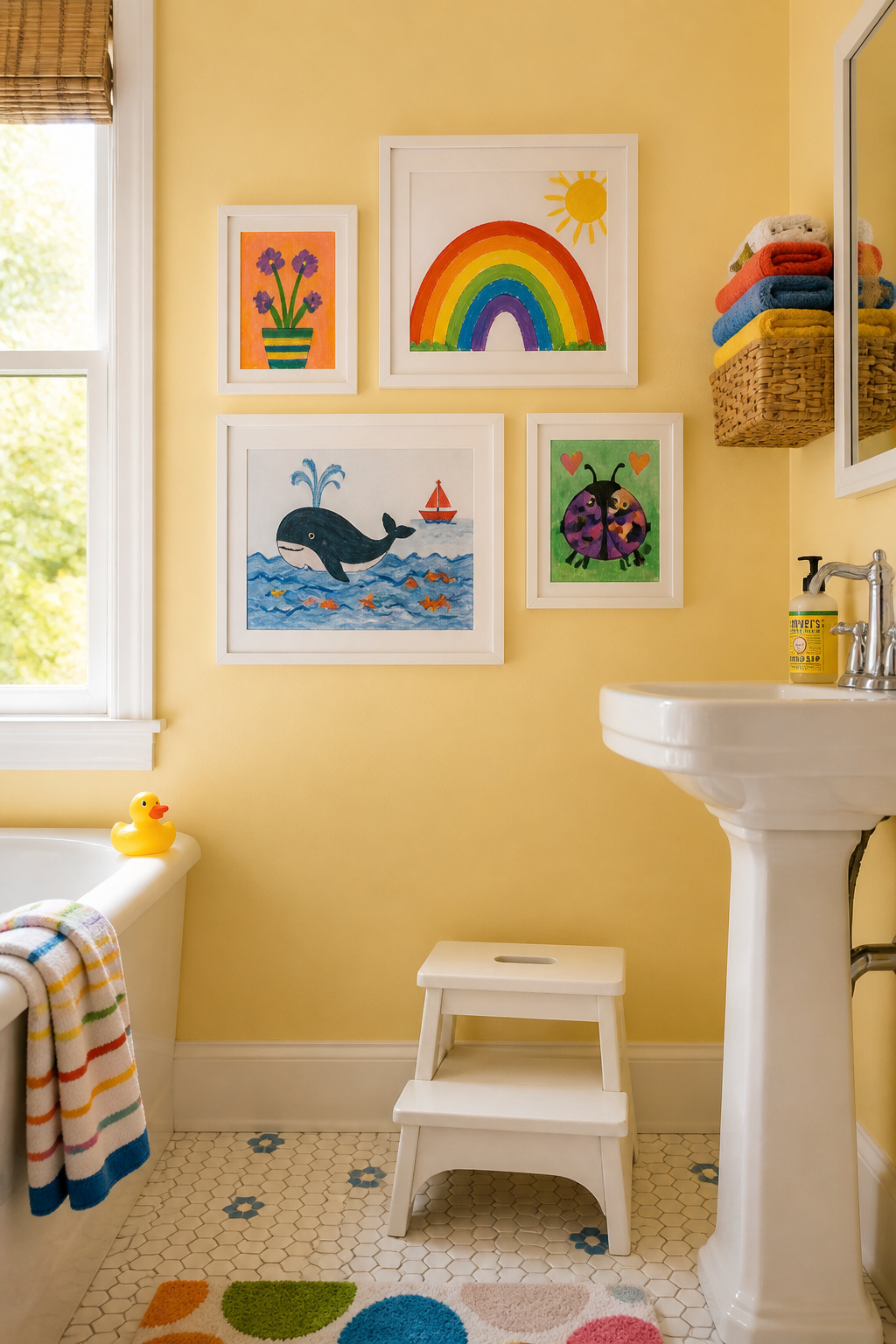
Children’s drawings are bathroom wall art with the highest personal relevance possible — and the bathroom is often overlooked as a location for displaying them, which is a missed opportunity. It’s a room the whole family uses several times a day, it has defined viewing positions (standing at the sink, sitting on the toilet), and it’s intimate enough that personal, slightly chaotic art feels completely appropriate. The key is curation: selecting three to five pieces that represent the child’s current work, not attempting a comprehensive archive.
Frame Systems That Make Swapping Easy
Frame systems designed for rotating children’s art make the process nearly frictionless. IKEA RIBBA frames ($5-15 depending on size) are the standard choice — inexpensive, standard sizing, easy to swap without tools. Dedicated rotating art frame systems like Articulate Art Frames and Display It Frames have a front-opening mechanism that allows artwork to be changed without removing the frame from the wall; priced $20-35 each, they’re worth it for a dedicated display location. A horizontal gallery ledge at reachable height is the most flexible option — no new holes when you swap the work.
For shared bathrooms in mixed-age households, mount children’s displays at a height that works for both — center at 48-50 inches accommodates both adult eye level (57-60 inches) and children’s eye level (36-44 inches). Limit the children’s display zone to one wall: above the toilet, or a single wall beside the mirror. Matching frame finishes (all white or all natural wood) unifies varied and stylistically inconsistent work into a coherent visual statement.
Scanning children’s artwork before displaying it is worth doing. Free apps like Artkive or Unfolder are designed specifically for this. The digital archive means the original can be stored safely while a high-quality reprint goes in the frame — practical for fragile work that wouldn’t survive bathroom humidity in its original form.
16. Budget Bathroom Wall Art Ideas From Thrift Stores and Printables
The most interesting bathroom art I’ve seen wasn’t expensive. Most of it came from thrift stores and museum archives. The thrift-and-reframe method is effective — not a compromise but a creative strategy that produces more idiosyncratic results than anything available at mass-market retail, because the constraints force actual decision-making about what goes in the frame.
The approach: buy for the frame, not the print. Thrift stores and estate sales stock framed art for $3-15 regularly. The included print is usually disposable; the frame is the asset. Look for solid wood or metal frames with intact glazing, clean miter joints, and standard sizing (5×7, 8×10, 11×14, 16×20) that will accept replacement prints. Buy the frame, strip out the original print, clean or replace the glazing with acrylic (cut to size at local glass shops for $5-15), insert a free public domain image, seal the back.
The Best Free Print Sources
For the prints themselves: the Metropolitan Museum’s Open Access portal (metmuseum.org) gives free access to 492,000+ public domain images. The Rijksmuseum’s Rijksstudio allows free download of the entire collection at high resolution. The Smithsonian Open Access collection has 4.7 million digital files. The art in these collections is, in many cases, more considered and historically significant than anything you’ll find at a home goods store, and it’s free.
When printing, always step up from standard copy paper. A local print shop or online service printing on heavyweight matte paper (270gsm) costs $1.50-3 for an 8×10 and $8-12 for a 16×20 through Mpix. The paper surface makes the difference between a print that looks like a deliberate design choice and one that looks like an inkjet test.
This budget approach applies to more than bathrooms — budget-friendly DIY decor ideas explores how the thrift-and-transform method works across other rooms.
IKEA RIBBA frames in black or white are the benchmark for budget framing: $5 for an 8×10, $15 for a 16×20.
How to Choose the Right Bathroom Wall Art for Your Space
The question when choosing bathroom wall art isn’t really which type to select — it’s what the specific wall you’re working with can support. A small powder room (under 30 sq ft) calls for either one oversized single piece or a tight grid of matching frames; free-form gallery walls and multiple unrelated pieces compete with the limited real estate. A large master bathroom with good ventilation can handle virtually anything on this list, including the paper-based media that require the most careful framing.
Humidity level is the second variable. A bathroom with a steam shower and no exhaust fan is a challenging environment for anything paper-based — metal prints, acrylic panels, powder-coated sculptures, and sealed ceramics are the practical choices. A well-ventilated bathroom with an exhaust fan that runs during showers brings the humidity risk down considerably; properly archival-framed paper art survives fine.
Before buying anything, photograph the wall you’re working with. Note its dimensions and the dominant colors in the room — tile, grout, fixture finish, towels. The art has to live with all of those variables, not just look good in isolation.
One practical tip: tape a piece of paper the exact size of your intended art to the wall and live with it for a week before committing. It sounds excessive. It eliminates most bad decisions. One considered piece of bathroom wall art makes a stronger statement than five impulse purchases — and in a room this small, with this much daily attention, it’s worth getting right.